

Enterprise buyers expect vendors to demonstrate maturity in how systems are conceived, built, delivered, and sustained. Whether evaluating a SaaS platform, an embedded hardware system, or a critical infrastructure solution, technical decision-makers scrutinize how well an organization manages complexity, risk, and long-term lifecycle obligations. In environments where system failures carry regulatory, operational, or safety consequences, structured systems engineering becomes a prerequisite for vendor selection.
As procurement cycles extend and due diligence deepens, vendors face mounting pressure to articulate their system lifecycle management practices with precision. Generic claims about quality or agility no longer satisfy enterprise stakeholders who require evidence of repeatable processes, traceability, and governance. This creates a fundamental challenge: how do you demonstrate engineering discipline without appearing rigid, and how do you communicate capability without resorting to marketing generalities?
ISO/IEC 15288 provides a shared reference point that addresses this gap. It establishes a common vocabulary and process framework for systems engineering, enabling vendors to communicate lifecycle management practices in terms enterprise buyers recognize and value. Rather than requiring certification or prescribing specific methods, the standard offers a structured approach to managing systems from concept through retirement—an approach that supports both internal execution and external trust.
This article examines ISO/IEC 15288 in the context of enterprise sales, compliance discussions, and system delivery. It covers the standard's scope, process architecture, practical applications, and business implications for vendors operating in regulated or high-assurance environments. For enterprise sales teams, product leaders, and compliance owners, understanding ISO/IEC 15288 means understanding how structured lifecycle processes translate into competitive advantage during evaluations, RFP responses, and long-term customer relationships.
What Is ISO/IEC 15288?
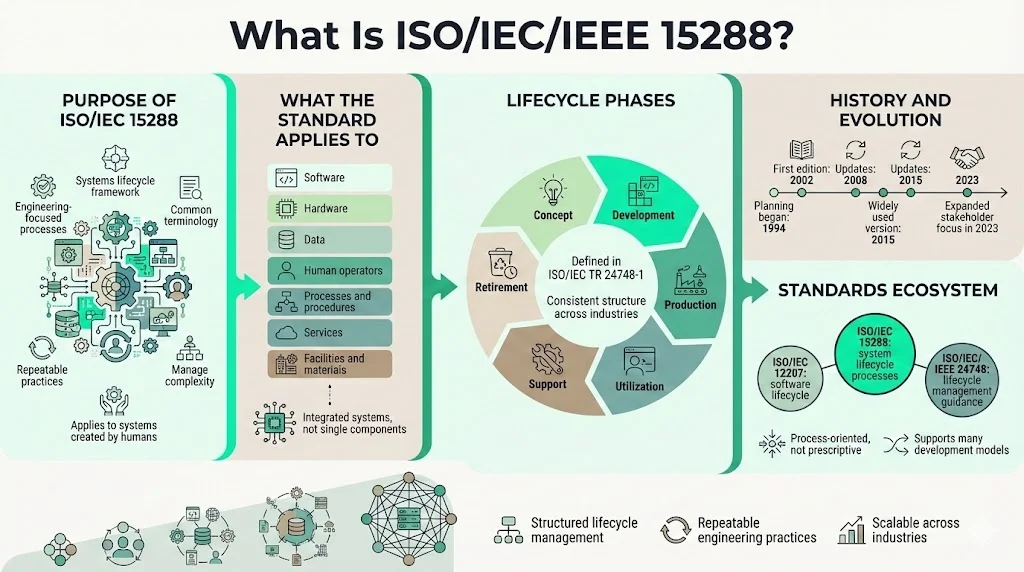
ISO/IEC/IEEE 15288 establishes a common framework of process descriptions for describing the lifecycle of systems created by humans. It defines a set of processes and associated terminology from an engineering viewpoint. The standard applies to systems that integrate multiple elements—software, hardware, data, human operators, processes, services, procedures, facilities, and materials—providing structure for managing their conception, development, production, utilization, support, and eventual retirement.
Planning for ISO/IEC 15288 started in 1994 when the need for a common systems engineering process framework was recognized. The first edition was issued in November 2002, with subsequent updates in 2008, 2015, and 2023. The 2015 edition, published jointly with IEEE as ISO/IEC/IEEE 15288:2015, represents the most widely referenced version in current enterprise environments, though the 2023 revision reflects recent advancements in systems complexity and stakeholder involvement.
ISO/IEC/IEEE 15288:2015 references lifecycle phases defined in ISO/IEC TR 24748-1: concept, development, production, utilization, support, and retirement. These phases provide a consistent structure for managing system evolution across industries, from enterprise software platforms to industrial control systems to complex infrastructure deployments.
ISO/IEC 15288 fits within a broader systems engineering ecosystem that includes complementary standards such as ISO/IEC 12207 for software-specific lifecycle processes and ISO/IEC/IEEE 24748 for lifecycle management guidance. The standard's process-oriented approach supports organizations in implementing repeatable, improvable practices without mandating specific methodologies or development models.
Building toward SOC 2, ISO 27001, or another framework?
Drop your work email and we'll help you turn security work into audit-ready evidence automatically.
Core Principles Behind ISO/IEC 15288
System Lifecycle Focus
ISO/IEC 15288 treats systems as evolving entities requiring structured management across their entire lifespan. Rather than focusing narrowly on design or implementation, the standard addresses the full continuum from initial concept through operational sustainment to eventual retirement. This lifecycle perspective matters particularly in enterprise contexts where contractual obligations extend years beyond initial delivery, and where system modifications, security updates, and capacity expansions must occur without disrupting production operations.
Enterprise buyers purchasing long-lived systems—whether industrial control platforms, financial transaction systems, or regulated healthcare infrastructure—evaluate vendors based on their ability to sustain systems over 5-, 10-, or 15-year horizons. A lifecycle approach demonstrates that vendors understand deprecation planning, backward compatibility management, and the operational realities of systems that cannot be replaced on short timelines.
Systems Engineering Processes
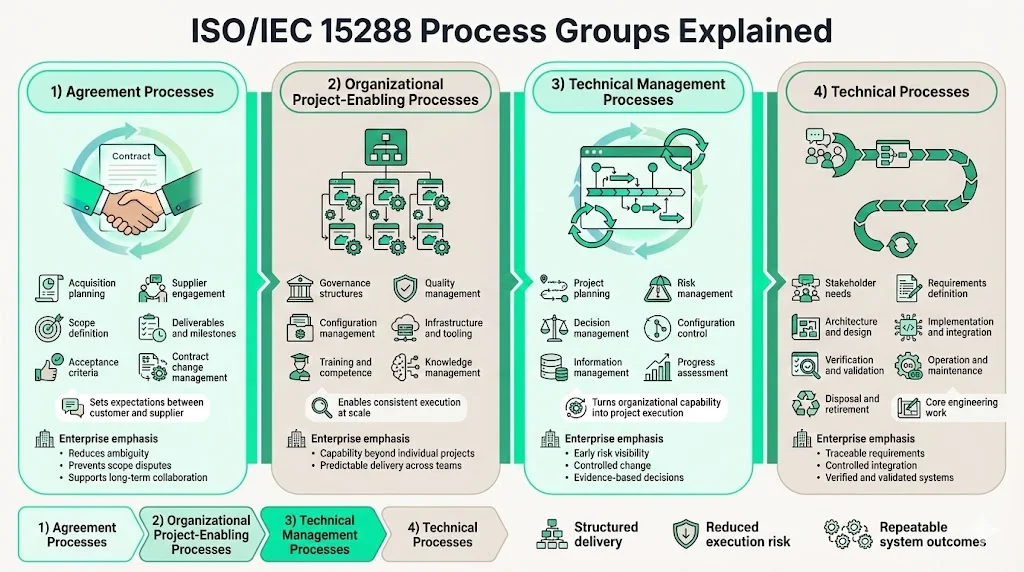
The standard organizes system development and management into four process groups: Agreement Processes, Organizational Project-Enabling Processes, Technical Management Processes, and Technical Processes. These groups bring structure to activities that otherwise risk becoming ad hoc or team-dependent. By defining clear purposes, outcomes, and activities for each process, ISO/IEC 15288 enables organizations to establish repeatable practices that function across projects, product lines, and organizational boundaries.
Process-based thinking addresses a fundamental challenge in complex system development: coordinating specialized activities—requirements analysis, architecture definition, integration, verification, risk management—so they occur in logical sequence with appropriate dependencies and handoffs. In environments where multiple engineering teams, third-party suppliers, and customer stakeholders must collaborate, process standardization reduces coordination friction and makes accountability explicit.
Process Standardization and Consistency
Using a common process vocabulary across internal teams and external partners eliminates ambiguity in system management discussions. When an enterprise customer asks about your verification approach, your risk management cadence, or your requirements traceability practices, ISO/IEC 15288 provides a shared reference point that enables precise communication. Rather than explaining proprietary internal methodologies, vendors can map their practices to recognized process definitions, accelerating trust-building during due diligence.
Standardization also supports internal scaling. Organizations managing multiple concurrent system development efforts benefit from consistent processes that allow resource sharing, knowledge transfer, and quality benchmarking across portfolios. Engineers moving between projects encounter familiar process structures, reducing onboarding friction and preserving institutional knowledge.
Breakdown of ISO/IEC 15288 Process Groups
Agreement Processes
Agreement Processes establish and maintain clear expectations between customers and suppliers throughout the system lifecycle. These processes address acquisition, supply relationship management, and contract fulfillment—activities that directly affect enterprise procurement dynamics. When buyers issue RFPs requiring detailed system development plans, delivery milestones, and acceptance criteria, vendors relying on structured Agreement Processes produce responses demonstrating understanding of customer needs and realistic execution capability.
For enterprise-focused vendors, Agreement Processes matter because they formalize accountability. Rather than operating under vague statements of work, these processes ensure that scope, deliverables, responsibilities, and acceptance criteria are explicitly defined and maintained as systems evolve. In long-term contracts where requirements shift and system scope expands, disciplined agreement management prevents disputes and supports collaborative problem-solving.
Organizational Project-Enabling Processes
Organizational Project-Enabling Processes provide the governance, quality assurance, infrastructure, and resource management that allow system development to occur effectively. These processes operate at the organizational level, establishing standards, tooling, training programs, and oversight mechanisms that support consistent execution across portfolios. Enterprise buyers evaluating vendor maturity examine these enabling processes to assess whether systems engineering discipline results from individual heroism or from institutional capability.
When vendors demonstrate established quality management systems, configuration management infrastructure, and knowledge management practices, they signal that execution capability persists across personnel changes and project transitions. Organizations scaling system development across multiple customers or product lines require robust enabling processes to maintain quality and delivery predictability without proportionally increasing overhead.
Technical Management Processes
Technical Management Processes address planning, assessment, decision-making, risk management, configuration management, and information management at the project level. These processes translate organizational capabilities into project-specific execution plans, tracking progress and managing technical risks throughout system development. In enterprise environments, buyers expect vendors to articulate how risks are identified, analyzed, and mitigated; how technical decisions are evaluated and documented; and how system baselines are controlled as requirements evolve.
Technical Management Processes support performance optimization by creating feedback loops between planning and execution. Regular technical reviews, risk assessments, and progress evaluations enable early detection of problems—schedule delays, technical challenges, resource constraints—allowing corrective action before issues escalate into contract disputes or delivery failures.
Technical Processes
Technical Processes encompass the core engineering activities that define, realize, verify, and validate systems. These processes include business or mission analysis, stakeholder needs definition, requirements definition, architecture definition, design definition, system analysis, implementation, integration, verification, validation, operation, maintenance, and disposal. Each process produces specific outcomes—stakeholder requirements, system architectures, verified system elements, validated operational systems—that collectively transform concepts into functioning systems.
Stakeholder involvement spans from early needs definition through operational validation, ensuring that systems address real requirements rather than assumed needs. System integration occurs as a controlled, repeatable activity with defined interfaces, integration sequences, and interface verification. In enterprise environments where system failures carry significant consequences, verification and validation processes provide documented evidence that systems meet specified requirements and operate correctly in intended environments.
How ISO/IEC 15288 Supports Systems Engineering in Practice
ISO/IEC 15288 translates abstract engineering principles into repeatable actions by defining process purposes, outcomes, and activities without prescribing specific implementation methods. Organizations adopt the standard's process framework and tailor it to their operational contexts—development methodologies, industry requirements, organizational structure. This allows Agile software teams, waterfall hardware programs, and hybrid system development efforts to apply consistent lifecycle thinking while accommodating their specific execution approaches.
The standard improves communication across engineering, product, and business teams by establishing shared terminology and process expectations. When product managers discuss requirements definition, they reference the same structured activities that engineers follow. When business stakeholders inquire about delivery timelines, engineering teams explain progress using lifecycle stages and process milestones that align with contract obligations. This linguistic consistency reduces misunderstandings and accelerates decision-making.
Managing technical risk in large, interconnected systems requires visibility into dependencies, interface definitions, integration plans, and verification strategies. ISO/IEC 15288's Technical Management and Technical Processes provide frameworks for identifying risks early—during architecture definition and design—rather than discovering them during integration or deployment. Risk-based approaches to verification and validation allow resource allocation toward highest-risk system elements, optimizing assurance activities without exhaustive testing.
The standard supports continuous improvement without locking teams into rigid methods. Organizations assess their current practices against ISO/IEC 15288's process definitions, identify gaps, and implement targeted improvements. Because the standard focuses on process purposes and outcomes rather than prescriptive procedures, teams adopt practices that align with their operational realities while progressively strengthening lifecycle discipline.
Use Cases for Companies Selling to Enterprise Clients
Enterprise Software and Platform Providers
Organizations developing large-scale enterprise platforms—ERP systems, customer data platforms, financial transaction systems—apply ISO/IEC 15288 to manage dependencies across internal and customer-owned systems. These platforms integrate with customer identity providers, data warehouses, legacy applications, and third-party services, creating complex system boundaries that require disciplined interface management and integration planning.
Lifecycle processes become particularly relevant as platform providers manage multi-year release roadmaps, backward compatibility requirements, and customer-specific customizations. Structured requirements management, architecture definition, and configuration management processes enable platform evolution without breaking existing customer deployments. During enterprise sales cycles, demonstrating mature lifecycle management practices differentiates vendors capable of supporting long-term partnerships from those suited only for tactical implementations.
Industrial, Defense, and Infrastructure Vendors
Vendors operating in industrial automation, defense systems, critical infrastructure, or aerospace domains face system lifespans measured in decades alongside stringent assurance requirements. ISO/IEC 15288 provides the process foundation for managing systems where hardware obsolescence, regulatory changes, and technology evolution occur during operational service. Lifecycle processes addressing maintenance, system modification, and eventual retirement become as important as initial development processes.
These environments require vendors to align internal processes with customer and regulatory expectations that often explicitly reference systems engineering standards. Defense procurements, infrastructure projects, and regulated industrial systems specify ISO/IEC 15288 compliance in contract requirements, making process alignment a precondition for bidding. Vendors demonstrating established lifecycle processes communicate readiness to meet complex program management and assurance obligations.
SaaS Companies Operating in Regulated Environments
SaaS vendors serving healthcare, financial services, or government customers increasingly encounter enterprise buyers expecting systems engineering maturity despite cloud-native architectures. ISO/IEC 15288 strengthens system management practices by providing structured approaches to requirements traceability, change management, verification, and operational monitoring—capabilities that support compliance audits and security assessments.
During due diligence, enterprise buyers examine how SaaS vendors manage system changes, maintain service availability, respond to security vulnerabilities, and ensure data protection. Applying lifecycle processes to cloud operations—treating infrastructure, application updates, and service management as engineered systems—demonstrates operational discipline that satisfies scrutiny from CISOs, compliance teams, and procurement organizations evaluating vendor risk.
Compliance Relevance of ISO/IEC 15288
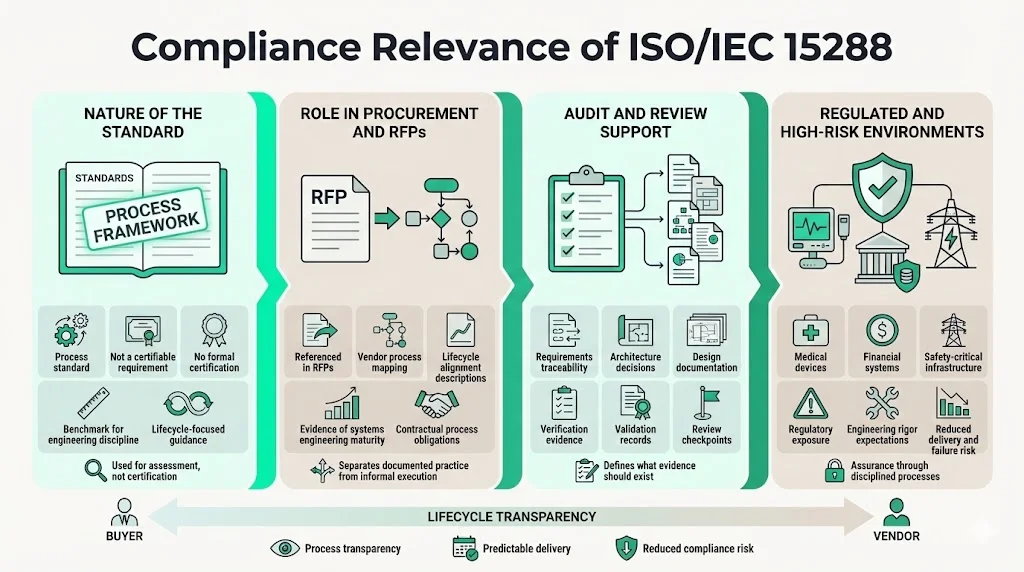
ISO/IEC 15288 functions as a process standard rather than a certifiable compliance requirement. Organizations do not pursue ISO/IEC 15288 certification in the manner they pursue ISO 9001 or ISO 27001 certification. Instead, enterprises use the standard as a benchmark during vendor assessments, evaluating whether suppliers demonstrate structured lifecycle management practices aligned with recognized engineering discipline.
RFPs for complex systems frequently reference ISO/IEC 15288, requiring vendors to describe how their development processes map to the standard's framework. Procurement teams assess vendor responses to determine whether systems engineering capability exists as documented practice rather than informal knowledge. During contract negotiations, alignment with ISO/IEC 15288 may become a contractual obligation, requiring vendors to follow specified processes and provide process evidence during project reviews.
The standard supports security and quality reviews by providing traceability frameworks that connect requirements through design, implementation, verification, and validation. Auditors examining system security controls or quality assurance practices expect to see documented evidence of engineering rigor—requirements analysis, architecture decisions, verification results, validation records. ISO/IEC 15288's process definitions establish what evidence should exist and when it should be produced, giving auditors clear evaluation criteria.
In environments where system failures carry regulatory consequences—medical devices, financial systems, safety-critical infrastructure—buyers require vendors to demonstrate that systems result from disciplined engineering processes rather than ad hoc development. ISO/IEC 15288 alignment provides assurance that systems undergo structured requirements analysis, design review, integration planning, and validation before deployment.
ISO/IEC 15288 and Quality Assurance
Structured lifecycle processes reduce rework and late-stage issues by establishing clear decision points, review criteria, and acceptance gates throughout system development. When requirements undergo structured analysis and stakeholder validation before design begins, teams avoid building systems that fail to meet actual needs. When architectures undergo technical review before implementation, teams identify interface problems and integration risks early rather than discovering them during system testing.
Technical reviews and validation activities embedded within ISO/IEC 15288's Technical Processes create quality checkpoints aligned with lifecycle stages. Design reviews verify that architectures satisfy requirements; verification activities confirm that implementations match designs; validation activities ensure that integrated systems perform correctly in operational contexts. These activities occur progressively, allowing incremental quality confirmation rather than relying on final system testing to detect all defects.
Traceability across requirements, design, and delivery enables impact analysis when changes occur. If a stakeholder requirement changes mid-project, traceability relationships identify affected architecture decisions, design elements, and verification activities. This visibility allows teams to assess change impacts accurately and implement modifications without unintended side effects. During audits or customer reviews, traceability demonstrates that delivered systems align with approved requirements and that no requirements were overlooked during implementation.
ISO/IEC 15288 vs Other Common Standards
Comparison With ISO 9001
ISO 9001 establishes quality management system requirements applicable to any organization, regardless of industry or product. It focuses on customer satisfaction, process control, continuous improvement, and management responsibility. ISO/IEC 15288 provides systems engineering process definitions specific to system development, addressing technical activities, lifecycle stages, and engineering discipline.
The two standards complement each other in enterprise settings. ISO 9001 provides organizational quality management infrastructure—document control, corrective action, management review—while ISO/IEC 15288 defines the technical processes that occur within that quality framework. Organizations holding ISO 9001 certification strengthen their systems engineering capability by adopting ISO/IEC 15288's lifecycle processes. Conversely, organizations following ISO/IEC 15288 benefit from ISO 9001's quality management disciplines to ensure consistent process execution.
Enterprise buyers evaluating vendors often expect both quality management certification and systems engineering process maturity. ISO 9001 demonstrates organizational commitment to quality, while ISO/IEC 15288 alignment demonstrates technical capability to manage complex system development. Together, they address both organizational discipline and engineering rigor.
Relationship With Other Systems and Software Standards
ISO/IEC 15288 aligns closely with ISO/IEC 12207, which addresses software lifecycle processes specifically. The two standards share consistent process structures, terminology, and lifecycle concepts, differing primarily in scope. ISO/IEC 15288 applies to systems comprising multiple element types—hardware, software, human operators, facilities—while ISO/IEC 12207 focuses on software-intensive systems. Organizations developing systems with significant software components often apply both standards, using ISO/IEC 15288 for system-level processes and ISO/IEC 12207 for software-specific activities.
In mixed hardware-software environments—embedded systems, cyber-physical systems, industrial control systems—ISO/IEC 15288 provides the system-level framework while allowing software development to follow ISO/IEC 12207's more granular software processes. This layered approach ensures that software receives appropriate lifecycle management while maintaining integration with hardware, data, and operational elements.
ISO/IEC 15288 also relates to capability maturity models, engineering management standards, and industry-specific process frameworks. Defense contractors align ISO/IEC 15288 with acquisition standards; automotive suppliers map it to ASPICE; aerospace organizations connect it to AS9100. This adaptability allows the standard to function across industries while maintaining consistent core principles.
Business Benefits for Enterprise-Focused Vendors
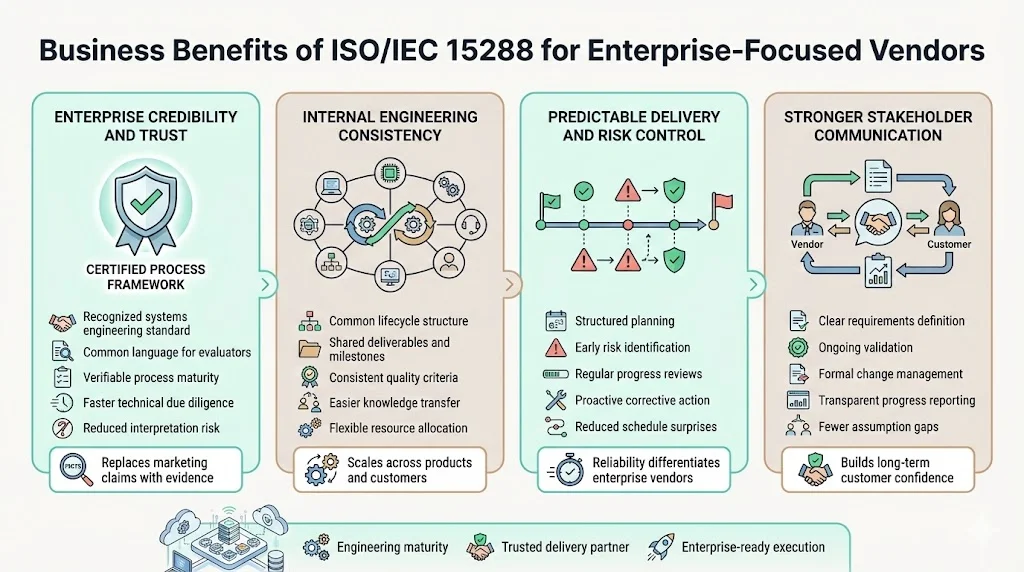
Vendors demonstrating ISO/IEC 15288 alignment gain credibility during enterprise evaluations by communicating engineering maturity in recognized terms. Rather than describing proprietary processes that require interpretation, vendors map their practices to standard process definitions, accelerating trust-building with technical evaluators who understand systems engineering frameworks. This becomes particularly valuable in competitive procurements where multiple vendors claim engineering excellence—alignment with ISO/IEC 15288 provides verifiable evidence rather than marketing claims.
Internal coordination across system development teams improves when organizations adopt consistent lifecycle processes. Engineers working on different products or serving different customers follow familiar process structures, enabling knowledge sharing and resource flexibility. Technical leads understand what activities should occur at each lifecycle stage, what deliverables should be produced, and what quality criteria apply. This consistency reduces management overhead while supporting scalable execution.
Risk management and delivery predictability strengthen when lifecycle processes include structured planning, assessment, and decision-making activities. Organizations following ISO/IEC 15288's Technical Management Processes identify risks during planning rather than discovering them during execution. Regular progress reviews detect schedule or technical problems early, allowing corrective action before delays accumulate. For vendors managing multiple concurrent customer engagements, predictable execution capability differentiates reliable partners from those prone to missed commitments.
Stakeholder communication throughout the lifecycle improves when vendors follow structured processes for requirements definition, validation, and change management. Enterprise customers expect visibility into system development, regular progress updates, and mechanisms for providing feedback. ISO/IEC 15288's stakeholder-focused processes formalize these interactions, ensuring customer needs remain visible and that delivered systems satisfy actual requirements rather than initial assumptions.
Implementation Considerations
Organizations implementing ISO/IEC 15288 begin by assessing current system management practices against the standard's process definitions. This gap analysis identifies which processes exist, which require strengthening, and which are absent. Rather than attempting comprehensive implementation simultaneously, organizations prioritize processes based on business needs—vendors facing requirements traceability challenges during audits might strengthen requirements definition processes; those experiencing integration problems might focus on Technical Processes for integration and verification.
Mapping existing processes to ISO/IEC 15288 activities demonstrates that organizations often perform many standard activities informally. Implementation involves formalizing these practices, documenting procedures, establishing deliverable templates, and training teams. Organizations avoid creating bureaucratic overhead by tailoring processes appropriately—small teams developing low-complexity systems require lighter processes than large programs managing safety-critical infrastructure.
Training teams without slowing delivery requires phased adoption and just-in-time education. Organizations introduce processes incrementally, allowing teams to learn through application rather than classroom training alone. Pilot projects demonstrate process value before broader rollout, building organizational buy-in by showing tangible benefits—reduced rework, earlier risk detection, improved customer communication—rather than imposing processes purely for compliance.
Tools and frameworks support adoption by embedding process guidance into daily work. Requirements management tools enforce traceability relationships; configuration management systems control baselines; project management platforms track process activities and deliverables. Rather than maintaining processes through manual discipline alone, organizations leverage tooling to make process compliance natural within engineering workflows.
Common Misunderstandings About ISO/IEC 15288
ISO/IEC 15288 applies across industries—enterprise software, manufacturing, healthcare technology, financial systems—not exclusively to defense or aerospace domains. While the standard originated partially from military systems engineering needs, its process framework addresses system lifecycle challenges universal to complex system development. SaaS companies, platform providers, and infrastructure vendors all manage systems requiring structured lifecycle processes.
The standard does not mandate specific development methodologies. Organizations practicing Agile, DevOps, continuous delivery, or traditional waterfall approaches all apply ISO/IEC 15288 by mapping their activities to standard processes. Agile teams perform requirements analysis iteratively through user stories and backlog refinement; waterfall teams perform upfront requirements specification—both align with the standard's requirements definition process despite different implementation approaches.
ISO/IEC 15288 addresses systems broadly defined, not software exclusively. Systems include hardware elements, human operators, procedures, facilities, and services alongside software components. Organizations developing embedded systems, industrial automation, medical devices, or infrastructure solutions apply the standard's full scope. Even pure software systems benefit from systems thinking when they integrate with customer environments, external services, or operational procedures.
Conclusion
ISO/IEC 15288 matters in enterprise sales and delivery because it provides a shared foundation for communicating systems engineering capability. Rather than asking vendors to explain proprietary processes or trust unverifiable maturity claims, enterprise buyers reference ISO/IEC 15288 as a benchmark for structured lifecycle management. Vendors demonstrating alignment signal that they approach system development with engineering discipline—requirements traceability, risk management, verification, validation—rather than ad hoc practices that collapse under complexity or scale.
The standard functions as a framework rather than a rigid rulebook, supporting organizations across industries, development methodologies, and system types. It strengthens internal execution by providing process structure that scales across projects and teams. It improves customer relationships by formalizing stakeholder engagement, requirements validation, and delivery acceptance. It supports compliance discussions by establishing traceability frameworks that satisfy auditors and regulators examining engineering rigor.
Organizations evaluating ISO/IEC 15288 adoption should view the standard as a way to strengthen trust, execution, and long-term system outcomes. In enterprise environments where system failures carry significant consequences and vendor relationships extend across years, lifecycle process maturity differentiates partners capable of sustained delivery from vendors suited only for short-term engagements. ISO/IEC 15288 provides the vocabulary, process definitions, and lifecycle perspective that enable vendors to demonstrate that capability credibly.
Frequently Asked Questions (FAQ)
ISO/IEC 15288 is an international standard establishing a common framework of lifecycle processes for systems engineering. It defines processes, activities, and terminology for managing systems from conception through retirement, applicable to systems combining software, hardware, data, human operators, and other elements.
Organizations developing complex systems for enterprise customers benefit most from ISO/IEC 15288. This includes software platform providers, industrial automation vendors, defense contractors, infrastructure suppliers, medical device manufacturers, and SaaS companies serving regulated industries. Systems engineers, engineering managers, product leaders, and compliance teams use the standard to structure lifecycle management practices.
ISO/IEC 15288 provides repeatable process definitions that bring discipline to requirements analysis, architecture definition, design, integration, verification, and validation. It establishes clear handoffs between lifecycle stages, supports requirements traceability, enables risk management, and formalizes stakeholder engagement. These processes reduce late-stage rework, improve delivery predictability, and support quality assurance.
ISO/IEC 15288 is not a certifiable compliance requirement like ISO 9001 or ISO 27001. Organizations voluntarily adopt the standard to strengthen systems engineering practices. However, enterprise customers often reference ISO/IEC 15288 in RFPs, procurement requirements, or contracts, expecting vendors to demonstrate process alignment. In defense, aerospace, and regulated industries, contractual obligations may explicitly require ISO/IEC 15288 conformance.
ISO 9001 establishes quality management system requirements applicable to any organization, focusing on customer satisfaction, process control, and continuous improvement. ISO/IEC 15288 defines systems engineering lifecycle processes specific to system development, addressing technical activities, lifecycle stages, and engineering discipline. ISO 9001 provides organizational quality infrastructure; ISO/IEC 15288 defines technical processes that operate within that infrastructure. The two standards complement each other in enterprise environments requiring both quality management certification and systems engineering maturity.

