

Most organizations treat cybersecurity frameworks as static checklists, yet more than 2,400 U.S. critical infrastructure organizations have adopted maturity-based approaches since 2012—recognizing that cyber defense requires continuous capability building, not one-time compliance artifacts. This shift reflects a fundamental market reality: enterprise buyers increasingly evaluate vendor cybersecurity maturity before executing contracts, particularly when those vendors integrate into energy systems, operational technology environments, or industrial automation infrastructure.
Cyber risk tied to electricity transmission and power grid operations has escalated beyond technical concern into strategic business liability. The U.S. Department of Energy developed the Cybersecurity Capability Maturity Model (C2M2) in 2012 with energy and cybersecurity industry experts, establishing a measurement framework focused on capability development rather than pass-fail certification. This distinction matters: C2M2 assesses how well organizations implement, sustain, and improve cybersecurity practices across both information technology and operational technology environments—the exact attack surfaces enterprise buyers scrutinize during vendor risk assessments.
What Is C2M2? A Plain-Language Overview
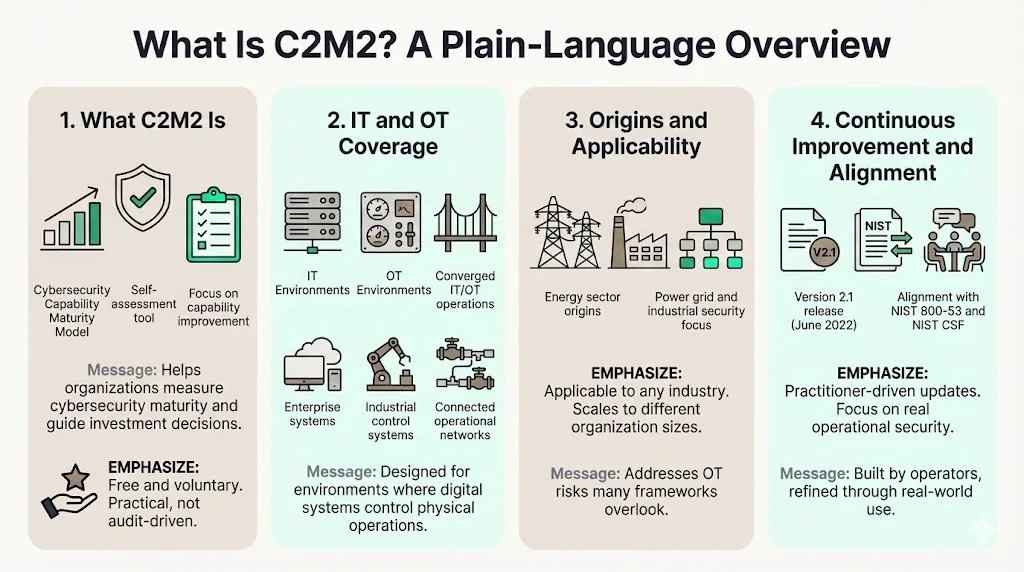
C2M2 is a free tool to help organizations evaluate their cybersecurity capabilities and optimize security investments. The acronym stands for Cybersecurity Capability Maturity Model. It uses industry-vetted cybersecurity practices focused on both information technology (IT) and operations technology (OT) assets and environments—addressing the convergence of traditional enterprise systems and industrial control systems that define modern energy operations.
While the U.S. energy industry led development of the C2M2 and championed its adoption, any organization—regardless of size, type, or industry—can use the model to measure and improve cybersecurity posture. The framework's origin in power grid security means it directly addresses operational technology risks that many compliance frameworks overlook: supervisory control and data acquisition systems, industrial Internet of Things devices, process control components, and the network infrastructure connecting physical operations to digital management systems.
Version 2.1, released in June 2022, incorporates guidance from cybersecurity practitioners in the energy sector to address new attack vectors and improve alignment with NIST 800-53 and the NIST CSF. This continuous refinement by practitioners—not consultants or auditors—reinforces C2M2's focus on real operational security rather than paperwork generation.
Building toward SOC 2, ISO 27001, or another framework?
Drop your work email and we'll help you turn security work into audit-ready evidence automatically.
Why C2M2 Exists
C2M2 emerged from a gap that existing compliance frameworks failed to address: measuring actual cybersecurity capability within operational environments. Most policy-driven frameworks specify what controls must exist without providing a method for assessing how well those controls function, how consistently organizations implement them, or whether capability improves over time.
Electricity transmission systems, industrial automation platforms, and energy management infrastructure present unique attack surfaces. Adversaries targeting these systems pursue operational disruption, not just data theft. Traditional IT security frameworks built around confidentiality, integrity, and availability require translation when applied to operational technology environments where availability and safety take precedence over confidentiality.
C2M2 addresses this operational reality by structuring cybersecurity assessment around capability maturity: organizations progress from ad hoc, reactive practices toward documented, consistent, and continuously improving security operations. This approach provides leadership with visibility into security program effectiveness—information essential for resource allocation, risk prioritization, and strategic planning. Enterprise buyers value this same visibility when evaluating vendor risk, particularly vendors whose systems connect to or influence critical operational infrastructure.
Who C2M2 Is For
U.S. energy organizations have used C2M2 to evaluate and improve cybersecurity capabilities for more than a decade, with DOE responding to more than 2,400 requests from owners and operators in critical infrastructure sectors since the model's introduction. The framework directly applies to:
Energy providers and utilities: Electric transmission organizations, power generation facilities, and distribution system operators managing grid infrastructure.
Operational technology operators: Organizations running industrial control systems, supervisory control and data acquisition platforms, or process automation environments across energy, manufacturing, water systems, and transportation infrastructure.
Critical infrastructure vendors: Software, hardware, and managed service providers whose products integrate into power grid systems, energy management platforms, or industrial automation environments.
Enterprise technology vendors serving regulated markets: Organizations selling into sectors where buyers conduct rigorous vendor risk assessments and expect documented security maturity aligned with industry-recognized frameworks.
C2M2 has expanded beyond its energy sector origins. Sector-specific variants like the Dams-C2M2 were developed to address distinct operational characteristics of different infrastructure types, demonstrating the model's adaptability across critical infrastructure domains. Enterprise buyers in these sectors increasingly reference C2M2 maturity levels in vendor questionnaires and contract security requirements, making framework familiarity a competitive advantage for technology providers.
How the C2M2 Framework Is Structured
Domains
C2M2 includes 342 cybersecurity practices grouped into 10 domains that represent activities an organization can perform to establish and mature capability. Each domain contains structured cybersecurity practices focused on a specific subject area, such as Risk Management—a group of practices for establishing and maturing cyber risk management capability.
The 10 domains address:
Asset, Change, and Configuration Management: Maintaining accurate inventory of IT and OT assets, tracking configuration states, and managing changes that could introduce security vulnerabilities.
Threat and Vulnerability Management: Identifying, assessing, and remediating vulnerabilities across the technology stack; monitoring threat intelligence; and maintaining awareness of attack vectors relevant to operational environments.
Risk Management: Establishing risk-based approaches that connect cybersecurity decisions to business impact, regulatory obligations, and operational requirements.
Identity and Access Management: Controlling who can access systems, what actions they can perform, and how access privileges are granted, monitored, and revoked.
Situational Awareness: Maintaining visibility into security events, network activity, and system behavior to detect anomalies that signal potential compromise.
Information Sharing and Communications: Coordinating with industry peers, information sharing organizations, and government entities to exchange threat intelligence and incident information.
Event and Incident Response, Continuity of Operations: Planning for, detecting, responding to, and recovering from security incidents while maintaining operational continuity.
Supply Chain and External Dependencies Management: Assessing and managing risks introduced by third-party vendors, service providers, and interconnected systems.
Workforce Management: Ensuring personnel possess appropriate skills, receive relevant training, and understand their security responsibilities.
Cybersecurity Program Management: Establishing governance, strategy, and organizational structures that enable sustained security operations.
Practices within each domain are organized into objectives that can be achieved by implementing the practices—providing a roadmap from current state to target capability.
Maturity Indicator Levels
C2M2 defines three maturity indicator levels (MILs): MIL1 (Initial practices), MIL2 (Documented and consistently performed), and MIL3 (Institutionalized and adaptive). Practices within each domain are organized to progress along a maturity scale that measures progression through maturity attributes.
MIL1 represents organizations implementing practices informally. Security activities occur, but documentation may be incomplete, processes vary by individual or team, and consistency depends on personnel rather than established procedures.
MIL2 indicates documented, standardized practices performed consistently across the organization. Procedures exist in writing, training ensures personnel understand expectations, and management monitors compliance with established processes.
MIL3 reflects institutionalized capability with continuous improvement mechanisms. Organizations at this level measure practice effectiveness, adapt based on lessons learned, optimize resource allocation based on performance data, and sustain capability despite personnel changes or organizational restructuring.
It is not typically optimal to achieve the highest MIL in all domains—organizations should determine the level of practice performance for each domain that best enables them to meet business objectives and cybersecurity strategy. This risk-based approach prevents wasteful overinvestment in low-risk areas while ensuring critical capabilities receive appropriate resources.
Core Capabilities C2M2 Assesses
C2M2 examines cybersecurity through operational lenses, not just policy documentation. The framework emphasizes capabilities that directly impact an organization's ability to prevent, detect, respond to, and recover from cyber incidents:
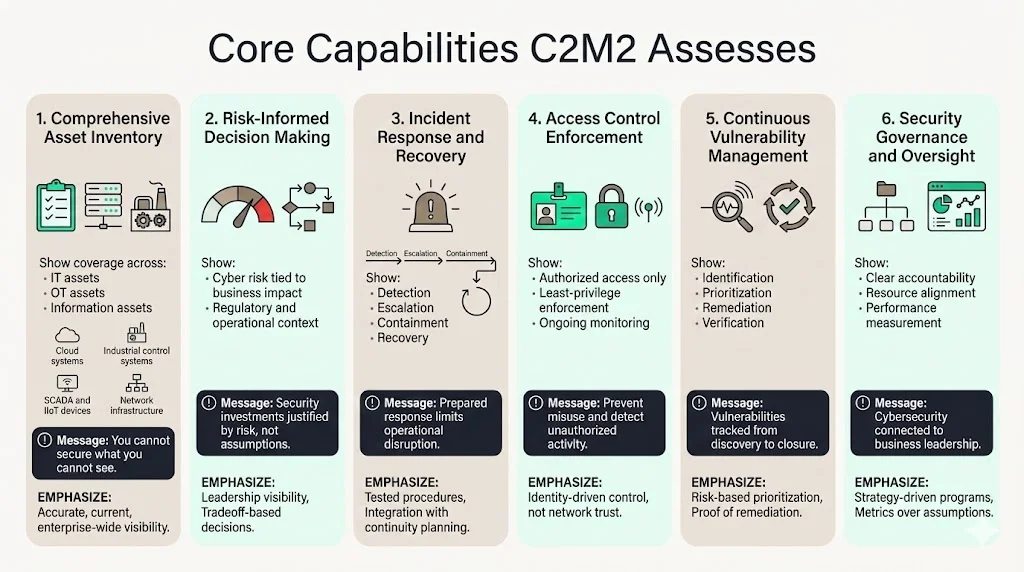
Comprehensive asset inventory: Organizations must maintain accurate, current inventories spanning traditional IT infrastructure, operational technology components, network devices, cloud assets, and information assets. Assets include IT assets, OT assets, and information assets—covering traditional and emerging enterprise IT, industrial control system devices, process control components, safety instrumented systems, IoT and IIoT devices, SCADA system components, and network and communications assets. This visibility forms the foundation for every other security capability.
Risk-informed decision making: Organizations connect cybersecurity investments to documented risk assessments that consider business impact, regulatory requirements, threat landscape, and operational criticality. Risk management practices ensure leadership can evaluate security proposals against measurable business outcomes rather than vendor marketing claims.
Defined incident response protocols: Clear, tested procedures specify how organizations detect security events, escalate incidents, contain threats, eradicate adversary presence, recover operations, and capture lessons learned. These protocols integrate with continuity of operations planning to maintain critical functions during cyber incidents.
Access control enforcement: Identity and access management capabilities ensure only authorized personnel can access systems, with privileges limited to necessary functions and continuous monitoring to detect unauthorized access attempts or privilege misuse.
Continuous vulnerability management: Organizations systematically identify vulnerabilities through scanning, threat intelligence, and security research; prioritize remediation based on risk; track fixes through completion; and verify remediation effectiveness.
Security governance connecting operations and leadership: Program management capabilities establish clear accountability, allocate resources based on documented strategy, measure security effectiveness through defined metrics, and ensure cybersecurity considerations inform business decisions rather than functioning as an operational afterthought.
C2M2 and Regulatory Compliance
C2M2 is not a regulation. It is a voluntary framework designed to help organizations evaluate their cybersecurity capabilities and optimize security investments. This voluntary nature distinguishes C2M2 from mandatory compliance requirements like NERC CIP for electric utilities or HIPAA for healthcare organizations.
The framework's value for compliance stems from its comprehensive coverage of security practices that satisfy requirements across multiple regulatory regimes. Organizations implementing C2M2 practices build capabilities that simultaneously address NERC CIP critical infrastructure protection standards, NIST Cybersecurity Framework guidance, ISO 27001 information security management requirements, and sector-specific regulations.
Regulators and enterprise buyers increasingly view maturity evidence as a trust signal. An organization documenting MIL2 or MIL3 capabilities demonstrates consistent, institutionalized security operations—not just policies written to satisfy auditors. This operational focus creates more reliable security outcomes than frameworks that emphasize policy documentation over implementation effectiveness.
For enterprise vendors, C2M2 alignment provides common language with buyers conducting vendor risk assessments. Security, legal, and procurement teams familiar with maturity models can quickly evaluate vendor capabilities, compare competing proposals using consistent criteria, and structure contract requirements around measurable maturity targets rather than vague security promises.
How C2M2 Compares to Other Maturity Models
C2M2 differs from checklist-based frameworks through its explicit focus on capability maturity rather than control existence. Where frameworks like ISO 27001 or SOC 2 assess whether specific controls are implemented, C2M2 examines how well those controls function, how consistently organizations execute security practices, and whether capability improves over time.
The model's operational technology emphasis distinguishes it from frameworks designed primarily for traditional IT environments. C2M2 directly addresses industrial control systems, SCADA environments, and the convergence risks created when corporate networks connect to operational technology infrastructure. Many compliance frameworks treat OT security as an afterthought, requiring translation and adaptation before becoming operationally useful.
C2M2's structure provides flexibility across organization size and sector. Small utilities and large energy providers use the same framework, adjusting maturity targets based on risk profile, resource availability, and business requirements. This scalability differs from rigid compliance frameworks that impose uniform requirements regardless of organizational context.
The model emphasizes actual security capability over compliance artifacts. Organizations performing well on C2M2 assessments demonstrate genuine security operations, not merely policies satisfying auditors. This focus on implementation effectiveness creates more reliable security outcomes than frameworks where organizations can achieve compliance while maintaining fundamentally insecure operations.
What a C2M2 Assessment Looks Like
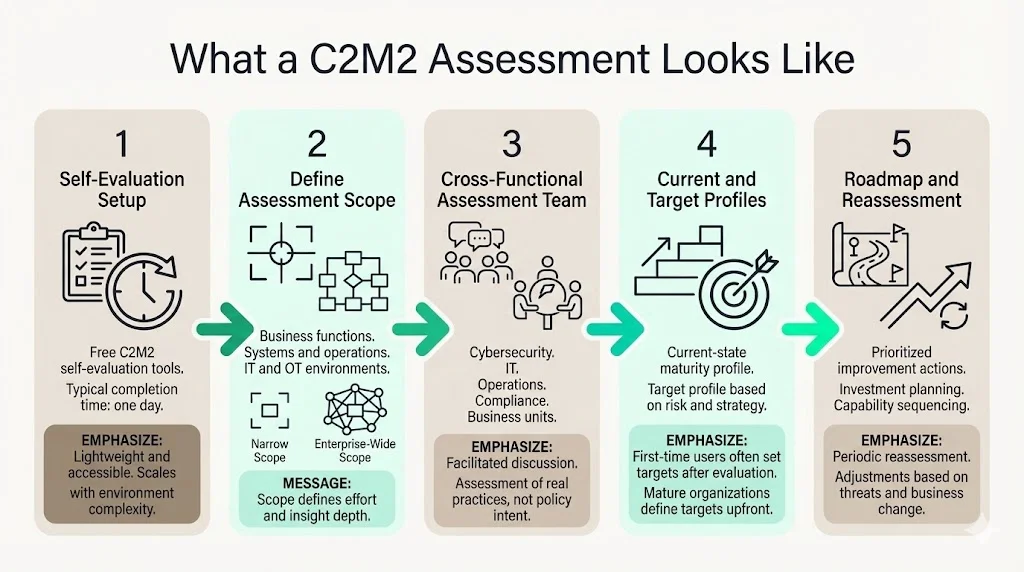
Organizations typically perform self-evaluation using free C2M2 self-evaluation tools available from DOE, which can be completed in one day. An organization can complete a self-evaluation using C2M2 tools in as little as one day, though comprehensive assessments spanning multiple business functions or complex operational environments require more time.
Organizations typically begin by defining assessment scope: which business functions, systems, or operational areas will the evaluation cover. Narrow scopes allow focused assessment of specific operations; broader scopes provide enterprise-wide visibility but require more extensive stakeholder coordination.
Assessment teams include representatives from cybersecurity, operations, IT, compliance, and relevant business units. This cross-functional participation ensures evaluation reflects actual practices rather than policy aspirations. A facilitator—either internal staff trained in C2M2 methodology or external consultants experienced with maturity assessments—guides the team through structured evaluation of practices within each domain.
For organizations using the model for the first time, a target profile is typically identified after the initial self-evaluation to develop familiarity with the model, while experienced organizations often identify target profiles before evaluation. The target profile defines desired maturity levels for each domain based on risk assessment, business strategy, and resource constraints.
Organizations use C2M2 to consistently measure cybersecurity capabilities over time, identify target maturity levels based on risk, and prioritize actions and investments. Results inform improvement roadmaps that sequence capability development based on risk priority, resource availability, and dependencies between practices. Organizations repeat assessments periodically to measure progress and adjust priorities based on evolving threats, business changes, or lessons learned from incidents.
Why C2M2 Matters to Companies Selling to Enterprise Clients
Enterprise procurement increasingly treats vendor cybersecurity maturity as a buying signal, not just an internal vendor management concern. Security questionnaires, vendor risk assessments, and contract negotiations now routinely probe vendor security capabilities using maturity frameworks as evaluation criteria.
Organizations selling software, hardware, or services into energy sector accounts face buyers familiar with C2M2 who expect vendors to articulate security capabilities using maturity language. A vendor demonstrating MIL2 capabilities across relevant domains provides procurement teams with concrete evidence of security effectiveness—evidence that shortens security review cycles and reduces buyer skepticism.
C2M2 alignment creates shared vocabulary across security, legal, and procurement functions. Technical security teams can assess vendor implementation practices; legal teams can incorporate maturity requirements into contract terms; procurement teams can compare vendor proposals using consistent criteria. This alignment reduces negotiation friction and accelerates deal cycles for vendors prepared to discuss capabilities in maturity terms.
Strong maturity posture provides competitive advantage in regulated and infrastructure-heavy industries. When multiple vendors offer comparable functionality, demonstrated security capability becomes a differentiator. Organizations with documented C2M2 maturity can substantiate security claims that competitors state aspirationally, creating trust that translates into contract awards and expanded customer relationships.
For vendors pursuing long-term enterprise relationships, C2M2 provides a framework for sustained security dialogue with customers. Periodic maturity updates demonstrate ongoing capability improvement, security incidents become learning opportunities documented through improved practices, and customer-vendor security discussions focus on operational effectiveness rather than compliance paperwork.
Common Misunderstandings About C2M2
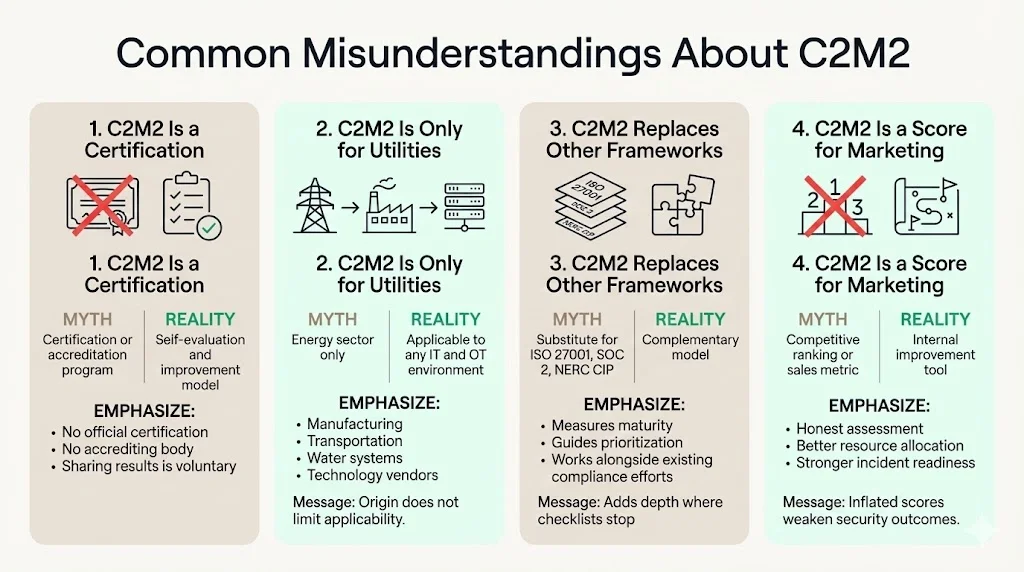
C2M2 is not a certification program. Organizations do not receive C2M2 certification, and no accreditation body issues C2M2 credentials. The framework provides a measurement tool for self-assessment and capability improvement. Some organizations share C2M2 results with customers or partners, but this represents voluntary transparency, not mandatory certification.
C2M2 is not limited to utilities. While energy sector organizations drove initial development and adoption, the framework applies to any organization operating IT and OT environments. Manufacturing, water systems, transportation infrastructure, and technology vendors all use C2M2 to assess and improve cybersecurity capabilities.
C2M2 does not replace existing frameworks. Organizations maintaining ISO 27001 certification, pursuing SOC 2 attestation, or complying with NERC CIP requirements continue those efforts while using C2M2. The model complements existing frameworks by providing maturity measurement and improvement prioritization capabilities that checklist-based frameworks lack.
C2M2 focuses on improvement, not marketing scores. Organizations evaluating C2M2 results should resist treating maturity levels as competitive metrics or marketing claims. The framework's value derives from honest capability assessment that informs resource allocation and improvement planning. Organizations inflating maturity ratings undermine their own security planning while creating compliance manufacturing that fails during actual incidents.
Turn a C2M2 self-assessment into a funded improvement plan
Book a demo and we'll show how Konfirmity tracks the practices behind each maturity level across your IT and OT environments, so progress between assessments is visible rather than remembered.
Book a demo
Conclusion
C2M2 provides organizations with a practical mechanism for assessing cybersecurity capability maturity and planning improvement investments based on documented risk and business requirements. The framework's operational technology focus, capability-based structure, and continuous improvement orientation address gaps that compliance-focused frameworks leave unresolved.
For enterprise vendors, C2M2 familiarity enables more effective dialogue with buyers conducting vendor risk assessments. Organizations articulating security capabilities using maturity language demonstrate operational security rather than merely asserting compliance claims. This operational evidence shortens security review cycles, reduces contract negotiation friction, and provides competitive differentiation in markets where cybersecurity effectiveness influences buying decisions.
Understanding C2M2 helps technology providers meet enterprise buyer expectations, particularly in energy, critical infrastructure, and regulated sectors where operational technology security directly impacts business operations. Organizations that build genuine security capabilities—rather than manufacturing compliance artifacts—create sustainable competitive advantages while protecting customers from the very real threats facing interconnected operational environments.
FAQs
C2M2 is the Cybersecurity Capability Maturity Model developed by the U.S. Department of Energy in 2012 with energy and cybersecurity industry experts. It is a free tool to help organizations evaluate their cybersecurity capabilities and optimize security investments, with particular emphasis on operational technology environments and critical infrastructure protection.
Any organization—regardless of size, type, or industry—can use the model to evaluate, prioritize, and improve cybersecurity capabilities. Energy providers, utilities, industrial automation operators, and technology vendors serving critical infrastructure sectors benefit most. Organizations operating both IT and operational technology environments or selling into regulated markets gain competitive advantage through C2M2 alignment.
C2M2 uses industry-vetted cybersecurity practices focused on both information technology (IT) and operations technology (OT) assets and environments—directly addressing operational technology risks that many frameworks overlook. The model emphasizes capability development and continuous improvement over checklist compliance, providing flexible application across organization sizes and sectors while maintaining focus on operational effectiveness rather than paperwork generation.
C2M2 is a voluntary framework designed to help organizations evaluate their cybersecurity capabilities and optimize security investments. No regulation mandates C2M2 adoption. However, enterprise buyers increasingly expect vendors to demonstrate security maturity using recognized frameworks, and some contracts incorporate C2M2 requirements. Organizations pursue C2M2 assessment to improve security operations, satisfy customer expectations, or support regulatory compliance efforts.
An organization can complete a self-evaluation using C2M2 tools in as little as one day. Focused assessments covering specific operational areas typically require one to three days for data collection, stakeholder interviews, and results documentation. Comprehensive enterprise-wide assessments spanning multiple business functions and complex operational environments may require one to two weeks, depending on organization size, assessment scope, and facilitator experience. Preparation time—gathering documentation, coordinating stakeholders, and training assessment participants—adds days to weeks before formal evaluation begins.