

Organizations selling to large enterprise clients—particularly those pursuing government or defense contracts—encounter a mandatory identifier that determines eligibility before contract award. The Commercial and Government Entity (CAGE) code is an identifier assigned to entities located in the United States or its outlying areas by the Defense Logistics Agency (DLA) Commercial and Government Entity (CAGE) Branch to identify a commercial or government entity by unique location. This five-character alphanumeric code serves as your organization's procurement identity across federal systems.
This article examines what the CAGE code is, how federal agencies use it, the regulatory requirements governing its assignment and maintenance, and the practical implications for vendors selling into enterprise markets. We address the relationship between CAGE codes and other business identifiers—specifically the D-U-N-S number and Employer Identification Number (EIN)—and clarify common misconceptions about how these systems interoperate. For organizations outside the United States, we cover the NATO CAGE (NCAGE) code requirements that govern international supplier participation.
What is a CAGE Code?
The Commercial and Government Entity Code, or CAGE Code, is a unique identifier assigned to suppliers to various government or defense agencies, as well as to government agencies themselves and various organizations. CAGE codes provide a standardized method of identifying a given facility at a specific location.
CAGE codes are all five characters in length. The code itself carries no semantic meaning beyond serving as a unique identifier; it does not encode industry classification, geographic information, or organizational structure. There is no meaning encoded in the code itself, other than the underlying NCB; it is simply a unique identifier.
For entities located outside the United States and its outlying areas, this type of code is known as a NATO CAGE (NCAGE) code. The NCAGE code is a five-character alpha-numeric identifier assigned to entities located outside the United States by the NATO or NSPA organizations. The NCAGE system operates under the NATO Codification System and serves the same identification function for international suppliers.
How it's assigned and by whom
The Defense Logistics Agency (DLA) Commercial and Government Entity (CAGE) Branch assigns identifiers to entities located in the United States or its outlying areas to identify a commercial or government entity by unique location. For U.S.-based entities, CAGE code assignment occurs through registration in the System for Award Management (SAM).
If the Offeror is located in the United States or its outlying areas and does not already have a CAGE code assigned, the DLA Commercial and Government Entity (CAGE) Branch will assign a CAGE code as a part of the SAM registration process. The assignment process integrates with SAM registration validation: when that is complete, your registration is sent for CAGE/NCAGE Code assignment or validation. While the average overall processing time is up to three business days, the Defense Logistics Agency (DLA, also known as CAGE) completes the validation process. This usually takes 2-3 weeks depending on if DLA has any follow up questions during the registration and approval process.
For entities located outside the United States, entities located outside the United States and its outlying areas may obtain an NCAGE code by contacting the Codification Bureau in the foreign entity's country if that country is a member of NATO or a sponsored nation. NCAGE codes may be obtained from the NSPA at https://eportal.nspa.nato.int/AC135Public/scage/CageList.aspx if the foreign entity's country is not a member of NATO or a sponsored nation.
Scope and applicability
CAGE codes function within federal procurement systems to identify suppliers, contractors, and government entities. Commercial and Government Entity (CAGE) Codes are five-character codes assigned by the Defense Logistics Agency (DLA) to identify a specific entity, such as a manufacturer or supplier. These codes can also be assigned to universities, non-profit organizations, and even individuals who work with the government. In fact, some federal agencies require their employees to have a CAGE Code in order to access certain systems and resources.
The regulatory framework governing CAGE code requirements appears in the Federal Acquisition Regulation (FAR). The Offeror shall provide its CAGE code with its offer with its name and location address or otherwise include it prominently in its proposal. The CAGE code must be for that name and location address. The CAGE code is required prior to award.
FAR 52.204-18 establishes maintenance obligations: Contractors shall ensure that the CAGE code is maintained throughout the life of the contract for each location of contract, including subcontract performance. The regulation imposes specific update requirements: The contractor shall communicate any change to the CAGE code to the contracting officer within 30 days after the change, so that a modification can be issued to update the CAGE code on the contract.
Working toward a federal compliance baseline?
Drop your work email and we'll help you map controls to NIST and prove them with real evidence.
Why the CAGE Code Matters (and for Whom)
1) Role in federal procurement / government contracting
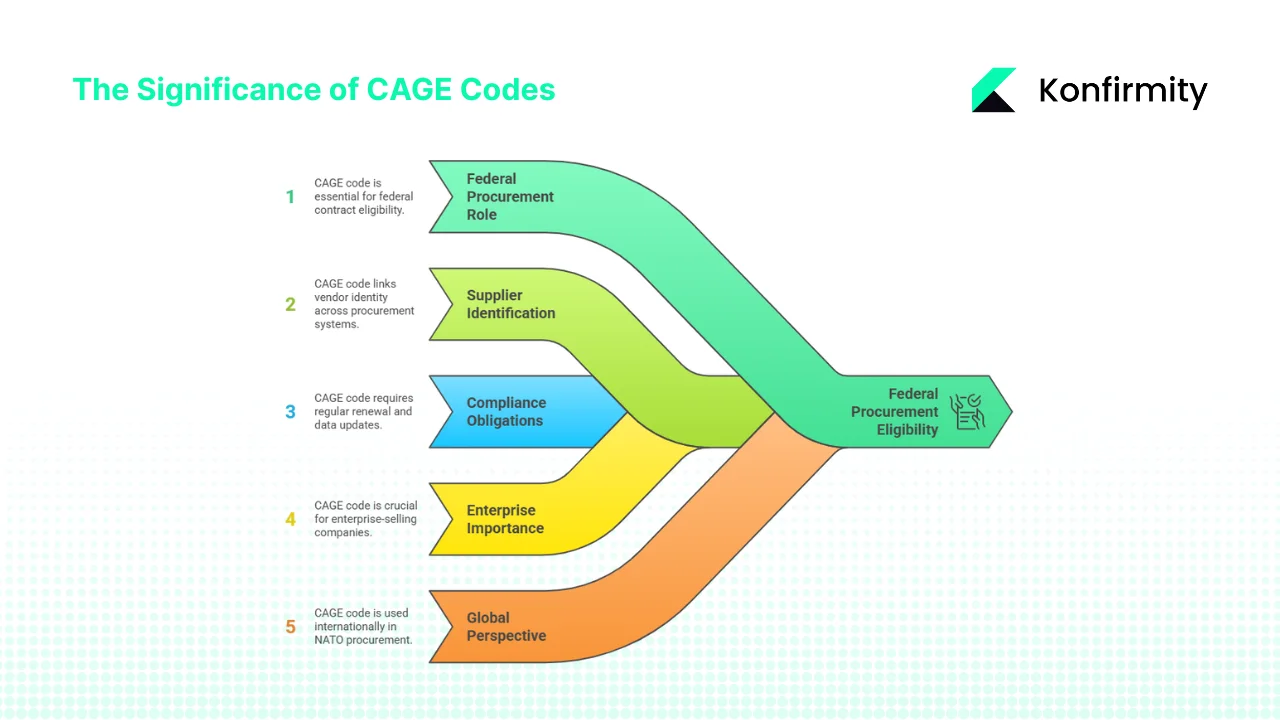
Organizations pursuing federal contracts encounter CAGE code requirements as a threshold eligibility criterion. For businesses seeking to engage with GSA or other federal agencies, it is a non-negotiable requirement that ensures the government can securely and accurately identify each commercial or institutional entity.
DLA uses CAGE codes to identify specific entities or corporations. This is particularly useful in contracts, logistics, and quality control processes. The code's utility extends across multiple defense and procurement agencies: CAGE Codes are also crucial to the operations of the Defense Contract Management Agency (DCMA), the Defense Finance and Accounting Service (DFAS), the Defense Contract Audit Agency (DCAA), and the Army, Navy, and Air Force to ensure quality products are delivered on time, at projected cost, and that they meet all performance requirements for defense contracts.
2) Linking with supplier identification and classification
Federal procurement systems rely on CAGE codes to maintain vendor identity across databases and contracting vehicles. In GSA's acquisition ecosystem, the CAGE Code is used extensively to link a contractor's identity across multiple systems and platforms, including: GSA Advantage! – Marketplace where buyers search for pre-approved vendors and products. eBuy – Online RFQ and RFP system tied to GSA Schedules. FAS Sales Reporting Portal – Tracks contract sales and performance. GSA eLibrary – Shows contractor profiles and authorized offerings.
CAGE Codes are essential in NSN (National Stock Number) manufacturing. For context, an NSN is a unique 13-digit identifier assigned to an item of supply by the Defense Logistics Information Service (DLIS). DLIS uses CAGE Codes to identify manufacturers and suppliers of NSN items, even to the point that the manufacturer's CAGE Code is frequently included on weapon system parts, permanent data plates as well as other DoD supply items.
3) Compliance and regulatory obligations
An entity issued a CAGE code must renew it every five years. This renewal requirement applies to codes issued after August 26, 2016. Organizations must maintain accurate registration data throughout the code's lifecycle, with updates required when entity name, address, or ownership changes.
The regulatory framework imposes specific update timing: contractors must communicate changes to the contracting officer within 30 days. Contractors located in the United States or its outlying areas that are not registered in SAM shall submit written change requests to the DLA Commercial and Government Entity (CAGE) Branch. Requests for changes shall be provided at https://cage.dla.mil. Change requests to the CAGE master file are accepted from the entity identified by the code.
For classified work, CAGE code requirements extend to subcontractor arrangements: If the solicitation includes FAR clause 52.204-2, Security Requirements, a subcontractor requiring access to classified information under a contract shall be identified with a CAGE code on the DD Form 254. The Contractor shall require a subcontractor requiring access to classified information to provide its CAGE code with its name and location address or otherwise include it prominently in the proposal.
4) Real-world importance for enterprise-selling companies
Prime contractors working with federal agencies require their subcontractors and vendors to maintain proper procurement identifiers. When your organization appears in a prime contractor's supply chain, that prime must report your CAGE code in contract documentation, subcontractor listings, and procurement data systems. Without a valid CAGE code, you cannot be included in federal contract proposals as a subcontractor, delaying contract award or disqualifying the prime contractor's bid.
Enterprise clients engaged in government work expect vendors to maintain SAM registration and valid CAGE codes as baseline compliance requirements. This expectation extends beyond direct government contractors to include their entire vendor ecosystem. Organizations that cannot produce a CAGE code signal unfamiliarity with federal procurement requirements—a risk indicator for enterprise clients whose own contract performance depends on subcontractor compliance.
Vendor registration processes at large enterprises frequently request CAGE codes as mandatory fields. The absence of this identifier creates friction in onboarding, requires manual workarounds, and positions your organization as less procurement-mature than competitors who maintain proper federal identifiers.
5) Global perspective (outside US)
CAGE Codes are used internationally as part of the NATO Codification System (NCS), where they are sometimes called NCAGE Codes. International suppliers pursuing contracts with U.S. government agencies or NATO member nations must obtain NCAGE codes through their national codification bureaus or the NATO Support and Procurement Agency (NSPA).
For foreign companies and non-U.S. based parent companies located outside the U.S., you will need an NCAGE Code from the NATO codification system community. As we mentioned before, any foreign organization that wishes to conduct business with the U.S. government will need an NCAGE Code.
The NCAGE process precedes SAM registration for foreign entities. Organizations must first obtain the NCAGE code, then use that code during SAM registration to establish federal procurement eligibility.
How to Get or Associate Your Organisation with a CAGE Code
1) Pre-registration steps
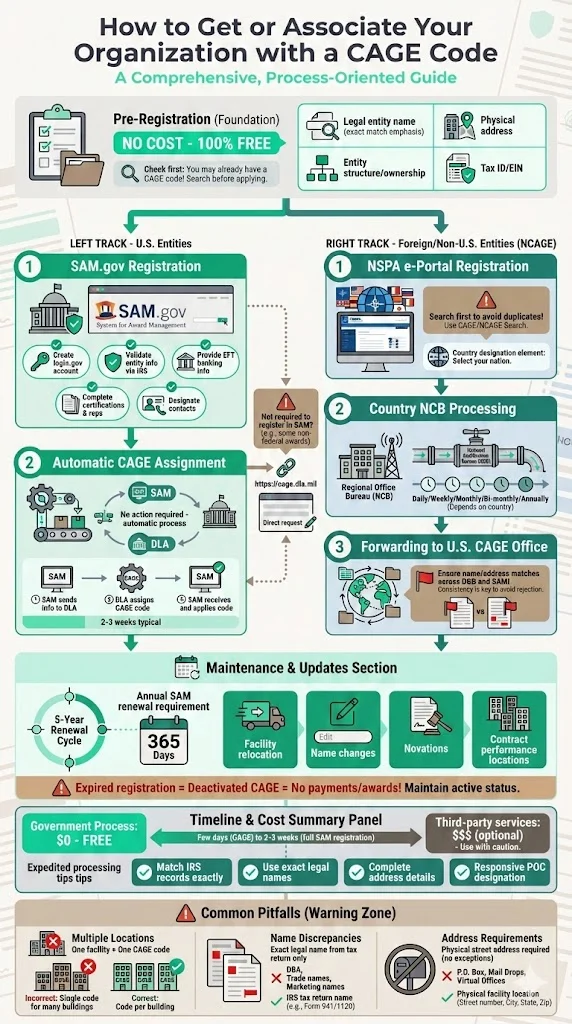
Organizations must gather foundational business information before initiating CAGE code assignment. Required information includes legal entity name (exactly as registered with your state or national authority), physical address of the facility requiring the code, entity structure and ownership information, and Employer Identification Number (for U.S. entities) or equivalent tax identification.
There is no cost to obtain a CAGE Code. The assignment process integrates with SAM registration at no charge. Organizations should verify they do not already possess a CAGE code before requesting assignment—particularly relevant for entities that previously registered in SAM or held government contracts under different ownership or facility arrangements.
2) Step-by-step process (U.S.)
For U.S.-based entities, CAGE code assignment occurs through SAM.gov registration:
You do not need to have a CAGE Code prior to registering in the System for Award Management (SAM). Once you submit your Entity Registration for processing, SAM will send your entity information to the DLA for CAGE Code assignment. The DLA assigns the CAGE Code, SAM will then receive and apply the code to the Entity Registration. No further action by the registrant is necessary to apply the CAGE Code to an Entity Registration, unless the DLA requests additional information.
Organizations not required to register in SAM for specific procurement actions may request CAGE codes directly: If registration in SAM is not required for the subject procurement, and the Offeror does not otherwise register in SAM, an Offeror located in the United States or its outlying areas may request that a CAGE code be assigned by submitting a request at https://cage.dla.mil.
The SAM registration process itself requires creating a login.gov account, validating entity information including tax identification through IRS consent procedures, providing banking information for electronic funds transfer (EFT), completing representations and certifications relevant to your business type, and designating points of contact.
3) Non-U.S./foreign entities (NCAGE)
You can request an NCAGE Code by registering your company using the e-portal for the NATO Support and Procurement Agency (NSPA). Before registering, it's best to search your company in the e-portal to ensure a code has not already been assigned.
NSPA and the appropriate country's NCBs will forward all NCAGE code information to the U.S. CAGE Program Office. Depending on the assigned country, the data transmission to the U.S. CAGE Program Office will vary from daily/weekly/monthly/bi-monthly/annually based on their internal procedures.
Foreign entities must ensure business name and address information remains consistent across NCAGE records, D&B records (if applicable), and subsequent SAM registration. Discrepancies between these systems cause registration failures and validation delays.
4) Maintenance and updates
Contractors shall ensure that the CAGE code is maintained throughout the life of the contract for each location of contract, including subcontract performance. Maintenance obligations include communicating changes within required timeframes, updating facility information when relocations occur, notifying the contracting officer of novations or name changes, and renewing codes every five years (for codes issued after August 26, 2016).
Organizations registered in SAM must update their registration annually to maintain active status. This annual renewal process also validates and maintains CAGE code information. Entities that allow SAM registration to expire risk CAGE code deactivation, which blocks payment processing and contract award eligibility.
5) Timeline and cost
SAM registration (including CAGE code assignment) carries no government fee. Organizations complete registration directly through SAM.gov without payment to federal agencies. Third-party services offering SAM registration assistance charge fees for their consulting services, but the underlying government process remains free.
CAGE Codes are generally assigned within a few business days, although this can vary depending on entity verification and completeness of submitted information. The end-to-end timeline from SAM registration submission through CAGE code assignment typically spans 2-3 weeks, accounting for IRS tax validation, entity verification by DLA, and any follow-up information requests.
Organizations requiring expedited processing should ensure all submitted information precisely matches IRS tax records, use exact legal entity names without variations or abbreviations, provide complete address information including suite or building numbers, and designate knowledgeable points of contact who can respond quickly to validation questions.
6) Common pitfalls to avoid
CAGE codes identify facilities at specific locations. Organizations with multiple physical facilities require separate CAGE codes for each location engaged in contract performance. A common error involves assuming a single CAGE code covers all company locations—this creates compliance gaps when contracts specify performance at facilities not associated with the registered code.
Entity name discrepancies between IRS records and SAM registration cause validation failures. Organizations must use the exact legal name appearing on their most recent federal tax return. Trade names, "doing business as" (DBA) names, or marketing names do not satisfy registration requirements unless formally registered with tax authorities.
Address accuracy matters because CAGE codes identify specific facility locations. Post office boxes do not satisfy registration requirements for CAGE codes; organizations must provide physical street addresses where contract performance or facility operations occur.
Connecting CAGE Code with Other Identifiers
CAGE Code vs D-U-N-S Number
A CAGE Code is not the same thing as a DUNS number. CAGE Codes are assigned by DLA (Defense Logistics Agency) while the DUNS number was the old identification system, replaced by UEI in 2022.
The D-U-N-S (Data Universal Numbering System) number is a nine-digit identifier issued by Dun & Bradstreet, a commercial credit reporting firm. D&B's system, in addition to providing the means for uniquely identifying contractor entities, may be used to "roll-up Government procurements to the ultimate parent organization to show the corporate family receiving U.S. obligations" and contains business-related information. D-U-N-S numbers serve commercial credit and business intelligence purposes beyond government contracting.
Key differences:
- Issuing authority: CAGE codes come from the Defense Logistics Agency (government-managed); D-U-N-S numbers come from Dun & Bradstreet (commercial entity)
- Format: CAGE codes use five alphanumeric characters; D-U-N-S numbers use nine digits
- Scope: CAGE codes identify specific facility locations; D-U-N-S numbers identify business entities globally
- Purpose: CAGE codes serve federal procurement identification; D-U-N-S numbers serve broader commercial credit and business verification
- Current status: As of April 2022, UEI replaced DUNS on April 4, 2022, becoming the mandatory identifier for SAM.gov registrations and federal contracts. The federal government transitioned away from proprietary D-U-N-S numbers to government-issued Unique Entity Identifiers (UEI), though D-U-N-S numbers remain relevant for commercial credit purposes
CAGE Code vs EIN (Employer Identification Number)
The Employer Identification Number (EIN) is a nine-digit tax identification number issued by the Internal Revenue Service to business entities operating in the United States. EIN serves tax administration purposes—identifying entities for federal tax filing, reporting, and compliance obligations.
Key differences:
- Issuing authority: CAGE codes come from DLA; EIN comes from the IRS
- Format: CAGE codes use five alphanumeric characters; EIN uses nine digits (formatted XX-XXXXXXX)
- Purpose: CAGE codes identify facilities for procurement; EIN identifies entities for tax purposes
- Scope: CAGE codes are location-specific; EIN applies to the entire legal entity regardless of location
- Requirement: CAGE codes are required for federal contracting; EIN is required for tax administration and employment
The EIN serves as a prerequisite for CAGE code assignment because SAM registration requires tax validation through IRS systems. Organizations must possess a valid EIN and provide consent for IRS validation as part of the SAM registration process that ultimately results in CAGE code assignment.
Relationship to vendor registration, supplier database, industry classification
Enterprise procurement systems and government vendor databases collect multiple identifiers to establish comprehensive supplier profiles. A typical vendor registration requires CAGE code (for government contracting eligibility), Unique Entity Identifier (UEI, for SAM registration), EIN (for tax purposes), NAICS codes (North American Industry Classification System, defining primary business activities), and banking information (for electronic payment processing).
The CAGE code itself does not encode industry classification information. However, within procurement systems, CAGE codes link to entity records that include industry classification codes, capabilities statements, past performance data, and contract history. This linkage enables procurement professionals to identify qualified suppliers by combining location (CAGE code), industry (NAICS code), and past performance criteria.
Why this matters for companies selling to enterprise clients
Prime contractors and large enterprises conducting government work vet their supplier ecosystems for procurement compliance. When your organization pursues business with these clients, they evaluate whether your procurement identifiers align with federal requirements. Misaligned identifiers—or missing CAGE codes—signal compliance gaps that create risk for the prime contractor.
Enterprise procurement teams filter supplier databases by CAGE code status to identify government-contract-ready vendors. Organizations lacking valid CAGE codes may be excluded from procurement opportunities or encounter delays during supplier qualification processes. For companies selling to multiple large enterprises, maintaining current CAGE codes and understanding how these identifiers interoperate reduces friction in vendor onboarding across different client systems.
Real-World Use Cases and Examples
Case: Government contract bidding
A software development firm pursues a subcontract opportunity with a defense prime contractor. The prime contractor's solicitation requires the software firm to provide its CAGE code as part of the subcontractor proposal documentation. The Offeror shall provide its CAGE code with its offer with its name and location address or otherwise include it prominently in its proposal. The CAGE code must be for that name and location address.
The software firm discovers it lacks a CAGE code three days before proposal submission. It initiates SAM registration immediately, but CAGE code assignment requires 2-3 weeks for processing. Do not delay submission of the offer pending receipt of a CAGE code. The firm submits its proposal with documentation showing SAM registration in process, but the prime contractor's proposal evaluation stalls pending CAGE code validation. This delay reduces the prime contractor's confidence in the software firm's procurement readiness and creates schedule risk for contract award.
Lesson: Organizations pursuing government contracting opportunities (directly or as subcontractors) should obtain CAGE codes proactively, before specific opportunities emerge. The 2-3 week assignment timeline makes late registration incompatible with typical proposal development schedules.
Case: Supplier registering in a corporate enterprise's vendor database
A cybersecurity firm seeks to become an approved vendor for a Fortune 500 defense contractor. The defense contractor's vendor onboarding portal includes a mandatory CAGE code field. The portal validates entered CAGE codes against the DLA CAGE database, rejecting invalid or inactive codes.
The cybersecurity firm possesses a CAGE code obtained five years ago during a previous SAM registration. However, the firm allowed its SAM registration to expire after that contract concluded. When it enters its CAGE code in the vendor portal, validation fails because the expired SAM registration resulted in CAGE code deactivation.
The firm must renew its SAM registration to reactivate the CAGE code. This renewal process includes updating entity information, re-validating tax identification with the IRS, and updating banking information. The renewal delays vendor qualification by three weeks, causing the firm to miss inclusion in the defense contractor's upcoming procurement cycle.
Lesson: CAGE codes require ongoing maintenance through annual SAM renewal. Organizations should monitor SAM registration expiration dates and renew registration 60-90 days before expiration to avoid deactivation and qualification delays.
Case: International supplier working with a U.S. prime contractor
A manufacturing firm based in Germany pursues a subcontract with a U.S. aerospace prime contractor. The German manufacturer must provide an NCAGE code as part of its supplier qualification package.
The manufacturer initiates an NCAGE code request through Germany's National Codification Bureau (NCB). The NCB processes the request and assigns an NCAGE code, then transmits the code information to the U.S. DLA CAGE Program Office. NSPA and the appropriate country's NCBs will forward all NCAGE code information to the U.S. CAGE Program Office. Depending on the assigned country, the data transmission to the U.S. CAGE Program Office will vary from daily/weekly/monthly/bi-monthly/annually based on their internal procedures.</parameter>
Operational impact: supplier classification, audit readiness, regulatory compliance
Organizations maintaining valid CAGE codes demonstrate procurement maturity to prime contractors and enterprise clients. During supplier audits or qualification reviews, auditors verify CAGE code validity through the DLA CAGE database. Valid, current codes satisfy audit requirements; invalid or expired codes trigger compliance findings that threaten supplier qualification status.
CAGE codes enable contract traceability across federal spending databases. Government agencies report contract awards using CAGE codes to identify contractors and subcontractors. This reporting populates databases like the Federal Procurement Data System (FPDS), which tracks government spending, supplier performance, and contract compliance. Organizations with active CAGE codes appear in these databases; those without codes cannot be properly tracked or credited for contract performance.
For organizations pursuing multiple federal contracts or working with multiple prime contractors, CAGE codes provide consistent identification across different contract vehicles and procurement systems. This consistency enables past performance tracking, reduces duplicative qualification efforts, and streamlines supplier verification.
Common challenges and how companies overcome them
Challenge: A supplier operates from multiple facilities but only registered one CAGE code for its headquarters location. When it wins a contract requiring performance at a different facility, the contracting officer identifies a mismatch between the registered CAGE code location and the actual performance location.
Solution: The supplier requests an additional CAGE code for the performance facility through the DLA CAGE system. Organizations with multiple facilities should identify which locations will engage in federal contract performance and obtain facility-specific CAGE codes proactively.
Challenge: A company undergoes a merger, changing its legal entity name. It continues using its old CAGE code without updating the name change with DLA. During contract award processing, the contracting officer identifies a mismatch between the CAGE code registered name and the current entity name on the contract.
Solution: Organizations must update CAGE code information within 30 days of name changes, address changes, or ownership changes. Updates for SAM-registered entities occur through SAM registration updates. Entities not in SAM must submit change requests directly to the DLA CAGE Branch.
Checklist for companies selling to enterprise clients:
- Verify current CAGE code status in the DLA CAGE database (https://cage.dla.mil)
- Confirm SAM registration remains active with expiration date at least 60 days in future
- Ensure CAGE code facility address matches actual contract performance location
- Validate entity name consistency across CAGE records, SAM registration, IRS tax records, and state business registration
- Document CAGE codes for all facilities engaged in government contract work
- Establish calendar reminders for SAM renewal 90 days before expiration
- Designate internal ownership for CAGE code maintenance and compliance monitoring
- Update CAGE information within 30 days of any entity name, address, or ownership changes
Best Practices for Suppliers (selling to enterprise clients)
-
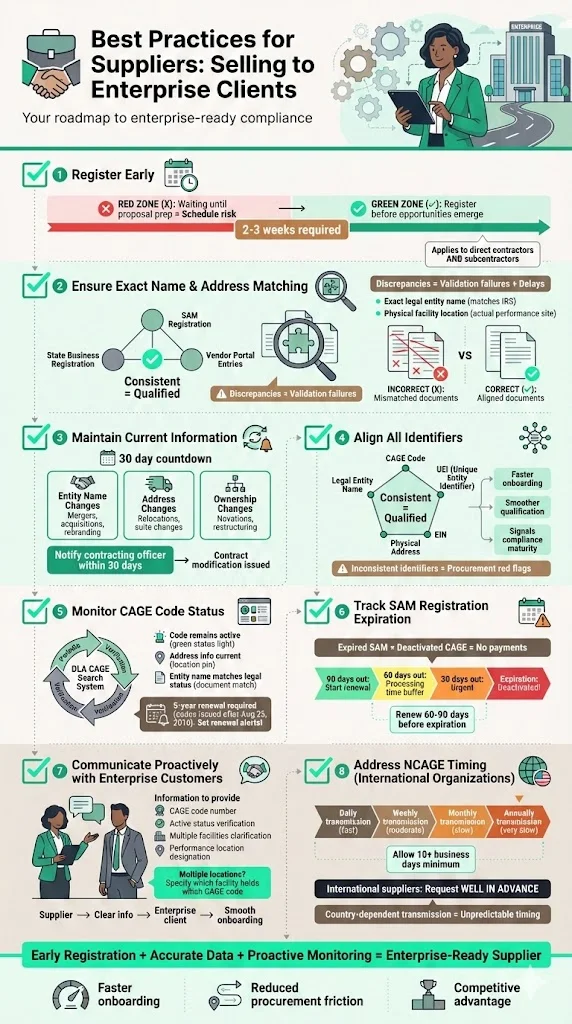
Register early—CAGE code assignment requires 2-3 weeks through the SAM registration process. Organizations pursuing government contracting opportunities (directly or as subcontractors to enterprise clients) should obtain CAGE codes before specific opportunities emerge. Waiting until proposal preparation creates avoidable schedule risk.
-
Ensure exact name and address matching—CAGE codes identify facilities at specific locations using precise entity names. Entity names must match IRS tax records exactly. Address must reflect the physical facility location where contract performance will occur. Discrepancies between SAM registration, IRS records, state business registration, and vendor portal entries cause validation failures and processing delays.
-
Maintain current information—<cite index="14-15">The contractor shall communicate any change to the CAGE code to the contracting officer within 30 days after the change, so that a modification can be issued to update the CAGE code on the contract. Changes triggering update requirements include entity name changes (mergers, acquisitions, rebranding), physical address changes (facility relocations, suite number changes), and ownership changes (novations, structural reorganizations).
-
Align all identifiers—Enterprise procurement systems collect multiple identifiers. Ensure consistency across CAGE code, Unique Entity Identifier (UEI), EIN, legal entity name, and physical address. Inconsistent identifiers create confusion during vendor qualification, slow onboarding processes, and signal compliance immaturity to procurement professionals.
-
Monitor CAGE code status—Verify CAGE code validity periodically through the DLA CAGE Search and Inquiry system. Check that your code remains active, address information remains current, and entity name matches current legal status. An entity issued a CAGE code must renew it every five years. For codes issued after August 26, 2016, establish calendar reminders for five-year renewal deadlines.
-
Track SAM registration expiration—SAM registration expires annually. Expired registration deactivates CAGE codes and blocks payment processing. Organizations should renew SAM registration 60-90 days before expiration to account for processing time and avoid deactivation.
-
Communicate proactively with enterprise customers—When enterprise clients request CAGE codes during vendor onboarding, provide your code along with verification that it remains active. If your organization operates multiple facilities, clarify which facility locations hold CAGE codes and which facility will perform under specific contracts.
-
For international organizations, address NCAGE timing—Allow 10 business days from the date of submission to the CAGE/NCAGE request. NCAGE code processing varies by country, with transmission to the U.S. CAGE Program Office occurring on schedules ranging from daily to annually depending on the issuing nation's procedures. International suppliers should initiate NCAGE requests well in advance of U.S. government contracting opportunities.
Your CAGE code opens the door; security keeps it open
Book a demo and we'll show how Konfirmity builds the NIST SP 800-171 and CMMC evidence that federal buyers ask for once your registration is active and the contract clauses start arriving.
Book a demo
Conclusion
The CAGE code functions as a foundational identifier for organizations engaged in federal procurement—either directly as prime contractors or indirectly as subcontractors to enterprises conducting government work. The Offeror shall provide its CAGE code with its offer with its name and location address or otherwise include it prominently in its proposal. The CAGE code must be for that name and location address. The CAGE code is required prior to award. This regulatory requirement makes CAGE codes non-negotiable for organizations selling into government contracting channels.
For enterprise-selling companies, CAGE codes signal procurement readiness and compliance maturity. Prime contractors and large enterprises conducting government work evaluate their supplier ecosystems for federal procurement compliance; organizations lacking valid CAGE codes encounter qualification barriers, onboarding delays, and competitive disadvantages. The code's role extends beyond direct government contracting to encompass vendor registration, supplier database qualification, and procurement system integration across enterprise clients.
Organizations should evaluate their current CAGE code status: Do you possess an active code? Does it reflect your current entity name and facility location? Does your SAM registration remain active with sufficient time before expiration? For international organizations: Have you obtained an NCAGE code appropriate to your nation's codification system? These questions determine your readiness to engage in federal procurement channels and qualify as a supplier to enterprises conducting government work.
While the CAGE code serves specialized purposes within government and defense procurement, many enterprise clients operating in these channels expect suppliers to meet the same identification standards they maintain. Obtaining the identifier represents a foundational step—modest in effort, significant in impact—for organizations pursuing larger enterprise contracts with confidence.
FAQs
CAGE Code stands for Commercial and Government Entity Code. It is an identifier assigned to entities located in the United States or its outlying areas by the Defense Logistics Agency (DLA) Commercial and Government Entity (CAGE) Branch to identify a commercial or government entity by unique location. The five-character alphanumeric code serves as a unique facility identifier in federal procurement systems, enabling government agencies, prime contractors, and defense organizations to track suppliers, process payments, and maintain contract documentation.
For U.S.-based entities, CAGE codes are assigned during SAM.gov registration at no cost. You do not need to have a CAGE Code prior to registering in the System for Award Management (SAM). Once you submit your Entity Registration for processing, SAM will send your entity information to the DLA for CAGE Code assignment. The DLA assigns the CAGE Code, SAM will then receive and apply the code to the Entity Registration. Organizations not required to register in SAM may request CAGE codes directly from the DLA CAGE Branch at https://cage.dla.mil. Foreign entities must obtain NCAGE codes through their national codification bureaus or the NATO Support and Procurement Agency (NSPA) before registering in SAM.
No. The CAGE code and EIN serve different purposes and operate in separate systems. The Employer Identification Number (EIN) is a nine-digit tax identification number issued by the Internal Revenue Service for federal tax administration. The CAGE code is a five-character alphanumeric identifier issued by the Defense Logistics Agency for federal procurement identification. While the EIN identifies the legal entity for tax purposes regardless of location, the CAGE code identifies specific facility locations for contract performance. Organizations need both identifiers: the EIN for tax compliance and the CAGE code for federal contracting eligibility.
No. A CAGE Code is not the same thing as a DUNS number. CAGE Codes are assigned by DLA (Defense Logistics Agency) while the DUNS number was the old identification system, replaced by UEI in 2022. D-U-N-S numbers are nine-digit identifiers issued by Dun & Bradstreet (a commercial credit reporting firm) for business identification and credit purposes globally. CAGE codes are five-character identifiers issued by a government agency specifically for federal procurement. The federal government transitioned away from D-U-N-S numbers to government-issued Unique Entity Identifiers (UEI) as of April 2022, though D-U-N-S numbers remain relevant for commercial credit and business verification outside government contracting.