

Most organizations approach data privacy compliance as a periodic certification exercise rather than a continuous operational discipline. This creates a fundamental disconnect between legal requirements and security infrastructure—a gap that becomes apparent when regulatory scrutiny intensifies or enforcement actions materialize. The California Consumer Privacy Act represents one of the most consequential privacy frameworks in U.S. regulatory history, establishing data protection standards that extend far beyond California's borders and imposing operational obligations that require sustained technical implementation.
What Is the CCPA?
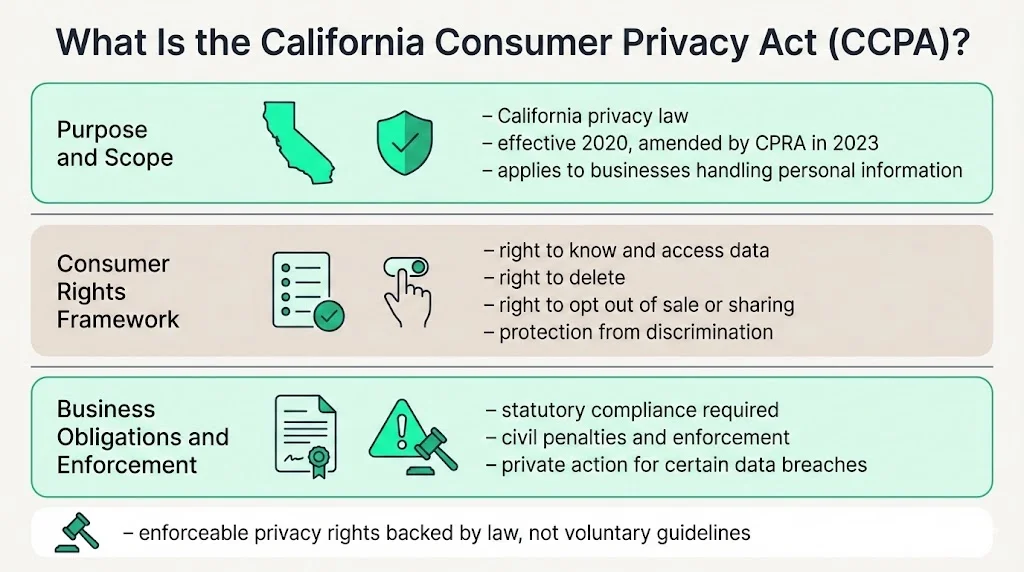
The California Consumer Privacy Act is comprehensive privacy legislation enacted to give California residents meaningful control over their personal information. Originally effective January 1, 2020, and subsequently amended by the California Privacy Rights Act in 2023, the CCPA establishes enforceable rights for consumers and corresponding obligations for businesses that collect, process, or sell personal information.
The law operates on a rights-based framework, granting California residents the ability to know what personal information businesses collect, access their data, request deletion, opt out of sale or sharing, and exercise these rights without facing discriminatory treatment. Unlike self-regulatory approaches or industry-specific frameworks, the CCPA imposes statutory obligations backed by civil penalties and private rights of action in breach scenarios.
Need to stand behind your GDPR posture?
Drop your work email and we'll help you close the gaps before a regulator or customer finds them.
Who Must Comply With the CCPA?
CCPA compliance obligations apply to for-profit entities doing business in California that meet specific thresholds. A business falls under CCPA jurisdiction if it satisfies any one of three criteria: annual gross revenues exceeding $25 million, buying, selling, or sharing personal information of 100,000 or more California consumers or households annually, or deriving 50 percent or more of annual revenue from selling or sharing consumers' personal information.
These thresholds create extraterritorial reach. Enterprise sellers operating outside California frequently trigger compliance obligations through volume of California consumer data processed or revenue thresholds exceeded through national operations. The law applies to personal information of California residents regardless of where data processing occurs, meaning geographic location of servers or corporate headquarters does not determine applicability.
Businesses must also ensure compliance extends through their vendor ecosystem. Service providers and contractors processing personal information on behalf of covered businesses face contractual obligations to maintain CCPA protections, creating cascading compliance requirements throughout data processing chains.
CCPA Consumer Rights and Data Protection Standards
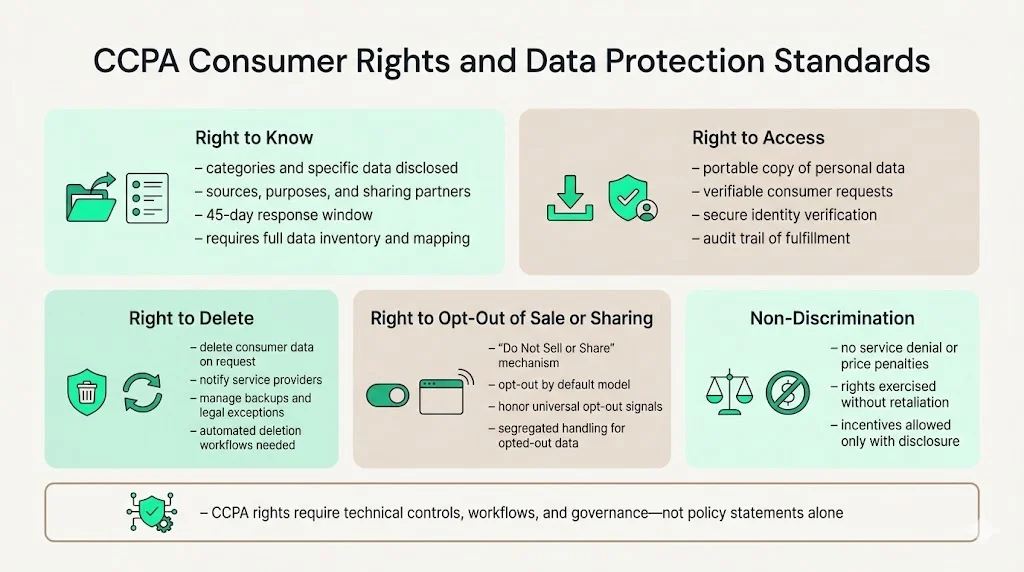
The CCPA establishes five core consumer rights that fundamentally reshape how businesses handle personal information. Each right imposes specific technical and operational requirements.
Right to Know
California consumers can request disclosure of personal information categories collected, specific pieces of personal information held, sources from which information was collected, business purposes for collection, and categories of third parties with whom information is shared. Businesses must provide this information in readily usable formats within 45 days of receiving verifiable consumer requests, with one 45-day extension permitted when reasonably necessary.
Transparency requirements mandate businesses maintain comprehensive data inventories mapping information flows, retention periods, and processing purposes. This operational requirement extends beyond disclosure obligations to inform risk management and incident response capabilities.
Right to Access
Consumers can request access to specific pieces of personal information a business has collected. Businesses must deliver portable copies in formats that allow consumers to transmit information to another entity without hindrance. Access requests require verifiable consumer request protocols—authentication mechanisms confirming requestor identity that balance fraud prevention with accessibility requirements.
Implementation demands technical infrastructure supporting data retrieval across systems, user-friendly delivery mechanisms, and audit trails documenting request fulfillment. Organizations processing personal information across distributed systems or legacy infrastructure face significant technical implementation challenges.
Right to Delete
Consumers can request deletion of personal information collected from them, subject to specific exceptions. Businesses must delete consumer information from their records and direct service providers to delete consumer information from their records. Exceptions exist for completing transactions, detecting security incidents, complying with legal obligations, and other specified purposes.
Deletion requirements create technical complexity around backup systems, data retention policies driven by separate legal requirements, and distinguishing between consumer-provided information and derived or inferred data. Automated deletion workflows integrated with service provider agreements become operational necessities rather than aspirational capabilities.
Right to Opt-Out of Data Sale
The CCPA requires businesses to provide clear mechanisms allowing consumers to opt out of sale or sharing of personal information. Businesses must give consumers notice when using ADMT and allow consumers to opt out of such processing, establishing "Do Not Sell or Share My Personal Information" links prominently on homepages. User consent mechanisms must respect universal opt-out preference signals transmitted by browsers or devices.
Unlike opt-in consent models, the CCPA establishes opt-out as default, allowing businesses to process personal information until consumers affirmatively exercise opt-out rights. This creates ongoing obligations to monitor consumer preferences, honor opt-out requests across processing activities, and maintain segregated data handling for opted-out consumers.
Non-Discrimination
Businesses cannot discriminate against consumers who exercise CCPA rights by denying goods or services, charging different prices, providing different quality levels, or suggesting consumers will receive different treatment. Financial incentive programs tied to data collection remain permissible if properly disclosed and reasonably related to value provided by consumer data, but penalties for exercising rights are prohibited.
These provisions prevent businesses from creating structural barriers to rights exercise through pricing models or service tiers that effectively coerce consumers into surrendering privacy protections.
New Compliance Requirements in 2026
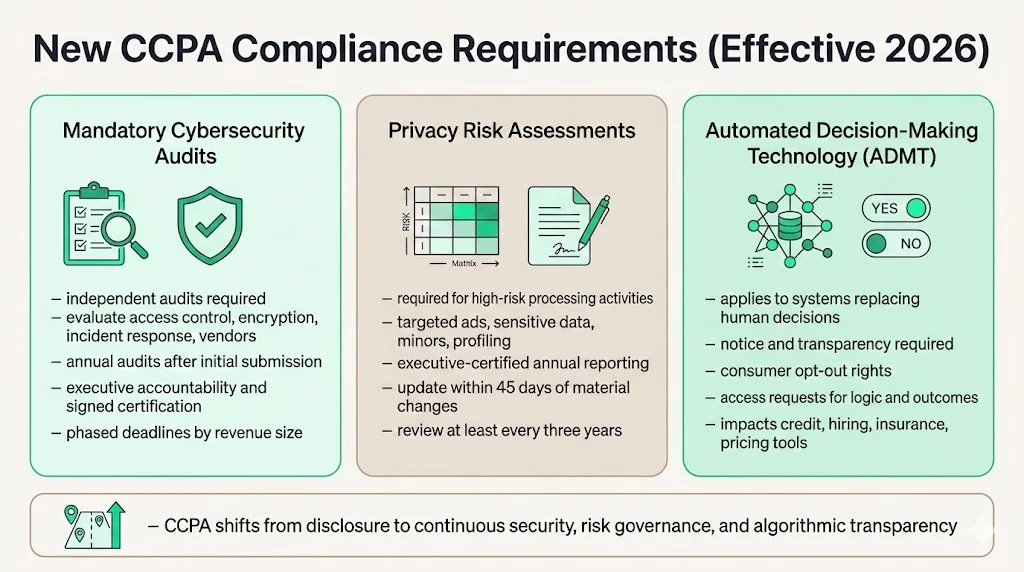
Revisions to the CCPA's existing obligations took effect on January 1, 2026, introducing substantial new operational requirements around cybersecurity audits, risk assessments, and automated decision-making technology. These requirements represent a shift from disclosure-focused compliance toward technical security implementation and algorithmic transparency.
Cybersecurity Audits
The California Privacy Protection Agency approved regulations covering cybersecurity audits, risk assessments, automated decisionmaking technology, insurance companies, and updates to existing CCPA regulations. The duty to conduct audits applies to any business whose processing of personal information presents a "significant risk to consumers' security," including businesses that derive 50% or more of annual revenue from sale or sharing of personal information or process the personal information of more than 250,000 consumers or households.
Under the CCPA regulations, a cybersecurity audit is a comprehensive evaluation of a business's cybersecurity program and its ability to protect personal information from unauthorized access and use. Audits must be conducted by qualified independent professionals—either external auditors or internal auditors who do not report to individuals responsible for cybersecurity program management.
Implementation follows a phased timeline based on annual gross revenue. Businesses making over $100 million must submit certifications to the CPPA by April 1, 2028; businesses making $50-$100 million by April 1, 2029; and businesses making under $50 million by April 1, 2030. Following initial audits, businesses must complete annual audits and submit certifications on recurring 12-month cycles.
The regulations require that audit reports include the title of up to three individuals responsible for the business's cybersecurity program, and the highest-ranking auditor must sign and date a statement certifying that they completed an independent review, exercised objective and impartial judgment, and did not rely primarily on assertions made by company management. This personal accountability requirement imposes executive-level responsibility for audit accuracy and program effectiveness.
The audit must evaluate 18 specified cybersecurity components when applicable to business operations, including inventory and management of personal information, access controls and authentication mechanisms, encryption protocols, vulnerability management, incident response capabilities, and oversight of service providers. Organizations cannot treat this as checkbox compliance—auditors must provide narrative reports with supporting evidence demonstrating control effectiveness.
Privacy Risk Assessments
Businesses subject to risk assessment requirements must begin compliance by January 1, 2026. Risk assessments become mandatory for processing activities that present significant risk to consumer privacy, including use of personal information for targeted advertising, sale or sharing of sensitive personal information, processing personal information of consumers known to be under 16, and profiling presenting foreseeable risk of unfair or deceptive treatment or unlawful disparate impact.
A senior executive must submit an annual certified report to the Agency, outlining the number and types of risk assessments conducted and the categories of personal information involved. Unlike earlier proposed versions, final regulations do not require submission of complete risk assessments but mandate executive certification under penalty of perjury.
Businesses must update risk assessments within 45 calendar days whenever material changes occur to processing activities and review assessments at minimum every three years. Risk assessments conducted for other regulatory purposes may be repurposed if they contain required information or are supplemented to meet CCPA specifications.
This requirement pushes organizations beyond reactive compliance toward proactive risk identification. Effective risk assessments require cross-functional collaboration between legal, security, engineering, and business units to identify processing activities, evaluate privacy impacts, and implement mitigation controls before incidents occur.
Automated Decision-Making Technology Rules
Under the CCPA, ADMT means "any technology that processes personal information and uses computation to replace human decision-making or substantially replace human decision-making". Beginning January 1, 2027, businesses using ADMT for significant decisions affecting consumers must provide specific notice, allow opt-out unless exceptions apply, and respond to access requests regarding ADMT.
Significant decisions include those producing legal or similarly significant effects concerning consumers. Disclosure requirements mandate businesses explain ADMT use in plain language, describe information processed, and identify decision types made using automated systems. Consumers gain rights to opt out of ADMT processing and request information about logic involved in automated decisions affecting them.
These requirements directly impact enterprise use of algorithmic tools for credit decisioning, employment screening, insurance underwriting, and personalized pricing. Organizations must evaluate technology stacks to identify ADMT applications, implement notice and opt-out mechanisms, and establish processes for responding to ADMT-specific access requests.
How CCPA Supports Data Protection and Information Security
CCPA compliance requirements, particularly 2026 cybersecurity audit obligations, drive substantive security improvements beyond performative compliance documentation. The mandatory audit framework compels businesses to implement technical controls that actually protect personal information rather than merely creating audit-ready documentation.
Cybersecurity audit requirements specify evaluation of encryption implementation, multifactor authentication deployment, vulnerability remediation tracking, and incident response procedures. These mandates align with security frameworks including NIST Cybersecurity Framework and ISO 27001 control objectives, creating compliance synergies for organizations pursuing multiple certifications.
User consent governance becomes embedded in operational workflows rather than isolated legal disclaimers. Opt-out preference signal processing, verifiable consumer request authentication, and deletion request propagation through vendor networks require technical implementation across systems. Privacy policy frameworks must reflect actual data handling practices documented through data inventories and risk assessments, creating accountability mechanisms between stated policies and operational reality.
Organizations prepared for breach scenarios benefit from CCPA-driven audit and risk assessment disciplines. Documented security controls, tested incident response procedures, and maintained evidence of control effectiveness enabled faster breach response, more accurate breach impact assessments, and demonstrated reasonable security measures that influence regulatory enforcement decisions and litigation outcomes.
The executive accountability provisions—requiring senior executives to certify audit completion and risk assessment accuracy under penalty of perjury—drive governance improvements throughout organizations. When executives face personal liability for compliance program effectiveness, security initiatives receive budget priority and organizational attention that isolated compliance teams historically struggle to secure.
Comparing CCPA to Other Global Standards
CCPA vs GDPR
The General Data Protection Regulation establishes the European Union's comprehensive data protection framework, creating instructive comparisons with CCPA's California-focused approach. Both laws establish consumer rights, impose processing limitations, and create enforcement mechanisms, but fundamental structural differences shape compliance approaches.
Scope of application differs significantly. GDPR applies to controllers and processors offering goods or services to EU data subjects or monitoring EU data subject behavior, creating global extraterritorial reach. CCPA applies to for-profit entities doing business in California meeting revenue or data volume thresholds, creating narrower but still extraterritorial jurisdiction limited to California residents.
Consent models represent the most consequential operational distinction. GDPR requires affirmative opt-in consent for most processing activities, establishing lawful basis requirements before data collection occurs. CCPA establishes opt-out frameworks allowing businesses to process personal information until consumers exercise opt-out rights. This fundamental difference shapes user experience design, consent management platform requirements, and data processing workflows.
Rights and personal data definitions demonstrate meaningful variation. GDPR grants data portability rights, restricts automated decision-making more broadly, and defines personal data to encompass any information relating to identified or identifiable natural persons. CCPA establishes narrower personal information definitions with broader exceptions for publicly available information and creates more limited portability obligations.
Penalties and enforcement diverge substantially. GDPR authorizes fines up to 4 percent of annual global turnover or €20 million, whichever is greater, for serious infringements. CCPA establishes statutory damages of $2,500 per violation or $7,500 per intentional violation, with private rights of action for data breaches creating $100 to $750 per consumer per incident statutory damages. Enforcement architecture also differs—GDPR creates data protection authorities in each member state with investigation and penalty authority, while CCPA designates the California Attorney General and California Privacy Protection Agency as enforcement bodies.
Organizations operating across jurisdictions frequently implement GDPR-level protections as baseline compliance posture, then address CCPA-specific requirements including cybersecurity audits, risk assessments, and California resident identification protocols. This layered approach creates compliance efficiency while respecting jurisdictional nuances.
Practical Steps for Enterprise Compliance
Enterprise sellers must implement systematic compliance programs integrating legal requirements with operational capabilities and security infrastructure. Effective CCPA compliance requires sustained execution across multiple functional areas.
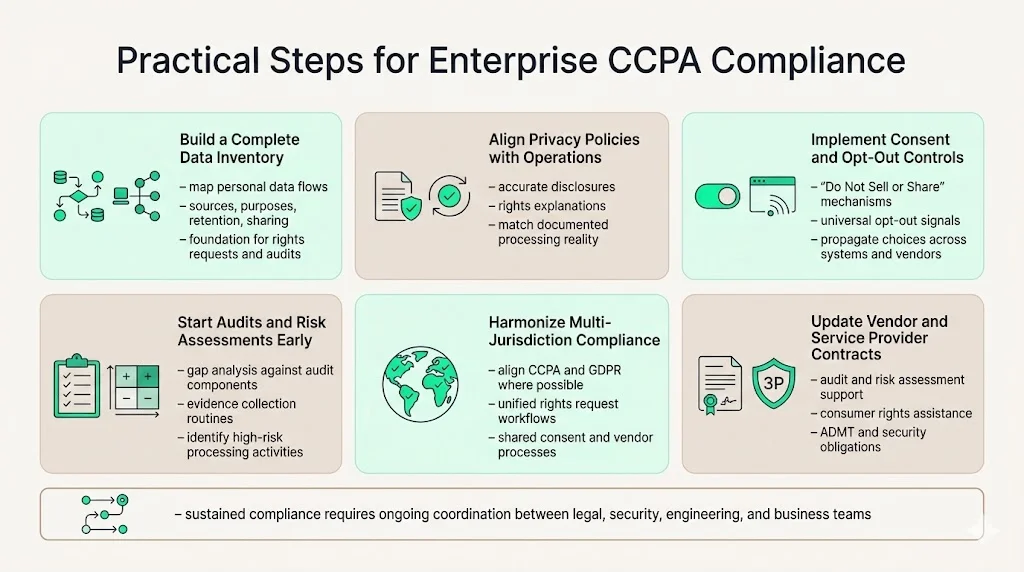
Conduct comprehensive data inventories mapping personal information flows throughout systems. Document what information is collected, from which sources, for what purposes, retention periods applied, third parties receiving information, and technical infrastructure supporting each processing activity. Data mapping provides the foundation for responding to consumer requests, conducting risk assessments, scoping cybersecurity audits, and maintaining accurate privacy disclosures.
Update privacy policy language to reflect CCPA-required disclosures including personal information categories collected, business purposes for collection, categories of sources, third party sharing practices, and consumer rights with instructions for exercising each right. Privacy policies must match operational reality documented through data inventories—discrepancies create enforcement risk and undermine consumer trust.
Establish user consent and opt-out systems supporting "Do Not Sell or Share My Personal Information" mechanisms, universal opt-out preference signal processing, and consent preference management across properties. Technical implementation must propagate consumer choices throughout data processing systems and service provider relationships, requiring integration across marketing automation platforms, analytics tools, advertising networks, and data enrichment vendors.
Build audit and risk assessment routines starting immediately rather than waiting for filing deadlines. Organizations meeting cybersecurity audit thresholds should conduct gap analyses comparing current security postures against the 18 specified audit components, immediately identify deficiencies, and establish evidence collection procedures. Risk assessment requirements demand evaluation frameworks identifying high-risk processing activities, documented risk analysis, and mitigation tracking.
Pilot cross-jurisdiction compliance frameworks harmonizing CCPA and GDPR requirements where operational overlap exists. Unified consent management platforms, standardized data subject rights request fulfillment processes, and consolidated vendor due diligence programs create compliance efficiencies while respecting jurisdictional differences requiring separate handling.
Revise service provider and contractor agreements to incorporate CCPA-specific obligations including assistance with cybersecurity audits, risk assessments, consumer rights requests, and ADMT compliance. Vendor management programs must verify third party compliance capabilities through contractual provisions, audit rights, and periodic assessments.
Risks, Enforcement, and Penalties
Businesses failing CCPA compliance face enforcement actions by the California Attorney General and California Privacy Protection Agency, statutory civil penalties, and private litigation following data breaches. Enforcement trends through 2025 demonstrate increasing regulatory sophistication and willingness to pursue substantive violations beyond technical notice deficiencies.
Civil penalties reach $2,500 per violation or $7,500 per intentional violation, with violations assessed per affected consumer in many enforcement actions. Businesses processing hundreds of thousands of California consumers face potential multimillion-dollar penalty exposure for systemic compliance failures. Private rights of action following data breaches create statutory damages of $100 to $750 per consumer per incident, generating class action litigation risk independent of actual harm demonstrated.
Enforcement priorities increasingly focus on failure to honor consumer rights requests, inadequate data security measures preceding breaches, and misleading privacy disclosures contradicted by actual data practices. The California Privacy Protection Agency has signaled particular interest in cybersecurity audit and risk assessment compliance as these requirements take effect, creating heightened scrutiny for organizations meeting applicability thresholds.
Proactive data protection implementation and transparency reduce legal and brand risk substantially. Organizations demonstrating good faith compliance efforts, documented security programs, and prompt breach notification receive more favorable treatment in enforcement proceedings than organizations with minimal compliance investment discovered through complaints or breaches. Reputational damage from privacy violations increasingly influences customer acquisition costs, enterprise sales cycles, and vendor due diligence outcomes—consequences that often exceed direct regulatory penalties.
Get ready for the CCPA audit and assessment duties
Book a demo and we'll show how Konfirmity keeps your data inventory, consumer request records and privacy risk assessments current, so the newer California obligations do not land as a fire drill.
Book a demo
Conclusion
The California Consumer Privacy Act establishes data protection standards that extend far beyond California's geographic boundaries, imposing operational obligations requiring sustained technical implementation and executive accountability. New obligations introduced in the revised regulations related to automated decisionmaking technology, cybersecurity audits, and risk assessments began taking effect in 2026 and 2027, representing a regulatory evolution from disclosure-focused compliance toward substantive security infrastructure requirements.
Enterprise readiness demands more than legal analysis and policy documentation. Organizations must build technical capabilities supporting consumer rights fulfillment, implement security controls meeting audit requirements, and establish governance frameworks creating executive accountability for compliance program effectiveness. The 2026 cybersecurity audit requirements particularly exemplify this shift—mandating independent evaluation of security controls with executive certification, creating personal accountability that drives organizational prioritization.
The role of governance, security controls, and genuine respect for consumer rights determines long-term business resilience. Organizations treating CCPA compliance as checkbox exercises that satisfy auditors on paper while maintaining unchanged security postures face increasing enforcement risk, breach vulnerability, and reputational damage. Businesses implementing actual security infrastructure producing compliance as a natural outcome position themselves for sustainable operations in an increasingly regulated data environment.
FAQs
The California Consumer Privacy Act is comprehensive privacy legislation granting California residents enforceable rights over their personal information and imposing corresponding obligations on businesses that collect, process, or sell consumer data. The law establishes rights to know, access, delete, opt out of data sale, and receive non-discriminatory treatment for exercising these rights.
Businesses must comply if they operate for profit in California and meet any of three thresholds: annual gross revenues exceeding $25 million, buying, selling, or sharing personal information of 100,000 or more California consumers or households annually, or deriving 50 percent or more of annual revenue from selling or sharing consumer personal information. Geographic location of operations does not eliminate compliance obligations if thresholds are met.
Businesses subject to risk assessment requirements must begin compliance by January 1, 2026, and by April 1, 2028, must submit to the CPPA an attestation that required risk assessments were completed. Cybersecurity audit obligations apply to businesses whose processing presents significant risk to consumer security, requiring comprehensive evaluation of security programs by independent auditors and annual certifications submitted to the California Privacy Protection Agency on phased timelines through 2030.
California residents can request disclosure of personal information collected and processing purposes, access specific pieces of their personal information, request deletion of information collected from them, opt out of sale or sharing of personal information, and exercise rights without discriminatory treatment. Rights extend to automated decision-making technology with disclosure and opt-out provisions for significant decisions affecting consumers.
CCPA establishes opt-out consent models allowing processing until consumers object, while GDPR requires affirmative opt-in consent for most processing activities. CCPA applies narrower geographic scope limited to California residents but with extraterritorial reach for businesses meeting thresholds, while GDPR applies across the European Union with global extraterritorial effect. GDPR authorizes fines up to 4 percent of global annual turnover; CCPA establishes per-violation statutory penalties with private rights of action following breaches. Both frameworks establish consumer rights, processing limitations, and security requirements but differ substantially in consent mechanisms, enforcement architecture, and penalty structures.