Most organizations pursuing enterprise clients discover that risk management operates differently at scale. Enterprise clients have enhanced their awareness and oversight of enterprise risk management, scrutinizing vendor governance practices before contract execution. For technical decision-makers selling into regulated industries or large-scale organizations, demonstrating mature risk-management capabilities determines whether your proposal advances beyond initial review.
The Committee of Sponsoring Organizations of the Treadway Commission (COSO) developed the Enterprise Risk Management framework to provide structured guidance for identifying, assessing, managing, and monitoring organizational risk. This framework addresses how enterprise risk management integrates with internal controls, governance structures, risk assessment processes, strategic decision-making, and the achievement of organizational objectives—precisely the capabilities enterprise clients verify during vendor due diligence.
Enterprise buyers expect vendors to demonstrate systematic risk oversight aligned to business strategy, not reactive crisis management. Organizations lacking documented ERM approaches face immediate disqualification from opportunities requiring SOC 2 attestation, ISO 27001 certification, or regulatory compliance validation. The COSO ERM framework establishes the foundation for these requirements.
What is the COSO Enterprise Risk Management Framework?
The COSO Enterprise Risk Management framework represents industry-standard guidance for implementing systematic risk management across organizational units, business processes, and strategic initiatives. COSO originally established the framework in the mid-1980s for internal controls, published ERM guidance in 2004, and updated it most recently in 2017.
The framework was revised in 2017 to strengthen the emphasis on the integration of ERM with strategy and performance. This evolution reflects a fundamental shift: enterprise risk management operates as a continuous strategic discipline, not an annual compliance exercise. The framework integrates risk management with internal controls and enterprise governance by providing structured methodologies for risk identification, assessment, response, and monitoring aligned to organizational objectives.
The framework applies across industries and organizational scales, though its value intensifies for vendors serving enterprise clients where governance transparency, audit readiness, and risk disclosure directly influence contract terms and customer confidence.
Turning a risk framework into something auditors accept?
Drop your work email and we'll help you build a risk process that produces the evidence on its own.
Why enterprise-level risk management matters for vendors to enterprise clients
Enterprise governance encompasses board-level oversight connecting organizational strategy to risk appetite, tolerance definitions, and performance monitoring. Enterprise clients evaluate vendor governance maturity because third-party failures directly impact their own compliance posture, operational resilience, and regulatory standing.
Robust risk management supports vendor credibility through documented internal controls, transparent risk reporting, and evidence-based decision-making frameworks. Organizations demonstrating mature ERM capabilities secure preferential contract terms, accelerated procurement cycles, and reduced insurance requirements. Conversely, vendors lacking systematic risk management face contract disqualification, extended due diligence periods, punitive audit clauses, and reputational damage when incidents occur.
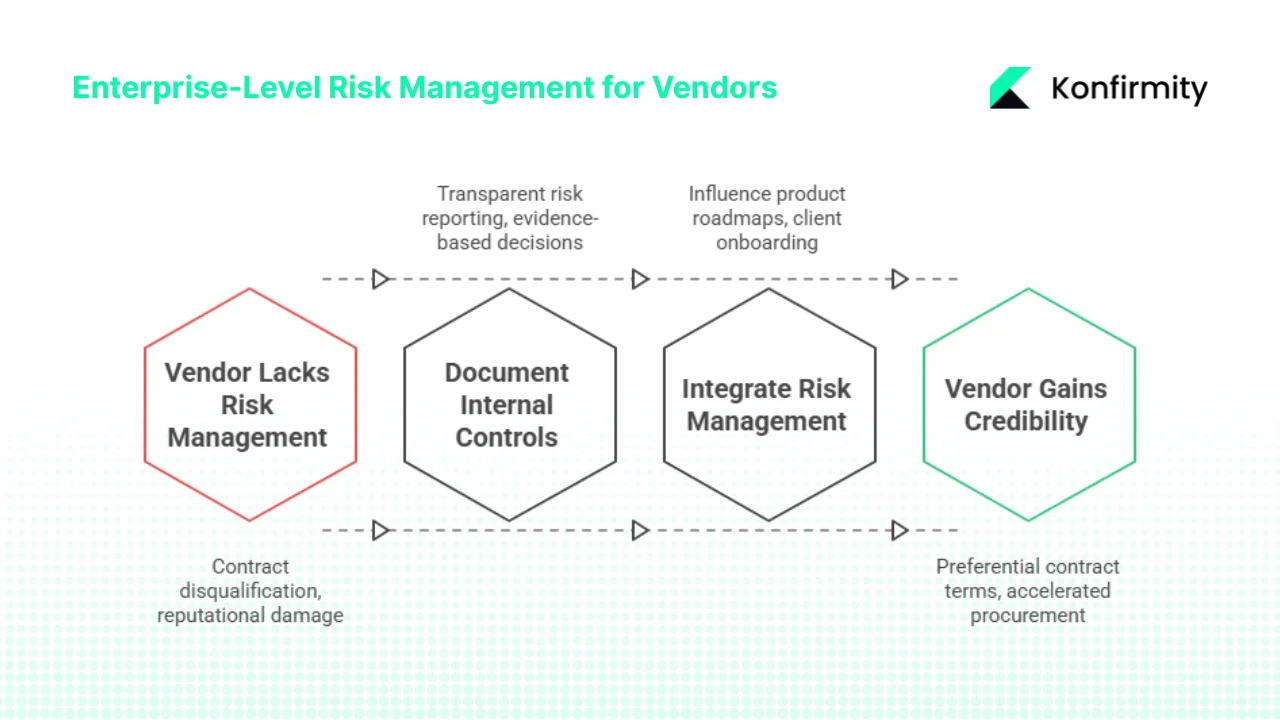
The updated COSO framework highlights the importance of considering risk in both the strategy-setting process and in driving performance. For vendors, this integration means risk management influences product roadmaps, client onboarding processes, service delivery models, and resource allocation—creating alignment between risk response and organizational objectives while satisfying enterprise client governance requirements.
Key components of the COSO ERM Framework
Eight-component version (2004 model)
The COSO ERM framework originally featured eight interrelated components visualized as a three-dimensional cube:
- Internal Environment: Establishes organizational risk appetite, governance philosophy, and ethical culture—the foundation shaping how teams identify and respond to risk across client engagements.
- Objective Setting: Defines strategic, operational, reporting, and compliance objectives before risk assessment begins, ensuring risk tolerance aligns with organizational goals.
- Event Identification: Systematically identifies internal and external events affecting objective achievement, distinguishing between risks requiring mitigation and opportunities informing strategy.
- Risk Assessment: Evaluates identified risks based on likelihood and impact, prioritizing response efforts and resource allocation across enterprise-client contracts.
- Risk Response: Implements one of four approaches—avoid, accept, reduce, or share—based on risk appetite and cost-benefit analysis for each identified risk.
- Control Activities: Deploys policies, procedures, and mechanisms ensuring risk responses execute effectively across vendor operations and client-facing services.
- Information & Communication: Establishes channels for relevant risk information to flow vertically and horizontally, enabling timely decision-making and stakeholder transparency.
- Monitoring: Tracks control effectiveness, risk response performance, and environmental changes requiring framework adjustments through ongoing oversight and periodic evaluation.
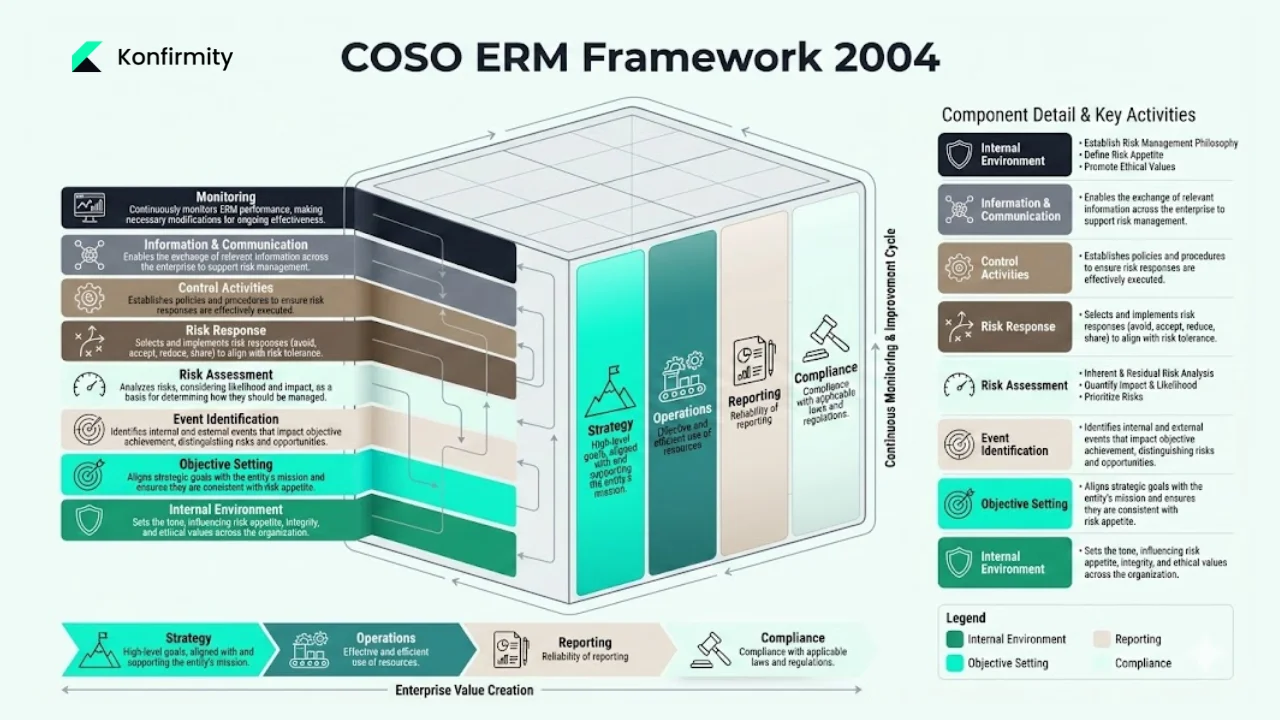
The 2004 model aligned these components across four objective categories: Strategy, Operations, Reporting, and Compliance—the domains enterprise clients scrutinize during vendor assessment.
Five-component version (2017 update)
The 2017 COSO ERM Framework consists of five interrelated components: Governance and Culture; Strategy and Objective-Setting; Performance; Review and Revision; Information, Communication and Reporting.
The framework contains 20 principles spanning these five components:
- Governance & Culture: Establishes board oversight, operating structures, desired behaviors, core values commitment, and human capital development—addressing the "tone at the top" that enterprise clients evaluate during governance reviews.
- Strategy & Objective Setting: Integrates risk considerations into strategy formulation, business context analysis, risk appetite definition, and alternative strategy evaluation before execution.
- Performance: Identifies, assesses, prioritizes, and responds to risks affecting strategy and objective achievement, then develops portfolio views of organizational risk exposure.
- Review & Revision: Evaluates ERM framework performance, assesses organizational change impacts, pursues continuous improvement, and adapts to evolving risk landscapes.
- Information, Communication & Reporting: Leverages information systems, communicates risk information across organizational levels, and reports on culture, capabilities, and performance to internal and external stakeholders.
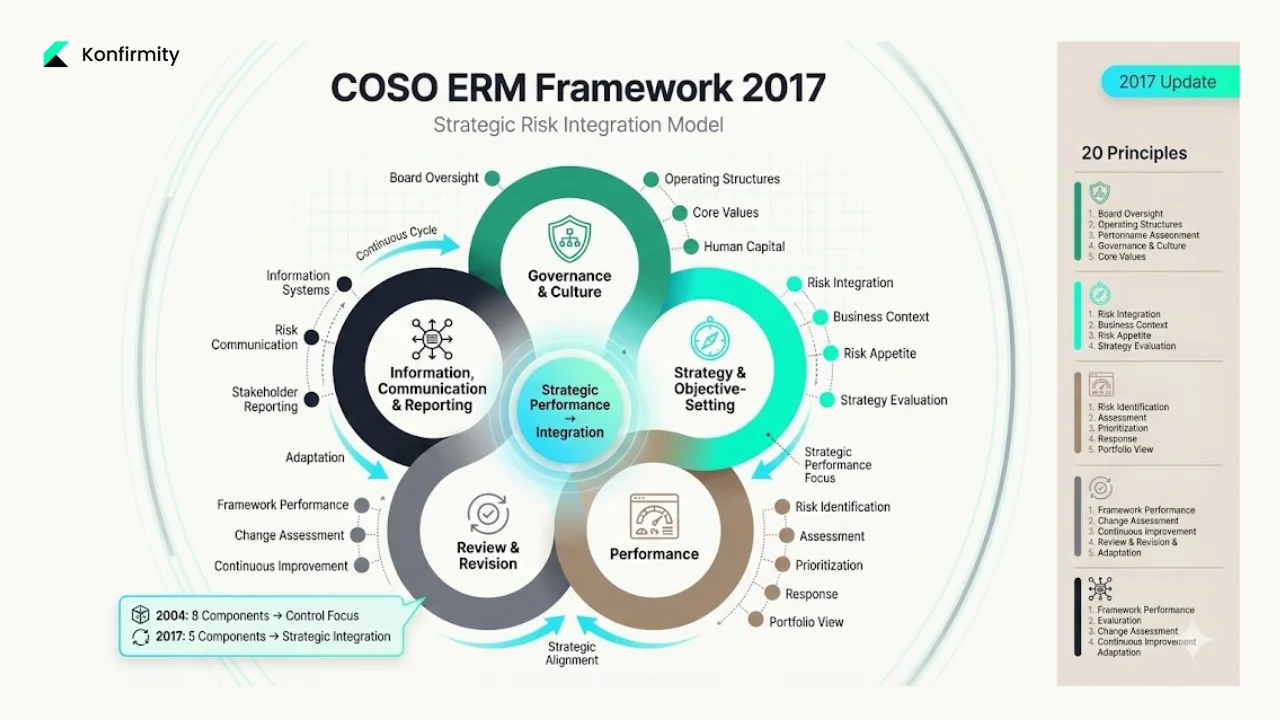
The 2017 update emphasizes linking risk management to strategic performance rather than focusing solely on control mechanics. Vendors serving enterprise clients typically adopt the 2017 model for its strategic integration while maintaining 2004 control-activity rigor for operational risk management.
Linking the framework to internal controls and vendor operations
Internal controls represent the policies, procedures, and mechanisms organizations implement to ensure objectives are achieved, risks are managed, and resources are protected. COSO supplemented the ERM model with guidance in 'Internal Control – Integrated Framework', establishing the relationship between broader risk management and specific control implementation.
Vendors map internal control activities to COSO ERM components by documenting how control processes fulfill framework requirements. For example: A vendor providing enterprise-client services establishes objectives for service availability and data protection (Objective Setting), identifies events such as infrastructure failures or cybersecurity incidents (Event Identification), assesses likelihood and impact using CVSS scoring and business impact analysis (Risk Assessment), implements response strategies including redundancy architecture and incident response procedures (Risk Response), then establishes access controls, change management protocols, and vulnerability management processes (Control Activities) with continuous monitoring through SIEM platforms and security dashboards (Monitoring).
This mapping demonstrates to enterprise clients how systematic risk management produces documented control effectiveness rather than reactive incident handling. Organizations proving this integration during vendor assessments secure contracts requiring SOC 2 Type II attestation, ISO 27001 certification, or HIPAA compliance validation—requirements demanding evidence-based control implementation aligned to risk management frameworks.
Free template pack
Free Download: COSO ERM Risk Assessment Template
A working risk register, a severity and prioritisation matrix, a risk appetite statement worksheet, and a component-by-component maturity check, just enter your work email.
Practical steps for implementing the COSO ERM framework in your business
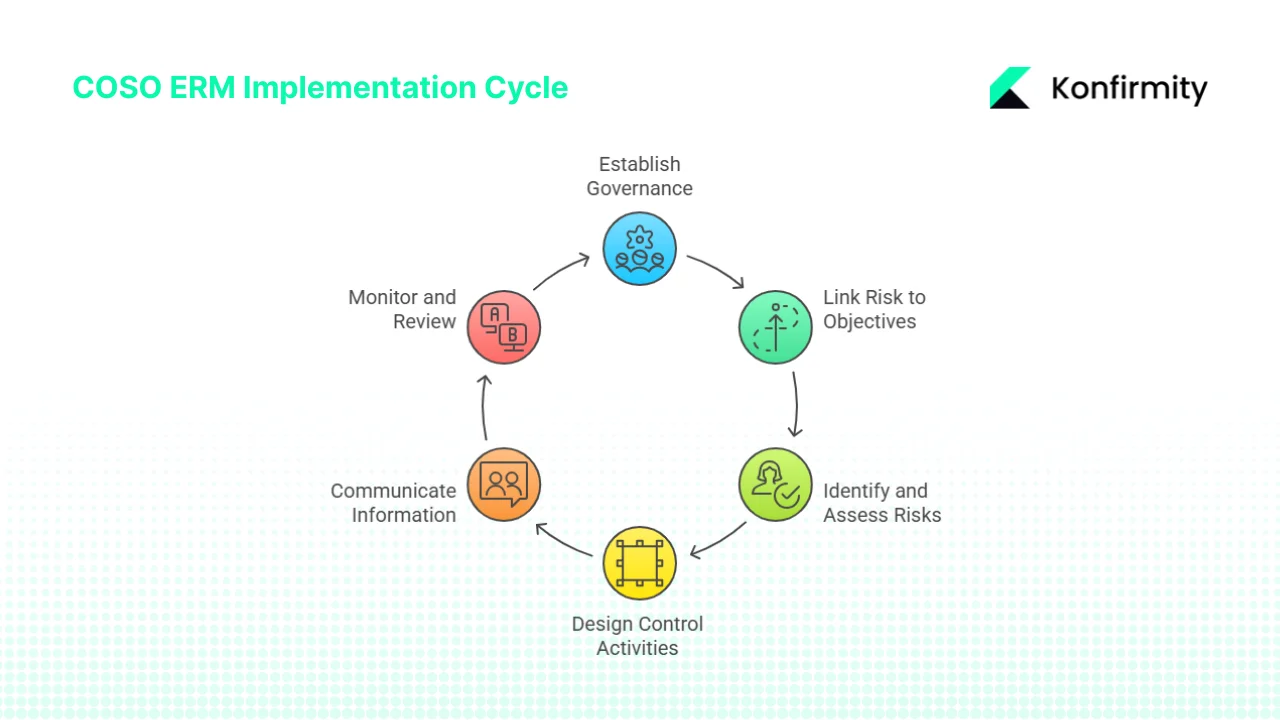
Step 1: Establish governance and tone at the top
Secure board or executive leadership commitment defining organizational risk appetite, tolerance thresholds, and governance accountability. Document oversight responsibilities, escalation protocols, and decision-making authority across risk categories relevant to enterprise-client engagements.
Step 2: Link risk management to organizational objectives
Align risk assessment processes to strategic objectives, operational performance targets, regulatory compliance requirements, and contractual obligations. Enterprise clients evaluate whether vendor risk management supports service delivery commitments and protects client data, intellectual property, and regulatory standing.
Step 3: Identify and assess risks across business operations
Catalog risks spanning strategic direction, operational execution, financial reporting, regulatory compliance, third-party dependencies, technology infrastructure, and client ecosystem integration. Apply likelihood and impact assessments using quantitative methods (financial exposure, probability distributions) and qualitative approaches (risk matrices, expert judgment) appropriate to organizational maturity.
Step 4: Design control activities and risk-response mechanisms
Implement policies and procedures addressing prioritized risks through avoidance (eliminating risk-generating activities), acceptance (acknowledging residual risk within tolerance), reduction (deploying controls decreasing likelihood or impact), or sharing (transferring risk through insurance, contracts, or service providers). Document control design, implementation evidence, and effectiveness metrics satisfying enterprise-client audit requirements.
Step 5: Communicate information and build risk-aware culture
Establish reporting mechanisms flowing risk information vertically to leadership and horizontally across functions. Deploy dashboards tracking key risk indicators, control performance metrics, incident response effectiveness, and compliance status—artifacts enterprise clients request during vendor reviews and contract renewals.
Step 6: Monitor and review risk-management effectiveness
Implement continuous monitoring through automated controls, periodic assessments via internal audit functions, and responsive adjustments addressing environmental changes, client requirements evolution, strategic pivots, and regulatory updates. Enterprise clients expect vendors to demonstrate sustained risk management maturity, not point-in-time compliance snapshots.
Companies selling to enterprise clients must incorporate third-party risk management, contract performance risk, regulatory change impact, and client ecosystem dependencies into risk inventories. Maintain maturity-scale assessments and executive dashboards satisfying client due diligence requirements and supporting audit readiness for SOC 2, ISO 27001, and framework-specific certifications.
Organizations treating risk management as separate from strategy and operational decision-making create fundamental gaps that surface during enterprise-client audits, incident investigations, or contract disputes—gaps that terminate relationships and damage market reputation.
How this framework supports decision-making and achieving organisational objectives
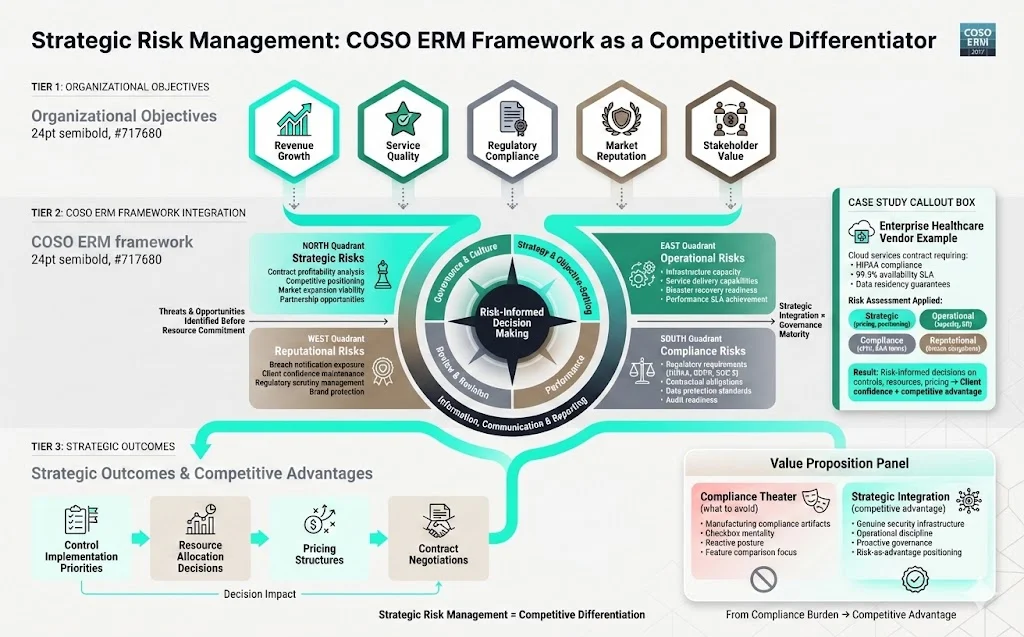
Organizational objectives encompass revenue growth, service quality standards, regulatory compliance maintenance, market reputation protection, and stakeholder value creation. Risk management safeguards these objectives by identifying threats to achievement and opportunities enhancing performance before resource commitments occur.
The COSO framework highlights the importance of considering risk in both the strategy-setting process and provides greater insight into the value of ERM when setting and carrying out strategy. For enterprise-client vendors, demonstrating this strategic integration differentiates organizations that manufacture compliance artifacts from those implementing genuine security infrastructure producing compliance as operational outcomes.
Consider a vendor evaluating a cloud-services contract with an enterprise healthcare client requiring HIPAA compliance, 99.9% availability SLAs, and data residency guarantees. Applying the COSO ERM framework: The vendor assesses strategic risks (contract profitability, competitive positioning), operational risks (infrastructure capacity, disaster recovery capabilities), compliance risks (ePHI safeguards, business associate agreement terms), and reputational risks (breach notification obligations, regulatory scrutiny). This assessment informs control implementation priorities, resource allocation decisions, pricing structures, and contract negotiations—linking risk management to strategic objectives while building client confidence in vendor governance maturity.
Organizations proving this linkage during enterprise sales cycles demonstrate operational discipline beyond feature comparisons, positioning risk management capabilities as competitive advantages rather than compliance burdens.
Monitoring, information & communication, making the framework operational
Effective risk management requires timely, relevant information flowing between organizational levels and across functional boundaries. Both the eight-component and five-component COSO models emphasize information systems, communication protocols, and monitoring mechanisms transforming framework theory into operational practice.
Deploy metrics tracking key risk indicators (KRIs), control performance measures, risk-response effectiveness, and escalation-trigger events. Establish executive dashboards visualizing risk portfolios, compliance status, incident trends, and audit findings—artifacts enterprise clients review during vendor assessments and contract renewals.
Monitoring extends beyond periodic audits to continuous oversight through automated controls, real-time alerting, feedback loops, and adaptive responses. Organizations implementing SIEM platforms, vulnerability management systems, compliance monitoring tools, and GRC platforms operationalize COSO framework monitoring components while generating evidence satisfying enterprise-client audit requirements.
Enterprise clients expect regular risk reporting including control effectiveness attestations, change event notifications, incident disclosures, and remediation progress updates. Vendors lacking structured monitoring and communication processes face contract breaches when undisclosed incidents surface through client-side discovery or regulatory investigation.
Benefits and challenges of applying the COSO ERM framework
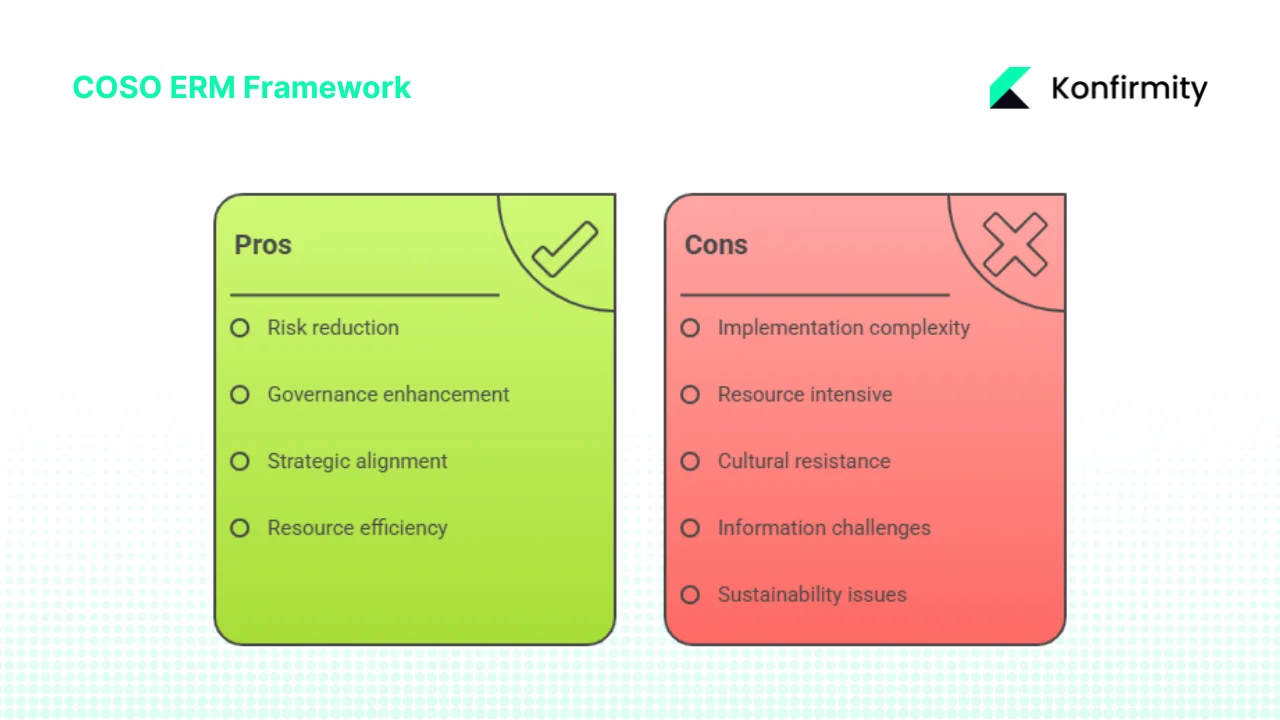
Benefits
Systematic risk identification and management across organizational units reduces operational surprises, financial losses, and reputational damage. Organizations implementing the COSO framework document risk inventories, assessment methodologies, and response strategies satisfying enterprise-client governance requirements and audit standards.
The framework supports governance transparency and internal control effectiveness, enhancing enterprise-client trust during procurement, ongoing relationship management, and contract renewals. Risk management integrated with strategic objectives improves decision-making by quantifying trade-offs, clarifying resource priorities, and aligning investments to organizational goals.
Enterprise risk portfolios enable resource allocation based on risk-adjusted returns rather than functional budgets, improving capital efficiency and performance outcomes.
Challenges
Implementation complexity increases across diverse business units, geographic locations, and functional specializations. Organizations require dedicated resources, executive sponsorship, and multi-year roadmaps achieving framework maturity—investments smaller vendors struggle to justify despite enterprise-client expectations.
Cultural transformation from siloed functional risk handling to enterprise-wide integrated risk thinking encounters resistance from teams perceiving additional bureaucracy without recognizing strategic value. Securing quality risk information and ensuring effective communication across organizational boundaries demands process redesign, technology investment, and behavioral change.
Sustaining framework effectiveness over time requires ongoing discipline, periodic reassessment, and responsive adaptation as business strategies evolve, client requirements change, and risk landscapes shift. Organizations treating ERM implementation as projects with defined end dates inevitably experience framework degradation and control gaps.
Smaller vendors must scale framework implementation appropriately, avoiding "over-engineering" that consumes resources without delivering proportional value. Focus initial efforts on high-risk client contracts, critical business processes, and regulatory compliance domains before expanding enterprise-wide.
Vendor checklist, are you ready for enterprise-client risk expectations?
Evaluate organizational readiness across COSO ERM framework components:
✅ Governance: Board or executive leadership provides risk oversight, defines risk appetite, establishes accountability for risk management across business units and client engagements.
✅ Objectives: Business objectives are documented, measurable, and aligned to enterprise-client segment requirements for service quality, compliance, security, and operational resilience.
✅ Risk inventory: Major risks spanning strategic direction, operational execution, regulatory compliance, third-party dependencies, cybersecurity threats, and client ecosystem integration are cataloged and prioritized.
✅ Risk assessment: Likelihood and impact evaluations using quantitative methods (financial exposure, probability analysis) or qualitative approaches (risk matrices, CVSS scoring) are documented and current.
✅ Control activities: Policies, procedures, and technical controls addressing prioritized risks are documented, implemented, and tested with evidence satisfying audit requirements.
✅ Information & communication: Risk reports flow to leadership, operational teams receive relevant risk guidance, clients receive contractually required notifications, and dashboards track performance metrics.
✅ Monitoring: Review processes including internal audit functions, executive oversight, compliance assessments, and KPI tracking are established with defined frequencies and escalation protocols.
✅ Linkage: Risk-management activities demonstrably connect to business strategy, inform decision-making, guide resource allocation, and support client-service delivery commitments.
Map each capability to corresponding COSO framework components. Establish phased implementation beginning with high-risk client contracts, piloting processes within single business units, then expanding enterprise-wide as maturity increases and value demonstrates.
Organizations achieving 75-85% checklist completion position themselves competitively for enterprise contracts requiring governance transparency, compliance attestations, and operational resilience validation.
Conclusion
The COSO Enterprise Risk Management framework provides structured guidance for organizations selling to enterprise clients where risk management, governance transparency, and control effectiveness directly influence contract awards, pricing terms, and relationship sustainability. Risk management extends beyond loss avoidance to support organizational objective achievement, improve strategic decision-making, strengthen governance practices, and enhance internal control effectiveness.
Organizations demonstrating COSO framework adoption during enterprise sales cycles differentiate themselves through documented risk maturity rather than feature comparisons alone. This differentiation accelerates procurement, reduces audit friction, improves contract terms, and builds long-term client confidence.
Implement or review the framework systematically: establish governance, link risk to strategy, make risk management visible through metrics and reporting, and sustain effectiveness through continuous monitoring and adaptation. Enterprise clients increasingly require vendors to demonstrate recognized ERM frameworks as prerequisites for contract consideration—organizations lacking this foundation face immediate disqualification regardless of technical capabilities.
Being able to articulate how your organization applies the COSO ERM framework transforms risk management from compliance burden to competitive advantage, building trust with enterprise clients who depend on vendor governance maturity to protect their own regulatory standing and operational performance.
FAQs
Q1. What is the COSO framework for Enterprise Risk Management?
The COSO ERM framework is guidance developed by the Committee of Sponsoring Organizations of the Treadway Commission providing a structured approach for organizations to identify, assess, manage and monitor risks in pursuit of their objectives. Originally issued in 2004, the framework was revised in 2017 to integrate risk management with corporate governance, strategy setting, performance management, and internal controls.
Q2. What are the 5 components of COSO?
The five-component version of the latest COSO ERM framework (2017) includes: Governance and Culture; Strategy and Objective-Setting; Performance; Review and Revision; Information, Communication and Reporting. The earlier COSO Internal Control – Integrated Framework uses five different components: Control Environment, Risk Assessment, Control Activities, Information and Communication, and Monitoring.
Q3. What are the 8 components of the COSO ERM framework?
The 2004 version of the COSO ERM framework features eight interrelated components: Internal Environment, Objective Setting, Event Identification, Risk Assessment, Risk Response, Control Activities, Information & Communication, and Monitoring. These components were visualized as a three-dimensional cube representing their integration across organizational units and objective categories.
Q4. What are the 5 components of ERM?
Referring to the COSO ERM 2017 update, the five components are Governance & Culture, Strategy & Objective Setting, Performance, Review & Revision, and Information, Communication & Reporting. These components encompass risk identification, assessment, response, monitoring, and communication integrated with strategic planning and performance management throughout organizational operations.