Most organizations treat due diligence questionnaires as procurement paperwork. This approach fundamentally misunderstands what a DDQ represents—a structured risk-assessment instrument that determines whether vendor relationships expose enterprise clients to data-protection failures, compliance violations, or operational disruptions. For companies selling to large enterprises, the ability to respond comprehensively to a DDQ has become a market differentiator, separating vendors with mature security infrastructure from those manufacturing compliance on paper.
Over 60% of data breaches now involve third parties, making vendor assessment a critical component of enterprise risk management. A Ponemon Institute study found that 66% of organizations experienced a data breach due to vendor security failures, yet most lack structured processes for evaluating third-party controls before contract execution. The DDQ addresses this gap by standardizing vendor evaluation across security, compliance, financial stability, and operational resilience criteria.
What is a DDQ?
A due diligence questionnaire, or DDQ, is a list of relevant questions to ask potential parties you're considering doing business or partnering with, providing key information to help determine whether the company upholds regulatory, security-based, or other important standards. Unlike security questionnaires that focus narrowly on technical controls, DDQs encompass operational structure, financial viability, regulatory compliance posture, and data-protection practices across the vendor's entire environment.
Core components typically include financial records and stability indicators, legal and regulatory compliance status, data security and privacy controls, operational procedures and business continuity planning, third-party relationships and subprocessor arrangements, and contractual obligations including audit rights and breach notification protocols.
Why enterprises ask DDQs of vendors and suppliers
An estimated 60% of security incidents arise from vendors and third parties, and DDQs help companies mitigate these risks by enabling a comprehensive third-party risk assessment before the business relationship begins. Enterprises recognize that outsourcing functions to vendors effectively outsources risk—but not compliance responsibility. Regulatory frameworks including GDPR, HIPAA, SOC 2, and ISO 27001 explicitly require organizations to maintain oversight of third-party data handling and security practices.
The DDQ provides standardization and comparison efficiency. When evaluating multiple vendors for the same function, enterprises use DDQs to compare responses against identical criteria, creating an objective basis for risk-based decision-making. This standardization also reduces the administrative burden on both parties compared to customized question sets for each vendor evaluation.
Variants and contexts of DDQ
DDQs serve different purposes depending on transaction context. In vendor assessment scenarios, enterprise clients evaluate a supplier's security posture, data-handling practices, and operational controls before contract execution. Transactional DDQs support mergers, acquisitions, and investment decisions, where buyers conduct comprehensive due diligence on target businesses before closing transactions.
In asset management, AIMA's DDQs assist investors in assessing fund investments and fund managers in their choice of service providers. These questionnaires have become the industry-standard template for institutional investors evaluating hedge funds, private equity managers, and alternative investment vehicles.
Need to stand behind your GDPR posture?
Drop your work email and we'll help you close the gaps before a regulator or customer finds them.
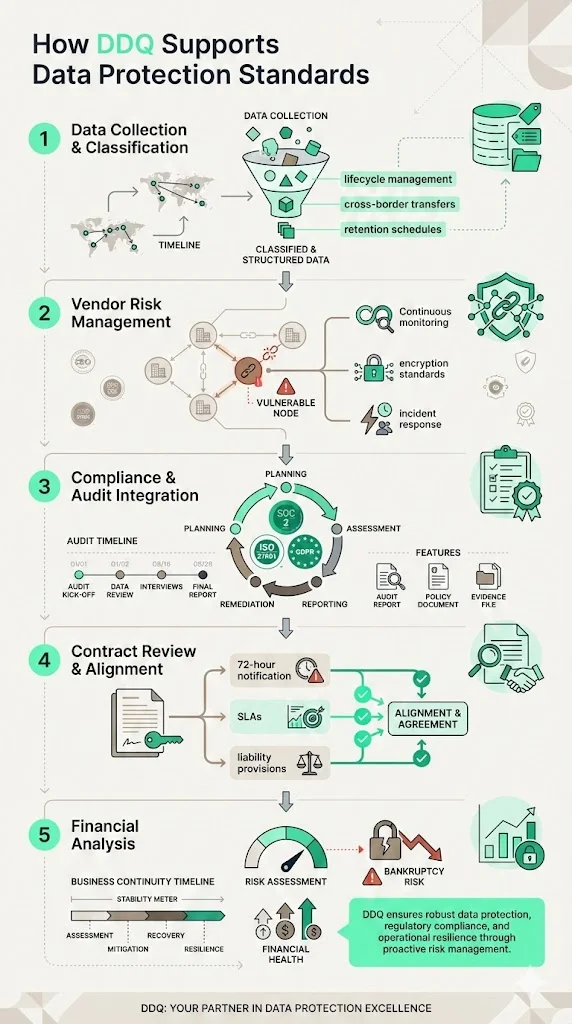
How DDQ Supports Data Protection Standards
1) Data collection and classification questions
DDQs typically include detailed questions about how vendors collect, classify, store, process, and delete data throughout its lifecycle. Without understanding a vendor's data-collection practices and classification schemes, enterprises cannot properly assess whether appropriate protection controls are applied to sensitive information. Questions address data-flow mapping, cross-border transfer mechanisms, retention schedules, and deletion procedures—all fundamental to demonstrating compliance with data-protection regulations.
2) Vendor risk management and supplier evaluation
Continuous monitoring is a cornerstone of effective VRM programs, especially for large enterprises with thousands of vendors, including reviewing vendors' security posture and performance to ensure compliance with established standards and contractual obligations, as one compromised vendor in highly regulated industries like healthcare and finance could potentially affect the entire supply chain network. The DDQ establishes the baseline for this ongoing assessment by capturing encryption standards, access-control implementations, disaster-recovery capabilities, vulnerability-management processes, and incident-response procedures.
For vendors selling to enterprises, completing a DDQ with substantive, evidence-backed responses demonstrates operational maturity and reduces procurement friction. Generic assertions like "we comply with GDPR" carry minimal weight. Enterprises expect specifics: encryption algorithms and key-management procedures, documented data-flow maps showing processing activities, third-party audit reports from independent assessors, penetration-test results and vulnerability remediation timelines, and data-processing agreements with clearly defined responsibilities.
3) Compliance and audit process integration
DDQs are critical for verifying that third parties follow industry regulations like SOC 2, ISO 27001, or GDPR, reducing the risk of data breaches or compliance violations. Enterprises often tie vendor contracts to compliance standards and audit rights, using DDQ responses to determine required contractual protections.
The audit process component includes questions about whether the vendor permits on-site audits or facility inspections, shares Type II SOC 2 reports or ISO 27001 certifications, maintains comprehensive audit logs for data access and modifications, and conducts regular internal audits and third-party assessments. Vendors demonstrating continuous audit readiness position themselves as lower-risk partners compared to those unable to produce current compliance documentation.
4) Contract review and alignment
Many DDQs include sections addressing contract terms, liability limitations, data-protection responsibilities, right-to-audit provisions, and breach-notification obligations. These responses directly inform contract negotiations. If a vendor's DDQ reveals inadequate data-protection practices, the enterprise may require strengthened service-level agreements, enhanced indemnification provisions, or additional security controls as contract conditions.
The contract-review process examines whether data-processing agreements meet regulatory requirements, breach-notification timelines comply with applicable laws (GDPR requires notification within 72 hours), liability caps adequately protect the enterprise from vendor failures, and termination provisions address data return and deletion upon contract end.
5) Financial analysis and viability
Vendor financial stability represents a frequently overlooked data-protection consideration. If a vendor experiences financial distress or bankruptcy, the enterprise client's data may be compromised, operations disrupted, or information improperly transferred to third parties during asset liquidation. DDQs addressing financial health, business continuity planning, and succession procedures help enterprises assess these operational risks.
Practical Steps for Vendors to Prepare for DDQs
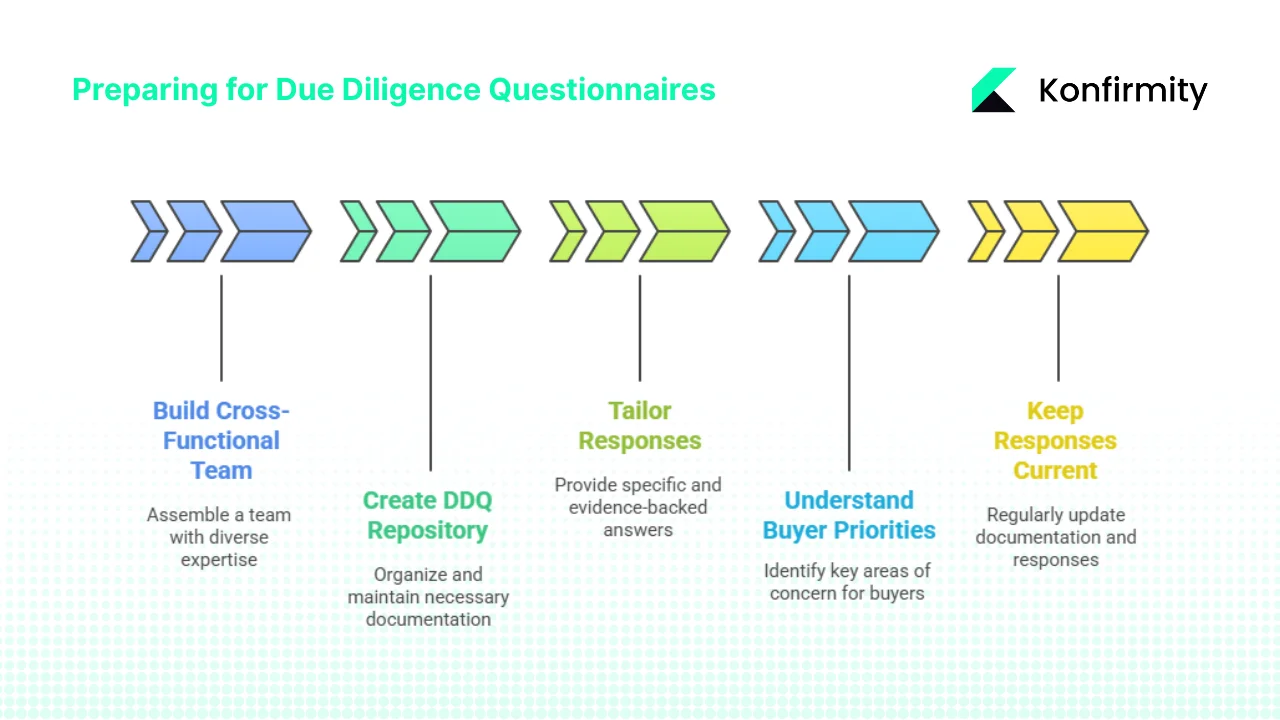
1) Build an internal cross-functional team
DDQs span legal, information security, finance, and operations domains. Assign clear responsibilities: a data-protection lead for security and privacy questions, a finance lead for financial-stability inquiries, a compliance lead for regulatory and audit questions, and an operations lead for business-continuity and process questions. This cross-functional structure ensures responses receive proper technical review before submission.
2) Create a living DDQ-ready repository
Maintain current documentation including information security policies and procedures, SOC 2 Type II reports or ISO 27001 certifications, data-classification schemes and data-flow maps, business-continuity and disaster-recovery plans, vendor and subprocessor assessment records, and penetration-test results and vulnerability-scan reports. This repository enables rapid response when enterprise clients issue DDQs, reducing sales-cycle friction.
3) Tailor responses with substance and evidence
Generic compliance assertions lack credibility with enterprise buyers. Reference specific controls: data encryption using AES-256 at rest and TLS 1.3 in transit, documented data-flow mapping showing all processing activities, third-party penetration tests conducted quarterly with findings remediated within defined SLAs, and vendor risk-assessment program covering all subprocessors. Evidence-backed responses demonstrate genuine security maturity rather than performative compliance.
4) Understand what enterprise buyers prioritize
Data-protection controls and encryption standards, access-control implementations and privilege management, vendor risk-management programs and subprocessor oversight, contractual audit rights and breach-notification procedures, and business-continuity planning and disaster-recovery capabilities consistently rank as enterprise-client priorities. Understanding their risk-management frameworks allows vendors to align responses with buyer expectations, accelerating procurement cycles.
5) Keep DDQ responses current
Data-protection regulations, security threats, and vendor landscapes evolve continuously. An outdated response may surface during audit or contract review, creating trust issues. Periodically review and update the repository—quarterly for security documentation, annually for policies and certifications, and immediately following material changes to infrastructure, subprocessors, or compliance status.
Common Pitfalls and How to Avoid Them
- Incomplete or inconsistent responses across sections signal organizational dysfunction. When legal responses contradict IT responses regarding data-retention practices, enterprise buyers question vendor reliability. Establish internal review processes ensuring cross-functional alignment before DDQ submission.
- Lack of documented evidence or outdated documents undermines credibility. Referencing a SOC 2 report from three years ago or citing policies no longer in effect raises immediate concerns. Maintain current documentation and proactively disclose when requested materials are pending renewal.
- Generic responses fail to satisfy enterprise requirements. Stating "we follow industry best practices" without specificity provides no assurance. Enterprise clients expect detailed control descriptions demonstrating actual implementation.
- Under-estimating time requirements creates rushed, incomplete responses. Comprehensive DDQs may contain 150-200 questions spanning multiple domains. Allocate sufficient time for proper response development, internal review, and evidence gathering before the deadline.
- Failing to align DDQ responses with contract terms creates downstream issues. If DDQ responses promise quarterly penetration testing but contracts contain no such obligation, enterprises will require contract amendments or reject the vendor entirely.
The Business Case for Vendors: How Being DDQ-Ready Drives Sales
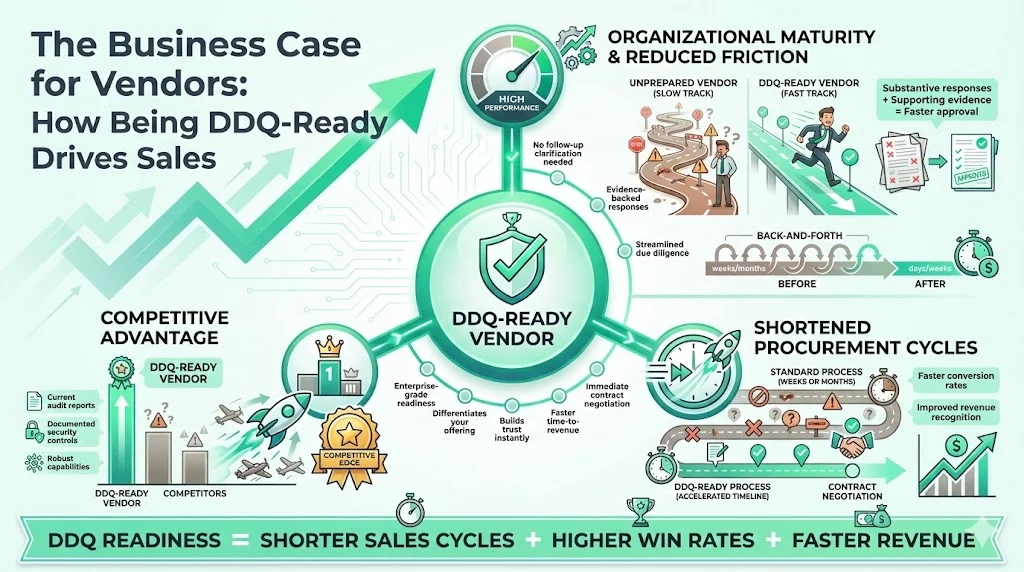
Responding quickly and comprehensively to enterprise DDQs demonstrates organizational maturity and reduces procurement friction. Enterprises evaluating multiple vendors favor those able to provide substantive responses with supporting evidence over those requiring extensive follow-up clarification.
Addressing data-protection standards thoroughly shows readiness for enterprise-grade data handling. When competitors struggle to produce current audit reports or document their security controls, vendors with robust DDQ-response capabilities gain significant competitive advantage.
This preparation shortens procurement cycles. Enterprises cannot proceed to contract negotiation until DDQ review concludes satisfactorily. Vendors requiring multiple response iterations or unable to provide requested documentation extend sales cycles by weeks or months. DDQ readiness accelerates these timelines, improving conversion rates and revenue recognition.
FAQs
1) What does DDQ mean?
DDQ stands for Due Diligence Questionnaire—a structured set of questions evaluating a company's operations, compliance posture, financial stability, and risk-management practices. Enterprises use DDQs to assess vendors before establishing business relationships or during ongoing vendor management.
2) What is a DDQ in private equity?
In private equity, DDQs are tools for evaluating investment strength, with corporations and individual investors creating questionnaires exploring critical investment criteria like supplier information, leadership and board backgrounds, and competitive analyses. Institutional investors issue DDQs to funds they might invest in, evaluating operations, risk management, governance, and compliance before capital commitment.
3) What is the difference between DDQ and RFP?
A Request for Proposal (RFP) solicits vendor proposals for delivering specific services or solutions, including pricing, scope, and deliverables. A DDQ gathers information about vendor practices, controls, financials, compliance posture, and risk profile. RFP asks "what will you do and at what cost?" while DDQ asks "who are you, how do you operate, and what risks do you pose?"
4) What is DDQ in asset management?
In asset management, AIMA's DDQs assist investors in assessing fund investments and fund managers in their choice of service providers, directors, and boards. Asset managers receive DDQs from investors covering investment strategy, risk management, governance, operations, data protection, and manager due diligence.