The Defense Innovation Unit (DIU) is a U.S. Department of Defense organization founded in 2015 to help the military make faster use of emerging commercial technologies. Then-Secretary of Defense Ash Carter established DIU to address a fundamental problem: traditional defense procurement cycles were too slow to keep pace with rapid commercial technology innovation. While adversaries accelerated their technological capabilities, the Pentagon's research and acquisition processes remained trapped in decade-long timelines—creating a strategic vulnerability that threatened national security.
DIU matters more today than ever. Global strategic competition increasingly hinges on technological superiority in artificial intelligence, autonomous systems, cybersecurity, and space capabilities. The Department of Defense aims to keep pace with foreign adversaries by quickly adopting commercial technologies, yet DOD leaders expressed concern that it is not doing so at the speed and scale needed. The accelerating pace of military technology development—particularly in areas like AI/ML, cyber operations, and unmanned systems—demands an acquisition approach fundamentally different from legacy defense procurement.
For enterprise technology companies—particularly those developing cybersecurity platforms, AI solutions, autonomous systems, or dual-use technologies—DIU represents a unique channel to the defense market. Unlike traditional defense contracting, which requires extensive prior military experience and tolerance for multi-year procurement cycles, DIU provides a pathway for commercial firms to contribute solutions without legacy defense-industry credentials. This creates opportunities for companies already selling enterprise solutions to extend their capabilities into the defense sector, gain credibility through national security validation, and access large-scale production contracts.
What is the Defense Innovation Unit (DIU)?
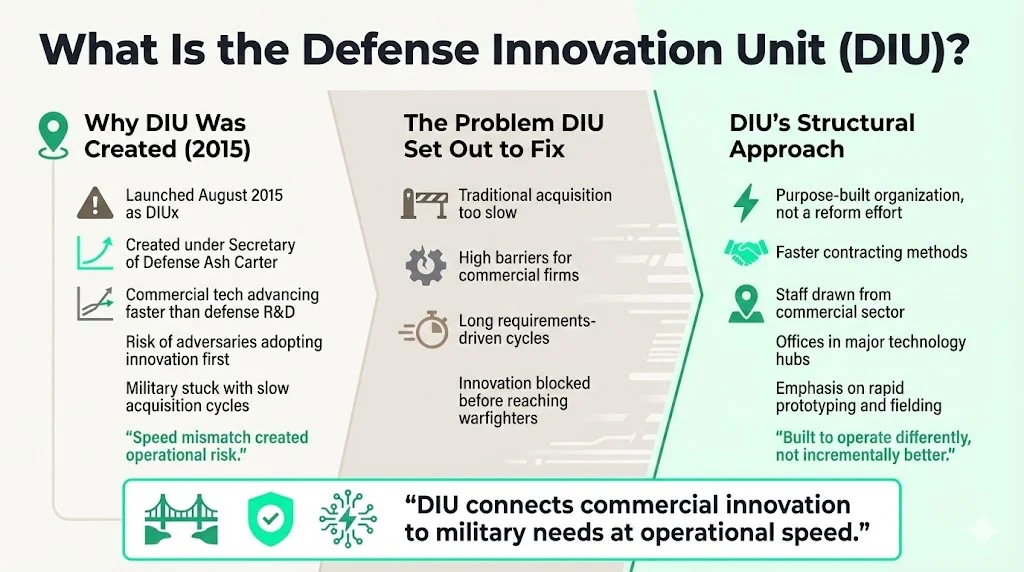
DIU was launched in August 2015 as "Defense Innovation Unit Experimental (DIUx)" by then-Secretary of Defense Ash Carter. Carter's rationale was straightforward: commercial technology companies—especially in Silicon Valley—were advancing capabilities in AI, autonomy, cybersecurity, and data analytics at speeds far exceeding Pentagon research laboratories and traditional defense contractors. Yet the military's acquisition bureaucracy created insurmountable barriers preventing these innovations from reaching warfighters. The result: adversaries could potentially out-innovate the U.S. military by leveraging the same commercial technologies while American forces remained locked into slower, legacy systems.
DIU represented a structural intervention—not merely process improvement. Rather than attempting to reform the entire defense acquisition system, Carter created an organization specifically designed to operate differently: faster contracting mechanisms, commercial-sector staffing, physical presence in technology hubs, and focus on rapid prototyping rather than requirements-driven development.
DIU's Mission and Core Goals
DIU's mission is to accelerate DoD adoption of commercial technology, transform military capacity and capability, and strengthen the American national security innovation base. The organization serves as a bridge between the commercial technology industry and defense establishment—enabling access to innovations that lack traditional defense origins but possess significant military applicability.
DIU pursues innovative solutions and works closely with DoD partners and companies to deliver results and support technology adoption in 12-24 months. This timeframe contrasts sharply with traditional defense research and development, which typically spans 5-10 years from concept to deployment. DIU's focus emphasizes speed and scalability: rapid prototyping to validate commercial solutions, followed by transition to production at scale when successful.
The strategic intent: position the U.S. military to leverage commercial innovation cycles rather than compete with them through parallel, slower government-funded development programs.
Working toward a federal compliance baseline?
Drop your work email and we'll help you map controls to NIST and prove them with real evidence.
How DIU Works: Structure, Portfolios, and Processes
Organizational Setup & Presence
DIU is headquartered in Mountain View, California – Silicon Valley – with offices in Austin, Boston, Chicago, and the Pentagon just outside Washington, D.C. This geographic distribution positions DIU directly within major technology ecosystems, enabling proximity to commercial innovators, venture capital networks, and startup communities. The Mountain View headquarters places DIU at the center of the world's most concentrated technology talent and innovation hub—a deliberate choice signaling the organization's commercial orientation.
DIU is staffed by civilians and both active duty and reserve military personnel. This hybrid staffing model blends commercial-sector expertise—individuals who understand technology development, venture funding, and startup culture—with military operational knowledge. The combination enables DIU to translate warfighter requirements into commercial-sector language while simultaneously ensuring proposed solutions address genuine military needs rather than theoretical capabilities.
Technology Portfolios & Focus Areas
DIU operates six portfolios dedicated to solving national security demand in AI/ML (artificial intelligence/machine learning), Autonomy, Cyber, Human Systems, Energy, and Space. This structure reflects current and emerging defense priorities, aligning investment areas with technologies fundamental to military modernization and strategic competition.
The AI/ML portfolio addresses applications ranging from predictive maintenance and logistics optimization to intelligence analysis and autonomous system decision-making. The Autonomy portfolio encompasses unmanned aerial systems, ground robots, maritime platforms, and swarm technologies. Cyber focuses on defensive capabilities, threat detection, and resilience of military networks and systems. Human Systems explores soldier augmentation, training technologies, and human-machine interfaces. Energy addresses battlefield power generation, energy storage, and advanced materials. Space encompasses commercial satellite capabilities, launch services, and space-based sensing and communications.
These portfolio areas map directly to technologies where commercial innovation outpaces traditional defense research—making them ideal domains for DIU's bridging function.
Procurement & Contracting Model: Commercial Solutions Opening (CSO) & Rapid Prototyping
In 2016, DIU pioneered a process called the 'Commercial Solutions Opening' (CSO) for awarding prototype contracts through the use of Other Transaction Authority (OTA). The CSO mechanism represents DIU's most significant procedural innovation. Unlike traditional Federal Acquisition Regulation (FAR)-based procurement—which requires extensive proposal documentation, cost accounting systems, and compliance overhead—CSO allows companies to submit existing commercial products or prototypes with minimal customization.
Other Transaction Authority provides statutory flexibility to award prototype agreements outside standard procurement regulations. This reduces bureaucratic barriers substantially: companies don't need cost accounting systems compliant with FAR requirements, don't face the same proposal and reporting overhead, and can maintain greater intellectual property control. The approach recognizes that commercial companies develop products for market needs, not military specifications—and that adapting existing commercial solutions often delivers better outcomes than funding custom military developments from scratch.
DIU provides a quick path to revenue, potential access to large-volume contracts, and lower barriers to entry into the defense market. The process flow: DIU identifies a military capability gap, issues a CSO solicitation, evaluates commercial solutions, awards prototype contracts within weeks to months, then transitions successful prototypes to production contracts or follow-on programs of record.
Scale and Impact Metrics
From fiscal years 2016 through 2023, DIU made 450 awards to companies to develop prototypes. This volume demonstrates significant activity levels—far exceeding what a traditional defense research organization would accomplish over the same timeframe.
DIU reported that 51 percent of completed prototypes transitioned to production. This transition rate provides a meaningful benchmark. In traditional defense research, the gap between prototype and production deployment often proves insurmountable—successful prototypes frequently fail to transition due to funding gaps, requirements changes, or integration challenges. A 51 percent transition rate indicates DIU's model successfully bridges the "valley of death" between prototype and production for approximately half of its projects—a substantial achievement in the defense acquisition context.
DIU's Role in Compliance, Security & Military Modernization
1) Bridging Commercial Tech and Military Security Needs
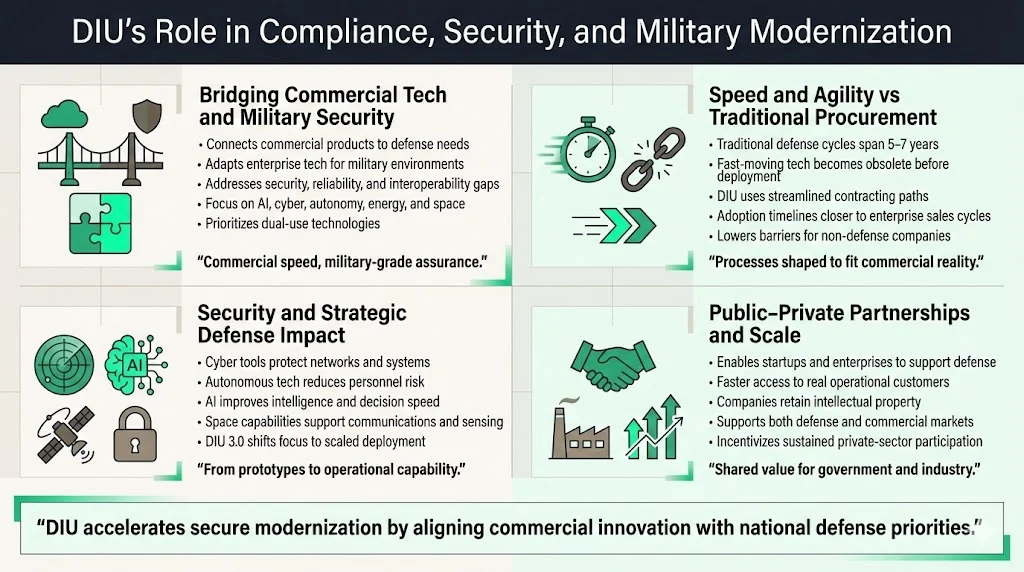
DIU partners with organizations across the Department of Defense, from the services and components to combatant commands and defense agencies, to rapidly prototype and field advanced commercial products that address national security challenges. This bridging function addresses a fundamental challenge: commercial technologies developed for enterprise or consumer markets require adaptation, integration, and validation before military deployment. Security requirements, operational environments, reliability standards, and interoperability needs differ substantially between commercial and defense contexts.
DIU's portfolio focus on AI, cybersecurity, autonomy, energy, and space directly addresses evolving threat landscapes. Dual-use technologies—those with both commercial and military applications—receive particular emphasis, making DIU a critical node for technology commercialization toward defense systems. This approach accelerates military modernization by leveraging commercial R&D investments rather than funding parallel government-exclusive development.
2) Speed and Agility vs Traditional Defense Procurement
Traditional defense procurement involves extensive requirements definition, source selection processes spanning years, complex cost accounting, and rigorous oversight—appropriate for major weapons systems but counterproductive for rapidly evolving technologies. For commercial software platforms, AI tools, or cybersecurity solutions, 5-7 year acquisition cycles guarantee obsolescence before deployment.
DIU's streamlined processes offer enterprises a fundamentally different pathway. Companies accustomed to enterprise sales cycles—typically 6-18 months from initial contact to contract—find DIU's 12-24 month adoption timeline familiar. Rather than requiring companies to meet legacy defense acquisition burdens, DIU adapts its processes to commercial practices. This transformation makes defense opportunities accessible to firms lacking traditional defense-industry experience.
3) Security and Strategic Defense Relevance
DIU's technology portfolios directly address contemporary national security challenges. Cybersecurity solutions protect military networks, weapons systems, and operational technology from sophisticated adversaries. Autonomous systems reduce personnel risk while increasing operational tempo. AI/ML capabilities enhance intelligence analysis, predictive maintenance, and decision-making speed. Space technologies provide communications, sensing, and positioning capabilities increasingly contested by peer adversaries.
In 2023, DIU announced changes (DIU 3.0) to increase its effectiveness, shifting its focus to address DOD's most critical operational needs. This strategic evolution recognizes that rapid prototyping alone proves insufficient—technologies must deploy at scale to achieve operational impact. DIU 3.0 emphasizes production deployment rather than merely demonstrating feasibility, increasing the organization's relevance to military readiness and strategic competition.
4) Public-Private Partnerships & Commercialization Pathways
DIU provides structured yet flexible mechanisms for private firms—startups, mid-size enterprises, commercial vendors—to contribute to national security. The model benefits both parties: DoD gains access to cutting-edge technology with speed; companies gain a significant, high-stakes customer and potentially large-scale contracts.
This partnership approach differs from traditional government-funded research, where the government owns resulting intellectual property and controls commercialization. DIU's model recognizes that commercial companies need paths to broader markets, not merely government contracts. By allowing companies to retain intellectual property and sell to both defense and commercial customers, DIU creates sustainable incentives for private-sector participation.
What DIU Means for Enterprise-Tech Companies
1) Opportunity to Enter Defense Market without Legacy-Defense Background
If your company develops cybersecurity tools, AI platforms, autonomy solutions, space technologies, advanced materials, or other dual-use innovations, DIU provides a channel to work with DoD without legacy defense-industry credentials. The commercial-style contracting reduces barriers to entry—firms don't need extensive defense contracting histories to be considered.
This accessibility represents a fundamental shift. Traditional prime contractors—Lockheed Martin, Raytheon, Northrop Grumman—built their positions through decades of military-specific development and deep understanding of defense acquisition regulations. DIU's model recognizes that for many technology domains, commercial leaders now possess superior capabilities. The challenge becomes adaptation and integration rather than ground-up military-specific development.
2) Faster Time-to-Contract and Clearer Paths to Production
Compared with traditional military procurement cycles, DIU's model offers substantially shorter paths from proposal to prototype to production contract. For enterprises accustomed to commercial product development cycles, DIU's 12-24 month adoption timeline proves far more compatible than 5-10 year traditional defense acquisition.
DIU officials said they will use its established process to award prototype agreements that can deliver technologies at scale to meet DOD's most critical needs, and will increasingly work with military services and combatant commands. This emphasis on production-scale deployment—not merely demonstrations—creates opportunities for substantial, long-term contracts once prototypes validate successfully.
3) Compliance & Security Considerations for Vendors
Working with DIU—as part of DoD—requires adherence to defense-related compliance and security standards. Vendors must ensure their products meet heightened security, reliability, and integration requirements for military use. This includes cybersecurity standards potentially exceeding commercial practice, supply chain security to prevent adversary compromise, and operational reliability under harsh environmental conditions.
For enterprise firms already managing compliance frameworks—SOC 2 attestations, ISO 27001 certifications, GDPR data protection requirements—extending to defense security standards represents a manageable evolution. However, the stakes differ substantially. Commercial data breaches damage reputation and trigger regulatory penalties; defense security failures potentially compromise military operations and endanger personnel. The compliance rigor required reflects these consequences.
Companies must assess whether their security posture, development practices, and supply chain controls can meet defense-grade standards. This may require additional investment in security infrastructure, personnel vetting, or supply chain visibility—but provides corresponding benefits through enhanced security credibility when selling to other high-assurance customers.
4) Strategic Value and Competitive Differentiation
Being a DIU vendor demonstrates that a company's solutions are robust enough for national security use. This validation creates competitive differentiation when pitching to enterprise clients—especially those in regulated industries, government agencies, critical infrastructure, or defense-adjacent sectors.
The credibility extends beyond marketing claims. Enterprises evaluating cybersecurity platforms, AI tools, or autonomous systems face difficult assessments of vendor capabilities, security practices, and solution maturity. A vendor's successful deployment in defense contexts provides tangible evidence of technical sophistication, security rigor, and ability to meet demanding requirements—making procurement decisions easier for risk-averse enterprise buyers.
Challenges, Limitations, and Risks
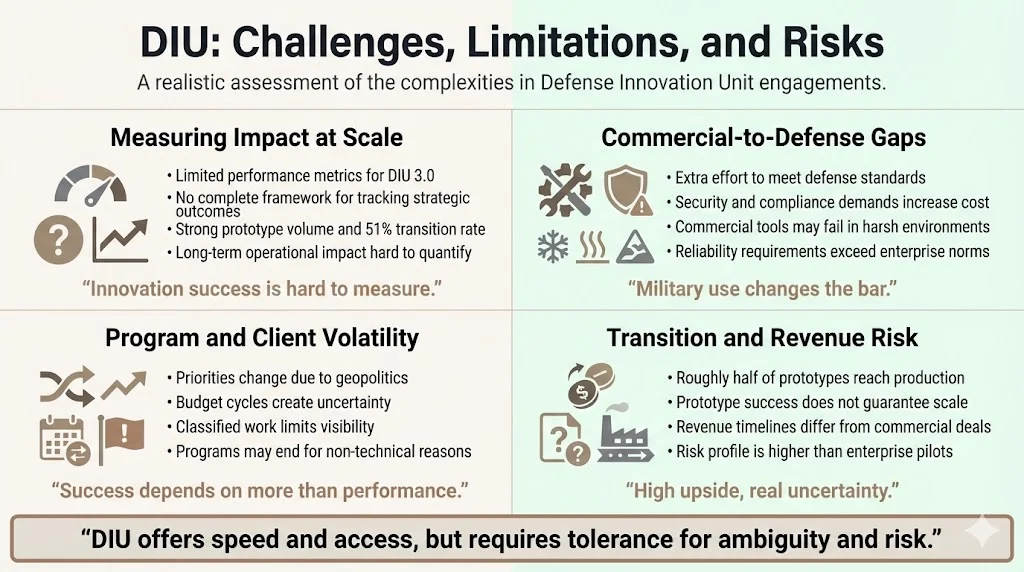
DIU has limited ability to gauge progress toward addressing DOD's most critical needs because it does not yet have a complete performance management process—specifically, DIU has not set performance goals and metrics to assess its progress toward achieving DIU 3.0's strategic goal. This limitation reflects broader challenges in measuring innovation impact. While DIU has issued many prototype contracts and achieved a 51 percent transition rate, assessing long-term operational impact remains difficult.
For companies, ensuring commercial products meet strict defense standards—security, reliability, compliance—may require substantial additional resources or adaptation. Solutions that perform adequately in commercial contexts may prove inadequate for military operational environments: extreme temperatures, electromagnetic interference, limited bandwidth, adversarial jamming, or physical durability requirements.
Working with military clients involves unpredictability. Geopolitical events shift priorities rapidly. Budget cycles create funding uncertainty. Security classifications limit information sharing. Programs face cancellation due to strategic realignments unrelated to technical performance. Companies must assess whether they can tolerate this volatility—balancing the substantial opportunity against operational unpredictability.
The 51 percent transition rate, while impressive relative to traditional defense research, means approximately half of prototypes don't transition to production. Companies investing resources in DIU engagements face a meaningful probability that prototype success won't convert to production revenue. This risk-reward calculation differs from commercial sales, where successful pilots typically convert to full deployments.
Recent Developments & Future Directions
In 2023, DIU announced changes (termed "DIU 3.0") to increase its effectiveness. This strategic refresh refocuses DIU on deploying technologies at scale to meet the most critical operational needs of the Department of Defense—moving beyond demonstrations to operational impact.
Recent DIU activities demonstrate this production-scale focus. Under the Hybrid Space Architecture program, companies will work to create an operational pilot communications architecture by 2026, prototyping capabilities at multiple operational demonstrations. This initiative integrates commercial and military space assets into resilient communications networks—addressing contested space domains where adversaries threaten traditional military satellites.
DIU continues expanding its technology portfolios and partnership mechanisms. The organization maintains presence across multiple technology hubs, operates Innovation OnRamp programs to connect commercial firms with defense needs, and increasingly coordinates with other DoD innovation entities. For enterprise technology companies, these developments suggest expanding opportunities to engage—with clearer pathways from prototype to production deployment.
Clear the defense security bar without stalling your roadmap
Book a demo and we'll show how Konfirmity extends the SOC 2 and ISO 27001 work you already do into the defense-grade security and supply chain controls a DIU prototype contract puts you up against.
Book a demo
Conclusion
The Defense Innovation Unit operates at the intersection of commercial technology innovation and military capability requirements. By providing streamlined contracting mechanisms, geographic presence in technology hubs, and focus on rapid prototyping with paths to production, DIU creates accessible channels for commercial firms to contribute to national security.
For companies selling enterprise solutions—particularly in cybersecurity, artificial intelligence, autonomy, space technologies, or defense-adjacent domains—DIU represents a unique opportunity. The organization offers lower entry barriers than traditional defense contracting, faster time-to-contract timelines compatible with commercial product cycles, and potential paths to large-scale production deployments. Successful DIU engagement builds credibility demonstrating solutions meet national security-grade requirements—competitive differentiation valuable when selling to risk-averse enterprise customers in regulated industries.
The trade-offs require consideration: stricter compliance requirements, heightened security standards, operational unpredictability, and meaningful probability that prototype success won't convert to production revenue. Companies must assess whether their security posture, supply chain controls, and organizational capabilities can meet defense-grade standards—and whether they can tolerate the volatility inherent in military customer relationships.
Yet for firms possessing robust security practices, dual-use technologies, and tolerance for government sales cycles, DIU provides structured pathways to contribute technological capabilities while accessing substantial defense market opportunities. The organization's evolution toward production-scale deployment under DIU 3.0 increases relevance—moving beyond demonstrations to operational impact that strengthens both national security and commercial vendor growth trajectories.
FAQs
DIU partners with organizations across the Department of Defense to rapidly prototype and field advanced commercial products that address national security challenges. The organization scouts commercial innovations, works with private companies to develop and validate solutions, and transitions successful prototypes into production contracts or programs of record.
DIU is headquartered in Mountain View, California (Silicon Valley), with offices in Austin, Boston, Chicago, and the Pentagon just outside Washington, D.C.
DIU stands for Defense Innovation Unit. Originally, it was named DIUx (Defense Innovation Unit Experimental) when launched in August 2015.
DIU operates as a Department of Defense organization reporting to the Secretary of Defense. This direct reporting relationship—established during DIU's 2016 reboot—provides the organization with strategic visibility and authority to work across military services, combatant commands, and defense agencies.