The Data Universal Numbering System (DUNS) is a proprietary system developed by Dun & Bradstreet that assigns a unique numeric identifier to a single business entity. For enterprise-level sellers and buyers managing hundreds or thousands of vendor relationships, supplier databases, and cross-border transactions, this nine-digit identifier serves a purpose far beyond credit reporting. DUNS functions as a foundational metadata standard that enables robust entity validation, supports data integrity across disparate systems, and underpins third-party risk management programs essential to modern compliance frameworks.
Most organizations still treat business identifiers as administrative overhead—an onboarding formality rather than a strategic data-governance tool. This approach creates fundamental gaps in vendor master data, supplier databases, and audit trails—gaps that become apparent when compliance audits reveal duplicate vendor records, when payment errors stem from entity misidentification, or when cross-border transactions fail because parties cannot reliably verify counterparty identity. DUNS addresses these operational and governance challenges by providing a globally recognized, location-specific identifier that anchors data protection, supply chain integrity, and regulatory compliance workflows.
In 2026, as data protection regulations intensify globally and enterprises increasingly rely on automated vendor-risk analytics, DUNS offers a stable reference point for managing third-party data with precision. This glossary explores how DUNS functions as a unique identifier infrastructure, its role in compliance and risk management, and practical considerations for integrating this system into enterprise data-governance architectures.
What is DUNS?
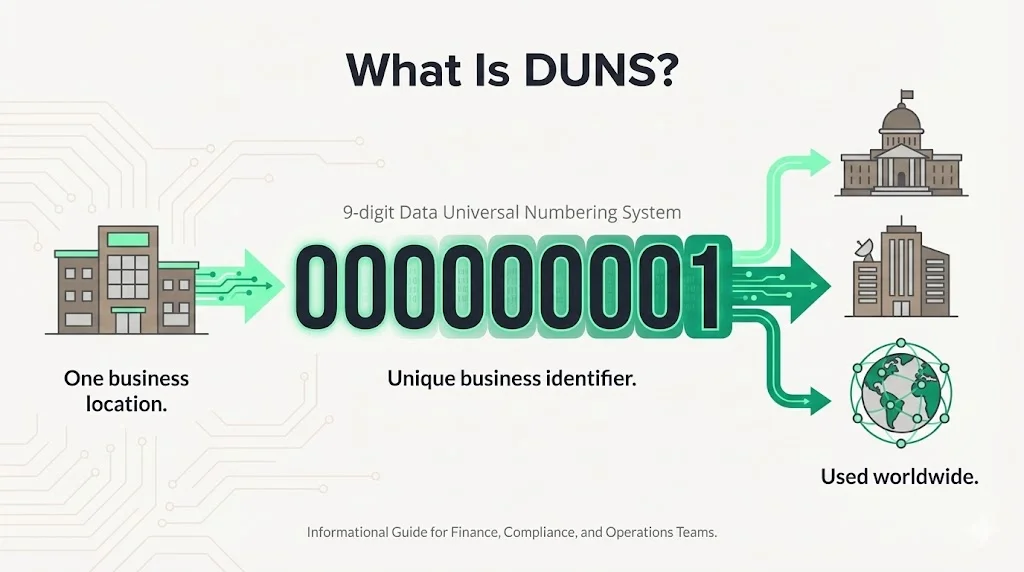
Dun & Bradstreet created DUNS in 1963 to support its credit reporting operations. The system assigns a unique numeric identifier, referred to as a "DUNS number," to a single business entity. Over six decades, DUNS has evolved from a credit-reporting tool into a universal enterprise identifier used by government agencies, multinational corporations, and international organizations worldwide.
Structure and Scope
The DUNS number is random, and the digits have no apparent significance. Each identifier consists of nine digits that carry no encoded information about industry, geography, company size, or legal structure. This design prioritizes uniqueness over semantic meaning—the number functions purely as a reference key, not as a classification scheme.
DUNS is a location-specific identifier system. An organization with multiple locations, such as a university, may have multiple DUNS numbers. Each physical site, branch office, subsidiary, or operational location of a company can receive its own distinct DUNS number. For enterprises with complex organizational structures—holding companies with subsidiaries across jurisdictions, or retail chains with hundreds of locations—this location specificity enables granular tracking and governance.
Businesses may choose to append four extra alphanumeric characters to their DUNS number, creating a DUNS+4 number for internal use (for example, to identify different electronic funds transfer accounts). This suffix has no significance otherwise and is not tracked by Dun & Bradstreet. The DUNS+4 variant allows organizations to extend the identifier for internal subdivisions—different funds, accounts, business units—while maintaining the primary DUNS as the external reference.
Adoption and Global Recognition
DUNS is used to maintain up-to-date and timely information on more than hundreds of millions of global businesses. United Nations offices and Australian government agencies require certain businesses to have a DUNS number. Organizations including the European Commission, major technology corporations like Apple and Google, and large retailers such as Walmart reference DUNS for vendor validation and partner onboarding. Unlike national employer identification numbers, a DUNS number may be issued to any business worldwide. This global scope makes DUNS particularly valuable for enterprises managing international supply chains or cross-border compliance obligations.
A critical development occurred in April 2022: the federal government stopped using DUNS and started using new Unique Entity Identifiers (UEI) as the primary means of identifying entities registered for federal awards, removing all DUNS numbers from the System for Award Management after April 4, 2022. While U.S. federal procurement shifted away from mandatory DUNS usage, the identifier remains widely used across private-sector supply chains, international organizations, and non-U.S. government entities. For enterprises operating beyond U.S. federal contracting, DUNS continues to serve as an established standard for entity validation and vendor master-data management.
Need to stand behind your GDPR posture?
Drop your work email and we'll help you close the gaps before a regulator or customer finds them.
How DUNS Functions as a "Unique Identifier" for Enterprises
DUNS provides a globally standardized unique identifier—conceptually similar to how ISBN works for books or how DOIs work for academic papers. By mapping each company and each physical location to a unique DUNS number, businesses avoid ambiguity created by name similarities, mergers, acquisitions, subsidiaries, or rebranding. When two companies share similar names, operate across multiple jurisdictions with varying legal entity structures, or undergo frequent organizational changes, names and addresses become unreliable identifiers. DUNS eliminates this ambiguity.
The number is assigned once Dun & Bradstreet's identity resolution process identifies a company as being unique from any other in the Data Cloud, serving as the starting point for any company's Live Business Identity. Because the DUNS database is maintained by D&B and updated over time, it forms a consistent reference backbone for enterprise metadata. Organizations can map vendor records, contracts, compliance documentation, audit histories, and payment transactions to a single stable identifier that persists across system migrations, mergers, or address changes.
For enterprises selling to other enterprises or managing complex supplier ecosystems, referencing DUNS when onboarding clients or vendors ensures clarity: each entity is unambiguously identified. Because of its universal recognition and unique assignment, the D‑U‑N‑S Number can serve as a primary data key within an organization's Master Data Management architecture. This enables clean data mapping across ERP systems, CRM platforms, procurement tools, compliance databases, and audit systems—reducing duplicate records, reconciliation errors, and compliance gaps.
Drawing Parallels: DUNS and Library-Style Cataloging / Metadata Standards
In library science, materials use standardized identifiers: ISBN for books, ISSN for serials, DOIs for journal articles. These identifiers enable libraries, publishers, and researchers to catalog, reference, and retrieve materials unambiguously across systems and institutions. Similarly, DUNS acts as a metadata standard for companies rather than publications. This makes company data more like bibliographic data—structured, standardized, and interoperable.
Just as bibliographic systems prevent duplicate or ambiguous entries of books, DUNS prevents duplicate or ambiguous entries of companies in business data systems. For enterprise sellers maintaining large supplier or client databases, treating each company as an "item" in a catalog—but identified by DUNS—helps maintain data hygiene and avoid misidentification. When onboarding a new vendor, searching the DUNS database confirms whether the entity already exists in your system under a different name or address, preventing duplicate records that fragment compliance history, contract data, and risk assessments.
This cataloging approach also supports data interoperability. When multiple enterprises use DUNS as a common identifier, supplier data can be exchanged, aggregated, and reconciled across organizational boundaries with precision. Industry consortia, regulatory bodies, and supply-chain networks can reference the same entity unambiguously, enabling collaborative risk management, transparency initiatives, and coordinated compliance efforts.
Role of DUNS in Data Protection, Compliance, and Risk Management
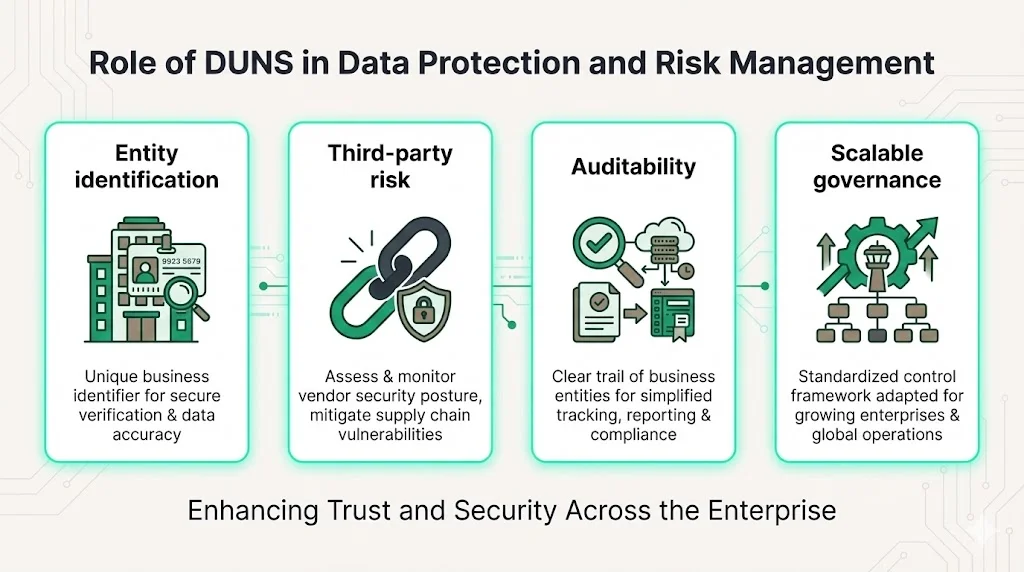
DUNS supports data protection standards and secure business data practices in ways that extend well beyond credit reporting. For enterprises managing third-party risk, supplier databases, and cross-border data flows, DUNS offers infrastructure for governance, auditability, and entity validation.
A. Unique, Standardized Identification Reduces Risk of Duplicate or Fraudulent Records
When companies rely solely on names or address matching, there is substantial risk of duplicates, errors, or identity confusion—especially with subsidiaries, affiliates, or similarly named companies. DUNS offers a reliable single source of truth to identify and track organizations across systems. This supports data integrity and governance by ensuring that each vendor, client, or partner is represented once in your database, with all associated data—contracts, compliance documentation, risk assessments, audit findings—mapped to a single persistent identifier.
This reduces the risk of fragmented compliance records. If a vendor appears under multiple names or addresses across different systems, compliance teams may fail to detect patterns of non-compliance, repeated security incidents, or contractual breaches. DUNS consolidates these records, enabling comprehensive risk visibility.
B. Facilitates Due Diligence, Compliance, and Third-Party Risk Management
For enterprises onboarding vendors or partners, referencing DUNS ensures you know exactly which legal entity you are engaging. That clarity supports compliance under privacy and security regulations, because you can tie all relevant data—contracts, audits, payment history, credentials, data processing agreements—to one identifier. When conducting due diligence, compliance teams can query the DUNS number to retrieve credit history, corporate hierarchy, regulatory actions, and historical compliance data from Dun & Bradstreet's database or third-party risk platforms that integrate DUNS.
Because DUNS is globally recognized and maintained independently, it supports cross-border compliance and due diligence—critical when working with international clients or suppliers. Organizations operating across jurisdictions face varying legal entity structures, naming conventions, and local identifiers. DUNS provides a universal reference that transcends these differences, enabling consistent vendor-risk assessment regardless of jurisdiction.
For enterprises subject to data protection regulations such as GDPR, CCPA, or sector-specific frameworks like HIPAA, identifying data processors and subprocessors accurately is a legal requirement. DUNS enables precise mapping of which entities handle personal data, where they operate, and how they fit within corporate hierarchies—supporting Data Processing Agreements, Business Associate Agreements, and regulatory filings.
C. Enables Accurate Data Sharing and Audit Trails
When sharing vendor or client data between systems—integrating procurement platforms with ERP, syncing CRM with compliance tools, or consolidating audit logs—using DUNS as the primary key ensures uniform mapping across different databases and systems. This helps enterprises maintain traceable audit trails, improves data reconciliation, and reduces errors—all important under data protection and governance frameworks.
Auditors increasingly demand evidence of how third-party data is managed, tracked, and secured. When vendor records are fragmented across systems or inconsistently identified, producing comprehensive audit trails becomes labor-intensive and error-prone. DUNS simplifies this by serving as the common thread that ties together contracts, risk assessments, security questionnaires, compliance certifications, incident reports, and payment records. This consolidated view enables faster, more reliable audit responses and strengthens your ability to demonstrate continuous third-party oversight.
D. Scales Supplier & Partner Databases with Metadata Reliability
For large enterprises with hundreds or thousands of suppliers, clients, or partners, DUNS helps build a cataloging system where each partner is an item with a unique identifier. As businesses grow or reorganize—subsidiaries spin off, mergers occur, acquisitions reshape corporate structures—DUNS ensures continuity. The same entity retains the same DUNS number unless a legal restructuring creates a new entity, in which case a new DUNS is issued. This persistence supports long-term data governance and historical tracking.
When enterprises scale their supplier databases, metadata reliability becomes critical. Manual data entry, inconsistent naming conventions, and address changes introduce errors that compound over time. By anchoring vendor master data to DUNS, organizations reduce data-quality degradation and enable automated data-hygiene processes—such as flagging duplicate entries, detecting entity changes, or triggering compliance reviews when corporate hierarchies shift.
Use Cases for Enterprise Sellers / Buyers
Onboarding new clients or suppliers: Using DUNS to verify identity and avoid duplicates during vendor intake. When a prospective supplier submits onboarding documentation, searching for their DUNS number confirms whether they already exist in your system and retrieves existing compliance history, risk scores, and contractual terms.
Supplier master-data governance: Maintaining a clean supplier database using DUNS as the primary key. This enables automated deduplication, consistent entity tracking across business units, and integration with third-party risk platforms that leverage DUNS for identity resolution.
Compliance audits, risk assessments: Using DUNS to link contracts, compliance documents, performance history, and credit history. When auditors request evidence of vendor oversight, querying by DUNS consolidates all relevant records—security assessments, data processing agreements, incident reports—into a single entity view.
M&A, corporate restructuring: Tracking parent companies, subsidiaries, and branches via DUNS and DUNS+4, preserving data integrity through organizational changes. When a supplier undergoes acquisition, their DUNS enables you to map the new corporate hierarchy and reassess risk exposure.
International deals: With cross-border clients or suppliers, DUNS offers a globally recognized identifier—useful for global enterprises navigating varying local identifiers, legal structures, and regulatory requirements. This simplifies due diligence for international vendors and supports consistent risk management across geographies.
Limitations, Considerations, and Best Practices
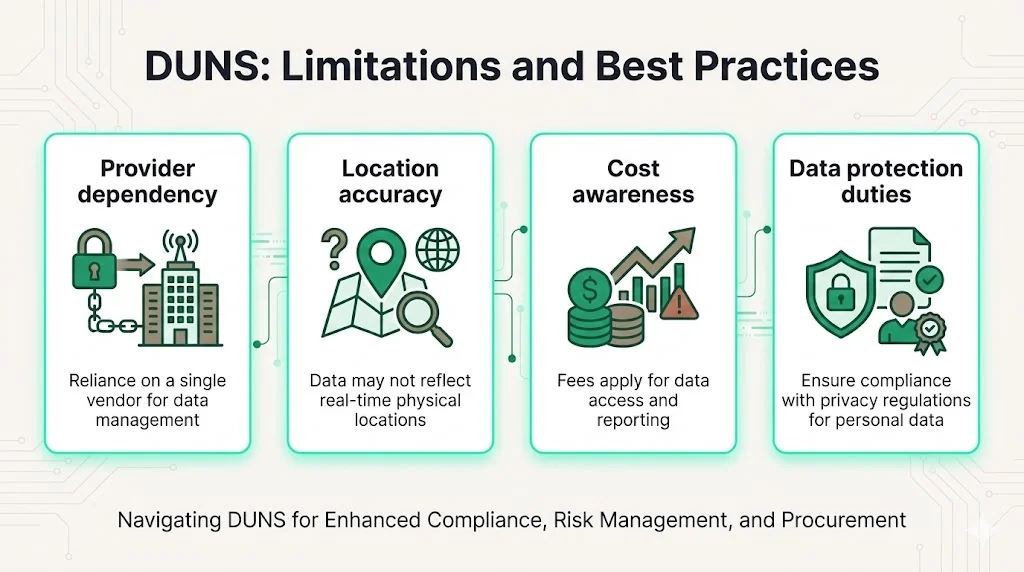
DUNS is proprietary: the identifier is issued and controlled by Dun & Bradstreet. This introduces dependency on an external data provider. Quality and currency of data depend on D&B's processes, update cycles, and coverage. Enterprises should implement internal processes to validate or cross-verify DUNS data, particularly for high-risk vendors or critical suppliers. Relying solely on D&B's database without independent verification may leave gaps in due diligence.
For companies with multiple locations or subsidiaries, managing DUNS and DUNS+4 properly is essential. Treat each location or business unit separately to avoid confusion—a single vendor with three facilities should have three DUNS numbers if each facility operates as a distinct entity. Failing to account for this can result in incomplete compliance coverage or misallocated risk.
Dun & Bradstreet provides a DUNS number free of charge. However, accessing detailed business credit reports, risk scores, or enhanced data tied to a DUNS number typically requires paid services. Enterprises should evaluate the cost-benefit of D&B's commercial offerings versus alternative vendor-risk platforms that integrate DUNS data.
Compliance with data privacy regulations remains critical: having identifiers does not remove responsibility for how you collect, store, and share company data. DUNS facilitates entity identification, but enterprises must still implement appropriate data governance, access controls, and data processing agreements when handling vendor or client information. Using DUNS does not substitute for conducting independent security assessments, reviewing compliance certifications, or enforcing contractual data-protection obligations.
How DUNS Fits into 2026 Data Protection and Data Governance Trends
With stricter data-protection laws worldwide—GDPR enforcement intensifying, state-level privacy legislation expanding in the U.S., and sector-specific regulations tightening—enterprises need robust systems to manage third-party data. DUNS offers a standardized identifier that can simplify vendor and client data governance. When every vendor is anchored to a persistent unique identifier, organizations can implement automated compliance workflows: triggering risk reassessments when corporate hierarchies change, flagging vendors operating in restricted jurisdictions, or consolidating data processing agreements across subsidiaries.
As procurement, supply-chain, and vendor-management functions become more automated and data-driven—integrating ERP systems, leveraging AI-driven vendor risk analytics, adopting continuous monitoring platforms—DUNS serves as a stable anchor for metadata mapping and reconciliation. Machine-learning models that assess vendor risk, predict supply-chain disruptions, or detect fraudulent entities rely on clean, consistent input data. DUNS provides that consistency, enabling more reliable automated risk scoring and anomaly detection.
For global enterprises operating across jurisdictions, DUNS helps maintain compliance and transparency when exchanging corporate data across borders. Cross-border data transfers require documented legal bases, safeguards, and transparency about data recipients. DUNS enables precise identification of data processors, subprocessors, and affiliates—supporting Data Protection Impact Assessments, Standard Contractual Clauses, and regulatory filings that require detailed entity information.
Conclusion
DUNS is more than a business-credit tool—it functions as a universal, standardized identifier that supports data integrity, governance, and protection. For enterprise sellers and buyers managing complex supplier ecosystems, cross-border transactions, and regulatory compliance obligations, integrating DUNS into data management, vendor onboarding, compliance, and master-data systems adds reliability, reduces risk, and supports scalable growth.
Organizations that treat DUNS as foundational metadata infrastructure within their data-governance architectures gain clearer entity visibility, cleaner vendor databases, and more robust audit trails. In an environment where third-party risk management and data protection compliance are business-critical, DUNS provides the unique identifier infrastructure necessary to manage vendor relationships with precision and accountability.
FAQ
A DUNS number is a unique nine-digit identifier assigned by Dun & Bradstreet to a single business entity. It is a location-specific means of identifying business entities.
Unlike national employer identification numbers, a DUNS number may be issued to any business worldwide. Local identifiers vary by country, carry jurisdiction-specific legal or tax information, and may not be universally recognized. DUNS is global, standardized, and designed purely for unique entity identification—not for tax or legal classification.
Yes—an organization with multiple locations, such as a university, may have multiple DUNS numbers. Each distinct physical location or business unit can receive its own DUNS number, enabling location-specific tracking and governance.
Yes, Dun & Bradstreet provides a DUNS number free of charge. However, accessing detailed credit reports, risk assessments, or enhanced data tied to a DUNS number typically requires paid services.
DUNS is proprietary and controlled by Dun & Bradstreet, meaning data accuracy and coverage depend on their maintenance processes. Enterprises should implement independent verification for high-risk vendors. Additionally, having a DUNS number does not remove responsibility for how you manage or protect associated data under privacy and security regulations—it is an identifier, not a compliance solution.