

Most organizations exchange data across systems, business units, and partner networks without establishing common semantic definitions. This creates fundamental ambiguity—confusion that compounds when teams interpret "customer revenue," "account status," or "transaction date" differently across departments. The consequences manifest during system integrations, regulatory audits, or M&A data harmonization when definitions conflict and data quality deteriorates.
ISO/IEC 11179 is an international standard that documents the standardization and registration of metadata to make data understandable and shareable. Rather than treating metadata as informal documentation scattered across wikis and spreadsheets, the standard provides a structured framework for defining, naming, classifying, and registering data elements in centralized metadata registries. For technical decision-makers managing enterprise data environments, this translates to reliable data definitions, enforceable data governance, and reduced friction when integrating systems across organizational boundaries.
What is ISO 11179?
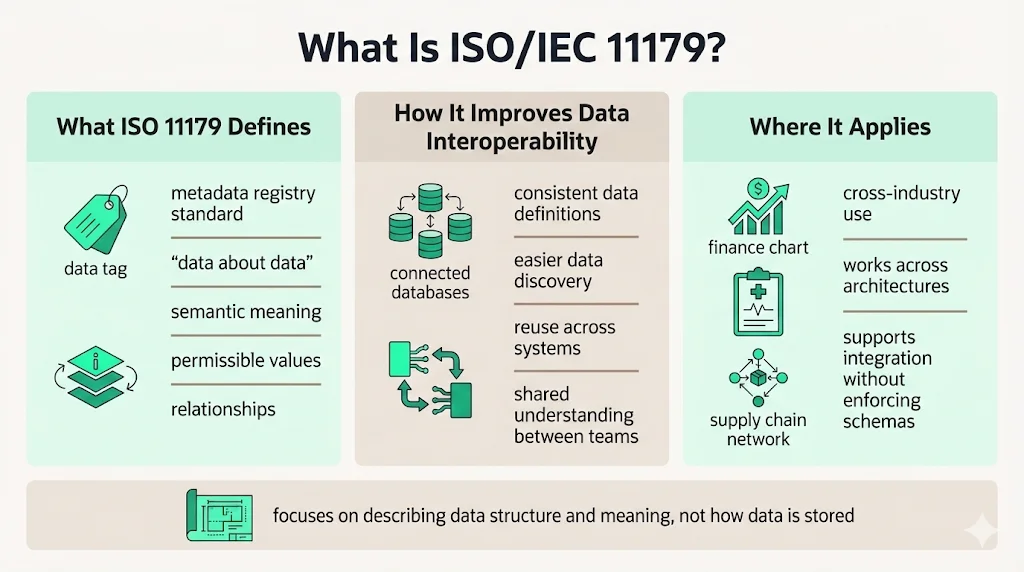
ISO/IEC 11179 is an international standard for describing metadata registries that defines the technical, structural and governance requirements for describing the structure of data in a reusable way. The standard establishes how organizations should describe "data about data"—the semantic meaning, permissible values, relationships, and structural characteristics that make data elements interpretable across systems and organizational contexts.
The standardization and registration allows for easier locating, retrieving, and transmitting data from disparate databases. ISO 11179 applies broadly across industries, data architectures, and domains—from financial services to healthcare to supply chain management. It does not prescribe database schemas or storage formats; rather, it defines the conceptual model for how metadata should be structured, documented, and shared to enable interoperability.
Building toward SOC 2, ISO 27001, or another framework?
Drop your work email and we'll help you turn security work into audit-ready evidence automatically.
Structure of the Standard: How ISO 11179 is Organized
ISO/IEC 11179 comprises multiple parts, each addressing distinct aspects of metadata registry architecture and administration. The standard has evolved through multiple editions, with recent updates extending its scope to handle modern data environments including complex data sets and computable data.
Part 1: Framework — Provides the foundational overview of the standard, explaining the purpose of each component and establishing core concepts including the definition of data elements as the fundamental unit within a metadata registry.
Part 2: Classification — Defines the procedures for registering classification schemes and classifying administered items in a metadata registry (MDR). Classification enables organizing metadata items into taxonomies, hierarchies, or categorization structures that improve discoverability and management.
Part 3: Metamodel for Registry Common Facilities — Specifies the metamodel that defines the registry. This part establishes the conceptual data model showing how metadata items relate to each other, their required attributes, and the structural foundation of the registry itself. Part 3 is the technical heart of the standard, typically depicted using UML diagrams.
Part 4: Formulation of Data Definitions — Specifies rules and guidelines for building definitions of data elements. Provides prescriptive guidance for creating precise, unambiguous definitions that eliminate semantic confusion and ensure consistency across the organization.
Part 5: Naming and Identification Principles — Establishes naming conventions and unique identification mechanisms for metadata items. Systematic naming is critical for avoiding duplication and supporting automated metadata discovery across distributed systems.
Part 6: Registration — Defines the administrative procedures and governance processes for how metadata items are registered in the registry, including submission workflows, stewardship responsibilities, and quality controls.
Part 7 and Modern Extensions — Released in December 2019 and provides an extension to part 3 for registration of metadata about data sets. Additional parts such as Part 31 (data specification registration), Part 32, and Part 34 (computable data registration) extend the standard to handle complex, nested data structures and modern computational requirements beyond individual data elements.
The core construct throughout ISO 11179 is the Data Element—the foundational concept in an ISO/IEC 11179 metadata registry, whose purpose is to maintain a semantically precise structure of data elements. A Data Element combines semantic meaning (the concept being represented) with representation (how the data is structured, its data type, permissible values, and value domain). This separation between meaning and representation enables reuse of concepts across different technical implementations.
How ISO 11179 Fits into Data Management & Governance
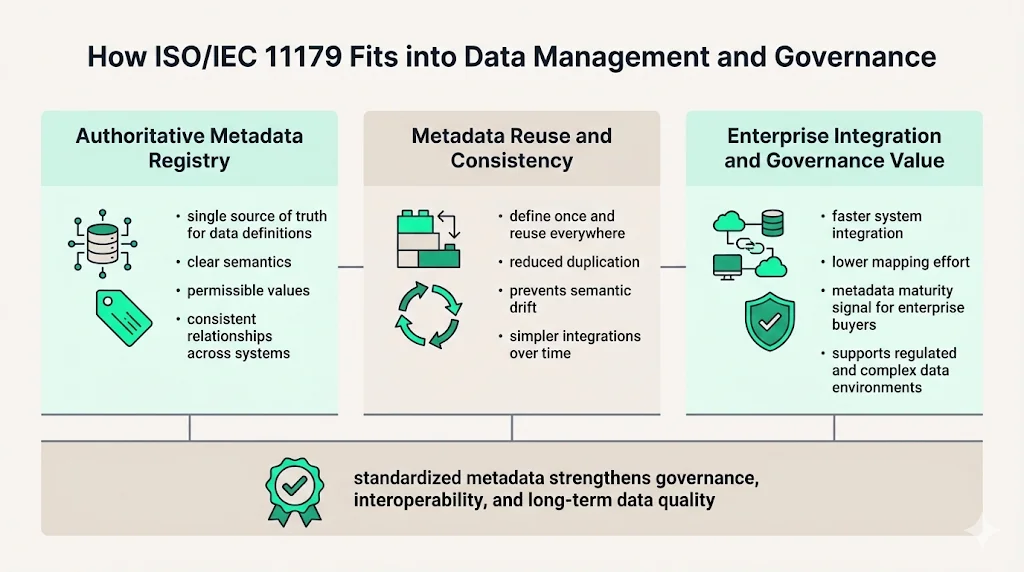
Metadata registries governed by ISO 11179 function as authoritative repositories for data definitions, establishing semantic clarity about what data means, how it is structured, what values are permissible, and how data elements relate to each other. For organizations managing data across multiple systems, departments, or external partnerships, this centralized definitional authority prevents duplication, reduces ambiguity, and enforces consistency.
The registry model supports reuse of metadata elements—once a data element is defined, classified, and registered, it becomes available for reference across applications, integration projects, and reporting systems. This eliminates the common practice of reinventing data definitions for each new project, which creates semantic drift and integration complexity over time.
For vendors serving enterprise clients, alignment with ISO 11179 principles signals metadata maturity and facilitates integration. Systems designed with standardized metadata structures exchange data more reliably, reduce mapping overhead during implementations, and enable clients to maintain semantic consistency across their technology stack. This becomes particularly important in industries with complex data environments—financial services, healthcare, government, supply chain—where data accuracy and interoperability directly impact regulatory compliance and operational effectiveness.
Why ISO 11179 Matters: Benefits for Organizations
Organizations implementing ISO 11179-compliant metadata registries realize measurable improvements in data management efficiency and quality:
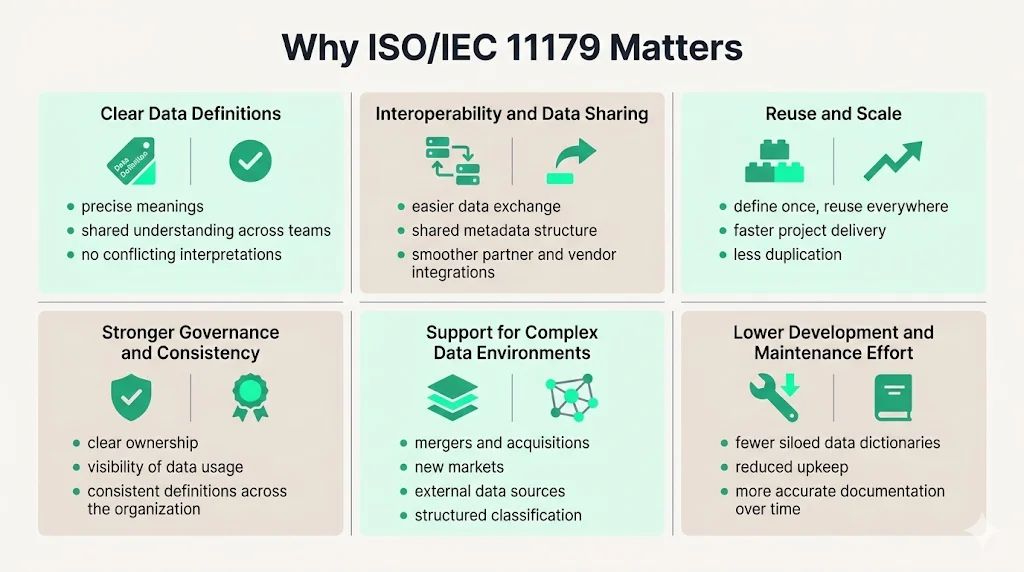
Clear, unambiguous data definitions — By applying formulation guidelines from Part 4 and naming conventions from Part 5, organizations eliminate the semantic confusion that arises when different departments or systems interpret the same term differently. When "customer" is precisely defined with explicit scope, attributes, and relationships, cross-functional teams interpret data consistently.
Interoperability and data sharing — Standard metadata structures make data exchange feasible within and across organizational boundaries. Partners, vendors, and internal systems can consume data with confidence when metadata follows a common registry structure rather than proprietary, undocumented formats.
Reusability and scalability — Metadata elements defined once scale across multiple systems and projects. Instead of building fragmented data dictionaries for each application, organizations reference the central registry, reducing redundancy and accelerating project timelines. New integrations leverage existing metadata definitions rather than starting from zero.
Better data governance and consistency — A centralized registry provides visibility into how data is defined, who owns definitions, and where data elements are used across the enterprise. This oversight supports data quality initiatives, regulatory compliance efforts, and organizational change management when systems evolve or merge.
Support for complex data environments — As organizations grow through acquisition, expand into new markets, or integrate external partner data, ISO 11179 helps manage increasing complexity. The classification schemes, registration workflows, and metamodel provide structure for governing heterogeneous data sources.
Reduced development and maintenance overhead — Rather than maintaining informal, siloed data dictionaries that require manual synchronization, development teams reference a structured metadata registry with defined governance processes. This reduces maintenance burden and improves accuracy over time.
Common Misconceptions & Limits (What ISO 11179 Does: And Doesn't Do)
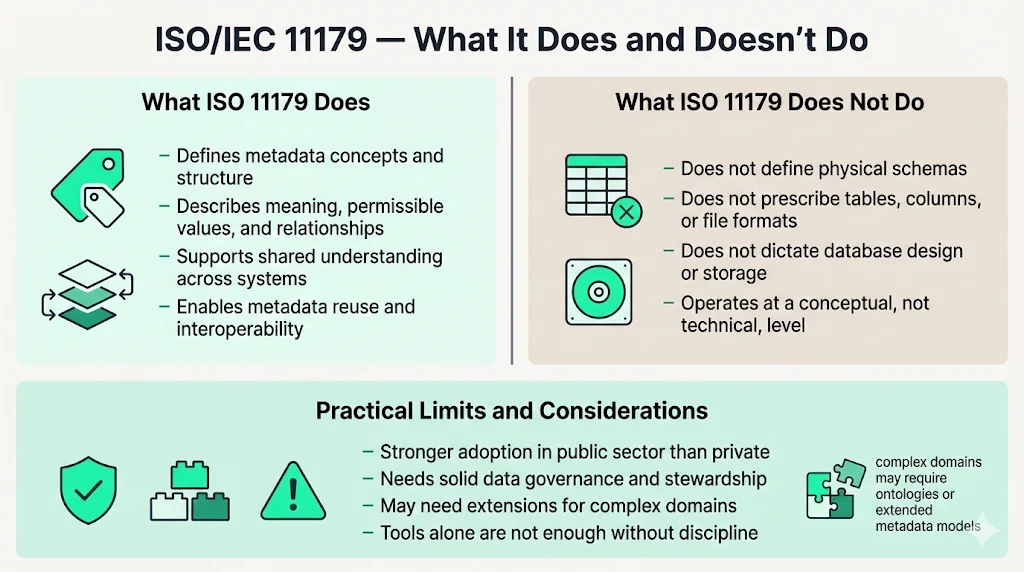
The standard defines how metadata are conceptually modeled and how they are shared among parties, but does not define how data is physically represented as bits and bytes. ISO 11179 addresses semantic and representational metadata—what data means and how it should be described—not database implementation details, storage formats, or physical schemas.
It does not refer to the description of physical files, tables and columns. The ISO/IEC 11179 constructs are "semantic" as opposed to "physical" or "technical". This distinction matters: organizations expecting ISO 11179 to prescribe database design will find it operates at a higher conceptual level. Implementation requires translating the conceptual metadata model into specific technical architectures.
While commercial adoption is increasing, the spread of ISO/IEC 11179 has been more successful in the public sector. Government agencies—including the U.S. Department of Transportation, Environmental Protection Agency, and Department of Justice—have adopted ISO 11179 for data interoperability initiatives. Commercial enterprises have been slower to implement formal metadata registries, often due to the governance maturity and organizational discipline required.
For highly complex domains requiring rich semantic frameworks—such as healthcare electronic health records, hierarchical product catalogs, or ontology-driven data models—the eXtended Metadata Registry initiative explored the use of ontologies as the basis for MDR content in order to provide richer semantic framework than could be achieved by lexical and syntax naming conventions alone. Some communities have found the standard's classification and naming capabilities insufficient for deeply nested or domain-specific data structures without extensions.
Implementing a compliant metadata registry requires more than software—it demands disciplined data governance, taxonomy management, stewardship processes, and organizational commitment to maintaining metadata quality. Organizations lacking maturity in these areas will struggle to realize ISO 11179 benefits regardless of tool selection.
How ISO 11179 Helps in Managing Business Data (for Enterprises)
ISO 11179 addresses practical business challenges that arise when data grows beyond a single application or department:
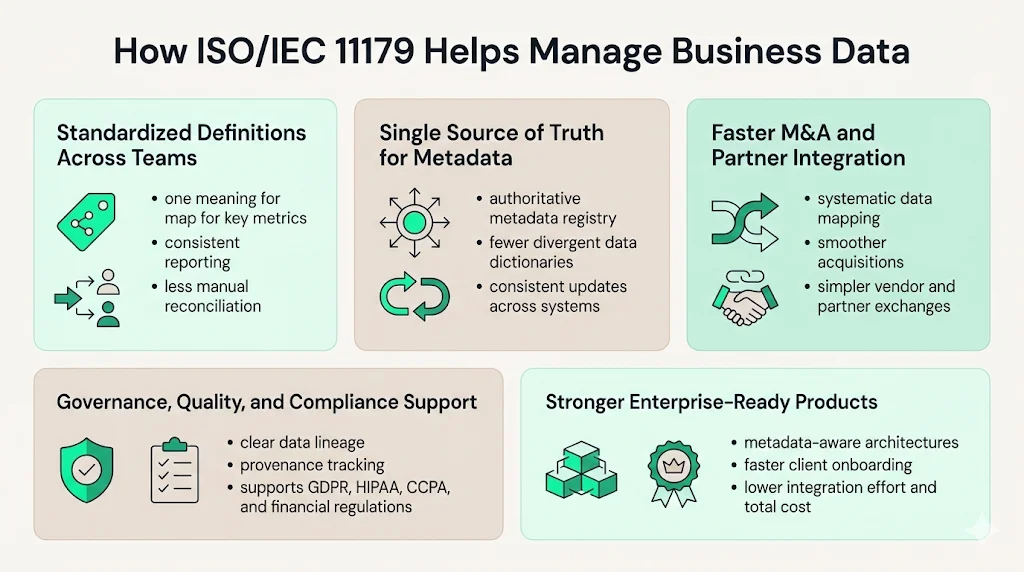
Standardizing data definitions across business units — When sales, finance, and operations each maintain separate definitions for "customer lifetime value" or "order fulfillment time," reconciliation becomes manual and error-prone. A centralized metadata registry enforces consistent definitions across departments, reducing integration friction and improving reporting accuracy.
Creating a single source of truth for metadata — Rather than maintaining multiple data dictionaries that diverge over time, organizations establish one authoritative registry. Changes propagate from the registry to consuming systems, maintaining consistency across the enterprise and client engagements.
Enabling smoother mergers, acquisitions, and partnerships — When two companies integrate systems during M&A, semantic alignment determines integration success. If both organizations follow ISO 11179 principles, data element mappings become systematic rather than interpretive. Similarly, when establishing data exchanges with vendors or partners, common metadata standards reduce negotiation and custom mapping overhead.
Supporting data quality, governance, and compliance initiatives — Regulatory frameworks—particularly in finance (Basel III, Dodd-Frank), healthcare (HIPAA), and privacy (GDPR, CCPA)—require accurate data lineage, provenance documentation, and definitional clarity. ISO 11179 provides the structural foundation for documenting data elements with the precision regulators and auditors expect.
Helping product vendors serve enterprise clients — Software providers building platforms, integration tools, or data products can differentiate by offering metadata-aware architectures. When vendor solutions align with ISO 11179 concepts, enterprise clients achieve faster implementations, more reliable data exchange, and lower total cost of ownership.
What ISO 11179 Does Not Cover, and When It Might Not Be Enough
ISO 11179 is technology-neutral and implementation-agnostic. It does not prescribe specific database management systems, programming languages, or technical architectures. Organizations must translate the conceptual metamodel into concrete implementations—whether SQL databases, NoSQL systems, graph databases, or cloud-native platforms.
The standard does not guarantee semantic richness for every domain. Complex ontologies, deeply nested object hierarchies, or specialized taxonomies (such as medical terminologies like SNOMED CT or product classification systems like UNSPSC) may require extensions or complementary standards. ISO 11179 provides the registry framework, but domain-specific semantic models must be developed separately.
Organizations without foundational data governance capabilities—defined stewardship roles, established classification schemes, formal approval workflows—will find ISO 11179 difficult to implement effectively. The standard assumes governance maturity; it does not create it. Companies treating metadata management as a purely technical problem rather than an organizational discipline will struggle with adoption.
How Organizations Can Get Started With ISO 11179
Implementing ISO 11179 requires systematic planning and organizational commitment:
Audit existing data definitions and metadata practices — Inventory current data elements, definitions, naming conventions, and classification schemes. Identify duplication, ambiguity, and inconsistencies across systems. Document where definitions conflict or where semantic clarity is absent.
Design or select a metadata registry aligned with ISO 11179 principles — Ensure the registry platform supports core concepts: Data Elements, Data Element Concepts, Value Domains, Conceptual Domains, classification schemes, naming conventions, and unique identification. The registry should enforce the metamodel specified in Part 3 and support registration workflows per Part 6.
Define naming conventions, classification schemes, and data element definitions — Establish organizational standards following Part 5 naming guidelines and Part 4 definition formulation rules. Create classification taxonomies appropriate for your business domains. Document governance processes for submitting, reviewing, approving, and retiring metadata items.
Register metadata items methodically — Begin with high-priority data elements used across multiple systems or critical for regulatory reporting. Follow registration procedures to capture metadata items with complete attributes: definitions, naming, classification, stewardship information, permissible values, relationships.
Use the registry proactively in new projects and integrations — For new application development, data exchanges, or system integrations, reference registry definitions rather than creating ad hoc metadata. Enforce policies requiring teams to register new data elements before implementation.
Maintain governance and continuous improvement — Treat the registry as a living asset requiring ongoing stewardship. Periodically review definitions for accuracy and relevance. Update classifications as business requirements evolve. Retire obsolete elements. Monitor usage and quality metrics to ensure the registry remains authoritative.
Conclusion
ISO 11179 provides the structural foundation for clarity, consistency, and interoperability in enterprise data management. Rather than treating metadata as informal documentation, the standard establishes rigorous frameworks for defining, naming, classifying, and registering data elements in centralized metadata registries. For organizations managing data across systems, departments, and organizational boundaries, this discipline reduces ambiguity, enables reuse, and supports governance at scale.
For vendors serving enterprise clients—particularly those building integration platforms, data products, or systems requiring cross-organizational data exchange—adopting ISO 11179 principles reduces implementation friction, builds client trust, and demonstrates metadata maturity. A well-implemented metadata registry delivers compounding returns: reusability improves, integration complexity decreases, and data quality strengthens over time as the organization scales.
Frequently Asked Questions (FAQs)
ISO/IEC 11179 is an international standard that documents the standardization and registration of metadata to make data understandable and shareable. It establishes a structured framework for metadata registries, defining how organizations should describe, name, classify, and manage data elements to enable semantic clarity and interoperability across systems.
ISO 11179 is not specific to Geographic Information Systems. It applies as a general metadata registry standard across domains. Geospatial data has separate ISO standards within the ISO 19100 series addressing geographic information and geomatics. Organizations managing geospatial metadata may apply ISO 11179 principles for registry structure while using domain-specific geospatial standards for content.
There is no single "ISO standard for databases" prescribing database architecture or implementation. ISO 11179 defines how metadata—descriptions of data elements—should be structured and registered, not how databases should be designed or how data should be physically stored. Database professionals may reference ISO 11179 when documenting database metadata, but the standard operates at the conceptual level rather than the physical implementation level.
Part 2 of ISO/IEC 11179 addresses classification schemes within metadata registries. It defines procedures for registering classification schemes and classifying administered items (metadata elements) within the registry. Classification enables organizing metadata into taxonomies, hierarchies, or categories, improving discoverability and supporting governance. The classification framework allows organizations to apply multiple classification schemes simultaneously—by business function, regulatory domain, system ownership, or other dimensions relevant to the enterprise.
ISO 11179 helps by standardizing data element definitions across business units, creating a single authoritative source for metadata, enabling smoother integrations during mergers or partnerships, supporting data quality and compliance initiatives, and reducing development overhead by promoting metadata reuse. Organizations following ISO 11179 principles avoid the semantic confusion that arises when different departments interpret terms differently, making data sharing and system integration more reliable.
The data element is the foundational concept in an ISO/IEC 11179 metadata registry. The purpose of the registry is to maintain a semantically precise structure of data elements. ISO 11179 provides the standard metamodel defining how data elements, concepts, value domains, and relationships should be structured, ensuring metadata registries operate with precision, consistency, and interoperability. Without this standard framework, metadata registries become proprietary and incompatible across organizations.
Organizations implementing ISO 11179 realize clear data definitions eliminating misinterpretation, improved interoperability enabling reliable data sharing, metadata reusability reducing redundancy and accelerating projects, stronger data governance providing oversight on definitions and usage, better support for complex data environments as organizations scale, and reduced development overhead by eliminating fragmented data dictionaries. These benefits compound over time as the registry matures and organizational adoption deepens.
There have been no formal third party tests developed to test for metadata registry compliance. No independent agencies certify ISO/IEC 11179 compliance. Unlike management system standards such as ISO 9001 or ISO 27001 with formal certification processes, ISO 11179 describes a metadata registry framework rather than an auditable management system. Organizations adopt the standard internally by aligning their metadata registry architecture and governance processes with ISO 11179 principles. Compliance is demonstrated through conformance to the metamodel, naming conventions, registration procedures, and classification schemes specified in the standard—but no third-party certification body issues ISO 11179 certificates.