

Most organizations approach environmental responsibility as a compliance checkbox rather than a systematic measurement discipline. This creates a fundamental gap between sustainability claims and verifiable environmental data—a gap that becomes apparent when enterprise clients demand evidence of supply chain impacts or regulators scrutinize environmental disclosures. Life Cycle Assessment (LCA) provides the methodology to measure environmental impact across a product's complete life cycle, from raw material extraction through manufacturing, use, and end-of-life disposal. ISO 14044:2006 specifies requirements and provides guidelines for life cycle assessment (LCA), establishing the globally recognized standard that ensures LCA studies deliver consistent, reproducible, and credible environmental impact data. Understanding ISO 14044 equips organizations to conduct rigorous assessments, meet enterprise procurement requirements, and transform raw environmental data into strategic insights for product design, supply chain optimization, and regulatory compliance.
What is ISO 14044?: Definition and Core Principles
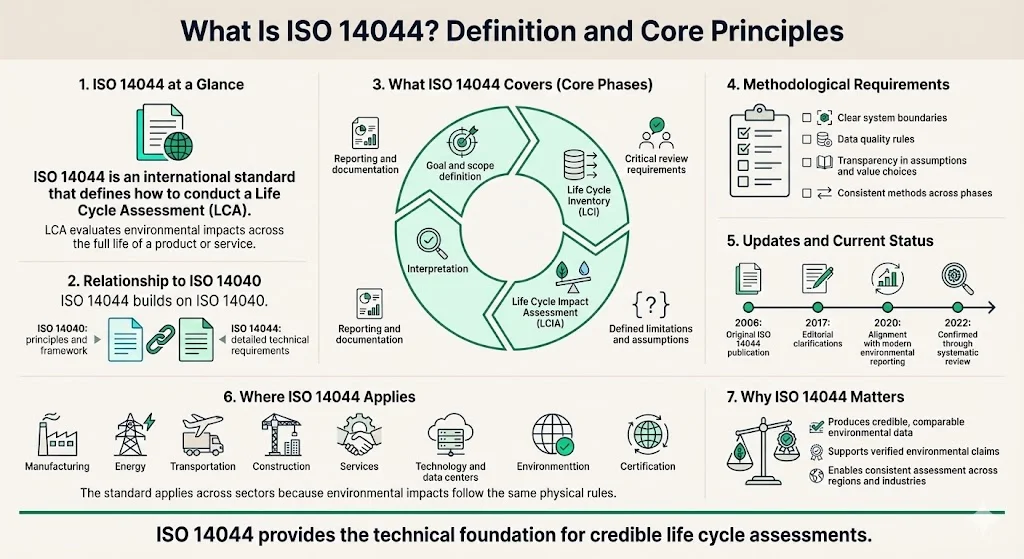
ISO 14044 is an international standard developed by ISO, or the International Organization for Standardization, that provides a guideline for conducting a life cycle assessment—the comprehensive evaluation of environmental impacts throughout a product or service's entire existence. ISO 14044:2006 specifies requirements and provides guidelines for life cycle assessment (LCA) including: definition of the goal and scope of the LCA, the life cycle inventory analysis (LCI) phase, the life cycle impact assessment (LCIA) phase, the life cycle interpretation phase, reporting and critical review of the LCA, limitations of the LCA, relationship between the LCA phases, and conditions for use of value choices and optional elements. The standard builds directly on ISO 14040, which establishes the overarching principles and framework for LCA, while ISO 14044 provides the detailed technical requirements practitioners need to execute credible assessments.
The 2017 Amendment to ISO 14044 primarily addressed editorial corrections and clarifications to improve consistency in interpretation across different regions and sectors. The 2020 Amendments to both standards enhanced alignment with evolving environmental reporting requirements. The standard was confirmed through systematic review in 2022, maintaining its relevance across all sectors—manufacturing, energy, transportation, construction, services—wherever organizations need verifiable environmental impact data. ISO 14044 applies universally because environmental impacts follow consistent physical principles regardless of industry: resource consumption, emissions, waste generation, and energy use operate according to the same thermodynamic and ecological laws whether assessing pharmaceutical production or data center operations.
Building toward SOC 2, ISO 27001, or another framework?
Drop your work email and we'll help you turn security work into audit-ready evidence automatically.
How ISO 14044 Relates to Life Cycle Assessment (LCA): Methodology & Phases
Life Cycle Assessment maps a product or service's environmental impacts across its complete life cycle, from raw material extraction through manufacturing, distribution, use, and end-of-life treatment—whether disposal, recycling, or energy recovery. The ISO standards define LCA through four interconnected phases. Each phase feeds into the others, creating an iterative process that refines and improves the assessment. This structure ensures systematic evaluation rather than selective measurement of convenient metrics.
Goal and Scope Definition establishes the assessment's purpose, system boundaries, functional unit, and impact categories under evaluation. The functional unit defines the basis for comparison—one kilogram of product, one kilometer of transport, one unit of service delivered—ensuring environmental data remains comparable across alternatives. System boundaries determine which life cycle stages enter the assessment: cradle-to-gate (raw materials through factory gate), cradle-to-grave (complete life cycle including use and disposal), or gate-to-gate (specific manufacturing processes). This initial step involves outlining the LCA's purpose and determining its boundaries. This scope must be clearly defined to ensure that the assessment addresses the intended questions and is relevant to the stakeholders.
Life Cycle Inventory (LCI) requires detailed data collection quantifying inputs—raw materials, energy, water, transportation—and outputs—atmospheric emissions, waterborne effluents, solid waste—across every included life cycle stage. ISO 14044 provides detailed guidance on data collection, calculation procedures, and allocation methods when processes produce multiple products. The standard recognises that data quality varies, so it requires documentation of data sources and their limitations. Inventory accuracy determines assessment credibility: incomplete data collection or unverified assumptions produce unreliable results regardless of sophisticated impact assessment methods applied afterward.
Life Cycle Impact Assessment (LCIA) translates inventory data into environmental impacts using scientifically validated characterization models. The standards require three mandatory elements: Selection of impact categories (such as climate change, acidification, eutrophication) Classification – assigning inventory results to impact categories Characterisation – calculating category indicator results using science-based models. Impact categories typically include climate change (greenhouse gas emissions expressed as CO₂ equivalents), resource depletion (fossil fuels, minerals, water), human toxicity, ecotoxicity, eutrophication, acidification, and ozone depletion. ISO 14044 ensures these calculations follow accepted scientific methods, preventing arbitrary or inconsistent impact characterization.
Interpretation analyzes results against the defined goal and scope, identifying environmental hotspots—specific life cycle stages, components, or processes causing disproportionate impacts. The final step is where the results are considered in the context of the objectives defined at the beginning of the process. This phase aims to provide a comprehensive understanding of the LCA results and to communicate the findings effectively. Interpretation drives actionable insights: if raw material extraction accounts for 70% of climate impact while manufacturing represents 15%, improvement efforts should prioritize material selection and sourcing rather than production efficiency alone. This methodology transforms raw environmental data into strategic direction for product redesign, supply chain optimization, and resource allocation decisions.
Use Cases: Where and How Companies Use ISO 14044 / LCA
Organizations conducting ISO 14044-aligned LCA gain verifiable environmental data that supports multiple strategic and compliance objectives across product development, supply chain management, and stakeholder communication.
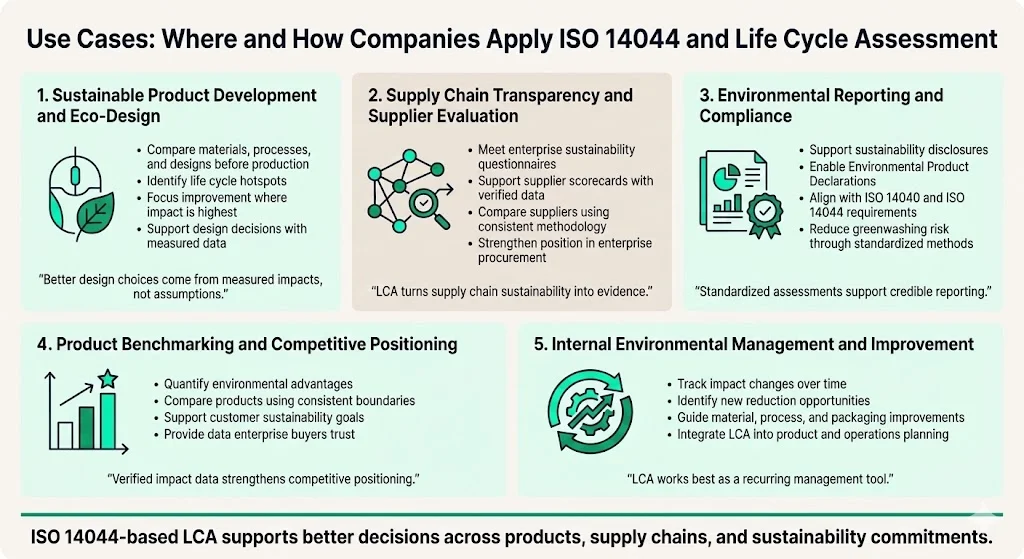
1) Sustainable product development and eco-design relies on LCA to evaluate environmental impacts of alternative materials, manufacturing processes, or design configurations before committing to production. Identifying hotspots—life cycle stages or components generating disproportionate environmental impacts—enables evidence-based prioritization of improvement efforts. A manufacturer discovering that raw material extraction contributes 65% of product carbon footprint while assembly represents 8% can direct redesign efforts toward material substitution or supplier selection rather than manufacturing process optimization. LCA-driven design decisions reduce environmental impact systematically rather than through intuition or marketing preferences.
2) Supply chain transparency and supplier evaluation addresses enterprise procurement requirements for environmental data. Organizations selling to large corporations increasingly face sustainability questionnaires, supplier scorecards, and environmental performance requirements. Providing ISO 14044-based LCA data demonstrates credible environmental assessment rather than unsubstantiated claims. LCA enables objective comparison across suppliers or product variants, supporting procurement decisions with quantified environmental impact data. For B2B suppliers, LCA capability represents competitive differentiation when enterprise clients mandate supply chain environmental transparency.
3) Environmental reporting and compliance uses LCA results to support sustainability disclosures, regulatory submissions, or Environmental Product Declarations (EPDs). Building on these foundational standards are application-standard ISO standards that require LCAs to adhere to the ISO 14040 and ISO 14044 standards and provide guidance for specific applications of the LCA, such as creating Environmental Product Declarations (EPDs). Standardized methodology prevents accusations of greenwashing—selective disclosure of favorable environmental metrics while omitting unfavorable data. Organizations using ISO 14044-aligned LCA demonstrate systematic environmental assessment rather than marketing-driven sustainability narratives.
4) Product benchmarking and competitive differentiation leverages LCA to demonstrate lower environmental impact compared to alternatives. Quantified environmental advantages—30% lower carbon footprint, 40% reduced water consumption, 25% less waste generation—provide verifiable competitive positioning. Enterprise clients implementing sustainability commitments require supplier environmental data that supports their corporate environmental goals. ISO 14044-based LCA delivers the credibility enterprise procurement teams demand when evaluating supplier environmental performance.
5) Internal environmental management and continuous improvement integrates LCA into systematic environmental performance monitoring. Periodic reassessment tracks environmental impact trends as products, processes, or supply chains evolve. LCA results identify improvement opportunities: material substitution reducing resource depletion, process modifications lowering emissions, design changes improving recyclability, packaging optimization decreasing waste. Organizations treating LCA as ongoing environmental management—rather than one-time assessment—embed continuous improvement into product development and operations.
Compliance Relevance for Enterprises: Why ISO 14044 Matters Today
Regulatory and stakeholder pressure drives enterprise demand for supplier environmental data. Large corporations implementing sustainability commitments, ESG reporting requirements, or science-based targets require supply chain environmental transparency. Many environmental regulations reference ISO 14040/44. The EU's Product Environmental Footprint method, CBAM requirements, and various national standards all build on these ISO foundations. Organizations providing ISO 14044-aligned LCA data meet enterprise procurement requirements credibly rather than through unverifiable sustainability claims.
Risk mitigation represents a fundamental driver for rigorous environmental assessment. Organizations making environmental claims without verifiable data face reputational damage, regulatory scrutiny, or stakeholder criticism when those claims prove unsubstantiated. Standardized LCA methodology reduces compliance risk by establishing documented, reproducible environmental assessments that withstand regulatory review or third-party verification. ISO 14044 specifies when and how LCA studies need independent verification. Critical review becomes mandatory when: Results will be used for comparative assertions disclosed publicly The study will support public environmental claims.
Transparency and trust emerge from systematic environmental assessment. Enterprise clients, investors, and regulators increasingly discount unverified sustainability narratives. ISO 14044-based LCA builds stakeholder confidence through internationally recognized methodology, documented data sources, and reproducible results. Organizations demonstrating environmental performance through standardized assessment gain credibility unavailable to competitors relying on marketing claims or selective disclosure.
Strategic sustainability advantage requires systematic measurement and improvement. ISO-compliant LCAs are often used to calculate Scope 3 emissions for purchased goods and capital equipment. Organizations conducting rigorous LCA identify optimization opportunities across supply chains, product portfolios, and operational processes. This enables evidence-based environmental strategy rather than aspirational sustainability commitments unsupported by measurable progress. Scalability follows from standardized methodology: organizations can apply ISO 14044 across multiple products, services, or business units, ensuring consistency in environmental assessment regardless of portfolio complexity or geographic distribution.
Limitations & Considerations: When ISO 14044 / LCA Needs Careful Use
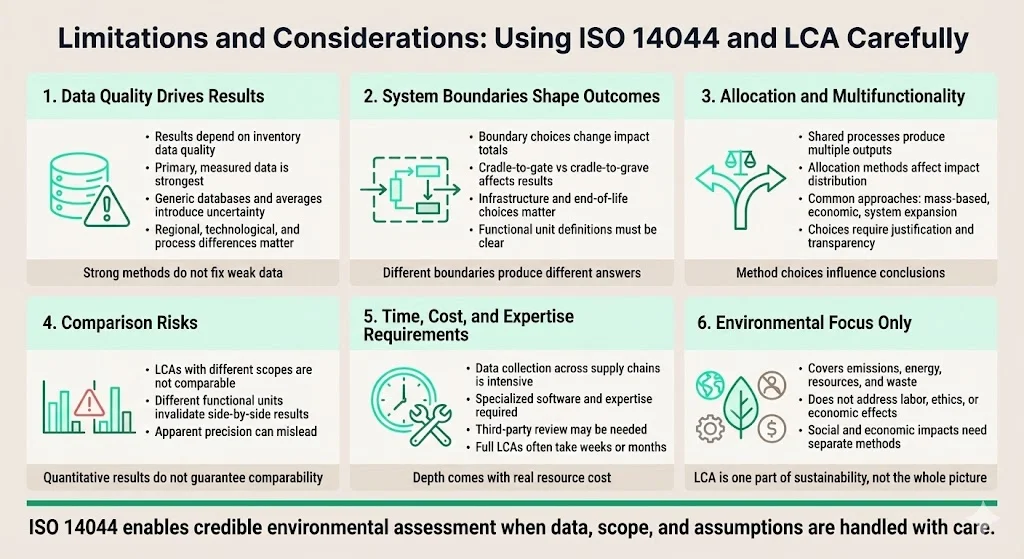
Data quality and availability determine LCA reliability. ISO 14044 provides detailed guidance on data collection, calculation procedures, and allocation methods when processes produce multiple products. The standard recognises that data quality varies, so it requires documentation of data sources and their limitations. Organizations lacking access to primary data—actual measured inputs and outputs from their processes—must rely on generic databases or industry averages. These proxies introduce uncertainty: database values may not reflect specific manufacturing conditions, regional energy grids, transportation distances, or technological variations. Poor inventory data produces unreliable impact assessments regardless of methodological rigor applied during LCIA phases.
Boundary definitions and assumptions directly influence results. System boundary decisions—which life cycle stages to include, where to truncate upstream or downstream processes, how to handle infrastructure or capital equipment—affect calculated impacts. Changing boundaries produces different outcomes: expanding boundaries from cradle-to-gate to cradle-to-grave typically increases measured impacts by including use-phase energy consumption and end-of-life treatment. Organizations must define functional units, system scope, and allocation approaches carefully to ensure results address intended questions. Comparing assessments with different boundaries or functional units produces meaningless comparisons despite apparent quantitative precision.
Allocation and multifunctionality issues arise when processes produce multiple products or when materials undergo recycling. How should environmental burdens be allocated between co-products from the same manufacturing process? Should recycled material receive credit for avoided virgin material production? ISO 14044 provides allocation guidance, but methodological choices influence results. Different allocation approaches—mass-based, economic value-based, system expansion—yield different impact distributions. These choices require documentation and justification, but introduce subjectivity into ostensibly objective environmental assessment.
Complexity and cost represent practical barriers. Conducting comprehensive LCA requires data collection across supply chains, specialized software tools, expertise in impact assessment methodology, and potentially third-party critical review. Organizations may invest weeks or months collecting inventory data, particularly for complex products with extensive supply chains. This resource intensity limits LCA application: organizations typically conduct detailed assessments for major products or strategic decisions rather than routine product development activities.
LCA focuses primarily on environmental aspects—resource consumption, emissions, waste generation—without capturing social or economic dimensions. Labor conditions, community impacts, workplace safety, supply chain ethics, economic development effects remain outside standard LCA methodology. Organizations requiring comprehensive sustainability assessment must supplement environmental LCA with social impact assessment, economic analysis, or integrated sustainability frameworks addressing environmental, social, and governance dimensions.
How to Implement ISO 14044 in Your Company: Practical Steps for Enterprise Suppliers
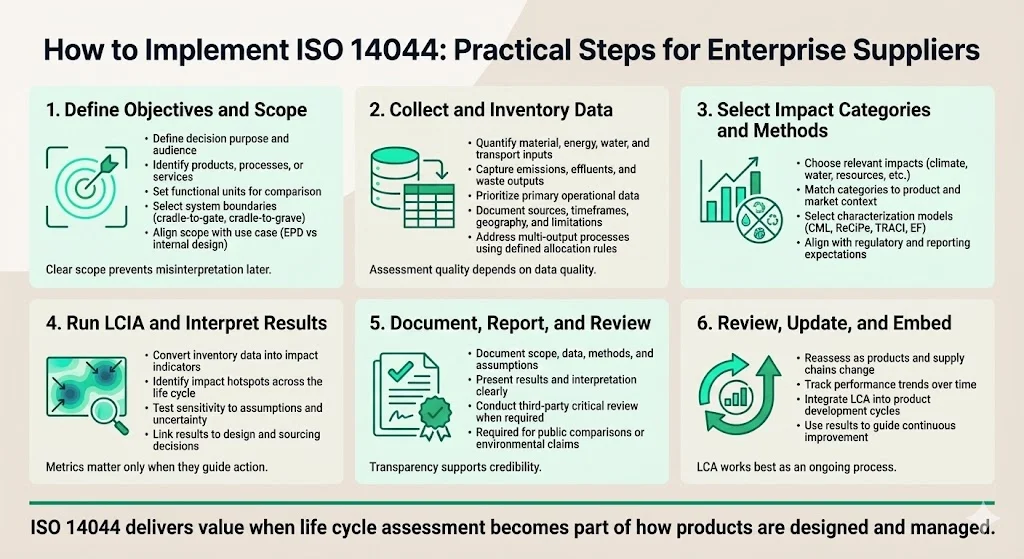
- Define clear objectives and scope. Establish what products, processes, or services require assessment, what decision the LCA will support, and what audiences will use the results. Specify functional units ensuring meaningful comparison: one kilogram of product, one year of service operation, one unit of customer value delivered. Determine system boundaries—cradle-to-gate, cradle-to-grave, or specific life cycle stages—aligned with assessment objectives. Organizations creating Environmental Product Declarations require different scope than internal product development teams evaluating design alternatives.
2) Gather and inventory data systematically. Collect quantified inputs—raw materials by mass and composition, energy consumption by type and quantity, water usage, transportation distances and modes—and outputs—atmospheric emissions by chemical species, waterborne effluents, solid waste by category—for all included life cycle stages. ISO 14044 provides detailed guidance on data collection, calculation procedures, and allocation methods when processes produce multiple products. The standard recognises that data quality varies, so it requires documentation of data sources and their limitations. Prioritize primary data from actual operations over generic database values where feasible. Document data sources, collection methods, temporal coverage, geographic relevance, and technological representativeness. Data quality determines assessment credibility more than sophisticated impact assessment methods.
3) Choose impact assessment methods and categories relevant to your context. Select impact categories (such as climate change, acidification, eutrophication) appropriate for your products, markets, and stakeholder requirements. Climate change remains universally relevant, but water scarcity matters more for agricultural products than software services. Regional regulations may prioritize specific impacts: European assessments frequently emphasize resource depletion and circularity, while carbon footprinting dominates corporate sustainability reporting. Select characterization models—CML, ReCiPe, TRACI, EF 3.0—appropriate for your geographic context and reporting requirements.
4) Run Life Cycle Impact Assessment and interpret results. Apply characterization factors translating inventory data into impact category indicators. Identify hotspots—life cycle stages, materials, or processes causing disproportionate environmental impacts—guiding improvement prioritization. Assess sensitivity to key assumptions or data uncertainties. Consider redesign opportunities: material substitution, process modifications, supply chain optimization, design for recyclability, packaging reduction. Interpretation must connect quantitative results to actionable decisions rather than generating environmental metrics without strategic application.
5) Document and report aligned with standards and stakeholder requirements. Prepare LCA reports documenting goal and scope, system boundaries, functional units, data sources and quality, allocation methods, impact assessment approaches, results, and interpretation. Organizations supporting Environmental Product Declarations or public comparative assertions require third-party critical review verifying methodology compliance. ISO 14044 specifies when and how LCA studies need independent verification. Critical review becomes mandatory when: Results will be used for comparative assertions disclosed publicly The study will support public environmental claims Reviewers verify that your study meets all ISO requirements for methodology, data, interpretation and reporting.
6) Review and update systematically. LCA represents ongoing environmental management rather than one-time assessment. As products evolve, supply chains change, manufacturing processes improve, or energy grids decarbonize, environmental impacts shift. Periodic reassessment tracks performance trends and identifies emerging improvement opportunities. Organizations embedding LCA into product development cycles build environmental considerations into design decisions systematically rather than retrofitting environmental improvements after product launch.
Relationship with Other ISO Standards: Where ISO 14044 Fits in the LCA Standard Ecosystem
ISO 14040 provides the overall framework. ISO 14044 gives the technical rules for conducting and reporting an LCA. ISO 14040 establishes principles—what LCA is, why it matters, overall structure—while ISO 14044 specifies technical requirements practitioners need for credible execution. Organizations new to LCA should understand both standards, but implementation focuses primarily on ISO 14044 requirements for goal definition, inventory analysis, impact assessment, and interpretation.
ISO 14067:2018 focuses specifically on carbon footprinting, providing guidelines for quantifying and reporting a product's impact on climate change. It complements ISO 14044 but focuses on greenhouse gas emissions (GHG) and is aligned with the ISO 14040/44 LCA standards. While ISO 14044 addresses multiple environmental impact categories—climate change, resource depletion, toxicity, eutrophication, acidification—ISO 14067 narrows focus exclusively to greenhouse gas emissions and climate change impact. Organizations requiring only carbon footprint data may implement ISO 14067, but comprehensive environmental assessment demands full ISO 14044 methodology covering all relevant impact categories.
Building on these foundational standards are application-standard ISO standards that require LCAs to adhere to the ISO 14040 and ISO 14044 standards and provide guidance for specific applications of the LCA, such as creating Environmental Product Declarations. ISO 14025 (Environmental Product Declarations): Offers a framework for using LCA data to create Environmental Product Declarations. EPDs provide standardized environmental performance communication for products, enabling comparison within product categories. EPD development requires ISO 14044-compliant LCA as the foundation for environmental data, supplemented by ISO 14025 requirements for declaration format, verification, and publication. Organizations pursuing EPDs must first implement rigorous ISO 14044 methodology before creating standardized declarations.
LCA feeds into broader environmental management and sustainability frameworks. ISO 14001 environmental management systems can incorporate LCA as the methodology for assessing environmental aspects and impacts. Corporate sustainability reporting, ESG disclosures, and regulatory compliance increasingly reference ISO 14044 as the credible standard for environmental performance quantification. Organizations building comprehensive environmental management integrate ISO 14044 LCA with environmental monitoring, compliance tracking, and continuous improvement systems.
Conclusion
ISO 14044 provides the internationally recognized standard enabling organizations to conduct credible life cycle assessments measuring environmental impact across products' complete life cycles—from raw material extraction through manufacturing, use, and end-of-life treatment. ISO 14044:2006 specifies requirements and provides guidelines for life cycle assessment (LCA) including: definition of the goal and scope of the LCA, the life cycle inventory analysis (LCI) phase, the life cycle impact assessment (LCIA) phase, the life cycle interpretation phase, reporting and critical review of the LCA. For organizations selling to enterprises, implementing ISO 14044-aligned LCA addresses growing procurement requirements for supply chain environmental transparency, supports regulatory compliance, and transforms environmental data into competitive differentiation. Adopting standardized LCA methodology delivers more than compliance checkbox completion: it enables systematic environmental improvement through hotspot identification, evidence-based product redesign, and supply chain optimization. Organizations treating LCA as ongoing environmental management—rather than isolated assessment projects—build stakeholder trust through verifiable environmental performance data rather than unsubstantiated sustainability claims.
FAQs
ISO 14044 is an international standard developed by ISO, or the International Organization for Standardization, that provides a guideline for conducting a life cycle assessment—the systematic evaluation of environmental impacts across a product or service's complete life cycle from raw material extraction through disposal or recycling. ISO 14044:2006 specifies requirements and provides guidelines for life cycle assessment (LCA) including: definition of the goal and scope of the LCA, the life cycle inventory analysis (LCI) phase, the life cycle impact assessment (LCIA) phase, the life cycle interpretation phase, reporting and critical review. The standard ensures LCA studies deliver consistent, reproducible, and credible environmental performance data.
ISO 14040: This standard provides the foundational principles and framework for LCAs. It defines what a product life cycle is and provides high-level guidelines for each phase of the LCA process, from setting goals and deciding the study's scope to interpreting the results. ISO 14040 establishes why LCA matters and the overall approach, while ISO 14044 provides detailed requirements for conducting an LCA. It includes specifications for choosing impact categories, category indicators, and characterization models. Organizations implementing LCA need both standards, but execution focuses primarily on ISO 14044 technical requirements for data collection, impact assessment methodology, reporting, and critical review when required.
ISO 14044 provides a comprehensive life cycle assessment methodology covering multiple environmental impact categories—climate change, resource depletion, water consumption, toxicity, eutrophication, acidification, ozone depletion—across products' complete life cycles. ISO 14067:2018 focuses specifically on carbon footprinting, providing guidelines for quantifying and reporting a product's impact on climate change. It complements ISO 14044 but focuses on greenhouse gas emissions (GHG) and is aligned with the ISO 14040/44 LCA standards. ISO 14067 narrows scope exclusively to greenhouse gas emissions and climate change impact. Organizations requiring only carbon footprint data may implement ISO 14067, but comprehensive environmental assessment addressing multiple impact categories demands full ISO 14044 methodology.
ISO 14040 and ISO 14044 are the foundation of a broader ecosystem of LCA-related standards. ISO 14040 and ISO 14044 standards provide the foundational principles, framework and guidelines for conducting LCAs. ISO 14040 establishes the overarching principles and framework defining what LCA is and how it functions, while ISO 14044 specifies detailed technical requirements for executing credible assessments. Together these standards provide the internationally recognized methodology ensuring LCA studies deliver consistent, reproducible, and verifiable environmental impact data across all sectors and applications.