

Most organizations treat corporate social responsibility as a communications exercise—issuing reports that satisfy investors while operations remain disconnected from stated values. This creates a credibility gap that becomes apparent when enterprise buyers conduct vendor due diligence, when regulatory scrutiny intensifies, or when stakeholder expectations collide with documented practices. ISO 26000 is increasingly viewed as a way of assessing an organization's commitment to sustainability and its overall performance. The standard provides internationally recognized guidance for organizations seeking to align operations with social responsibility principles—not as a certification to display, but as a framework for embedding accountability into decision-making structures.
Enterprise buyers now evaluate vendors against documented evidence of responsible operations across human rights, labor practices, environmental impact, and governance structures. ISO 26000 establishes a common language for these assessments, defining what social responsibility means operationally rather than aspirationally. Organizations selling into regulated industries or serving multinational enterprises face increasing pressure to demonstrate alignment with recognized social responsibility frameworks—pressure that extends beyond compliance checkboxes into operational reality.
What Is ISO 26000?
The standard was launched in 2010 following five years of negotiations between many different stakeholders across the world. Representatives from government, NGOs, industry, consumer groups and labour organizations around the world were involved in its development, which means it represents an international consensus. This International Standard was developed using a multi-stakeholder approach involving experts from more than 90 countries and 40 international or broadly-based regional organizations involved in different aspects of social responsibility.
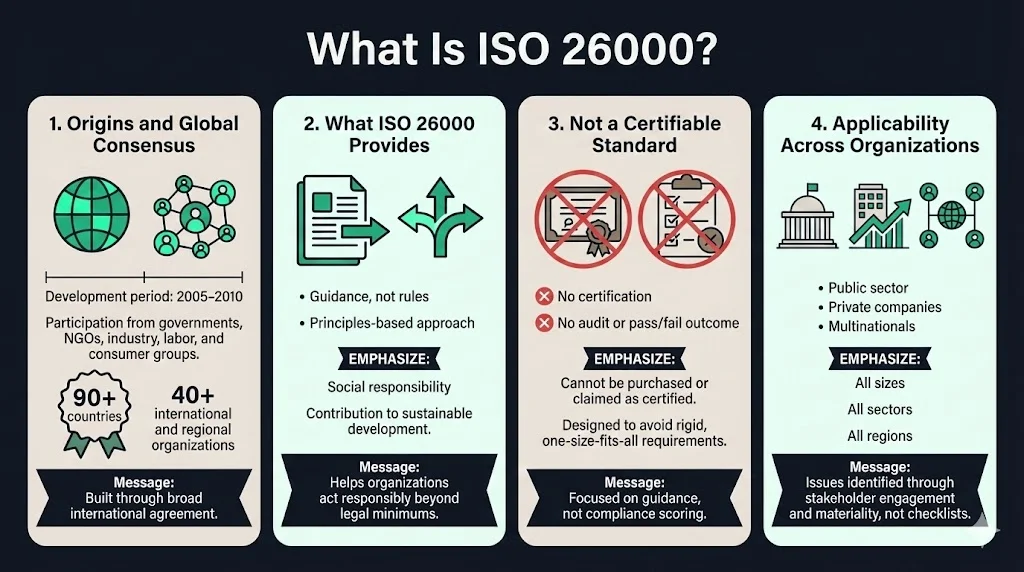
ISO 26000:2010 provides guidance rather than requirements, so it cannot be certified unlike some other well-known ISO standards. This distinction proves fundamental: organizations cannot purchase ISO 26000 certification because the standard intentionally avoids prescriptive requirements that vary by industry, geography, or organizational structure. It is intended to assist organizations in contributing to sustainable development and encourage them to go beyond legal compliance, recognizing that compliance with law is a fundamental duty of any organization and an essential part of their social responsibility.
It is aimed at all types of organizations regardless of their activity, size or location. Whether public sector entities, privately held companies, or multinational corporations, the guidance applies across operational contexts. This universality stems from focusing on social responsibility principles rather than sector-specific mandates—a design choice that allows organizations to identify relevant issues through stakeholder engagement and materiality assessments rather than checking predetermined boxes.
Building toward SOC 2, ISO 27001, or another framework?
Drop your work email and we'll help you turn security work into audit-ready evidence automatically.
Core Principles Behind ISO 26000
ISO 26000 establishes foundational principles that inform how organizations approach social responsibility decisions. These principles create the ethical baseline for operational choices across governance structures, supply chains, and stakeholder relationships.
Accountability requires organizations to answer for decisions affecting society, the economy, and the environment. This extends beyond legal liability into voluntary acceptance of responsibility for impacts—both intended and unintended. Enterprise buyers evaluate accountability through documented decision-making processes, disclosed risk assessments, and established mechanisms for addressing stakeholder concerns.
Transparency in business decisions means disclosing policies, decisions, and activities that affect stakeholders. Organizations demonstrate transparency through accessible reporting, clear communication about impacts, and willingness to provide information about decision-making criteria. This principle directly counters superficial disclosure practices that provide data without meaningful context.
Ethical behavior serves as the baseline expectation, not an aspirational goal. The principle requires organizations to base decisions on honesty, equity, and integrity—standards that apply regardless of legal requirements or competitive pressures. Ethical behavior encompasses both compliance with established norms and proactive consideration of broader impacts on people and the environment.
Respect for stakeholder interests mandates that organizations identify, consider, and respond to individuals or groups affected by decisions and activities. This extends beyond shareholders to employees, suppliers, customers, communities, and civil society organizations. Enterprise procurement teams increasingly evaluate how vendors identify stakeholders and integrate their concerns into operational decisions.
Respect for the rule of law establishes legal compliance as non-negotiable while acknowledging that laws alone do not define social responsibility. Organizations must comply with applicable legal frameworks even when enforcement remains weak—a standard particularly relevant for multinational operations spanning varied regulatory environments.
Respect for international norms of behavior requires organizations to adhere to internationally recognized standards even when local laws permit lower standards. This principle directly addresses operations in jurisdictions with weak regulatory frameworks, establishing that legal permission does not equal responsible conduct.
Respect for human rights recognizes both their importance and universality. Organizations must respect human rights throughout operations and spheres of influence, conducting due diligence to identify risks and taking action to prevent or mitigate adverse impacts. This principle connects directly to supply chain oversight, labor practices, and operational presence in high-risk jurisdictions.
The Seven Core Subjects of ISO 26000
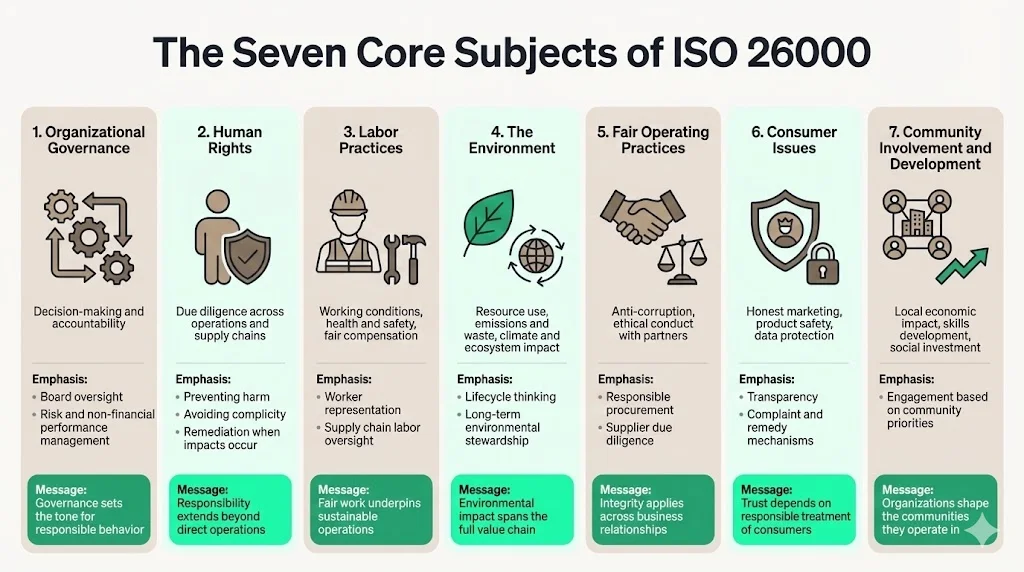
ISO 26000 organizes social responsibility guidance into seven core subjects, each encompassing multiple issues organizations must evaluate for relevance and significance.
1) Organizational Governance
Organizational governance provides the system through which organizations make and implement decisions to achieve objectives. This encompasses decision-making structures, authority delegation, accountability mechanisms, and processes for balancing stakeholder interests. Effective governance integrates social responsibility principles into strategy development, operational planning, and risk management frameworks.
Enterprise buyers evaluate organizational governance through documented oversight structures, board-level accountability for social and environmental performance, and established processes for identifying and managing non-financial risks. Governance failures frequently manifest as control weaknesses during operational audits—gaps between stated policies and actual practices that emerge when decision-making lacks systematic integration of social responsibility considerations.
2) Human Rights
Human rights due diligence requires organizations to systematically identify risks of adverse impacts, prevent or mitigate those risks, and provide or cooperate in remediation when harm occurs. This extends beyond direct operations into supply chains and business relationships where organizations may contribute to or become complicit in violations.
Avoiding complicity means ensuring that organizational activities, products, or services do not facilitate human rights violations by other parties. Enterprise procurement teams evaluate human rights practices through supplier codes of conduct, documented due diligence processes, and evidence of risk assessment across global operations. Organizations operating in high-risk jurisdictions face heightened scrutiny regarding labor conditions, freedom of association, and respect for Indigenous peoples' rights.
3) Labor Practices
Labor practices encompass all policies and practices involving work performed within, by, or on behalf of the organization. This includes direct employment, contracted work, and supply chain labor. Working conditions extend beyond legal minimums to encompass occupational health and safety programs, reasonable working hours, fair remuneration, and safe physical environments.
Fair wages must meet legal requirements while providing sufficient income to meet basic needs and allow discretionary income. Worker representation and collective bargaining rights apply even in jurisdictions where legal protections remain weak. Enterprise buyers evaluate labor practices through factory audits, documented health and safety programs, and evidence of systematic monitoring across operational locations.
4) The Environment
Managing environmental impact requires organizations to consider the full lifecycle consequences of decisions—from resource extraction through production, distribution, use, and end-of-life management. This encompasses pollution prevention, sustainable resource use, climate change mitigation and adaptation, and ecosystem protection.
Organizations demonstrate environmental responsibility through documented emissions tracking, waste reduction programs, water stewardship initiatives, and biodiversity impact assessments. Links to sustainable development goals connect environmental performance to broader commitments regarding resource availability for future generations and ecosystem health. Enterprise procurement increasingly includes environmental performance criteria in vendor scorecards, particularly for suppliers with significant manufacturing footprints or resource-intensive operations.
5) Fair Operating Practices
Fair operating practices address ethical conduct in dealings with other organizations—competitors, suppliers, contractors, customers, and public entities. Anti-corruption measures extend beyond bribery prohibitions to encompass conflicts of interest, improper influence, and facilitating payments that enable corrupt practices by others.
Responsible procurement requires organizations to integrate social and environmental criteria into supplier selection and evaluation. This includes conducting due diligence on supplier practices, establishing codes of conduct, and monitoring compliance throughout business relationships. Ethical conduct across partnerships means promoting social responsibility adoption throughout value chains rather than treating it as an isolated organizational concern.
6) Consumer Issues
Consumer issues encompass organizational responsibilities to customers or consumers of products and services. Honest marketing prohibits deceptive practices, misleading claims, or manipulation that exploits consumers' lack of information or experience. Data protection requires safeguarding personal information collected, stored, or processed during business operations—a responsibility that intensifies as data-driven business models expand.
Product safety and reliability extend beyond legal requirements to encompass appropriate testing, clear communication about risks, and systematic processes for addressing safety concerns when they emerge. Organizations demonstrate consumer protection through documented quality assurance processes, transparent privacy policies, and established mechanisms for addressing complaints and providing remedies.
7) Community Involvement and Development
Community involvement recognizes that organizations exist within broader social contexts and have responsibilities to communities where they operate. Local economic impact encompasses employment creation, local sourcing practices, and tax contributions that fund public services. Organizations contribute to community development through investment in infrastructure, support for local institutions, and initiatives that build community capacity.
Skills development programs provide training beyond immediate operational needs, supporting workforce development and economic opportunity in surrounding communities. Social investment extends beyond corporate philanthropy into strategic engagement that addresses community priorities identified through stakeholder dialogue. Enterprise buyers increasingly evaluate vendor community engagement when operational presence in specific regions creates dependencies or significant local impacts.
How ISO 26000 Impacts Businesses Selling to Enterprises
Large enterprises increasingly expect vendors to demonstrate alignment with recognized social responsibility frameworks. This expectation manifests in vendor questionnaires requesting documented policies across human rights, labor practices, environmental management, and governance structures. ISO 26000 provides the framework many enterprises reference when establishing vendor requirements—creating common terminology and evaluation criteria across procurement functions.
Vendor assessments now routinely include questions directly mapped to ISO 26000's core subjects. Organizations seeking preferred supplier status face scrutiny regarding documented approaches to identifying social responsibility issues, stakeholder engagement processes, and mechanisms for monitoring performance across operational locations. Superficial responses that reference policies without demonstrating operational integration fail these assessments, particularly when procurement teams conduct site visits or require third-party audits.
ISO 26000 strengthens stakeholder engagement by establishing systematic approaches to identifying relevant parties, understanding their concerns, and integrating feedback into decision-making. Enterprise clients, institutional investors, and regulatory bodies increasingly demand evidence of meaningful stakeholder engagement—documentation showing how organizations identify material issues rather than generic statements about commitment to responsibility.
Long-term contracts and preferred supplier status depend on demonstrated operational alignment with social responsibility principles. Enterprise buyers evaluate vendors against documented evidence of performance, not aspirational statements. Organizations using ISO 26000 as their implementation framework demonstrate structured approaches to identifying relevant issues, establishing policies and procedures, monitoring performance, and continuously improving practices—the operational discipline enterprise procurement teams seek when evaluating vendor risk.
ISO 26000 and Corporate Social Responsibility Strategy
ISO 26000 supports structured CSR programs by providing a comprehensive framework for identifying material issues, establishing priorities, and measuring progress. Organizations using the guidance conduct gap analyses against the seven core subjects, identifying areas where current practices fall short of international expectations and where stakeholder concerns require enhanced attention.
The guidance helps organizations measure and improve social performance through systematic evaluation of practices against recognized principles. This extends beyond compliance tracking into performance assessment across dimensions not captured by legal requirements—evaluating how decisions affect stakeholders, whether processes integrate social responsibility considerations, and whether outcomes align with stated commitments.
Connecting CSR goals with transparency and accountability expectations means establishing measurable objectives, documenting progress, and disclosing performance to stakeholders. ISO 26000 provides the structure for this integration, linking individual initiatives to broader social responsibility principles and ensuring that activities address material issues rather than isolated concerns.
Organizations ground actions in recognized guidance to avoid superficial claims that fail scrutiny. Enterprise buyers differentiate between vendors making aspirational statements about responsibility and those demonstrating systematic approaches to identifying issues, implementing controls, and monitoring performance. ISO 26000 alignment signals structured commitment rather than performative CSR—the operational discipline that withstands procurement due diligence and stakeholder scrutiny.
Practical Ways Businesses Use ISO 26000
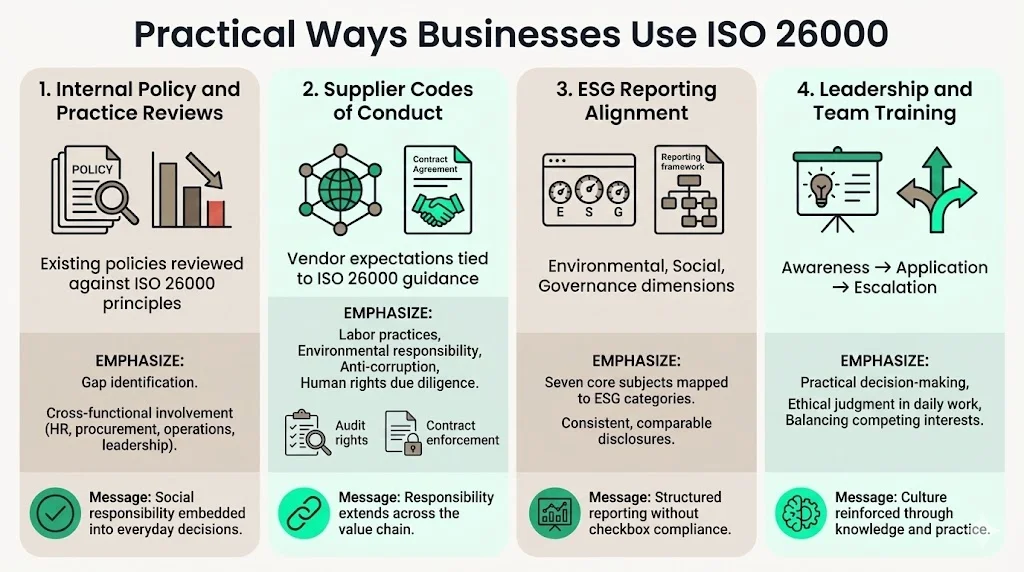
Organizations implement ISO 26000 through internal policy reviews that evaluate existing practices against the standard's principles and core subjects. Gap analysis identifies areas requiring enhanced policies, improved processes, or additional controls. This assessment extends across organizational functions—from procurement and human resources to operations and investor relations—ensuring that social responsibility considerations integrate into decision-making rather than remaining isolated in sustainability departments.
Supplier codes of conduct frequently reference ISO 26000 when establishing expectations for vendors. Organizations translate the standard's guidance into specific requirements regarding labor practices, environmental management, anti-corruption measures, and human rights due diligence. These codes establish contractual commitments backed by audit rights and termination provisions for material violations.
ESG reporting alignment uses ISO 26000's framework to structure disclosure across environmental, social, and governance dimensions. The seven core subjects map directly to ESG reporting categories, helping organizations ensure comprehensive coverage of material topics. This alignment facilitates comparison across reporting frameworks while maintaining focus on substantive performance rather than checkbox compliance.
Training leadership and teams on responsible practices embeds social responsibility principles into organizational culture. This extends beyond policy awareness into practical application—teaching personnel how to identify social responsibility issues in daily decisions, when to escalate concerns, and how to balance competing interests while maintaining ethical standards.
ISO 26000 Compared to Other ISO Standards
ISO 26000 vs ISO 14001
ISO 26000:2010 is not a management system standard. ISO 14001, by contrast, establishes requirements for environmental management systems subject to third-party certification. ISO 14001 focuses exclusively on environmental aspects of operations, providing a structured approach to identifying environmental impacts, establishing objectives and targets, implementing operational controls, and monitoring performance.
ISO 26000 encompasses environmental considerations within a broader social responsibility framework that includes human rights, labor practices, governance, fair operating practices, consumer issues, and community development. Organizations frequently implement both standards together—using ISO 14001 for systematic environmental management while applying ISO 26000's broader guidance to address social responsibility issues extending beyond environmental performance.
The management system structure of ISO 14001 provides documented procedures, defined responsibilities, and systematic monitoring mechanisms suitable for certification audits. ISO 26000 provides guidance for identifying relevant issues and establishing appropriate approaches without prescribing specific management system requirements. This distinction reflects different purposes: ISO 14001 enables certification to demonstrate environmental management system implementation, while ISO 26000 helps organizations understand and operationalize social responsibility principles.
Benefits of Aligning With ISO 26000
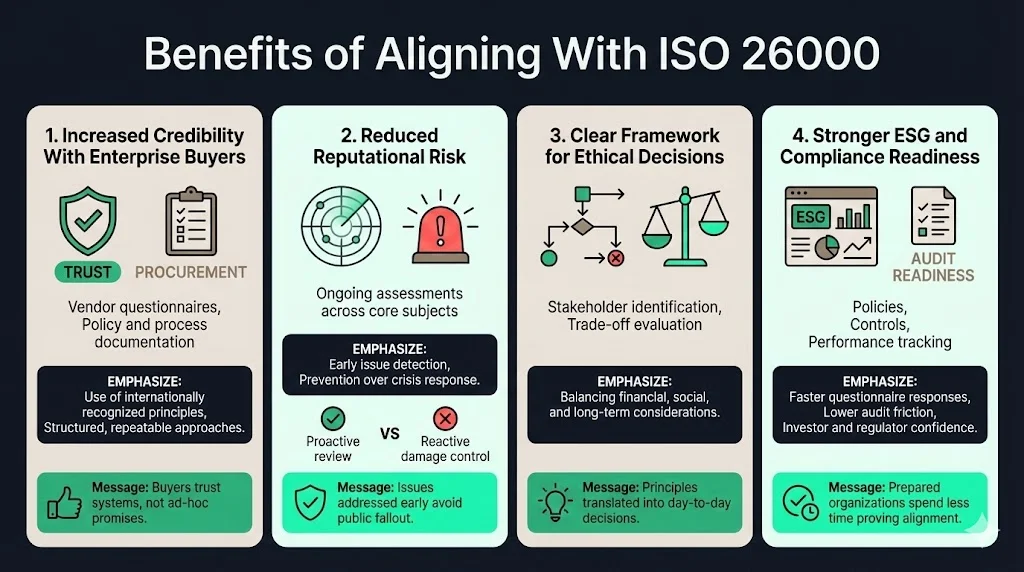
Alignment with ISO 26000 strengthens credibility with enterprise buyers by demonstrating structured approaches to identifying and managing social responsibility issues. Organizations referencing the standard signal familiarity with internationally recognized principles and commitment to systematic implementation rather than ad-hoc responses to stakeholder concerns. This credibility proves particularly valuable when vendor questionnaires request documentation of policies, procedures, and performance across multiple social responsibility dimensions.
Reduced reputational risk stems from systematic identification and mitigation of social and environmental impacts. Organizations using ISO 26000 conduct regular assessments of practices across core subjects, identifying potential issues before they escalate into public controversies or regulatory enforcement actions. This proactive approach contrasts with reactive crisis management that typically follows reputational failures.
Clear structure for ethical business practices addresses the operational challenge of translating principles into decisions. ISO 26000 provides frameworks for evaluating choices against social responsibility criteria, identifying stakeholders affected by decisions, and balancing competing interests while maintaining ethical standards. This structure proves valuable when personnel face complex decisions involving trade-offs between financial performance, stakeholder interests, and long-term sustainability.
Better readiness for ESG and compliance reviews results from documented approaches to identifying material issues, implementing controls, and monitoring performance. Organizations aligning with ISO 26000 develop the policies, procedures, and performance data that satisfy due diligence requirements from investors, procurement teams, and regulatory bodies. This readiness reduces the resource burden of responding to questionnaires, supporting audits, and demonstrating operational alignment with stated commitments.
Common Misunderstandings About ISO 26000
It is not intended or appropriate for certification purposes or regulatory or contractual use. Any offer to certify, or claims to be certified, to ISO 26000 would be a misrepresentation of the intent and purpose and a misuse of this International Standard. Organizations encountering certification offers for ISO 26000 should recognize these as misrepresentations—the standard explicitly prohibits certification claims because it provides guidance rather than auditable requirements.
Alignment matters without certification because enterprise buyers evaluate actual practices rather than certificates. Vendor assessments examine documented policies, evidence of implementation, and performance data demonstrating operational alignment with social responsibility principles. Organizations demonstrating systematic approaches to identifying issues, engaging stakeholders, and monitoring performance across ISO 26000's core subjects satisfy procurement requirements regardless of certification status.
Enterprises evaluate real-world behavior through site visits, document reviews, and third-party audits that assess operational reality rather than stated policies. This scrutiny reveals whether organizations genuinely integrate social responsibility into decision-making or maintain policies disconnected from operational practices. ISO 26000 alignment signals commitment to systematic implementation—the operational discipline that withstands due diligence rather than superficial compliance that fails when examined.
Conclusion
Social responsibility represents a business expectation embedded in vendor selection criteria, contract terms, and ongoing performance evaluations. Organizations treating it as optional or delegating it to communications functions face procurement barriers when enterprise buyers demand documented evidence of systematic approaches to managing social and environmental impacts. ISO 26000 provides the framework for translating principles into operational practices that satisfy due diligence requirements.
ISO 26000 establishes a shared language between enterprises and suppliers—common terminology for discussing human rights due diligence, stakeholder engagement, environmental management, and governance structures. This shared framework facilitates meaningful dialogue during vendor assessments, enabling organizations to demonstrate operational alignment rather than navigating fragmented requirements across different procurement functions or customer bases.
Long-term value stems from embedding responsible practices into operations rather than maintaining them as parallel initiatives disconnected from core business processes. Organizations integrating ISO 26000's principles into decision-making structures, risk management frameworks, and performance evaluation systems build operational resilience that extends beyond satisfying immediate procurement requirements. This integration positions organizations to adapt as stakeholder expectations evolve and regulatory frameworks expand—maintaining operational credibility rather than scrambling to address emerging requirements.
FAQs
No. ISO 26000:2010 provides guidance rather than requirements, so it cannot be certified unlike some other well-known ISO standards. Organizations claiming ISO 26000 certification misrepresent the standard's purpose—it provides guidance for implementing social responsibility principles rather than auditable requirements suitable for certification.
It is aimed at all types of organizations regardless of their activity, size or location. The guidance applies to public sector entities, privately held companies, nonprofits, and multinational corporations. Organizations working with enterprise clients find particular value in ISO 26000 because it establishes common frameworks for vendor social responsibility assessments.
ISO 26000 helps organizations demonstrate commitment to accountability, transparency, and ethical conduct through systematic approaches to identifying and addressing social responsibility issues. Enterprise buyers, investors, and other stakeholders evaluate organizational reputation based on documented evidence of responsible practices rather than aspirational statements—the operational discipline ISO 26000 provides directly influences trust and brand perception.
ISO 26000:2010 is not a management system standard. ISO 14001 establishes requirements for environmental management systems subject to certification. ISO 26000 provides broader social responsibility guidance encompassing environmental considerations alongside human rights, labor practices, governance, fair operating practices, consumer issues, and community development. Organizations frequently implement both standards—using ISO 14001 for systematic environmental management and ISO 26000 for comprehensive social responsibility.
Representatives from government, NGOs, industry, consumer groups and labour organizations around the world were involved in its development, which means it represents an international consensus. The standard applies across regions, industries, and legal systems—designed specifically to provide guidance that remains relevant despite variations in regulatory frameworks, cultural contexts, and economic development stages.

