Most organizations approach anti-bribery compliance as a risk mitigation checkbox rather than a fundamental governance discipline. This creates a critical gap between documented policies and operational reality—a gap that becomes apparent when regulatory scrutiny intensifies or business relationships with high-risk jurisdictions demand verifiable anti-corruption controls.
What is ISO 37001?
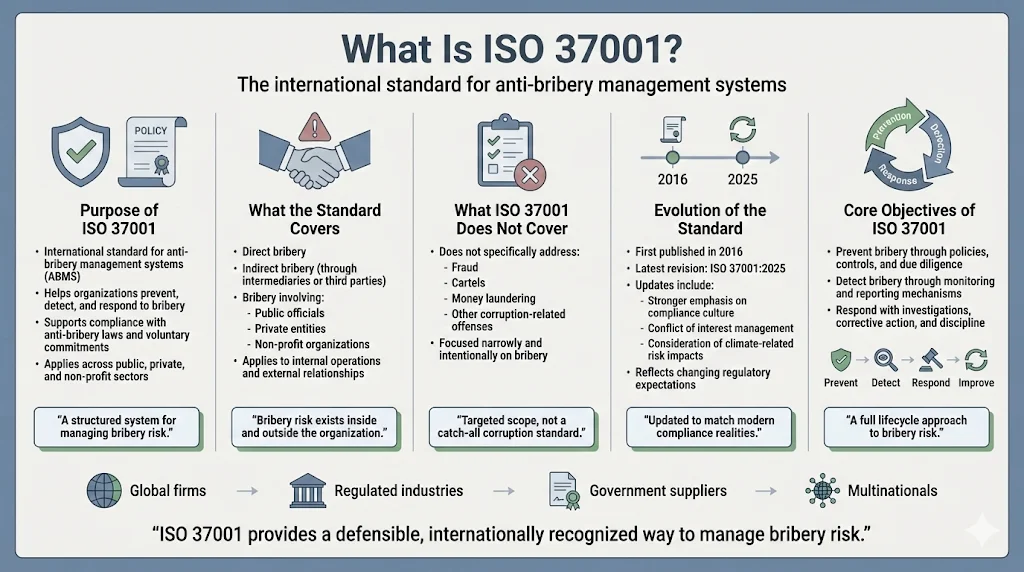
ISO 37001 is an international standard dedicated to establishing, implementing, maintaining, and improving an anti-bribery management system (ABMS), designed to help organizations prevent, detect, and respond to bribery, as well as comply with anti-bribery laws and voluntary commitments applicable to their activities. Originally published by the International Organization for Standardization (ISO) in 2016, the most recent update, ISO 37001:2025, includes enhanced provisions on compliance culture, climate change impacts, conflict of interest management, reflecting the evolving regulatory landscape.
The standard covers various forms of bribery—both direct and indirect—within public, private, and not-for-profit sectors. Unlike general anti-corruption frameworks, ISO 37001 is applicable specifically to bribery, intended to improve the organization's ability to prevent, detect, and respond to bribery and comply with anti-bribery laws; it does not specifically address fraud, cartels, money-laundering, or other activities related to corrupt practices.
The standard serves three primary objectives: preventing bribery through systematic controls, detecting bribery incidents through monitoring mechanisms, and responding appropriately to identified violations through documented corrective actions.
Building toward SOC 2, ISO 27001, or another framework?
Drop your work email and we'll help you turn security work into audit-ready evidence automatically.
The Core Components of ISO 37001
Anti-Bribery Management System
ISO 37001 sets out the requirements for the establishment, implementation, operation, maintenance, and continual improvement of an anti-bribery management system (ABMS). The ABMS functions as a structured framework integrating anti-bribery policies, procedures, and controls into existing organizational operations. Key components include anti-bribery policies, due diligence procedures, financial and non-financial controls, training programs, and mechanisms for monitoring.
Compliance Standards
ISO 37001 establishes specific compliance benchmarks that organizations must meet to achieve certification. These benchmarks address both organizational culture and operational processes, requiring documented evidence of control implementation across all business functions. The standard mandates leadership commitment, risk-based approaches, and proportionate controls aligned with organizational size, sector, and geographic risk exposure.
Risk Management
Organizations that implement an ABMS in accordance with ISO 37001:2025 gain enhanced risk management, strengthening the organization's ability to prevent, detect, and respond to bribery risks both internally and in business relationships. ISO 37001 helps companies identify a range of risk scenarios, including operating in geographically sensitive areas or dealing with high-risk associates. This risk-based approach requires organizations to conduct regular assessments identifying potential bribery vulnerabilities in transactions, third-party relationships, and operational contexts.
Internal Controls
The standard requires implementation of financial and non-financial controls addressing high-risk activities including gifts, hospitality, donations, procurement, and interactions with public officials. These controls must be proportionate to identified risks and integrated into existing governance structures rather than operating as standalone compliance exercises. The measures required by ISO 37001 are designed to be integrated into the organization's existing management structure and controls; many of the required measures will be those which the organization has already implemented, and where a new or enhanced measure is required, this can be integrated into the organization's existing structure and systems.
Ethical Practices
ISO 37001 focuses on fostering a culture of integrity, transparency, and trust within organizations. This cultural component requires leadership demonstration of ethical commitment, clear communication of anti-bribery expectations, and protection mechanisms for whistleblowers reporting suspected violations.
How ISO 37001 Supports Corporate Governance
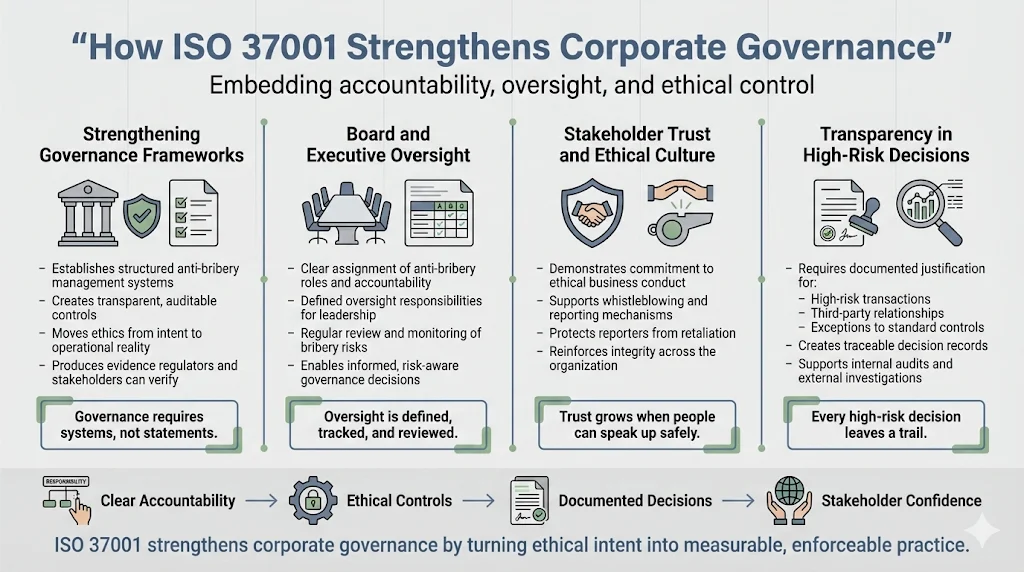
ISO 37001 certification strengthens corporate governance frameworks by establishing transparent, auditable anti-bribery controls that satisfy regulatory requirements and stakeholder expectations. Organizations implementing the standard demonstrate measurable commitment to ethical operations rather than aspirational compliance statements.
The standard supports increased stakeholder trust by demonstrating a strong commitment to ethical business practices and organizational integrity, while establishing whistleblowing and reporting mechanisms that protect individuals without fear of retaliation. For boards and executive leadership, ISO 37001 provides structured oversight mechanisms ensuring anti-bribery responsibilities are clearly assigned, monitored, and regularly reviewed.
The standard enhances decision-making transparency by requiring documented rationale for high-risk transactions, third-party engagements, and exceptions to standard procedures. This documentation creates accountability trails that satisfy both internal governance requirements and external regulatory inquiries.
Preventive Measures: How ISO 37001 Reduces Risk
ISO 37001 provides a manageable business framework for preventing, detecting and addressing bribery risks that can potentially reduce corporate costs related to bribery misconducts. The standard mandates specific preventive measures designed to address bribery risks before violations occur:
Due Diligence and Third-Party Management
Organizations must conduct risk-based due diligence on business associates, partners, and third parties who may present bribery risks. The standard establishes consistent processes for assessing transactions, third parties, and business associates. This due diligence extends beyond initial vetting to include ongoing monitoring throughout the business relationship.
Employee Training and Awareness
Comprehensive training programs ensure personnel understand anti-bribery policies, recognize potential violations, and know reporting procedures. Training must be tailored to role-specific risks, with enhanced requirements for employees in high-risk functions such as procurement, sales, and government relations.
Policy Development and Implementation
Anti-bribery policies must address specific high-risk scenarios including gifts and hospitality thresholds, facilitation payments (explicitly prohibited), political contributions, charitable donations, and sponsorships. Policies require regular review and updating to reflect changing business operations and regulatory requirements.
Auditing and Monitoring
The standard promotes continual improvement of anti-bribery policies through regular audits, performance reviews, and corrective actions. Both internal audits and external assessments verify control effectiveness, identify gaps, and track remediation activities.
The Benefits of Implementing ISO 37001
Business Integrity and Reputation
Compliance with the ISO 37001 standard can be a key market differentiator when used to minimise the risk of unlawful behavior and showcase an organisation's dedication to ethical practices; ISO 37001 certification is a valuable credential that can build customer and investor confidence in the organisation's integrity and credibility. ISO 37001 is a rare and very sought-after standard for anti-bribery management systems, and is recognised around the world as a marque of integrity and trust in business.
Access to New Markets
Organizations operating in or expanding to high-corruption-risk jurisdictions face increased scrutiny from clients, partners, and regulators. ISO 37001 certification provides verifiable evidence of anti-bribery controls, facilitating market entry and partnership opportunities that would otherwise require extensive due diligence. Having ISO 37001 certification puts your business one step closer to securing the next contract you pitch for.
Competitive Advantage
In procurement processes for government contracts and enterprise-level engagements, ISO 37001 certification increasingly serves as a differentiating requirement. Organizations without demonstrable anti-bribery management systems face exclusion from opportunities where compliance verification is mandatory.
Reduced Legal and Financial Risks
ISO 37001 supports adherence to anti-bribery laws and regulations, thereby reducing legal exposure and potential penalties. The estimated annual cost of bribery worldwide exceeds $1.5 trillion—implementing systematic controls mitigates exposure to enforcement actions, reputational damage, and operational disruptions resulting from bribery investigations.
While certification to ISO 37001 cannot guarantee that bribery will not occur, it verifies that you have a structured management system in place to prevent such situations. This documented evidence of reasonable precautions provides defensibility during regulatory inquiries and can influence prosecution decisions and penalty determinations.
ISO 37001 vs. ISO 37301: Key Differences
Organizations evaluating compliance management frameworks frequently encounter both ISO 37001 and ISO 37301. Understanding their distinct scopes prevents implementation gaps and resource misallocation.
ISO 37001: Anti-Bribery Management Systems
ISO 37001 is the international standard specifically for anti-bribery management systems. Its scope addresses exclusively bribery prevention, detection, and response. The standard provides detailed requirements for controls specific to bribery risks including gifts, hospitality, facilitation payments, and public official interactions.
ISO 37301: Compliance Management Systems
ISO 37301 establishes requirements for general compliance management systems addressing the full range of an organization's compliance obligations. Rather than focusing on a specific risk area, ISO 37301 provides a framework for managing all regulatory, legal, and voluntary compliance commitments across multiple jurisdictions and business functions.
Comparison of Scope and Application
ISO 37001 delivers specialized anti-bribery controls with specific implementation guidance for bribery scenarios. ISO 37301 provides broader compliance governance applicable to diverse regulatory requirements including environmental regulations, labor laws, data protection, and industry-specific mandates.
Organizations may implement both standards concurrently. ISO 37001 supports alignment with compliance frameworks, such as ISO 37301 (Compliance Management) to support broader governance frameworks. The anti-bribery management system can be a stand-alone system or integrated into an already implemented management system; an organization can choose to implement the anti-bribery management system in conjunction with or as part of other systems, such as those relating to quality, environment and safety.
How to Get ISO 37001 Certification
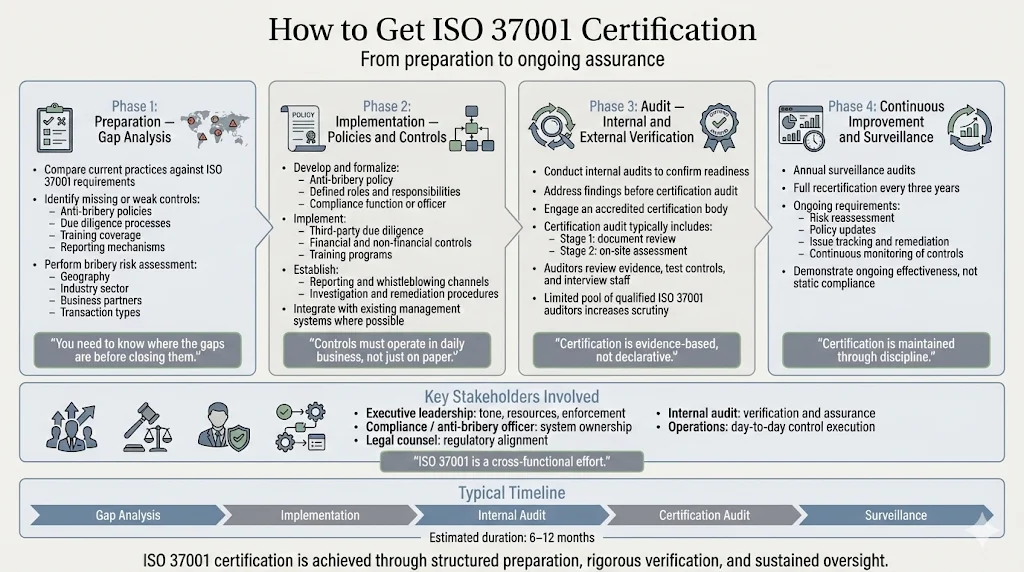
Achieving ISO 37001 certification requires systematic preparation, implementation, and verification through accredited certification bodies. Organizations typically invest 6-12 months establishing compliant anti-bribery management systems before formal audit.
Preparation: Gap Analysis
Initial preparation involves comprehensive gap analysis comparing current anti-bribery controls against ISO 37001 requirements. This assessment identifies missing policies, inadequate due diligence procedures, insufficient training programs, and control weaknesses requiring remediation. Organizations must evaluate bribery risks specific to their operations, geography, industry sector, and business relationships.
Implementation: Policy and Control Development
Implementation requires developing and integrating anti-bribery policies, procedures, and controls throughout organizational operations. This includes establishing anti-bribery policy documents, defining roles and responsibilities (including compliance function requirements), implementing due diligence procedures for third parties, creating financial and non-financial controls, developing training programs, establishing reporting mechanisms, and documenting procedures for investigating suspected violations.
The standard can be implemented as a standalone system or integrated into an existing management framework, complementing other compliance and ethical guidelines to strengthen an organization's overall governance structure.
Audit: Internal and External Verification
Achieving certification to ISO 37001 is a challenge because it is not a typical management system; by the nature of adhering to anti-bribery and anti-corruption laws, meeting the needs of this standard are exceptionally high, and only a handful of accredited assessors are qualified to audit ISO 37001.
Internal audits verify control implementation and effectiveness before engaging external certification bodies. External audits conducted by accredited third-party auditors assess compliance with ISO 37001 requirements through document review, personnel interviews, control testing, and evidence evaluation. Certification audits typically occur in two stages: initial document review followed by on-site assessment.
Continuous Improvement: Ongoing Monitoring
ISO 37001 certification requires ongoing surveillance audits (typically annually) and recertification audits (typically every three years). Organizations must maintain continuous monitoring of anti-bribery controls, conduct regular risk assessments, update policies reflecting operational changes, track and remediate identified issues, and document improvement activities.
Key stakeholders in the certification process include executive leadership (providing resources and demonstrating commitment), compliance function or designated anti-bribery officer (managing implementation), legal counsel (ensuring regulatory alignment), internal audit (conducting verification activities), and operational personnel (implementing day-to-day controls).
Examples of Companies with ISO 37001 Certification
The standard was adopted by the governments of Singapore and Peru for their anti-bribery management systems, and formed the basis for the "Shenzhen Standard," an official anti-bribery standard published by the city of Shenzhen, China in June 2017; Microsoft and Walmart have also announced intentions to obtain ISO 37001 certification.
Organizations achieving ISO 37001 certification span diverse sectors including technology, manufacturing, construction, professional services, and financial services. Certification benefits include enhanced credibility during enterprise sales cycles, reduced due diligence timelines when establishing partnerships, improved access to government contracting opportunities, and documented compliance posture satisfying regulatory expectations.
Companies operating in high-corruption-risk markets report ISO 37001 certification as instrumental in securing contracts where anti-bribery controls represent mandatory vendor requirements. The certification provides third-party verification eliminating protracted compliance questionnaires and repetitive audit requests from multiple clients.
The Role of Auditing in ISO 37001
Auditing serves as the verification mechanism ensuring anti-bribery controls function effectively rather than existing only in policy documents. ISO 37001 requires both internal and external audit activities.
Internal Audits
Internal audits assess control implementation, identify weaknesses, and verify corrective actions before external certification audits. Internal audit programs must cover all ISO 37001 requirements on a regular cycle, typically annually. Auditors examine policy documentation, test control effectiveness through transaction sampling, interview personnel regarding anti-bribery procedures, and review incident reports and investigations.
External Audits
External audits conducted by accredited certification bodies provide independent verification of ISO 37001 compliance. These audits assess organizational context and risk assessment adequacy, leadership commitment and resource allocation, anti-bribery policy comprehensiveness, due diligence procedure effectiveness, control implementation and operation, training program completion and effectiveness, monitoring and reporting mechanism functionality, and corrective action processes.
Corrective Actions
Auditing identifies nonconformities requiring corrective action before certification or to maintain existing certification. Organizations must document root cause analysis, implement corrective measures, and verify effectiveness. The corrective action process demonstrates commitment to continuous improvement rather than minimum compliance.
Continuous Monitoring
Beyond scheduled audits, ISO 37001 requires ongoing monitoring of anti-bribery control effectiveness. This includes periodic risk reassessments, control testing, incident tracking and analysis, third-party monitoring, and policy effectiveness reviews. Monitoring results inform management review meetings where leadership evaluates ABMS performance and approves improvement initiatives.
Developing Policies to Align with ISO 37001
Anti-bribery policies represent the foundation of ISO 37001 compliance. Effective policies establish clear expectations, provide implementation guidance, and create accountability for violations.
Key Elements of Strong Anti-Bribery Policies
ISO 37001-compliant policies must address specific high-risk scenarios with detailed guidance. Core policy elements include prohibition statements explicitly forbidding all forms of bribery, definitions clarifying what constitutes bribery in operational contexts, gifts and hospitality thresholds with approval procedures for exceptions, facilitation payment prohibition with reporting requirements if coerced payments occur, political contribution and charitable donation controls preventing disguised bribes, third-party due diligence requirements, public official interaction protocols, and reporting procedures with whistleblower protections.
Policies require specificity appropriate to organizational risk profiles. Generic prohibition statements fail to provide actionable guidance when personnel encounter ambiguous situations requiring judgment calls.
Integration into Business Strategy
Anti-bribery policies cannot function as standalone compliance documents disconnected from operational realities. Effective integration requires embedding policy requirements into standard business processes including procurement procedures requiring vendor due diligence, sales processes addressing gift and hospitality approvals, contract management incorporating anti-bribery clauses, financial controls flagging suspicious transactions, and human resources processes covering background checks and disciplinary procedures.
Training and Communication Strategies
Policy documents should be communicated to all employees and relevant stakeholders. Training programs must translate policy requirements into role-specific guidance. Initial training during onboarding establishes baseline understanding; periodic refresher training reinforces expectations and addresses policy updates. High-risk roles require enhanced training addressing specific scenarios relevant to their functions.
Communication strategies extend beyond formal training to include leadership messaging reinforcing anti-bribery commitment, case studies illustrating policy application, accessible policy repositories, and regular reminders during relevant business activities.
ISO 37001 provides organizations with systematic controls addressing bribery risks that threaten business integrity, regulatory compliance, and stakeholder trust. The standard is applicable to any organization, regardless of size or sector, including entities in public, private, and not-for-profit sectors that wish to proactively combat bribery.
Organizations treating anti-bribery compliance as documentation exercises rather than operational disciplines create fundamental vulnerabilities. ISO 37001 certification demonstrates verifiable commitment to preventing bribery through implemented controls, not aspirational policy statements. For companies selling to enterprise clients, operating in high-risk jurisdictions, or seeking competitive differentiation in regulated industries, ISO 37001 certification increasingly represents a business necessity rather than a voluntary enhancement.
We implement anti-bribery management systems that produce genuine risk mitigation and regulatory compliance—not compliance theater satisfying auditors while leaving organizations exposed. ISO 37001 certification through managed implementation ensures controls function operationally, not just documentarily.
Run the ABMS and the ISMS off one set of records
Book a demo and we'll show how Konfirmity keeps policy versions, training completions, third-party due diligence and internal audit findings in one place, so your information security program reuses the governance you already run.
Book a demo
Frequently Asked Questions
ISO 37001 is an international standard dedicated to establishing, implementing, maintaining, and improving an anti-bribery management system, designed to help organizations prevent, detect, and respond to bribery, as well as comply with anti-bribery laws and voluntary commitments.
An ISO 37001 readiness checklist assesses organizational preparedness for certification by evaluating anti-bribery policy documentation, leadership commitment and resource allocation, bribery risk assessment completion, due diligence procedures for third parties, financial and non-financial controls implementation, training program deployment, reporting and investigation mechanisms, monitoring and audit processes, and documented evidence of control operation. The checklist identifies gaps requiring remediation before formal certification audit.
Certification requires conducting gap analysis against ISO 37001 requirements, implementing required policies and controls, performing internal audits verifying effectiveness, engaging accredited certification bodies, completing Stage 1 documentation review, passing Stage 2 on-site audit, addressing any nonconformities identified, and maintaining compliance through surveillance audits. Organizations typically invest 6-12 months achieving initial certification depending on existing control maturity.
ISO 37001 specifically addresses anti-bribery management systems with detailed requirements for preventing, detecting, and responding to bribery. ISO 37301 establishes general compliance management system requirements applicable to all organizational compliance obligations across regulatory, legal, and voluntary commitments. ISO 37001 provides specialized anti-bribery controls; ISO 37301 offers a broad compliance governance framework. Organizations may implement both standards concurrently for comprehensive compliance management.
ISO 37001 provides organizations with a systematic approach to combat bribery through legal compliance and fostering a culture of integrity, transparency, and trust; by implementing an anti-bribery management system, organizations can mitigate risks and damage associated with bribery, enhance their reputation, and ensure stable and fair market operations.
Core requirements include establishing anti-bribery policy with leadership commitment, conducting bribery risk assessments, implementing due diligence procedures for third parties and transactions, creating financial and non-financial controls, providing role-appropriate training, establishing reporting mechanisms with whistleblower protections, conducting regular internal audits, investigating suspected violations with documented corrective actions, and maintaining ongoing monitoring and management review processes.
ISO 37001 is applicable to any organization, regardless of size or sector, including entities in public, private, and not-for-profit sectors. ISO 37001 is a flexible business tool that can be adapted by any organisation, large or small, in any country, regardless of business type or bribery risk. The standard uses risk-based approaches allowing proportionate implementation scaled to organizational size, complexity, and risk exposure.
Certification benefits include reduced legal and regulatory risks through documented compliance controls, enhanced reputation and stakeholder trust, competitive advantage in procurement processes requiring anti-bribery verification, improved access to markets and partnerships in high-risk jurisdictions, potential mitigation during enforcement actions through demonstrated reasonable precautions, and operational improvements through systematic risk management. Certification reduces the risk of bribery occurring in your organization or against your organization and/or employees.
Organizations including the governments of Singapore and Peru have adopted the standard for their anti-bribery management systems; Microsoft and Walmart have announced intentions to obtain ISO 37001 certification. Certified organizations span technology, manufacturing, construction, professional services, and financial sectors. Companies report certification as instrumental in securing enterprise contracts, reducing client due diligence requirements, and providing verifiable anti-bribery controls satisfying regulatory expectations.