

Most organizations treat energy management as a cost center to be optimized reactively—adjusting consumption only when prices surge or regulatory pressure intensifies. This approach creates a fundamental gap between energy expenditure and strategic performance management, a gap that becomes apparent when enterprise buyers scrutinize your operational efficiency or when energy-related compliance obligations expand beyond voluntary commitments.
ISO 50001:2018 is an international standard that provides a framework for establishing, implementing, maintaining, and improving an Energy Management System (EnMS). The standard specifies the requirements for establishing, implementing, maintaining, and improving an energy management system, whose purpose is to enable an organization to follow a systematic approach in achieving continual improvement of energy performance, including energy efficiency, energy security, energy use, and consumption. This article examines the specific requirements organizations must address to implement ISO 50001, the business impact for enterprise-focused companies, and how the standard transforms energy performance from a reactive cost management exercise into a disciplined operational capability.
What is ISO 50001?
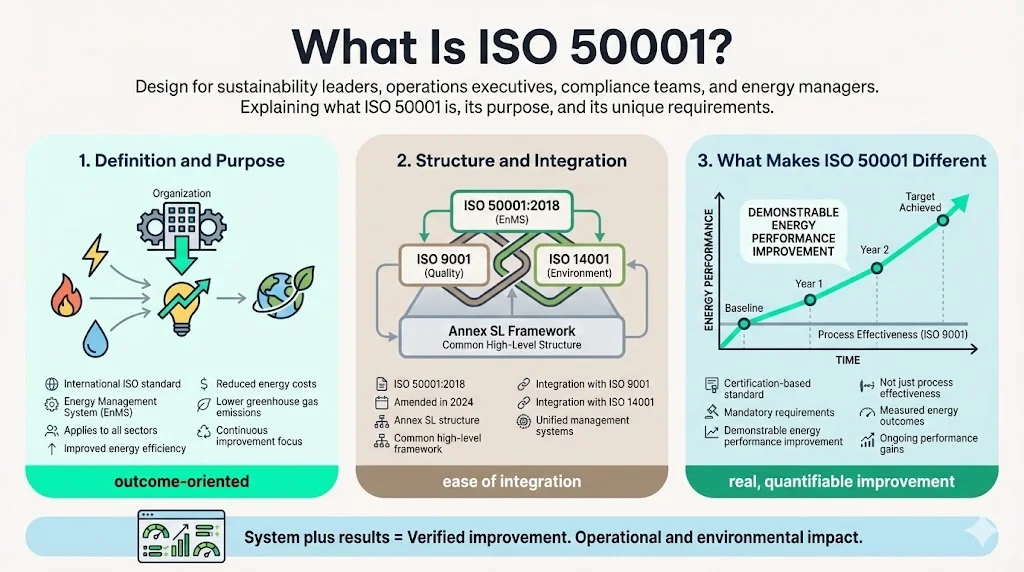
ISO 50001 Energy management systems - Requirements with guidance for use, is an international standard created by the International Organization for Standardization (ISO). It supports organizations in all sectors to use energy more efficiently through the development of an energy Management System. The standard aims to help organizations continually reduce their energy use, and therefore their energy costs and their greenhouse gas emissions.
ISO 50001:2018, the revised version of the standard, was published in 2018 and amended in 2024. The 2018 revision aligned ISO 50001 with Annex SL, the high-level structure used across ISO management system standards including ISO 9001 and ISO 14001, enabling organizations to integrate energy management seamlessly with existing quality and environmental management systems.
Unlike voluntary guidance documents, ISO 50001 establishes mandatory requirements for organizations seeking certification. A significant feature in ISO 50001 is the requirement to "... improve the EnMS and the resulting energy performance" (clause 4.2.1 c). This distinguishes ISO 50001 from other management system standards by requiring demonstrable improvement in actual energy performance, not merely system effectiveness.
Who Should Follow ISO 50001
Any organization, regardless of size, sector, or location, can implement ISO 50001 to improve its energy performance. The standard applies universally across industries, from manufacturing facilities and data centers to commercial buildings and service providers.
Energy-intensive organizations—including industrial manufacturers, logistics operations, healthcare systems, and technology infrastructure providers—derive immediate operational benefits from systematic energy management. For enterprises selling to other businesses, ISO 50001 certification addresses increasingly common RFP requirements around sustainability credentials, energy performance metrics, and environmental management system integration.
The growth of ISO 50001 is expected to accelerate as an increasing number of companies integrate ISO 50001 into their corporate sustainability strategies and supplier requirements. Organizations operating in regulated sectors or selling into European markets face heightened scrutiny regarding energy performance documentation and compliance with national energy efficiency schemes.
Is Certification Mandatory
Like other ISO management system standards, certification to ISO 50001 is possible but not obligatory. Some organizations decide to implement the standard solely for the benefits it provides. Others decide to get certified to it, to show external parties they have implemented an energy management system.
The standard itself is voluntary. Organizations can adopt ISO 50001 requirements internally to structure energy management practices without pursuing formal certification. However, certification through accredited certification bodies provides third-party validation that becomes particularly valuable when enterprise buyers conduct supplier assessments, when responding to sustainability-focused RFPs, or when demonstrating compliance with voluntary energy efficiency commitments.
Building toward SOC 2, ISO 27001, or another framework?
Drop your work email and we'll help you turn security work into audit-ready evidence automatically.
ISO 50001 Requirements Explained
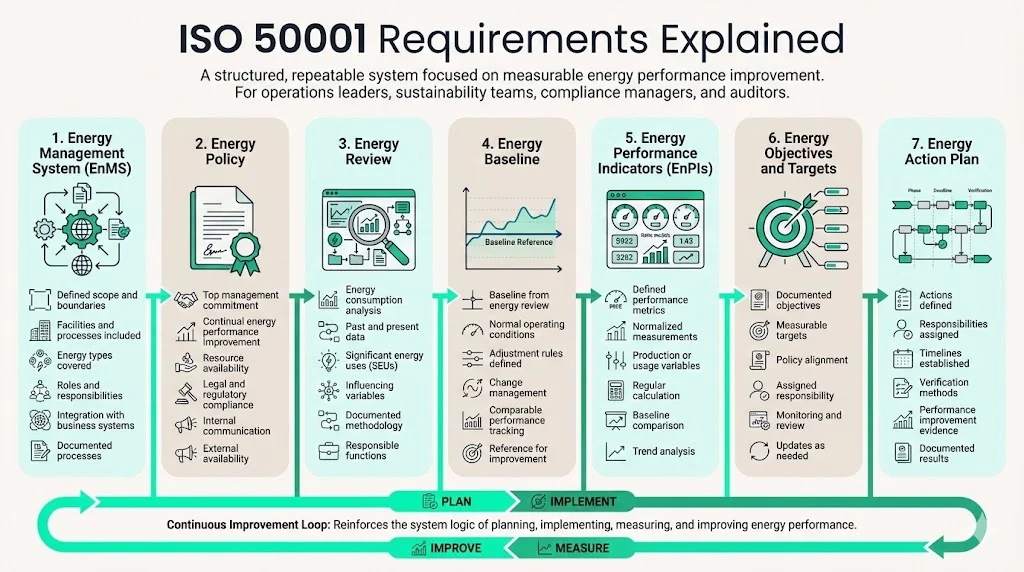
ISO 50001 structures requirements across planning, implementation, monitoring, and improvement phases. Organizations must address each requirement systematically to achieve certification and maintain ongoing compliance.
1) Energy Management System (EnMS)
An energy management system (EnMS) integrates energy management into existing business systems, enabling organizations to better manage their energy and sustain achieved savings. Companies use an EnMS to establish the policies and procedures to systematically track, analyze, and improve energy efficiency.
The EnMS represents the organizational structure, documented processes, and allocated resources dedicated to energy performance management. ISO 50001 requires establishing an EnMS that encompasses scope definition, boundary determination, and integration with existing management systems. Organizations must define which facilities, processes, and energy types fall within the EnMS scope and document how energy management responsibilities integrate with operational decision-making.
2) Energy Policy
The energy policy establishes top management's commitment to energy performance improvement and sets the organization's strategic direction for energy management. ISO 50001 requires that the energy policy include explicit commitments to continual improvement of energy performance, ensuring availability of information and resources necessary to achieve energy objectives, and compliance with applicable legal and other requirements related to energy use.
The policy must be documented, communicated within the organization, and made available to interested parties. This requirement ensures energy management carries executive sponsorship and strategic alignment rather than existing as a facilities management initiative disconnected from business objectives.
3) Energy Review
Organizations must conduct a comprehensive energy review to identify significant energy uses, document current energy consumption patterns, and analyze variables affecting energy performance. The energy review examines past and present energy consumption data across facilities and processes within the defined EnMS scope.
This review identifies significant energy uses—those activities, facilities, or equipment that account for substantial energy consumption or present significant potential for energy performance improvement. Organizations must document the methodology used to determine significance, the data sources analyzed, and the personnel or functions associated with significant energy uses. The energy review forms the analytical foundation for subsequent baseline establishment and performance indicator selection.
4) Energy Baseline
The energy baseline establishes the reference point against which energy performance improvements are measured. ISO 50001 requires organizations to establish one or more energy baselines using data from the energy review, covering a period that reflects normal operations and accounts for variables affecting energy consumption.
Baselines must be adjusted when variables no longer reflect organizational operations, when significant changes occur to processes or systems, or according to predetermined methods. This requirement prevents organizations from claiming performance improvements that result from reduced production output or other business changes unrelated to energy management initiatives. The baseline provides the comparative benchmark for demonstrating the actual energy performance improvement required by clause 4.2.1 c.
5) Energy Performance Indicators (EnPIs)
An EnPI is a metric used to measure energy performance. It can be a simple ratio, a model, or a more complex calculation depending on the organization's needs. Organizations must establish EnPIs appropriate for monitoring and measuring energy performance, with the methodology documented and regularly reviewed.
EnPIs typically normalize energy consumption against relevant variables such as production volume, square footage, degree days, or operating hours. A manufacturing facility might track energy consumed per unit produced, while a commercial building might measure energy intensity per square foot adjusted for heating and cooling degree days. ISO 50001 requires that EnPIs be calculated at defined intervals, compared against the baseline, and used to demonstrate energy performance improvement over time.
6) Energy Objectives & Targets
Organizations must establish documented energy objectives at relevant functions and levels within the organization. These objectives must be consistent with the energy policy, measurable when practicable, monitored, communicated, and updated as appropriate.
Objectives translate the energy policy into specific, actionable goals. They typically address reducing energy consumption in significant energy use areas, improving energy efficiency of specific processes or equipment, or achieving defined reductions in energy intensity metrics. Organizations must establish targets—specific performance requirements arising from energy objectives—and allocate responsibility for achieving objectives and meeting targets to designated personnel or functions.
7) Energy Action Plan
ISO 50001 requires organizations to establish, implement, and maintain action plans to achieve energy objectives and targets. Action plans must specify designated responsibilities, means and timeframes for achieving individual targets, methods for verifying energy performance improvement, and methods for verifying results.
Action plans bridge strategic objectives and operational implementation. They document specific activities such as equipment upgrades, process modifications, operational procedure changes, or behavioral initiatives designed to achieve measurable energy performance improvements. Organizations must define how improvement results will be verified and document the verification methodology.
Support Requirements
ISO 50001 includes supporting requirements that enable the EnMS to function effectively across the organization.
Competence and Awareness
Organizations must determine the necessary competence of personnel whose work affects energy performance, ensure personnel are competent based on appropriate education, training, or experience, and take actions to acquire necessary competence. This includes ensuring personnel are aware of the energy policy, their contribution to EnMS effectiveness, and the implications of not conforming to EnMS requirements.
Training requirements extend beyond energy management team members to include personnel operating significant energy use equipment, those making procurement decisions affecting energy performance, and management responsible for resource allocation decisions impacting energy initiatives.
Documentation and Control
ISO 50001 requires documented information covering the EnMS scope and boundaries, the energy policy, energy objectives and targets, and evidence demonstrating EnMS implementation. Organizations must create, update, and control this documentation, ensuring it remains available where needed, adequately protected, and maintained in a usable format.
Documentation requirements support audit evidence collection and ensure consistency in energy management practices across organizational changes. Documented information includes energy data records, significant energy use determinations, baseline calculations, EnPI methodologies, action plan tracking, monitoring and measurement records, and internal audit results.
Legal and Other Requirements
Organizations must establish, implement, and maintain processes to identify, access, and understand legal requirements and other requirements applicable to energy use, energy consumption, and energy efficiency. This includes requirements arising from regulatory obligations, voluntary commitments, contractual agreements, or organizational requirements.
Organizations must determine how legal and other requirements apply to their energy use and ensure these requirements are addressed when establishing, implementing, and maintaining the EnMS. This requirement ensures energy management activities align with applicable regulatory frameworks and voluntary commitments such as carbon reduction targets or energy efficiency schemes.
Execution and Operation
ISO 50001 specifies operational requirements for implementing and maintaining the EnMS.
1) Monitoring and Measurement
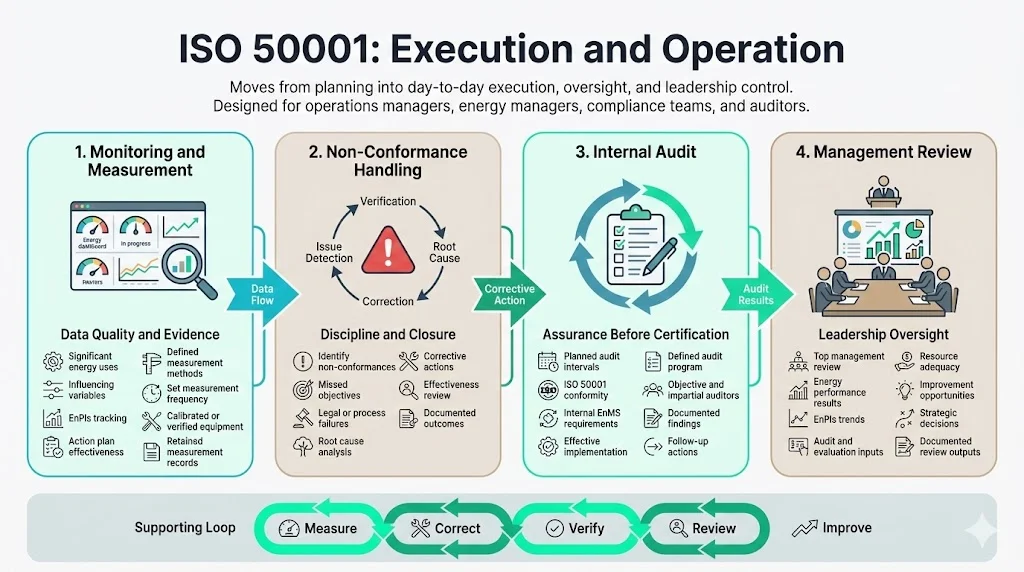
Organizations must determine what needs to be monitored and measured, including significant energy uses, variables affecting significant energy uses, EnPIs, effectiveness of action plans, and actual versus expected energy consumption. ISO 50001 requires defining monitoring and measurement methods, establishing measurement frequencies, and ensuring monitoring and measurement equipment is calibrated or verified at specified intervals.
Monitoring and measurement provide the data necessary to evaluate energy performance improvement, verify action plan effectiveness, and support management decision-making. Organizations must retain documented information as evidence of monitoring and measurement results.
2) Non-Conformance Handling
When non-conformances occur—including failures to meet legal or other requirements, failures to achieve energy objectives, or failures to implement EnMS processes as planned—organizations must react to the non-conformance, evaluate the need for action to eliminate causes, implement necessary actions, and review the effectiveness of corrective actions taken.
This requirement ensures systematic resolution of EnMS failures and energy performance shortfalls rather than allowing issues to persist. Organizations must document the nature of non-conformances, subsequent actions taken, and results of corrective actions.
3) Internal Audit
ISO 50001 requires organizations to conduct internal audits at planned intervals to determine whether the EnMS conforms to ISO 50001 requirements, conforms to the organization's own EnMS requirements, and is effectively implemented and maintained. Organizations must establish an audit program defining frequency, methods, responsibilities, and reporting requirements.
Internal audits provide systematic evaluation of EnMS implementation before certification audits occur. Auditors must be objective and impartial, with documented competence requirements. Organizations must document audit programs, audit results, and actions taken in response to audit findings.
4) Management Review
Top management must review the EnMS at planned intervals to ensure its continuing suitability, adequacy, and effectiveness. Management review must consider the status of actions from previous reviews, changes in external and internal issues relevant to the EnMS, energy performance and related EnPIs, results of EnMS evaluation including audit results, opportunities for continual improvement, and resource adequacy.
Management review ensures executive oversight of energy performance and provides the forum for strategic decisions regarding EnMS scope changes, resource allocation, and energy objective adjustments. Organizations must retain documented information demonstrating management review outputs including decisions related to continual improvement opportunities and resource needs.
Continuous Improvement
This standard shares the Plan-Do-Check-Act structure to continual improvement used in ISO 9001 (quality management), ISO 14001 (environmental management), and other management systems. The Plan-Do-Check-Act cycle structures ISO 50001 requirements into iterative phases: planning activities establish the baseline and objectives, implementation activities execute action plans, checking activities monitor performance and audit compliance, and acting activities drive corrective actions and improvement initiatives.
ISO 50001, therefore, has made a major leap forward in 'raising the bar' by requiring an organization to demonstrate that they have improved their energy performance. Organizations must continually improve the suitability, adequacy, and effectiveness of the EnMS and energy performance. This requirement prevents stagnation at initial performance levels and ensures energy management evolves with changing organizational needs, technology capabilities, and performance expectations.
Business Impact of ISO 50001 Requirements
ISO 50001 implementation delivers measurable business value for enterprise-focused organizations beyond energy cost reduction.
1) Operational Benefits
According to the DOE, or the U.S. Department of Energy, companies dedicated to energy performance improvement could benefit from a 12% reduction in energy usage—demonstrating how systematic energy management reduces operational costs while improving resource predictability. Energy performance data collected under ISO 50001 requirements informs procurement decisions, facility planning, and capital investment prioritization.
Organizations achieve cost savings through multiple mechanisms: identifying and eliminating energy waste in existing processes, optimizing equipment operation and maintenance schedules based on energy performance data, and prioritizing capital investments in energy-efficient technologies based on documented performance baselines and quantified improvement potential.
2) Market & Competitive Impact
ISO 50001 certification demonstrates an organization's commitment to continual improvement in energy management, allowing them to lead by example within their respective industries and ensure related legislative and regulatory requirements are met. For enterprises selling to other businesses, certification addresses increasingly common RFP requirements around environmental management systems, sustainability credentials, and energy performance documentation.
Enterprise buyers conducting supplier assessments frequently evaluate energy management capabilities as part of vendor risk management and corporate sustainability initiatives. ISO 50001 certification provides third-party verified evidence of systematic energy management, differentiating certified suppliers from competitors claiming undefined "energy efficiency" initiatives.
3) Risk & Regulatory Compliance
ISO 50001 integrates compliance checks into the energy management process, helping businesses track evolving laws, avoid penalties, and meet voluntary commitment. The legal and other requirements clause ensures organizations systematically identify and address applicable energy regulations rather than reacting to compliance gaps during regulatory audits or enforcement actions.
Organizations operating across multiple jurisdictions face varying energy reporting requirements, efficiency standards, and carbon reduction mandates. ISO 50001 provides the systematic framework for tracking these obligations, documenting compliance evidence, and demonstrating due diligence in energy regulatory matters.
4) Organizational Culture
ISO 50001 requirements around competence, awareness, and communication build organizational accountability for energy performance beyond facilities management teams. When procurement personnel understand energy performance implications of equipment specifications, when operations teams track energy metrics alongside quality and productivity metrics, and when executive management reviews energy performance quarterly, energy efficiency becomes embedded in operational decision-making rather than isolated as a separate initiative.
Implementation Challenges and Best Practices
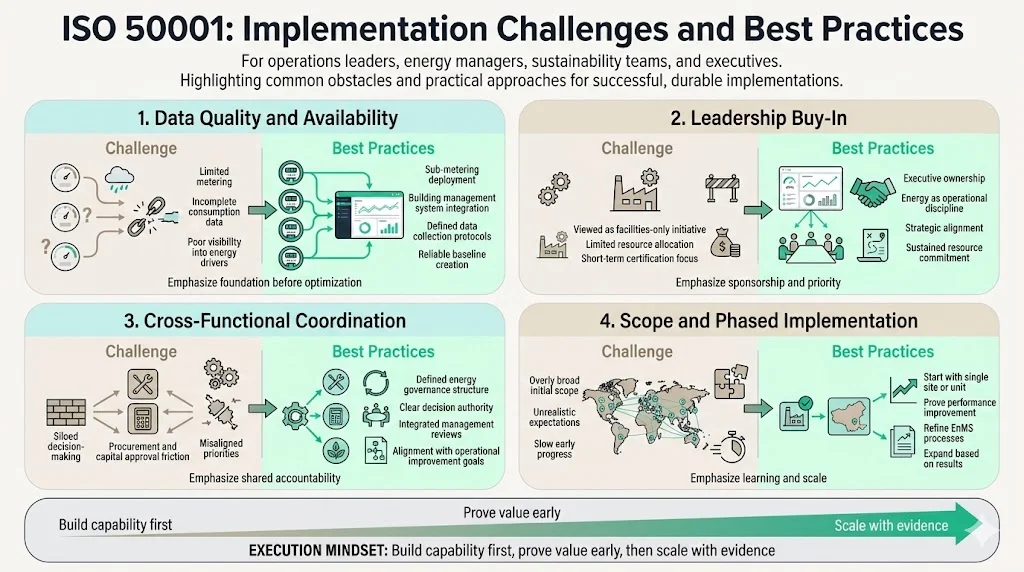
Organizations pursuing ISO 50001 certification encounter predictable implementation challenges. The most common obstacle involves data quality and availability—many organizations lack metering infrastructure necessary to monitor energy consumption at the granularity required to identify significant energy uses, establish meaningful baselines, and calculate normalized EnPIs. Implementing sub-metering, integrating building management system data, and establishing data collection protocols requires capital investment and technical expertise before EnMS implementation can proceed effectively.
Leadership buy-in determines implementation success. When executive management views ISO 50001 as a facilities initiative rather than a strategic operational capability, organizations struggle to secure resources for action plan implementation, achieve cross-functional collaboration, and sustain energy performance improvement beyond initial certification. Effective implementations position energy management as an operational discipline comparable to quality management or safety management, with equivalent executive oversight and resource allocation.
Cross-functional collaboration between energy management teams, operations, procurement, facilities, and finance functions creates practical implementation challenges. Energy objectives frequently require operational procedure changes, equipment procurement decisions, or capital investment approvals outside the direct control of energy management personnel. Organizations address this challenge by establishing energy management governance structures with clear decision-making authority, integrating energy performance metrics into existing management review processes, and aligning energy objectives with broader operational improvement initiatives.
Practical implementation approaches include starting with a limited scope—such as a single facility or business unit—to develop EnMS processes and demonstrate performance improvement before expanding certification scope. This phased approach builds organizational competence, identifies data quality requirements, and establishes the business case for broader implementation based on demonstrated results rather than projected benefits.
Conclusion
ISO 50001 requirements transform energy management from reactive cost control to systematic operational discipline. The standard establishes mandatory requirements across planning, implementation, monitoring, and improvement phases, requiring organizations to document energy performance baselines, establish measurable objectives, implement action plans, conduct internal audits, and demonstrate continual energy performance improvement.
For enterprise-focused organizations, ISO 50001 certification provides third-party verified evidence of systematic energy management that addresses increasingly common supplier assessment requirements, regulatory compliance obligations, and competitive differentiation needs. The operational benefits—including measurable energy cost reduction, improved resource predictability, and enhanced procurement decision-making—justify implementation investment independent of certification value.
Organizations implementing ISO 50001 must address data quality requirements, secure executive sponsorship, establish cross-functional collaboration mechanisms, and allocate resources for action plan implementation. When executed effectively, ISO 50001 requirements build the management system infrastructure necessary to sustain energy performance improvement over multiple audit cycles and changing organizational conditions.
FAQs
ISO 50001 requirements include establishing an energy management system with documented energy policy, conducting energy reviews to identify significant energy uses, establishing energy baselines and performance indicators, setting measurable energy objectives and targets, implementing energy action plans, monitoring and measuring energy performance, conducting internal audits, and demonstrating continual improvement of energy performance. Organizations must also address supporting requirements including competence and awareness, documentation control, and legal compliance.
Any organization regardless of size, sector, or geographic location can implement ISO 50001. The standard applies particularly to energy-intensive operations including manufacturing facilities, data centers, logistics operations, and commercial buildings. Organizations selling to enterprise buyers increasingly face ISO 50001 certification requirements in RFPs and supplier assessments as part of corporate sustainability initiatives and supply chain risk management programs.
ISO 50001 certification is voluntary. Organizations can implement the standard's requirements internally to structure energy management practices without pursuing formal certification. However, certification through accredited certification bodies provides third-party validation valuable for addressing supplier assessment requirements, demonstrating regulatory compliance, and differentiating from competitors in enterprise sales processes.
ISO 50001 certificates typically remain valid for three years following initial certification, subject to successful annual surveillance audits conducted by the certification body. Surveillance audits verify ongoing compliance with ISO 50001 requirements and continued energy performance improvement. Organizations must undergo recertification audits at three-year intervals to maintain valid certification status.