

Most organizations build networks atop cabling infrastructure they rarely examine—until performance degrades, connectivity fails, or auditors question whether that infrastructure meets established standards. ISO/IEC 11801 Information technology — Generic cabling for customer premises specifies general-purpose telecommunication cabling systems (structured cabling) that are suitable for a wide range of applications (analog and ISDN telephony, various data communication standards, building control systems, factory automation, and data center operations). This international standard establishes the technical foundation for how copper and fiber-optic cabling should perform across commercial, industrial, and residential environments—defining categories, performance classes, testing procedures, and topology requirements that determine whether your network infrastructure can support current applications and future demands.
For enterprises selling connectivity solutions, network infrastructure, or building services to technical decision-makers, ISO/IEC 11801 compliance represents more than regulatory checkbox satisfaction. It signals infrastructure that accommodates 10 Gigabit Ethernet today, scales to support IoT deployments tomorrow, and maintains consistent performance characteristics across global offices operating under different regional standards. Understanding this standard's structure, performance classifications, and implementation requirements enables organizations to specify cabling systems that deliver measurable transmission performance rather than optimistic vendor promises.
What is ISO/IEC 11801: The Basics
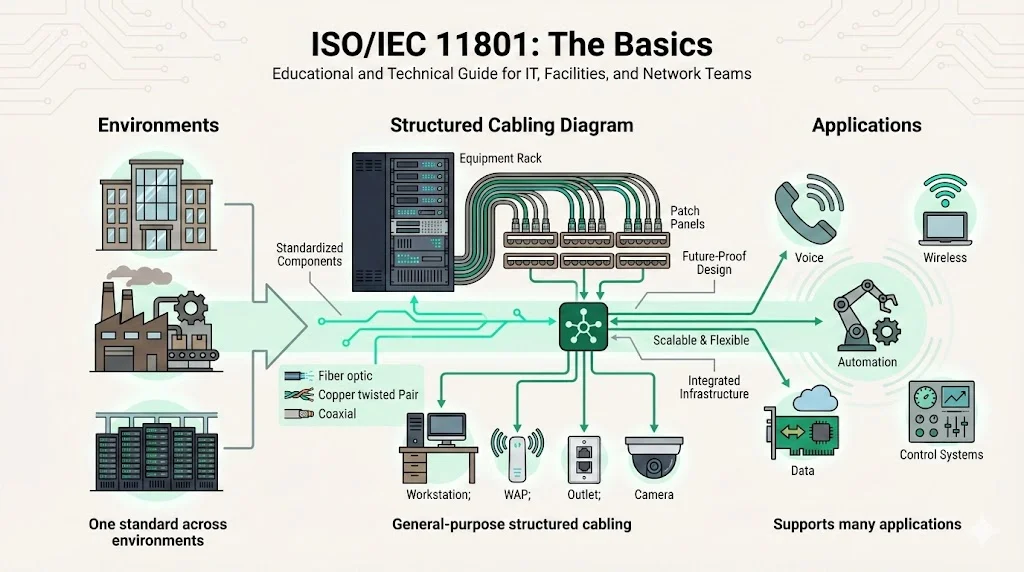
ISO/IEC 11801 is an international standard that specifies general-purpose telecommunication cabling systems (structured cabling) that are suitable for a wide range of applications (analog and ISDN telephony, various data communication standards, building control systems, factory automation). The standard addresses both balanced copper cabling (twisted-pair configurations) and optical fiber cabling, providing unified specifications applicable across diverse use cases—from traditional voice telephony and data communications to modern building automation, wireless access point connectivity, and industrial control systems.
Scope & Context
The standard targets premises spanning approximately 3 kilometers with office space up to 1 square kilometer, designed to support 50 to 50,000 users. While optimized for this range, implementation principles extend beyond these parameters when properly adapted. The standard unified several prior standards for commercial, home, and industrial networks, as well as data centers, and defined requirements for generic cabling and distributed building networks—consolidating fragmented cabling specifications into a cohesive framework applicable across building types and network environments.
Who Publishes It: Understanding "IEC in ISO/IEC"
The standard is co-published by the International Organization for Standardization (ISO) and the International Electrotechnical Commission (IEC). An international cabling standard was initiated in 1990 and developed by iso/iec committee sc25/wg3, specifically ISO/IEC JTC 1/SC 25/WG 3. The "IEC" designation reflects collaboration between ISO, which develops broad international standards across industries, and IEC, which specializes in electrical and electronic technologies. This partnership ensures the standard addresses both general information technology requirements and electrical performance specifications critical to transmission integrity.
Building toward SOC 2, ISO 27001, or another framework?
Drop your work email and we'll help you turn security work into audit-ready evidence automatically.
The Structure of ISO/IEC 11801 (Parts, What They Cover)
ISO/IEC 11801 cabling standard is divided into six parts. Since then, because of its size, the standard has been divided into six parts, replacing the previous monolithic document structure with modular specifications tailored to distinct environments:
Part 1: General Requirements — Defines fundamental specifications for balanced copper cabling and optical fiber systems, including transmission parameters, component characteristics, link and channel performance specifications, and testing procedures applicable across all premises types.
Part 2: Office Premises — Performance categories of the cabling and network topology in office premises are defined in Part 2. To meet the requirements of the new standard for cabling networks installed in office premises, Category 6 must be utilized at a minimum, with Category 6A required for transmission speeds exceeding 1 Gbit/s.
Part 3: Industrial Premises — Addresses cabling requirements for industrial buildings, automation systems, and process control environments where vibration, electrical noise, contaminants, and environmental factors demand ruggedized specifications beyond typical office-grade installations.
Part 4: Single-Tenant Homes — Specifies residential cabling systems for single-family dwellings, accommodating home networking, entertainment systems, and residential automation infrastructure.
Part 5: Data Centers — Establishes high-performance network infrastructure specifications for data center environments requiring maximum bandwidth, minimal latency, and robust redundancy.
Part 6: Distributed Building Services — Part 6 defines requirements for structured cabling systems in a new perspective area of distributed services: telecommunications, e.g. wireless access points, distributed antenna systems; energy management, e.g. lighting, power distribution, incoming utility metering; environmental control, IoT devices, and security systems. The structured cabling systems implemented in distributed services, the components and cables of at least Category 6A must be installed.
This modular structure enables organizations to reference specific parts relevant to their environment rather than navigating a comprehensive document covering all scenarios—streamlining specification development, procurement processes, and compliance verification.
Cabling Types under ISO/IEC 11801: Copper & Fiber Optics
Copper Cabling (Twisted Pair)
The standard supports balanced twisted-pair copper cabling configurations with standardized shielding designations introduced in the 2002 edition. These designations follow a two-part nomenclature where the first code indicates overall cable shielding and the second (following the slash) specifies individual pair or quad shielding. Common designations include U/UTP (unshielded cable with unshielded twisted pairs), F/UTP (foil-shielded cable with unshielded twisted pairs), and S/FTP (braided-shield cable with foil-shielded twisted pairs). This standardization eliminates ambiguity in shielding specifications, ensuring consistent interpretation across manufacturers, installers, and purchasers globally.
Fiber-Optic Cabling
The standard defines both multimode and single-mode fiber-optic cabling options suited for high-performance requirements in data center backbone infrastructure, campus connectivity, and environments requiring electromagnetic interference immunity. Optical Fiber: OM1, OM2, OM3, OM4, OM5 (multimode) and OS1, OS2 (single mode). Fiber-optic implementations deliver higher bandwidth capacity, support longer transmission distances without signal degradation, provide inherent security against electromagnetic eavesdropping, and future-proof infrastructure against escalating data rate requirements that exceed copper cabling capabilities.
Performance Classes / Cabling Categories and What They Mean
ISO/IEC 11801 establishes a classification system for twisted-pair copper cabling based on frequency limits and transmission performance characteristics. These classes define link and channel performance expectations:
Class D / Category 5e: Operates up to 100 MHz, supporting applications including Gigabit Ethernet (1000BASE-T). Represents minimum viable performance for modern office environments, though increasingly insufficient for bandwidth-intensive applications.
Class E / Category 6: Up to 500 MHz using category 6A cable and connectors provides improved crosstalk performance and higher bandwidth capacity. Supports 10 Gigabit Ethernet (10GBASE-T) over limited distances, suitable for general office deployments.
Class E_A / Category 6A: Extends operation to 500 MHz with enhanced alien crosstalk specifications. Supports 10 Gigabit Ethernet over 100-meter horizontal cabling runs—the Category 6A standard for enterprise deployments requiring consistent high-speed performance.
Class F / Category 7: Up to 600 MHz using Category 7 cable and connectors. Class F features even stricter specifications for crosstalk and system noise than Class E. To achieve this, shielding was added for individual wire pairs and the cable as a whole. The Category 7 cable standard was ratified in 2002, and primarily introduced to support 10 gigabit Ethernet over 100 m of copper cabling.
Class F_A / Category 7A: Operates up to 1000 MHz (1 GHz), designed for installations requiring maximum copper cabling performance and extended future-proofing. As of 2025, there is no equipment that has connectors supporting the Class FA (Category 7A) channel, limiting practical deployment despite theoretical specifications.
Class I / Category 8.1 and Class II / Category 8.2: Up to 2 GHz (2000 MHz) using Category 8.1 cable and connectors. It is defined up to 2000 MHz and only for distances up to 30 m or 36 m, depending on the patch cords used. Category 8 cabling supports 25GBASE-T and 40GBASE-T applications within data center environments requiring maximum copper performance over short distances.
For fiber-optic systems, the standard defines multimode fiber types (OM1 through OM5) and single-mode fiber types (OS1, OS2) with associated specifications for modal bandwidth, attenuation, and transmission distance capabilities. Lower-numbered multimode designations (OM1, OM2) support legacy applications, while OM3, OM4, and OM5 accommodate high-speed applications including 40 and 100 Gigabit Ethernet over extended distances.
Why ISO/IEC 11801 Matters for Businesses (Especially Enterprises)
1) Standardization and Compatibility
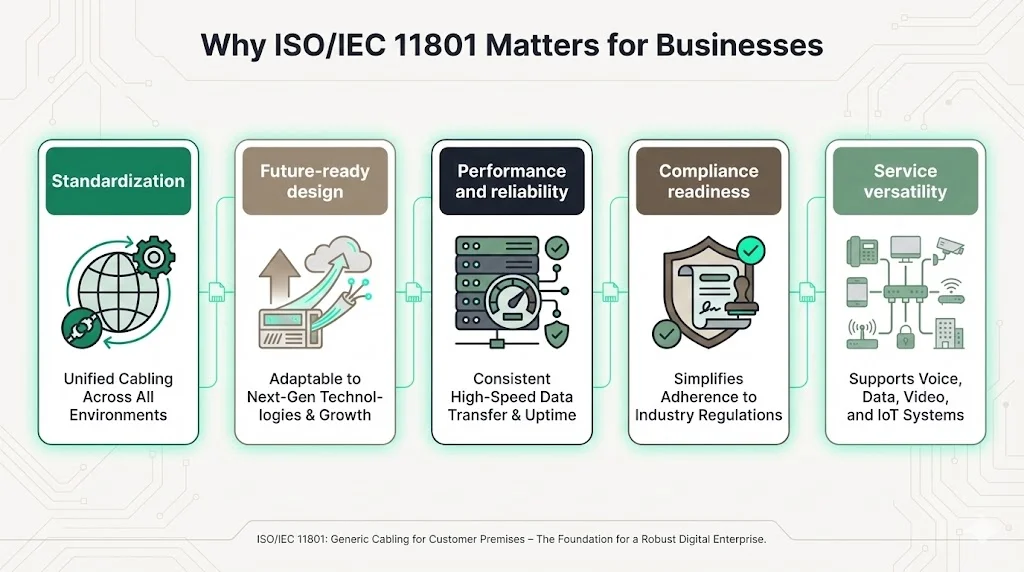
Adherence to an internationally recognized standard ensures interoperability across components sourced from multiple vendors, equipment deployed across buildings or campuses, and infrastructure implemented across geographies. For multinational enterprises operating under diverse regional standards, ISO/IEC 11801 provides a universal baseline preventing vendor lock-in scenarios where proprietary cabling systems constrain equipment choices or future upgrades. Infrastructure installed to standard specifications today accommodates network hardware replacements, protocol upgrades, and application migrations without requiring complete cabling system replacement.
2) Future-Proofing and Scalability
Because ISO/IEC 11801 defines high-performance cabling classes extending to Category 8 copper and advanced multimode fiber specifications, infrastructure built to these standards handles increasing data loads, expanding IoT deployments, converged building automation systems, and bandwidth-intensive applications over 10 to 15-year infrastructure lifecycles. Organizations specifying Category 6A cabling today position themselves to support 10 Gigabit Ethernet, Multi-Gigabit wireless access point backhaul, and future applications without infrastructure overhaul—reducing total cost of ownership compared to lower-category installations requiring premature replacement.
3) Infrastructure Quality, Performance Guarantees, and Reliability
With defined performance specifications encompassing transmission requirements, testing procedures, and link/channel characteristics, organizations building networks expect consistent, measurable performance regardless of installer or component supplier. This reduces network performance issues, unplanned downtime, and connectivity problems stemming from substandard cabling that meets visual inspection criteria while failing electrical performance testing. Structured cabling installed to ISO/IEC 11801 specifications delivers documented attenuation, crosstalk, return loss, and propagation delay characteristics verifiable through standardized testing procedures.
4) Compliance and Market Expectations
Enterprise clients increasingly expect cabling vendors and system integrators to demonstrate adherence to international standards as qualification criteria in procurement processes. For organizations selling to Fortune 500 companies, government agencies, or regulated industries, ISO/IEC 11801 compliance represents baseline competency—differentiating qualified vendors from competitors offering unspecified "enterprise-grade" cabling without documented performance characteristics. For data centers, large office campuses, or multi-site enterprises, compliance satisfies audit requirements and demonstrates infrastructure investment in proven standards rather than proprietary specifications lacking independent validation.
5) Versatility: Support for Multiple Services (Data, Voice, Building Control, Automation, IoT)
ISO/IEC 11801 is the international standard for structured cabling – This International standard structured cabling is suitable for a wide range of applications (analog & ISDN telephony, various data communication standards etc.). Infrastructure built to this standard supports legacy telephony systems, modern Voice over IP implementations, data networking from 100 Megabit to 10+ Gigabit rates, building automation protocols, physical security systems, and IoT device connectivity—eliminating the need for parallel cabling infrastructures serving different application categories. Enterprises deploying converged services across unified cabling reduce installation complexity, maintenance overhead, and troubleshooting time compared to environments maintaining separate voice, data, and building control wiring systems.
Implications for Companies Selling to Enterprise Clients (What to Include in Proposals, What to Watch For)
When proposing cabling solutions to enterprise clients, reference ISO/IEC 11801 compliance explicitly—specifying which parts apply (Part 2 for offices, Part 5 for data centers, Part 6 for building services) and which performance class/category the design targets. Document cable type selections (copper versus fiber) based on client-specific parameters: user headcount, bandwidth requirements per workstation, anticipated growth trajectories, building dimensions, electromagnetic interference environments, and use cases including IoT deployments or building management system integration.
Design for scalability by specifying higher-class cabling (Category 6A minimum, fiber for backbone and high-interference areas) when clients project expansion, plan data center consolidation, or require 10+ year infrastructure stability without mid-lifecycle upgrades. Organizations investing in Category 6A today avoid premature obsolescence compared to Category 6 installations that appear cost-effective initially but constrain future application support.
Ensure installation and testing methodologies follow standard requirements—specifying performance testing for every link, proper connector types matching cable shielding designations, correct structured wiring topology with appropriate consolidation points and patch panels, and documentation mapping physical cabling to logical network design. Highlight tangible benefits including reduced future upgrade costs (infrastructure supporting multiple technology generations), guaranteed component compatibility (eliminating vendor lock-in), and support for multiple services converged over single cabling infrastructure (reducing installation and maintenance overhead).
For multinational clients operating across regions, emphasize that ISO/IEC 11801-compliant cabling delivers uniform specifications across offices regardless of local regulatory variations—simplifying global standardization initiatives, enabling consistent performance expectations across geographies, and facilitating centralized procurement strategies.
How ISO/IEC 11801 Compares with Other Standards (Regional or Alternative Standards)
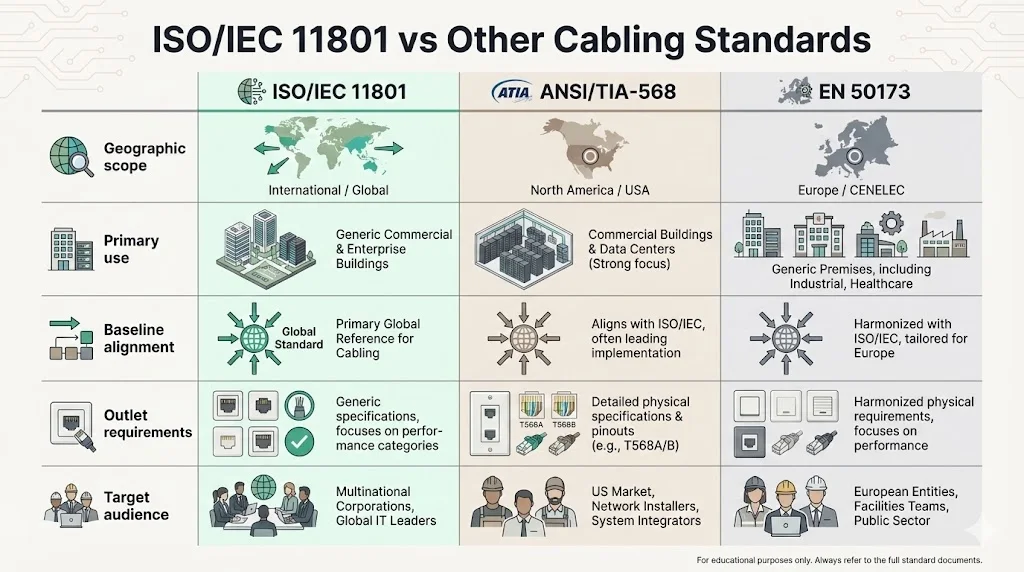
Beyond ISO/IEC 11801, regional cabling standards govern structured cabling implementations. In North America, ANSI/TIA-568 represents the dominant standard developed by the Telecommunications Industry Association. The U.S. cabling standard at the time, eia/tia-568, was used as the basis for this international standard, establishing foundational alignment between international and North American specifications. European countries reference EN 50173, a regional standard for structured cabling harmonized with ISO/IEC 11801 but incorporating region-specific requirements.
Key differences emerge in performance testing procedures, connector specifications, and implementation details. ISO/IEC 11801 targets a global common baseline suitable across geographies, while regional standards may incorporate variations reflecting local regulatory requirements, installation practices, or market preferences. iso/iec-11801 requires a minimum of two telecommunications outlets per work area, whereas TIA-568 specifies different outlet density recommendations.
For companies selling globally or to clients with international operations spanning multiple continents, ISO/IEC 11801 compliance offers a universal, consistent standard circumventing regional variants. Organizations maintaining offices across North America, Europe, and Asia-Pacific regions benefit from unified cabling specifications rather than region-specific implementations complicating global standardization, cross-border equipment deployment, and international support operations.
Best Practices & Considerations When Implementing ISO/IEC 11801 Cabling for Enterprise Clients
Begin with comprehensive needs assessment: document building dimensions and layout, current and projected user counts, data/voice/automation service requirements, bandwidth expectations per workstation and application category, and 5 to 10-year growth projections. This assessment determines appropriate cabling class selection (balancing performance requirements against budget constraints) and medium selection (copper for horizontal distribution, fiber for backbone links, high-interference areas, or distances exceeding 90 meters).
Follow structured wiring topology principles: implement hierarchical backbone cabling connecting telecommunications rooms, horizontal cabling extending to work areas, properly positioned consolidation points where topology demands flexibility, and systematically organized patch panels enabling logical port mapping and troubleshooting efficiency. This topology, fundamental to structured cabling methodology, ensures scalability, maintainability, and logical organization as networks expand.
Ensure proper shielding selection, connector types matching cable specifications, professional termination techniques, and strict adherence to performance specifications. Shielding designations must match throughout the channel—mixing shielded and unshielded components within a single link compromises performance. Testing links and channels according to standard performance requirements before commissioning prevents post-installation issues. For fiber installations, verify attenuation, return loss, and polarity. For copper, test insertion loss, near-end crosstalk (NEXT), alien crosstalk (for Category 6A and above), return loss, and propagation delay against Class/Category specifications using certified test equipment.
Document cabling layout comprehensively: maintain as-built drawings showing physical cable routes, topology diagrams mapping logical connectivity, labeling schemes enabling rapid port identification, and test results for every installed link. This documentation proves invaluable during troubleshooting, facilitates future upgrades or reconfigurations, supports audit processes, and reduces mean time to repair when connectivity issues emerge.
Conclusion
ISO/IEC 11801 establishes the globally recognized framework for structured cabling—encompassing copper and fiber specifications, diverse environment types from offices to data centers, and comprehensive performance classifications ensuring infrastructure meets documented transmission requirements. ISO/IEC 11801 is the most important international standard for structured cabling systems. It sets the basic requirements for the transmission parameters of structured cabling systems, their components and for the topology of the network's physical layer.
For organizations selling to enterprise clients, leveraging ISO/IEC 11801 in proposals and installations builds credibility through reference to established international standards rather than proprietary specifications. Compliance ensures high performance backed by measurable transmission characteristics, scalability supporting multiple technology generations, and risk reduction eliminating substandard cabling as network failure points. Investing in compliant cabling infrastructure delivers quantifiable returns: easier technology upgrades without infrastructure replacement, component compatibility across vendors and geographies, future-proofing against escalating bandwidth demands, and unified support for data, voice, building automation, and IoT services converged over single structured cabling systems.
Organizations treating cabling as commodity infrastructure installed to minimum cost discover performance limitations years later when applications exceed infrastructure capabilities. Those specifying ISO/IEC 11801-compliant systems with appropriate performance class selection build networks that perform reliably today and accommodate future requirements without premature replacement—reducing total cost of ownership while maintaining operational flexibility essential to competitive advantage.
FAQs
ISO/IEC 11801 Information technology — Generic cabling for customer premises specifies general-purpose telecommunication cabling systems (structured cabling) that are suitable for a wide range of applications (analog and ISDN telephony, various data communication standards, building control systems, and factory automation). The standard defines requirements for balanced copper cabling (twisted-pair) and optical fiber systems applicable across commercial, industrial, residential, and data center environments.
The standard is co-published by the International Organization for Standardization (ISO) and the International Electrotechnical Commission (IEC). "IEC" refers to the International Electrotechnical Commission, which specializes in electrical and electronic technology standards. ISO/IEC standards jointly published by these organizations cover areas where information technology intersects with electrical and electronic systems—such as telecommunications cabling requiring both IT system specifications and electrical performance characteristics.
ISO/IEC 11801 represents the global structured cabling standard, while EN 50173 serves as the European regional standard for structured cabling. EN 50173 harmonizes with ISO/IEC 11801 in many respects but may incorporate region-specific requirements reflecting European regulatory environments or installation practices. ISO/IEC 11801 aims to provide globally consistent guidelines and performance classifications applicable across geographies.
ISO/IEC 11801 is the most important international standard for structured cabling systems. It sets the basic requirements for the transmission parameters of structured cabling systems, their components and for the topology of the network's physical layer. The standard defines cabling types, performance classes from Category 5e through Category 8 for copper and OM1 through OS2 for fiber, and installation guidelines across various premises types including offices (Part 2), industrial facilities (Part 3), data centers (Part 5), and distributed building services (Part 6).