Enterprise buyers increasingly demand that vendors demonstrate information security maturity aligned with recognized international standards—not superficial compliance artifacts, but systematic security frameworks addressing technical, organizational, infrastructural, and personnel controls. Most vendors selling to European enterprises encounter procurement requirements referencing IT Grundschutz, yet few understand how this German framework translates into competitive advantage when engaging technical decision-makers who evaluate vendor risk.
IT Grundschutz (often translated as "IT baseline protection") represents a systematic methodology for building an information security management system developed by Germany's Bundesamt für Sicherheit in der Informationstechnik (BSI). For vendors engaging enterprise clients—particularly those operating in Germany, the European Union, or regulated sectors—understanding IT Grundschutz provides strategic positioning capability: it demonstrates rigorous security controls, supports vendor risk assessments, and aligns with ISO 27001 certification pathways enterprises recognize globally.
This definition covers the formal structure of IT Grundschutz, practical use cases for vendors serving enterprise clients, and compliance relevance including certification pathways. Enterprise-facing vendors must understand how security frameworks like IT Grundschutz translate into buyer confidence, reduce procurement friction, and demonstrate that security controls protect actual systems rather than merely satisfy auditors on paper.
What is IT Grundschutz?
According to the Bundesamt für Sicherheit in der Informationstechnik (BSI), IT Grundschutz is a systematic methodology for establishing an information security management system (ISMS) covering technical, organizational, infrastructural, and personnel aspects of information security. IT Grundschutz is a voluntary security standard from the German Federal Office for Information Security that addresses the establishment of an Information Security Management System, providing organizations with structured approaches to risk management, threat assessment, and security control implementation.
The framework originates from Germany as a national standard, though its influence extends throughout the European Union where enterprises increasingly reference BSI standards in vendor security requirements. English translations typically refer to "IT baseline protection" or "BSI IT baseline protection," though the German term "IT Grundschutz" remains widely used in international procurement documentation.
Unlike ISO 27001, IT Grundschutz specifies concrete measures for securing IT systems with normal protection requirements, allowing organizations to implement standardized safeguards without conducting full risk analyses. This practical approach differentiates IT Grundschutz from abstract framework standards: it provides prescriptive guidance while maintaining compatibility with international certification requirements.
Core Components and Structure
The IT Grundschutz Kompendium encompasses 113 building blocks (Bausteine) organized across 10 thematic areas, each addressing specific aspects of an organization's IT environment. These building blocks cover infrastructure security, application controls, network architecture, software development lifecycle, outsourcing arrangements, personnel security measures, organizational policies, and technical safeguards—providing comprehensive coverage across the information security landscape.
The modular structure enables organizations to select relevant building blocks based on their specific technology stack, business processes, and operational environment. Each building block specifies security requirements addressing confidentiality, integrity, and availability—the fundamental pillars of information security. This systematic approach supports both threat assessment and risk-based decision making while offering standardized controls for organizations with "normal protection needs" that don't require extensive custom risk analysis.
The framework covers technical security controls (encryption, access management, vulnerability scanning), organizational measures (security policies, incident response procedures, documentation requirements), infrastructural safeguards (physical security, environmental controls, redundancy), and personnel aspects (security awareness training, background checks, separation of duties). This comprehensive scope ensures vendors can map their entire security posture against recognized standards when responding to enterprise procurement requirements.
How IT Grundschutz Fits Into Broader Security Standards
Organizations can obtain ISO 27001 certification based on IT Grundschutz, demonstrating that implemented information security measures correspond to recognized international standards. This compatibility provides strategic value: vendors can implement IT Grundschutz building blocks while pursuing globally recognized ISO 27001 certification, satisfying both German/EU enterprise requirements and international buyer expectations through a unified ISMS implementation.
The BSI maintains explicit mapping between IT Grundschutz requirements and ISO/IEC 27001 control objectives, enabling organizations to demonstrate compliance with multiple frameworks simultaneously. This alignment reduces duplication for vendors serving diverse enterprise clients across geographies—implementing one rigorous framework satisfies varied buyer security requirements rather than maintaining separate compliance programs for different standards.
For enterprise-facing vendors, this relationship matters: buyers increasingly expect vendors to hold ISO 27001 certification as baseline evidence of security maturity. Implementing IT Grundschutz provides a structured pathway to ISO 27001 while offering additional prescriptive guidance that accelerates control implementation compared to ISO's more abstract requirements.
Key Benefits for Organizations
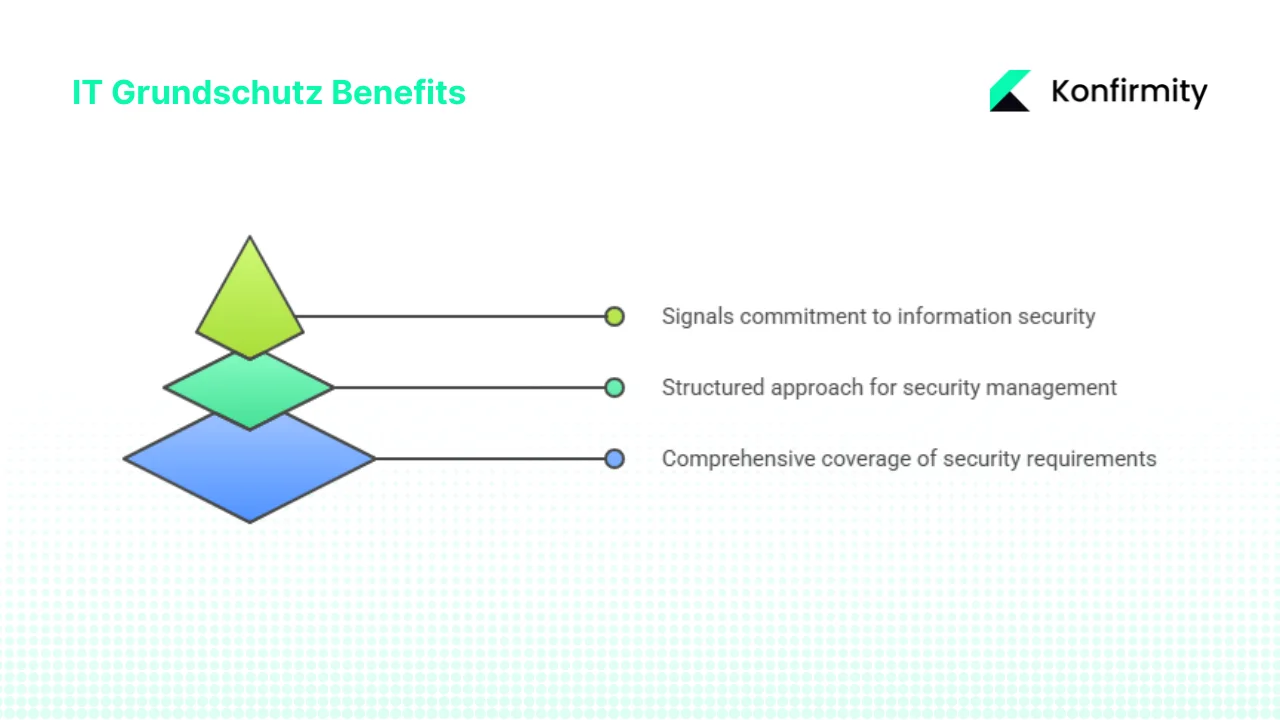
IT Grundschutz improves information security posture by providing comprehensive coverage of confidentiality, integrity, and availability requirements across technical systems, business processes, and organizational structures. The structured framework enables vendors to reference specific building blocks when responding to customer security questionnaires, map controls systematically during vendor risk assessments, and demonstrate security maturity using terminology enterprise buyers recognize.
Organizations implementing IT Grundschutz gain a defensible security framework addressing cybersecurity fundamentals, risk management methodology, and compliance alignment—three critical dimensions enterprise buyers evaluate during vendor selection. The framework supports consistent security policy development, systematic threat assessment, and documented control implementation that withstands audit scrutiny.
For vendors, the strategic benefit extends beyond technical security improvements: IT Grundschutz implementation signals to enterprise buyers that the vendor takes information security seriously, invests in recognized frameworks rather than ad-hoc approaches, and maintains controls compatible with the buyer's own security requirements. This positioning reduces procurement friction, accelerates vendor risk approval, and differentiates vendors from competitors offering generic "we take security seriously" assurances without substantive framework implementation.
Building toward SOC 2, ISO 27001, or another framework?
Drop your work email and we'll help you turn security work into audit-ready evidence automatically.
Use Cases for Enterprise-Facing Vendors
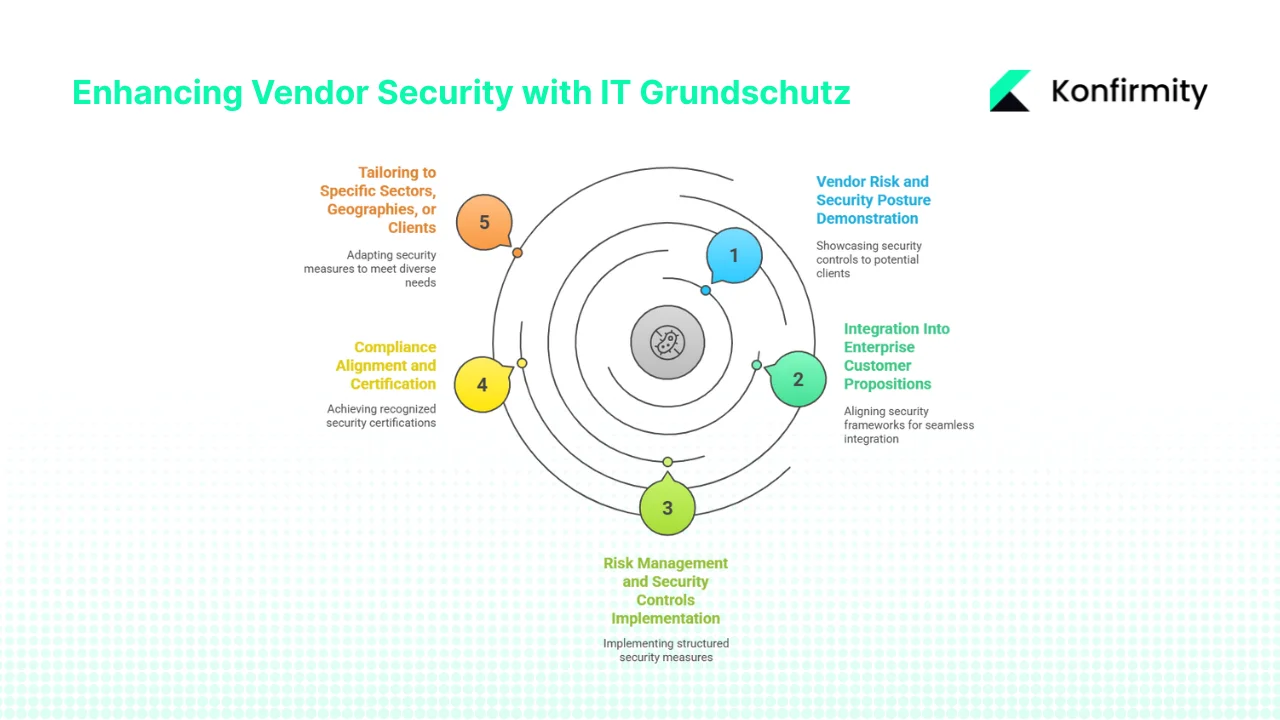
1) Vendor Risk and Security Posture Demonstration
Enterprise buyers conduct vendor risk assessments before onboarding new suppliers, particularly when vendors will access sensitive data, integrate with internal systems, or support critical business processes. These assessments evaluate vendor security controls, compliance posture, incident response capabilities, and overall information security maturity. Vendors lacking structured evidence of security control implementation face extended procurement cycles, remediation requirements, or disqualification from consideration.
IT Grundschutz provides vendors with a recognized framework for organizing security evidence and mapping controls systematically. Rather than responding to each customer's unique security questionnaire from scratch, vendors can reference specific IT Grundschutz building blocks, demonstrate how implemented controls address enterprise requirements, and provide standardized documentation that satisfies varied buyer assessment methodologies.
For example, when an enterprise buyer questions network security controls, vendors can reference IT Grundschutz building blocks covering network architecture, access controls, segmentation, and monitoring—providing specific control descriptions, implementation evidence, and alignment with recognized standards. This structured approach reduces assessment time, demonstrates security sophistication, and positions the vendor as a low-risk supplier choice.
2) Integration Into Enterprise Customer Propositions
Enterprises implementing IT Grundschutz themselves expect their vendor ecosystem to maintain compatible security frameworks. This expectation particularly applies in Germany and the broader European Union where BSI standards carry regulatory weight and procurement influence. Vendors serving these markets gain competitive advantage by aligning their security programs with IT Grundschutz, enabling seamless integration into customer security architectures.
For vendors operating in Germany or selling to German enterprises, IT Grundschutz alignment directly influences purchasing decisions. Procurement teams favor vendors who speak the same security language, use compatible control frameworks, and can demonstrate systematic compliance with standards the enterprise recognizes. This alignment reduces friction during vendor onboarding, simplifies security reviews, and signals that the vendor understands the regulatory environment in which the customer operates.
The value proposition becomes clear: vendors can position themselves as security-aligned partners rather than risky third parties requiring extensive remediation before onboarding. This positioning shortens sales cycles, reduces customer security concerns, and differentiates vendors in competitive procurement scenarios.
3) Risk Management and Security Controls Implementation
Vendors building information security management systems face fundamental questions: which controls should we implement? How do we prioritize security investments? What evidence satisfies auditors and enterprise buyers? IT Grundschutz answers these questions with prescriptive building blocks covering infrastructure, applications, development processes, and organizational measures.
Rather than designing custom control frameworks from abstract principles, vendors can select relevant IT Grundschutz building blocks matching their technology environment, implement specified requirements, and document control effectiveness using standardized evidence. This approach streamlines ISMS development, ensures comprehensive coverage of security domains, and provides recognized structure for ongoing threat assessment and control refinement.
For example, a SaaS vendor implements IT Grundschutz building blocks addressing software development security, cloud infrastructure, access management, encryption, logging and monitoring, incident response, and change management. These building blocks provide specific requirements for each domain, eliminating guesswork about adequate security measures and ensuring systematic coverage of common attack vectors and vulnerabilities.
4) Compliance Alignment and Certification
Enterprise buyers increasingly require third-party attestation of vendor security controls—not self-attestation, but independent audit reports confirming control effectiveness. Vendors pursuing ISO 27001 certification can leverage IT Grundschutz as the implementation framework, combining prescriptive German guidance with internationally recognized certification.
This dual approach satisfies multiple buyer requirements: enterprises wanting BSI alignment see IT Grundschutz implementation; international buyers recognize ISO 27001 certification; and both audiences receive independent verification of control effectiveness through certified audits. The certification pathway demonstrates vendor commitment to information security, provides competitive differentiation, and reduces repetitive customer assessments.
Organizations obtain certification by implementing an ISMS based on IT Grundschutz building blocks, mapping controls systematically, collecting implementation evidence, and engaging accredited auditors for independent assessment. The resulting ISO 27001 certificate based on IT Grundschutz provides vendors with marketable evidence of security maturity, satisfying data protection requirements, cybersecurity expectations, and compliance obligations across customer segments.
5) Tailoring to Specific Sectors, Geographies, or Clients
Vendors serving German enterprises, financial institutions, healthcare organizations, or other regulated sectors face specific security requirements reflecting regional regulations and industry expectations. IT Grundschutz provides sector-relevant building blocks addressing specialized requirements while maintaining broad applicability across industries.
A practical use case: SaaS vendors create dedicated security documentation pages mapping their controls to IT Grundschutz building blocks, explaining how infrastructure security, application controls, data protection measures, and operational procedures align with recognized standards. This documentation reassures enterprise buyers during vendor evaluation, provides security teams with concrete control evidence, and demonstrates that the vendor understands enterprise security expectations rather than offering generic assurances.
German-speaking markets particularly value IT Grundschutz references in security documentation. Vendors can highlight specific building block implementation, provide German-language security documentation, and position their security program using terminology familiar to German and European enterprise buyers. This localization demonstrates market understanding and commitment to regional standards rather than forcing European customers to translate generic American security frameworks into local context.
Compliance Relevance of IT Grundschutz
Why Compliance Matters for Enterprise Vendors
Enterprise buyers operate under regulatory regimes governing data protection, cybersecurity, financial reporting, healthcare privacy, and sector-specific requirements. These regulations create compliance obligations that extend to vendors accessing customer data, processing sensitive information, or integrating with internal systems. Buyers manage regulatory risk by requiring vendors to demonstrate security controls, maintain compliance certifications, and undergo periodic audits—transferring compliance burden upstream to their supplier ecosystem.
Vendors unable to demonstrate recognized security frameworks face buyer resistance, extended procurement processes, contract limitations restricting data access, or complete disqualification from enterprise opportunities. Conversely, vendors pointing to IT Grundschutz implementation, ISO 27001 certification, or other recognized attestations reduce buyer friction, accelerate vendor approval, and access enterprise opportunities competitors cannot pursue.
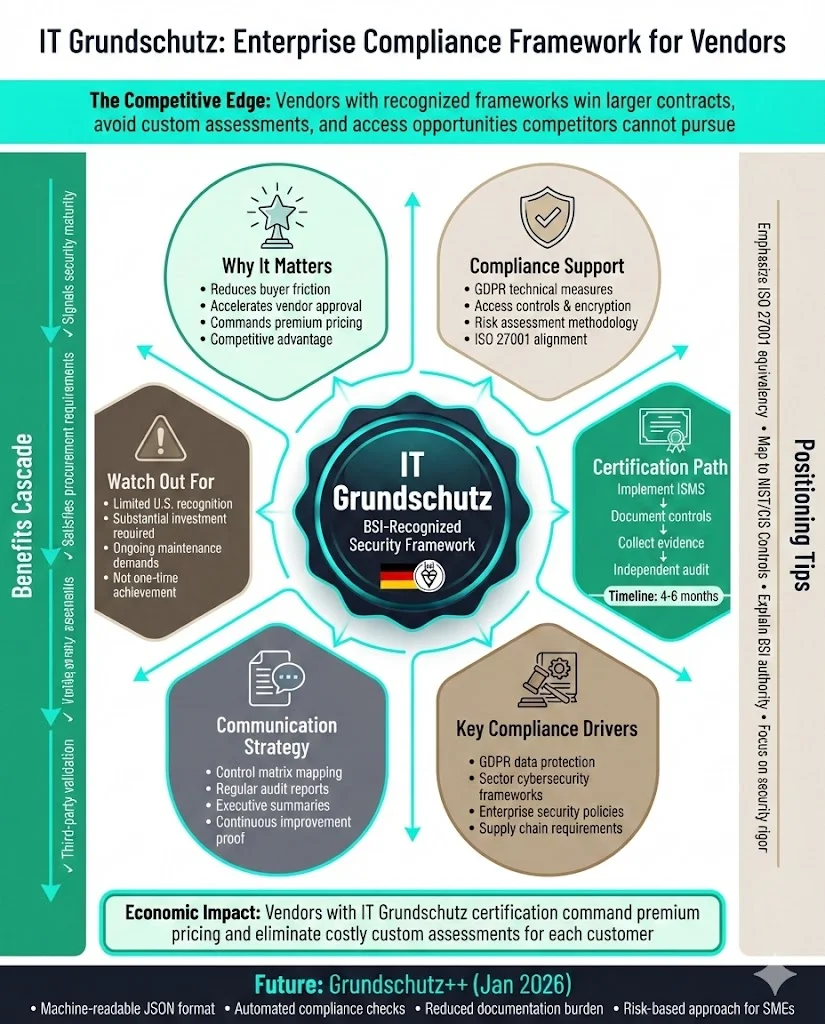
The economic impact proves substantial: vendors with recognized security frameworks win larger enterprise contracts, command premium pricing reflecting reduced buyer risk, and avoid costly custom assessments for each prospective customer. Compliance becomes competitive advantage rather than regulatory burden.
How IT Grundschutz Supports Compliance
IT Grundschutz helps elevate and maintain information security levels within institutions, providing systematic methodology addressing threat assessment, security framework implementation, security control deployment, and risk management—critical components auditors evaluate during compliance reviews. The BSI's recognized authority lends credibility: enterprise buyers trust that IT Grundschutz represents current security best practices rather than vendor-invented frameworks lacking independent validation.
The methodology supports compliance with data protection regulations like GDPR by specifying technical and organizational measures protecting personal data confidentiality, integrity, and availability. Building blocks address access controls, encryption, data minimization, purpose limitation, and security incident management—requirements appearing throughout data protection regulations. Vendors implementing IT Grundschutz can map controls directly to GDPR obligations, demonstrating systematic compliance rather than reactive gap-filling.
Cybersecurity regulatory frameworks increasingly require organizations to implement recognized security standards, conduct regular risk assessments, and maintain documented evidence of control effectiveness. IT Grundschutz satisfies these requirements through its structured building blocks, systematic methodology, and compatibility with international standards. For vendors serving regulated industries, IT Grundschutz implementation demonstrates security maturity meeting regulatory expectations across jurisdictions.
Certification and Audit Pathways
Organizations pursue formal certification to provide third-party validation of IT Grundschutz implementation and ISO 27001 compliance. The certification process involves implementing an ISMS based on IT Grundschutz building blocks, selecting relevant modules matching organizational scope, documenting control implementation, collecting evidence of effectiveness, and engaging accredited certification bodies for independent audit.
The audit examines whether implemented controls match IT Grundschutz requirements, operate effectively, and produce documented evidence demonstrating ongoing compliance. Auditors review policies, procedures, technical configurations, monitoring logs, incident records, and management reviews—verifying that controls exist not merely on paper but in operational practice protecting actual systems.
Benefits for enterprise-facing vendors prove substantial: certification provides marketable proof of security maturity, satisfies customer compliance requirements without repetitive assessments, and signals investment in information security beyond minimum regulatory obligations. Enterprise buyers frequently mandate vendor certifications in procurement requirements, making certification prerequisite for accessing large enterprise opportunities rather than optional differentiation.
The typical process spans 4-6 months for organizations implementing IT Grundschutz from baseline security postures, though timelines vary based on organizational complexity, existing control maturity, and resource allocation. Following certification, organizations undergo periodic surveillance audits maintaining certification validity and demonstrating continuous compliance.
Key Compliance Drivers for Enterprise Clients
Data protection regulations like GDPR require organizations to implement appropriate technical and organizational measures protecting personal data. These regulations extend to vendors processing customer data, creating contractual obligations for vendor security controls. Enterprise buyers demand vendor compliance evidence satisfying regulatory requirements they ultimately answer for—transferring data protection responsibility through supply chain requirements.
Cybersecurity frameworks across sectors require organizations to implement security controls, assess vendor risks, and maintain documented evidence of supply chain security. Financial services, healthcare, critical infrastructure, and government sectors face particularly stringent requirements. Vendors serving these sectors must demonstrate security frameworks meeting industry standards—IT Grundschutz provides recognized methodology satisfying these expectations.
Internal enterprise security policies frequently require vendor alignment with specific standards. Large enterprises maintain vendor security requirements specifying control frameworks, certification requirements, and audit frequencies. Vendors mapping their controls to IT Grundschutz building blocks can demonstrate alignment efficiently, responding to varied customer requirements using consistent framework documentation rather than creating custom security evidence for each buyer.
How Vendors Can Communicate IT Grundschutz Compliance to Clients
Maintain a control matrix documenting how vendor security controls map to IT Grundschutz building blocks, showing concrete implementation details rather than generic claims. This matrix serves as the foundation for responding to customer security questionnaires, vendor risk assessments, and compliance inquiries—providing specific control references rather than forcing security teams to interpret abstract security statements.
Provide regular audit reports or certifications summarizing security posture, control effectiveness, and compliance status. Executive summaries referencing IT Grundschutz implementation communicate security maturity to business decision-makers who may not understand technical details but recognize framework legitimacy. Combine technical control documentation for security practitioners with executive-level summaries for procurement stakeholders.
Use IT Grundschutz as foundation for continuous improvement: schedule periodic threat assessments, update control requirements based on evolving risks, review security policies annually against current building block versions, and refresh security controls matching technology changes. Communicate these ongoing efforts to enterprise customers, demonstrating that compliance represents sustained operational discipline rather than point-in-time certification achievement.
Pitfalls and Things to Watch
Not all enterprise buyers outside German-speaking markets immediately recognize IT Grundschutz, requiring vendors to translate framework value into universal terms. Emphasize ISO 27001 equivalency, explain BSI authority as Germany's national cybersecurity agency, and map IT Grundschutz controls to other frameworks the buyer recognizes (NIST, CIS Controls, ISO 27002). The underlying security rigor matters more than framework branding—position IT Grundschutz as implementation pathway to recognized ISO 27001 certification rather than obscure German standard.
Implementation requires substantial investment—particularly for vendors starting from minimal security maturity. Mapping comprehensive building blocks across infrastructure, applications, development processes, and organizational controls demands dedicated resources over 4-6 months minimum. Executives expecting rapid certification face disappointment; realistic timeline planning prevents false starts and resource waste.
Maintaining continuous compliance proves more demanding than achieving initial certification. Controls must remain effective as technology evolves, threats emerge, and business processes change. Organizations treating certification as one-time achievement rather than ongoing operational discipline face audit failures during surveillance reviews. Budget for sustained compliance operations including monitoring, evidence collection, periodic assessments, and control updates.
Future Trends and Relevance
The BSI plans comprehensive modernization of IT Grundschutz launching January 2026 with a transition phase, aiming to adapt the standard to current technological developments and threat landscapes while enabling continuous updates. The new Grundschutz++ will transform into machine-readable JSON format enabling partially automated compliance checks and integration with existing IT systems, replacing text-based PDFs with structured data supporting automation.
The BSI aims to reduce documentation burden and emphasize risk-based approaches, particularly for small and medium enterprises, while preserving comprehensive security methodology covering technical, organizational, and personnel dimensions. These changes address criticism of previous complexity while maintaining rigor enterprise buyers demand.
For enterprise-facing vendors, staying current with evolving IT Grundschutz versions signals ongoing commitment to security excellence rather than stagnant compliance. Vendors should monitor Grundschutz++ developments, plan for transition from current IT Grundschutz Kompendium to new JSON-based format, and communicate proactive adaptation to enterprise customers. Organizations demonstrating framework evolution alongside security standard updates position themselves as sophisticated security partners rather than checkbox compliance vendors.
Implementation Checklist for Vendors (Practical Steps)
Step 1: Scope analysis—define the "information verbund" (information domain/asset group) where IT Grundschutz applies. Identify systems, applications, infrastructure, data flows, and business processes requiring security controls. Scope boundaries determine which building blocks apply and what evidence auditors examine.
Step 2: Protection requirement and risk assessment—determine protection classes (normal, elevated, high) based on confidentiality, integrity, and availability requirements. Organizations with normal protection needs can apply standard building blocks without extensive risk analysis; elevated or high protection requirements demand supplementary risk assessments identifying additional controls.
Step 3: Select IT Grundschutz building blocks relevant to vendor services and technology environment. Cloud infrastructure providers select different building blocks than software development firms or managed service providers. Focus on building blocks covering actual systems and processes rather than attempting comprehensive implementation across all 113 modules.
Step 4: Map existing security controls to selected building blocks, identifying where current controls satisfy IT Grundschutz requirements and where gaps exist. Most vendors maintain some security measures; systematic mapping prevents duplicating existing controls while revealing missing safeguards.
Step 5: Gap analysis—identify missing controls across technical safeguards, organizational policies, infrastructural protections, and personnel measures. Prioritize gaps based on risk, implementation complexity, and resource requirements. Some gaps require simple policy documentation; others demand infrastructure investment or process redesign.
Step 6: Implementation plan—construct timeline prioritizing critical control gaps, allocating resources for technical implementation, organizational policy development, personnel training, and infrastructure upgrades. Realistic timelines spanning 4-6 months for comprehensive implementation prevent rushed deployments producing superficial compliance rather than genuine security improvements.
Step 7: Certification or attestation—prepare for independent audit by organizing evidence, documenting control implementation, and demonstrating operational effectiveness. Engage accredited certification bodies for ISO 27001 audit based on IT Grundschutz. Certification provides third-party validation enterprise buyers recognize.
Step 8: Monitoring and continuous improvement—establish ongoing processes reviewing threats regularly, updating controls matching evolving risks, and ensuring compliance remains current rather than degrading post-certification. Schedule periodic control reviews, threat assessments, and policy updates maintaining ISMS effectiveness.
Step 9: Communication to enterprise clients—develop security documentation summarizing compliance posture, explaining IT Grundschutz alignment, and demonstrating how implemented controls protect customer data and support customer compliance obligations. Position security framework as customer benefit rather than internal vendor achievement.
Step 10: Refresh and upgrade—plan for updating controls with new IT Grundschutz Kompendium editions, particularly the upcoming Grundschutz++ transition. Maintain control matrix currency, update documentation reflecting control changes, and communicate ongoing improvements to enterprise customers demonstrating sustained commitment rather than static compliance.
Use Case Example
Consider AcmeCloud Services, a SaaS platform vendor targeting enterprise clients across Germany and the European Union. AcmeCloud faced repeated vendor security assessments during enterprise procurements, each requiring 40-60 hours responding to unique security questionnaires. Larger opportunities stalled during vendor risk reviews when customers identified control gaps or questioned security framework legitimacy.
AcmeCloud implemented IT Grundschutz systematically: security leadership identified scope covering their cloud SaaS platform, data center infrastructure, software development lifecycle, and customer data processing. They selected relevant building blocks addressing application security, cloud operations, encryption and key management, access controls, incident response, business continuity, and vendor management for their own subprocessors.
Mapping existing controls revealed gaps in formal patch management procedures, change control documentation, security awareness training, and disaster recovery testing. Over five months, AcmeCloud implemented missing controls, documented policies systematically, collected operational evidence, and engaged a certification body for ISO 27001 audit based on IT Grundschutz.
Following certification, AcmeCloud experienced measurable benefits: sales cycles shortened by 30% as vendor risk approvals accelerated; RFP responses referenced IT Grundschutz building blocks and ISO 27001 certification rather than generic security claims; win rates improved in competitive procurements where security differentiation mattered; and customer remediation requests declined as implemented controls satisfied enterprise security requirements proactively.
The lesson proves clear: vendors aligning with enterprise compliance expectations through recognized frameworks like IT Grundschutz reduce procurement friction, demonstrate genuine security sophistication, and access opportunities competitors lacking systematic security implementation cannot pursue. The investment in framework implementation returns multiples through improved sales efficiency, premium positioning, and reduced compliance overhead across the customer base.
Conclusion
IT Grundschutz represents a systematic methodology for information security management covering technical controls, organizational measures, infrastructural safeguards, and personnel security across comprehensive building blocks developed by Germany's BSI. The framework provides vendors serving enterprise clients with a structured approach to risk management, security control implementation, and compliance alignment—translating abstract security principles into prescriptive requirements auditors and enterprise buyers recognize.
For enterprise-facing vendors, IT Grundschutz implementation demonstrates security maturity beyond superficial compliance, aligns with ISO 27001 certification pathways, and positions vendors favorably during procurement evaluations. The framework addresses fundamental enterprise buyer concerns: Does this vendor implement rigorous security controls? Can they provide independent attestation of control effectiveness? Will their security framework integrate with our standards?
Vendors should map their security controls to recognized frameworks like IT Grundschutz, implement structured ISMS methodologies, pursue third-party certification providing marketable proof of security investment, and communicate security posture clearly to enterprise buyers using terminology procurement teams recognize. In markets where enterprises demand vendor security frameworks satisfying data protection regulations, cybersecurity requirements, and internal compliance policies, IT Grundschutz provides defensible methodology demonstrating that security controls protect actual systems rather than manufacturing compliance artifacts impressing auditors without securing infrastructure.
The competitive landscape increasingly favors vendors who can demonstrate systematic security frameworks over those offering generic assurances. IT Grundschutz—particularly combined with ISO 27001 certification—provides that differentiation, reducing buyer risk perception and positioning vendors as sophisticated security partners rather than potential threat vectors requiring extensive remediation before onboarding.
FAQs
1) What is BSI Grundschutz in English?
BSI Grundschutz translates as "IT baseline protection" or "BSI IT baseline protection" in English. The term refers to the systematic information security management methodology developed by Germany's Bundesamt für Sicherheit in der Informationstechnik (BSI)—the Federal Office for Information Security. While English translations exist, the German term "IT Grundschutz" remains widely used in international enterprise procurement documentation, vendor security requirements, and compliance contexts. The framework provides prescriptive security controls through building blocks covering technical, organizational, infrastructural, and personnel aspects of information security, offering more concrete implementation guidance than abstract international standards while maintaining compatibility with ISO 27001 certification requirements.
2) What is the information security standard?
The term "information security standard" refers broadly to formalized frameworks specifying policies, procedures, controls, and practices protecting information assets against unauthorized access, disclosure, modification, or destruction. Information security standards address confidentiality (protecting sensitive data from unauthorized disclosure), integrity (ensuring data accuracy and preventing unauthorized modification), and availability (maintaining system access for authorized users). In this context, IT Grundschutz represents one such standard—a comprehensive German framework providing systematic methodology for implementing information security management systems. Other recognized information security standards include ISO/IEC 27001 (international ISMS standard), NIST Cybersecurity Framework (U.S. risk-based framework), and various industry-specific standards. Enterprise buyers evaluate vendors against these standards during procurement, requiring documented evidence of security control implementation rather than accepting generic security assurances lacking independent verification.