

Most organizations pursuing defense or government contracts focus on meeting minimum compliance checkboxes rather than demonstrating genuine interoperability and security readiness. This approach creates a fundamental gap between documentation and operational capability—a gap that becomes apparent when systems fail to integrate during joint exercises, coalition operations, or mission-critical deployments. For vendors targeting Department of Defense clients or security-sensitive enterprises, understanding the Joint Interoperability Test Command (JITC) and its certification requirements represents the difference between systems that look compliant on paper and infrastructure that actually performs under operational stress.
What is JITC?
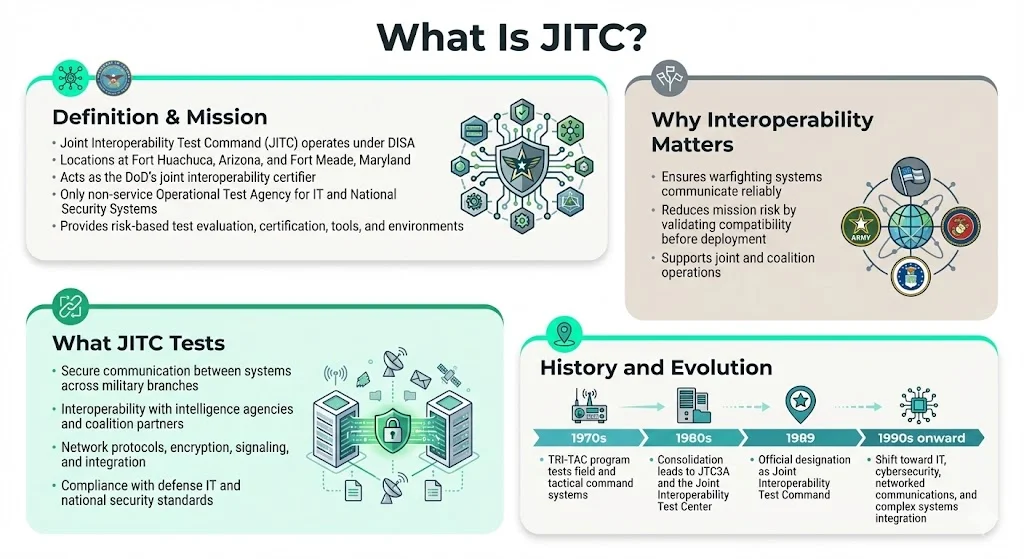
The Joint Interoperability Test Command (JITC) operates as a subordinate command under the Defense Information Systems Agency (DISA), with locations at Fort Huachuca, Arizona, and Fort George G. Meade, Maryland. JITC serves as the DoD's joint interoperability certifier and the only non-service Operational Test Agency for Information Technology and National Security Systems, providing risk-based Test Evaluation & Certification services, tools, and environments to ensure joint warfighting IT capabilities are interoperable and support mission requirements.
The command's mandate extends beyond validating individual products—JITC assesses whether disparate systems can communicate securely across military branches, intelligence agencies, coalition partners, and operational environments. This testing encompasses network protocols, encryption standards, signaling compatibility, systems integration, and compliance with security frameworks governing defense and national security deployments.
History and Evolution
JITC's roots trace to the TRI-TAC program of the 1970s, which tested field and tactical command systems. During the 1980s, repeated consolidation efforts among testing agencies transformed operations: the TRI-TAC program evolved into the Joint Tactical Command, Control, and Communications Agency (JTC3A), with Fort Huachuca operations eventually becoming the Joint Interoperability Test Center. In 1989, the Test Center gained its final designation as the Joint Interoperability Test Command, concurrent with a DoD-wide push toward interoperability aimed at ensuring military technology could work across branches, between different units within branches, and among coalition partners as multinational military action became more prevalent.
The focus of JITC shifted toward interoperability and information technology testing in the 1990s—reflecting the transition from field equipment evaluation to networked communications, cybersecurity validation, and systems integration across increasingly complex information environments.
Where JITC Operates
JITC maintains dual operational centers supporting the full spectrum of test and evaluation activities. Construction completion of a new 40,422 square foot Test and Evaluation Facility at Fort Huachuca was projected for early 2024, with the facility forecasted to be fully operational for over 629 personnel. This infrastructure expansion reflects the growing complexity of interoperability testing requirements as defense IT systems evolve toward cloud architectures, software-defined networks, and zero-trust security models.
The Fort Huachuca facility serves as JITC headquarters and provides lab-based testing environments, while Fort Meade operations support networked testing, cybersecurity assessments, and integration with classified environments. Both locations offer simulation capabilities, field testing support, and operational assistance during joint exercises.
Working toward a federal compliance baseline?
Drop your work email and we'll help you map controls to NIST and prove them with real evidence.
What JITC Actually Does: Test, Evaluate, Certify
Interoperability Assessment & System Compatibility
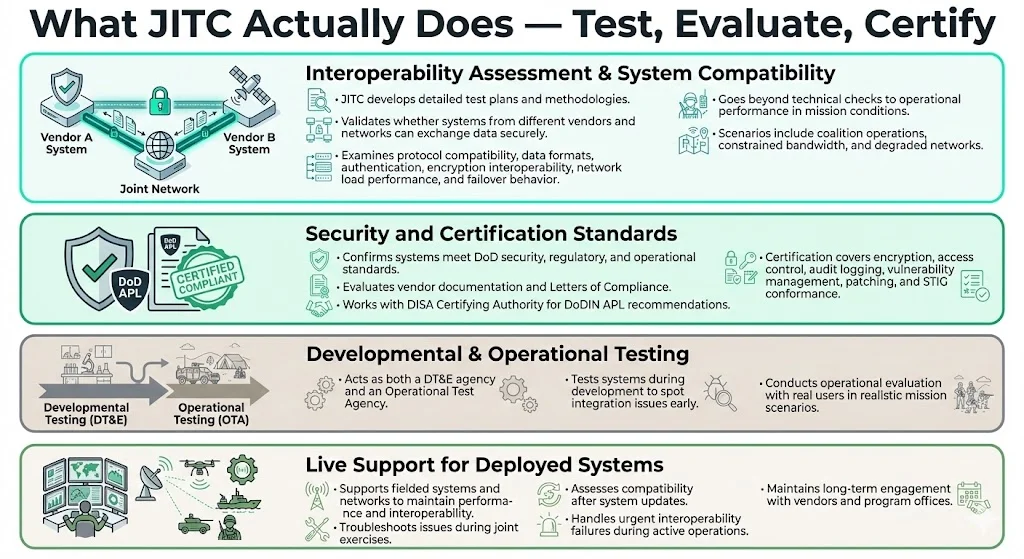
JITC develops and conducts rigorous interoperability test plans, procedures, and methodologies to validate whether systems from different vendors, deployed across different networks, can exchange data securely and reliably. This testing examines protocol compatibility, data format standardization, authentication mechanisms, encryption interoperability, network performance under load, and failover behavior during degraded conditions.
Interoperability assessment extends beyond technical compatibility to operational effectiveness: systems must not only connect but perform mission-critical functions when integrated with existing infrastructure. Testing scenarios replicate real-world conditions—including coalition operations where U.S. systems interface with allied technologies, contested environments with limited bandwidth, and degraded networks requiring adaptive routing.
Security and Certification Standards
JITC validates that IT products meet security, regulatory, and operational standards required for defense and national security deployment. Certification is based on interoperability testing, review of vendor documentation including Letters of Compliance, and DISA Certifying Authority recommendations for inclusion on the DoDIN Approved Products List. This multi-layered evaluation ensures systems satisfy both technical specifications and operational security requirements.
Upon passing evaluation, systems earn JITC certification and placement on the DoD Approved Products List (APL)—a prerequisite for procurement by defense agencies and military services. Certification addresses encryption algorithms, access controls, audit logging, vulnerability management, patch deployment mechanisms, and adherence to Security Technical Implementation Guides (STIGs) governing DoD system hardening.
Operational & Developmental Testing, and Live Support
JITC functions as both a Developmental Test & Evaluation (DT&E) agency and an Operational Test Agency for IT and National Security Systems. This dual role enables testing during development phases—identifying integration issues before deployment—and operational evaluation under realistic conditions with actual users and mission scenarios.
JITC provides support for deployed systems and networks to ensure ongoing interoperability and performance, including troubleshooting during joint exercises, real-time compatibility assessments when systems are updated, and urgent resolution of interoperability failures during operations. This sustained engagement distinguishes JITC from one-time certification bodies—the command maintains relationships with vendors and program offices throughout system lifecycles.
Why Interoperability & JITC Matter: Strategic Importance
1) Joint Force Coordination & Interagency Collaboration
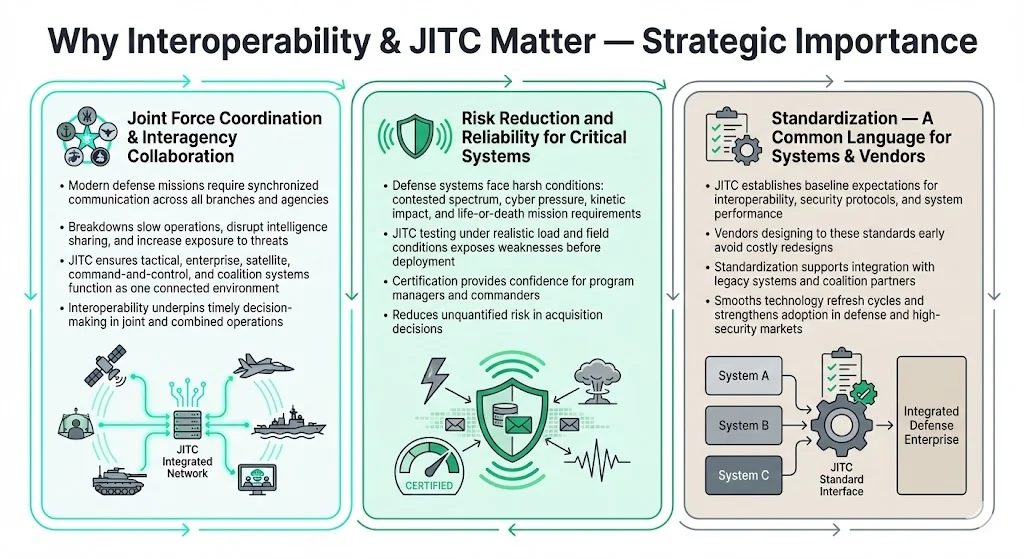
Modern defense operations require seamless coordination across Army, Navy, Air Force, Marine Corps, Space Force, intelligence agencies, coalition partners, and civil authorities. Without validated interoperability, communication breakdowns introduce operational delays, prevent information sharing during time-sensitive operations, and create vulnerabilities adversaries can exploit.
As warfare and defense strategies increasingly rely on integrated information systems, JITC's work is crucial for the seamless operation and security of military communication, intelligence, surveillance, and operational systems. The command ensures disparate systems—from tactical radios to enterprise networks, satellite communications to command and control platforms—function as an integrated joint force rather than isolated capabilities.
2) Risk Reduction and Reliability for Critical Systems
Systems deployed in defense environments operate under conditions commercial vendors rarely encounter: contested electromagnetic spectrum, adversarial cyber operations, kinetic threats to infrastructure, and mission requirements where failure costs lives. JITC testing under realistic conditions—both laboratory and field environments—identifies failure modes, compatibility gaps, and security vulnerabilities before systems reach operational deployment.
Certification signals that a system has survived rigorous evaluation against documented standards, providing confidence to program managers, acquisition authorities, and operational commanders that certified capabilities will perform when deployed. This assurance proves critical during acquisition decisions, where choosing untested systems introduces unquantified risk.
3) Standardization: A Common Language for Systems & Vendors
Through its test procedures and certification processes, JITC establishes interoperability baselines, security protocol requirements, compatibility expectations, and performance thresholds. Vendors aligning system architectures to these standards during development—rather than retrofitting after failures—accelerate certification timelines and reduce remediation costs.
Standardization enables the defense ecosystem: new systems integrate with legacy infrastructure, allied forces exchange information securely, and technology refresh cycles occur without disrupting operational capability. For vendors, designing to JITC requirements from initial architecture decisions positions products for government adoption while creating competitive differentiation in security-sensitive commercial markets.
Implications for Businesses / Enterprise-Tech Vendors
What It Means to Be JITC-Certified / Targeting Certification
For vendors, JITC certification unlocks access to defense contracts, intelligence community procurements, federal civilian agencies with national security responsibilities, and commercial enterprises requiring government-grade security and interoperability validation. Achieving certification requires meeting interoperability standards, implementing specified encryption algorithms, demonstrating secure network protocols, providing comprehensive documentation, and passing both laboratory and operational testing.
This investment extends beyond technical implementation to organizational capability: vendors must establish security development lifecycles, maintain configuration management discipline, document testing procedures, and commit to sustained support including security updates and compatibility maintenance as defense architectures evolve.
Opportunity: Government & Defense as Clients, Plus Critical Infrastructure & Enterprise Use Cases
JITC-certified products gain preference—or mandatory requirement status—for DoD procurements, intelligence community acquisitions, and federal agencies operating national security systems. Beyond government markets, certification signals to commercial enterprises in critical infrastructure sectors (energy, transportation, financial services, healthcare) that systems meet stringent security and interoperability standards validated through independent testing.
Large enterprises increasingly value such certification as objective evidence of security rigor, particularly when deploying systems handling sensitive data, supporting business-critical operations, or integrating with customer environments requiring documented compliance. JITC certification provides third-party validation that marketing claims cannot replicate.
Considerations / Challenges for Vendors
Preparing for JITC evaluation demands substantial investment: adherence to test procedures, implementation of cryptographic modules validated through separate FIPS 140 processes, documentation meeting DoD standards, potentially multiple testing cycles if initial assessments identify deficiencies, and ongoing maintenance to preserve certification status when updates occur.
Certification timelines extend months to over a year depending on system complexity, testing schedules, and remediation requirements—planning must account for this duration when targeting government opportunities. Systems require design-phase consideration of interoperability requirements: retrofitting architectural decisions made without JITC standards in mind proves exponentially more costly than building interoperability foundations from inception.
Certification expires upon changes that affect interoperability, but no later than the expiration date listed in the DoDIN Approved Products List memorandum—vendors must maintain certification through system updates, requiring ongoing engagement with JITC processes rather than treating certification as a one-time milestone.
How JITC's Processes Relate to Key Requirements
JITC's mandate directly addresses the operational realities facing defense and government IT deployments:
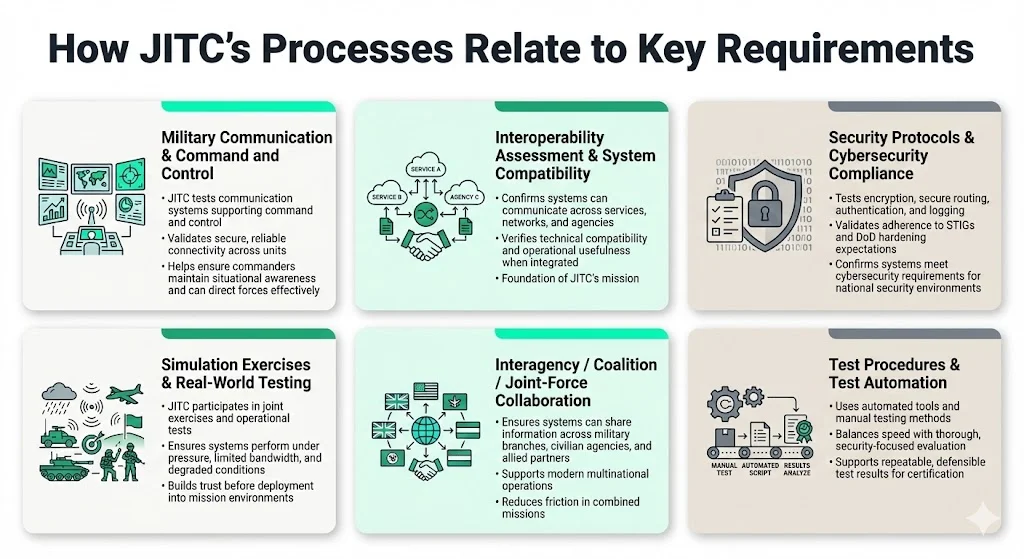
Military communication testing & command and control: JITC ensures communication systems used for command, control, and coordination among military units meet interoperability standards and security requirements, enabling commanders to maintain situational awareness and direct forces during operations.
Interoperability assessment & system compatibility: Core JITC function involves testing systems across services, networks, and agencies to confirm technical compatibility and operational effectiveness when integrated.
Security protocols & cybersecurity compliance: JITC certification validates encryption implementations, secure network capabilities, access controls, audit mechanisms, and adherence to Security Technical Implementation Guides governing DoD system hardening.
Simulation exercises & real-world operational testing: JITC's involvement in joint exercises and operational tests builds confidence that certified systems perform under operational stress, contested environments, and degraded conditions.
Interagency / coalition / joint-force collaboration: JITC facilitates systems working across different agencies, military branches, and coalition partners—critical as multinational operations become standard rather than exceptional.
Test procedures & test automation: JITC employs both automated testing tools and manual procedures to validate systems, balancing efficiency with thoroughness required for security-critical assessments.
What Being "JITC-Certified" Means
After completing evaluation and testing, products earning JITC certification gain listing on the DoD Approved Products List (APL). Certification confirms that systems meet requirements to operate effectively within the larger DoD network, demonstrating interoperability, security compliance, and operational readiness validated through independent assessment.
Certification assures that systems satisfy documented technical standards, pass security evaluations, demonstrate compatibility with defense infrastructure, and maintain required documentation—useful not only for military deployment but as credibility signaling to enterprise clients requiring objective security validation. For technologies including secure communications, network infrastructure, data storage, and collaboration platforms, JITC certification may serve as a procurement prerequisite or significant evaluation criterion.
What Businesses Should Do: How to Align with JITC Requirements
Vendors targeting defense, government, or security-sensitive enterprise clients should design systems with interoperability and security as foundational architectural decisions rather than features added during procurement cycles. This requires understanding relevant network protocols, encryption standards, authentication mechanisms, and compatibility requirements before committing to technical architectures.
Ensure compliance with applicable standards: implement FIPS 140-validated cryptographic modules, support protocols specified in defense standards, document security controls, maintain configuration management discipline, and establish processes for security updates that preserve certification status.
Invest in testing and certification processes early—factor the required time and resources into product roadmaps and government opportunity timelines. Organizations treating JITC certification as an afterthought face rushed preparations, incomplete evidence collection, and technical debt from architectural decisions made without interoperability considerations.
Maintain comprehensive documentation: JITC evaluation requires demonstrating not just that systems work but proving through documented evidence that security controls function as designed, configurations meet standards, and operational procedures support sustained compliance.
Use JITC certification as competitive differentiation in proposals to enterprise and government clients. Organizations evaluating vendors increasingly demand objective security validation—JITC certification provides independent verification that marketing claims and self-assessments cannot replicate.
Prove the security half of your certification claim
Book a demo and we'll show how Konfirmity documents the security controls, configuration management and update processes behind a JITC submission, so the evidence exists before testing starts rather than after.
Book a demo
Conclusion
JITC validates that IT and communication systems—particularly those deployed in defense, government, and security-critical contexts—demonstrate interoperable operation, meet security standards, and maintain readiness for mission-critical use under operational conditions. The command's test and certification processes reduce risk, establish compatibility baselines, and provide acquisition authorities with confidence that certified systems perform as required when deployed.
For vendors targeting enterprise or government clients, JITC certification represents powerful trust signaling and competitive differentiation. Organizations demonstrating commitment to rigorous interoperability and security validation position themselves favorably against competitors offering self-certified or untested capabilities. The investment required for certification—while substantial—opens access to defense markets, government contracts, and security-conscious enterprises valuing independent validation over vendor assertions.
Treat interoperability and security not as compliance checkboxes added during sales cycles, but as architectural foundations embedded during system design. Organizations building genuine security infrastructure and operational interoperability produce compliance as natural outcomes—systems that satisfy both auditors and operational requirements.
FAQs
An interoperability test validates whether different systems, devices, or software can work together—exchanging data, communicating securely, following common protocols—even when sourced from different vendors or deployed across different environments. These tests examine technical compatibility, protocol adherence, security interoperability, and operational effectiveness when systems integrate.
JITC stands for Joint Interoperability Test Command.
A system or product that passes JITC's test and evaluation process for interoperability, security, and compliance earns JITC certification. Certified products gain placement on the DoD Approved Products List (APL), indicating they meet standards required for military or government-level deployment and demonstrating validated interoperability with defense infrastructure.

