

NIST—the National Institute of Standards and Technology—is a nonregulatory federal agency that develops measurement standards, technology frameworks, and cybersecurity guidance used across government and enterprise environments. In security and compliance conversations, NIST meaning extends beyond its organizational identity: it represents the authoritative frameworks enterprises reference when demonstrating rigorous risk management, implementing security controls, and satisfying client expectations for documented security posture.
For enterprise-facing companies, NIST frameworks serve as the technical foundation for compliance programs, audit preparation, and vendor risk assessments. Regulatory bodies, federal contractors, and Fortune 500 buyers routinely expect security implementations aligned with NIST standards. Organizations leveraging NIST guidance position themselves with credible, auditor-recognized control structures rather than ad hoc security measures that fail scrutiny during procurement evaluations or incident investigations.
This article clarifies what NIST is, examines its core frameworks including the Cybersecurity Framework and SP 800 series, distinguishes voluntary adoption from mandatory requirements, and explains how enterprises integrate NIST principles into compliance programs and client engagements.
What NIST Is?
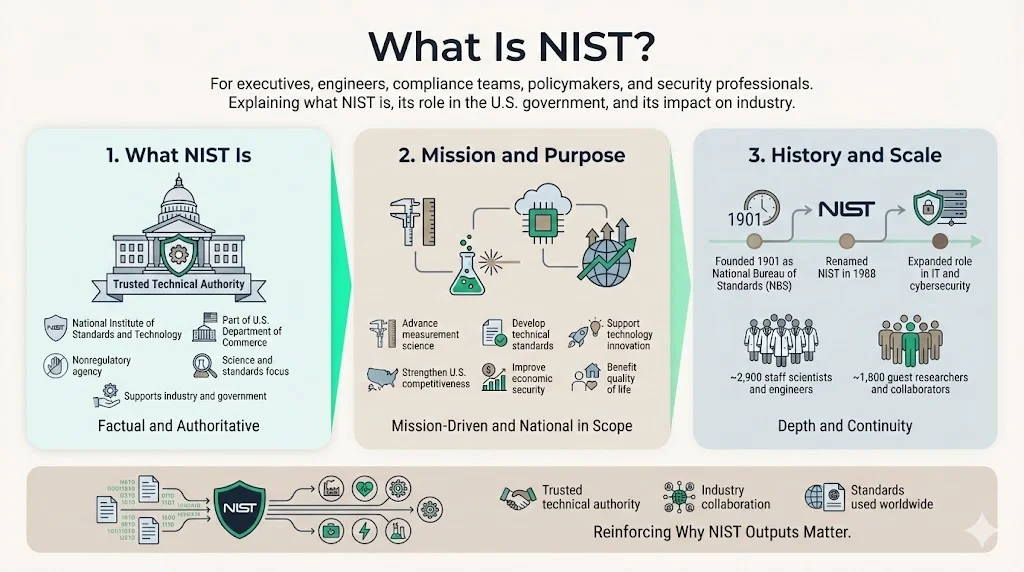
The National Institute of Standards and Technology is a nonregulatory agency of the United States Department of Commerce established to advance measurement science, standards development, and technology innovation. Originally named the National Bureau of Standards from 1901 to 1988, the agency became NIST in 1988 with an expanded mandate encompassing information technology, cybersecurity, and emerging technology standards.
NIST's official mission is to promote U.S. innovation and industrial competitiveness by advancing measurement science, standards, and technology in ways that enhance economic security and improve quality of life. The agency employs approximately 2,900 scientists, engineers, and technical personnel, with about 1,800 guest researchers and industry collaborators contributing to standards development across disciplines.
NIST's Scope Beyond Cybersecurity
NIST's activities encompass physical science laboratory programs including nanoscale science and technology, engineering, information technology, neutron research, material measurement, and physical measurement. The agency develops standards affecting manufacturing, construction safety, biotechnology, quantum computing, and artificial intelligence. Following the September 11, 2001 attacks, NIST conducted the official investigation into the collapse of the World Trade Center buildings, demonstrating its role in structural engineering and public safety beyond information security.
In the technology sector, NIST influences encryption standards, authentication protocols, and interoperability requirements that underpin secure communications and data protection. In August 2024, NIST released a final set of encryption tools designed to withstand quantum computer attacks, addressing emerging threats to cryptographic infrastructure. Its work establishes the measurement and validation methodologies that enable consistent implementation of security controls across organizations and sectors.
Working toward a federal compliance baseline?
Drop your work email and we'll help you map controls to NIST and prove them with real evidence.
Core NIST Frameworks and Standards
The NIST Cybersecurity Framework (CSF)
The NIST Cybersecurity Framework provides a voluntary, risk-based approach for managing cybersecurity risks across organizations of any size or sector. NIST released CSF 2.0 after public comment through November 4, 2023, updating the framework to improve applicability for small and medium enterprises and accommodate the constantly changing nature of cybersecurity. The framework organizes cybersecurity activities into five core functions: Identify, Protect, Detect, Respond, and Recover.
These functions establish a shared language for security operations across organizational boundaries. Identify encompasses asset management, risk assessment, and governance structures that establish security program foundations. Protect addresses access controls, data security, and protective technology implementation. Detect covers continuous monitoring, anomaly detection, and security event identification. Respond defines incident response planning, communications, and analysis procedures. Recover focuses on resilience planning, restoration procedures, and continuous improvement following security events.
The CSF provides implementation tiers that characterize the rigor of an organization's cybersecurity practices, ranging from Tier 1 (Partial) through Tier 4 (Adaptive), enabling organizations to assess maturity and establish target states aligned with risk tolerance and operational requirements.
Other Relevant Frameworks: NIST SP 800 Series
The NIST Special Publication 800 series comprises technical documents addressing specific security and privacy topics required for federal information systems but widely adopted in commercial environments. NIST SP 800-53 defines security and privacy controls for federal information systems and organizations, providing a comprehensive catalog of safeguards addressing confidentiality, integrity, and availability requirements across administrative, technical, and physical control families.
NIST SP 800-171 establishes requirements for protecting Controlled Unclassified Information (CUI) in nonfederal systems—a standard mandated for defense contractors and federal supply chain participants handling sensitive government data. This publication specifies 110 security requirements derived from the broader 800-53 control catalog, tailored for organizations without dedicated federal information system infrastructure.
Additional publications address incident handling (SP 800-61), contingency planning (SP 800-34), access control (SP 800-162), and supply chain risk management (SP 800-161), providing implementation guidance for specific security domains. These publications translate high-level framework principles into technical specifications and procedural requirements suitable for audit evidence and control implementation documentation.
How These Frameworks Support Enterprise Security
NIST frameworks provide enterprises with auditor-recognized control structures that map to regulatory requirements, client expectations, and industry standards. Organizations implementing NIST guidance establish documented risk management processes, security control baselines, and evidence collection routines that satisfy multiple compliance obligations simultaneously. Rather than implementing disparate security measures for each client request or regulatory requirement, enterprises adopting NIST frameworks build unified security infrastructure that produces compliance as a natural outcome.
These frameworks enable consistent vendor risk assessment by establishing common terminology and control expectations across procurement processes. Enterprise buyers evaluating security posture can reference NIST control families and implementation tiers rather than subjective security claims, streamlining vendor qualification and reducing procurement friction.
NIST and Enterprise Compliance
Voluntary vs. Mandatory
The NIST Cybersecurity Framework remains voluntary for most private sector organizations—no federal law mandates CSF adoption for commercial enterprises operating outside regulated industries or government contracting relationships. This voluntary status distinguishes NIST frameworks from regulatory requirements like HIPAA, GDPR, or PCI DSS that carry legal enforcement mechanisms and penalties for noncompliance.
However, NIST compliance becomes effectively mandatory in specific contexts. Federal agencies must implement NIST SP 800-53 controls under the Federal Information Security Modernization Act (FISMA). Defense contractors handling CUI must demonstrate NIST SP 800-171 compliance as a contractual requirement, with the Cybersecurity Maturity Model Certification (CMMC) program formalizing third-party assessment of these controls. Financial services firms, healthcare organizations, and critical infrastructure operators face regulatory expectations to implement frameworks "substantially similar" to NIST guidance even when not explicitly required.
Client contractual demands increasingly mandate NIST alignment as a vendor qualification criterion. Enterprise procurement processes routinely require security questionnaires mapping controls to NIST framework functions or SP 800-53 families, making voluntary adoption a practical business necessity for companies pursuing enterprise clients.
Integration With Compliance Requirements
Enterprises leverage NIST frameworks to satisfy overlapping audit requirements across multiple compliance programs simultaneously. NIST control families map to SOC 2 Trust Services Criteria, ISO 27001 control objectives, and regulatory requirements across sectors. Organizations implementing NIST 800-53 controls as a baseline can cross-walk those implementations to demonstrate compliance with industry-specific requirements, reducing redundant documentation and control implementation efforts.
This integration approach transforms compliance from a series of disconnected certification projects into a unified security operations discipline. Rather than maintaining separate control environments for SOC 2, ISO 27001, and client-specific requirements, organizations map all obligations to a NIST control baseline and produce framework-specific evidence from a single control implementation. This consolidation reduces the 550-600 hours annually that organizations typically allocate to fragmented compliance management.
Benefits for Enterprise Clients
Adopting NIST frameworks strengthens risk management by establishing systematic identification, assessment, and mitigation of cybersecurity risks across the organization. The risk-based approach inherent to NIST guidance ensures security investments address actual threat exposures rather than performative compliance activities that satisfy auditors without protecting systems.
Alignment with NIST guidance positions organizations favorably in vendor assessments and procurement processes. Enterprise buyers recognize NIST frameworks as credible security baselines, reducing vendor qualification timelines and improving competitive positioning against competitors lacking documented framework alignment. Organizations demonstrating NIST implementation signal security maturity and operational discipline that differentiates them in crowded vendor markets.
Federal agency guidelines and regulatory expectations increasingly reference NIST standards as authoritative security baselines. Organizations implementing NIST frameworks proactively address emerging regulatory requirements before formal mandates materialize, avoiding rushed remediation efforts when regulations codify existing NIST guidance.
NIST's Role in Risk Management and Security Best Practices
Risk-Based Approach
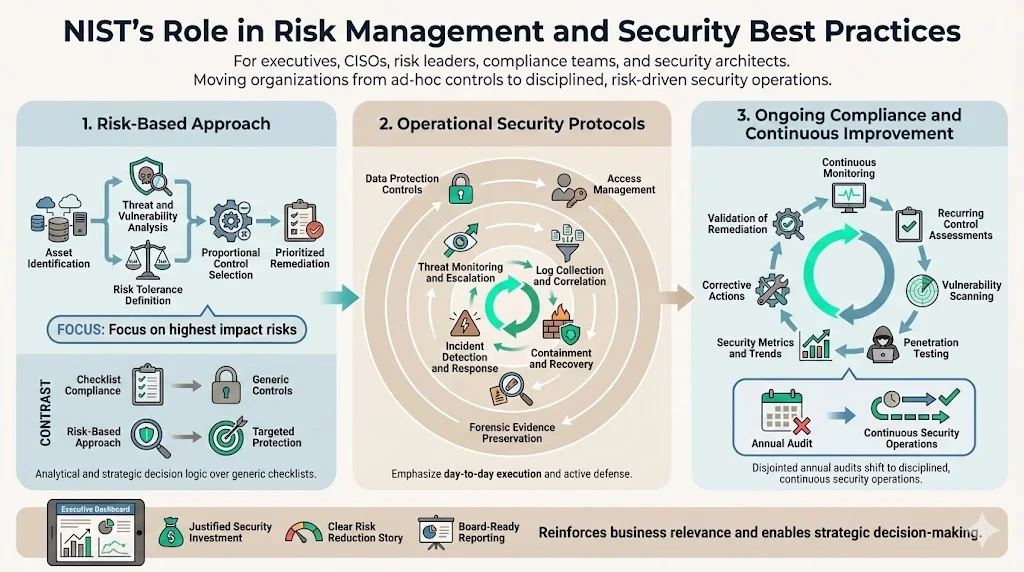
NIST frameworks operationalize risk management by requiring organizations to identify assets, assess threats and vulnerabilities, determine risk tolerance, and implement controls proportional to identified risks. This structured approach contrasts with checklist compliance that implements generic controls without consideration of organizational risk profiles or threat landscapes.
Organizations following NIST risk management principles document risk assessments identifying business-critical assets, evaluate threat actor capabilities and motivations, analyze vulnerabilities in current security posture, and calculate risk exposure using standardized methodologies. These assessments inform control selection and implementation priorities, ensuring limited security resources address the most consequential risks first.
The risk-based approach enables organizations to justify security investments and resource allocation decisions to executive leadership and boards of directors. Rather than requesting cybersecurity budgets based on vague "best practices," security teams present quantified risk exposure and demonstrate how proposed controls reduce specific threats to acceptable levels.
Operational Security Protocols
NIST frameworks translate into operational security protocols across incident response, threat detection, data protection, and access management. Organizations implementing NIST incident response guidance (SP 800-61) establish documented procedures for detecting security events, analyzing incidents, containing threats, eradicating malicious presence, and recovering normal operations while preserving forensic evidence for post-incident analysis.
Threat detection protocols following NIST principles include continuous monitoring of security controls, automated collection of security event logs, correlation of indicators across systems, and escalation procedures when anomalies suggest potential security incidents. These protocols transform reactive security postures into proactive threat hunting and detection capabilities that identify attacks before significant damage occurs.
Data protection safeguards address encryption requirements, access controls, data classification schemes, and secure transmission protocols specified across NIST publications. Organizations implementing these safeguards demonstrate to clients and auditors that sensitive data receives protection appropriate to its classification and regulatory requirements throughout its lifecycle.
Ongoing Compliance and Continuous Improvement
NIST frameworks emphasize continuous monitoring and improvement rather than point-in-time compliance certification. Organizations implementing NIST guidance establish recurring control assessments, vulnerability scanning schedules, penetration testing programs, and security metrics that track control effectiveness over time. This continuous evaluation approach identifies control deficiencies before auditors discover them during certification assessments or security incidents that expose vulnerabilities.
The continuous improvement cycle inherent to NIST frameworks requires organizations to analyze security metrics, identify trends indicating emerging risks, implement corrective actions addressing control deficiencies, and validate remediation effectiveness through follow-up assessments. This operational discipline transforms compliance from an annual audit preparation exercise into sustained security operations integrated with business processes.
Aligning NIST With Client Requirements
What Enterprise Clients Often Expect
Enterprise clients evaluating vendor security posture expect documented security programs grounded in recognized frameworks rather than informal security practices lacking structure or auditability. Security questionnaires distributed during vendor qualification processes routinely reference NIST control families, asking vendors to confirm implementation of specific controls and provide supporting evidence.
Procurement requirements increasingly specify framework alignment as a threshold qualification criterion. Vendors lacking documented NIST implementation face elimination from consideration before technical capabilities or pricing receive evaluation. Organizations demonstrating comprehensive NIST alignment advance through procurement processes with minimal security scrutiny, while competitors lacking framework documentation face extended security reviews, penetration testing requirements, and contractual risk transfer mechanisms that erode deal economics.
Enterprise clients expect evidence of formal risk management processes including documented risk assessments, treatment plans, and ongoing risk monitoring. NIST frameworks provide the structure for producing this evidence in formats recognizable to client security teams and acceptable to their audit and compliance functions.
Positioning Your Services
Organizations pursuing enterprise clients should explicitly communicate NIST alignment in proposals, security documentation, and governance discussions. Rather than describing security capabilities in generic terms, reference specific NIST control families implemented, framework functions addressed, and implementation tiers achieved. This precise communication signals security maturity and enables clients to efficiently map your controls to their vendor risk assessment requirements.
Security assessments and readiness reviews should map existing controls to NIST framework functions and SP 800-53 families, identifying gaps between current state and target implementation tiers. This gap analysis provides concrete remediation roadmaps that transform abstract security improvements into actionable implementation projects with defined outcomes.
Governance discussions with prospective clients should position NIST frameworks as the foundation for ongoing security operations rather than one-time compliance achievements. Emphasize continuous monitoring, recurring assessments, and systematic control improvement as evidence that security investments produce sustained protection rather than audit theater that satisfies certification requirements while leaving systems vulnerable.
Case Examples and Practical Tips
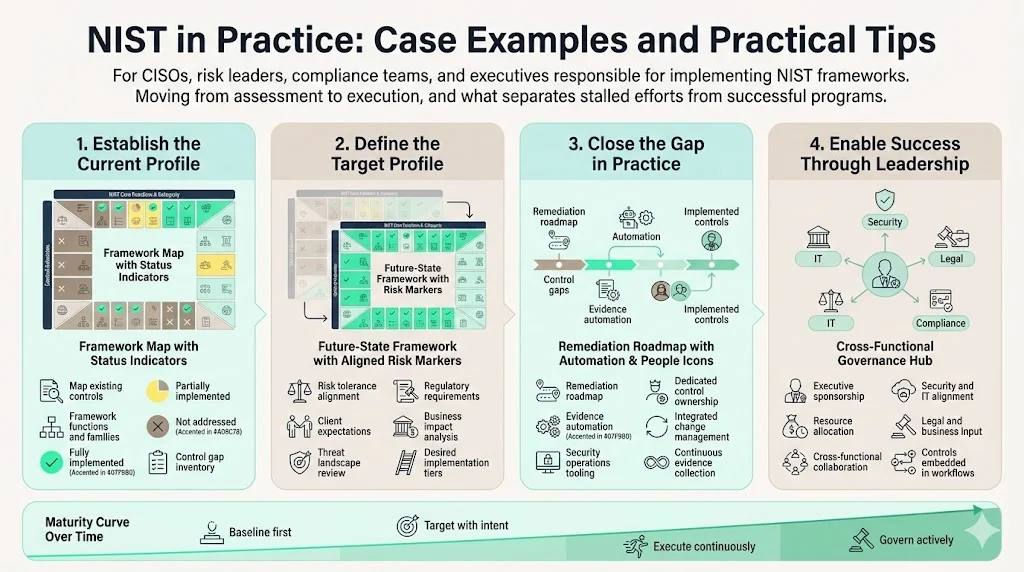
Organizations typically implement NIST frameworks by first developing a current profile documenting existing security controls mapped to framework functions and control families. This baseline assessment identifies which controls are fully implemented, partially implemented, or not addressed by current security measures. The assessment produces an inventory of control gaps requiring remediation to achieve target implementation tiers.
Target profiles define the desired security posture aligned with organizational risk tolerance, regulatory requirements, and client expectations. Organizations establish target profiles by evaluating threat landscapes, assessing business impact of potential security incidents, and determining appropriate implementation tiers for each framework function. The gap between current and target profiles becomes the remediation roadmap guiding security investments and implementation priorities.
Common implementation challenges include insufficient documentation of existing controls, lack of technical resources for control deployment, and difficulty maintaining control effectiveness evidence over time. Organizations overcome these challenges by implementing security operations platforms that automate evidence collection, establishing dedicated security personnel responsible for control maintenance, and integrating security controls into change management and deployment processes rather than treating them as separate compliance activities.
Successful NIST implementation requires executive sponsorship ensuring adequate resource allocation and cross-functional collaboration between security, IT operations, legal, and business units. Security controls spanning access management, incident response, and data protection require coordination across departments and integration with business processes. Organizations treating NIST implementation as purely a security team responsibility inevitably encounter resistance and incomplete control deployment.
Conclusion
NIST meaning transcends its definition as a federal standards agency—it represents the authoritative framework language that enterprises, regulators, and clients use to evaluate security posture and compliance credibility. Organizations implementing NIST frameworks establish documented risk management disciplines, auditor-recognized control structures, and evidence collection routines that satisfy multiple compliance obligations while building actual security infrastructure that protects systems rather than merely impressing auditors.
Enterprise stakeholders care about NIST guidance because it provides objective evaluation criteria for vendor security, translates abstract security concepts into measurable controls, and aligns private sector security practices with federal requirements increasingly referenced in regulatory expectations. Companies demonstrating comprehensive NIST alignment differentiate themselves in competitive procurement processes, reduce vendor qualification friction, and position themselves for emerging regulatory requirements before compliance deadlines create rushed remediation pressures.
The frameworks are not static checklists but operational disciplines requiring continuous monitoring, recurring assessment, and systematic improvement. Organizations approaching NIST implementation as sustained security operations rather than one-time certification projects realize the frameworks' full value: genuine risk reduction, streamlined compliance management, and credible security posture that withstands scrutiny from auditors, regulators, and enterprise clients.
FAQs
NIST stands for the National Institute of Standards and Technology, an agency of the United States Department of Commerce. Its mission is to promote U.S. innovation and industrial competitiveness by advancing measurement science, standards, and technology. Beyond cybersecurity, NIST develops standards across manufacturing, biotechnology, quantum computing, and physical sciences that influence technology development and regulatory requirements across sectors.
The NIST Cybersecurity Framework is voluntary for most private sector organizations—no federal law requires CSF adoption for commercial enterprises. However, NIST compliance becomes mandatory in specific contexts: federal agencies must implement NIST SP 800-53 controls under FISMA, defense contractors handling Controlled Unclassified Information must demonstrate NIST SP 800-171 compliance, and CMMC certification requires third-party assessment of NIST controls. Enterprise procurement processes increasingly mandate NIST alignment as a contractual requirement, making voluntary adoption a practical business necessity for vendor qualification.
The NIST Cybersecurity Framework (CSF) provides the foundational risk-based approach to security program structure, organizing activities into Identify, Protect, Detect, Respond, and Recover functions. NIST SP 800-53 defines comprehensive security and privacy controls widely referenced in enterprise security requirements and vendor assessments. NIST SP 800-171 specifies CUI protection requirements applicable to organizations in federal supply chains. Additional publications including SP 800-61 (incident handling), SP 800-34 (contingency planning), and SP 800-161 (supply chain risk management) address specific operational security domains frequently required in enterprise compliance programs.
NIST frameworks enable enterprises to satisfy multiple compliance obligations through unified control implementations rather than maintaining separate security environments for each certification or regulatory requirement. Controls implemented following NIST guidance map to SOC 2 Trust Services Criteria, ISO 27001 control objectives, and industry-specific regulatory requirements, reducing redundant documentation and implementation efforts. Organizations adopting NIST as their security baseline establish continuous monitoring, recurring assessments, and systematic evidence collection that maintain audit readiness year-round rather than requiring rushed preparation before certification assessments. This approach transforms compliance from disconnected certification projects into sustained security operations integrated with business processes.