Most organizations pursuing enterprise clients approach payment security compliance as a project milestone rather than an operational discipline. This creates a fundamental gap between audit readiness and actual security posture—a gap that becomes immediately apparent when evaluating cardholder data environments under scrutiny from payment brands and acquiring banks.
What QSA Stands For
QSA stands for Qualified Security Assessor, a designation conferred by the PCI Security Standards Council to individuals meeting specific information security education requirements and completing appropriate PCI SSC training. The term applies to both individual security professionals certified to conduct PCI DSS compliance assessments and the companies employing them. The initialism QSAC (Qualified Security Assessor Company) sometimes differentiates QSA companies from individual assessors.
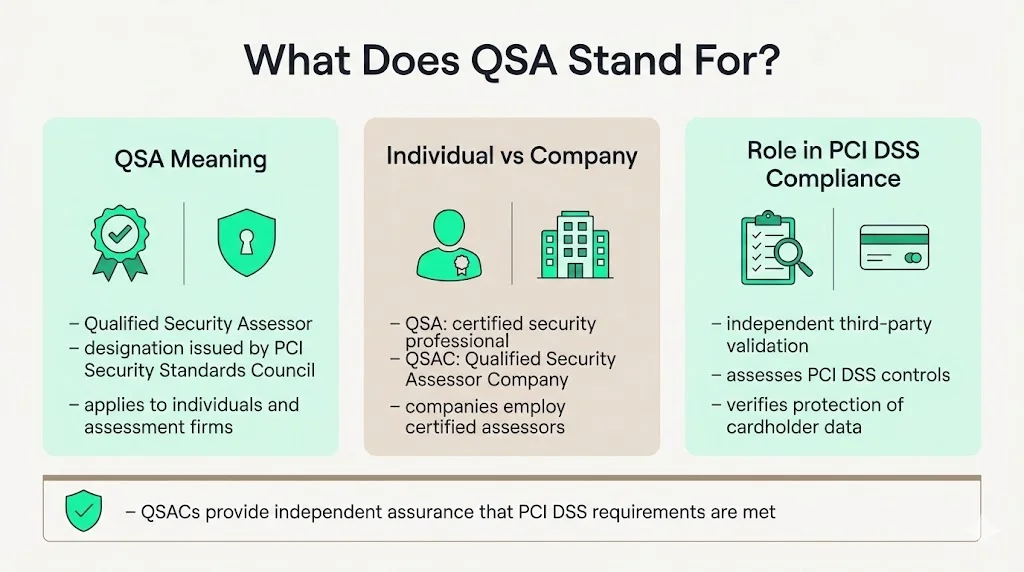
QSA companies are independent security organizations qualified by the PCI Security Standards Council to validate an entity's adherence to PCI DSS. These assessors serve as the authoritative third-party validators for organizations processing payment card data, providing independent verification that security controls meet the Payment Card Industry Data Security Standard requirements.
In scope for PCI DSS?
Drop your work email and we'll help you scope your CDE and the evidence you need to pass.
The History Behind QSA
The QSA designation emerged from the payment card industry's response to escalating data breach incidents affecting cardholder information. The PCI Security Standards Council—founded by the five major payment brands (Visa, Mastercard, American Express, Discover, and JCB International)—established the QSA program to ensure consistent, qualified assessment of organizations handling payment card data. The five founding members of the Council recognize QSAs certified by the PCI Security Standards Council as qualified to assess compliance to the PCI DSS standard.
The program addresses a critical need: standardizing how organizations demonstrate compliance with payment card security requirements. Without qualified, independent assessors applying consistent evaluation criteria, compliance validation would fragment across payment brands, creating operational complexity and inconsistent security outcomes.
QSA Meaning in Detail
Qualified Security Assessor Explained
The primary goal of a QSA is to perform an assessment of a firm handling credit card data against the high-level control objectives of PCI DSS. QSAs conduct formal audits evaluating whether organizations have implemented required security controls across their Cardholder Data Environment—the systems, networks, and processes that store, process, or transmit payment card information.
QSAs function as independent validators rather than consultants. While they may identify security gaps and recommend remediation approaches, their fundamental role involves assessing control effectiveness against documented PCI DSS requirements and testing procedures. This assessment produces formal compliance reports used by payment brands, acquiring banks, and business partners to verify an organization's security posture.
Core Responsibilities
QSAs conduct comprehensive onsite evaluations of security controls across 12 PCI DSS requirement domains. This includes assessing network security architecture, access control mechanisms, vulnerability management programs, security monitoring capabilities, and information security policies. QSAs complete Reports on Compliance (ROCs), which are required as onsite assessments for all Level 1 merchants annually.
Beyond technical control validation, QSAs examine documentation demonstrating sustained compliance over observation periods. They review security policies, incident response procedures, vendor management practices, and evidence of continuous monitoring. When gaps exist, QSAs document findings and specify remediation requirements, creating accountability for organizations to address deficiencies before achieving compliance attestation.
Because the quality of PCI DSS validation assessments can have tremendous impact on the consistent and proper application of security measures and controls, the PCI Security Standards Council's QSA qualification requirements are exacting and detailed, involving both the security companies and individual employees.
Why QSA Matters for Enterprise-Level Compliance
Regulatory Trust and Security
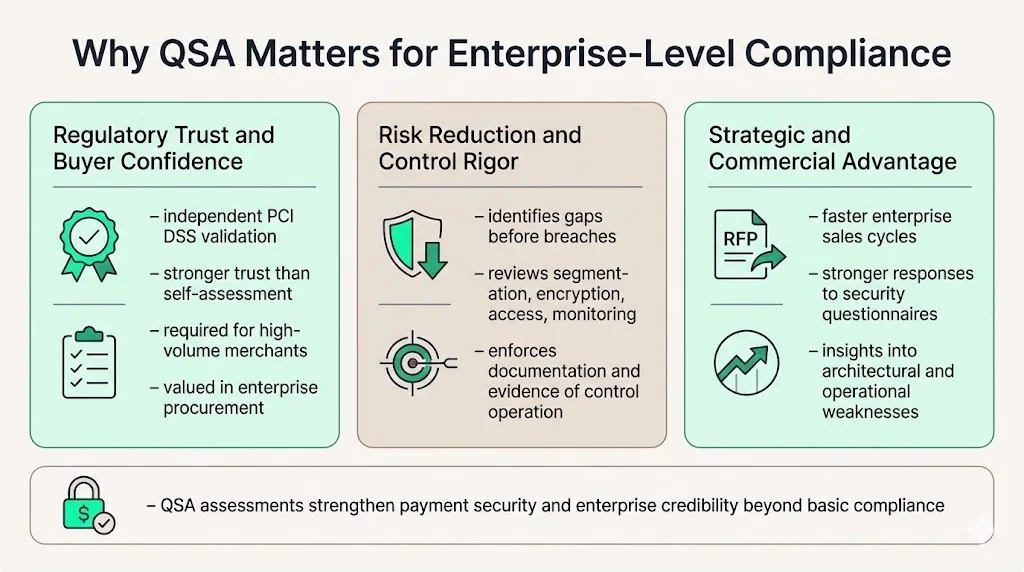
Enterprise organizations selling payment-enabled solutions face increasing scrutiny regarding security practices. QSA-validated compliance provides independent verification that security controls meet industry-established standards rather than relying on self-assessment. This independent attestation carries significant weight in enterprise procurement processes, where security posture directly influences vendor selection decisions.
Payment brands require specific merchant levels to undergo QSA assessments based on transaction volumes. Level 1 organizations processing more than 6 million credit or debit card transactions annually must undergo annual internal audits conducted by a QSA and submit to quarterly PCI scans by an Approved Scanning Vendor. Lower-volume merchants may complete Self-Assessment Questionnaires, though many enterprise buyers require QSA validation regardless of technical requirements.
Risk Reduction
QSA assessments identify security control deficiencies before they manifest as breaches. Organizations processing high transaction volumes face substantial financial and reputational risk from cardholder data compromises. QSA evaluations provide systematic identification of security gaps across network segmentation, encryption implementation, access controls, and monitoring capabilities—areas where implementation flaws frequently create breach vectors.
The assessment process forces organizations to document security controls, demonstrate operational effectiveness, and maintain evidence of sustained compliance. This rigor creates accountability mechanisms that prevent security debt accumulation and ensure controls remain effective as environments evolve.
Strategic Advantage
Enterprise sales cycles increasingly prioritize security validation as a gating factor. Organizations with QSA-validated PCI DSS compliance demonstrate operational maturity and security investment that differentiates them from competitors relying on self-assessment. This validation becomes particularly valuable in RFP responses, security questionnaires, and contract negotiations where independent attestation accelerates procurement decisions.
QSA assessments also provide strategic intelligence about security program effectiveness. Experienced assessors identify not just compliance gaps but architectural weaknesses and operational deficiencies that create broader security risk. Organizations leveraging these insights build more resilient security infrastructure that protects beyond payment card data.
How QSA Fits into the Compliance Process
Pre-Audit Preparation
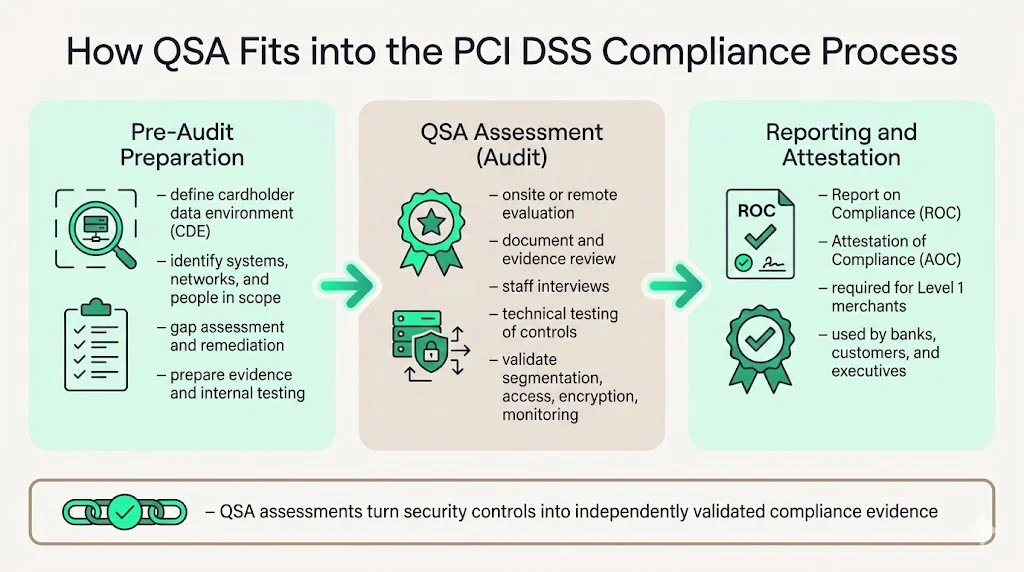
Organizations preparing for QSA assessments begin with scoping exercises defining the Cardholder Data Environment and identifying systems, networks, and personnel in scope for evaluation. This scoping determines which PCI DSS requirements apply and establishes the assessment boundary. Proper scoping prevents assessment scope creep while ensuring all relevant systems receive appropriate scrutiny.
Pre-audit readiness includes gap assessments identifying control deficiencies requiring remediation before formal evaluation. Organizations implement missing controls, document security policies, establish evidence collection processes, and conduct internal testing to verify control effectiveness. This preparation determines the assessment timeline and outcome quality.
Actual QSA Audit
QSA assessments involve onsite examination of security controls, review of documentation and evidence, interviews with security and operations personnel, and technical testing of control effectiveness. Initial audits may take as long as two years to complete due to 12 PCI DSS requirements and 281 directives, though not every requirement applies to every organization. Assessment duration depends on environment complexity, control maturity, and evidence completeness.
QSAs evaluate whether implemented controls satisfy PCI DSS requirements and testing procedures. This includes validating network segmentation, testing firewall configurations, reviewing access control implementations, examining encryption mechanisms, and assessing security monitoring capabilities. QSAs document findings, identify compensating controls where implemented, and determine whether security measures provide equivalent protection to standard requirements.
Reporting
QSAs complete Reports on Compliance (ROCs), which are required as onsite assessments for all Level 1 merchants annually. ROCs document assessment scope, methodology, findings, and compliance determinations for each PCI DSS requirement. Organizations achieving compliance receive Attestations of Compliance certifying adherence to PCI DSS requirements.
These reports serve multiple stakeholders. Payment brands and acquiring banks require ROCs demonstrating merchant compliance. Enterprise customers request compliance attestations during vendor security reviews. Internal stakeholders use assessment findings to prioritize security investments and demonstrate governance to executive leadership. The reports provide authoritative documentation of security posture backed by independent validation.
How to Become a QSA
Qualification Assessment
The QSA course requires prior certifications including CISSP, CISA, or CISM, along with substantial security and auditing experience. Candidates must demonstrate expertise across application security, information systems security, network security, IT security auditing, and information security risk assessment. This prerequisite experience ensures QSAs possess foundational knowledge necessary to evaluate complex security environments.
Individual candidates must work full-time for QSA companies already validated by the PCI Security Standards Council. The qualification process evaluates both the company's capabilities and individual employee expertise, ensuring organizations seeking QSA status maintain appropriate infrastructure, insurance coverage, and business practices.
Training and PCI SSC Exams
QSA training is a two-part program beginning with a five-hour prerequisite course and exam on PCI Fundamentals, followed by an in-depth course and exam delivered in-person. The training covers payment card industry operations, PCI DSS requirements and testing procedures, brand-specific validation requirements, compensating controls, and reporting obligations.
The time elapsed from application submission to a new QSA being listed on the PCI Security Standards Council website is estimated at three months. This timeline includes documentation review, training completion, examination passage, and final qualification approval. Candidates failing examinations must retake training before conducting PCI DSS assessments.
Maintaining Certification
The PCI Security Standards Council maintains an in-depth program for security companies seeking to be certified as Qualified Security Assessors and to be re-certified as QSAs each year. Annual recertification ensures QSAs remain current on PCI DSS updates, emerging payment technologies, and evolving threat landscapes. This ongoing requirement maintains assessment quality and consistency as the standard evolves.
QSAs must complete annual training and examinations covering PCI DSS changes and assessment methodology updates. The PCI Security Standards Council conducts quality assurance reviews of QSA assessment work, evaluating whether assessments follow required procedures and accurately apply PCI DSS requirements. QSAs demonstrating assessment deficiencies face remediation requirements or potential disqualification.
Common Misconceptions About QSA
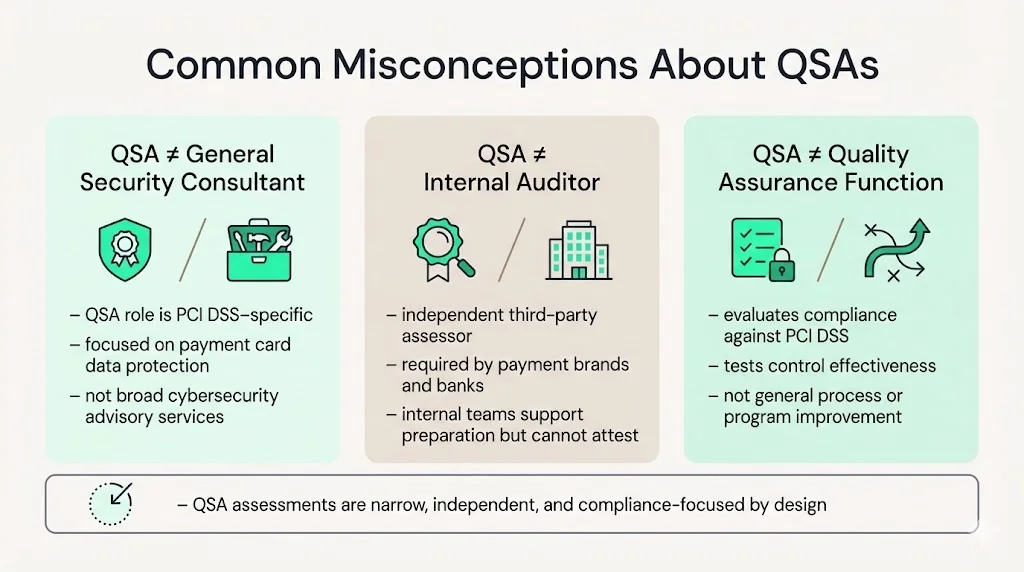
QSAs are not general security consultants providing broad cybersecurity advisory services. Their qualification specifically authorizes PCI DSS compliance assessments under PCI Security Standards Council oversight. While QSAs typically possess extensive security expertise applicable to broader contexts, the QSA designation itself remains narrowly focused on payment card data protection validation.
QSAs differ fundamentally from internal auditors conducting compliance reviews within organizations. QSAs provide independent third-party assessment required by payment brands and acquiring banks. Internal audit teams may support compliance preparation and ongoing monitoring, but they cannot provide the independent attestation that QSA assessments deliver.
The QSA role also differs from quality assurance functions focused on operational excellence and process improvement. QSAs assess control effectiveness against defined PCI DSS requirements rather than evaluating general security program quality. This compliance-specific scope distinguishes QSA assessments from broader security program evaluations.
Related Concepts
Qualification assessment refers to the evaluation processes determining whether organizations and individuals meet QSA program requirements before certification. This includes reviewing security company credentials, insurance coverage, business practices, and individual employee experience and certifications.
Quality assurance in the QSA context involves the PCI Security Standards Council's ongoing review of QSA assessment work to ensure consistent application of PCI DSS requirements and testing procedures. This differs from organizational quality assurance programs focused on operational excellence.
A qualified security analyst represents a distinct credential from QSA, though terminology confusion occurs frequently. Security analyst roles typically focus on threat detection, incident response, and security operations rather than formal compliance assessment and attestation.
Questionnaire and survey analysis comprises readiness assessment tools organizations use before formal QSA audits. Self-Assessment Questionnaires allow lower-risk merchants to evaluate compliance without full QSA assessments, though they lack the independent validation QSA reviews provide.
Quick service application refers to software development methodologies in technology contexts unrelated to payment security compliance.
Quantum secure communication represents emerging cryptographic approaches protecting data transmission against quantum computing threats—a future security technology trend distinct from current PCI DSS requirements.
Quasi-static approximation constitutes a technical physics and engineering term unrelated to security assessment or compliance validation.
QSA Meaning in the Broader Security Landscape
QSA work intersects with enterprise risk management frameworks, data protection strategies, and regulatory compliance programs extending beyond payment card security. Organizations maintaining PCI DSS compliance typically operate under multiple regulatory obligations including GDPR for European customer data, HIPAA for healthcare information, SOC 2 for service organization controls, and ISO 27001 for information security management systems.
Security controls implemented for PCI DSS compliance frequently satisfy requirements across multiple frameworks. Network segmentation, access controls, encryption mechanisms, vulnerability management, and security monitoring required by PCI DSS provide foundational security benefiting broader data protection efforts. Organizations leveraging QSA insights strategically strengthen overall security posture rather than treating payment card compliance as an isolated requirement.
The QSA role will likely expand as payment technologies evolve. Contactless payments, mobile wallets, cryptocurrency transactions, and embedded finance create new cardholder data flows requiring assessment. QSAs must adapt evaluation methodologies to cloud infrastructure, API-based integrations, and distributed payment processing architectures while maintaining consistent security validation standards.
Real-World Enterprise Scenarios
Consider an enterprise SaaS platform adding payment processing capabilities to support transaction-based pricing models. The organization processes sufficient transaction volume to require Level 1 merchant classification, mandating annual QSA assessment. During the initial QSA audit, assessors identify network segmentation deficiencies allowing lateral movement from corporate networks into the Cardholder Data Environment. They also discover insufficient logging and monitoring of privileged access to payment systems.
The QSA documents these findings with specific remediation requirements. The organization implements network segmentation improvements using VLANs and firewall rules, deploys Security Information and Event Management capabilities for privileged access monitoring, and establishes formal change control procedures for payment system modifications. The remediation effort requires four months and substantial security infrastructure investment, but ultimately produces both PCI DSS compliance and measurably stronger security posture.
The compliance attestation enables the organization to close enterprise deals previously blocked by security concerns. Sales cycles accelerate because prospects receive independent validation of security controls rather than relying on vendor self-assessment. The security improvements also reduce breach risk that would threaten customer trust and create substantial incident response costs.
Another scenario involves an enterprise payment gateway discovering during QSA assessment that third-party service providers accessing their Cardholder Data Environment lack appropriate security controls. The QSA identifies this as a vendor management deficiency requiring remediation. The organization establishes vendor security assessment procedures, implements contractual security requirements, and conducts ongoing monitoring of third-party access. These improvements prevent potential breaches originating from vendor compromises while satisfying PCI DSS vendor management requirements.
Meet your QSA with the evidence already gathered
Book a demo and we'll show how Konfirmity handles the pre-audit preparation a Qualified Security Assessor expects, so the on-site work is validation rather than discovery.
Book a demo
Conclusion
QSA meaning extends beyond the Qualified Security Assessor acronym to encompass independent validation that security controls protecting payment card data meet industry-established standards. For enterprise organizations processing payment transactions or selling payment-enabled solutions, QSA assessment provides authoritative attestation of security posture that accelerates sales cycles, satisfies payment brand requirements, and reduces breach risk. The rigor QSAs apply to control evaluation creates accountability mechanisms ensuring security measures remain effective rather than deteriorating into documentation exercises satisfying auditors without protecting systems.
Organizations treating QSA assessments as compliance obligations miss the strategic value these evaluations deliver. Experienced QSAs identify architectural weaknesses, operational deficiencies, and control gaps creating risk beyond payment card data exposure. The assessment process forces documentation of security controls, demonstration of operational effectiveness, and maintenance of evidence proving sustained compliance—disciplines that strengthen security programs regardless of regulatory requirements.
As payment technologies evolve and enterprise security scrutiny intensifies, QSA validation becomes increasingly valuable for organizations demonstrating security maturity to customers, partners, and payment brands. The independent attestation QSAs differentiate organizations committed to genuine security infrastructure from those manufacturing compliance artifacts without implementing effective controls.
FAQs
QSA stands for Qualified Security Assessor, a designation conferred by the PCI Security Standards Council to individuals meeting specific information security education requirements and completing appropriate PCI SSC training. The term applies to both individual assessors and the security companies employing them.
Level 1 organizations processing more than 6 million credit or debit card transactions annually must undergo annual internal audits conducted by a QSA. Lower merchant levels may complete Self-Assessment Questionnaires, though many enterprise buyers require QSA validation regardless of technical requirements. Organizations should consult their acquiring bank and payment brands for specific requirements.
QSAs conduct onsite examination of security controls, review documentation and evidence, interview security personnel, and perform technical testing of control effectiveness. They evaluate network segmentation, access controls, encryption mechanisms, vulnerability management, and security monitoring. QSAs complete Reports on Compliance documenting assessment findings and compliance determinations.
QSAs must be re-certified each year through annual training and examinations covering PCI DSS updates and assessment methodology changes. This annual recertification ensures QSAs remain current on evolving standards and maintain assessment quality.
QSAs are not general security consultants. Their qualification specifically authorizes PCI DSS compliance assessments under PCI Security Standards Council oversight. While QSAs typically possess broad security expertise, the QSA designation itself focuses narrowly on payment card data protection validation and independent compliance attestation required by payment brands.