I'll research current information about CMMC Registered Practitioners and related regulatory requirements to ensure accuracy.Let me gather additional information about CMMC implementation timelines and the broader context.---
Most organizations approaching CMMC compliance focus on what certification requires rather than understanding who can legitimately help them achieve it. This creates a fundamental gap—contractors engage advisors based on credentials that signal process familiarity rather than technical capability, a distinction that becomes critical when formal assessments reveal security deficiencies that superficial preparation failed to address.
The Defense Industrial Base comprises over 300,000 contractors handling sensitive government data. As CMMC requirements become mandatory in Department of Defense contracts throughout 2026, understanding the distinction between credentialed advisors and qualified practitioners becomes essential for enterprises managing vendor risk and compliance obligations.
What is a Registered Practitioner (RP)?
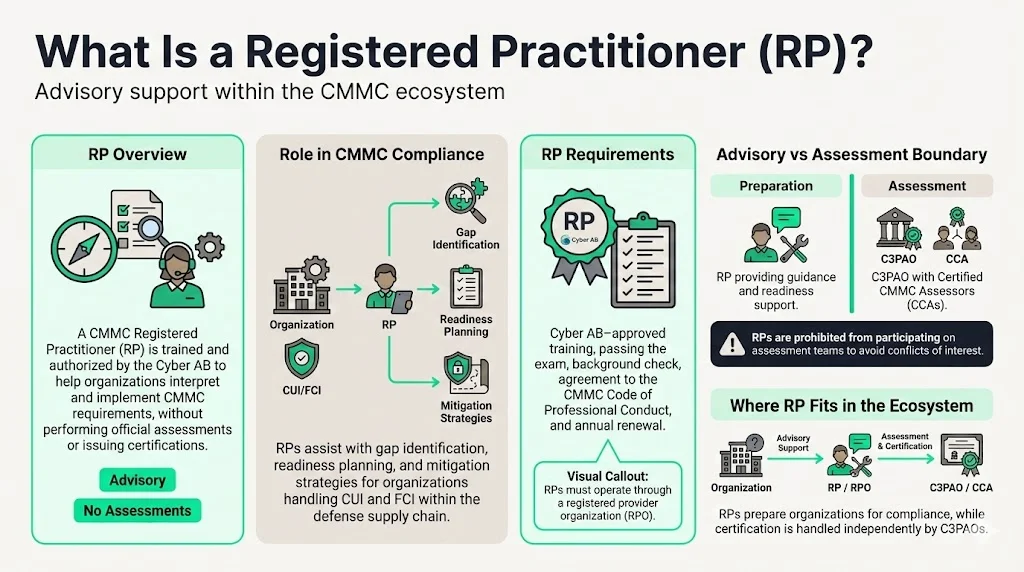
A CMMC Registered Practitioner is an individual trained and authorized by the Cyber AB to support organizations working toward CMMC compliance. While they do not perform official assessments or issue certifications, they play a critical role in helping companies interpret and implement CMMC effectively.
Individuals holding any level of an RP designation can provide CMMC implementation consulting services to assist in identifying gaps and providing mitigation strategies for an OSC preparing for an assessment. This role exists specifically within the CMMC ecosystem—a framework designed to protect Controlled Unclassified Information (CUI) and Federal Contract Information (FCI) across defense supply chains.
The RP designation involves specific requirements: an RP is an individual who has completed CyberAB-approved training and passed the required exam and background check. They must also agree to abide by the CMMC Code of Professional Conduct. CMMC RP's certification is valid for one year and they must work with a CMMC registered provider organization (RPO) in order to perform their CMMC-related consultative services.
The distinction between advisory and assessment roles matters: any level of RP cannot participate on assessment teams in order to prevent conflicts of interest. RPs prepare organizations for compliance; they do not certify it. Formal assessments require engagement with Certified Third-Party Assessment Organizations (C3PAOs) employing Certified CMMC Assessors (CCAs).
Working toward a federal compliance baseline?
Drop your work email and we'll help you map controls to NIST and prove them with real evidence.
Why Businesses Care About Registered Practitioners
1) Risk Management and Compliance Assurance
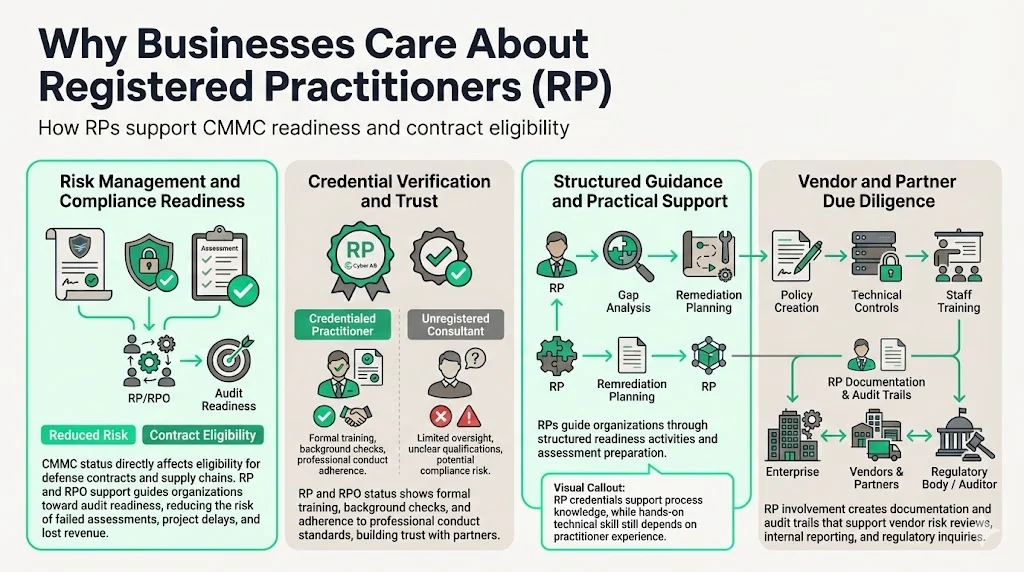
CMMC compliance directly affects contract eligibility for defense contractors. Organizations lacking proper certification face contract disqualification, supply chain exclusion, and revenue loss. Engaging credentialed practitioners provides structured pathways to audit readiness rather than ad-hoc internal efforts that frequently miss control requirements.
RPOs provide strategic guidance, readiness support, and hands-on help to implement required cybersecurity practices to help organizations prepare for a successful assessment. This preparation reduces the risk of failed assessments—events that delay contract awards and signal security inadequacy to procurement offices.
2) Credential Verification and Trustworthiness
The RP/RPO status shows knowledge of the process as a whole and that the organization is taking action to participate in the CMMC ecosystem, has some knowledge of the CMMC requirements, knows who is responsible for which aspects of compliance, and understands the process to get certified.
For enterprises conducting vendor due diligence, RP status provides baseline verification that consultants have completed formal training, passed background checks, and agreed to professional conduct standards. This credential offers more accountability than unregistered consultants operating without regulatory oversight.
3) Expertise and Structured Guidance
RPs guide organizations through gap assessments, remediation planning, policy development, technical implementation, and staff training. Experts are trained to guide defense contractors through the readiness process, from initial gap assessments to policy development and audit preparation.
However, credential alone does not guarantee deep technical expertise. The training is helpful to get you oriented to the concept of the CMMC and introduces key terms, players, and roles in the CMMC ecosystem, but it is not a replacement in any way for systems administrator, CMMC, or cybersecurity experience.
4) Vendor and Partner Due Diligence
Enterprises managing supply chain risk require documented evidence that vendors meet compliance standards. RP status creates audit trails demonstrating that partners engaged credentialed advisors during compliance preparation. This documentation supports vendor risk assessments, board reporting, and regulatory inquiries.
What Becoming a Registered Practitioner Requires
The CMMC RP path involves specific steps: You pay between $500 and $600 each year, training takes just four to five hours in an open-book format, and you also complete a background check as part of the process.
This training provides individuals with a foundational understanding of the basics of the CMMC model, what constitutes FCI, prime and subcontract flow, tools for implementing the CMMC level 1 framework, and a high-level overview of assessment scoping.
Citizenship requirements apply: pass a commercial background check and be a citizen of the USA, Australia, South Korea, or NATO countries. Additionally, you must be affiliated with a Registered Provider Organization, which means if you're an independent consultant or part of a company that hasn't yet registered as an RPO, that step will need to come first.
The training establishes foundational readiness knowledge but represents minimal technical depth. Organizations requiring implementation of NIST SP 800-171's 110 security requirements need practitioners with systems administration, network security, and compliance engineering experience beyond basic RP certification.
What RP Status Does Not Mean
Several critical limitations define RP boundaries:
Not Assessment Authority: RPs cannot perform official CMMC assessments or issue certifications. RPOs cannot complete CMMC assessments, even if they hire an assessor, and they must first become a C3PAO (the requirements for this are significantly higher than RPO status).
Not Technical Guarantee: The RP/RPO status does not mean the individual or org has the expertise to effectively assess or implement the FARS/NIST standards that the CMMC is built on, it simply means they signed up and now understand the CMMC process.
Not Hands-On Implementation: While an RPO can offer guidance and support for CMMC compliance, their ability to provide hands-on assistance is highly limited—for example, an RPO can advise on MFA implementation, but RPOs only provide guidance; they cannot deploy and manage the solution for you.
This is the root of where confusion can occur and where it gets dangerous as their feedback/consulting advice may not get you to where you need to be, and may not pass the test when it comes time for the actual assessor to review your network.
Over-reliance on RP status without verifying practical cybersecurity experience, relevant certifications (CISSP, CISA, CISM), and documented implementation track records creates compliance risk. The credential confirms process knowledge—not technical mastery or systems implementation capability.
Impacts on Organizations Engaging RPs
For Compliance-Driven Industries
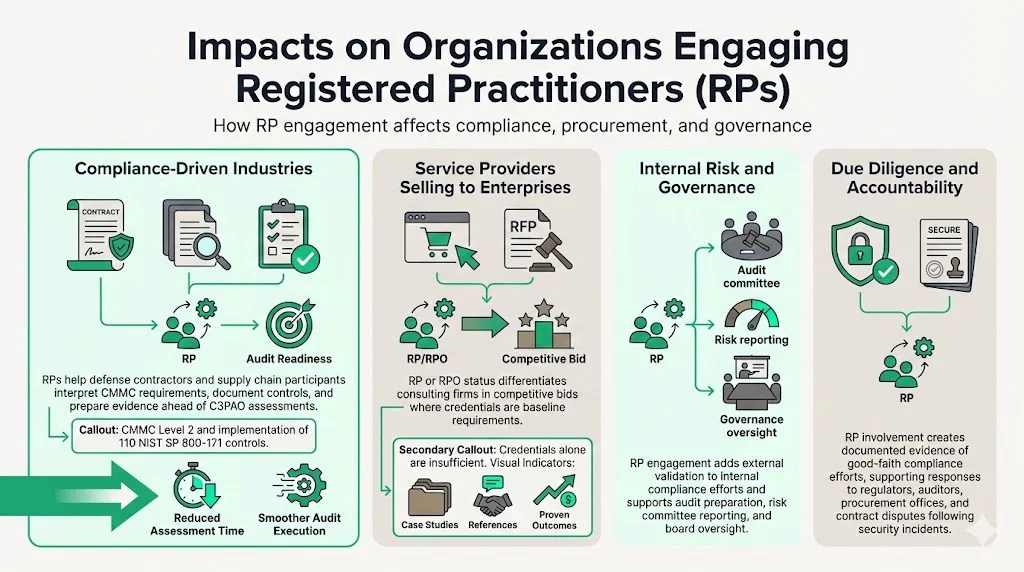
Defense contractors, subcontractors, and supply chain participants face mandatory CMMC requirements. Engaging RPs helps organizations interpret requirements, document controls, and prepare evidence collection before formal assessments. This preparation streamlines C3PAO engagements and reduces assessment duration.
Organizations handling CUI at CMMC Level 2 must implement 110 security requirements from NIST SP 800-171. RPs provide roadmaps for control implementation, policy documentation, and risk assessment—activities that establish audit readiness.
For Service Providers Selling to Enterprises
RP or RPO status differentiates consulting firms in procurement processes. Defense contractors evaluating compliance partners increasingly require documented credentials as baseline qualifications. Organizations without RP affiliation face disadvantages in RFPs where credential verification is mandatory.
However, credential alone does not substitute for demonstrated implementation experience. Enterprises should require case studies, client references, and evidence of successful assessment outcomes when evaluating RP-credentialed providers.
For Internal Risk and Governance
Enterprises using RPs for internal compliance efforts gain external validation beyond self-assessment. This creates accountability layers supporting audit preparation, risk committee reporting, and board governance requirements.
RP engagement documents due diligence efforts—critical evidence when demonstrating good-faith compliance attempts to regulators, auditors, or procurement offices investigating security incidents or contract disputes.
When to Require RP Status in Vendors
Enterprises should mandate RP credentials or equivalent professional licensing when:
Regulatory Compliance is Contractual: Defense contractors and subcontractors handling CUI or FCI must demonstrate CMMC compliance. Vendors supporting these efforts should hold verifiable credentials tied to the CMMC ecosystem.
Sensitive Operations Require Documented Expertise: When vendors access sensitive systems, handle protected data, or implement security controls, credentialed practitioners provide accountability that unregistered consultants cannot offer.
Vendor Due Diligence Requires Audit Trails: Governance frameworks, board oversight, and risk audits demand documented evidence of vendor qualifications. RP status creates verifiable credentials supporting vendor risk assessments.
Regulatory Landscapes Shift Rapidly: CMMC requirements continue evolving through phased implementation. Credentialed practitioners within the Cyber AB ecosystem receive updates, training revisions, and regulatory guidance that independent consultants may miss.
Enterprises should verify credentials directly through Cyber AB registries rather than accepting self-reported RP status. Request proof of current registration, RPO affiliation, and professional conduct agreement compliance.
Beyond CMMC: Registered Practitioners in Other Domains
The "registered practitioner" concept extends beyond cybersecurity frameworks. Healthcare, financial services, and professional consulting employ similar credentialing models where regulatory bodies authorize practitioners to provide services within defined scopes.
In healthcare, registered nurses (RNs) hold state licenses authorizing patient care delivery. Nurse practitioners (NPs) possess advanced clinical education enabling diagnostic, treatment, and prescriptive authority—capabilities exceeding RN scope. Both credentials require regulatory body registration, continuing education, and professional conduct adherence.
Licensed practitioners across industries share common characteristics: formal training completion, competency examinations, background verification, regulatory body registration, and ethical conduct agreements. These credentials signal baseline qualifications while not guaranteeing expertise depth or specialized capabilities.
Enterprises evaluating any registered practitioner—cybersecurity, healthcare, financial, or otherwise—should distinguish between credential scope and practical capability. Registration confirms process knowledge and regulatory compliance; it does not certify technical mastery or guarantee implementation success.
Keep your RP engagement from ending at the gap list
Book a demo and we'll show how Konfirmity carries the gaps an RP identifies through to implemented controls and recorded evidence, so the mitigation plan does not stall once the consulting hours end.
Book a demo
Frequently Asked Questions
A registered practitioner holds formal registration with a recognized authority or regulatory body after completing required training, passing examinations, and meeting conduct standards. Within CMMC, an RP is trained and authorized by the Cyber AB to support organizations working toward CMMC compliance, specifically for advisory and preparation services rather than official assessments.
A Registered Nurse (RN) holds a state nursing license authorizing direct patient care after completing nursing education and passing licensing examinations. A Nurse Practitioner (NP) possesses advanced clinical education—typically a master's or doctoral degree—enabling expanded scope including diagnosing illnesses, managing treatments, ordering diagnostic tests, and prescribing medications within regulatory boundaries defined by state practice acts.
Qualification requirements vary by domain and regulatory framework. Generally, practitioner status requires completing accredited education or training programs, passing competency examinations, meeting background or character requirements, registering with governing bodies, and adhering to professional conduct codes. For CMMC RPs specifically, qualification involves completing CyberAB-approved training, passing the required exam and background check, and agreeing to abide by the CMMC Code of Professional Conduct.