

Most organizations selling to enterprise clients focus on crafting compelling value propositions while overlooking a fundamental operational reality: enterprise procurement operates through structured, formal processes that require precise responses to specific document types. When your sales team receives a Request for Quotation (RFQ) but treats it like a strategic pitch opportunity, you've already misread the buyer's intent—and likely positioned yourself to lose on price against competitors who understood the actual procurement context.
Understanding "RFQ meaning" extends beyond simple acronym recognition. Nearly 40% of businesses admit to losing savings opportunities because of unclear requirements or inconsistent vendor quotes, which means buyers depend on standardized RFQ processes to compare suppliers fairly. For sellers, recognizing an RFQ signals that specifications are already defined, pricing is the primary decision factor, and your response strategy must shift from innovation to clarity, competitiveness, and compliance readiness.
This glossary term covers what RFQ means in procurement contexts, how it fits into the purchase process, how suppliers should structure responses, and what compliance or regulatory factors matter when responding to enterprise and public sector RFQs.
What Does "RFQ" Mean?
A request for quotation (RfQ) is a business process in which a company or public entity requests a quote from a supplier for the purchase of specific products or services. The acronym "RFQ" stands for "Request for Quotation" in most procurement contexts, though in some industries it may also mean "Request for Qualifications"—a document used to pre-screen vendors based on capability rather than price.
An RFQ is a competitive bid document used when inviting suppliers or contractors to submit a price bid for products or services where the requirements are standardized or produced in repetitive quantities. The buyer has already defined what they need; the RFQ exists to solicit and compare pricing, terms, and delivery commitments from multiple suppliers.
Key Characteristics
RFQs share several defining features that distinguish them from other procurement documents:
Clear specifications of product or service. RFQs often include the specifications of the items/services to make sure all the suppliers are bidding on the same item/service. Logically, the more detailed the specifications, the more accurate the quote will be and comparable to the other suppliers. Buyers provide product models, quantities, technical requirements, and quality standards so suppliers know exactly what to quote.
Pricing and commercial terms as primary decision factor. RFQs are all about price and cost. They are the procurement process for soliciting quotes for a specific item, task, or project. The buyer compares unit costs, bulk discounts, payment terms, and delivery timelines to determine fair market value.
Part of the purchase process once scope is defined. An RFQ is often used for high-volume/low-value items and should be completed more quickly than an RFP (Request for Proposal). The RFQ enters procurement after needs analysis and specification setting, but before contract negotiation.
RFQ vs Related Terms (RFI, RFP, RFT)
Recognizing the procurement document type helps suppliers understand buyer mindset and response strategy:
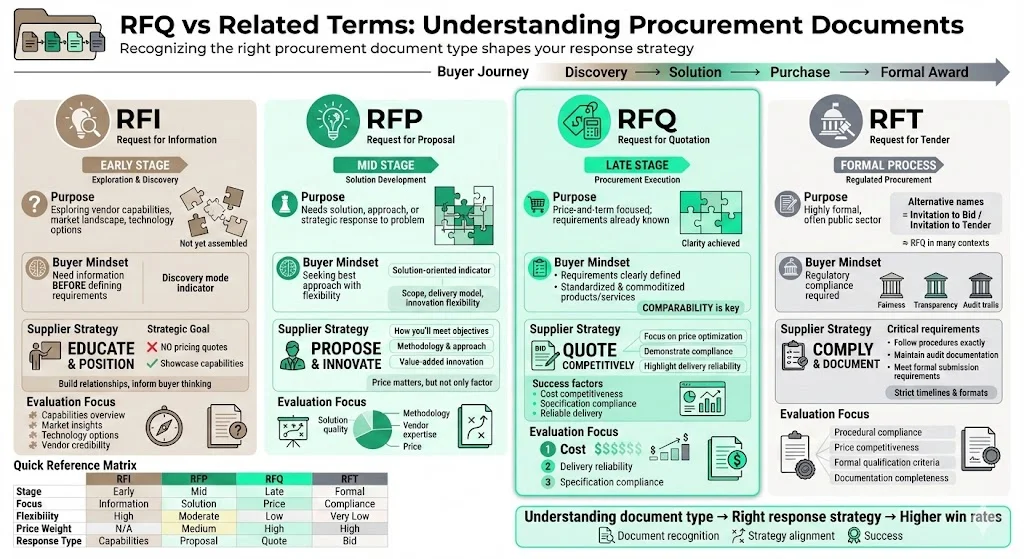
RFI (Request for Information): Early-stage inquiry exploring vendor capabilities, market landscape, or technology options. Buyers use RFIs when they need information before defining requirements. For suppliers, an RFI is an opportunity to educate and position—not to quote pricing.
RFP (Request for Proposal): Used when the buyer needs a solution, approach, or strategic response to a problem. RFPs invite vendors to propose how they would meet objectives, often with flexibility in scope, delivery model, or innovation. Evaluation weighs solution quality, methodology, and vendor expertise alongside price.
RFQ (Request for Quotation): Price-and-term focused document issued when requirements are already known. RfQs are best suited to products and services that are as standardized and as commoditized as possible, as this makes each supplier's quote comparable. Evaluation centers on cost, delivery reliability, and compliance with specifications.
RFT (Request for Tender): Often a synonym for RFQ or a highly formal procurement process in public sector contexts. The document may sometimes be called an Invitation to Bid or Invitation to Tender. In many jurisdictions, RFTs carry regulatory requirements for fairness, transparency, and audit trails.
For suppliers, the distinction matters: responding to an RFQ with strategic consulting language or innovation proposals signals that you misunderstood the transactional nature of the buyer's inquiry.
Building toward SOC 2, ISO 27001, or another framework?
Drop your work email and we'll help you turn security work into audit-ready evidence automatically.
Where Does RFQ Fit In the Purchase Process?
Role in Procurement / Purchase Process
The typical enterprise procurement process follows a defined sequence: need identification → specification development → supplier inquiry → RFQ issuance → supplier proposal submission → vendor selection → contract negotiation → purchase order execution. The RFQ enters after the buyer has completed internal requirements definition and is ready to solicit competitive bids.
The procurement team clearly outlines the product or service specifications, quantity, delivery timelines, and quality expectations. A shortlist of trusted suppliers is created based on previous performance, certifications, or market research. The formal RFQ document is sent to all shortlisted vendors with consistent details and submission deadlines. Suppliers then respond with pricing tables, commercial terms, and delivery commitments within the specified timeframe.
Vendors submit their pricing and terms. The procurement team evaluates each quote based on cost, delivery time, and compliance with requirements. Evaluation extends beyond unit price to include payment terms, warranty coverage, lead times, and vendor reliability. After analysis and negotiation, the buyer selects a supplier and issues a contract or purchase order.
Use Cases for RFQ
RFQs are most effective in scenarios where specifications are standardized and pricing comparison drives decision-making:
Standardized goods or services with known quantities. When a buyer needs 1,000 laptops of a specified model or recurring software licenses with defined user counts, an RFQ enables rapid price comparison across vendors offering identical or near-identical products.
Bulk purchasing or recurring purchases where supplier commoditization is high. Manufacturing companies sourcing raw materials with fixed specifications issue RFQs to invite competitive bids from multiple suppliers capable of meeting technical requirements.
Multiple potential suppliers available for rapid competitive pricing. When many vendors can fulfill requirements and differentiation rests primarily on cost and delivery terms, an RFQ streamlines evaluation by standardizing response format.
Practical examples:
- A large enterprise purchasing 1,000 laptops of a specific model sends RFQs to authorized resellers to compare unit pricing, volume discounts, and delivery schedules.
- A manufacturing company needing raw materials (steel, chemicals, components) with defined specifications uses RFQs to solicit pricing from qualified suppliers.
- A SaaS vendor renewing standard support services across enterprise clients issues RFQs to existing service providers for updated pricing based on user growth.
Benefits for Buyers and Suppliers
For buyers: A well-structured RFQ not only ensures fairness and transparency but also helps procurement teams compare bids accurately, standardize communication, and drive measurable cost savings. RFQs speed procurement when scope is known, provide audit trails for compliance, and reduce ambiguity in vendor responses through standardized formats.
For sellers (companies selling to enterprise clients): Recognizing an RFQ means you're in a pricing-comparison race where clarity on price, terms, and turnaround matters more than strategic differentiation. Your proposal must provide precise cost breakdowns, confirm you meet specifications, and demonstrate reliability.
The challenge: RFQs offer fewer opportunities to differentiate on innovation or strategic value. Price and delivery reliability become dominant factors, requiring suppliers to compete on operational efficiency and contract flexibility rather than solution design.
How to Create or Respond to an RFQ
For Buyers (Issuers)
Organizations issuing RFQs follow a structured process to ensure comparability and compliance:
Preparation and specification. Start your RFQ by preparing the relevant documentation. Identify clear requirements with input from internal stakeholders to make sure you've included all the requirements, including product definitions, technical specifications, quantities, delivery timelines, and quality standards.
What to include in the RFQ document:
- Company overview and project background providing context for the purchase
- Detailed product or service specifications with quantities, technical requirements, and acceptance criteria
- Commercial aspects: payment terms, pricing format (unit cost, bulk discount tables, total price), contract duration, warranty expectations
- Submission instructions: deadline, required format, evaluation criteria, vendor qualification requirements
- Terms and conditions, including compliance or regulatory requirements (certifications, data protection, ethical sourcing standards)
The template, in a format that can easily be compared, such as Excel, should include quantities, cost breakdown, if applicable, pricing, volume discounts, and total price (before taxes). Providing standardized response templates ensures apples-to-apples comparisons during evaluation.
Best practices: Clarity and consistency matter. The RFQ must include clear instructions for its completion and submission due date. It is important to allow enough time for a bidder to formulate his response. Buyers should establish Q&A mechanisms where suppliers can request clarifications, with answers shared equally among all bidders to maintain fairness.
Types of RFQs and bidding methods:
- Open bid: All vendor responses visible to competitors, encouraging aggressive pricing but potentially inflating costs if vendors collude.
- Sealed bid: Responses kept confidential until evaluation, common in public sector procurement to ensure fairness.
- Invited bid: RFQ sent only to pre-qualified or trusted suppliers, reducing evaluation workload but potentially limiting competitive pressure.
- Reverse auction: Vendors submit progressively lower bids in real-time, driving cost down when price is the sole decision criterion.
For Suppliers (Responders)
When you receive an RFQ, interpret it as confirmation that the buyer has defined specifications and is comparing pricing across multiple vendors. Your response strategy shifts from consultative selling to disciplined execution:
How to respond:
- Provide clear pricing tables. Include unit costs, bulk discount schedules, shipping or delivery terms, and total costs. Match the buyer's requested format to simplify comparison.
- Confirm you meet specifications and delivery timelines. Explicitly state compliance with technical requirements, quality standards, and delivery schedules. Any deviations must be clearly noted and justified.
- Highlight value-adds within scope constraints. While RFQs limit innovation opportunities, you can differentiate on warranty extensions, faster delivery, payment flexibility, or post-sale support—provided these align with evaluation criteria.
- Ensure compliance with vendor qualification criteria. If the RFQ requires certifications (ISO, SOC 2, industry-specific standards), proof of insurance, or capacity demonstrations, include documentation proactively.
- Submit before the deadline in the required format. Late or non-conforming responses are typically disqualified. Follow submission instructions precisely.
Competitive mindset: You are one of many suppliers; pricing and reliability drive selection. Avoid lengthy narrative proposals when the buyer requested a pricing table. Focus on clarity, accuracy, and responsiveness.
Vendor Selection & Contract Negotiation
Once all quotes are analyzed, the next stage is RFQ supplier selection. The procurement team scores each response based on predefined criteria such as cost, compliance, and added value. The chosen vendor is then invited for final negotiations to finalize terms and confirm delivery commitments.
After RFQ responses, buyers may request clarifications, conduct site visits, or validate capacity before negotiating contracts with selected vendors. For sellers, winning an RFQ response leads to contract negotiation covering terms, service-level agreements, warranties, liability caps, and compliance obligations. Being ready with standardized contract templates, pre-approved discount structures, and legal review capacity accelerates closure.
Compliance Relevance & Enterprise Considerations
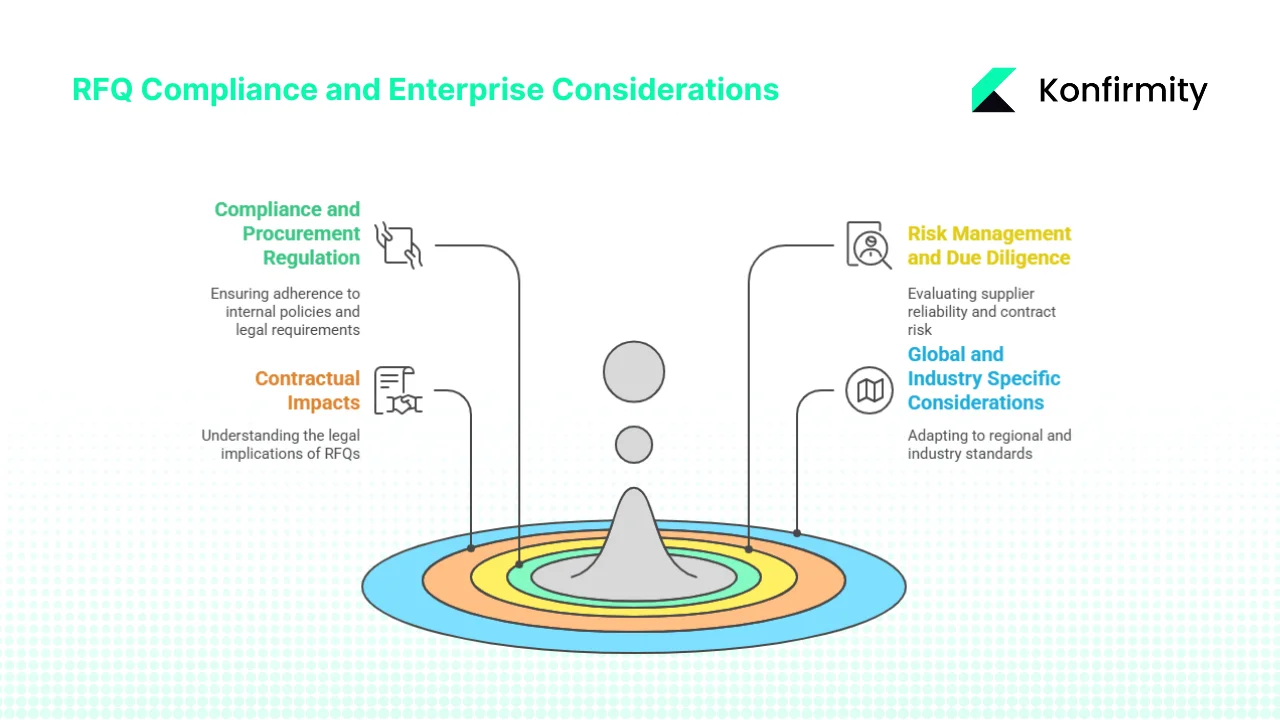
1) Compliance and Procurement Regulation
In enterprise and public sector procurement, RFQs often must adhere to internal policy requirements, audit trail standards, vendor fairness principles, and regulatory transparency obligations. Public sector RFQs in many jurisdictions carry legal requirements for open competition, non-discrimination, and documented decision criteria to withstand audit scrutiny.
For sellers, compliance readiness matters during RFQ response. Buyers may require vendor qualifications including security certifications (SOC 2, ISO 27001), regulatory compliance attestations (GDPR, HIPAA), ethical sourcing commitments, financial stability documentation, or insurance coverage. Failure to provide required compliance evidence disqualifies responses regardless of competitive pricing.
2) Risk Management & Supplier Due Diligence
Evaluation goes beyond just price; it includes delivery timelines, warranty terms, and service quality. Using an RFQ gives buyers a mechanism to compare not just cost but supplier reliability, contract risk, lead time accuracy, and warranty coverage. Buyers assess vendors on financial stability, operational capacity, past performance, and ability to scale delivery if demand increases.
For suppliers, demonstrating compliance histories, capacity documentation, and performance references strengthens RFQ responses. If the buyer requests references, delivery track records, or capacity certifications, providing them proactively signals reliability and reduces perceived risk.
3) Contractual Impacts for Enterprise Sellers
It's important to note that a request for a quote is not a firm offer to purchase. Therefore, it is not considered a formal contract or agreement. The final contract is created once the buyer sends an offer and the vendor or supplier accepts it. Winning an RFQ response does not create a binding contract; it positions you for contract negotiation or purchase order issuance.
For enterprise clients purchasing large volumes, regulatory oversight may apply. Competition law, procurement law, export controls, or sector-specific regulations may govern contract terms, pricing structures, or delivery conditions. For sellers, understanding standard terms in RFQs—payment schedules, delivery penalties, liability caps, warranty obligations—helps you avoid contractual risk during negotiation.
4) Global/Industry Specific Considerations
If selling globally, your enterprise client may follow different regional procurement rules. Public sector procurement in the European Union, United States federal government, or other jurisdictions imposes specific transparency, fairness, and documentation requirements. Private sector procurement may follow industry standards (automotive supply chain compliance, pharmaceutical quality systems, financial services vendor risk management).
Industry-specific compliance factors include:
- IT hardware procurement: Export control regulations, conflict mineral disclosures, cybersecurity certifications.
- Professional services: Data protection clauses (GDPR, CCPA), liability insurance, professional indemnity coverage.
- Manufacturing materials: Quality certifications (ISO 9001), safety data sheets, environmental compliance (RoHS, REACH).
For large enterprise sellers, aligning internal processes—pricing approval workflows, discount authorization limits, contract template libraries, compliance documentation repositories—with RFQ response requirements reduces friction and accelerates turnaround.
Common Pitfalls & How to Avoid Them
-
Pitfall #1: Responding without fully understanding buyer specifications. Submitting a quote for a product variant that doesn't meet technical requirements results in disqualification. Avoid this by carefully reviewing specifications, requesting clarifications during the Q&A period, and confirming compliance explicitly in your response.
-
Pitfall #2: Underestimating the competitive nature of RFQ processes. When buyers issue RFQs, they're comparing multiple suppliers primarily on price. Avoid this by benchmarking your pricing against market rates, structuring volume discounts strategically, and ensuring your cost structure supports competitive bids.
-
Pitfall #3: Delay in response or unclear submission format. Missing deadlines or submitting responses that don't match requested formats disqualifies vendors. Avoid this by tracking RFQ deadlines in your CRM, using response templates aligned with common RFQ structures, and building internal review cycles that allow submission 48 hours before deadlines.
-
Pitfall #4: Ignoring terms and conditions or compliance requirements. Winning an RFQ based on price but failing to meet compliance obligations creates friction during contract negotiation. Avoid this by maintaining current certifications (security, quality, regulatory), pre-validating insurance coverage and financial documentation, and reviewing buyer terms and conditions before quoting.
How to avoid pitfalls systematically: Use response checklists covering specifications, pricing accuracy, compliance documentation, and submission format. Maintain standardized RFQ response templates. Align pricing models, volume discount schedules, and contract terms internally before responding. Track deadlines using project management tools with automated reminders.
Strategic Implications for Companies Selling to Enterprise Clients
Recognizing when you're operating in an RFQ context versus an RFP context fundamentally changes your approach. In RFP scenarios, innovation, methodology, and strategic differentiation drive selection; in RFQ scenarios, price, reliability, and compliance dominate.
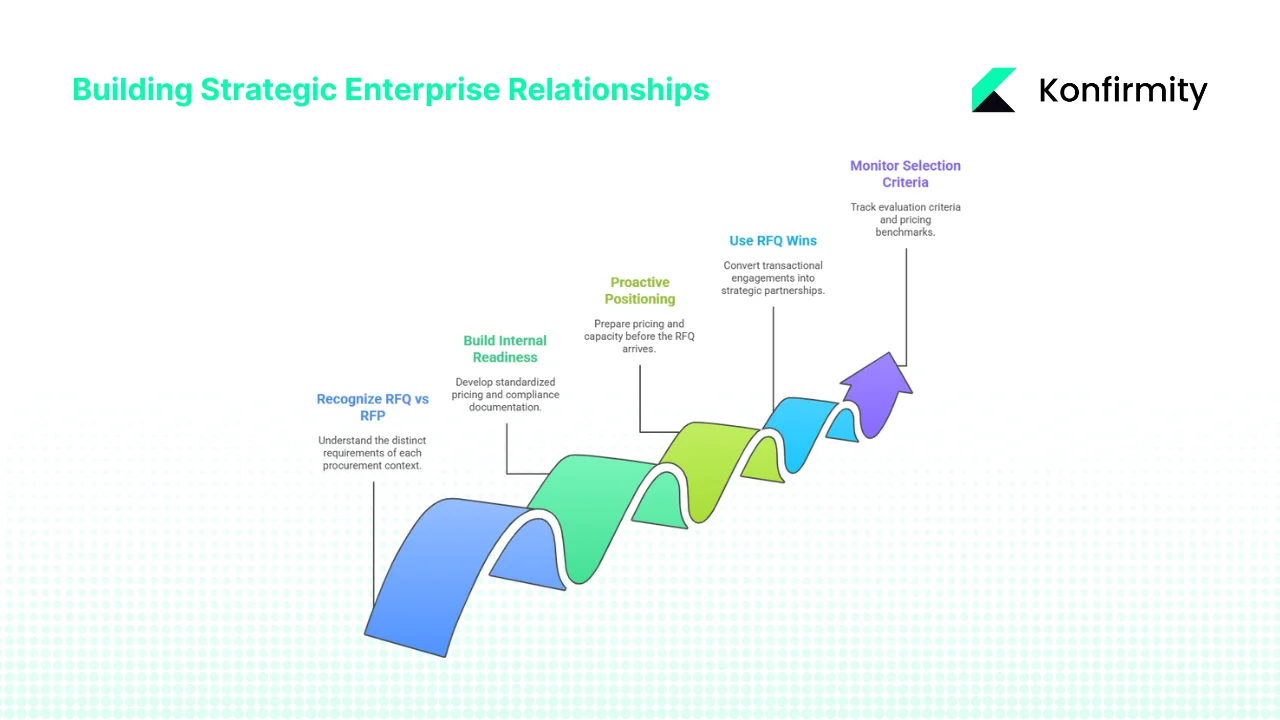
Build internal readiness: Develop standardized pricing models with pre-approved volume discount structures. Maintain up-to-date compliance documentation (certifications, insurance, financial statements, references) in accessible repositories. Create RFQ response templates covering common procurement requirements to accelerate turnaround.
Proactive positioning: When you anticipate an RFQ (renewing contracts, responding to market tenders, engaging procurement-led buyers), prepare pricing benchmarks, identify cost optimization opportunities, and align delivery capacity before the formal RFQ arrives. Early preparation enables competitive responses without sacrificing margin.
Use RFQ wins to build long-term relationships. Transactional RFQ engagements provide entry points for deeper partnerships. Deliver reliably on initial RFQ commitments, demonstrate responsiveness during contract execution, and identify opportunities to expand scope or add value beyond the initial purchase. Converting transactional relationships into strategic partnerships creates recurring revenue and reduces competitive pressure in future RFQs.
Monitor vendor selection criteria and pricing benchmarks. Track evaluation criteria across RFQs you respond to. If buyers consistently weight delivery speed, warranty coverage, or payment flexibility alongside price, adjust your value proposition accordingly. Benchmark your pricing against competitors by analyzing win/loss patterns and requesting buyer feedback after vendor selection.
Conclusion
"RFQ meaning" fundamentally centers on requesting formal quotes when requirements are set and price is the key decision factor. After the RfQ process, professional procurement organizations have to compare the quotations, and try to get the best price for the job. Aim is to determine the fair market value of the goods or services and thus generate savings for the company. For buyers, RFQs enable structured comparison, transparency, and cost control; for sellers, RFQs prompt disciplined, clear, competitive responses focused on pricing accuracy and delivery reliability.
For enterprise sellers in particular, understanding RFQ processes, compliance expectations, and response dynamics is critical to winning business in procurement-led buying environments. Misreading an RFQ as a strategic opportunity wastes resources and positions you to lose on price; recognizing it as a transactional procurement step enables you to respond with clarity, competitiveness, and contract readiness.
Organizations selling to enterprise clients should review RFQ readiness by auditing internal pricing approval workflows, maintaining current compliance documentation, developing standardized response templates, and training sales teams to recognize procurement document types. Aligning with enterprise procurement practices positions you to compete effectively when buyers issue formal RFQs.
FAQs
A Request for Quotation (RFQ) is a formal document issued by a buyer asking one or more vendors to submit price quotes and commercial terms for specific goods or services with defined specifications.
An RFQ focuses on price and terms for a well-defined requirement where specifications are already set; an RFP asks vendors for proposals including solution design, methodology, and approach when the buyer needs strategic input, not just a price.
Typically a purchasing organization, procurement department, or buying entity (in an enterprise or public sector) that has defined specifications and is ready to compare pricing and terms from multiple suppliers.
- RFP (Request for Proposal): Buyer solicits detailed proposals from vendors to meet a problem or requirement, emphasizing solution quality and strategic approach.
- RFQ (Request for Quotation): Buyer asks for pricing and terms for defined specifications, emphasizing cost comparison and delivery reliability.
- RFT (Request for Tender): Often a formal solicitation in public procurement (similar to RFQ or RFP depending on context) where vendors submit bids under defined rules, frequently with regulatory compliance requirements.

