Most organizations manage risk reactively—addressing threats as they emerge rather than embedding structured risk thinking into operational discipline. This approach creates a fundamental gap between perceived control and actual preparedness, a gap that becomes apparent during regulatory inquiries, security incidents, or strategic pivots under uncertainty.
Enterprise clients operating across jurisdictions and business units require standardized approaches to risk management that integrate with governance structures, compliance obligations, and internal control environments. Without a common framework, risk practices fragment across departments, producing inconsistent risk appetite definitions, duplicated efforts, and blind spots in threat landscapes.
ISO 31000 provides internationally recognized principles and guidelines for managing risk across any organization, regardless of size, industry, or complexity. Published by the International Organization for Standardization (ISO), the standard establishes a foundation for identifying, assessing, and treating risks systematically while supporting strategic decision-making and continual improvement.
This definition explains what ISO 31000 is, why it matters for enterprise organizations, its core concepts and structural elements, and how implementing the framework strengthens resilience, governance, and operational performance in practice.
What Is ISO 31000?
ISO 31000 provides principles, a framework and a process for managing risk. Any organization can use it regardless of its size, activity or sector. Published by the International Organization for Standardization (ISO), the standard establishes a systematic approach to identifying, analyzing, evaluating, and treating organizational risks.
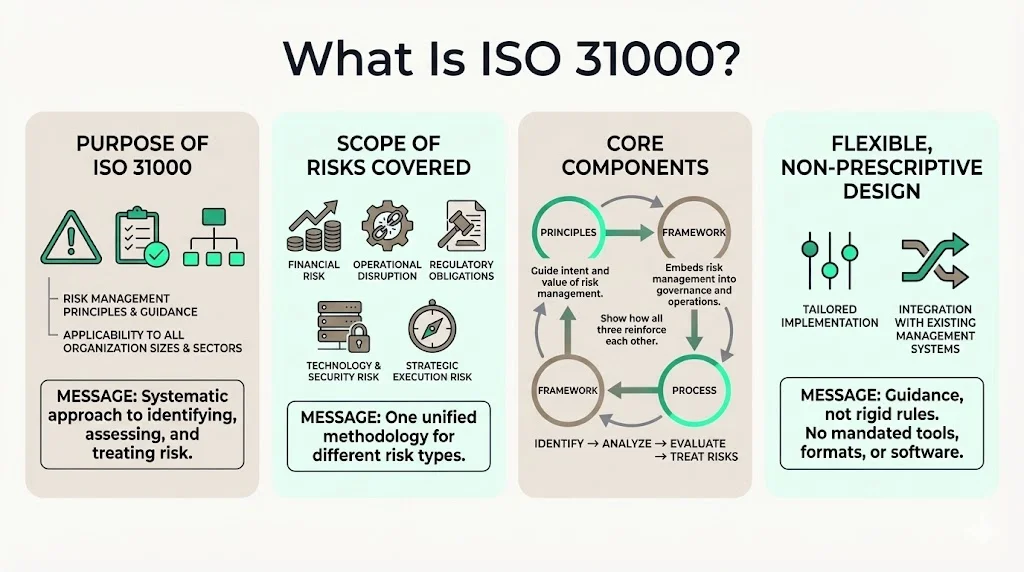
The current version of ISO 31000 was published in February 2018, replacing the original 2009 edition, introducing clearer language and placing greater emphasis on the integration of risk management into core business activities, decision-making processes, and organizational culture. The standard addresses financial uncertainties, operational disruptions, regulatory obligations, technology vulnerabilities, and strategic execution risks within a unified methodology.
ISO 31000 is founded on three core components: principles, a framework, and a process. These elements work together to ensure that risk management is structured, integrated, and aligned with organizational objectives. The principles guide the overall intent and value of risk management, the framework embeds it into the organization's governance and operations, and the process provides a systematic approach for identifying, assessing, and addressing risks.
Unlike prescriptive mandates, ISO 31000 provides guidance that organizations tailor to their risk profiles, governance structures, and operational contexts. The standard does not specify how risk registers should be formatted or which software platforms to use—it establishes principles for integrating risk thinking into existing management systems and decision-making workflows.
What ISO 31000 Is Not
ISO 31000 provides good practice guidelines but is not a certifiable risk management standard. Organizations cannot obtain ISO 31000 certification in the manner available for ISO 27001 Information Security Management Systems or ISO 9001 Quality Management Systems.
ISO 31000 cannot be used for certification purposes, but does provide guidance for internal or external audit programmes. This distinction matters for enterprise buyers evaluating compliance obligations: while ISO 27001 attestation demonstrates conformance to specific control requirements and enables third-party audits, ISO 31000 offers a flexible risk management architecture that supports multiple compliance frameworks simultaneously without imposing prescriptive control sets.
Individuals may be certified once they have demonstrated knowledge of the philosophy and content of the ISO 31000 risk management standard, including its purpose, principles, framework, and process. Organizations seeking formal attestation to risk management capabilities typically pursue ISO 27001 or SOC 2 certifications, using ISO 31000 as the underlying methodology informing their control design and risk treatment strategies.
Turning a risk framework into something auditors accept?
Drop your work email and we'll help you build a risk process that produces the evidence on its own.
Why ISO 31000 Matters for Enterprise Clients
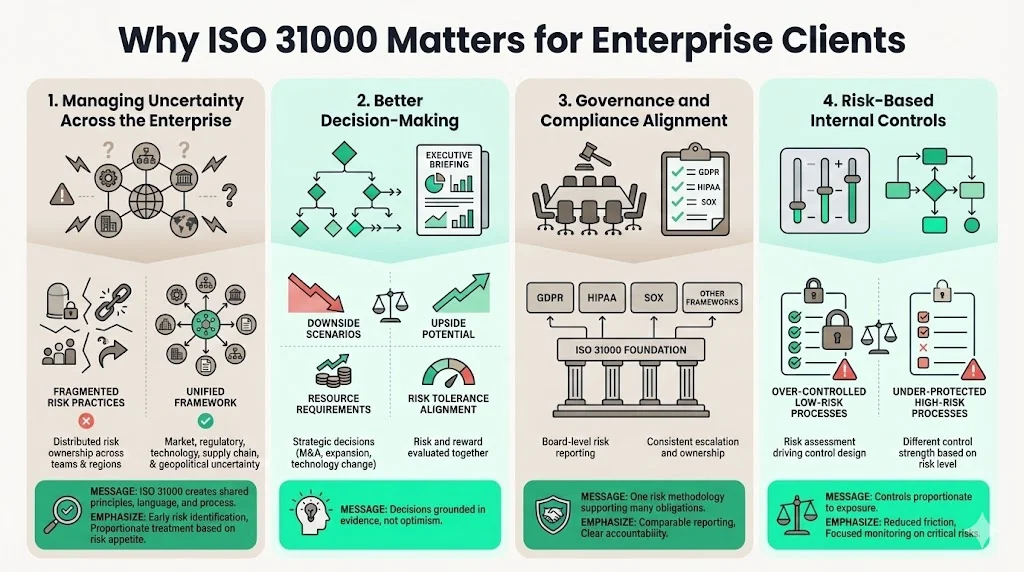
Enterprise organizations operate with distributed risk ownership across business units, geographies, and functional teams. Without a unifying framework, risk management fragments into inconsistent practices—finance teams assess credit risk using methodologies incompatible with how information security teams score vulnerabilities, procurement evaluates supplier risk differently than operations assesses production continuity, and executive risk committees receive reporting in non-comparable formats.
ISO 31000 addresses this fragmentation by establishing common principles, terminology, and processes that function across organizational boundaries. The standard provides the architecture for enterprise risk management programs that integrate strategic, operational, financial, and compliance risks within unified governance structures.
1) Managing Uncertainty Across Business Functions
Using ISO 31000 can help organizations increase the likelihood of achieving objectives, improve the identification of opportunities and threats and effectively allocate and use resources for risk treatment. Enterprise operations face uncertainty from market volatility, regulatory changes, technology disruptions, supply chain dependencies, and geopolitical factors that traditional planning models struggle to accommodate.
ISO 31000 shifts risk management from reactive incident response to systematic uncertainty management. Organizations implementing the framework establish processes for identifying emerging risks before they materialize as incidents, assessing potential impacts across interdependent systems, and developing treatment strategies proportionate to risk exposure and organizational risk appetite.
This approach enables enterprises to differentiate between risks requiring immediate mitigation, risks acceptable within defined tolerance levels, and uncertainties presenting strategic opportunities. Organizations avoid over-investing in low-probability threats while ensuring high-impact scenarios receive appropriate controls and contingency planning.
2) Support for Decision-Making
Rather than being a compliance exercise, ISO 31000 implementation is about improving the quality of decisions and increasing the organization's ability to manage uncertainty in pursuit of its objectives. Strategic decisions—market expansions, mergers and acquisitions, technology platform migrations, product launches—carry risk exposures that executives must evaluate against expected returns and organizational capabilities.
The guidelines help embed risk management into an organization's governance, strategy, planning, reporting processes, policies, values, and culture. When risk assessment integrates into decision-making workflows, leadership evaluates options with explicit consideration of potential downside scenarios, resource requirements for risk treatment, and alignment with risk appetite statements.
This integration produces decisions grounded in evidence rather than optimism. Organizations pursuing aggressive growth strategies understand the control investments required to manage expanded risk exposure. Technology modernization initiatives account for implementation risks, security vulnerabilities, and operational continuity during transitions. Strategic partnerships include evaluation of counterparty risk, contractual protections, and exit strategies should relationships deteriorate.
3) Alignment With Governance and Compliance
Board oversight responsibilities increasingly include understanding organizational risk posture, evaluating management's risk treatment strategies, and ensuring compliance with regulatory risk management requirements. ISO 31000 provides the governance structure for board-level risk committees to receive consistent, meaningful risk reporting that enables informed oversight.
Enterprise organizations subject to multiple regulatory frameworks—GDPR data protection requirements, HIPAA security safeguards, SOX internal controls, industry-specific regulations—face overlapping risk management obligations. ISO 31000 establishes the foundational risk methodology that supports compliance across frameworks without duplicating effort. Organizations map regulatory control requirements to unified risk registers, demonstrating to auditors how enterprise risk processes address specific compliance obligations.
Governance benefits extend beyond regulatory compliance. Organizations implementing ISO 31000 establish clear risk ownership, escalation protocols, and accountability structures. Business unit leaders understand their risk management responsibilities within delegated authority levels. Cross-functional risks escalate through defined channels ensuring appropriate management attention and resource allocation.
4) Enhancing Internal Controls
Internal control environments depend on systematic risk assessment to determine which processes require controls, what control objectives those mechanisms should achieve, and how to monitor control effectiveness over time. Organizations designing controls without understanding underlying risks implement either insufficient protections or expensive, burdensome procedures that impede operations without materially reducing exposure.
ISO 31000 provides the risk assessment methodology that informs control design. Organizations identify risks to critical business processes, evaluate likelihood and potential impact, then design controls proportionate to risk exposure. High-risk processes receive robust control environments with segregation of duties, automated validation, and frequent monitoring. Lower-risk activities operate with streamlined controls balancing efficiency and protection.
This risk-based approach to control design reduces operational friction while strengthening security postures. Organizations avoid implementing uniform control intensity across all processes—an approach that either under-protects critical functions or over-controls routine activities. Instead, control investments concentrate where risks warrant protection, and monitoring efforts focus on validating that controls effectively reduce exposure to acceptable levels.
Core Concepts in ISO 31000
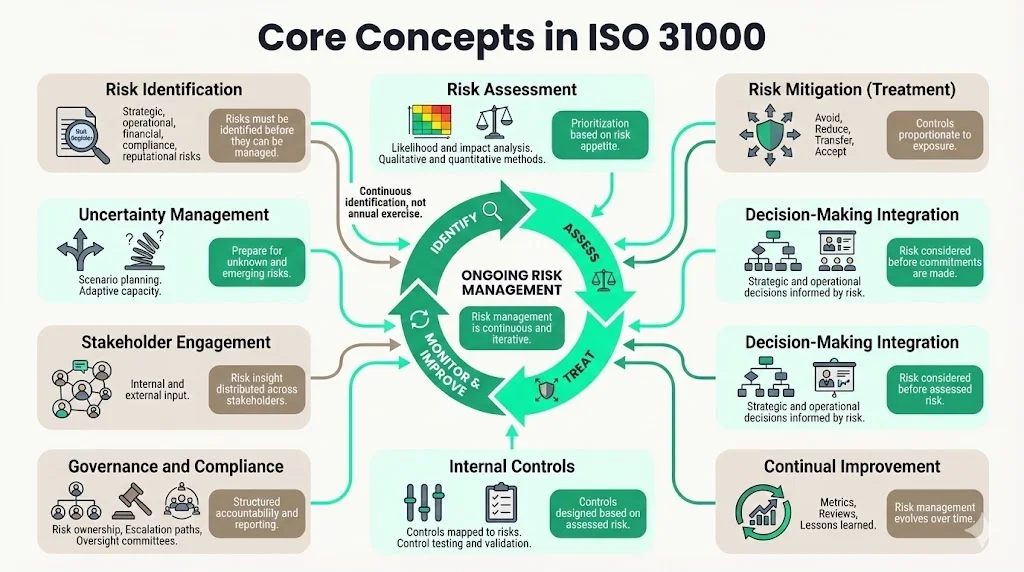
ISO 31000 establishes foundational concepts that define how organizations approach risk systematically. These concepts interconnect within the standard's process model, creating iterative cycles of assessment, treatment, and monitoring.
1) Risk Identification
Risk identification establishes the foundation for all subsequent risk management activities. Organizations cannot treat risks they have not recognized. Effective identification requires systematic examination of internal operations, external environment factors, dependencies, and potential threat scenarios.
Enterprise risk identification spans strategic risks affecting organizational objectives, operational risks disrupting business processes, financial risks impacting liquidity or profitability, compliance risks arising from regulatory obligations, and reputational risks affecting stakeholder confidence. Identification methodologies include structured workshops with cross-functional teams, analysis of historical incident data, scenario planning exercises, external threat intelligence, and stakeholder consultations.
Organizations conducting risk identification document potential events, their causes, and possible consequences. This documentation creates the risk register serving as the centralized inventory for ongoing risk management activities. Risk identification operates continuously—not as an annual project—ensuring emerging threats enter risk assessment processes as business environments evolve.
2) Risk Assessment
Risk assessment encompasses analysis and evaluation of identified risks. Analysis determines the nature of risk, including likelihood of occurrence, potential magnitude of impact, velocity at which risks could materialize, and existing controls currently reducing exposure. Organizations analyze risks qualitatively using structured scales or quantitatively through probabilistic modeling depending on data availability and analytical requirements.
Evaluation compares analyzed risks against organizational risk criteria and appetite statements, determining which risks require treatment, which fall within acceptable tolerance, and what priority different risks warrant. Enterprise risk assessment produces risk heat maps positioning threats based on likelihood and impact, enabling leadership to visualize the risk landscape and allocate treatment resources to highest-priority exposures.
Assessment methodologies vary by risk type. Cybersecurity risks commonly use CVSS scoring assessing vulnerability severity, exploitability, and potential impact. Financial risks employ value-at-risk calculations quantifying potential losses under adverse scenarios. Operational risks analyze failure modes, dependencies, and recovery time objectives. ISO 31000 accommodates diverse assessment techniques within unified process structure.
3) Risk Mitigation
Risk mitigation—termed "risk treatment" in ISO 31000—encompasses strategies organizations implement to modify risk exposure. Treatment options include avoiding risk by discontinuing activities creating exposure, reducing risk through controls lowering likelihood or impact, transferring risk via insurance or contractual arrangements, or accepting risk when treatment costs exceed potential impact.
Organizations develop risk treatment plans specifying actions, resource requirements, responsible parties, implementation timelines, and expected effectiveness. Treatment implementation integrates with project management disciplines, operational procedures, and technology deployments ensuring planned controls become operational realities rather than documented intentions.
Effective risk treatment balances protection and operational efficiency. Organizations implementing excessive controls create compliance burdens that slow operations, frustrate teams, and encourage workarounds undermining control effectiveness. Insufficient controls leave organizations exposed to preventable losses. Risk treatment plans reference risk assessment findings ensuring control intensity matches exposure levels and organizational risk appetite.
4) Uncertainty Management
ISO 31000 explicitly addresses uncertainty—situations where organizations lack complete information about potential events, their likelihood, or their consequences. Traditional risk management focuses on known risks organizations can quantify and control. Uncertainty management acknowledges that enterprise environments contain unknowable factors requiring different approaches than conventional risk treatment.
Organizations managing uncertainty build adaptive capacity, scenario planning capabilities, and resilience enabling response to unanticipated events. Strategic planning incorporates multiple future scenarios including disruptive possibilities outside historical precedent. Operational designs include redundancy, flexibility, and recovery capabilities functioning across diverse threat scenarios rather than optimizing for specific predicted risks.
This uncertainty-aware approach proved critical during recent disruptions—organizations with resilient architectures adapted to pandemic-driven remote work requirements, supply chain interruptions, and demand volatility more effectively than those optimized for narrow risk scenarios. Uncertainty management complements specific risk treatment, creating organizational capabilities that function when predicted risks fail to capture actual threat landscapes.
5) Stakeholder Engagement
Risk management requires input from parties affected by organizational decisions and operations. Stakeholder engagement identifies perspectives, concerns, and information distributed across internal teams, customers, suppliers, regulators, investors, and communities. Different stakeholders possess distinct risk perceptions and priorities that inform comprehensive risk assessment.
Internal stakeholders—business unit leaders, operational teams, compliance functions, information security—contribute domain expertise about risks within their areas. External stakeholders provide market intelligence, regulatory expectations, and feedback about how organizational activities create risks others bear. Engagement mechanisms include structured consultations, advisory committees, incident reporting channels, and collaborative risk assessment workshops.
Organizations implementing ISO 31000 establish communication protocols ensuring risk information flows to stakeholders requiring awareness. Risk reporting provides executives, boards, and oversight bodies visibility into risk posture, treatment progress, and emerging threats. Transparent communication builds stakeholder confidence that organizations actively manage risks rather than discovering exposures through incidents.
6) Decision-Making Integration
ISO 31000 emphasizes integrating risk thinking into decision processes at strategic and operational levels. Decisions inherently involve uncertainty and potential for adverse outcomes. Explicit risk consideration improves decision quality by surfacing assumptions, evaluating alternatives, and ensuring choices align with organizational risk appetite.
Strategic decisions—capital investments, market entry, organizational restructuring—undergo risk assessment examining potential obstacles, required capabilities, and downside scenarios. Investment committees evaluate project proposals including risk analysis alongside financial projections. Acquisition due diligence assesses target company risk profiles, integration challenges, and post-merger risk management requirements.
Operational decisions integrate risk consideration through approval workflows, change management processes, and exception handling procedures. Technology changes undergo security and operational risk assessment before implementation. Vendor selections include risk evaluation of supplier stability, performance history, and contractual protections. Routine decisions operating within established risk parameters proceed efficiently while exceptions triggering elevated risk receive appropriate scrutiny.
7) Governance and Compliance
ISO 31000 supports organizational governance by establishing structured oversight mechanisms, accountability frameworks, and reporting processes that enable boards and executive leadership to fulfill risk management responsibilities. Governance structures define risk ownership at business unit and functional levels, escalation protocols for risks exceeding delegated authority, and board committees providing independent risk oversight.
Compliance obligations increasingly mandate specific risk management practices—data protection regulations require risk assessments before processing personal information, financial regulations demand operational risk frameworks, healthcare regulations mandate security risk analysis protecting patient data. ISO 31000 provides the foundational risk management architecture supporting these compliance requirements while avoiding duplicative risk processes for each regulatory obligation.
Organizations demonstrating ISO 31000-aligned risk management to regulators, auditors, and certification bodies evidence structured, ongoing risk practices rather than ad hoc compliance activities. Risk registers document identified threats, assessment methodologies demonstrate systematic evaluation, treatment plans show mitigation efforts, and monitoring processes prove continuous oversight. This documentation supports compliance reporting, audit responses, and regulatory inquiries.
8) Internal Controls
Internal controls—the policies, procedures, and mechanisms preventing or detecting errors, fraud, and operational failures—require risk assessment to design effectively. ISO 31000 informs internal control frameworks by identifying risks requiring control intervention and evaluating whether existing controls adequately reduce exposure.
Organizations implementing ISO 31000 map internal controls to risks in control registers showing which mechanisms address specific threats. Control testing validates effectiveness by confirming controls operate as designed and achieve intended risk reduction. Control gaps identified through risk assessment trigger remediation efforts implementing additional protections or strengthening existing mechanisms.
This risk-based approach to internal controls appears throughout compliance frameworks. SOC 2 Trust Services Criteria require control design addressing specific risk categories. ISO 27001 mandates risk assessment determining necessary information security controls. HIPAA requires security risk analysis informing safeguard implementation. ISO 31000 provides the underlying risk methodology these frameworks reference.
9) Continual Improvement
ISO 31000 treats risk management as an iterative discipline requiring ongoing refinement based on performance monitoring, lessons learned from incidents, environmental changes, and evolving organizational capabilities. Continual improvement encompasses reviewing risk assessment accuracy, evaluating treatment effectiveness, updating risk registers as threats emerge or dissipate, and enhancing risk management processes themselves.
Organizations implementing continual improvement establish metrics tracking risk management performance—percentage of identified risks receiving timely treatment, incident frequency compared to assessed likelihood, control effectiveness validation results, and stakeholder satisfaction with risk communication. Performance data informs adjustments to risk criteria, assessment methodologies, treatment strategies, and resource allocation.
Post-incident reviews analyze whether risk management processes identified threats before incidents occurred, whether treatments functioned as intended, and what improvements would strengthen future performance. Near-miss events—situations where potential incidents did not materialize—provide learning opportunities about risk identification blind spots and treatment effectiveness. Continual improvement transforms organizational risk management capabilities over time, building institutional knowledge and adaptive capacity.
The ISO 31000 Framework: Structure and Process
ISO 31000 distinguishes between the organizational framework providing structure and leadership for risk management and the operational process executing risk management activities. Organizations implement both components to establish sustainable risk management capabilities.
The Three Key Components
The management of risks explained in the ISO 31000 standard is founded on three core components: principles, a framework, and a process. These elements work together to ensure that risk management is structured, integrated, and aligned with organizational objectives.
Principles establish the characteristics of effective risk management—integration with organizational activities, structured and comprehensive approaches, customization to organizational context, stakeholder inclusiveness, dynamic adaptation to change, evidence-based decisions, and human factor consideration. These principles guide how organizations approach risk management rather than prescribing specific techniques.
The framework defines organizational arrangements embedding risk management into governance structures, strategic planning, operational management, and performance monitoring. Framework elements include leadership commitment, integration mechanisms, resource allocation, and improvement processes.
The process provides systematic steps for executing risk management activities: communication and consultation, scope and context establishment, risk assessment (identification, analysis, evaluation), risk treatment, and monitoring and review. Process steps operate iteratively rather than as linear sequences—monitoring activities identify new risks triggering fresh assessment, treatment implementation reveals additional considerations requiring analysis, and contextual changes necessitate reassessment of previously evaluated risks.
Framework Elements
ISO 31000 states that the success of risk management will depend on the effectiveness of the management framework providing the foundations and arrangements that will embed it throughout the organization at all levels.
Leadership and commitment establishes executive sponsorship and board oversight ensuring risk management receives necessary authority, resources, and organizational priority. Leadership demonstrates commitment through policy statements defining risk management objectives, participation in risk governance committees, and accountability for risk management performance. Without visible leadership commitment, risk management remains isolated within compliance functions rather than integrating across operations.
Integration within governance embeds risk management into existing management systems, decision processes, and operational workflows rather than creating parallel risk bureaucracies. Organizations integrate risk considerations into strategic planning cycles, investment approval processes, operational procedures, and performance management systems. Integration ensures risk thinking influences decisions at points where choices occur rather than producing risk assessments leadership ignores during actual decision-making.
Designing and implementing risk practices translates principles and processes into operational reality within specific organizational contexts. Organizations establish risk registers, define risk assessment methodologies appropriate to their operations, assign risk ownership to accountable parties, implement risk reporting mechanisms, and deploy technology platforms supporting risk management activities. Design decisions consider organizational maturity, resource constraints, regulatory obligations, and cultural factors affecting adoption.
Monitoring, review, and improvement ensures risk management practices remain effective as organizations and environments evolve. Monitoring tracks risk exposure trends, treatment implementation progress, control effectiveness, and emerging threats. Reviews evaluate whether risk management processes achieve intended objectives, identify improvement opportunities, and validate that risk assessments accurately reflect actual exposure. Improvement initiatives enhance risk management capabilities based on performance data and lessons learned.
The Risk Management Process Steps
ISO 31000 defines systematic process steps organizations follow conducting risk management activities. These steps apply whether assessing enterprise strategic risks, evaluating operational process risks, or analyzing specific project risks.
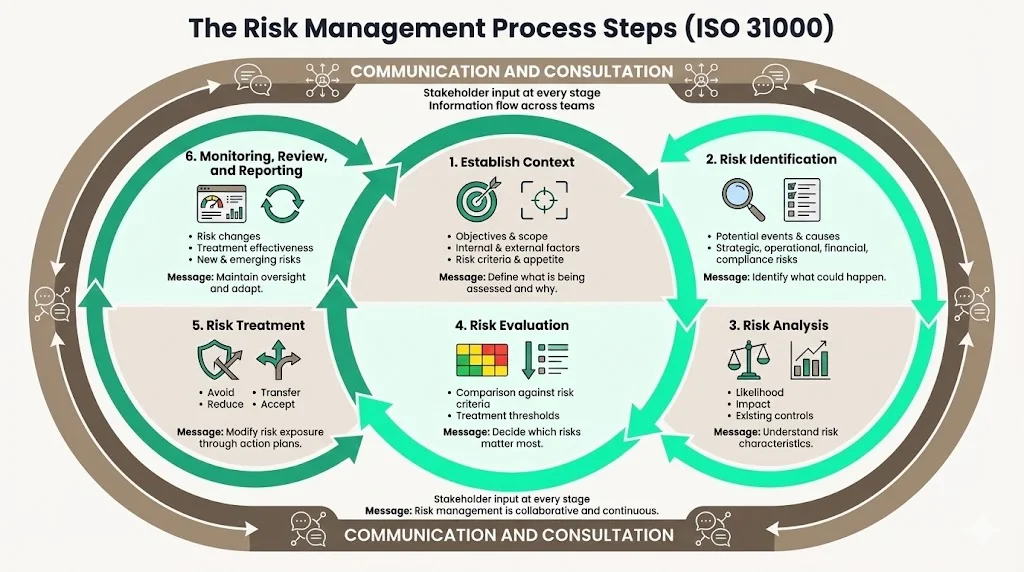
Communication and consultation occurs throughout the process, not as isolated activities. Organizations consult stakeholders when establishing risk context, gathering information during risk identification, validating assessment findings, evaluating treatment options, and reporting outcomes. Effective communication ensures risk information reaches parties requiring awareness and that risk management benefits from distributed knowledge across stakeholders.
Establishing context defines the scope, objectives, and criteria for risk assessment. Organizations specify what activities, assets, or decisions the assessment covers, identify internal and external factors creating risk, and establish criteria for evaluating risk significance. Context establishment prevents scope creep during assessment while ensuring relevant factors receive consideration. Context includes organizational risk appetite, regulatory requirements, stakeholder expectations, and strategic objectives against which risks are evaluated.
Risk identification, analysis, and evaluation form the assessment sequence examining what risks exist, their characteristics, and their significance. Identification catalogs potential events and their causes. Analysis determines likelihood, potential impact, existing controls, and other risk attributes. Evaluation compares analyzed risks against criteria and appetite, determining which require treatment and what priority they warrant. Organizations document assessment findings in risk registers serving as ongoing risk management tools.
Risk treatment selects and implements strategies modifying risk exposure. Organizations evaluate treatment options based on cost-effectiveness, feasibility, risk reduction effectiveness, and alignment with risk appetite. Treatment plans specify actions, responsibilities, timelines, and success criteria. Implementation integrates treatment activities with project management, operational procedures, and technology deployments ensuring controls become operational.
Monitoring, review, and reporting provides ongoing oversight of risks and treatment effectiveness. Monitoring tracks whether risk exposure changes, whether treatments achieve intended effects, whether new risks emerge, and whether assumptions underlying risk assessments remain valid. Reviews periodically reassess risks accounting for environmental changes and organizational evolution. Reporting communicates risk posture, treatment progress, and emerging concerns to stakeholders requiring awareness.
Implementing ISO 31000 in Enterprise Settings
Enterprise implementation of ISO 31000 differs substantially from deploying prescriptive compliance frameworks. Organizations cannot simply adopt a reference control set and declare conformance. Successful implementation requires assessing current practices, gaining leadership commitment, tailoring the framework to organizational context, and overcoming cultural and structural obstacles.
Practical Start Points
Organizations beginning ISO 31000 implementation conduct current-state assessments examining existing risk management practices. Most enterprises already conduct some risk activities—security risk assessments, financial risk analysis, operational risk management, compliance risk evaluation—but these practices typically operate within functional silos using inconsistent methodologies.
Current-state assessment inventories existing risk practices, identifies gaps where risk management is absent or inadequate, evaluates whether current approaches align with ISO 31000 principles, and determines what capabilities require development. Assessment findings inform implementation roadmaps prioritizing high-impact improvements over comprehensive transformation.
Leadership buy-in proves essential for successful implementation. Risk management requires cross-functional coordination, resource investment, and operational changes that line leadership may resist without executive mandate. Organizations secure buy-in by demonstrating how ISO 31000 supports strategic objectives, reduces incident frequency and severity, improves decision quality, and strengthens governance and compliance postures. Business cases quantify current risk management costs—incident response expenses, compliance failures, operational disruptions—against implementation investments and expected benefits.
Tailoring the Framework
ISO 31000 is not intended to promote uniformity of risk management across organizations. The design and implementation of risk management plans and frameworks will need to take into account the varying needs of a specific organization, its particular objectives, context, structure, operations, processes, functions, projects, products, services, or assets and specific practices employed.
Organizations tailor ISO 31000 to their risk profiles, regulatory environments, and operational realities. Financial services firms emphasize quantitative risk modeling, market risk assessment, and capital adequacy calculations aligned with banking regulations. Healthcare organizations prioritize patient safety risks, privacy protection, and clinical quality risks reflecting regulatory obligations and mission criticality. Technology companies focus on security vulnerabilities, product liability risks, and intellectual property protection.
Tailoring decisions include risk assessment methodologies—qualitative versus quantitative approaches, risk scoring scales, assessment frequency, and documentation requirements. Organizations operating in stable environments conduct periodic risk assessments while those facing rapid change implement continuous risk monitoring. Highly regulated industries maintain detailed risk documentation supporting compliance reporting while less-regulated organizations adopt streamlined approaches balancing rigor and efficiency.
Risk appetite statements require customization reflecting organizational strategy, stakeholder expectations, and competitive positioning. Risk-averse organizations pursuing stable, predictable performance establish conservative risk appetite with low tolerance for uncertainty. Growth-oriented organizations pursuing market leadership accept higher risk exposure in strategic initiatives while maintaining conservative approaches to operational and compliance risks.
Tools and Techniques
Organizations implement technology platforms supporting risk management workflows—risk registers centralizing risk information, assessment tools standardizing evaluation, treatment tracking monitoring mitigation progress, and dashboards visualizing risk posture for leadership. Platform selection depends on organizational scale, integration requirements with existing systems, and analytical capabilities.
Risk matrices provide visual tools plotting risks based on likelihood and impact dimensions, creating heat maps showing risk distribution. High-likelihood, high-impact risks appear in critical zones requiring immediate treatment. Low-likelihood, low-impact risks occupy acceptable zones potentially requiring monitoring without active treatment. Matrices enable leadership to quickly grasp risk landscapes and prioritize attention.
Bow-tie analysis diagrams risk events showing causal factors on the left, potential consequences on the right, and preventive and mitigative controls positioned appropriately. This technique helps organizations visualize how controls reduce either likelihood (preventive controls blocking causes) or impact (mitigative controls limiting consequences) and identify control gaps requiring additional treatment.
Scenario analysis examines how risks might manifest under different conditions, testing organizational resilience against adverse situations. Organizations develop plausible scenarios combining multiple risk events—supply chain disruption coinciding with demand spike, cybersecurity incident during system migration, key personnel departure during regulatory audit—evaluating whether current capabilities and controls enable adequate response.
Overcoming Common Enterprise Challenges
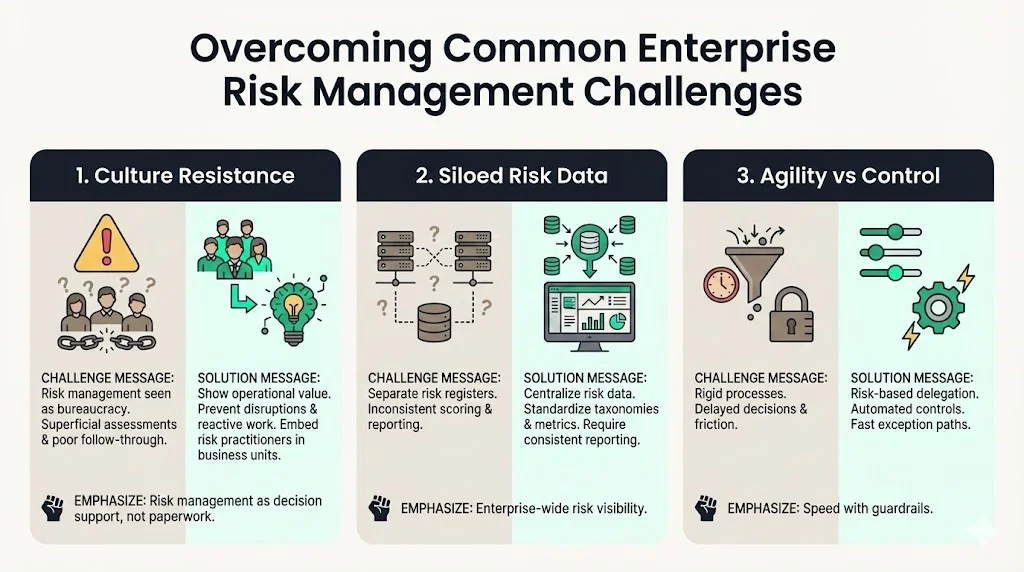
Culture resistance emerges when operational teams perceive risk management as bureaucratic compliance activity rather than value-adding discipline. Resistance manifests as incomplete risk identification, superficial assessments, and treatment plans lacking implementation. Organizations overcome resistance by demonstrating how risk management prevents operational disruptions, enables informed decision-making, and reduces firefighting reactive work. Embedding risk practitioners within business units rather than isolating them in compliance functions improves adoption.
Siloed risk data fragments enterprise risk visibility when business units and functional teams maintain separate risk registers, assessment methodologies, and reporting structures. Executive leadership receives inconsistent risk information preventing comprehensive understanding of organizational exposure and interdependencies between risks. Organizations address silos through enterprise risk platforms centralizing risk data, standardized taxonomies enabling cross-functional risk aggregation, and governance structures requiring consistent risk reporting.
Balancing agility and control challenges organizations implementing risk management in dynamic environments where rigid processes impede necessary speed. Excessive control creates approval bottlenecks, delayed decisions, and operational friction. Organizations balance agility and control through risk-based approaches delegating decisions within defined parameters, automated controls enabling real-time validation without manual workflows, and exception processes providing rapid escalation paths when situations exceed standard parameters.
Real-World Importance
ISO 31000 implementation produces tangible outcomes affecting organizational performance, resilience, and stakeholder confidence. These benefits emerge over time as risk management practices mature and integrate into operational discipline.
Enterprise Risk Culture
Organizations successfully implementing ISO 31000 develop risk-aware cultures where teams proactively identify threats, escalate concerns without fear of blame, and consider risk implications during routine decisions. Risk awareness becomes embedded in operational norms rather than restricted to compliance functions.
Cultural transformation requires sustained leadership commitment, visible responses to reported risks demonstrating that identification is valued, and learning-oriented incident reviews focusing on improvement rather than punishment. Organizations tracking leading indicators—risk identification frequency, treatment completion rates, near-miss reporting—demonstrate cultural maturity beyond lagging incident metrics.
Risk-aware cultures reduce incident frequency and severity because threats receive attention before materializing into disruptions. Teams identify process weaknesses, technology vulnerabilities, and external threats early enough for effective treatment. Organizations avoid surprise incidents revealing risks that operational teams recognized but failed to escalate.
Performance and Resilience
Implementing ISO 31000 can lead to efficiency gains, as it helps organizations recognize potential threats and opportunities in time, allocate resources wisely, and enhance stakeholder confidence. Organizations managing risks systematically experience fewer unplanned disruptions, reduced incident response costs, and improved operational predictability.
Resilience—the capacity to withstand disruptions and recover quickly—increases as organizations implement controls reducing vulnerability, develop contingency plans enabling rapid response, and build adaptive capabilities functioning across diverse scenarios. Resilient organizations maintain operations during supply chain interruptions, cybersecurity incidents, personnel changes, and market volatility that severely impact competitors lacking systematic risk management.
Financial performance improves through reduced loss frequency and severity, better capital allocation toward growth initiatives rather than incident remediation, and lower insurance premiums reflecting demonstrable risk management capabilities. Organizations pursuing strategic opportunities with clear understanding of associated risks and treatment strategies outperform those alternating between excessive risk-taking and paralyzing risk-aversion.
Case Use Illustrations
Product launches in regulated industries require extensive risk assessment examining safety risks, regulatory compliance requirements, manufacturing process risks, supply chain dependencies, and market acceptance uncertainty. Organizations conducting systematic risk assessment identify potential obstacles during development, implement controls preventing compliance failures, and develop contingency plans addressing supply disruptions or quality issues. Risk-informed launch decisions prevent costly recalls, regulatory enforcement actions, and reputational damage.
Compliance reporting cycles benefit from ISO 31000-aligned risk management providing the underlying risk assessment, control design, and monitoring evidence auditors require. Organizations maintaining continuous risk management throughout operating periods avoid rushed year-end compliance preparation. Risk registers document identified threats, treatment plans show mitigation efforts, and monitoring records demonstrate ongoing oversight—evidence directly supporting SOC 2, ISO 27001, HIPAA, and other compliance attestations.
Cyber scenarios illustrate ISO 31000 application to information security risk. Organizations identify threat vectors through vulnerability scanning, threat intelligence, and incident analysis. Risk assessment evaluates exploitability, potential impact to confidentiality/integrity/availability, and existing control effectiveness. Treatment implements technical controls (patching, access restrictions, monitoring), administrative controls (policies, training), and contingency plans (incident response, backup recovery). Continuous monitoring detects control failures and emerging threats requiring reassessment.
Turn ISO 31000 principles into a risk register auditors accept
Book a demo and we'll show how Konfirmity links your risk identification, assessment and treatment steps to the controls that produce SOC 2 and ISO 27001 evidence automatically.
Book a demo
Conclusion
ISO 31000 provides enterprise organizations with internationally recognized principles, framework components, and process steps for managing risk systematically across business functions, geographies, and operational contexts. The standard establishes common risk language, methodologies, and governance structures enabling organizations to integrate fragmented risk practices into cohesive enterprise risk management capabilities.
Organizations implementing ISO 31000 strengthen decision-making by explicitly evaluating uncertainty, potential obstacles, and treatment requirements when making strategic and operational choices. Risk-informed decisions balance opportunity and protection, allocate resources proportionate to exposure, and align with organizational risk appetite. Governance structures benefit from consistent risk reporting enabling board and executive oversight, clear risk ownership establishing accountability, and integration with compliance frameworks reducing duplicative effort.
ISO 31000 does not provide prescriptive control requirements organizations simply adopt. Successful implementation requires assessing current practices, securing leadership commitment, tailoring the framework to organizational context, and developing risk management capabilities over time through continual improvement. Organizations treating ISO 31000 as compliance checkbox activity fail to achieve the decision support, resilience, and performance benefits the standard enables.
Enterprise risk management remains an operational discipline, not a documentation project. The value of ISO 31000 emerges when risk thinking influences actual decisions, when identified risks receive treatment before becoming incidents, when controls designed through risk assessment effectively reduce exposure, and when organizations navigate uncertainty more successfully than competitors lacking systematic risk management. Organizations implementing ISO 31000 establish the foundation for ongoing risk confidence rather than periodic compliance attestation.
Frequently Asked Questions
ISO 31000 provides principles, a framework and a process for managing risk. The international standard, published by the International Organization for Standardization, establishes guidelines for identifying, assessing, treating, and monitoring organizational risks across any sector, industry, or organizational size. ISO 31000 offers flexible, principle-based guidance organizations tailor to their specific contexts rather than prescriptive requirements.
ISO 31000 cannot be used for certification purposes, but does provide guidance for internal or external audit programmes. Unlike ISO 27001 or ISO 9001, organizations cannot obtain third-party certification demonstrating conformance to ISO 31000. Individuals may be certified once they have demonstrated knowledge of the philosophy and content of the ISO 31000 risk management standard, including its purpose, principles, framework, and process. Organizations use ISO 31000 as the underlying risk methodology supporting certifiable frameworks like ISO 27001 or compliance attestations like SOC 2.
Any organization can use iSO 31000 regardless of its size, activity or sector. The standard proves particularly valuable for enterprise organizations managing risk across multiple business units, geographies, and functional areas requiring consistent risk language and methodology. Organizations subject to multiple regulatory frameworks benefit from ISO 31000 providing unified risk management supporting diverse compliance obligations. Any organization seeking to improve decision-making, strengthen governance, or build operational resilience can implement ISO 31000 principles.
The guidelines help embed risk management into an organization's governance, strategy, planning, reporting processes, policies, values, and culture. ISO 31000 integrates risk thinking into decision workflows ensuring strategic and operational choices explicitly consider uncertainty, potential obstacles, treatment requirements, and alignment with risk appetite. Decision-makers evaluate options with visibility into risk exposure, resource needs for risk treatment, and downside scenarios alongside expected benefits, producing more informed choices than optimism-driven decisions ignoring potential adverse outcomes.
Organizations implementing ISO 31000 experience stronger governance through structured risk oversight, clear accountability, and consistent reporting enabling board and executive leadership to fulfill risk management responsibilities. Risk visibility improves as enterprise risk management integrates fragmented practices into unified frameworks providing comprehensive exposure understanding. Improved resilience emerges from systematic risk identification, effective treatment implementation, and adaptive capabilities enabling response to diverse threat scenarios. Organizations demonstrate these capabilities to auditors, regulators, and stakeholders through risk documentation supporting compliance obligations and building confidence in organizational risk management.