

Most defense contractors worry about passing audits—then discover their supplier performance history has already disqualified them from contract consideration. SPRS "is the authoritative source to retrieve supplier and product PI [performance information] assessments for the DoD [Department of Defense] acquisition community to use in identifying, assessing, and monitoring unclassified performance." This repository aggregates delivery metrics, quality classifications, cybersecurity compliance scores, and risk assessments across multiple dimensions—data that contracting officers review before extending invitations to bid.
For companies in the Defense Industrial Base (DIB), SPRS functions as a continuous evaluation system, not a one-time certification checkpoint. Organizations treating supplier performance as an afterthought rather than an operational discipline face quantifiable consequences: contract awards routed to competitors with superior risk profiles, procurement decisions influenced by historical data spanning three years, and cybersecurity scores that signal preparedness—or vulnerability—to acquisition professionals scrutinizing every supplier interaction.
What Is SPRS
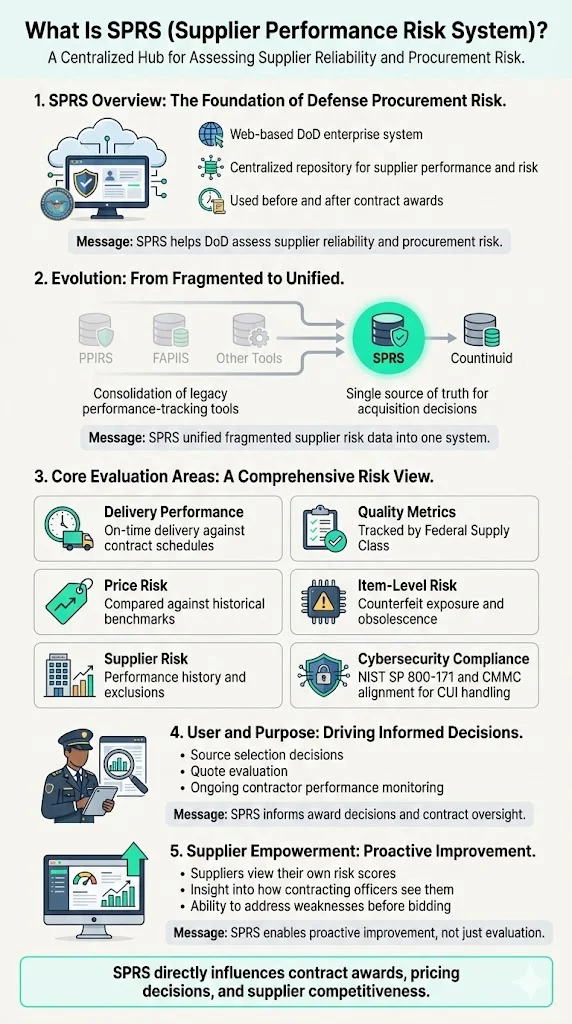
The Supplier Performance Risk System is a web-enabled enterprise application that provides price, item, and supplier procurement risk data and assessments, alongside on-time delivery scores and quality classifications for Department of Defense procurement. SPRS replaced legacy performance-tracking systems to create a unified repository where acquisition professionals evaluate supplier reliability before making award decisions.
SPRS provides item risk, price risk, and supplier risk assessment on end products and price risk and supplier risk assessment on services. The system tracks multiple data categories: delivery performance against contract schedules, quality metrics organized by Federal Supply Class, price comparisons against historical benchmarks, item-level risks including counterfeit exposure and obsolescence, supplier-level risk scores calculated from performance history, debarment and exclusion status, and cybersecurity compliance assessments tied to NIST SP 800-171 and Cybersecurity Maturity Model Certification (CMMC) requirements for organizations handling Controlled Unclassified Information (CUI).
Procurement professionals across defense agencies use SPRS to inform source selection, evaluate quotations, and monitor ongoing contractor performance. Suppliers can access their own performance profiles to understand how contracting officers perceive their risk posture and identify areas requiring remediation before pursuing competitive bids.
Turning a risk framework into something auditors accept?
Drop your work email and we'll help you build a risk process that produces the evidence on its own.
Why SPRS Matters: Risk Management, Supply-Chain Security, and Quality Control
Contracting officers shall consider supplier risk to assess the risk of unsuccessful performance and supply chain risk in award decisions, with supplier risk assessments including quality, delivery, and other contractor performance information. Defense Federal Acquisition Regulation Supplement (DFARS) clauses mandate that delivery and quality performance function as evaluation factors, making SPRS data a determinant of whether suppliers receive contract invitations.
SPRS enables risk-based procurement across three critical dimensions. Item risk assessments identify products with probability that a product, based on intended use, will introduce performance risk resulting in safety issues, mission degradation, or monetary loss. Price risk analysis flags proposed prices inconsistent with historical prices paid for that item or service, preventing overpayment and detecting pricing anomalies that suggest supply-chain manipulation. Supplier risk scoring quantifies the probability that an award may subject the procurement to the risk of unsuccessful performance or to supply chain risk.
For suppliers, SPRS performance directly influences contract eligibility. Favorable delivery records, quality classifications, and cybersecurity scores position organizations competitively. Negative indicators—late deliveries, quality defects, compliance gaps—create documented obstacles that contracting officers must weigh against mission requirements and schedule constraints. Organizations with poor SPRS profiles lose opportunities before ever submitting proposals.
How SPRS Works: Structure, Modules, and Performance Metrics
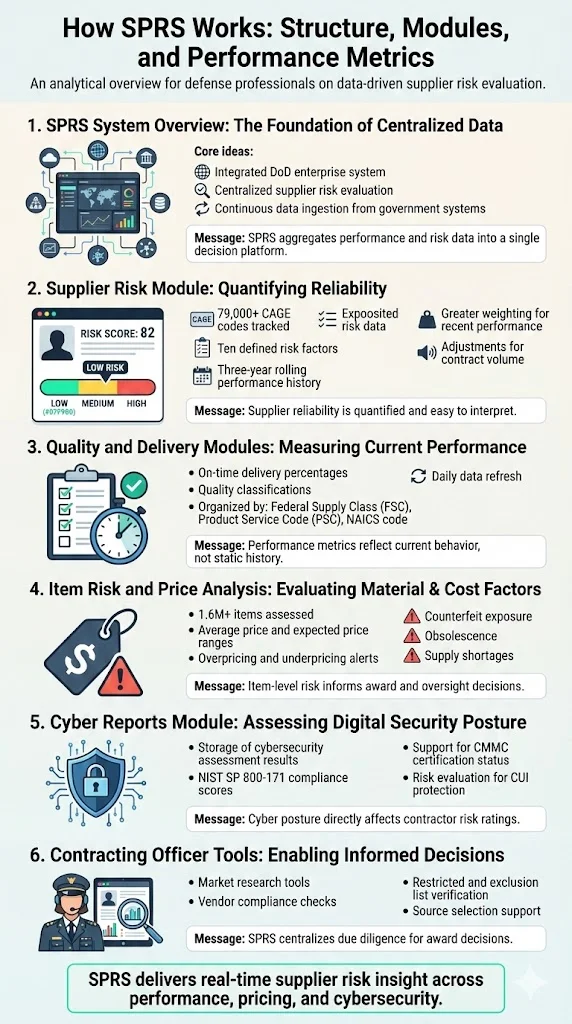
SPRS operates through integrated modules that analyze distinct risk categories. The Supplier Risk module generates overall risk scores by evaluating performance information across quality classifications and on-time delivery scores, with over 79,000 Commercial and Government Entity (CAGE) codes tracked. This scoring methodology examines ten identified risk factors over approximately three years of contract history, weighting recent performance more heavily and adjusting for contract volume. Suppliers receive both numerical risk scores and color-coded risk ratings that signal reliability at a glance.
Quality and delivery modules track on-time delivery percentages and quality classifications organized by Federal Supply Class, Product Service Code, and North American Industry Classification System codes. SPRS retrieves item, price, quality, delivery, and contractor information on contracts from Government reporting systems in order to develop risk assessments. These assessments update daily, reflecting current performance rather than static snapshots.
Item Risk analysis covers 1.6 million-plus items, evaluating average price, expected ranges, and generating over/underprice alerts. This module flags high-risk products with histories of counterfeiting, diminishing manufacturing sources, material shortages, or obsolescence—conditions requiring enhanced oversight or mitigation strategies before contract award.
The Cyber Reports module stores cybersecurity assessment results for contractors handling CUI. The SPRS score measures current cybersecurity compliance with NIST 800-171 and is used by the Department of Defense to measure the risk of a contractor's cybersecurity position in protecting sensitive DoD information. This scoring reflects implementation of technical controls specified in NIST SP 800-171 and increasingly, CMMC certification levels that require independent assessor validation.
Contracting officers access market research tools, vendor compliance status checks, and restricted-list verifications through SPRS, centralizing supplier due diligence within a single interface that supports informed source selection.
What SPRS Means for Companies Selling to Defense and Enterprise Buyers: Practical Implications
Defense contractors must recognize that SPRS will be used in the evaluation of performance, with supplier risk including quality and delivery considered to assess the risk of unsuccessful performance and supply chain risk. This evaluation occurs before solicitation responses, influencing whether organizations receive invitations to compete. Procurement professionals review SPRS data during market research, pre-solicitation planning, and offer evaluation—making supplier performance a continuous qualification criterion rather than a periodic audit event.
Organizations pursuing defense contracts require disciplined internal systems: documented delivery performance tracking against contract schedules, quality control processes that generate verifiable metrics, compliance management systems that maintain NIST SP 800-171 implementation evidence, and audit-ready records spanning multiple contract years. Contractors must submit their self-assessment score to the DoD's Supplier Performance Risk System by the time of contract award, with the self-assessment completed within the last three years and maintained for the duration of the contract.
Vendor risk mitigation demands proactive performance management. Organizations should implement supplier scorecards tracking the same metrics SPRS evaluates: on-time delivery rates, quality defect rates, contract compliance indicators, and cybersecurity control implementation status. Internal performance reviews should occur quarterly, identifying degradation trends before they accumulate into negative SPRS classifications. When performance issues arise, documented corrective actions and evidence of remediation become critical for disputing inaccurate SPRS records or demonstrating continuous improvement.
For acquisition organizations, SPRS data supports risk-informed source selection. Supplier segmentation strategies tier vendors by reliability, delivery performance, and cybersecurity maturity—enabling procurement teams to match supplier capabilities with contract requirements and risk tolerance. High-value or mission-critical acquisitions demand suppliers with superior SPRS profiles; commodity purchases may accept moderate risk in exchange for competitive pricing. This risk-based approach balances cost, schedule, and supply-chain security across portfolio procurement strategies.
Prime contractors face heightened diligence obligations. DFARS requirements mandate that primes verify subcontractor SPRS scores, ensuring supply-chain compliance flows through multiple tiers. Organizations assembling supplier networks must validate subcontractor cybersecurity scores, delivery track records, and quality histories—responsibilities that extend beyond contractual agreements to documented verification and ongoing monitoring.
Comparisons: SPRS Versus Generic Supplier Risk Management Frameworks
Governance and Purpose
Area
SPRS (Defense Acquisition)
Generic Supplier Risk Management
Primary driver
Federal statute and policy
Business choice
Governing authority
FAR, DFARS, DoDI 5000.79
Internal procurement or supply teams
Participation
Required for covered defense contracts
Optional
Purpose
Due diligence tied to award eligibility
Performance tracking and sourcing support
Enforcement
Contract eligibility and award impact
Internal actions only
Data Collection and Evaluation
Area
SPRS
Generic Supplier Risk Management
Data sources
Contract performance reports, assessments, compliance records
Delivery records, quality reports, financial reviews
Metrics
Schedule risk, quality risk, cost risk, compliance history
On-time delivery, defect rates, service response
Scoring method
Standardized scoring tied to policy
Company-defined scoring models
Update cycle
Periodic, policy-driven updates
Set by business need
Supplier Classification and Use
Area
SPRS
Generic Supplier Risk Management
Supplier tiers
Risk-based performance ratings
Strategic, preferred, approved, conditional
Use in sourcing
Direct input to award decisions
Guidance for sourcing choices
Corrective action
Formal remediation tied to performance risk
Improvement plans managed internally
Record retention
Preserved as part of acquisition record
Retained within company systems
Transparency and Consequence
Area
SPRS
Generic Supplier Risk Management
Visibility
Shared across defense agencies
Limited to one organization
Portability of performance
Follows supplier across contracts
Stays within one company
Impact of poor performance
Broad, lasting procurement effects
Localized business effects
Reputational reach
Government-wide
Company-specific
Structural Difference at a Glance
Aspect
SPRS
Generic Frameworks
Nature
Mandatory system built into procurement rules
Internal management practice
Decision basis
Policy-backed risk scoring
Business judgment supported by data
Consistency
Uniform across agencies
Varies by organization
Accountability
External and cross-agency
Internal and company-limited
Challenges, Limitations, and Considerations
For non-defense organizations, SPRS itself remains inaccessible—the system serves DoD acquisition exclusively. Building internal equivalents requires investment in data infrastructure, performance tracking systems, supplier cooperation in sharing operational metrics, and analytical capability to translate raw data into actionable risk scores. Many enterprises lack the procurement volume or internal expertise to justify sophisticated supplier risk scoring, relying instead on simpler pass/fail qualification systems.
Data quality determines SPRS utility—and represents its primary limitation. SPRS risk assessments are generated daily, with quoters or offerors able to access their risk assessments by following access instructions in the SPRS user's guide. However, inaccurate contract closeout data, delayed quality reporting, or incomplete delivery records create distorted risk profiles. Suppliers must monitor their SPRS assessments regularly and challenge erroneous data through formal dispute processes. Organizations unaware of negative SPRS entries discover performance issues only after losing contract opportunities.
System complexity presents interpretation challenges. SPRS integrates multiple risk dimensions—item, price, supplier, cyber—each calculated through different methodologies with distinct data sources and update frequencies. Contracting officers require training to weigh risk factors appropriately: a supplier with excellent delivery history but moderate cybersecurity scores may warrant award for non-CUI contracts while requiring remediation plans for sensitive acquisitions. Misinterpretation of SPRS data can disqualify capable suppliers or overlook substantive risks.
Transparency remains incomplete. SPRS reporting procedures and risk assessment methodology are detailed in the user's guide, with the method to challenge a rating also provided. Yet suppliers lack visibility into how contracting officers weigh SPRS data against other evaluation criteria, creating uncertainty about the materiality of specific performance deficiencies. Organizations cannot predict whether delivery delays from force majeure events will significantly impact future contract eligibility or receive contextual consideration.
Best Practices for Vendors and Buyers Implementing SPRS-Aligned Systems
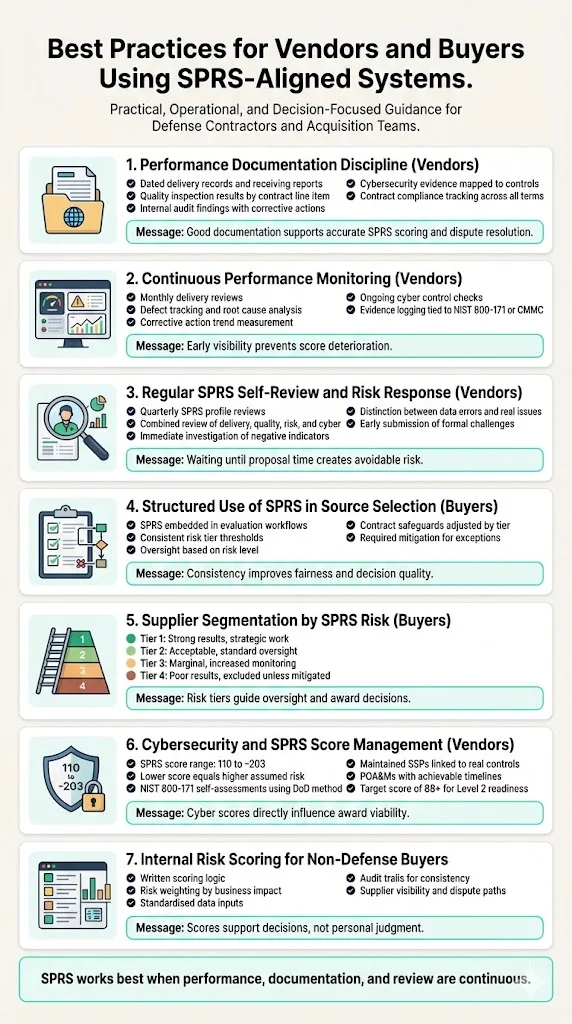
1) Performance Documentation Discipline (Vendors)
-
Keep delivery records with date stamps and receiving reports
-
Organize quality inspection results by contract line item
-
Retain internal audit results with corrective action responses
-
Store cybersecurity assessment evidence tied to specific controls
-
Track contract compliance across technical, schedule, and admin terms
-
Use documentation to support SPRS accuracy and challenge errors
2) Continuous Performance Monitoring (Vendors)
-
Review delivery metrics monthly to catch slippage early
-
Track defect rates and root causes, not just pass or fail results
-
Measure corrective action effectiveness over time
-
Maintain ongoing cybersecurity control monitoring
-
Log evidence and remediation status against NIST SP 800-171 or CMMC
3) Regular SPRS Self-Review and Risk Response (Vendors)
-
Check SPRS profiles at least once per quarter
-
Review delivery, quality, risk scores, and cyber status together
-
Investigate negative indicators as soon as they appear
-
Separate real performance issues from data errors
-
Submit formal challenges early rather than during proposal cycles
4) Structured Use of SPRS in Source Selection (Buyers)
-
Embed SPRS scores into formal evaluation steps
-
Classify suppliers by risk tier using consistent thresholds
-
Apply oversight levels based on risk, not vendor familiarity
-
Adjust contract length, surveillance, or safeguards for higher risk tiers
-
Require documented mitigation for exceptions
5) Supplier Segmentation Based on SPRS Risk
-
Tier 1: Strong SPRS results, suitable for strategic or high-value work
-
Tier 2: Acceptable performance, standard oversight
-
Tier 3: Marginal data, increased monitoring or safeguards
-
Tier 4: Poor SPRS results, excluded unless approved mitigation exists
6) Cybersecurity and SPRS Scoring Management (Vendors)
-
Understand SPRS scoring range: 110 to -203
-
Recognize that lower scores signal higher assumed DoD risk
-
Complete NIST SP 800-171 self-assessments using DoD methodology
-
Maintain System Security Plans tied to implemented controls
-
Build POA&Ms with realistic timelines for gaps
-
Submit accurate SPRS scores before award
-
Aim for 88 or higher to support CMMC Level 2 readiness
7) Internal Supplier Risk Systems for Non-Defense Buyers
-
Define scoring models with clear, written logic
-
Weight risk factors based on business impact
-
Standardize data collection to reduce subjectivity
-
Keep audit trails showing consistent application
-
Give suppliers visibility into scoring and dispute paths
-
Use scores to support decisions, not personal preference
Raise your SPRS score with controls, not optimism
Book a demo and we'll show how Konfirmity implements and evidences the NIST SP 800-171 controls behind your self-assessment score, and keeps the system security plan and remediation milestones current between submissions.
Book a demo
Conclusion
Contracting officers may consider item risk, price risk, and supplier risk assessments to determine the performance risk of the offeror or product and to assess the risk of ongoing contractor performance. SPRS formalizes this evaluation through structured data collection, standardized risk scoring, and centralized performance visibility—transforming supplier history into quantified procurement risk that influences award decisions across defense agencies.
For organizations pursuing defense contracts, SPRS represents operational reality: performance history determines contract eligibility as definitively as technical capability or pricing competitiveness. Companies that maintain disciplined delivery performance, implement rigorous quality control, achieve genuine cybersecurity compliance, and monitor their SPRS profiles proactively position themselves for sustained contract success. Organizations treating supplier performance as secondary to technical execution discover that excellence in one domain cannot compensate for deficiency in the other.
The principles underlying SPRS—continuous performance monitoring, data-informed risk assessment, supplier segmentation by reliability, and compliance verification—apply beyond defense procurement. Enterprises managing complex supply chains or compliance-sensitive operations benefit from adopting structured supplier risk management practices even absent regulatory mandates. These systems build vendor accountability, enable risk-informed sourcing decisions, and create performance incentives that strengthen supply-chain resilience over time.
FAQ
The Supplier Performance Risk System (SPRS) is the authoritative DoD source that provides price, item, and supplier procurement risk data and assessments, including on-time delivery scores and quality classifications. Managed by the Defense Information Systems Agency (DISA), SPRS aggregates performance information from government reporting systems to support acquisition professionals in evaluating supplier reliability, product risk, pricing reasonableness, and cybersecurity compliance. The system tracks delivery performance, quality metrics, item-level risks including counterfeit exposure, supplier risk scores calculated over approximately three years of contract history, debarment status, and cybersecurity assessments tied to NIST SP 800-171 and CMMC for contractors handling Controlled Unclassified Information. Contracting officers across defense agencies use SPRS data during market research, pre-solicitation planning, offer evaluation, and ongoing contract oversight—making it a continuous qualification and evaluation mechanism rather than a one-time certification.
Organizations receive SPRS supplier risk scores automatically based on their contract performance history with DoD agencies. Contractors with Commercial and Government Entity (CAGE) codes who perform defense contracts generate performance data through contract execution: delivery confirmations, quality inspection results, and contract closeout reports flow into SPRS from government reporting systems. This historical performance across multiple contracts over approximately three years calculates into risk scores that contracting officers access when evaluating future procurement opportunities. Quoters or Offerors can access their risk assessments by following access instructions in the SPRS user's guide, with access granted to their own risk assessment classifications only. For cybersecurity scoring, contractors must conduct self-assessments according to the DoD's NIST SP 800-171 Assessment Methodology and submit their self-assessment score to SPRS by the time of contract award. Organizations should register through the Procurement Integrated Enterprise Environment (PIEE) portal to view their SPRS profiles, verify data accuracy, and challenge incorrect records through formal dispute processes outlined in the SPRS user documentation.
NIST SP 800-171 requirements integrate into SPRS through the Cyber Reports module, which stores cybersecurity compliance assessments for defense contractors handling Controlled Unclassified Information. The SPRS score measures current cybersecurity compliance with NIST 800-171 and is used by the DoD to measure the risk of a contractor's cybersecurity position in protecting sensitive DoD information. Contractors must self-assess their implementation of the 110 security controls specified in NIST SP 800-171, calculating scores based on the DoD Assessment Methodology that deducts one, three, or five points for each unimplemented control depending on severity. Organizations submit these self-assessment results to SPRS, creating a cybersecurity compliance record that contracting officers review when awarding contracts requiring CUI access. NIST High On-Site Assessments have been converted to CMMC Level 2 certifications, with CMMC Level 2 and Level 3 eMASS assessments now released into SPRS for vendors. This integration reflects the transition from self-reported NIST SP 800-171 scores to third-party validated CMMC certifications, increasing assurance that reported cybersecurity postures reflect actual control implementation rather than aspirational claims.
SPRS scoring operates across two distinct contexts: cybersecurity compliance and overall supplier risk. For cybersecurity assessments tied to NIST SP 800-171, a perfect SPRS score is 110 and the lowest SPRS score is -203. Organizations begin with 110 points and deduct for unimplemented controls, with negative scores resulting from controls implemented incorrectly or creating vulnerabilities. An SPRS score of 88 or higher is considered good, as that is the minimum threshold of controls that need to be met during an organization's initial C3PAO-led assessment. Scores below this threshold signal cybersecurity deficiencies requiring Plans of Action and Milestones with remediation timelines, typically 180 days for conditional certifications. For overall supplier risk assessments, SPRS uses color-coded risk ratings based on delivery performance, quality classifications, and performance history across ten risk factors weighted by recency and contract volume. Lower numerical risk scores and favorable color classifications—typically green or blue ratings—indicate reliable vendors with consistent performance. Higher risk scores or yellow, orange, and red classifications signal delivery failures, quality defects, or compliance issues that increase perceived procurement risk. Contracting officers exercise discretion in weighing these scores against mission requirements, but organizations with poor risk ratings face significant disadvantages during source selection unless they demonstrate documented remediation and performance improvement trajectories.