Most enterprise vendors treat federal procurement registration as an administrative checkbox rather than a data governance obligation. This approach creates significant risk—a gap that becomes apparent when payment processing fails, compliance audits surface inconsistencies, or eligibility for high-value contracts is quietly revoked due to outdated records. The System for Award Management represents the authoritative source for vendor identity, financial routing, and compliance status across every federal agency. For enterprise sellers pursuing government contracts or institutional grants, SAM.gov functions as both gatekeeper and ongoing compliance monitor, making data accuracy a material business requirement rather than a procedural formality.
What is the System for Award Management?
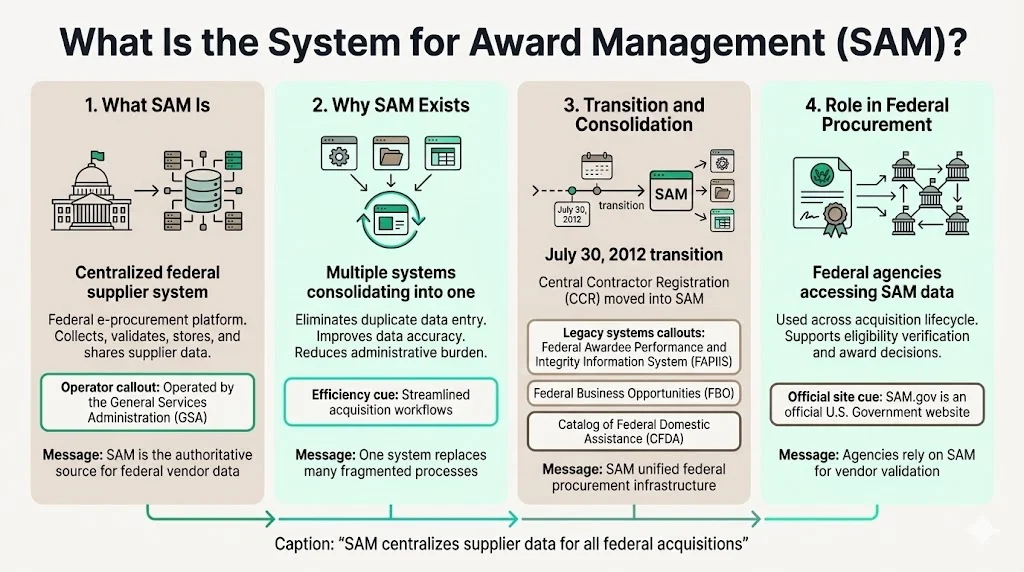
The System for Award Management is a federal e-procurement system that collects data from suppliers, validates and stores this data, and disseminates it to various government acquisition agencies. SAM.gov is an official website of the U.S. Government, operated by the General Services Administration.
Beginning July 30, 2012, the Central Contractor Registration transitioned to SAM, consolidating users' records from CCR and eight other separate websites and databases that previously managed discrete stages of federal procurement. GSA consolidated several federal procurement and award systems into SAM, streamlining processes, improving data quality by eliminating the need to enter the same data multiple times, and consolidating hosting to save taxpayer money. Legacy systems absorbed into the current platform include the Federal Awardee Performance and Integrity Information System, Federal Business Opportunities, and the Catalog of Federal Domestic Assistance.
Need to stand behind your GDPR posture?
Drop your work email and we'll help you close the gaps before a regulator or customer finds them.
Why SAM Matters to Enterprise Vendors
Enterprise vendors face materially different risk profiles than small contractors when managing SAM data. While registration requirements remain consistent across entity types, the operational consequences of data errors scale with contract volume and regulatory exposure. Large vendors managing multiple simultaneous federal contracts face heightened scrutiny around entity validation, beneficial ownership disclosure, and compliance certifications. A single data inconsistency—mismatched tax identification, outdated banking information, or incomplete representations—can cascade across active awards, triggering payment holds, audit flags, or eligibility questions that affect millions in contract value.
Business risk extends beyond transactional disruption. Federal agencies increasingly cross-reference SAM data against agency-specific compliance systems, past performance databases, and exclusion lists. Enterprise vendors with complex corporate structures, recent mergers, or multi-entity registrations face additional validation requirements that demand coordination across legal, finance, and contracts departments. Treating SAM as a static registration rather than an active data governance obligation creates vulnerabilities during agency due diligence, particularly when pursuing high-value indefinite delivery contracts or sensitive agency work requiring security clearances.
Core Functions of the System for Award Management
1) Award Registration and Vendor Identity
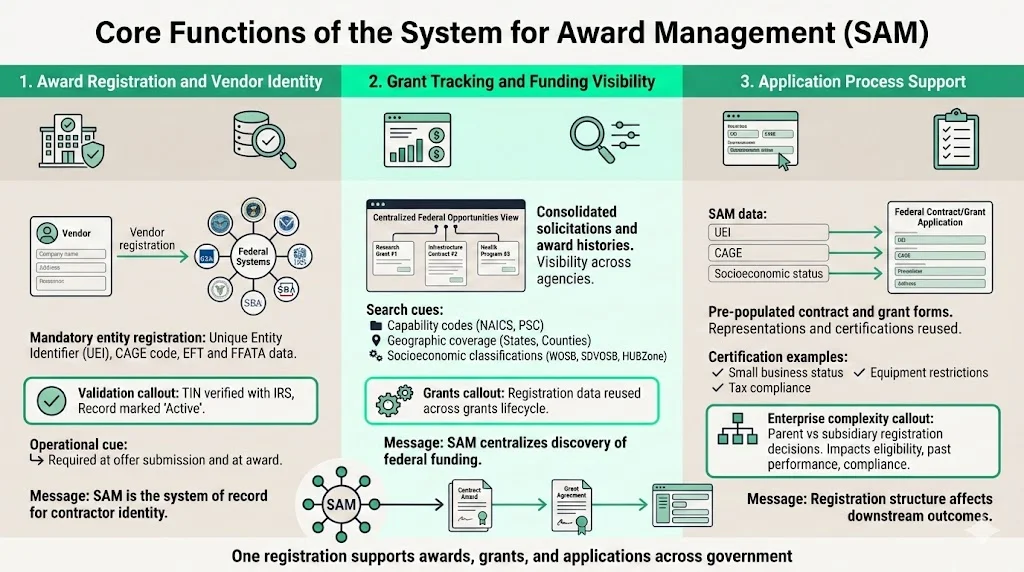
Registration in SAM requires entities to enter all mandatory information, including the unique entity identifier and the Electronic Funds Transfer indicator, the Commercial and Government Entity code, as well as data required by the Federal Funding Accountability and Transparency Act. The Government validates all mandatory data fields, including validation of the Taxpayer Identification Number with the Internal Revenue Service, and marks the record "Active". This validation process establishes the authoritative identity record federal agencies use throughout the procurement lifecycle.
Offerors must be registered in SAM when submitting an offer or quotation and at time of award, creating an absolute prerequisite for contract eligibility. Entity registration feeds agency acquisition portals, pre-award evaluation systems, and payment platforms, making SAM the system of record for contractor identity across the entire federal enterprise. Changes to legal business name, ownership structure, or entity status require coordinated updates across SAM and contract-specific novation processes, adding complexity for enterprises managing acquisition portfolios.
2) Grant Tracking and Funding Visibility
SAM provides centralized visibility into federal funding opportunities across agencies, enabling enterprise vendors to identify contract vehicles, cooperative agreements, and assistance programs aligned with organizational capabilities. The platform consolidates solicitation information, award histories, and funding announcements previously scattered across agency-specific portals. For enterprises pursuing diversified federal revenue streams, SAM registration enables searchability by capability codes, geographic service areas, and socioeconomic classifications that agencies use during market research and source selection.
Grant tracking functionality connects registration data to downstream application systems, ensuring consistency between entity information submitted during initial registration and data referenced throughout the grants lifecycle. Enterprises pursuing both procurement contracts and assistance awards benefit from unified entity management, though compliance obligations differ significantly between acquisition and grants administration frameworks.
3) Application Process Support
SAM data serves as the authoritative source for pre-populating federal contract and grant application forms, reducing manual data entry and minimizing transcription errors. Representations and certifications completed within SAM—covering areas such as small business status, telecommunications equipment restrictions, and tax delinquency—flow directly into agency evaluation systems, streamlining proposal submission and accelerating pre-award vetting.
Enterprise-level challenges during application processes stem from organizational complexity rather than technical barriers. Multi-division vendors must determine appropriate entity registration strategies: consolidated corporate registration versus subsidiary-specific registrations, each carrying distinct implications for small business eligibility, past performance evaluation, and socioeconomic certification. Incorrect registration architecture creates downstream complications during contract performance, particularly when teaming arrangements, subcontracting plans, or joint ventures require precise entity attribution for compliance measurement.
Data Protection Standards Inside SAM
Types of Data Collected
SAM collects comprehensive entity information spanning business identity, ownership structure, financial management capabilities, and operational contacts. Core data elements include legal business name, physical address, unique entity identifier, taxpayer identification number, and Commercial and Government Entity code. Financial data encompasses banking information for electronic funds transfer, account receivable contacts, and payment verification details that agencies use to process contract payments.
Point-of-contact information designates individuals authorized to represent the entity for electronic business transactions, government business inquiries, and entity administration. Role-based access controls determine which individuals may view or modify specific data sections, creating hierarchical permission structures that enterprise vendors must manage carefully to prevent unauthorized changes to registration status or compliance certifications.
Privacy and Security Framework
SAM implements federal data protection requirements consistent with the Federal Information Security Modernization Act and privacy standards established under the E-Government Act. Access controls segment data visibility based on user roles and agency authorities, distinguishing between publicly searchable information—such as entity name, CAGE code, and capability codes—and non-public data restricted to authorized government personnel with legitimate procurement or grants administration needs.
User authentication leverages Login.gov identity verification, requiring multi-factor authentication for account access. Entity administrators bear responsibility for managing role assignments, reviewing access logs, and maintaining separation between personnel authorized to view financial data versus those managing technical representations. These controls protect sensitive tax information, banking details, and proprietary capability descriptions from unauthorized disclosure.
Handling Sensitive Information
SAM employs encryption for data transmission and secure storage practices for sensitive financial and identity information. Banking and tax data remain accessible only to authorized payment officials within agencies holding active awards with the registered entity. Visibility restrictions prevent competitors or unauthorized third parties from accessing financial details, ownership percentages, or compensation structures submitted as part of registration requirements.
Enterprise vendors retain responsibility for protecting information used to authenticate SAM access, including Login.gov credentials, entity administrator authorization letters, and notarized documentation supporting ownership validation. Internal controls should govern who within the organization possesses authority to modify SAM data, establish points of contact, or update compliance certifications—particularly for entities managing multiple registrations or complex corporate hierarchies requiring consistent data governance across subsidiaries.
Compliance Monitoring and Ongoing Oversight
Entity registrations expire after one year and must be renewed to remain eligible to do business with the Federal government. This annual renewal requirement demands systematic tracking, as recipients must maintain currency of information in SAM until submitting the final financial report or receiving final payment, whichever is later. Lapsed registration immediately disqualifies entities from new awards and can halt payment processing on active contracts, creating cash flow disruptions and compliance violations.
Certifications and representations within SAM carry legal weight, subjecting signatories to civil and criminal penalties for false statements. Compliance monitoring extends beyond registration status to encompass exclusion screening, debarment checks, and validation against the Federal Awardee Performance and Integrity Information System. Agencies routinely verify active registration before exercising contract options, issuing task orders, or processing modifications, making continuous audit readiness essential rather than episodic.
Outdated or incorrect data creates material compliance risk. Agencies rely on SAM representations when evaluating contractor responsibility, determining set-aside eligibility, and validating security clearances for sensitive contracts. Misrepresentation—even through negligent failure to update changed circumstances—can trigger suspension, debarment proceedings, or False Claims Act liability when combined with certification requirements embedded in contract clauses.
Award Reporting and Performance Measurement
Award reporting obligations tie directly to SAM registration accuracy. Federal agencies use SAM data to populate contract award notices, performance measurement systems, and public transparency databases mandated by the Federal Funding Accountability and Transparency Act. Inconsistencies between SAM entity information and contract documentation create reporting errors that agencies must resolve before finalizing awards or exercising options.
Performance measurement systems cross-reference SAM identifiers to track past performance ratings, quality metrics, and schedule adherence across an entity's federal contract portfolio. Enterprises with multiple active contracts face aggregated performance visibility that agencies review during source selection evaluations. Inaccurate entity registration can fragment performance history, obscuring positive past performance or incorrectly attributing another entity's deficiencies.
Enterprise-scale reporting risks stem from coordination failures between operational teams managing contract deliverables and administrative functions responsible for SAM maintenance. When contract performance teams lack visibility into registration status or upcoming renewal deadlines, organizations face preventable disruptions that compromise delivery schedules and damage agency relationships built over years of successful performance.
Financial Management Implications for Enterprise Sellers
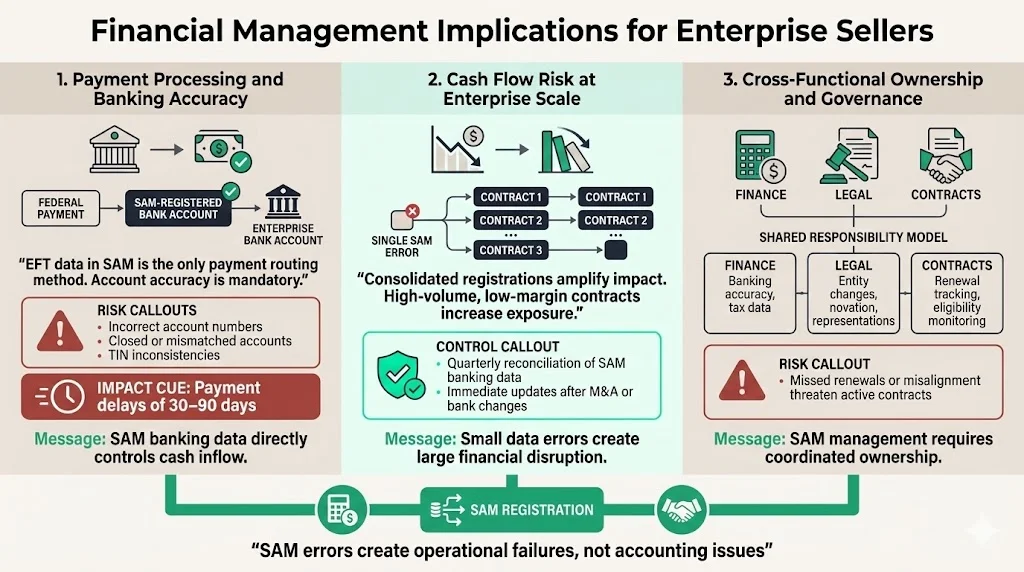
Payment processing for federal contracts flows exclusively through banking information registered in SAM. The Electronic Funds Transfer indicator and associated account details serve as the Government's sole payment routing mechanism, making data accuracy non-negotiable. Incorrect account numbers, closed accounts, or mismatched taxpayer identification create automatic payment rejections that delay receivables by 30 to 90 days while agencies investigate discrepancies and vendors submit corrected information.
Cash flow disruption from SAM payment errors affects enterprises disproportionately when managing high-volume, low-margin contracts with thin working capital buffers. A single banking error can affect dozens of simultaneous contracts if the enterprise uses consolidated entity registration, multiplying the financial impact beyond individual contract values. Internal controls should mandate quarterly reconciliation between SAM banking records and active corporate accounts, with escalation protocols when mergers, acquisitions, or banking relationship changes necessitate urgent SAM updates.
Finance, legal, and contracts teams must coordinate SAM management to prevent governance gaps. Finance owns banking data accuracy and tax identification validation. Legal manages entity structure changes, novation requirements, and representation certifications carrying legal liability. Contracts teams track registration renewal deadlines, monitor compliance status affecting award eligibility, and coordinate with agency contracting officers when registration issues threaten active performance. Failure to establish clear ownership and cross-functional review cycles leaves enterprises vulnerable to preventable operational failures.
Best Practices for Enterprise-Level SAM Data Governance
Assign explicit ownership for SAM data stewardship to a senior contracts or compliance professional with authority to coordinate across departments. Establish internal review cycles tied to the annual renewal deadline, beginning 90 days before expiration to allow time for validation, error correction, and agency coordination if questions arise. Implement automated calendar reminders and escalation protocols that engage executive leadership if renewal deadlines approach without completion.
Cross-check SAM data quarterly against internal systems of record: legal entity management databases for corporate structure changes, financial systems for banking information, and HR systems for point-of-contact accuracy. Discrepancies between internal records and SAM registration data indicate control failures requiring immediate investigation and remediation. Document review procedures, maintain audit trails of who modified data and when, and retain supporting documentation for representations and certifications that may require validation during agency audits.
Prepare for agency reviews by maintaining a compliance file containing registration confirmation screenshots, annual renewal documentation, and correspondence regarding validation questions or data corrections. When pursuing high-value contracts or competing for indefinite delivery vehicles, proactively verify SAM registration status before proposal submission deadlines to avoid disqualification for inactive or expired registration. For enterprises managing multiple entity registrations across subsidiaries or joint ventures, implement centralized monitoring to ensure consistent data governance and prevent overlooked renewal deadlines.
Treat security evidence the way you treat SAM data
Book a demo and we'll show how Konfirmity gives your security controls the same ongoing governance your SAM registration needs, so the compliance certifications behind a federal award never go stale.
Book a demo
Conclusion
The System for Award Management functions as the federal government's authoritative identity and compliance platform for the vendor and grantee community—not a registration formality to complete once and ignore. Enterprise vendors pursuing sustained federal revenue recognize that SAM represents ongoing operational infrastructure requiring the same governance rigor applied to financial reporting systems, security controls, or contract management platforms. Strong data practices reduce payment disruption risk, prevent eligibility complications during critical procurement competitions, and protect enterprise credibility with agency customers who rely on SAM data accuracy when making responsibility determinations.
Organizations treating SAM maintenance as administrative overhead rather than core compliance operations create preventable vulnerabilities that surface during audits, eligibility reviews, or payment processing failures. The long-term value of disciplined SAM governance extends beyond avoiding negative consequences to enabling strategic advantages: faster payment processing, streamlined proposal submission through accurate pre-populated data, and reliable entity visibility that supports business development efforts across the federal marketplace.
Frequently Asked Questions
SAM.gov serves as the central platform for entity registration to do business with the U.S. Government, updating and checking registration status, searching for assistance listings, wage determinations and contract opportunities, and running contract data reports. The platform consolidates vendor identity management, compliance monitoring, and procurement transparency functions previously distributed across multiple legacy systems.
All entities that want to do business with the federal government must be registered in SAM. This includes sole proprietors, small businesses, and large corporations contracting with the government to provide goods or services, individuals, nonprofits and state governments receiving Federal assistance, as well as Federal government agencies participating in intra-governmental transactions.
SAM implements role-based access controls, multi-factor authentication through Login.gov, and separation between publicly visible data and non-public financial information restricted to authorized government personnel. Encryption protects data transmission and storage for sensitive elements including banking details, taxpayer identification numbers, and ownership information. Agencies access non-public data only when legitimate procurement or grants administration needs exist for entities holding awards with that specific agency.
Entity registrations require annual renewal to maintain active status and eligibility for federal contracts and grants. Organizations must review and update information at least annually, with more frequent updates necessary when material changes occur to legal name, ownership structure, banking information, or compliance certifications. Failure to renew before expiration immediately disqualifies entities from receiving new awards and can disrupt payment processing on active contracts.
Inaccurate SAM data creates multiple risk categories depending on the affected information type. Banking or tax identification errors trigger automatic payment rejections, delaying receivables until corrections process through agency validation procedures—typically 30 to 90 days. Incorrect representations or certifications can result in contract termination, suspension or debarment proceedings, and False Claims Act liability when combined with contract clause requirements. Outdated entity information fragments past performance history, obscures contractor identity during agency searches, and may trigger responsibility determination questions that delay or prevent contract awards.