
Most enterprise-selling companies treat compliance frameworks as external obligations—certifications their buyers demand but rarely examine in operational detail. This approach creates a strategic blind spot when those buyers are themselves subject to stringent regulatory requirements like the Sarbanes-Oxley Act. Understanding precisely the Sarbanes-Oxley Act applies to which organizations, stakeholders, and operational environments determine how vendors position security capabilities, structure service agreements, and demonstrate control frameworks that support—rather than complicate—client audit readiness.
The compliance requirements apply to all U.S. public company boards, management, and accounting firms, yet the operational implications extend far beyond the named entities. Internal controls mandated under SOX necessarily encompass IT systems, data flows, and third-party vendors processing information that feeds financial reporting. For companies selling to enterprise clients, recognizing that "the Sarbanes-Oxley Act applies to" your buyer means understanding the control environment you're entering—and the evidence expectations that follow.
This analysis clarifies the scope of SOX applicability across public companies, executives, auditors, boards, and the vendor ecosystem. More importantly, it connects statutory compliance requirements to practical data protection standards and internal control frameworks that enterprise clients evaluate when assessing vendor risk. SOX extends beyond financial statement accuracy into IT General Controls, access management, change control, and audit trail integrity—domains where vendor systems either support or undermine client compliance posture.
What is the Sarbanes: Oxley Act of 2002 (SOX)?
In 2002, Congress passed the Sarbanes-Oxley Act in response to major corporate scandals at Enron, WorldCom, Tyco, and other companies—scandals that cost investors billions of dollars when share prices collapsed and shook public confidence in U.S. securities markets. The legislation introduced comprehensive reforms aimed at restoring investor confidence through enhanced financial disclosure accuracy, auditor independence, and corporate accountability.
The act created the Public Company Accounting Oversight Board (PCAOB), a quasi-public agency charged with overseeing, regulating, inspecting, and disciplining accounting firms in their roles as auditors of public companies. This represented a fundamental shift from self-regulation within the accounting profession to independent oversight with enforcement authority. SOX contains eleven sections that place requirements on all American public company boards of directors, management, and public accounting firms, establishing criminal and civil penalties for noncompliance that include substantial fines and imprisonment.
Key provisions relevant to internal controls and data
Two sections form the operational core of SOX compliance for most organizations. Section 302 requires Chief Executive Officers (CEOs) and Chief Financial Officers (CFOs) to personally certify the accuracy of financial reports and attest that they are directly responsible for internal controls and disclosures. Executives who "willfully" certify noncompliant financial reports face penalties of up to $5 million and 20 years imprisonment, establishing personal accountability at the highest organizational level.
Section 404 mandates that management assess and external auditors attest to the effectiveness of internal control over financial reporting (ICFR). This requirement extends directly into information technology infrastructure. IT General Controls under SOX encompass change management procedures, access controls, system security, backup and recovery protocols, and segregation of duties within systems processing financial data. Log collection and monitoring systems must provide an audit trail of all access and activity to sensitive business information, establishing data integrity and accountability requirements that overlap substantially with cybersecurity frameworks.
Companies today spend an average of one million to two million dollars and up to 10,000 hours on SOX programs annually, reflecting the resource intensity of maintaining documented, tested, and auditable internal controls. While financial reporting accuracy remains the statutory objective, the control domain necessarily extends into data systems, vendor integrations, and third-party service providers supporting financial processes.
Need to stand behind your GDPR posture?
Drop your work email and we'll help you close the gaps before a regulator or customer finds them.
Who the Sarbanes-Oxley Act Applies To?
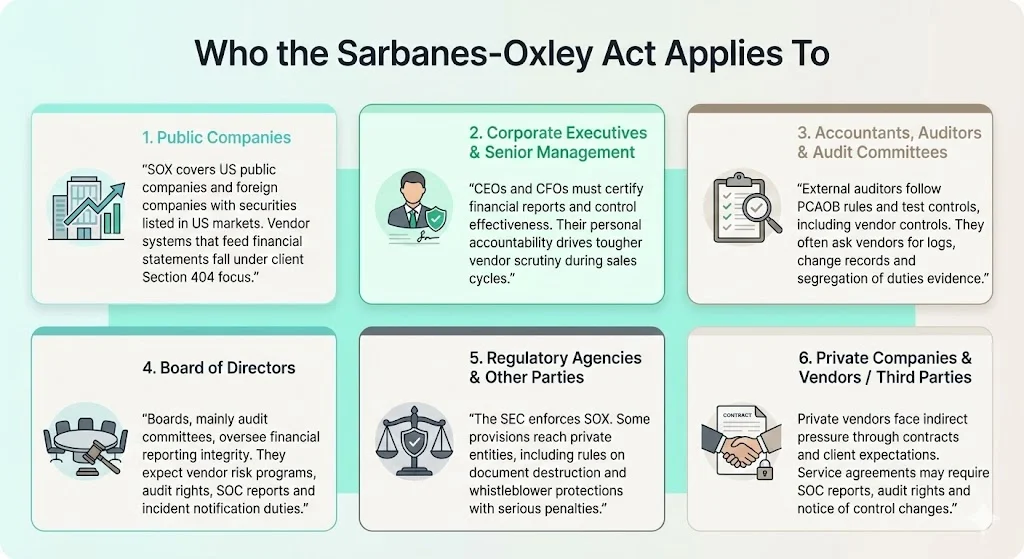
1) Public companies
SOX requirements apply to all U.S. public company boards, management, and accounting firms. Any company with securities registered under Section 12 of the Securities Exchange Act of 1934 or required to file reports under Section 15(d) falls under SOX jurisdiction. This includes U.S. companies traded on major exchanges and foreign companies with American Depositary Receipts (ADRs) listed on U.S. markets.
For vendors serving enterprise clients, this distinction matters operationally. When your client is a public company subject to SOX, their audit committees, internal audit teams, and external auditors will evaluate vendor controls as extensions of the client's own control environment. If your software processes data that ultimately feeds financial statements—customer transaction records, revenue recognition data, billing systems—you enter the scope of their Section 404 assessment. Enterprise procurement teams increasingly demand vendor evidence demonstrating control maturity aligned with their own compliance obligations.
2) Corporate executives and senior management
Section 302 holds CEOs and CFOs directly responsible for the accuracy of financial reports, requiring personal certification of both financial statements and the effectiveness of internal controls supporting those statements. This personal accountability elevates executive attention to control deficiencies, vendor risk management, and data integrity issues that might previously have been delegated entirely to finance or IT departments.
From a vendor perspective, this executive accountability translates into heightened scrutiny during contract negotiations. C-suite executives signing SOX certifications have personal liability exposure if vendor systems introduce control gaps, data integrity failures, or audit trail deficiencies. Vendors that can articulate how their platforms support—rather than complicate—executive certification requirements differentiate themselves in enterprise sales cycles.
3) Accountants, auditors and audit committees
External auditors of public companies are regulated under SOX through PCAOB oversight, which establishes auditing standards, conducts inspections, and enforces compliance. Audit committees within public companies bear responsibility for appointing, compensating, and overseeing external auditors, and must be composed of independent board members.
These stakeholders verify that controls—including IT controls and vendor controls—operate effectively throughout the fiscal period. Auditors conduct walkthroughs of key processes, test control effectiveness, and examine evidence supporting management assertions. When vendor systems support in-scope financial processes, auditors may require direct evidence from vendors: system access logs, change management documentation, segregation of duties matrices, disaster recovery test results. Vendors unable or unwilling to provide such evidence create audit obstacles for clients.
4) Board of directors
Boards of directors, particularly audit committees, bear governance oversight responsibility for financial reporting integrity and internal control effectiveness under SOX. The act increased the oversight role of boards of directors and the independence of outside auditors who review the accuracy of corporate financial statements. Audit committees must establish procedures for receiving and addressing complaints regarding accounting or auditing matters, including confidential, anonymous submissions from employees.
Board-level governance expectations increasingly encompass vendor risk management programs. Directors expect management to maintain inventories of vendors with access to financial systems, assess vendor control environments, and monitor vendor performance against contractual obligations. For vendors, this means contracts may include provisions granting clients audit rights, requiring annual SOC 2 reports, or mandating notification of control changes or security incidents.
5) Regulatory agencies and other parties
The Securities and Exchange Commission (SEC) enforces compliance with SOX, ensuring that companies adhere to the stringent requirements set forth by the act. The SEC reviews filings, investigates potential violations, and pursues enforcement actions including financial penalties and officer bars.
A number of provisions of the Act also apply to privately held companies, such as the willful destruction of evidence to impede a federal investigation. Intentionally destroying, altering or falsifying documents to impede a federal investigation carries fines and up to 20 years imprisonment, while retaliating against whistleblowers who provide law enforcement with information about possible federal offenses is punishable by up to 10 years imprisonment. These provisions establish that certain SOX requirements—particularly document retention and whistleblower protection—extend beyond public company boundaries.
6) Private companies and vendors / third parties (special note)
While SOX primarily targets public companies, vendors and third-party service providers become operationally relevant when they process data or maintain systems tied to a client's financial reporting environment. No direct statutory requirement compels private vendors to implement SOX-aligned controls, yet contractual obligations and client expectations create indirect compliance pressure.
Enterprise clients subject to Section 404 requirements routinely include vendor management provisions in service agreements: requirements for annual SOC 2 Type II reports, provisions granting audit rights to client internal audit teams or external auditors, notification obligations when control deficiencies are identified, and contractual representations regarding access controls, change management, and data retention. Private companies contemplating an IPO or gearing up for a merger or acquisition may also find reviewing their SOX internal controls prudent, as acquirers will assess control maturity during due diligence.
For companies selling to enterprise clients, understanding "the Sarbanes-Oxley Act applies to" your buyer shapes how you position security capabilities, what evidence you maintain, and how you structure audit readiness into operations rather than treating it as an annual scramble.
How SOX Supports Data Protection Standards
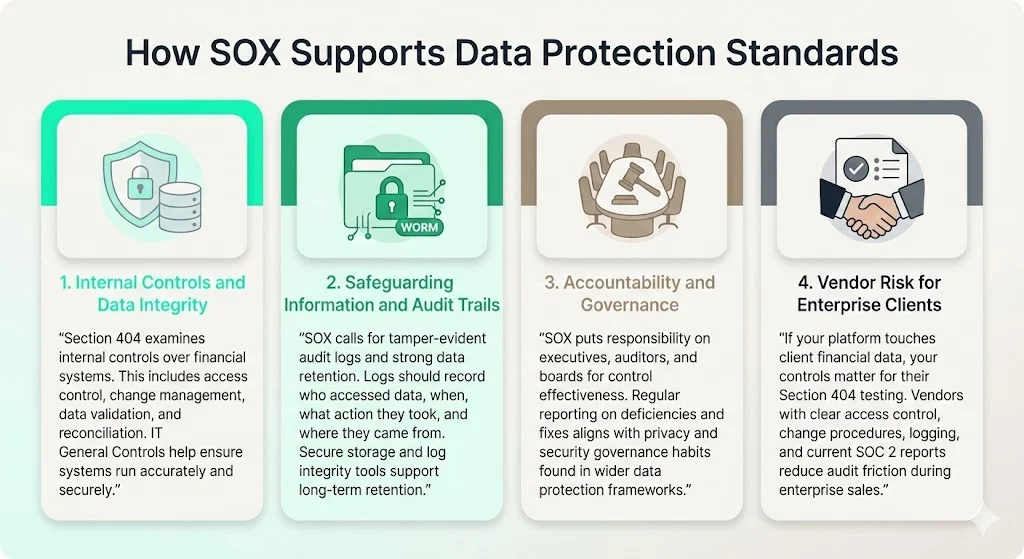
1) Internal controls and data integrity
Section 404 requires management to evaluate the effectiveness of internal control structures and procedures for financial reporting. From a data perspective, this encompasses controls over systems generating financial data: access controls limiting who can create, modify, or delete financial records; change management protocols ensuring system modifications are tested, approved, and documented; data validation rules preventing erroneous entries; and reconciliation procedures detecting discrepancies between systems.
IT General Controls under SOX include logical access controls, program change controls, program development controls, computer operations controls, and data center physical security. These ITGCs ensure IT systems processing financial information operate accurately, securely, and reliably. For example, access controls must enforce segregation of duties—preventing individuals from both initiating and approving transactions—while change management procedures must document all modifications to financial applications, including testing evidence and rollback procedures.
2) Safeguarding information and audit trails
Log collection and monitoring systems must provide an audit trail of all access and activity to sensitive business information under SOX requirements. Section 802 establishes criminal penalties for destroying, altering, or falsifying records in federal investigations, implicitly requiring organizations to maintain comprehensive, tamper-evident audit logs.
Strong data retention policies support both SOX compliance and broader data protection standards. Audit trails must capture who accessed financial data, when access occurred, what actions were performed, and from which systems or locations. These logs must be protected from unauthorized modification and retained for periods sufficient to support regulatory examinations and audits—typically seven years for financial records. Organizations implement write-once-read-many (WORM) storage, log integrity monitoring, and centralized log management platforms to satisfy these requirements.
3) Accountability and governance
SOX elevates accountability for executives, auditors, and boards, fostering a governance culture emphasizing oversight and control around financial data and reporting. This accountability framework overlaps substantially with data protection frameworks requiring designated data owners, documented risk assessments, control monitoring, and management review.
Executive certification requirements under Section 302 necessitate that senior management receive regular reporting on control effectiveness, significant deficiencies, material weaknesses, and remediation progress. This governance structure—requiring documented evidence trails, management review, and escalation procedures—mirrors privacy and security governance frameworks mandating data protection impact assessments, security steering committees, and executive risk reporting.
4) Supporting vendor risk management for enterprise clients
Enterprise clients evaluate vendors on how data flows into their financial reporting or internal control environment. If your platform processes customer transactions, maintains billing records, manages subscription renewals, or integrates with client financial systems, your control environment becomes relevant to client Section 404 assessments.
Vendors demonstrating control frameworks aligned with SOX expectations—documented access controls, change management procedures, segregation of duties, audit logging, annual SOC 2 Type II attestation—reduce client audit burden and accelerate procurement. Conversely, vendors unable to provide control evidence create audit gaps clients must address through compensating controls, increased testing, or control deficiency disclosures—complications that influence vendor selection decisions.
Practical Implications for Companies Selling to Enterprise Clients
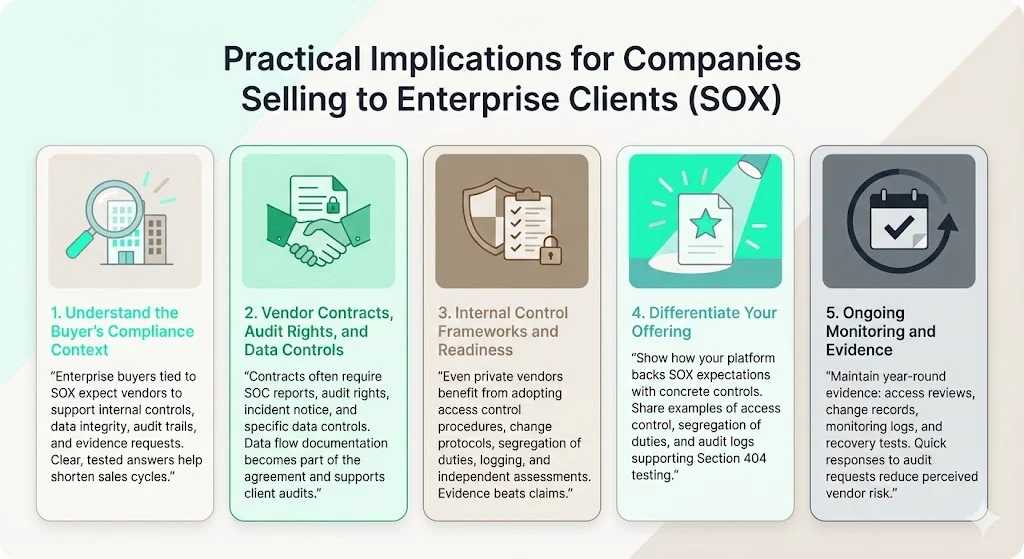
1) Understanding your buyer's compliance context
When selling to public companies or organizations influenced by SOX requirements, recognize that "the Sarbanes-Oxley Act applies to" them in ways that create operational expectations for vendors. Prepare to demonstrate how your product supports internal controls, maintains data integrity, provides audit trails, and enables client compliance rather than complicating it.
During enterprise sales cycles, anticipate questions about your control environment: Do you maintain annual SOC 2 Type II reports? What access controls govern customer data? How do you manage system changes? What audit logging capabilities exist? How quickly can you provide access logs during client audits? Organizations with documented, tested answers to these questions shorten sales cycles and reduce procurement friction.
2) Vendor contracts, audit rights and data controls
Enterprise contracts increasingly include provisions requiring vendors to support client SOX control environments. Common contractual requirements include annual SOC 2 Type II attestation, provisions granting clients or their auditors the right to audit vendor controls, notification obligations when control deficiencies or security incidents occur, and representations regarding specific controls like access management, change control, and data retention.
Data flow documentation becomes contractually relevant. Clients may require vendors to document precisely what data is collected, where it is stored, who has access, how it is protected, how long it is retained, and what happens upon contract termination. This documentation supports client understanding of vendor risk and enables auditors to assess whether vendor controls adequately protect financial reporting data.
3) Internal control frameworks and vendor readiness
Even if your organization is not publicly traded, adopting relevant controls enables credible conversations with enterprise clients. Consider implementing and documenting control frameworks anchored in SOX expectations: documented access provisioning and deprovisioning procedures, change management protocols requiring testing and approval before production deployment, segregation of duties preventing individuals from performing incompatible functions, audit logging capturing access and modifications to customer data, and annual independent assessments (SOC 2 Type II).
SOX auditing requires that internal controls and procedures can be audited using a control framework like COBIT, establishing that demonstrable, testable controls matter more than self-certification or marketing claims. Organizations that can provide evidence—not just assertions—of control effectiveness differentiate themselves.
4) Differentiating your offering
Emphasizing that you understand a buyer's compliance environment—that you recognize "the Sarbanes-Oxley Act applies to" them and have structured your operations accordingly—strengthens your value proposition. Provide case studies demonstrating how your solution enabled clients to meet or support SOX controls: how your audit logging satisfied Section 404 evidence requirements, how your access controls supported segregation of duties, how your change management procedures aligned with client ITGC expectations.
During procurement discussions, articulate specific control capabilities rather than generic security claims. Instead of "We take security seriously," specify: "We maintain role-based access controls with documented provisioning workflows, enforce segregation of duties preventing users from both creating and approving transactions, and provide tamper-evident audit logs with 13-month retention supporting your Section 404 testing requirements."
5) Ongoing monitoring and evidence-keeping
Companies must conduct regular SOX audits to ensure compliance with these standards, emphasizing that compliance is continuous rather than annual. Vendors supporting enterprise clients should maintain demonstrable evidence of controls operating effectively: access review logs documenting quarterly reviews of user permissions, change management records showing testing and approval for production deployments, security monitoring logs capturing and investigating anomalous access patterns, disaster recovery test results demonstrating backup integrity.
Organizations that maintain this evidence year-round respond rapidly to client audit requests, support client testing procedures, and demonstrate operational maturity that reduces perceived vendor risk. Conversely, vendors scrambling to produce evidence during client audits signal control immaturity that complicates client Section 404 assessments.
Common Misconceptions and Clarifications
Misconception #1: "SOX only applies if I'm a public company."
Clarification: While SOX places requirements on all American public company boards, directors, management, and accounting firms, a number of provisions also apply to privately held companies, such as the willful destruction of evidence to impede a federal investigation. Additionally, vendor systems and third parties supporting client financial reporting can be drawn into scope through contractual obligations and audit requirements.
Misconception #2: "SOX is purely accounting and finance, not IT or data."
Clarification: Section 404 demands internal controls over IT systems and data affecting financial reporting. IT General Controls under SOX encompass access controls, change management, system security, backup procedures, and audit logging—domains fundamentally about data protection and system integrity.
Misconception #3: "If I'm not in the U.S., SOX doesn't matter."
Clarification: SOX affects public and private U.S. companies and non-U.S. companies with a U.S. presence. Foreign companies with securities listed on U.S. exchanges face SOX requirements. Additionally, non-U.S. vendors serving U.S. public companies may encounter client expectations for SOX-aligned controls regardless of vendor geography.
Misconception #4: "SOX only affects the buyer; the vendor is off the hook."
Clarification: If a vendor supports financial-reporting systems or processes—transaction processing, billing, revenue recognition—they become relevant to client Section 404 assessments. Vendors may face audit inquiries, contractual control requirements, and expectations to provide evidence supporting client management assertions about control effectiveness.
Answer a SOX-regulated buyer without a compliance fire drill
Book a demo and we'll show how Konfirmity keeps your internal controls, audit trails and vendor evidence in order, so a public-company customer's audit rights stop being a quarterly scramble.
Book a demo
Conclusion
The Sarbanes-Oxley Act applies to U.S. public companies, their senior management, auditors, audit committees, boards of directors, and—through operational necessity and contractual obligation—extends influence to vendors and third parties supporting financial reporting environments. Organizations spend an average of one million to two million dollars and up to 10,000 hours on SOX programs annually, reflecting the resource intensity of maintaining documented, tested internal controls that satisfy auditor scrutiny.
The control dimension extends well beyond financial statement accuracy into IT systems, data integrity, access management, change control, and audit trail preservation—domains where vendor platforms either support or undermine client compliance posture. For companies selling to enterprise clients, particularly public companies, understanding that "the Sarbanes-Oxley Act applies to" your buyer means structuring your operations to support their control environment: maintaining documented controls, providing audit evidence, offering SOC 2 attestation, and demonstrating operational maturity that reduces rather than increases vendor risk.
Organizations that recognize SOX applicability not as an abstract regulatory concern but as a practical operational reality position themselves as credible partners for enterprise clients navigating complex compliance obligations. Review your own control frameworks, ensure you can provide documented evidence of control effectiveness, and incorporate SOX-relevant capabilities into your offering. Enterprise buyers increasingly distinguish between vendors that understand their compliance context and those that create audit complications—a distinction that influences procurement decisions, contract terms, and long-term client relationships.
FAQs
All U.S. public company boards, management, and accounting firms must comply with SOX requirements. This includes companies with securities registered on U.S. exchanges, their executives (particularly CEOs and CFOs), external auditors, audit committees, and boards of directors. Foreign companies with ADRs listed on U.S. markets also fall under SOX jurisdiction.
A number of provisions of the Act also apply to privately held companies, such as the willful destruction of evidence to impede a federal investigation. While private companies and vendors are not directly subject to Section 302 or 404 requirements, they may face contractual obligations to support client SOX compliance when providing services or systems tied to client financial reporting environments.
Section 404 requires effective internal controls over financial reporting, which necessarily encompasses IT General Controls governing systems processing financial data. These controls include logical access restrictions, change management procedures, segregation of duties enforcement, audit logging, backup and recovery protocols, and data integrity validations—domains that substantially overlap with data protection and cybersecurity frameworks.
Recognize that client SOX obligations create expectations for vendor control maturity. Prepare to demonstrate documented controls including access management, change control procedures, audit logging capabilities, segregation of duties, and annual SOC 2 Type II attestation. Understand what data your platform processes, how it connects to client financial systems, and what audit evidence you can provide. Position your control capabilities as supporting rather than complicating client Section 404 assessments.
Section 302 requires certification of financial statements by CEOs and CFOs, establishing internal controls and disclosures responsibilities. Section 404 mandates management assessment and external auditor attestation regarding internal control effectiveness over financial reporting. Section 802 establishes criminal penalties for destroying or falsifying records, implicitly requiring comprehensive audit trails. These provisions collectively establish requirements for documented, tested, auditable controls over data and systems supporting financial reporting.
No direct SOX certification exists for vendors. However, SOC 2 Type II attestation—an independent assessment of controls relevant to security, availability, processing integrity, confidentiality, and privacy—provides recognized evidence of control maturity that addresses many enterprise client expectations stemming from SOX obligations. Organizations may also pursue ISO 27001 certification, which establishes an Information Security Management System addressing many control domains relevant to SOX compliance.
Enterprise contracts increasingly include provisions requiring vendors to support client SOX environments: annual SOC 2 reporting, audit rights allowing clients or their auditors to examine vendor controls, notification obligations for control deficiencies or security incidents, data flow documentation, and specific control representations regarding access management, change control, and data retention. These contractual requirements reflect client needs to assess and monitor vendor risk as part of their own Section 404 compliance.
Common pitfalls include inability to provide audit evidence when clients request access logs or change management documentation, lack of annual SOC 2 attestation creating audit gaps for clients, inadequate access controls failing to enforce segregation of duties, insufficient audit logging preventing reconstruction of data access or modifications, and resistance to contractual audit rights creating procurement obstacles. Vendors treating security as marketing rather than operational discipline encounter friction in enterprise sales cycles.
SOX affects public and private U.S. companies and non-U.S. companies with a U.S. presence. Foreign companies with securities listed on U.S. exchanges must comply with SOX requirements. Additionally, non-U.S. vendors serving U.S. public companies may face client expectations for SOX-aligned controls regardless of vendor location, as clients assess vendor risk as part of their own compliance programs.
Companies must conduct regular SOX audits to ensure compliance with these standards. Public companies file quarterly reports (10-Q) and annual reports (10-K) with the SEC, requiring ongoing control monitoring throughout the fiscal year. Section 404 assessments occur annually, with management evaluating control effectiveness and external auditors attesting to management's assessment. Organizations maintain continuous control monitoring, quarterly management reviews, and annual independent audits to satisfy SOX requirements and maintain audit readiness.