Most organizations treat entity identifiers as technical minutiae—database constructs with no strategic implications. This perspective becomes problematic when regulatory reporting fails due to incorrect identifiers, when duplicate records create compliance gaps, or when systems cannot accurately map corporate hierarchies during financial audits. Entity IDs reveal networks of control, ownership, liability, and risks, making them fundamental to data management, regulatory compliance, and operational accuracy.
An entity ID is a unique identifier assigned to an organization, system record, or digital asset within a database or operational environment. These codes enable systems to distinguish one entity from another without ambiguity—eliminating confusion caused by similar names, merged organizations, or multi-jurisdictional operations. Understanding how entity identifiers function, when they're required, and how to implement them correctly determines whether your data infrastructure supports compliance objectives or creates audit exposure.
This definition examines entity IDs across contexts: internal database identifiers, regulatory constructs like the Legal Entity Identifier, and government-specific codes such as CAGE identifiers used in federal contracting.
What Is an Entity ID?
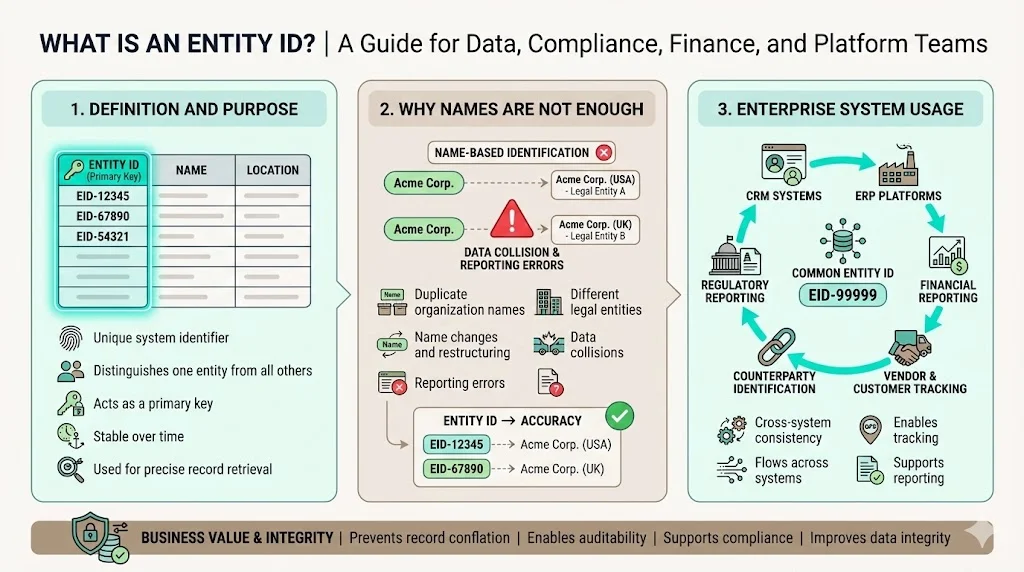
An entity ID is a unique code or system reference assigned to distinguish one record, organization, or digital asset from all others within a defined scope. In database architecture, entity IDs function as primary keys—ensuring that each row representing a legal entity, vendor, customer, or asset can be retrieved, referenced, and updated without risk of conflation with similar records.
Human-readable names create data management problems. Two companies named "Global Services LLC" registered in different states represent distinct legal entities but share identical nomenclature. Systems relying on name-based identification generate duplicate records, incorrect transaction assignments, and compliance reporting failures. Entity IDs resolve this by assigning each organization a unique alphanumeric code that remains constant regardless of name changes, relocations, or corporate restructuring.
Enterprise systems implement entity IDs across CRM platforms, ERP environments, financial reporting tools, and regulatory databases. Each identifier serves a specific operational or compliance function: tracking customer interactions, mapping vendor relationships, aggregating financial data, or satisfying regulatory mandates for transparent counterparty identification.
Types of Entity IDs in Business and Tech
Internal system identifiers include database primary keys, CRM account numbers, and ERP vendor codes. These identifiers exist exclusively within organizational boundaries, enabling efficient data retrieval and transaction processing but offering no cross-organizational standardization.
Global identifiers provide standardized recognition across jurisdictions and industries. The Legal Entity Identifier (LEI) is a 20-character alphanumeric code based on ISO 17442 standard, designed for entities participating in financial transactions. Similarly, government registries assign codes like CAGE identifiers for federal contractors or DUNS numbers for credit assessment.
Related concepts include tracking numbers for shipments, API keys for software access control, and digital asset identifiers for intellectual property management. Each serves the same fundamental purpose: unambiguous identification within a defined system.
Working toward a federal compliance baseline?
Drop your work email and we'll help you map controls to NIST and prove them with real evidence.
Key Concepts Behind Entity IDs
Unique Code and Database Record Logic
Uniqueness prevents the most common data management failure: record duplication leading to fragmented information, incorrect aggregations, and compliance gaps. When customer data exists in three separate records under slight name variations, revenue reporting becomes inaccurate, customer service deteriorates, and audit trails fragment across disconnected entries.
Consider acquisition scenarios. Company A acquires Company B, inheriting vendor relationships, customer contracts, and regulatory obligations. Without consistent entity identifiers mapping each acquired legal entity to existing records, post-merger integration creates duplicate vendor payments, missed contractual obligations, and regulatory reporting that fails to reflect actual corporate structure.
Organizations operating across multiple jurisdictions face compounded complexity. The same legal entity may be registered under different names in various countries, hold licenses under local language variations, and execute contracts through regional subsidiaries. Entity IDs provide the consistent reference point enabling accurate consolidation of activities, liabilities, and exposures across all operational contexts.
Enforcement in Digital Systems
Modern software architectures enforce entity ID requirements at the database level through primary key constraints, foreign key relationships, and referential integrity rules. When a transaction record references a counterparty, the system validates that the entity ID exists in the master entity table before allowing the transaction to commit. This enforcement prevents orphaned records—transactions pointing to non-existent entities—that corrupt analytical outputs and regulatory reports.
APIs rely on entity identifiers for access control, rate limiting, and transaction attribution. When external systems query your platform, they reference specific entity IDs to retrieve authorized data, submit transactions, or update records. Without rigorous identifier management, API integrations produce authorization failures, data leakage to incorrect parties, and audit trails that cannot accurately reconstruct transaction history.
Automation depends on consistent identifiers. Automated SLAs triggering security remediation, compliance monitoring systems flagging regulatory changes affecting specific entities, and risk scoring algorithms aggregating exposure across counterparties—all require accurate entity identification. Identifier inconsistency cascades into process failures throughout automated operations.
Legal Entity Identifier (LEI) as a Real-World Entity ID
What Is a Legal Entity Identifier?
The Legal Entity Identifier is a 20-digit alphanumeric reference code that uniquely identifies legally distinct entities engaging in financial transactions. This global standard meets ISO 17442-1:2020 specifications, providing consistent identification across jurisdictions, regulatory regimes, and financial instruments.
Unlike proprietary identifiers controlled by individual organizations or regional authorities, the LEI system operates under international governance. The Regulatory Oversight Committee oversees the system, with operational responsibility held by the Global LEI Foundation since late 2014. This structure ensures LEIs remain vendor-neutral, jurisdictionally consistent, and accessible through public databases.
Purpose and Use Cases
During the 2008 financial crisis, regulators discovered no single identification code existed worldwide for financial institutions, making it impossible to identify transaction counterparties, calculate total risk exposure, or analyze risks across markets. The LEI system emerged as the regulatory response to this transparency failure.
U.S. and European authorities require LEIs when reporting over-the-counter derivatives transactions, with 45 jurisdictions mandating LEI use for financial transactions. Beyond derivatives reporting, LEIs support securities trading, cross-border financing, syndicated lending, and any transaction where counterparty identification affects regulatory compliance or risk assessment.
Financial institutions increasingly require LEIs during client onboarding for Know-Your-Customer processes, anti-money laundering verification, and counterparty risk assessment. Organizations without LEIs face transaction delays, inability to access certain markets, and exclusion from business relationships with major financial institutions.
How LEI Data Is Structured and Managed
LEI records contain two data levels. Level 1 includes basic entity details: legal name, registered address, entity type, and LEI issuance and renewal dates. Level 2 data captures ownership structure, documenting parent and subsidiary relationships based on accounting consolidation standards.
The Global LEI Index functions as a centralized, searchable repository containing all issued LEIs with associated reference data. This public database enables any party to verify entity identity, confirm LEI validity, and understand corporate relationships. Organizations can search by LEI code, entity name, or jurisdiction to retrieve current entity information.
The system documents complex corporate structures and hierarchies, with relationship data showing networks of control, ownership, liability, and risks. For multinational banks holding thousands of legal entities, LEI data provides the structural map enabling regulators and counterparties to understand how entities interconnect and where ultimate accountability resides.
Who Needs an LEI
Individual persons may not obtain LEIs. The identifier applies exclusively to legal entities: corporations, partnerships, trusts, funds, and government entities conducting financial transactions. All financial companies and funds are required to have an LEI for regulatory reporting purposes.
Beyond mandatory requirements, entities involved in cross-border deals, syndicated loans, securities financing, or trading stocks, bonds, and derivatives may need an LEI. Legal entities transacting with multinational banks or financial institutions often must obtain and maintain an LEI as part of Know-Your-Customer processes.
Organizations assessing whether LEI requirements apply should evaluate: regulatory obligations under MiFID II, Dodd-Frank, EMIR, or other financial regulations; counterparty requirements imposed by banks or trading partners; and operational benefits from standardized identification in complex corporate structures.
How Businesses Obtain an LEI
Companies obtain LEIs through Local Operating Units by paying an initial registration fee and annual maintenance fee, with each unit sharing fees with the nonprofit Global LEI Foundation. These Local Operating Units operate as accredited LEI issuers, verified by the Global LEI Foundation to ensure data quality and operational consistency.
Annual renewal is mandatory</parameter> for entities continuing to participate in regulated financial transactions. LEIs that lapse due to non-renewal enter inactive status, preventing their use in regulatory reporting until renewed. Organizations must plan for annual renewal cycles as part of compliance calendaring.
The registration process requires providing entity formation documents, proof of legal registration, current operating address, and ownership structure documentation for Level 2 data. Processing typically completes within 1-3 business days for straightforward entity structures, with additional time required when ownership hierarchies involve multiple jurisdictions or complex arrangements.
How Entity IDs Impact Enterprise Businesses
A. Operational Efficiency
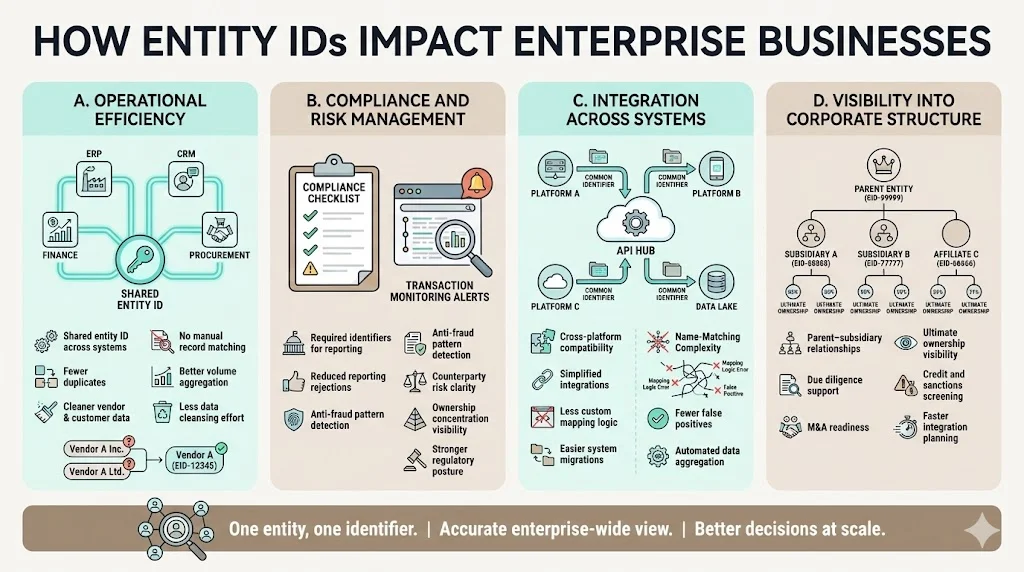
Consistent entity identifiers eliminate manual reconciliation between systems. When CRM platforms, ERP environments, and financial reporting tools reference the same entity ID for each customer, vendor, or subsidiary, data flows automatically across system boundaries without requiring staff to manually match records based on name variations or fuzzy logic algorithms.
<cite index="2-2,2-3">LEIs enable financial companies to become more efficient at internal reporting, risk management, data collection, and maintenance while easing regulatory reporting burdens by reducing overlap and duplication from multiple identifiers. Organizations operating without standardized identifiers allocate substantial resources to data cleansing, duplicate detection, and cross-system reconciliation—resources that standardized identification redirects toward higher-value activities.
Consider vendor management across a multinational enterprise. Regional offices contract with the same suppliers under different entity names, creating duplicate vendor records in procurement systems. Without entity IDs linking these records, the organization loses volume discount opportunities, fragments vendor performance data, and duplicates compliance assessments for the same counterparty.
B. Compliance and Risk Management
Regulatory reporting increasingly mandates specific identifier types. Since the LEI system launched in 2014, its use has been mandated in aspects of financial reporting in the United States and internationally. Organizations lacking required identifiers face reporting rejections, regulatory inquiries, and potential enforcement actions for non-compliance.
Entity IDs support anti-fraud controls by enabling systems to flag unusual patterns. When transaction monitoring systems track activity by entity ID rather than name, they detect scenarios like a counterparty suddenly receiving payments under multiple name variations—a common fraud indicator that name-based monitoring misses.
Counterparty risk assessment requires understanding corporate relationships. During credit evaluations, knowing that five apparently separate entities share ultimate ownership through a common parent materially affects risk concentration analysis. Entity IDs providing corporate hierarchy data make these relationships visible rather than requiring manual research across jurisdictional registries.
C. Integration Across Systems
Universal identifiers enable cross-platform interoperability without custom integration logic. When supply chain systems, financial platforms, and compliance tools all reference standardized entity IDs, data exchange becomes straightforward: each system queries external APIs using the entity ID, retrieves current data, and updates local records without requiring field mapping or transformation logic handling name variations.
Organizations implementing new software platforms face integration challenges when legacy systems use proprietary identifiers. Migration requires mapping old identifiers to new ones, validating that relationships transfer correctly, and ensuring no records become orphaned during transition. Standardized global identifiers reduce this complexity by providing consistent reference points recognized across both legacy and new environments.
Consider regulatory technology platforms aggregating compliance data. These systems must consolidate information about entities from dozens of sources: sanction lists, adverse media databases, corporate registries, and internal transaction records. Entity IDs enable automated matching across sources rather than probabilistic name-matching algorithms that generate false positives requiring manual review.
D. Visibility Into Corporate Structure
Understanding parent-child relationships and ultimate beneficial ownership becomes critical during due diligence, credit assessment, and sanctions screening. Entity identifiers documenting corporate hierarchies provide this visibility directly within operational systems rather than requiring external research.
Merger and acquisition scenarios particularly benefit from clear entity identification. Acquiring organizations need accurate inventories of all legal entities, their jurisdictional registrations, active licenses, and inter-entity relationships. Target companies using consistent entity IDs across systems provide this data cleanly; those lacking standardized identification require extensive manual mapping before integration planning can begin.
Entity ID vs Related Codes
A. LEI vs Entity ID
All LEIs are entity IDs, but not all entity IDs are LEIs. "Entity ID" broadly describes any unique identifier assigned to distinguish one organization or record from another within a defined context. LEI specifically refers to the 20-character code governed by ISO 17442 and issued through the Global LEI Foundation's accredited network.
Internal database primary keys, CRM account numbers, and ERP vendor codes are entity IDs serving organizational purposes without external recognition. LEIs provide globally standardized identification specifically for legal entities participating in financial transactions, with public accessibility and international governance ensuring consistency across jurisdictions.
Organizations require both: internal identifiers for operational efficiency within proprietary systems, and standardized global identifiers like LEI for regulatory compliance and cross-organizational interoperability.
B. Entity ID vs CAGE
Commercial and Government Entity (CAGE) codes identify suppliers in U.S. government procurement systems. The Defense Logistics Agency assigns these five-character alphanumeric codes through the System for Award Management (SAM) registration process.
CAGE codes serve procurement and contract administration functions: identifying vendors in solicitations, tracking contract awards, and managing supplier performance data across federal agencies. Unlike LEIs focused on financial transaction transparency, CAGE codes enable government contract management and supplier verification.
Scope differs fundamentally. CAGE codes apply to U.S. government contracting, while LEIs function globally across financial markets. Organizations selling to federal agencies require CAGE codes regardless of LEI status; entities engaged in international finance need LEIs independent of government contracting activities.
C. Entity ID vs DUNS Number (or Other Codes)
Dun & Bradstreet's Data Universal Numbering System (DUNS) assigns nine-digit identifiers for business credit profiling and commercial relationship management. Unlike LEIs governed by regulatory bodies, DUNS operates as a proprietary system managed by a private credit reporting company.
DUNS numbers track creditworthiness, payment history, and business relationships. Government agencies historically required DUNS numbers for grant applications and certain contracting scenarios, though SAM.gov now issues Unique Entity IDs as the primary government identifier independent of DUNS.
Organizations frequently maintain multiple identifier types simultaneously: internal entity IDs for operational systems, LEIs for financial reporting, DUNS numbers for credit relationships, and CAGE codes for government contracting. Each serves distinct functions within specific ecosystems, requiring coordinated management to ensure all identifiers remain current and correctly associated with appropriate legal entities.
Best Practices for Managing Entity IDs in Enterprise Systems
A. Choose Your Identifier Strategy
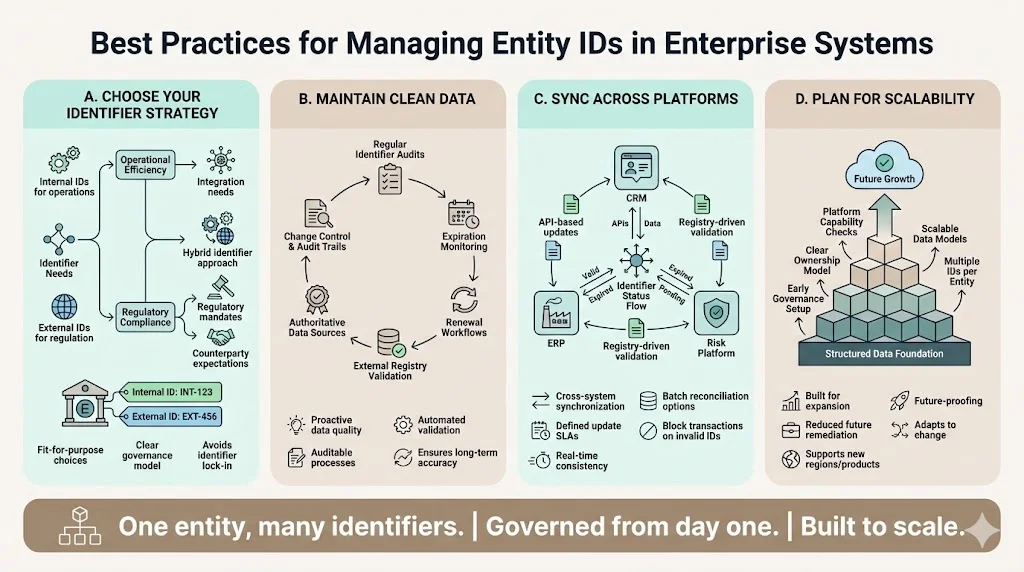
Organizations must determine when internal proprietary identifiers suffice versus when standardized global identifiers become necessary. Internal customer relationship management benefits from CRM-generated account IDs optimized for sales workflows. Financial reporting to regulators mandates LEIs regardless of internal identifier preferences.
The decision framework evaluates: regulatory requirements dictating specific identifier types; counterparty expectations from banks, trading partners, or customers; system integration complexity when exchanging data with external platforms; and long-term scalability as operations expand across jurisdictions.
Hybrid approaches prove most effective: maintain internal identifiers for operational efficiency while systematically capturing and syncing required external identifiers like LEIs, CAGE codes, or DUNS numbers for entities where applicable.
B. Maintain Clean Data
Entity identifiers require systematic data governance. Regular audits verify that identifiers remain current, particularly for codes requiring annual renewal like LEIs. Automated monitoring flags approaching expiration dates, triggering renewal workflows before identifiers lapse and disrupt operations.
Reconciliation routines detect discrepancies between internal records and authoritative external sources. LEI validation against the Global LEI Index, CAGE code verification through SAM.gov, and DUNS confirmation through Dun & Bradstreet ensure organizational records reflect current valid identifiers rather than outdated codes producing reporting failures.
Master data management disciplines apply: designate authoritative system sources for entity data, implement change control workflows requiring approval before identifier updates, and maintain audit trails documenting when identifiers were assigned, modified, or deprecated.
C. Sync Across Platforms
Systems sharing entity identifiers must implement synchronization logic ensuring consistency. When LEI renewals complete in compliance systems, CRM platforms, ERP environments, and financial reporting tools require updates reflecting current identifier status.
API-based integration enables automated synchronization. Compliance platforms querying the Global LEI Index for updated entity data push changes to integrated systems through standardized interfaces, eliminating manual update processes prone to delays and errors.
Organizations lacking integration capabilities implement alternative controls: scheduled batch synchronization comparing internal records against external registries, manual update procedures with defined SLAs for propagating identifier changes, and validation rules preventing transaction submission when identifiers show as expired or invalid in authoritative sources.
D. Plan for Scalability
Standardized identifier practices prevent technical debt as organizations grow. Early-stage companies using ad hoc identification methods face painful remediation when regulatory requirements or system integrations suddenly demand consistent entity identification across historical records.
Implement identifier governance from formation: establish policies defining when entities require which identifier types, assign responsibility for obtaining and maintaining each code, and architect data models accommodating multiple identifier types per entity as business scope expands.
New system implementations and software vendor selections should evaluate identifier management capabilities: Does the platform support multiple identifier types per entity? Can it validate identifiers against external registries? Does it enforce identifier uniqueness and referential integrity? These architectural considerations determine whether systems support or obstruct scalable entity identification practices.
Conclusion
Entity IDs function as the foundational reference layer enabling accurate data management, regulatory compliance, and operational automation across enterprise systems. Organizations treating identifiers as incidental database constructs rather than strategic compliance infrastructure discover gaps when regulatory reporting fails, when system integrations cannot match entities across platforms, or when corporate structure analysis requires manual research across fragmented records.
The distinction between internal operational identifiers and standardized global codes like LEI determines whether entity identification supports only internal workflows or enables cross-organizational interoperability and regulatory transparency. More than 1.9 million LEIs have been issued across over 225 countries and territories, reflecting widespread adoption driven by regulatory mandates and operational benefits from standardized identification.
Implementing rigorous identifier management practices—selecting appropriate identifier types for each use case, maintaining current valid codes through renewal processes, synchronizing identifiers across integrated systems, and architecting for scalability—reduces manual reconciliation effort, eliminates reporting errors from incorrect entity references, and positions organizations to meet evolving regulatory requirements as authorities increasingly mandate standardized identification for transparency and risk management objectives.
FAQs
An entity ID is a unique alphanumeric code assigned to distinguish one organization, system record, or digital asset from all others within a defined scope—functioning as a database primary key, regulatory identifier, or system reference code that enables unambiguous identification regardless of name variations or organizational changes.
Government systems use entity IDs for vendor registration (CAGE codes through SAM.gov), grant eligibility verification, contract award tracking, and compliance reporting. Federal agencies require contractors to maintain current entity identifiers for payment processing, performance monitoring, and regulatory oversight across procurement lifecycles.
Entity ID broadly describes any unique organizational identifier. LEI specifically refers to the 20-character code governed by ISO 17442 for entities in financial transactions, issued through the Global LEI Foundation's network and required for financial regulatory reporting. CAGE codes are five-character alphanumeric identifiers assigned by the Defense Logistics Agency for U.S. government procurement, serving contract administration rather than financial transparency functions.
Organizations require entity IDs based on operational context: internal database systems assign proprietary identifiers for all customers, vendors, and subsidiaries; financial institutions and entities trading securities or derivatives need LEIs for regulatory compliance; government contractors require CAGE codes; and businesses establishing commercial credit relationships obtain DUNS numbers. Specific identifier requirements depend on industry, jurisdiction, and transaction types.
Internal entity IDs generate automatically within database systems during record creation. LEIs are obtained through Local Operating Units accredited by the Global LEI Foundation, requiring entity formation documentation, ownership structure details, and annual renewal fees. CAGE codes are assigned through SAM.gov registration for government contracting. DUNS numbers are requested directly from Dun & Bradstreet for credit profiling purposes.