Most organizations view the Defense Industrial Base (DIB) as relevant only to prime contractors building fighter jets or missile systems. This assumption creates a fundamental gap—overlooking how thousands of enterprises across cybersecurity, advanced manufacturing, logistics, and technology sectors already operate within the DIB ecosystem without fully recognizing the compliance obligations, strategic opportunities, and national security implications that accompany this designation.
The Defense Industrial Base encompasses far more than military manufacturing and aerospace industry operations. It includes the worldwide network of organizations, facilities, and resources providing materials, products, and services essential to defense purposes—from research and development of weapon systems to the delivery of cybersecurity solutions protecting defense networks. For companies selling to enterprise clients, particularly those serving government agencies or defense contractors, understanding what the DIB is and how it functions determines access to high-value contracts, shapes regulatory compliance strategies, and influences competitive positioning.
This definition examines what DIB means in practical terms: the scope of the industrial complex, why it matters for national security and enterprise business, key components from supply chain resilience to export controls, and actionable guidance for companies determining their fit within this ecosystem.
What does "DIB" stand for?
The Defense Industrial Base (DIB) refers to the worldwide industrial complex that enables research and development, design, production, delivery, and maintenance of military weapons systems, subsystems, components, and the full spectrum of services supporting national defense operations. The term encompasses a network of organizations, facilities, and resources providing materials, products, and services for defense purposes—a definition broadly recognized across defense policy literature and government documentation.
Scope of the DIB
The DIB operates across domestic and global dimensions, incorporating foreign entities supplying strategic materials, private companies developing military technology, government-owned laboratories conducting classified research, and academic institutions contributing to defense-oriented R&D. This worldwide scope reflects the reality that no single nation maintains complete autonomy over every component, material, and capability required for modern defense systems.
Players within the DIB range from large prime contractors managing multi-billion-dollar weapon system programs to small specialized suppliers providing niche components, cybersecurity tools, or strategic materials. The ecosystem includes military manufacturing facilities, aerospace industry contractors, defense logistics providers, cybersecurity firms protecting defense networks, suppliers of rare earth elements and specialty alloys, maintenance and sustainment organizations, and technology companies developing artificial intelligence, quantum computing, or autonomous systems for defense applications.
Industries extend beyond traditional defense contractors to encompass advanced manufacturing, aerospace engineering, shipbuilding, electronics and semiconductors, cybersecurity and information technology, chemical and materials science, telecommunications infrastructure, energy systems supporting military installations, and transportation and logistics networks enabling global force projection.
Building toward SOC 2, ISO 27001, or another framework?
Drop your work email and we'll help you turn security work into audit-ready evidence automatically.
Why the DIB matters for companies and for national security
1) Importance for national security and enterprise business
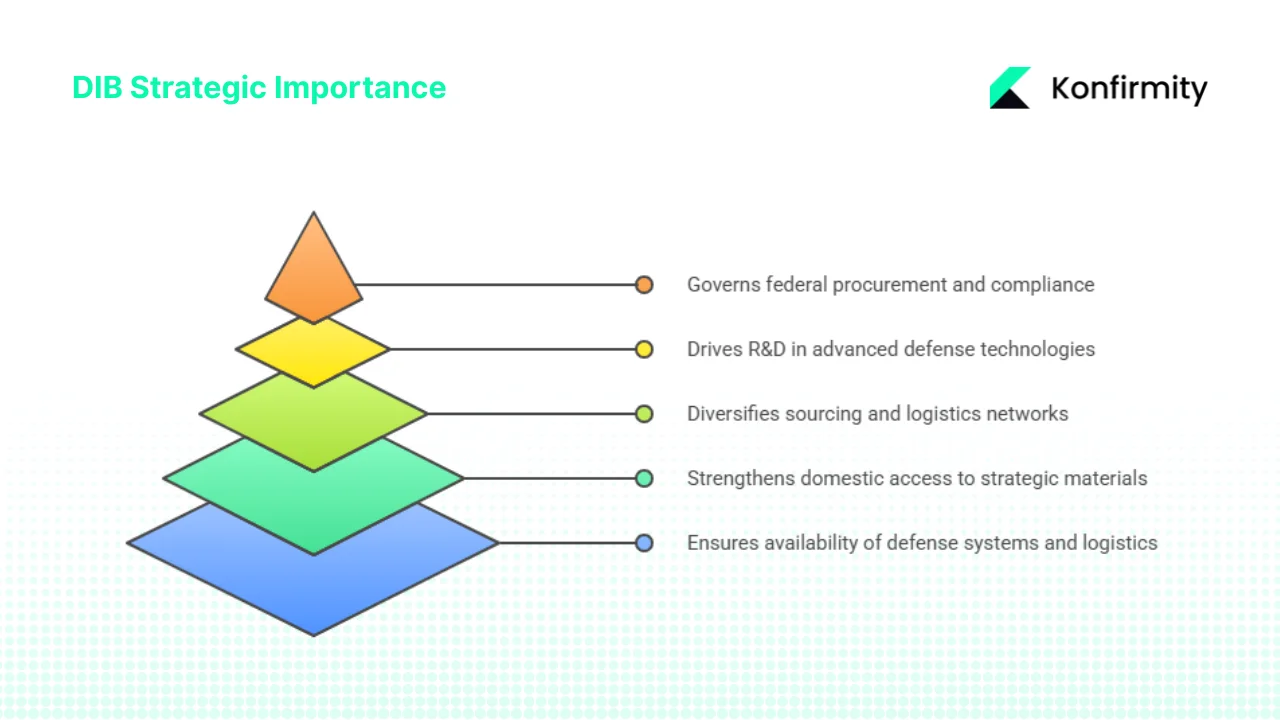
The Defense Industrial Base underpins national security by ensuring the continuous availability of weapon systems, defense logistics capabilities, intelligence infrastructure, and the technological superiority required for strategic deterrence. Without a resilient DIB, military readiness deteriorates, supply chains become vulnerable to disruption, and adversaries gain opportunities to exploit dependencies on foreign-controlled suppliers or compromise defense networks.
For companies selling to enterprise clients—especially those targeting government agencies, defense contractors, or critical infrastructure operators—being part of or aligned with the DIB means access to large-scale federal contracts, participation in high-barrier markets with significant compliance requirements, and long-term partnerships anchored in national security priorities. Organizations operating within the DIB ecosystem face complex regulatory frameworks, but they also gain competitive advantages through established relationships, security clearances, and demonstrated capability to meet stringent standards that exclude less-prepared competitors.
2) Link to industrial policy and strategic materials
National industrial policy increasingly aims to strengthen the DIB, ensure domestic access to strategic materials, and build resilient supply chains insulated from geopolitical disruption. Governments recognize that dependence on adversarial nations for rare earth elements, advanced semiconductors, or specialty chemicals creates unacceptable vulnerabilities. Industrial policy responses include subsidies for domestic production, stockpiling of strategic materials, export restrictions protecting sensitive technologies, and procurement preferences favoring suppliers meeting security and origin requirements.
Strategic materials—including rare earth elements essential for precision-guided munitions, specialty alloys used in aerospace manufacturing, advanced semiconductors powering defense electronics, and chemical precursors for munitions production—represent critical chokepoints where supply disruptions directly impact defense readiness. Companies controlling access to or substitutes for strategic materials occupy advantageous positions within the DIB ecosystem.
3) Supply chain resilience and military logistics
The DIB must deliver reliably during crisis periods when commercial supply chains face disruption, transportation networks become contested, and adversaries actively target defense logistics. Supply chain resilience requires diversified sourcing for critical components, redundant manufacturing capacity, stockpiles of long-lead-time materials, and logistics networks capable of operating under contested conditions.
Military logistics demands impose standards exceeding typical commercial requirements: traceability of components to prevent counterfeit parts, quality assurance processes ensuring reliability in extreme environments, configuration management maintaining precise specifications across decades-long weapon system lifecycles, and rapid response capabilities delivering critical spares to forward-deployed forces. Enterprises serving DIB clients must meet these elevated standards consistently, with documented evidence of compliance and continuous monitoring for supply chain vulnerabilities.
4) Technology innovation and cybersecurity in defense
Research and development in military technology forms the competitive foundation of the DIB, driving innovation in autonomous systems, hypersonic weapons, directed energy, quantum technologies, artificial intelligence, and advanced materials. Organizations contributing to defense-oriented R&D gain early access to emerging requirements, shape technical standards, and establish intellectual property positions protecting market share as technologies transition from laboratory to production.
Cybersecurity in defense represents a critical dimension of DIB operations, with adversaries persistently targeting defense contractors, supply chain partners, and supporting infrastructure to steal intellectual property, compromise weapon system integrity, or disrupt production. The Department of Defense's DIB Cybersecurity Strategy mandates specific security controls, continuous monitoring, and incident reporting obligations for organizations handling controlled unclassified information or contributing to defense programs. Companies unprepared for these cybersecurity requirements face exclusion from DIB opportunities regardless of technical capabilities in other domains.
5) Federal procurement and regulatory environment
Many DIB transactions occur through federal procurement mechanisms governed by the Federal Acquisition Regulation (FAR), Defense Federal Acquisition Regulation Supplement (DFARS), and agency-specific procurement policies. These frameworks establish qualification requirements, cost accounting standards, intellectual property rights allocation, and compliance obligations that shape how companies price offerings, structure contracts, and manage customer relationships within the DIB ecosystem.
Companies must understand compliance requirements spanning cybersecurity standards like CMMC (Cybersecurity Maturity Model Certification), export control regulations restricting technology transfer, supply chain security rules mandating disclosure of foreign ownership or sourcing, cost accounting standards for government contracts, and intellectual property protections balancing government rights with contractor interests. The regulatory environment creates barriers to entry but also protects established participants from competitors unwilling to invest in compliance infrastructure.
Key components of the DIB ecosystem
1) Research and development and military technology
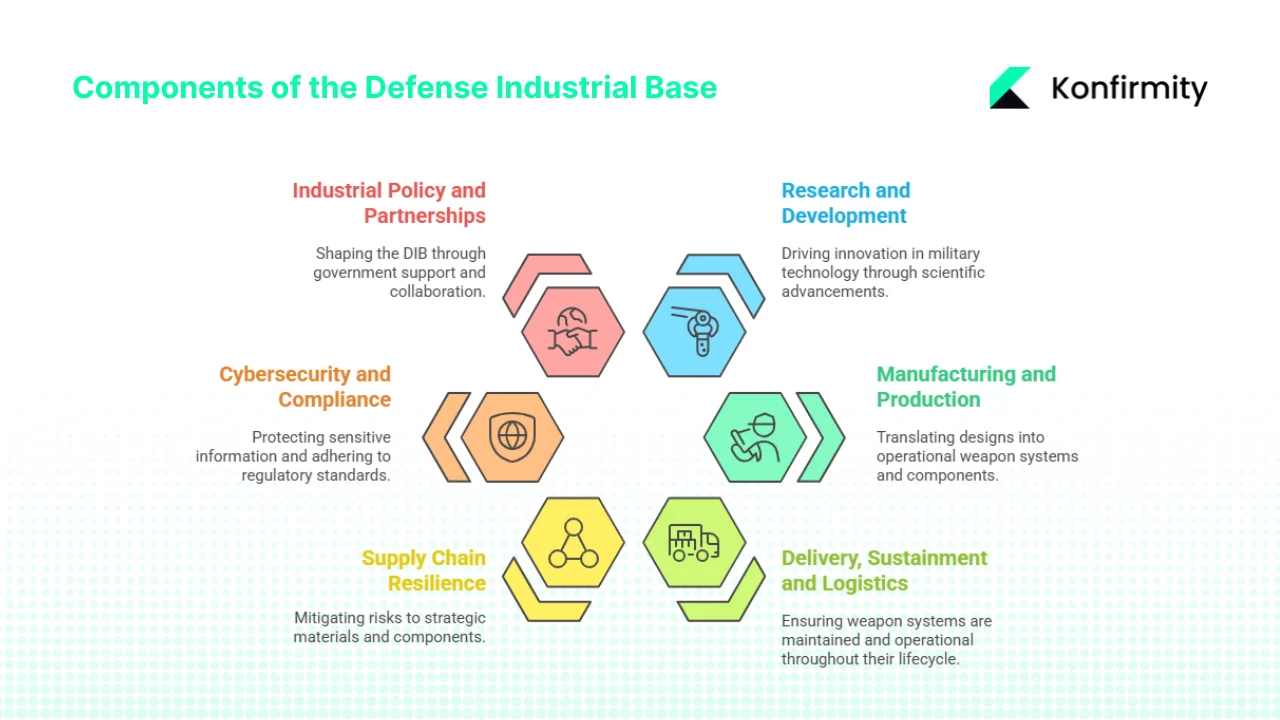
Research and development forms the upstream foundation of the DIB, encompassing basic science research at government laboratories and academic institutions, applied research translating scientific advances into defense-relevant technologies, technology demonstration projects proving feasibility of novel weapon systems, and engineering development refining designs for production. This R&D ecosystem produces innovations in military technology spanning aerospace systems, autonomous vehicles, artificial intelligence for intelligence analysis and targeting, advanced materials improving weapon system performance, cybersecurity tools protecting defense networks, and communications technologies enabling networked warfare.
The aerospace industry contributes substantially to defense-oriented R&D, developing next-generation aircraft, space-based surveillance systems, missile defense technologies, and hypersonic weapons. Organizations participating in defense R&D gain early visibility into future procurement priorities, influence technical requirements benefiting their capabilities, and establish relationships with program managers shaping acquisition decisions.
2) Manufacturing and production
Production of weapon systems, subsystems, components, and strategic materials represents the core of DIB operations, translating designs into operational capabilities delivered to military services. Military manufacturing encompasses facilities producing complete weapon systems like aircraft, ships, and ground vehicles; suppliers fabricating subsystems such as propulsion systems, avionics, or fire control equipment; component manufacturers providing electronics, fasteners, or mechanical assemblies; and materials producers supplying specialty alloys, composites, or chemicals meeting defense specifications.
Large defense contractors typically manage weapon system integration, final assembly, and program management, while networks of small and medium suppliers provide specialized components, manufacturing services, and niche capabilities. The aerospace industry exemplifies this tiered structure, with prime contractors like Boeing, Lockheed Martin, and Northrop Grumman orchestrating thousands of suppliers contributing to aircraft production. Companies competing in this space must demonstrate manufacturing capabilities meeting quality standards, possess facilities with appropriate security clearances for classified work, and maintain production capacity adequate for government demand fluctuations.
3) Delivery, sustainment and logistics
After production, weapon systems require delivery to military services, installation and integration with existing infrastructure, training for operators and maintainers, and decades of sustainment support through maintenance, spare parts provisioning, upgrades, and eventual disposal. Military logistics supporting these activities demands supply chain visibility tracking assets globally, maintenance capabilities operating in austere environments, transportation networks moving oversized or hazardous materials, and configuration management ensuring spare parts compatibility across weapon system variants and production lots.
The sustainment phase typically represents 60-70% of total weapon system lifecycle costs, creating long-term revenue opportunities for organizations providing maintenance services, spare parts, technical support, and modernization upgrades. Companies excelling in military logistics demonstrate responsiveness meeting urgent operational needs, quality ensuring first-time-right repairs, and lifecycle management optimizing total cost of ownership across decades-long service lives.
4) Supply chain resilience and strategic materials
Supply chain disruptions affecting strategic materials, critical components, or specialized manufacturing capabilities pose existential risks to the DIB. Vulnerabilities include single-source suppliers creating bottlenecks, foreign-controlled sources subject to geopolitical disruption, long lead times preventing rapid production increases, obsolete components for legacy weapon systems, and counterfeit parts infiltrating supply chains.
Companies selling into the DIB must assess sourcing risk for materials and components, identify alternative suppliers or substitutes reducing dependence on vulnerable sources, maintain visibility into sub-tier suppliers often invisible to prime contractors, and implement quality assurance processes detecting counterfeit or substandard materials. Strategic materials requiring particular attention include rare earth elements used in precision-guided munitions and electronics, specialty alloys for aerospace applications, advanced semiconductors powering defense systems, and chemical precursors for energetics and propellants.
5) Cybersecurity, export controls and compliance
Cyber threats targeting DIB supply chains and networks pose risks including theft of intellectual property related to weapon system designs, insertion of malicious code or hardware compromising system integrity, disruption of production facilities or logistics networks, and exfiltration of classified information. Cybersecurity in defense requires implementing technical controls protecting controlled unclassified information, continuous monitoring detecting intrusions, incident response capabilities containing breaches, and supply chain security assessing cyber risks from vendors and partners.
Export controls restrict international trade of defense goods and technology to prevent adversaries from acquiring capabilities threatening national security. Regulations like the International Traffic in Arms Regulations (ITAR) and Export Administration Regulations (EAR) classify defense articles and technologies, establish licensing requirements for exports, restrict foreign persons' access to technical data, and impose criminal penalties for violations. Companies handling defense-related technologies must implement export control programs ensuring compliance, train employees on restrictions, and obtain licenses before sharing technical information with foreign nationals.
Regulatory frameworks governing DIB contractors extend beyond cybersecurity and export controls to encompass cost accounting standards for government contracts, intellectual property rights allocation, small business subcontracting goals, domestic preference requirements, and supply chain transparency obligations. Compliance burden increases with contract value and program sensitivity, requiring dedicated personnel and systems managing regulatory requirements.
6) Industrial policy, government-industry partnerships
National policy shapes the DIB ecosystem through defense spending priorities, procurement regulations favoring domestic suppliers, subsidies supporting strategic industries, export restrictions protecting sensitive technologies, and public-private partnerships developing emerging capabilities. Governments increasingly recognize that market forces alone produce suboptimal outcomes for national security, justifying interventions ensuring defense industrial capacity, supply chain resilience, and technological superiority.
Government-industry partnerships take forms including cooperative research agreements sharing costs for technology development, consortia addressing common challenges like supply chain security or workforce development, advisory bodies providing industry input to policy decisions, and public-private ventures commercializing defense technologies. Companies engaging effectively with government stakeholders gain visibility into policy directions, influence regulatory frameworks, and access partnership opportunities unavailable to less-engaged competitors.
What "DIB" means for companies selling to enterprise clients
1) Identifying opportunities in the DIB space
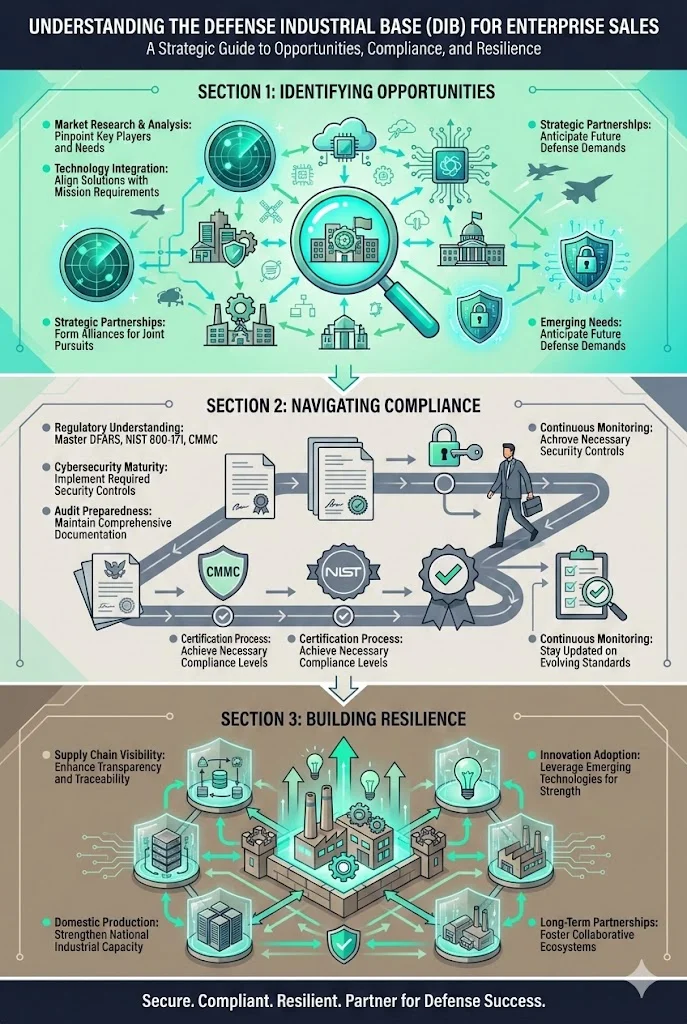
Companies determine fit within the DIB ecosystem by mapping current capabilities against defense requirements, identifying customer segments including prime defense contractors, government agencies, and military services, and assessing competitive positioning relative to established suppliers. Opportunities exist for suppliers of components meeting defense specifications, logistics services supporting military operations, cybersecurity tools protecting defense networks, aerospace subcontractors contributing to aircraft or space systems, advanced manufacturing capabilities producing complex geometries or materials, technology providers developing artificial intelligence or autonomous systems, and professional services supporting program management or engineering functions.
Organizations serving defense contractors as sub-tier suppliers already operate within the DIB ecosystem, facing compliance obligations and supply chain security requirements flowing down from prime contracts. Companies should assess whether current customer relationships involve defense programs, review contract terms for DIB-specific clauses, and evaluate readiness for cybersecurity, export control, and supply chain transparency requirements.
2) Navigating procurement and compliance
Understanding federal procurement processes requires familiarity with acquisition frameworks, contract types, proposal evaluation criteria, and post-award administration. Defense contractors must register in government databases like the System for Award Management (SAM), obtain required certifications, respond to solicitations following prescribed formats, and manage contracts meeting cost accounting, reporting, and intellectual property requirements.
Compliance with cybersecurity standards increasingly determines eligibility for defense contracts, with CMMC requiring third-party assessment of security controls before contract award. Organizations must implement technical safeguards protecting controlled unclassified information, document security policies and procedures, train personnel on cybersecurity obligations, and maintain continuous monitoring, detecting and responding to threats.
Export control compliance demands classification of products and technologies, establishment of internal controls restricting access by foreign persons, licensing processes for international transfers, and recordkeeping documenting compliance. Companies failing to implement robust export control programs face criminal penalties, debarment from government contracting, and reputational damage undermining customer relationships.
3) Building resilience and competitive edge
Emphasizing supply chain resilience aligns company capabilities with national security priorities, differentiating offerings from competitors unable to demonstrate sourcing security, production redundancy, or crisis response capabilities. Companies build resilience through diversified supplier bases reducing single-source dependencies, domestic manufacturing capacity insulated from geopolitical disruption, stockpiles of strategic materials or long-lead-time components, and logistics networks capable of operating under contested conditions.
Technology innovation serves as a differentiator in military technology markets, where performance advantages translate directly to mission success. Organizations investing in defense-oriented R&D, collaborating with government laboratories or academic institutions, and protecting intellectual property through patents or trade secrets establish competitive moats difficult for followers to overcome.
Risk factors to watch
Dependence on strategic materials or single suppliers creates vulnerabilities when geopolitical events disrupt supply chains, price volatility affects material costs, or suppliers exit markets due to regulatory burden or limited demand. Companies should continuously assess supply chain risks, qualify alternative sources, and engage with government programs stockpiling strategic materials.
Cybersecurity breaches compromise intellectual property, disrupt operations, and trigger regulatory investigations, potentially resulting in contract termination, financial penalties, or debarment. Organizations must invest in security infrastructure, continuous monitoring, and incident response capabilities proportionate to threats facing the DIB ecosystem.
Export control violations carry criminal penalties including imprisonment, fines, and debarment from government contracting. Companies handling defense-related technologies must maintain rigorous compliance programs, audit internal controls regularly, and immediately report inadvertent violations to regulatory authorities.
Changes in industrial policy, defense budget shifts, or procurement priorities disrupt demand for specific capabilities, technologies, or suppliers. Companies should monitor government strategy documents, budget submissions, and acquisition forecasts to anticipate shifts requiring capability adjustments or market repositioning.
Case example
A mid-sized cybersecurity company providing endpoint protection and threat detection previously served commercial enterprises across financial services and healthcare sectors. Recognizing opportunity in defense markets, leadership assessed readiness for DIB involvement, discovering existing products required modifications to meet government security standards, personnel needed security clearances for classified customer sites, and compliance infrastructure was inadequate for CMMC Level 2 certification required by target defense contractors.
The company invested 18 months developing DIB-ready capabilities: implementing technical controls protecting controlled unclassified information, establishing export control processes restricting foreign nationals' access to defense-related technologies, obtaining facility security clearances enabling classified work, and pursuing CMMC certification through third-party assessment. These investments enabled pursuit of defense contractor subcontracts providing cybersecurity services protecting weapon system development networks.
By framing value around DIB-specific requirements—demonstrating compliance, emphasizing supply chain security with domestic-only development teams, and showcasing continuous monitoring capabilities exceeding commercial standards—the company secured initial contracts with aerospace industry prime contractors. Success in these engagements established credentials enabling direct pursuit of Department of Defense contracts, expanding addressable market and differentiating positioning relative to competitors unable or unwilling to invest in DIB compliance infrastructure.
Practical steps and best practices for companies
1) Assessing fit and readiness for DIB involvement
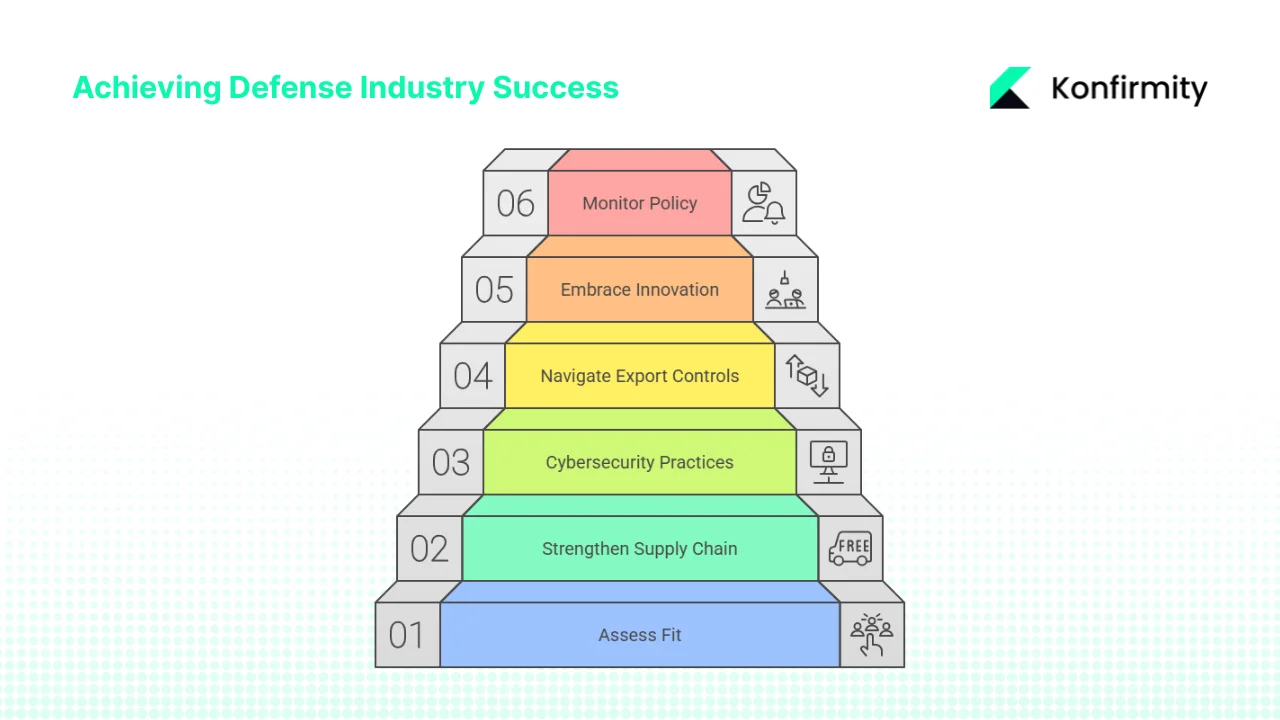
Map current capabilities against DIB requirements by evaluating products or services against defense specifications, comparing manufacturing standards to government quality systems like AS9100, assessing cybersecurity posture relative to CMMC requirements, and reviewing export control implications of technologies or foreign ownership structures. This assessment identifies gaps requiring remediation before pursuing defense opportunities and capabilities differentiating offerings within the DIB ecosystem.
2) Strengthening supply chain and resilience
Diversify suppliers for strategic materials and critical components, qualifying multiple sources reducing dependence on single providers or foreign-controlled entities. Build logistics redundancy through alternative transportation modes, distributed warehousing, or contractual arrangements ensuring priority access during disruptions. Establish partnerships with complementary suppliers creating integrated solutions addressing complex defense requirements exceeding individual company capabilities.
3) Cybersecurity practices in defense context
Adopt frameworks specific to the DIB, implementing NIST SP 800-171 controls protecting controlled unclassified information and pursuing CMMC certification demonstrating compliance through third-party assessment. Establish continuous monitoring detecting intrusions or anomalous activity, implement incident response procedures containing breaches and notifying affected parties, and maintain evidence of security control effectiveness through documentation, logging, and periodic assessments.
4) Navigating export controls and regulatory compliance
Understand relevant export control regimes including ITAR governing defense articles and EAR covering dual-use technologies, classify products and technical data determining applicable restrictions, implement internal controls restricting foreign persons' access to controlled information, establish licensing processes for international transfers or foreign national access, and train employees on export control obligations through regular programs reinforcing compliance expectations.
5) Embracing technology innovation and R&D collaboration
Participate in defense-oriented R&D projects through Small Business Innovation Research (SBIR) programs funding early-stage technology development, cooperative research agreements sharing costs with government laboratories, or prime contractor partnerships contributing specialized capabilities to weapon system development. Collaboration provides visibility into future requirements, establishes relationships with program stakeholders, and creates intellectual property positioning companies for production contracts as technologies mature.
6) Monitoring industrial policy and market shifts
Stay abreast of government policy changes through defense strategy documents, Congressional budget submissions, and acquisition forecasts published by military services. Track procurement trends including increasing emphasis on cybersecurity, supply chain security, and domestic sourcing. Monitor defense budget priorities shifting between modernization, readiness, and force structure, adjusting capability investments and marketing strategies to align with funded requirements.
Challenges and evolving trends in the DIB space
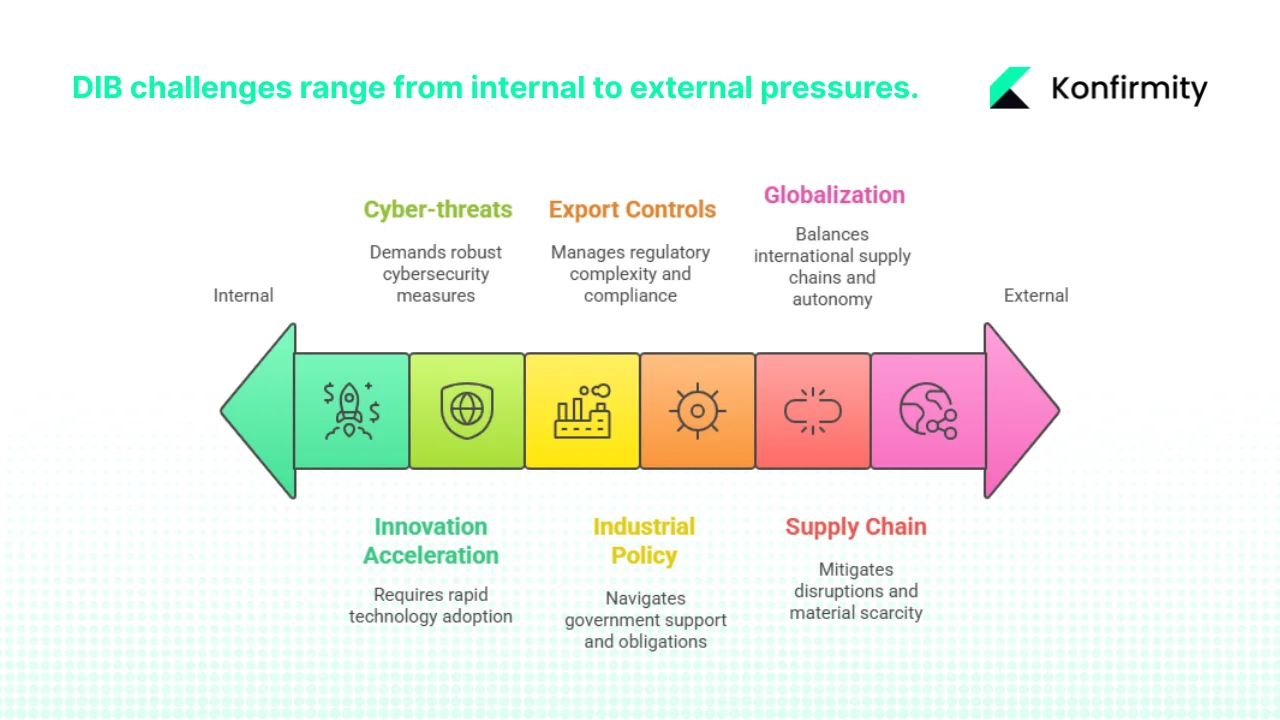
1) Globalization versus strategic autonomy
Balancing international supply chains offering cost advantages and specialized capabilities against national security demands for domestic production creates tension throughout the DIB ecosystem. Governments increasingly prioritize strategic autonomy for critical technologies, imposing domestic preference requirements, restricting foreign suppliers, or subsidizing domestic production despite higher costs. Companies must navigate these competing pressures, evaluating when international sourcing creates unacceptable risks and where domestic alternatives exist or can be developed.
2) Cyber-threats and resilience
Rising threat landscapes targeting the DIB include nation-state actors stealing weapon system designs, criminal organizations conducting ransomware attacks disrupting production, and supply chain compromises inserting malicious hardware or software into defense systems. Growing emphasis on cybersecurity in defense networks drives compliance requirements, technology investments in threat detection and response, and supply chain security assessments extending beyond first-tier suppliers to map and secure complex multi-tier networks.
3) Innovation acceleration
Trends in the aerospace industry, advanced materials science, and weapon systems development require rapid innovation compressing timelines from concept to production. Advanced manufacturing techniques including additive manufacturing, digital twins enabling virtual testing, and artificial intelligence optimizing designs accelerate development while reducing costs. Companies unable to adopt emerging technologies face obsolescence as defense customers demand faster, cheaper capability delivery.
4) Supply chain disruptions and strategic materials scarcity
Risk of chokepoints in strategic materials—including rare earth elements predominantly mined and refined in adversarial nations, specialty alloys produced by limited suppliers, and advanced semiconductors fabricated in geopolitically vulnerable regions—affects DIB resilience. Recent disruptions from pandemic impacts, geopolitical tensions, and natural disasters expose vulnerabilities, driving government and industry investments in alternative materials, domestic production capacity, and strategic stockpiles.
5) Export controls, regulatory complexity and compliance burden
As the DIB becomes more geopolitically sensitive, regulations governing technology transfer, foreign investment, and supply chain transparency grow more complex. Enhanced scrutiny of foreign ownership through Committee on Foreign Investment in the United States (CFIUS) reviews, expanded export control lists capturing emerging technologies, and new supply chain security requirements increase compliance burden particularly for smaller suppliers lacking dedicated regulatory staff.
6) Industrial policy shifts and increased government involvement
Governments increasingly focus on the DIB through subsidies incentivizing domestic production, procurement preferences favoring trusted suppliers, export restrictions protecting sensitive technologies, and industrial strategies identifying critical capabilities requiring government support. This increased involvement creates opportunities for companies aligning with policy priorities but also imposes obligations, reduces flexibility, and creates dependencies on continued government support.
Conclusion
Understanding what DIB means extends beyond recognizing the acronym to comprehending the worldwide industrial ecosystem enabling defense capabilities, the compliance obligations accompanying participation, and the strategic opportunities available to organizations aligning capabilities with national security priorities. For companies serving enterprise clients—particularly those targeting government agencies, defense contractors, or critical infrastructure operators—the DIB represents accessible markets protected by high barriers to entry, long-term partnerships anchored in mission-critical requirements, and differentiation through demonstrated capability meeting stringent standards.
Being aligned with the DIB requires mapping where your organization fits within the ecosystem, assessing readiness across cybersecurity posture, export control compliance, supply chain resilience, and manufacturing standards, and developing strategies addressing gaps while leveraging differentiating capabilities. Organizations investing in DIB readiness gain competitive advantages through credentials excluding less-prepared competitors, relationships with program stakeholders shaping requirements, and positioning for growth as defense budgets prioritize modernization and supply chain security.
For companies determining DIB engagement strategies, begin by evaluating current customer relationships for defense program involvement, reviewing contract terms for DIB-specific clauses, assessing compliance readiness relative to CMMC and export control requirements, and identifying capability gaps requiring remediation. Engage with industry associations, government outreach programs, and prime contractor supplier development initiatives to build knowledge, establish relationships, and position for opportunities within this complex but accessible ecosystem.