

Most organizations maintain dedicated data center budgets averaging $9-15 million annually for hardware refresh cycles, facility costs, and infrastructure staffing—yet face 6-12 month procurement timelines when business requirements change. This creates a fundamental constraint on enterprise agility, forcing technical teams to over-provision capacity or delay critical initiatives while waiting for physical infrastructure deployment.
Infrastructure as a Service (IaaS) eliminates this constraint by delivering virtualized compute, storage, and networking resources on demand through internet-based provisioning. For CTOs and infrastructure leaders, IaaS represents a transition from capital-intensive hardware ownership to consumption-based infrastructure access—enabling cost predictability, deployment velocity, and architectural flexibility that physical data centers cannot match. Within the broader cloud computing ecosystem, IaaS serves as the foundational layer upon which modern enterprise IT architectures are built.
Cloud Computing and the Evolution of Enterprise IT
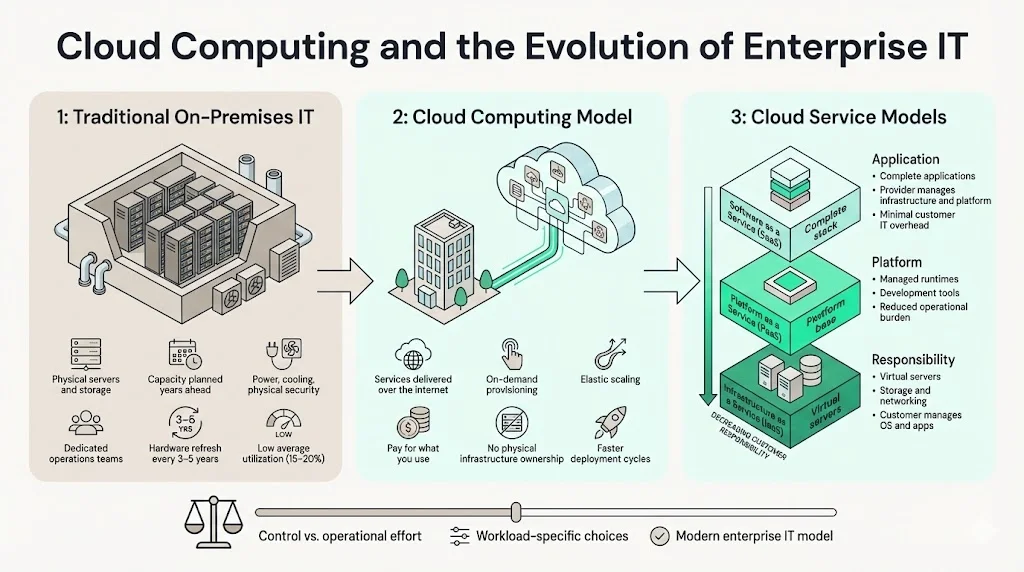
Cloud computing represents the delivery of computing services—including servers, storage, databases, networking, software, and analytics—over the internet rather than through locally maintained infrastructure. This model fundamentally restructures how organizations acquire, deploy, and manage technology resources.
Traditional on-premises IT infrastructure requires enterprises to forecast capacity requirements years in advance, purchase and deploy physical hardware, maintain environmental systems (power, cooling, physical security), and staff operations teams for ongoing maintenance. Hardware depreciation cycles force replacement every 3-5 years regardless of actual utilization rates, which industry data consistently shows average 15-20% for most enterprise environments.
The cloud computing model restructures this approach through three primary service models: Infrastructure as a Service (IaaS) provides virtualized infrastructure components; Platform as a Service (PaaS) adds managed runtime environments and development tools; Software as a Service (SaaS) delivers complete applications. Each model represents a different level of abstraction and management responsibility, allowing enterprises to select the appropriate balance of control and operational burden for specific workloads.
Building toward SOC 2, ISO 27001, or another framework?
Drop your work email and we'll help you turn security work into audit-ready evidence automatically.
What Is IaaS?
Infrastructure as a Service (IaaS) delivers fundamental computing resources—virtual servers, storage systems, and network infrastructure—as on-demand services provisioned through provider-managed data centers. Rather than purchasing, installing, and maintaining physical servers, storage arrays, and networking equipment, enterprises access equivalent virtualized resources through API calls or management consoles, paying only for consumed capacity.
This eliminates the capital expenditure, procurement timelines, and physical constraints associated with traditional infrastructure. An enterprise requiring 200 virtual servers for a new application can provision that capacity in minutes rather than the 3-6 months typically required for hardware procurement, data center space allocation, installation, and configuration of equivalent physical infrastructure.
Key Characteristics
IaaS operates through several defining characteristics that distinguish it from traditional infrastructure models:
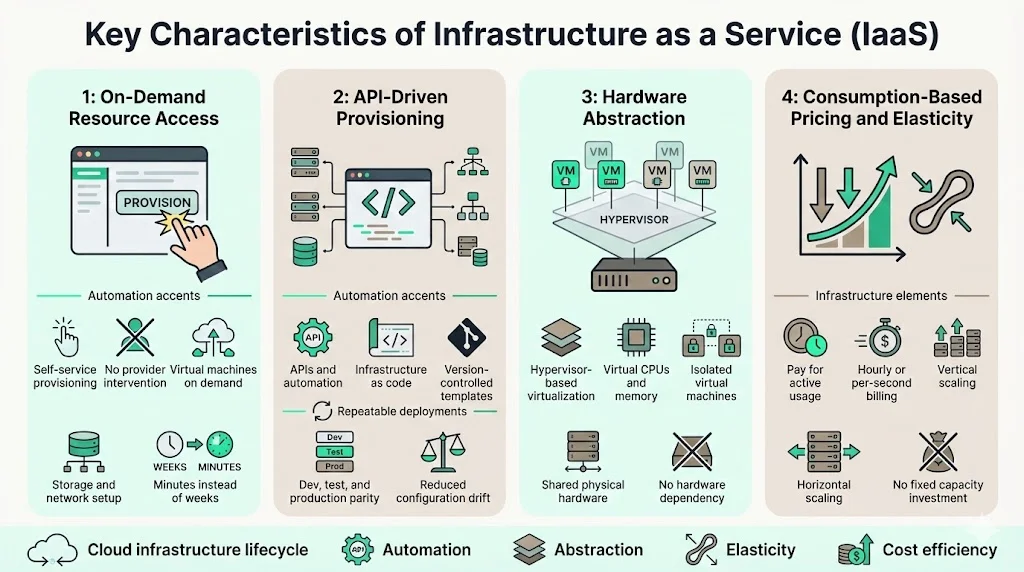
On-demand resource access allows enterprises to provision infrastructure remotely without human intervention from the provider. Technical teams deploy virtual machines, configure storage volumes, or establish network segments through self-service interfaces rather than submitting procurement requests or coordinating with data center operations staff.
API-driven provisioning enables infrastructure deployment through programmatic interfaces, supporting infrastructure-as-code practices where entire environments are defined in version-controlled templates and deployed through automated workflows. This architectural approach eliminates manual configuration drift and enables consistent, repeatable deployments across development, testing, and production environments.
Hardware abstraction through virtualization decouples computing resources from physical hardware through hypervisor technology that creates isolated virtual machines sharing underlying server capacity. Enterprises consume virtual CPUs, memory allocations, and network bandwidth without concern for the specific physical servers, storage arrays, or network switches providing those resources.
Consumption-based pricing and elastic scalability align infrastructure costs directly with utilization. Resources scale vertically (increasing CPU or memory for existing instances) or horizontally (adding additional instances) in response to demand changes, with billing calculated hourly or per-second based on active resource consumption rather than fixed capacity investments.
How IaaS Works (Technical Overview)
Virtualization and Abstraction
Virtualization technology serves as the foundational enabling mechanism for IaaS, using hypervisor software (such as KVM, VMware ESXi, or Microsoft Hyper-V) to partition physical server hardware into multiple isolated virtual machines. Each virtual machine operates as an independent system with dedicated CPU allocation, memory, storage, and network interfaces—despite sharing underlying physical hardware with other virtual machines.
This abstraction layer allows providers to achieve utilization rates of 60-80% across their physical infrastructure compared to the 15-20% typical in enterprise data centers, creating the economic model that makes IaaS pricing competitive with owned infrastructure while maintaining profitability for providers.
Infrastructure Components
IaaS delivers three fundamental infrastructure categories:
Compute resources provide virtual servers with configurable CPU, memory, and local storage specifications. Enterprises select instance types matching workload requirements—ranging from general-purpose configurations to memory-optimized, compute-optimized, or GPU-accelerated instances for specialized workloads like machine learning or high-performance computing.
Storage systems separate into block storage (network-attached volumes presenting as disks to virtual machines, suitable for databases and transactional workloads) and object storage (HTTP-accessible repositories for unstructured data, documents, backups, and archives). Storage performance tiers allow enterprises to balance cost against IOPS requirements and latency sensitivity.
Networking infrastructure includes virtual networks with configurable IP addressing, subnets, routing tables, and access controls. Virtual firewalls, load balancers, VPN connections, and direct physical connections to provider data centers enable enterprises to construct complex network topologies and integrate cloud resources with existing on-premises infrastructure in hybrid architectures.
The physical data center infrastructure—including servers, storage arrays, networking equipment, power distribution, cooling systems, and physical security—remains the provider's responsibility, housed in geographically distributed facilities offering redundancy and regional deployment options for latency optimization and data residency compliance.
Deployment and Self-Service
Enterprise users provision infrastructure through web-based management consoles, command-line interfaces, or infrastructure-as-code tools like Terraform and CloudFormation. Launching a new virtual machine requires selecting an operating system image, specifying compute and storage configurations, defining network placement, and configuring access credentials—a process completed in 2-5 minutes compared to the weeks or months required for physical server procurement, delivery, installation, and configuration.
This represents a fundamental operational shift from traditional IT procurement models requiring purchase orders, budget approvals, vendor coordination, and data center operations scheduling. Infrastructure becomes immediately responsive to business requirements rather than constraining project timelines around hardware availability.
Business Value of IaaS for Enterprises
1) Cost Efficiency
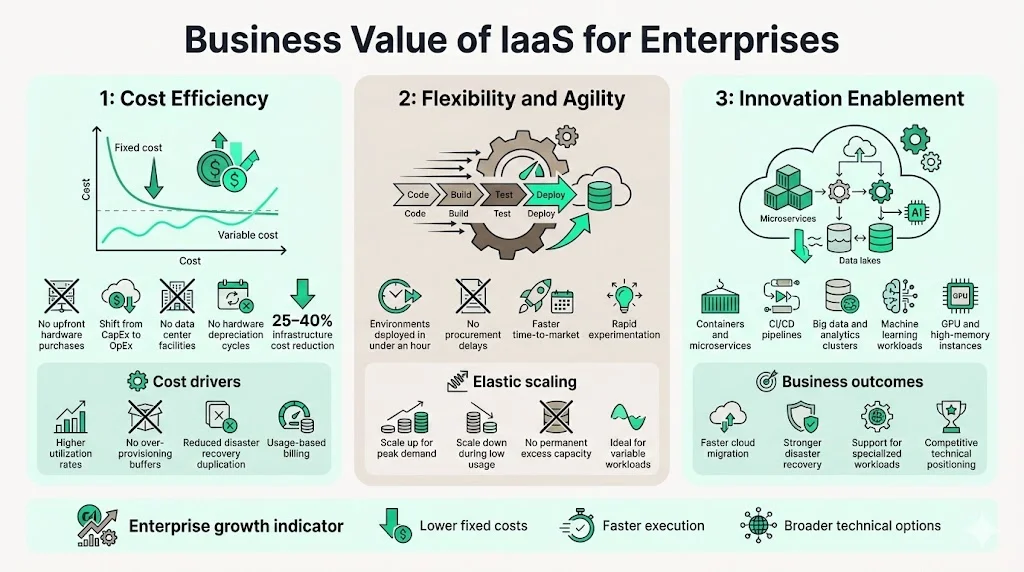
IaaS eliminates capital expenditure requirements for infrastructure hardware, converting fixed asset investments into operational expenses aligned with actual consumption. Enterprises avoid upfront hardware purchases, data center facility costs, and the technical obsolescence risk inherent in 3-5 year depreciation cycles for physical equipment.
The financial impact varies by workload characteristics, but organizations typically reduce infrastructure costs 25-40% through improved utilization rates, elimination of over-provisioned capacity buffers, and removal of redundant disaster recovery infrastructure. Usage-based billing provides cost predictability through consumption tracking and budget forecasting tools, though this requires disciplined governance to prevent uncontrolled resource sprawl.
2) Flexibility and Agility
Development teams deploy complete environments—including multiple servers, load balancers, databases, and storage—in under an hour rather than waiting weeks for infrastructure provisioning. This velocity enables rapid experimentation, faster time-to-market for new services, and the ability to respond to competitive pressures or market opportunities without infrastructure constraints.
Scalability operates bidirectionally: resources scale up during demand peaks (seasonal traffic, batch processing workloads, marketing campaigns) and scale down during lower-utilization periods, eliminating the permanent over-provisioning required when capacity must accommodate peak demand. This elasticity particularly benefits variable workloads where static infrastructure would remain underutilized 60-80% of the time.
3) Innovation Enablement
IaaS removes infrastructure barriers to adopting emerging technologies and architectural patterns. Organizations deploy containerized applications, implement microservices architectures, establish continuous integration/continuous deployment pipelines, and provision big data analytics clusters without capital approval processes or hardware procurement delays.
This infrastructure accessibility accelerates cloud migration initiatives, supports disaster recovery strategies through geographically distributed backup environments, and enables enterprises to maintain competitive positioning in markets where technical agility directly impacts business outcomes. The ability to provision infrastructure matching specific workload requirements—including GPU clusters for machine learning or high-memory instances for in-memory databases—supports specialized use cases that would require prohibitive capital investment in owned hardware.
Comparing IaaS With Other Cloud Service Models
IaaS vs. PaaS
Platform as a Service builds upon IaaS by adding managed runtime environments, development frameworks, database systems, and middleware. Where IaaS provides virtual machines requiring enterprise teams to install, configure, and maintain operating systems and application stacks, PaaS abstracts infrastructure management entirely—developers deploy application code directly to managed platforms handling scaling, patching, and availability automatically.
IaaS offers maximum control and flexibility for custom configurations, legacy application migrations, and environments requiring specific security controls or compliance frameworks. PaaS sacrifices infrastructure control for operational simplicity, making it suitable for modern application development but less appropriate for workloads requiring OS-level access or specialized networking configurations.
IaaS vs. SaaS
Software as a Service delivers complete applications—email systems, CRM platforms, collaboration tools—as ready-to-use services requiring no infrastructure or platform management from enterprise IT teams. SaaS represents the highest level of abstraction, eliminating all infrastructure and application maintenance responsibilities.
IaaS provides the raw infrastructure layer supporting custom-built applications, proprietary systems, or specialized workloads where pre-built SaaS solutions don't exist or don't meet specific business requirements. Organizations use SaaS for commodity business functions and IaaS for differentiated technical capabilities requiring architectural control.
Where IaaS Fits in Enterprise Architecture
IaaS serves as the foundation for hybrid cloud strategies combining on-premises infrastructure with cloud resources, allowing gradual migration while maintaining existing investments. It supports workloads requiring custom technology stacks, applications with specific compliance or data residency requirements, and environments where enterprises need OS-level control for security tool installation, monitoring agents, or specialized configurations.
Organizations commonly adopt multi-tier strategies: SaaS for business applications (email, collaboration, CRM), PaaS for new application development, and IaaS for migrated legacy systems, specialized workloads, and environments requiring maximum architectural control.
Use Cases of IaaS in the Enterprise
Enterprise application hosting represents the primary IaaS use case—migrating existing applications from on-premises data centers to cloud infrastructure without application rewriting. Lift-and-shift migrations move workloads to virtual machines replicating on-premises server configurations, establishing cloud presence while deferring architectural modernization.
Development and testing environments benefit significantly from IaaS economics. Organizations provision complete replicas of production infrastructure for testing, use them for hours or days, then delete them—paying only for actual consumption rather than maintaining permanent infrastructure that sits idle between testing cycles. This enables more thorough testing across more environment variations without proportional infrastructure investment.
Disaster recovery and business continuity implementations use IaaS to maintain standby environments in geographically separate regions, eliminating the cost of duplicate physical data centers. Organizations replicate critical data continuously but provision compute resources only when activating disaster recovery procedures, dramatically reducing disaster recovery infrastructure costs while improving recovery time objectives.
Big data analytics and high-performance computing workloads require massive compute capacity intermittently. Rather than maintaining specialized hardware for periodic processing jobs, enterprises provision hundreds or thousands of instances for hours, process data, and release resources—paying for capacity only during active processing windows.
Security and Compliance
Shared Responsibility Model
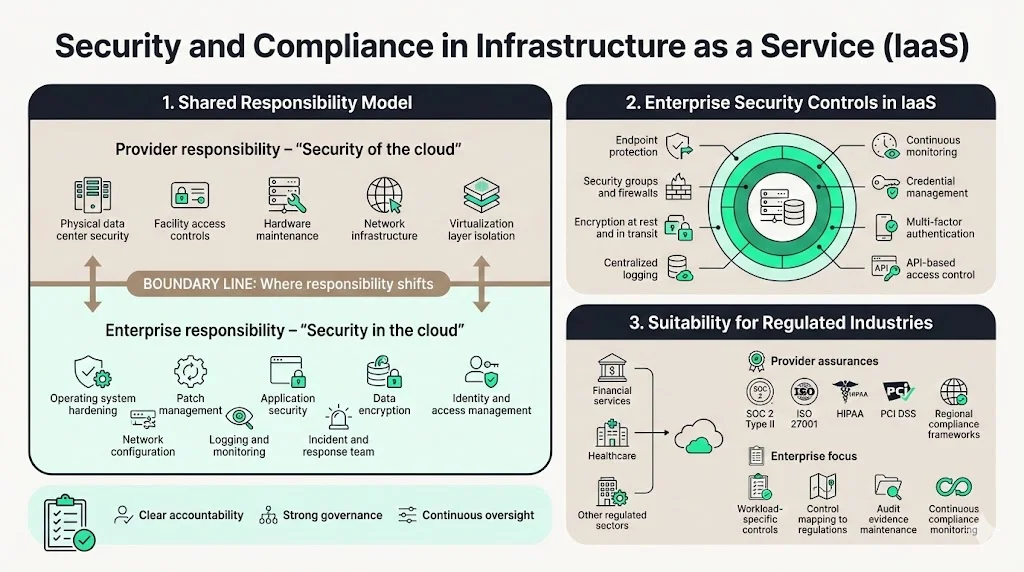
IaaS operates under a shared responsibility model clearly delineating security obligations between provider and enterprise. Providers secure physical data center infrastructure—including facility access controls, hardware maintenance, network infrastructure, and the virtualization layer separating customer environments. This represents the "security of the cloud."
Enterprises maintain responsibility for "security in the cloud"—operating system hardening and patching, application security, data encryption, identity and access management, network configuration, and security monitoring. This division requires enterprises to implement security controls equivalent to on-premises environments while leveraging provider-managed infrastructure security.
Organizations must deploy endpoint protection, configure security groups and access controls, implement encryption for data at rest and in transit, establish logging and monitoring, and maintain incident response capabilities. The infrastructure access model—where administrative control occurs through API calls rather than physical access—requires robust credential management and multi-factor authentication to prevent unauthorized infrastructure manipulation.
Suitability for Regulated Industries
Financial services, healthcare, and other heavily regulated sectors successfully operate on IaaS when implementing appropriate governance frameworks, control mappings, and compliance programs. Major IaaS providers maintain certifications across SOC 2 Type II, ISO 27001, HIPAA, PCI DSS, and regional frameworks, providing attestations that underlying infrastructure meets security and compliance requirements.
Enterprise responsibility focuses on implementing workload-specific controls, maintaining audit evidence, and documenting how IaaS configurations satisfy regulatory requirements. This typically requires dedicated compliance expertise, control implementation, and continuous monitoring—achievable requirements given proper resourcing and commitment to security operations.
Pricing Models
IaaS pricing operates primarily on pay-as-you-go consumption billing, calculating charges based on provisioned resource hours (or seconds), storage capacity, and data transfer volumes. A virtual machine with 4 vCPUs and 16GB memory might cost $0.15-0.25 per hour depending on provider and region, accumulating charges continuously while running.
Reserved instances provide 30-70% discounts compared to on-demand pricing in exchange for 1-3 year capacity commitments, suitable for steady-state workloads with predictable utilization. Spot instances offer 60-90% discounts for interruptible capacity that providers can reclaim with short notice, appropriate for fault-tolerant batch processing or stateless workloads.
Usage metrics creating cost variability include compute instance hours, persistent storage volumes (charged per GB-month), data transfer (particularly egress from provider networks to the internet), and ancillary services like load balancers, IP addresses, or managed database backups. Enterprises require governance frameworks and cost monitoring tools to prevent uncontrolled spending through orphaned resources, over-provisioned instances, or unnecessary data transfer.
Challenges and Considerations
IaaS adoption requires technical skills distinct from traditional infrastructure management—including cloud architecture design, API-based automation, infrastructure-as-code implementation, and cloud-native security practices. Organizations face skills gaps when transitioning from physical infrastructure administration to cloud operations, requiring training investments or external expertise during transition periods.
Governance and cost management present ongoing operational challenges. The self-service provisioning model that enables agility also enables uncontrolled resource creation, leading to cost overruns and security risks from misconfigured or unmonitored resources. Effective IaaS operations require tagging standards, automated cost allocation, budget alerts, and regular resource audits identifying unused or over-provisioned capacity.
Integration with existing enterprise systems creates technical complexity in hybrid architectures. Connectivity between cloud environments and on-premises infrastructure requires VPN tunnels or dedicated network connections, identity systems need federation across environments, and monitoring tools must provide unified visibility across distributed infrastructure. These integration requirements introduce architectural dependencies that constrain migration sequencing and require careful planning.
Choosing an IaaS Provider
Provider evaluation should assess multiple operational and strategic factors beyond pricing comparisons. Performance characteristics including compute capabilities, storage IOPS, and network throughput directly impact application behavior. Global data center presence affects latency for distributed user bases and provides geographic redundancy options.
Service Level Agreements define provider commitments for uptime, support responsiveness, and performance guarantees—typically offering 99.9-99.99% availability SLAs with service credits for missed targets. Compliance and certification programs determine suitability for regulated workloads, requiring providers to maintain relevant attestations (SOC 2, ISO 27001, industry-specific frameworks).
Major providers include Amazon Web Services (AWS) with the broadest service catalog and market presence, Microsoft Azure with deep enterprise integration and hybrid capabilities, Google Cloud Platform emphasizing data analytics and machine learning services, and IBM Cloud focused on hybrid cloud and regulated industry requirements. Provider selection should align with existing technology investments, required geographic presence, specific compliance needs, and technical team expertise.
Conclusion
Infrastructure as a Service fundamentally restructures enterprise IT economics and operational models, replacing capital-intensive hardware ownership with consumption-based access to virtualized infrastructure. For technical leaders, IaaS eliminates the 3-6 month provisioning timelines and fixed capacity constraints that traditionally limited organizational agility while providing cost structures aligning infrastructure spending directly with business utilization.
The value proposition extends beyond cost considerations to architectural flexibility—enabling hybrid cloud strategies, supporting rapid experimentation, and providing infrastructure capabilities (specialized compute types, global distribution, elastic scaling) that would require prohibitive capital investment in owned infrastructure. Organizations implementing IaaS with appropriate governance, security controls, and operational discipline gain infrastructure responsiveness that directly supports business growth and competitive positioning.
FAQ Section
IaaS eliminates capital expenditure requirements for infrastructure hardware, removing the 3-6 month procurement timelines that delay project initiatives. It provides immediate access to scalable compute, storage, and networking resources through self-service provisioning, allowing technical teams to deploy complete environments in minutes rather than months. Organizations gain the ability to scale infrastructure bidirectionally in response to demand changes without over-provisioning permanent capacity, aligning infrastructure costs directly with business utilization rather than forecasted peak requirements.
IaaS delivers virtualized infrastructure components—virtual machines, storage, and networking—requiring enterprises to manage operating systems, middleware, and applications. PaaS adds managed runtime environments and development platforms, abstracting infrastructure management so developers deploy code directly without managing underlying servers. SaaS provides complete applications as ready-to-use services, eliminating all infrastructure and platform responsibilities. The models represent increasing levels of abstraction, trading architectural control for reduced operational complexity.
Security operates under a shared responsibility model. Providers secure physical data center infrastructure, hardware, network equipment, and the virtualization layer separating customer environments—representing "security of the cloud." Enterprises secure everything running on that infrastructure: operating systems, applications, data, access controls, network configurations, and security monitoring—representing "security in the cloud." Both parties must fulfill their respective responsibilities to maintain comprehensive security posture.
Yes, when enterprises implement appropriate governance, compliance frameworks, and security controls. Major IaaS providers maintain certifications across SOC 2 Type II, ISO 27001, HIPAA, PCI DSS, and regional compliance frameworks, demonstrating that underlying infrastructure meets security requirements. Enterprise responsibility focuses on configuring workload-specific controls, implementing data protection measures, maintaining audit evidence, and documenting how IaaS deployments satisfy specific regulatory obligations—achievable requirements with proper compliance expertise and dedicated security operations.
IaaS typically uses pay-as-you-go pricing based on resource consumption—charging per hour (or per second) for running virtual machines, per GB-month for storage capacity, and per GB for data transfer. Pricing varies based on instance specifications (CPU, memory, storage), geographic region, and commitment model. Reserved instances provide 30-70% discounts for 1-3 year commitments, while spot instances offer 60-90% discounts for interruptible capacity. Total costs depend on provisioned resources, utilization patterns, data transfer volumes, and ancillary services like load balancers or IP addresses.