

Most organizations treating vendor selection as a straightforward procurement exercise overlook a fundamental challenge: you cannot define detailed requirements when you don't fully understand what solutions exist in the market. This knowledge gap creates procurement inefficiency—rushed RFPs that miss critical capabilities, vendor pools that exclude optimal suppliers, and requirements documents that fail to align with available technology or regulatory realities.
A Request for Information (RFI) is a common business process whose purpose is to collect written information about the capabilities of various suppliers. Unlike binding procurement documents, the RFI functions as a fact-finding tool deployed during the early stages of vendor selection, particularly when enterprises lack market visibility or need to validate compliance credentials before committing resources to detailed proposal evaluation. This glossary term covers the RFI definition, its 2026 use cases across regulated industries, and how it differs functionally from RFPs and RFQs in the procurement lifecycle.
What Is an RFI?
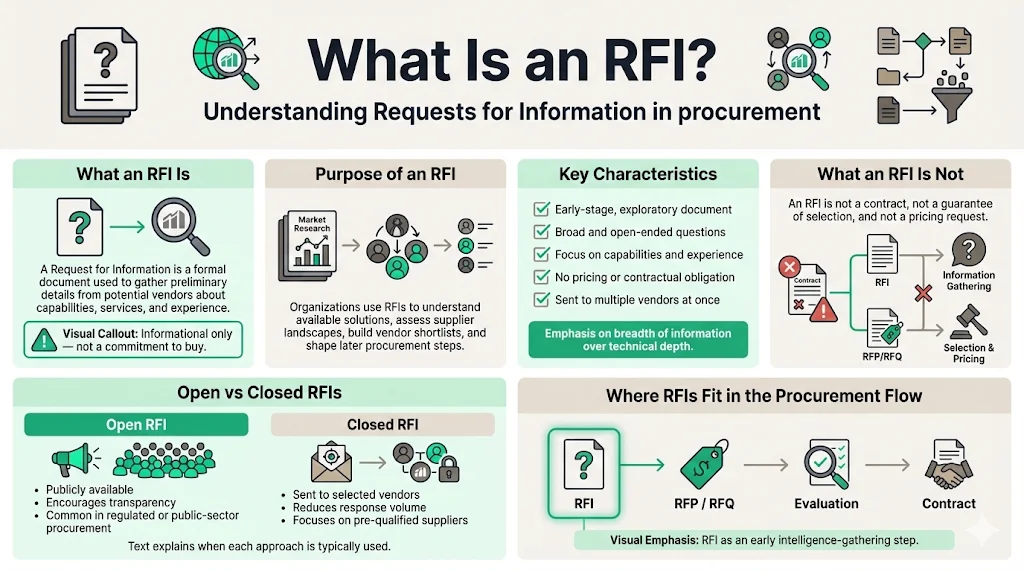
A Request for Information (RFI) is a formal procurement document that businesses use to gather preliminary information from potential vendors about their capabilities, products, or services before making purchasing decisions. The RFI represents an informational inquiry—not a commitment to contract or purchase. Organizations issue RFIs to build vendor pools, assess market offerings, and collect intelligence that shapes subsequent procurement requirements.
Key Characteristics
RFIs are typically—but not always—the first step in vendor selection. They are deployed when buyers lack comprehensive understanding of available solutions, technology capabilities, or supplier landscapes within specific domains. Because the RFI is more of a fact-finding document, you'll want to ask open-ended questions, ones that allow the vendor to talk about its full range of offerings.
RFIs are characteristically broad in scope rather than prescriptive. Questions focus on general capabilities, company background, relevant experience, service delivery models, and baseline technical competencies. It's important to know that an RFI is not a contract or a signal that a supplier will be chosen. Neither buyers nor suppliers carry binding obligations at this stage—the RFI establishes informational groundwork for decisions that follow.
Organizations typically send RFIs to multiple potential vendors simultaneously to build a comprehensive view of market options. Usually, RFIs are straightforward and do not require much detail from the vendor. The emphasis remains on breadth of information rather than depth of technical specification or pricing commitments.
Variations (Open vs Closed)
An RFI may be open, where information is publicly gathered from anyone interested who wants to provide a submission, or closed, where parties are privately approached to provide information. Open RFIs support transparency in procurement, particularly for public-sector organizations or enterprises subject to regulatory oversight requiring demonstrable fairness in vendor selection. Closed RFIs allow buyers to solicit information from pre-identified vendors who meet baseline qualification criteria, reducing response volume while maintaining focus on relevant suppliers.
Building toward SOC 2, ISO 27001, or another framework?
Drop your work email and we'll help you turn security work into audit-ready evidence automatically.
Use Cases and When to Use an RFI
When Buyer Has Limited Market Visibility
RFI is really a preliminary document used by companies that don't understand the marketplace they're about to enter—in the case of a company searching for a customer relationship management (CRM) solution, it would use an RFI if it had no prior experience with CRM and wanted to gain an understanding on the range of options. Organizations entering new technology domains—enterprise software platforms, cloud infrastructure, specialized security tools—use RFIs to understand what capabilities exist, how solutions are delivered, and what implementation models vendors offer.
An RFI is particularly useful when a company is early in the buying process and trying to figure out its specific requirements for a good or service. When internal teams cannot clearly define specifications because they lack exposure to available options, the RFI becomes essential for shaping realistic requirements before drafting more detailed procurement documents.
Vendor Discovery and Capability Assessment
RFIs enable systematic vendor discovery by casting a wide net across potential suppliers. By sending RFIs to prospective sellers, you can better understand what's available in the market, including expertise, capabilities, experience levels, and more. Organizations use responses to build shortlists of vendors demonstrating relevant technical capabilities, industry experience, service delivery models, and organizational scale appropriate to project requirements.
The RFI serves as an initial capability filter. Vendors disclose their offerings, market positioning, specializations, client references, and operational footprint. Oftentimes, the vendor will explain its position in the marketplace (for instance, what industries it specializes in), how it licenses its product, and what other fees you can expect. This baseline information allows procurement teams to identify suppliers warranting deeper evaluation through subsequent RFP processes.
Risk Mitigation and Compliance/Credibility Checking
For enterprises operating in regulated environments—healthcare, financial services, government contracting—RFIs provide early visibility into vendor compliance postures, security practices, and regulatory credentials. Organizations can request information about certifications (SOC 2, ISO 27001, HIPAA compliance), audit history, security infrastructure, data handling practices, and regulatory adherence before investing resources in detailed proposal evaluation.
By conducting an RFI, buyers can minimise potential risks associated with selecting the wrong requirements. The process allows buyers to gain a better understanding of the market and how to design their tender to get the best proposals. Early identification of vendors lacking requisite compliance credentials or security capabilities prevents wasted effort on proposals from suppliers unable to meet regulatory thresholds. This risk-reduction function becomes particularly valuable for organizations subject to stringent data protection requirements, industry-specific regulations, or contractual obligations requiring documented vendor due diligence.
Building Foundations for More Detailed Procurement (RFP / RFQ)
RFIs are therefore rarely the final stage and are instead often used in combination with request for proposal (RFP), request for tender (RFT), and request for quotation (RFQ). The intelligence gathered through RFI responses informs how organizations structure subsequent procurement documents. An RFP is usually what follows an RFI; in fact, it's rare that a company will go from an RFI to an RFQ.
Organizations use RFI findings to refine project scope, establish realistic timelines, define technical specifications grounded in available capabilities, and craft evaluation criteria reflecting actual market differentiation. By not performing enough due diligence prior to sending out the RFP, a company is alienating the very vendors that could best serve its needs. The RFI prevents this outcome by ensuring procurement teams understand market realities before drafting RFPs—avoiding poorly scoped requirements, unrealistic expectations, or evaluation criteria misaligned with vendor capabilities.
RFI vs Other Procurement Documents
Understanding functional distinctions between RFI, RFP, and RFQ clarifies when each document serves procurement objectives:
RFI (Request for Information): Gathers general information about vendor capabilities and market offerings. Non-binding and informational. Used when market knowledge is limited or during early procurement stages before requirements are fully defined.
RFP (Request for Proposal): Solicits detailed proposals addressing defined business needs or project requirements. Binding evaluation process leading toward contract negotiation. Used once the buyer understands needs and seeks vendor proposals offering specific solutions, methodologies, and implementation approaches.
RFQ (Request for Quotation): Requests pricing for known products or services with clear specifications. Binding, price-focused evaluation. Used when requirements and specifications are clearly defined, and selection primarily depends on cost comparison among qualified vendors.
An RFP is usually what follows an RFI; in fact, it's rare that a company will go from an RFI to an RFQ. The typical progression moves from RFI (information gathering) to RFP (solution proposals) to final contract negotiation. Organizations with clearly defined specifications may bypass RFI and RFP stages, proceeding directly to RFQ for price-based vendor selection.
An RFI alone rarely culminates in contract award or purchase decision. Its role remains preparatory—establishing the informational foundation that enables effective downstream procurement activities.
Why RFIs Matter for Companies Selling to Enterprise Clients
1) Early Visibility and Opportunity to Shape Requirements
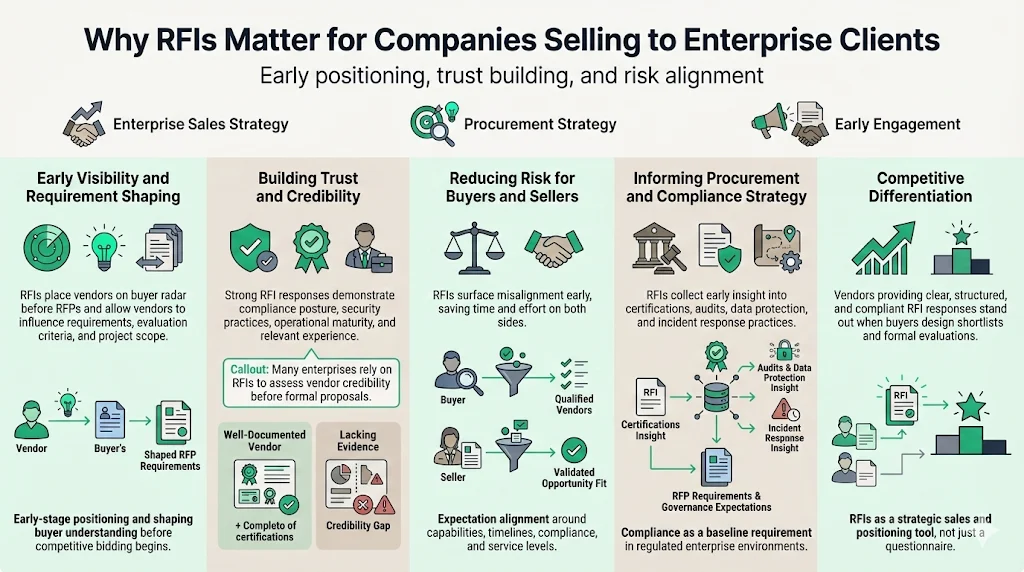
Responding to RFIs positions vendors on buyer radar before formal RFP processes begin. An RFI is often used as a solicitation sent to a broad base of potential suppliers for the purpose of conditioning suppliers' minds, developing strategy, building a database, and preparing for an RFP. Vendors providing comprehensive, well-structured RFP responses can influence how buyers define requirements, evaluation criteria, and project scope in subsequent RFPs.
This early engagement opportunity benefits vendors offering differentiated capabilities or innovative approaches. By educating buyers about available solutions during the RFI stage, vendors shape procurement parameters before competitors enter formal bidding processes. Organizations that ignore RFI opportunities sacrifice this positioning advantage.
2) Building Trust & Demonstrating Credibility
Enterprise clients demand extensive documentation, compliance verification, and operational transparency. Statistics show that 43% of organizations use RFI documents as part of their procurement process. Well-prepared RFI responses showcase vendor professionalism, compliance credentials, security practices, relevant experience, and service delivery capabilities before formal proposal evaluation begins.
For vendors targeting regulated industries or security-conscious enterprises, the RFI response demonstrates audit readiness, regulatory compliance posture, certification maintenance, and operational maturity. Organizations that respond comprehensively to compliance-focused RFI questions establish credibility differentiating them from competitors lacking documented security infrastructure or regulatory adherence.
3) Reducing Risk for Both Buyer and Seller
RFIs flag fundamental misalignments early in procurement cycles. Buyers avoid investing time evaluating vendors unable to meet baseline requirements. Vendors avoid expending resources on detailed proposals unlikely to align with client needs, technical environments, or regulatory constraints.
You can think of an RFI as an informal first step in evaluating a supplier's ability to do business with you. It's also a chance for suppliers to see if the request is a good fit for their business. This mutual evaluation reduces wasted effort on both sides—buyers filter vendor pools to qualified candidates, while vendors assess opportunity alignment before committing significant proposal development resources.
The RFI establishes expectation alignment regarding deliverable capabilities, compliance requirements, service levels, implementation timelines, and operational constraints. This transparency supports productive long-term vendor-client relationships grounded in realistic mutual understanding rather than mismatched assumptions discovered post-contract.
4) Informing Procurement Strategy & Compliance Planning
For organizations operating in regulated environments, RFIs gather compliance information informing procurement strategy before formal vendor selection begins. Buyers can request details about security certifications, audit frequency, data protection practices, incident response procedures, and regulatory compliance programs. They support transparency and compliance, especially in larger or public organizations.
Vendors surfacing comprehensive compliance documentation during RFI stages position themselves advantageously for subsequent RFP evaluation. Procurement teams use RFI responses to design RFPs incorporating relevant security controls, compliance verification requirements, service-level commitments, and governance policies aligned with enterprise risk management frameworks. Organizations demonstrating mature compliance postures through RFI responses differentiate themselves in competitive procurement environments where regulatory adherence represents a selection threshold rather than a differentiator.
How to Structure an RFI (for Buyers) / How Sellers Should Respond
Typical Sections in an RFI Document
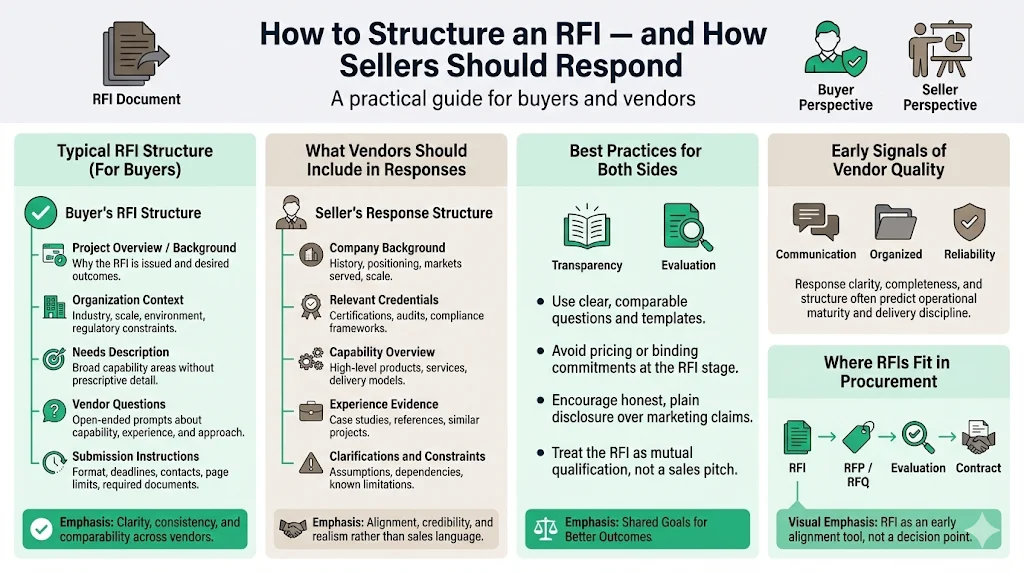
Standard RFI structure includes several core components establishing context and guiding vendor responses:
Project Overview / Background: Explains why the organization is issuing the RFI, what business challenges drive the inquiry, and what outcomes the organization seeks to achieve.
Organization Context: Provides relevant details about the buyer's industry, scale, operational environment, regulatory constraints, and business objectives informing vendor responses.
Needs Description: Outlines broad areas where information is sought—functionality requirements, service capabilities, compliance expectations, technical capabilities, or implementation approaches—without prescribing detailed specifications.
Vendor Questions: Presents specific open-ended questions or prompts guiding vendor responses. Questions focus on capabilities, experience, approach, credentials, and relevant background rather than detailed technical specifications or pricing commitments.
Submission Instructions: Specifies response format, submission deadline, contact information, page limits, and any mandatory documentation required for response evaluation.
For Vendors: What to Include in Response
Effective RFI responses address buyer information needs while demonstrating vendor credibility and capability:
Company Background: Overview of organizational history, mission, market positioning, sectors served, client base, geographic presence, and operational scale.
Relevant Credentials: Certifications, compliance attestations, regulatory approvals, industry accreditations, audit history, and security framework adherence (SOC 2, ISO 27001, HIPAA, GDPR compliance documentation).
Capability Overview: High-level description of products, services, technical capabilities, delivery models, implementation approaches, and support infrastructure—demonstrating alignment with stated buyer needs without committing to detailed specifications or pricing.
Experience Evidence: Case studies, client references, relevant project examples, industry-specific implementations, and outcomes demonstrating track record addressing similar requirements.
Clarifications and Constraints: Transparent disclosure of limitations, assumptions, dependencies, or conditions affecting capability delivery—establishing realistic expectations early in procurement cycles.
Best Practices (for Both Sides)
Buyers should structure RFIs with clear, comparable questions enabling systematic response evaluation. Avoid requesting pricing or binding commitments at the RFI stage—these belong in subsequent RFP or RFQ processes. Use consistent templates and formats simplifying response comparison across multiple vendors.
Encourage honest, transparent disclosure rather than marketing language. The RFI functions as a mutual evaluation tool—buyers benefit from accurate capability representation, while vendors benefit from realistic opportunity assessment before investing proposal resources.
Buyers can evaluate vendor responsiveness, communication quality, and information completeness as early signals of vendor reliability and operational maturity. Organizations providing thorough, well-organized RFI responses often demonstrate the same operational discipline in service delivery.
Potential Limitations / When RFI May Not Be Useful
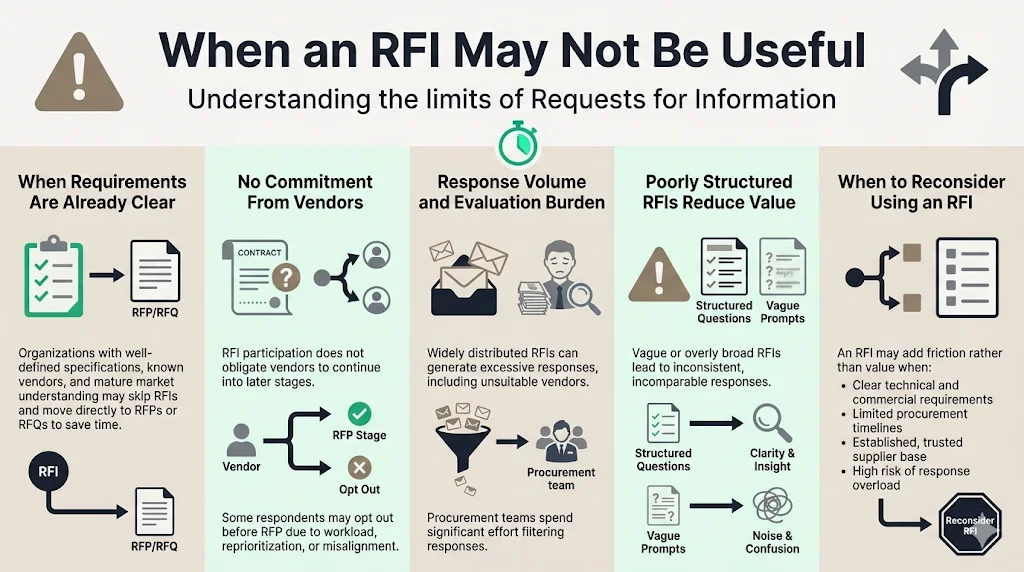
Organizations with clearly defined requirements, established vendor relationships, or deep market knowledge may find RFIs add unnecessary procurement cycle time. When specifications are precise and evaluation criteria well-understood, proceeding directly to RFP or RFQ accelerates vendor selection without sacrificing decision quality.
RFI responses carry no binding commitment regarding vendor participation in subsequent procurement stages. Some vendors respond to RFIs but later decline RFP participation due to workload constraints, opportunity reprioritization, or concerns identified during initial evaluation. Organizations cannot assume RFI respondents will remain available through full procurement cycles.
Broadly distributed RFIs risk generating excessive responses including vendors clearly unsuitable for requirements. Filtering and evaluating large response volumes consumes procurement team resources—potentially offsetting time savings RFIs intended to provide. Poorly structured RFIs with vague or overly broad questions yield inconsistent responses difficult to compare systematically, reducing rather than enhancing procurement efficiency.
Answer an RFI early and shape the requirements
Book a demo and we'll show how Konfirmity keeps your security and compliance answers ready to reuse, so an early-stage information request costs you hours rather than a week.
Book a demo
Conclusion
The Request for Information serves as a strategic procurement tool for gathering vendor intelligence, assessing market capabilities, verifying compliance credentials, and shaping requirements before committing resources to detailed proposal evaluation. The RFI is the first step to ensuring you have all the details you need to make informed decisions during sourcing and procurement. In many ways, it may be the most crucial step as it determines which companies will be included in your pool of potential sellers as your project progresses.
For companies selling to enterprise clients, RFI responses provide early visibility, demonstrate credibility through documented compliance postures, and create opportunities to influence requirement definition before competitive RFP processes begin. Organizations that respond comprehensively to RFIs position themselves advantageously in procurement cycles where regulatory compliance, security infrastructure, and operational maturity represent selection thresholds.
The RFI is not a final procurement step—it establishes the informational foundation enabling effective vendor selection, realistic requirement definition, and compliance-informed procurement strategy. When deployed appropriately, RFIs reduce risk for buyers and sellers while improving procurement outcomes through better-informed decision-making.
FAQs
RFI (Request for Information) gathers general information about vendor capabilities and market offerings during early procurement stages—non-binding and informational. RFP (Request for Proposal) solicits detailed proposals addressing defined business needs, representing a binding evaluation process leading toward contract negotiation. RFQ (Request for Quotation) requests pricing for known products or services with clear specifications, focusing evaluation primarily on cost comparison among qualified vendors. RFIs typically precede RFPs, which in turn may precede RFQs or contract negotiation.
No. RFIs involve no contract commitment from buyers or suppliers. An RFI is not an invitation to bid, is not binding on either the buyer or sellers, and may or may not lead to an RFP or RFQ. RFI responses inform buyer decisions about which vendors warrant further evaluation through subsequent RFP processes, but do not obligate buyers to proceed with any vendor or commit to contract award.
RFIs can be useful in situations where an organization has little knowledge on possible vendors and wants to reduce the time and cost of evaluating vendors. Organizations should issue RFIs when they lack market visibility, need vendor discovery, require compliance credential assessment before detailed evaluation, or need market intelligence to define realistic requirements. Companies with clearly defined specifications and established vendor knowledge can bypass RFIs and proceed directly to RFP or RFQ processes.
RFI responses provide early visibility with potential buyers before formal competitive processes begin, demonstrating vendor capabilities, compliance credentials, and operational maturity. Comprehensive RFI responses position vendors to influence how buyers define requirements, evaluation criteria, and project scope in subsequent RFPs—creating competitive advantage before other vendors enter formal proposal stages. RFIs also allow vendors to assess opportunity alignment before investing significant proposal development resources.
In some organizations, especially government agencies, using RFP is mandatory. It creates a standard sourcing process that fosters equality and impartiality for all potential vendors. RFP also helps fight corruption and collusion by ensuring an audit trail to justify the decisions. Open RFIs allow broad vendor participation, ensuring transparency in supplier selection processes particularly important for public-sector procurement. For regulated industries, RFIs enable buyers to request compliance credentials, security documentation, and regulatory attestations early—supporting risk management and documented due diligence requirements before contract commitment.

