

Vendor assessment in GeM (Government e-Marketplace) is a mandatory evaluation process for Original Equipment Manufacturers (OEMs) and specific reseller categories, designed to verify credentials, production capacity, and quality standards before sellers can list products or participate in high-value government tenders. For businesses targeting government procurement or enterprise clients who prioritize vetted supply chains, this assessment represents a formal gatekeeper—one that separates compliant, capable vendors from those lacking operational substance or audit-ready documentation.
Successful vendor assessment ensures credibility and boosts the seller's reputation on the GeM marketplace, directly influencing bid eligibility, buyer confidence, and long-term contract opportunities. This glossary term breaks down the assessment framework, explains why GeM mandates it, outlines the two-stage validation process, and clarifies how vendors can strengthen their standing within India's ₹4+ lakh crore government procurement ecosystem.
What Is Vendor Assessment in GEM?
Vendor assessment is a key element of the GeM system, a mandatory evaluation designed to verify the quality, reliability, and operational capabilities of vendors. The evaluation entails assessing vendors against several parameters including their financial health, product quality, delivery schedules, and regulatory compliance.
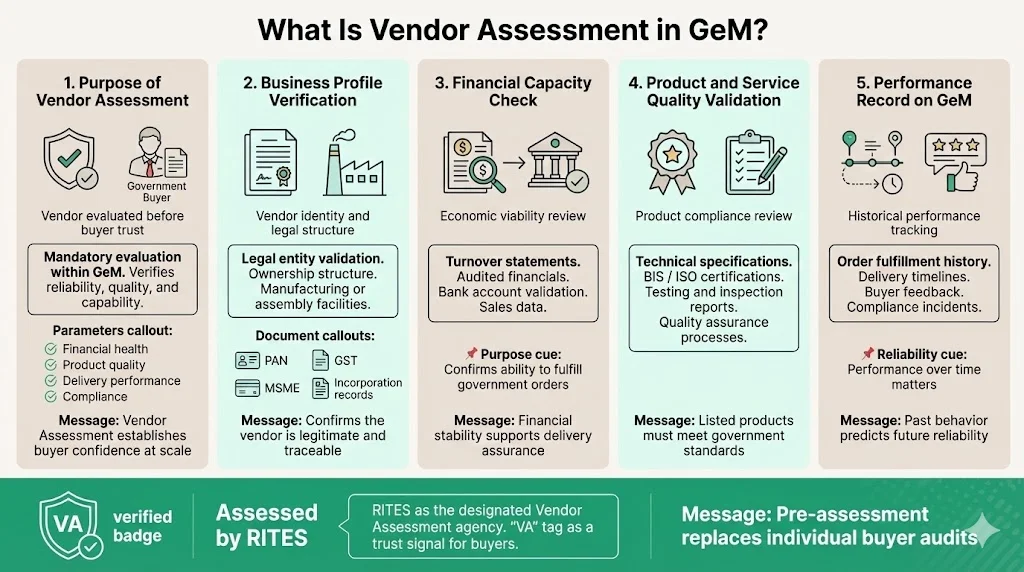
The scope of vendor assessment covers four critical dimensions:
-
Business profile verification: Confirms legal entity status, ownership structure, manufacturing or assembly facilities, and statutory registrations (PAN, GST, MSME, incorporation documents).
-
Financial capacity check: Reviews turnover statements, audited financials, bank details, and sales data to establish economic viability and operational scale.
-
Product and service quality validation: Examines technical specifications, BIS or ISO certifications, testing reports, production logs, and quality assurance protocols to confirm that listed products meet government standards.
-
Performance record on GeM: Analyzes historical order fulfillment, customer feedback, delivery timelines, and compliance incidents to gauge operational reliability over time.
The assessment is conducted by RITES (Rail India Technical and Economic Service), the designated Vendor Assessment agency, which has replaced the Quality Council of India (QCI). Pre-assessed vendors are tagged as "VA," assuring buyers of verified and authenticated sellers, which functions as a trust signal in a procurement environment where government buyers cannot independently audit thousands of suppliers.
Building toward SOC 2, ISO 27001, or another framework?
Drop your work email and we'll help you turn security work into audit-ready evidence automatically.
The Purpose of Vendor Assessment in GeM
GeM insists on vendor assessment to construct a procurement infrastructure that minimizes risk, ensures quality, and supports audit-defensible purchasing decisions. Each objective serves a distinct compliance or operational need.
1) Supplier Evaluation and Qualification
Vendor assessment acts as a credibility benchmark on the GeM portal, with government departments preferring sourcing from verified OEMs, knowing they meet stringent production, quality, and delivery standards. Rather than relying on self-declared capabilities, the assessment validates that a vendor operates manufacturing or assembly infrastructure, holds necessary licenses, and possesses documented capacity to fulfill large-scale government orders. This qualification layer reduces the incidence of fraudulent listings or shell entities appearing as legitimate suppliers.
For enterprises sourcing through GeM or considering vendors active on the platform, the VA tag indicates that a third-party technical agency has verified operational claims—not merely marketing assertions.
2) Quality Assurance
Vendor assessment is performed to determine the quality of a product or service. Assessors review product specifications against declared certifications (BIS, ISO, testing lab reports), examine quality control procedures, and confirm that manufacturing processes align with product claims. This verification prevents the common procurement failure mode where products meet technical bid requirements on paper but fail performance or safety standards in practice.
Government buyers purchasing medical equipment, electronics, construction materials, or IT hardware rely on vendor assessment to ensure that quality declarations withstand operational scrutiny—not just auditor review.
3) Risk Management
Completing the process properly ensures long-term presence on the platform and avoids compliance-related penalties or account issues. Vendor assessment mitigates several risk categories: non-delivery, substandard product quality, financial insolvency mid-contract, and legal non-compliance. By front-loading verification, GeM reduces the likelihood that a government department awards a high-value contract to a vendor incapable of execution.
For enterprise procurement teams leveraging GeM as a vetted supplier pool, vendor assessment functions as a first-line risk control—filtering out entities lacking operational substance before contract negotiation begins.
4) Performance Analysis
Vendor assessment significantly impacts Seller Ratings displayed on the GeM Marketplace. GeM evaluates past delivery performance, order fulfillment rates, customer feedback, and incident history as part of vendor scoring. Sellers with documented performance records and verified operational capacity receive higher ratings, which directly influence buyer selection in competitive bids. This creates a performance feedback loop where vendors demonstrating reliability gain preferential visibility and contract opportunities.
5) Compliance Check and Contract Assessment
Vendor assessment confirms that sellers meet statutory requirements—valid GST registration, tax compliance, legal ownership structures, and adherence to labor and environmental regulations where applicable. For government buyers subject to audit by the Comptroller and Auditor General (CAG) or departmental oversight, procuring from VA-tagged vendors provides audit-defensible evidence that due diligence occurred before contract award.
Who Needs to Complete Vendor Assessment
Vendor assessment is essential for sellers dealing with Q1 and Q2 category products on the GeM Portal—categories that include electronics, electrical goods, furniture, medical equipment, IT hardware, and other high-value or technically sensitive items.
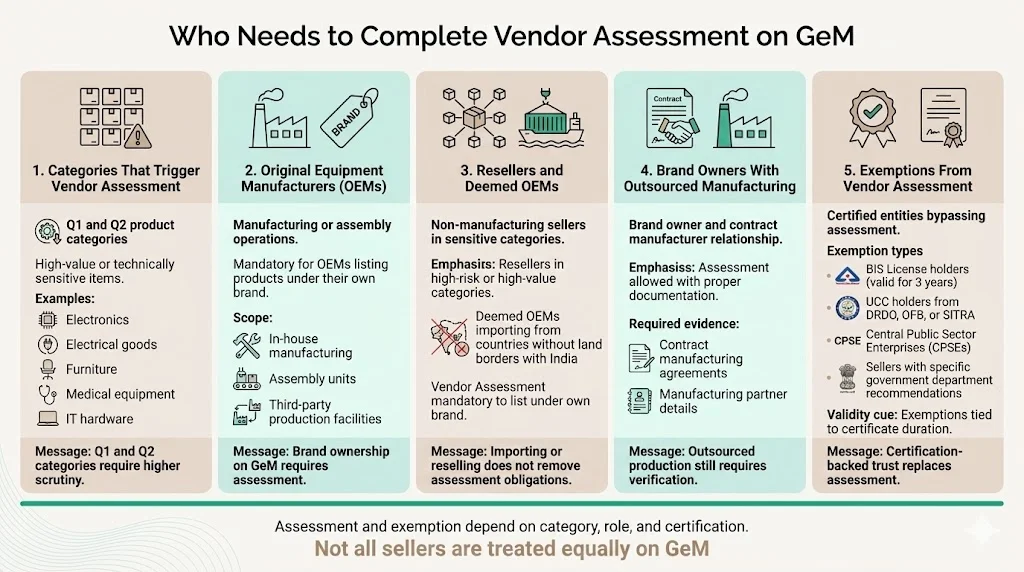
Original Equipment Manufacturers (OEMs): Any entity operating manufacturing, assembly, or third-party production facilities must complete vendor assessment to claim brand ownership and list products under their name on GeM.
Resellers in specific categories: Certain high-risk or high-value product categories require resellers to undergo assessment, particularly where product authenticity or quality assurance is critical.
Deemed OEMs: Entities importing products manufactured outside India (from countries not sharing a land border) and selling under their brand must register as Deemed OEMs and complete assessment.
Brand owners with outsourced manufacturing: Companies owning a brand but contracting production to third parties can apply for vendor assessment by providing contract manufacturing agreements and manufacturing partner details.
Exemptions exist for certain categories. OEMs holding BIS (Bureau of Indian Standards) License for the product category validated through the BIS database receive exemption, valid for three years. OEMs having a Unique Certification Code (UCC) issued by DRDO, OFB, or SITRA are also exempt, with the exemption coterminous with UCC certificate validity. Central Public Sector Enterprises (CPSEs) and sellers with specific government department recommendations may also qualify for exemptions under certain conditions.
Vendor Assessment in the Procurement Process
Vendor assessment occupies a critical position in the GeM procurement lifecycle: seller registration → vendor assessment → enhanced profile visibility → bid eligibility → contract award.
After initial registration, sellers list products in relevant categories. However, several tenders are exclusively open to OEMs or require verified OEM support documents, and without assessment, sellers may miss high-value opportunities. Completing vendor assessment unlocks access to these restricted tenders and provides a competitive advantage in open bids where buyers filter for VA-tagged suppliers.
For enterprise clients, GeM's vendor assessment ecosystem reduces the burden of independent supplier qualification. Rather than conducting separate audits for each potential supplier, procurement teams can leverage RITES-validated vendor profiles as a baseline due diligence layer, then apply additional organizational requirements as needed.
Vendor ratings—heavily influenced by assessment outcomes—directly affect procurement decisions. In competitive bidding scenarios where multiple vendors meet technical and financial criteria, buyers frequently default to higher-rated, VA-tagged suppliers to minimize execution risk.
How the Vendor Assessment Process Works
The process involves two stages: Desktop Assessment and Video Assessment. Both stages are conducted online through the RITES platform, with fees paid directly to RITES.
1) Start and Application
Log in to your GeM account, navigate to "My Account," and access the "Vendor Assessment" section. Sellers falling under exemption categories must upload exemption documents; others proceed with the assessment process.
2) Document Submission
Update vendor profile with contact details, production capacity, sales data, invoices for raw materials and sales from the past 3 years, and review and submit financial and bank details. The application details are forwarded to RITES, and the seller receives RITES Vendor Login credentials via email and SMS, which sellers use to upload documents and complete the online assessment.
3) Verification Steps
Desktop Assessment: RITES reviews the documents and information provided by the business, aiming to get a clear understanding of the entity's processes, policies, procedures, and overall performance. The assessment for OEMs centers around Vendor Profile, Financial Profile, and Production Capability. Any discrepancies trigger a non-compliance (NC) notice, requiring clarification, and the application moves to the next stage after closing all non-compliance points.
Video Assessment: After Desktop Assessment, information is validated through a Video Assessment conducted by a RITES auditor using a mobile-based application through video calling, validating the entire process submitted by the vendor through documents in Desktop Assessment. Sellers must explain the raw material process, manufacturing processes, and quality assurance details during the video assessment.
The video assessment requires operational readiness: functioning manufacturing site, available quality management personnel, high-speed internet connectivity, and the GeM Video Assessment App installed on a compatible Android device. RITES auditors verify that physical facilities, production equipment, and documented processes align with claims made during desktop assessment.
4) Assessment Outcome
After Video Assessment, the seller gets the OEM Panel or OEM certificate in GeM. Approved vendors receive the VA tag on their GeM profile, immediately visible to all government and enterprise buyers browsing the marketplace.
What Documents Are Reviewed
Vendor assessment requires comprehensive documentation across business, financial, operational, and product categories:
Business registrations: PAN card, GST registration certificate, MSME/Udyam registration (if applicable), certificate of incorporation or partnership deed, proof of business address.
Financials: Audited financial statements for the past three years, turnover declarations, bank account details, GST returns, income tax returns, sales invoices demonstrating transaction history.
Product records: Technical specifications and datasheets, BIS or ISO certifications, testing lab reports, production capacity declarations, process flow diagrams from raw material to finished goods, production logs or summary reports for recent months.
Ownership and compliance proofs: Ownership declarations, contract manufacturing agreements (if applicable), supplier lists with purchase orders and invoices, quality control standard operating procedures, transportation and delivery protocols.
The specific documentation requirements vary by product category and OEM type. Deemed OEMs face additional scrutiny around import documentation and international manufacturing partner credentials.
How Long Is the Rating Valid
Vendor assessment exemptions for BIS license holders are valid for three years. While specific validity periods for standard vendor assessment certificates are not uniformly published, the three-year benchmark aligns with industry practice for quality certifications and audit cycles.
When assessment validity expires, vendors must reapply and undergo the evaluation process again. GeM tracks certificate expiration dates and may restrict bid eligibility or remove the VA tag from profiles with lapsed assessments. Maintaining current assessment status requires monitoring expiration timelines and initiating renewal applications with sufficient lead time—typically 60–90 days before expiry—to avoid gaps in marketplace eligibility.
Can Scores Be Improved?
Vendor assessment outcomes and seller ratings are not static. Vendors can improve scores and credibility through several operational strategies:
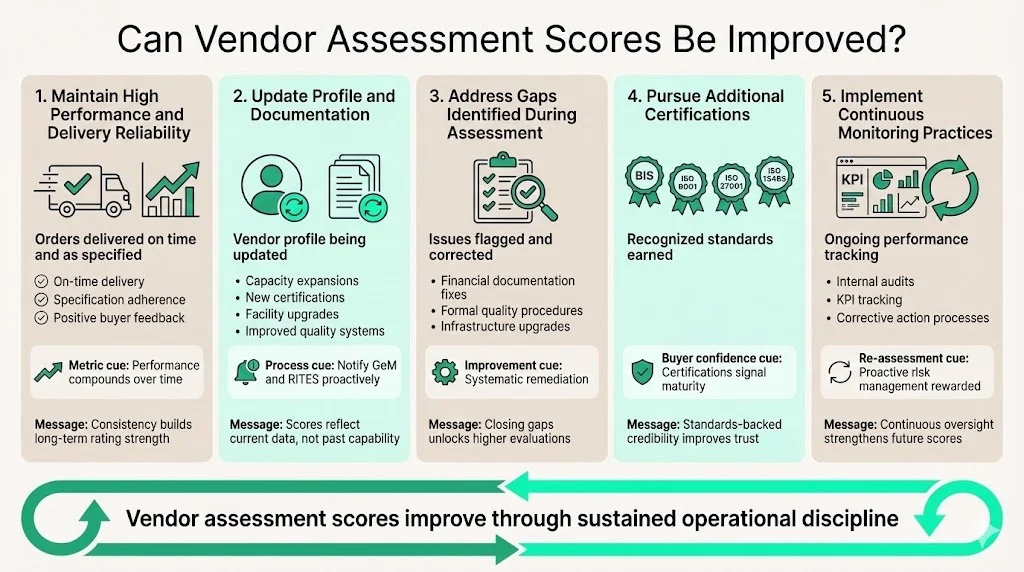
Maintain high performance and delivery reliability: Consistent on-time delivery, adherence to order specifications, and positive buyer feedback directly enhance seller ratings. Performance metrics accumulate over time, meaning sustained operational excellence compounds into competitive advantage.
Update profile and documentation upon changes: Notify GeM and RITES of capacity expansions, new certifications, facility upgrades, or improved quality management systems. Proactively updating documentation ensures that vendor profiles reflect current capabilities, not outdated snapshots.
Address gaps noted during assessment: If RITES flags non-compliance issues or documentation weaknesses during initial assessment, systematically remediate those gaps. Strengthening financial controls, formalizing quality procedures, or upgrading production facilities removes barriers to future high scores.
Pursue additional certifications: Obtaining BIS licenses, ISO 9001 quality management certification, or industry-specific standards (ISO 27001 for IT, ISO 13485 for medical devices) signals continuous improvement and operational maturity. These certifications often correlate with higher seller ratings and increased buyer confidence.
Engage in continuous monitoring practices: Implement internal audits, track performance KPIs, and establish corrective action protocols for delivery or quality issues. Vendors demonstrating proactive risk management during re-assessment or performance reviews receive favorable evaluation outcomes.
Real-World Importance for Enterprise Sales
Vendor assessment extends beyond government procurement compliance—it functions as a market signal with tangible implications for enterprise sales.
Builds Credibility
Verified suppliers carry competitive advantages in procurement. The VA tag serves as third-party validation that a vendor possesses operational substance, not merely marketing claims. Enterprise procurement teams evaluating suppliers for multi-year contracts or strategic partnerships view GeM vendor assessment as supplementary due diligence—reducing the need for redundant audits and accelerating supplier onboarding timelines.
Reduces Enterprise Risk
Vendor assessment mitigates several enterprise risk categories: supply chain disruption (from vendor insolvency or capacity shortfalls), quality failures (from inadequate production controls), and compliance violations (from unverified statutory status). For enterprises subject to regulatory oversight or board-level supply chain governance requirements, sourcing from VA-tagged vendors provides audit-defensible evidence that supplier qualification protocols were followed.
Supports Strategic Supplier Selection
Enterprise procurement increasingly emphasizes supplier rationalization—concentrating spend among fewer, higher-quality vendors rather than maintaining fragmented supplier bases. Vendor assessment provides objective, standardized evaluation criteria that support strategic supplier selection decisions. Procurement teams can compare vendors across assessment scores, performance histories, and certification portfolios to identify partners capable of scaling alongside enterprise growth.
Enhances Long-Term Value
Vendors who successfully navigate assessment often exhibit stronger operational disciplines: documented processes, formalized quality controls, financial transparency, and continuous improvement mindsets. These characteristics correlate with long-term supplier reliability and partnership value. Enterprises investing in multi-year contracts or joint development initiatives benefit from partnering with vendors demonstrating the organizational maturity that vendor assessment validates.
Clear the security questionnaire after you clear vendor assessment
Book a demo and we'll show how Konfirmity turns the internal audits and documented quality procedures GeM assessment already expects into the ISO 27001 evidence enterprise and government buyers ask for next.
Book a demo
Conclusion
Most government and enterprise procurement failures stem from inadequate supplier qualification—awarding contracts based on lowest price or superficial credentials rather than verified operational capacity. GeM's vendor assessment framework addresses this systemic weakness by requiring third-party validation before vendors gain full marketplace access. For sellers, the assessment represents an investment in credibility that unlocks sustained government and enterprise contract opportunities. For buyers, VA-tagged vendors reduce procurement risk and provide audit-defensible supplier choices.
FAQs
Vendor assessment is a mandatory evaluation process conducted by RITES that verifies a seller's credentials, production capacity, financial health, and quality standards before they can list certain products or participate in government tenders on the GeM platform.
Original Equipment Manufacturers (OEMs), resellers in specific high-value categories (Q1 and Q2 products), Deemed OEMs importing products from abroad, and brand owners with outsourced manufacturing arrangements must complete vendor assessment. Exemptions exist for BIS license holders, UCC certificate holders, and certain government-recommended entities.
Business registrations (PAN, GST, MSME, incorporation), financial statements (audited financials, turnover, bank details, tax returns), product documentation (technical specs, certifications, testing reports, production logs), and operational records (quality control procedures, supplier lists, manufacturing process flows).
Vendor assessment certifications and exemptions are typically valid for three years. Vendors must reapply and undergo re-evaluation before expiration to maintain their VA tag and full marketplace access.
Vendor scores improve through consistent on-time delivery, positive buyer feedback, updating documentation to reflect capacity expansions or new certifications, addressing non-compliance gaps identified during assessment, and pursuing additional quality or industry-specific certifications that demonstrate operational maturity.