
In 2026, enterprise buyers rarely sign a contract without asking for assurance artifacts. Security questionnaires, data processing agreements, and vendor risk assessments arrive early in procurement. Without operational controls and continuous evidence, deals stall — even when teams believe they're "ready" on paper. A well-run GDPR gap assessment builds credibility with these buyers, verifying that your organization's handling of personal data aligns with the General Data Protection Regulation (GDPR) and supports other frameworks like SOC 2, ISO 27001, and HIPAA.
As the founder of Konfirmity, a human-led managed security and compliance service, I've seen how real control design, continuous monitoring, and year-round operations shorten sales cycles. This article lays out why companies that sell to enterprise clients must prioritize GDPR gap assessments, how to run them effectively, and how to use the findings to strengthen your security program.
Gap Analysis vs. Gap Assessment
Gap analysis and gap assessment mean the same thing in a GDPR context: a structured comparison of your current data protection practices against GDPR's requirements to find what's missing. Some teams use "analysis" and others use "assessment," but the process, and the templates below, are identical either way.
What Is a GDPR Gap Assessment?
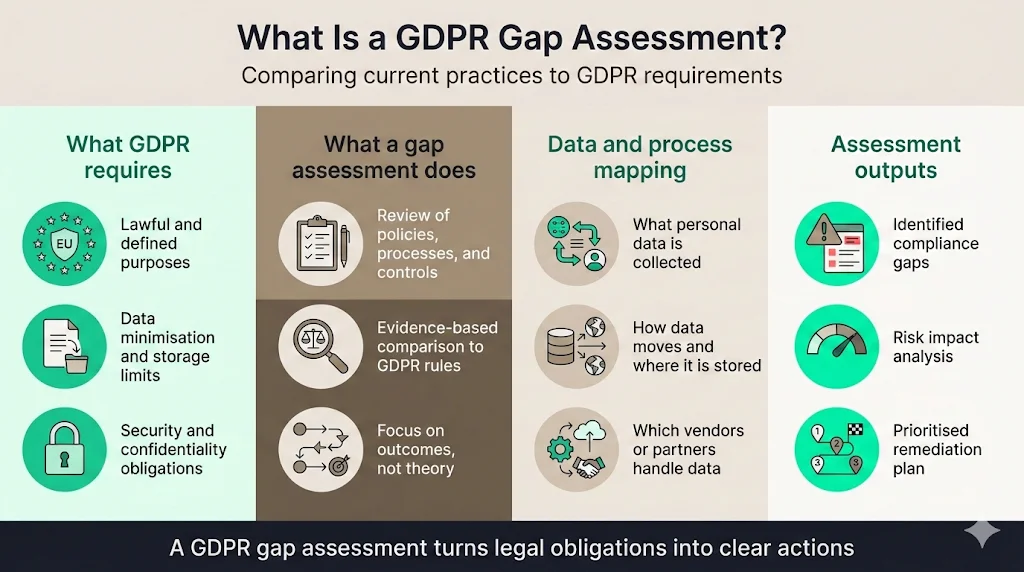
GDPR is the European Union's data-protection framework. It governs how organizations collect, use, store, and share personal data about people in the EU. Key principles include purpose limitation, data minimization, storage limitation, and integrity and confidentiality; Article 5 requires that personal data be collected for specified purposes, kept only as long as necessary, and protected with appropriate security measures. A gap assessment compares your current practices against these legal obligations. It's systematic, evidence-based, and oriented around outcomes. By mapping processes, policies, and technical controls to GDPR requirements, you identify compliance gaps, understand their risk impact, and develop action plans to close them.
The output of a gap assessment isn't just a list of problems. It provides:
- A clear inventory of personal data and processing activities — what data you collect, how it flows through your systems, where it's stored, and which third parties handle it.
- An analysis of deficiencies — missing policies, weak controls, outdated practices, or inadequate documentation.
- A risk-based remediation roadmap — actions ranked by severity and effort to address compliance obligations and improve security.
Why GDPR Gap Assessments Are Essential for Enterprise-Selling Companies
Regulatory and Buyer Expectations
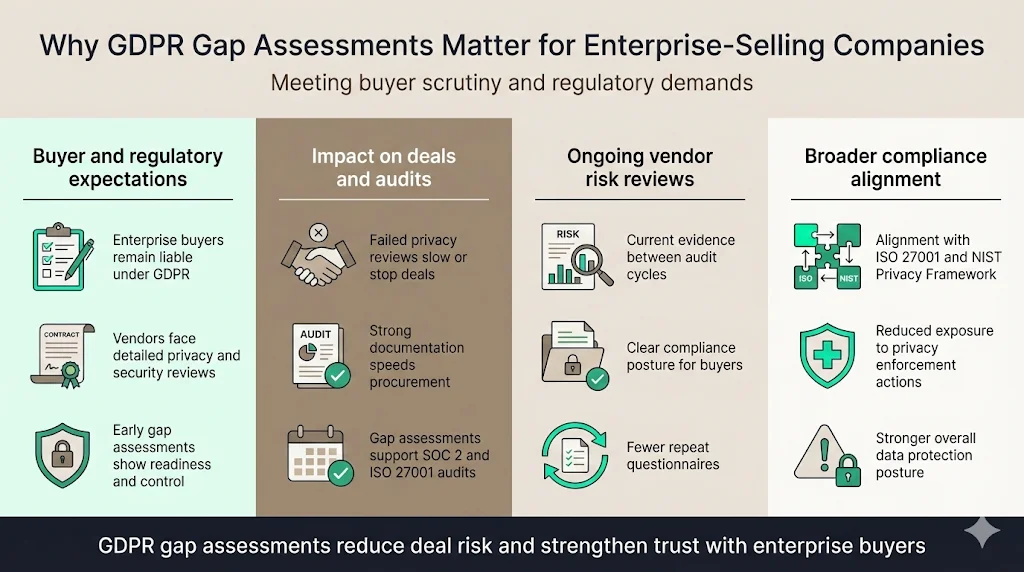
Enterprise clients must obey strict regulatory requirements. When they outsource processing to a vendor, they remain responsible for personal data under GDPR. As a result, procurement teams issue lengthy questionnaires covering data handling, encryption, access controls, breach notification, and subcontractor oversight, and examine contracts and third-party risk reviews directly. A gap assessment done before these conversations shows you have a mature privacy program and can meet data protection obligations, and positions you to negotiate data processing agreements, security addenda, and indemnity clauses with confidence.
Impact on Contracts, Audits, and Vendor Risk Reviews
Failing a buyer's privacy assessment can delay or kill a deal. Organizations that provide complete documentation — policies, risk assessments, and evidence of control operation — accelerate closing instead. A well-documented gap assessment feeds directly into SOC 2 and ISO 27001 audits: SOC 2 Type II requires controls to operate effectively over an observation period of 3–12 months, and reports are valid for 12 months, so an updated gap assessment keeps your evidence current between audits. It also simplifies vendor risk reviews, since you can hand buyers a summary of your compliance posture directly.
Links to Privacy Compliance and Data Protection Goals
GDPR compliance supports other frameworks directly. The ISO 27001 risk assessment process emphasizes identifying and evaluating risks to information assets and choosing treatment options based on risk priority. NIST's Privacy Framework helps organizations manage privacy risk while fostering innovation. A GDPR gap assessment builds a foundation that aligns with both.
Key Concepts in a Gap Assessment
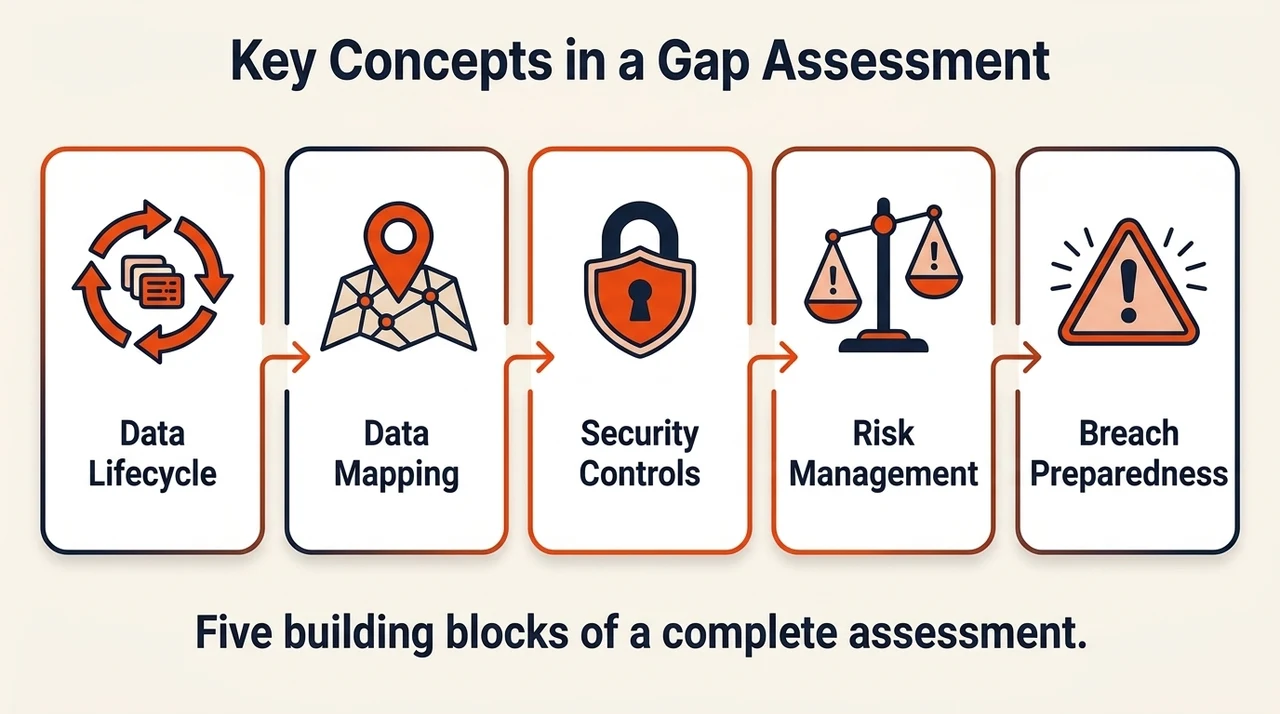
Before diving into step-by-step instructions, here are the core topics that underpin an effective gap assessment.
Personal Data Lifecycle
Personal data flows through stages — collection, use, storage, sharing, and deletion. GDPR's principles demand minimization and purpose limitation. A gap assessment traces data from the moment it enters your organization to its disposal or anonymization: do you collect more data than necessary, do you process it only for specified purposes, how long do you retain it? For each stage, document the legal basis (consent, legitimate interest, contract) and identify gaps.
Data Mapping
Data mapping is the process of identifying data sources, flows, and storage locations — an inventory of systems, databases, SaaS applications, and vendors that process personal data. A structured mapping template captures data sources, data types (contact details, payment information, health data), storage locations, legal bases for processing, and retention periods. Without a complete map, you can't assess compliance or risk properly.
Security Controls
GDPR requires "appropriate technical and organisational measures" to protect personal data: encryption, access control, logging, vulnerability management, and incident detection. SOC 2's Trust Services Criteria emphasize security, availability, processing integrity, confidentiality, and privacy, with the security criterion mandatory for every SOC 2 audit. Assessing controls means verifying design and operating effectiveness across all of these dimensions.
Risk Management
Compliance is about risk reduction, not risk elimination. The ISO 27001 risk assessment methodology calls for establishing context, identifying assets and threats, analysing and evaluating risks using a qualitative or quantitative scale, and choosing treatment options (treat, avoid, transfer, accept). A privacy risk scoring system helps prioritise remediation actions based on likelihood and impact.
If your focus is specifically on identifying and scoring privacy risks rather than closing compliance gaps, see our GDPR Risk Assessment Guide.
Privacy Policies and Documentation
GDPR requires clear, transparent privacy notices and internal policies. You must explain how you collect and use data, provide rights for data subjects (access, rectification, erasure), and document processing activities (Records of Processing Activities – ROPA). Policies should align with Article 5 principles and be easily accessible to employees and customers. An assessment checks that policies are up to date and reflect actual practices.
Vendor Assessment and Third-Party Management
Most organizations rely on vendors (cloud providers, analytics tools, customer support software) to process data. Vendor risk assessment means identifying critical vendors, collecting information, assessing controls, and monitoring performance. Best practices include tiering vendors by criticality, using standard questionnaires (CAIQ, SIG), aligning with frameworks like ISO 27001, NIST 800-53, SOC 2, HIPAA, and GDPR, and establishing continuous monitoring. Contracts should include data protection clauses and data transfer safeguards.
Employee Training and Awareness
GDPR compliance isn't solely a legal or technical exercise. Employees who handle personal data must understand privacy principles, secure data handling, and reporting obligations. Training should cover data classification, phishing awareness, secure authentication, and incident escalation, with records of sessions and completion rates forming part of the evidence.
Data Breach Preparedness Planning
Despite best efforts, incidents happen. GDPR requires organizations to report breaches to supervisory authorities within 72 hours and notify affected individuals when there's high risk to their rights and freedoms. Breach preparedness means having an incident response plan, procedures for containment and eradication, communication plans, and defined roles. Aligning with frameworks like ISO 27001's Annex A and SOC 2's security criteria ensures your plan covers what auditors expect.
Before You Begin: Preparations
Assemble Your GDPR Assessment Team
A successful gap assessment is cross-functional. It should involve:
- Legal and privacy counsel — interpret GDPR requirements, advise on lawful bases, and review policies.
- Security leaders (CISO or equivalent) — oversee technical controls, incident response, and risk management.
- IT and data owners — provide access to systems, data flows, and technical documentation.
- Business unit representatives — explain how data supports marketing, sales, product, and support functions.
- Vendor management — coordinate third-party assessments and contract reviews.
Clear roles help avoid confusion. Assign a project lead to coordinate tasks, a legal lead to manage interpretations, and control owners for each domain (access control, encryption, incident response, etc.).
Define Scope
Scope determines the boundaries of your assessment: which data categories (customer data, employee data, marketing leads), systems (databases, CRM, HR systems), processes (onboarding, billing, analytics), regions (EU vs. global), business units, and vendors are in scope. A narrow scope speeds up the assessment but risks missing compliance gaps; a broad scope offers more assurance but needs more resources. Consider prioritizing high-risk areas first, like customer personal data or systems subject to regulatory audits.
Gather Essential Documents
Collect documentation up front:
- Privacy policies and public notices — confirm they reflect actual practices and cover purposes, rights, and contact details.
- Records of Processing Activities (ROPA) — document each processing purpose, data category, data subject type, recipients, legal basis, and retention period.
- Security policies — encryption standards, access control policies, secure coding standards, change management procedures, logging policies.
- Contracts and vendor agreements — data processing agreements, sub-processor lists, service addenda, and data transfer safeguards.
- Incident response plans — step-by-step guides for identifying, containing, and reporting breaches.
- Training records — dates, attendance, and content of privacy and security training sessions.
Step-by-Step Gap Assessment Walkthrough
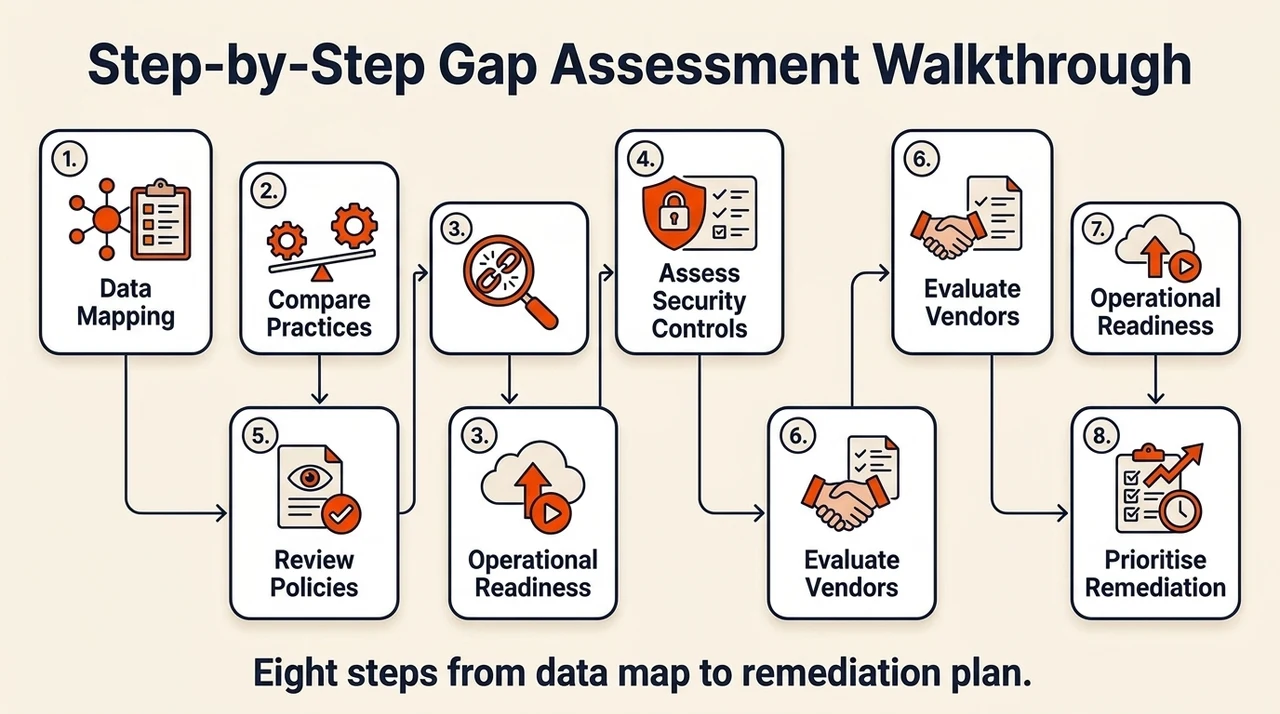
Each step below builds on the previous one toward a comprehensive picture of your compliance posture.
Step 1: Data Mapping
- Document all personal data. List the data you collect (names, contact details, IP addresses, purchase history, health data) and its source (web forms, customer support, analytics tools).
- Map data flows. Draw diagrams showing how data moves between systems — from your website to your CRM, then to your billing platform and analytics provider, for example.
- Identify storage and transfer locations. Note databases, backups, cloud regions, and third-party processors.
- Label legal bases and retention periods. For each data element, identify whether the basis is consent, contract, legitimate interest, legal obligation, or vital interest, and document retention schedules and disposal methods.
- Validate accuracy. Review logs and system configurations, and talk to data owners to confirm the map is comprehensive and current.
Step 2: Compare Practices with Regulatory Requirements
Build a GDPR requirements checklist covering:
- Lawful processing (Articles 6–9) — does each processing activity have a valid legal basis, and are special categories of data handled with extra safeguards?
- Principles (Article 5) — purpose limitation, data minimization, accuracy, storage limitation, integrity/confidentiality, accountability.
- Data subject rights (Articles 12–23) — your process for access, rectification, erasure ("right to be forgotten"), restriction, portability, objection, and automated decision-making requests.
- Transparency (Articles 12–14) — do privacy notices clearly explain purposes, retention periods, recipients, and rights?
- Data transfers (Chapter V) — do cross-border transfers use approved safeguards (Standard Contractual Clauses, Binding Corporate Rules, adequacy decisions, certification mechanisms)?
- Data Protection Impact Assessments (DPIAs) — does high-risk processing undergo a DPIA, reviewed by legal counsel?
- Security measures (Article 32) — encryption, pseudonymization, access controls, change management, logging, incident response.
- Breach notification (Articles 33–34) — does your incident response plan meet the 72-hour reporting requirement and include communication procedures?
Compare current practice against this checklist, noting where you meet requirements, where they're partially implemented, and where they're missing. This gap list becomes the basis for remediation.
Step 3: Identify Compliance Gaps
With your checklist in place, analyze the evidence for:
- Missing controls — no documented data minimization policy, no MFA on administrative accounts.
- Outdated controls — policies not updated in the last 18 months, encryption standards behind current best practice.
- Evidence gaps — controls implemented but no records (access review results, training logs, system activity logs).
- Process gaps — data subject requests not tracked within statutory timelines, no DPIA for a new product feature.
- Third-party gaps — vendors without security attestations or outdated data processing agreements.
Categorize each gap by severity (high, medium, low) and impact (privacy breach risk, contractual breach, customer trust), using a risk matrix to score likelihood and impact together. A missing encryption policy might be high severity because it affects all data; an outdated privacy notice might be medium severity but high reputational risk.
Step 4: Assess Security Controls
Review the technical and organizational measures protecting personal data:
- Encryption and key management — is data at rest and in transit encrypted with strong algorithms? Check key rotation and access to encryption keys.
- Access control — IAM policies: least privilege, segregation of duties, periodic access reviews, MFA, with documented evidence of regular reviews.
- Logging and monitoring — are system events (logins, privilege changes, data exports) logged and monitored for anomalies?
- Vulnerability management — patching policies, scan frequency, severity thresholds (CVSS scores).
- Incident detection — intrusion detection/prevention, endpoint protection, SIEM coverage.
- Business continuity and disaster recovery — do backup and recovery procedures meet availability requirements? SOC 2's Availability criterion covers exactly this.
- Change management and secure development — do code and infrastructure changes follow documented processes with security review and approval?
Link your assessment to established frameworks: ISO 27001 requires risk assessments, treatment plans, and Annex A controls; SOC 2's Trust Services Criteria emphasize security, availability, processing integrity, confidentiality, and privacy. Aligning your controls with these frameworks lets you reuse evidence across certifications.
Step 5: Review Privacy Policies and Documentation
Internal and external documentation must match reality:
- External privacy notices — do they reflect actual data collection, processing purposes, and third-party disclosures, and explain rights and contact details?
- Internal policies and procedures — do employees have clear instructions on data classification, acceptable use, retention, and disposal, referencing GDPR and other frameworks?
- Records of Processing Activities (ROPA) — is each activity documented with purpose, legal basis, categories, retention, and security measures?
- Data retention schedules — do retention periods align with business and regulatory needs, with deletion or anonymization confirmed when no longer required?
- Audit trails and evidence — logs of policy approvals, changes, and training records, since evidence of adherence is what an audit actually checks.
Step 6: Evaluate Vendor and Third-Party Risks
Third-party risk management is often the weakest link:
- Identify critical vendors — which vendors handle personal data or provide services critical to your operations (cloud providers, payment processors, email services)?
- Categorize vendors by risk — high, medium, low, based on data sensitivity, volume, and criticality.
- Collect information — questionnaires (CAIQ, SIG), due diligence reports, public attestations (SOC 2, ISO 27001, ISO 27701, PCI DSS).
- Assess controls — encryption, access control, incident response, subcontractor management.
- Review contracts — Standard Contractual Clauses, data processing clauses, breach and change notification requirements.
- Monitor performance — continuous monitoring (security ratings services), periodic reassessment, contract renewal review.
Step 7: Evaluate Operational Readiness
A compliance program succeeds only if it operates daily:
- Employee training and awareness — do employees complete privacy and security training annually, covering phishing, secure password practices, data classification, and incident reporting, with completion records kept?
- Incident handling and breach preparedness — test your incident response plan with tabletop exercises, reviewing detection time, escalation paths, communication templates, and lessons learned.
- Change management processes — do system and application changes follow documented procedures with security review and approval?
- Audit readiness — is evidence collected continuously rather than scrambled together right before an audit? SOC 2 auditors review evidence over 3–12 months for exactly this reason.
Step 8: Prioritise and Document Remediation Actions
Prioritize actions by risk and urgency, combining likelihood, impact, and regulatory significance:
- High priority — gaps risking immediate non-compliance or severe breach (no breach notification procedure, missing encryption for sensitive data).
- Medium priority — moderate risk (incomplete ROPA, outdated training materials).
- Low priority — cosmetic or documentation improvements (minor wording changes in a privacy notice).
For each gap, document: description (what's missing or weak), risk (impact on privacy rights, compliance, business objectives), mitigation (policy update, technical implementation, new process), owner, and timeline. This remediation plan becomes a living document tracking progress and accountability — integrate it with your project management system so nothing falls through the cracks.
Templates and Tools
Templates standardize your assessment and save time. Here are four you'll actually use.
Gap Analysis Template
A table with columns for: GDPR requirement/principle (e.g., data minimization), current state (existing processes and controls), desired state (required controls and practices), risks (impact if the gap remains), and mitigation actions (steps to close it). This ensures every requirement gets assessed and addressed systematically, not just the obvious ones.
Data Mapping Template
A table or spreadsheet with fields for: data source (website, mobile app, customer support), data type (name, email, IP, payment data, health data), storage location (database, file system, third-party service), legal basis (consent, contract, legitimate interest, legal obligation), retention period, and recipients (internal teams, processors, sub-processors).
Risk Assessment Matrix
A matrix with likelihood on one axis and impact on the other. Score each identified gap (1–5 for likelihood, 1–5 for impact) and multiply to prioritize remediation — the same approach ISO 27001 recommends for evaluating and prioritizing risk generally.
Audit Checklist
A checklist to verify during your gap assessment: have all data flows been documented, is there a valid legal basis for each processing activity, are privacy notices accurate and complete, do security controls meet current best practices, are vendor agreements up to date with GDPR clauses, have employees completed privacy training in the last 12 months, and is there evidence of regular risk assessments?
Free template pack
Free Download: GDPR Gap Assessment Template Pack
Get the free templates for data mapping, risk scoring, and audit prep, just enter your work email.
How to Use Templates Effectively
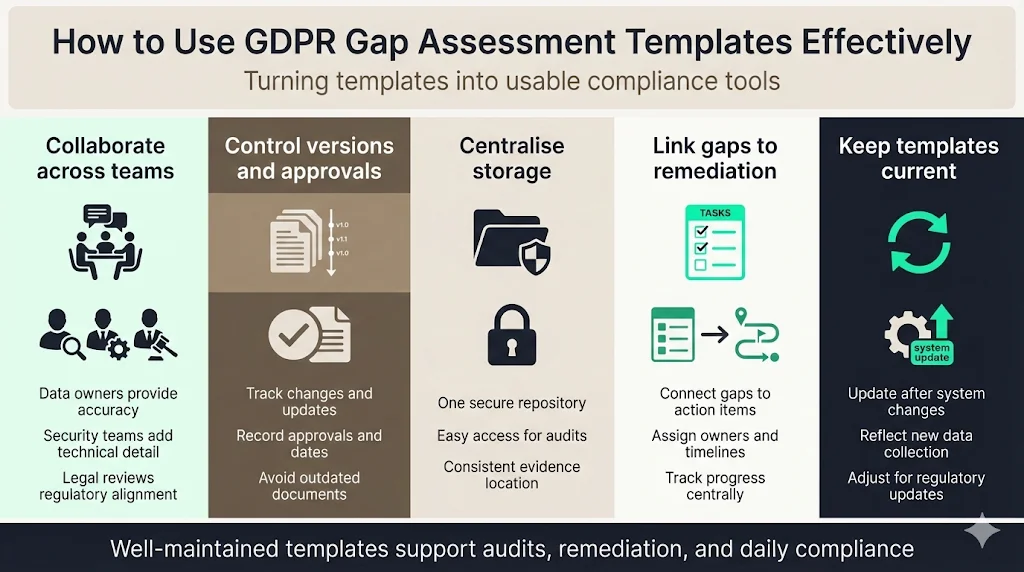
- Collaborate. Involve stakeholders when filling templates — data owners provide accurate descriptions, security teams supply technical detail, legal counsel confirms the interpretations align with law.
- Version control. Use a repository or compliance tool to track changes, approvals, and dates.
- Central storage. Store templates and evidence in a secure, central repository accessible to auditors.
- Link to remediation. Tie each gap to a specific action in your project management system.
- Update regularly. Treat templates as living documents — update them when systems change, new data is collected, or regulations evolve.
Real data protection makes GDPR compliance the easy part.
Share your work email and we'll help you turn your gap assessment findings into an operating program.
Common Compliance Gaps & How to Address Them
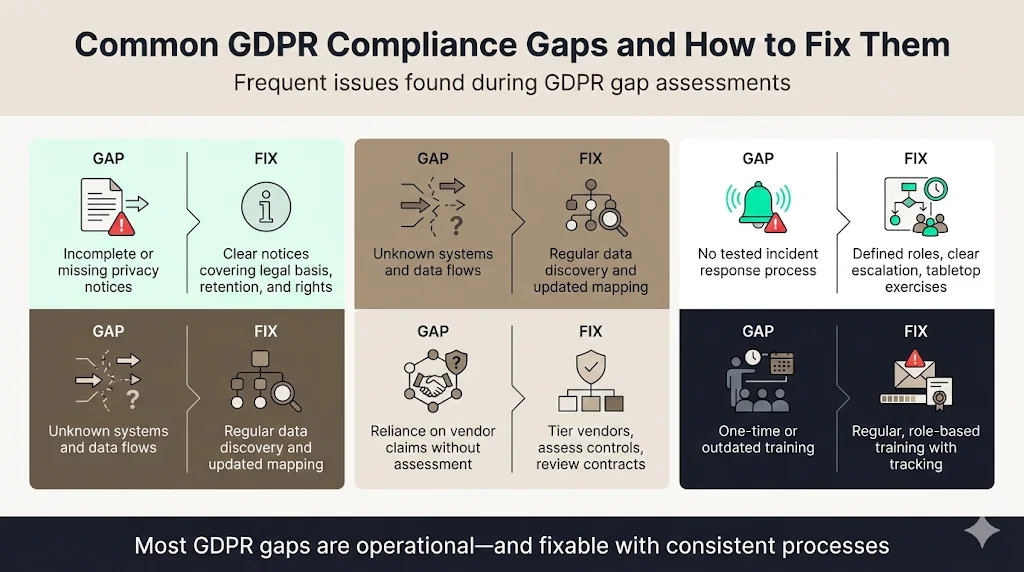
The compliance gaps that show up most often in a GDPR gap assessment are rarely exotic — through hundreds of privacy assessments, the same handful of deficiencies recur.
Missing privacy notices. Some organizations collect personal data without a clear privacy notice, or one that omits essentials like legal basis or retention — a direct GDPR transparency violation. Fix: draft notices covering every processing activity in plain language, explain rights, publish them prominently, and review annually or whenever a process changes.
Lack of accurate data maps. Teams routinely underestimate how many systems store personal data, and unmapped flows become unknown risk. Fix: run regular data discovery scans, involve engineers and business units directly, and update the map whenever a new tool is added — automated data mapping tools help at scale.
Weak vendor risk assessment. Many companies rely on a vendor's marketing claims instead of a formal assessment, and rarely tier vendors or actually review contracts. Fix: implement a vendor risk program that tiers by criticality, uses standardized questionnaires, reviews controls, and monitors performance continuously, with GDPR clauses and transfer safeguards built into every contract.
Incomplete breach response procedures. Some organizations have no formal incident response plan, or one that's never been tested, leading to delayed or mishandled notifications. Fix: build a plan aligned with Articles 33 and 34, define roles and communication procedures, and run tabletop exercises — confirm the same plan satisfies SOC 2 and ISO 27001 as well.
Patchy employee training. Employees often get one-time training at onboarding and nothing after, and don't know how to recognize a data subject request or report a potential breach. Fix: provide role-tailored training at least annually, covering phishing, data handling, GDPR rights, and incident reporting, with attendance tracked for accountability.
Integrating Gap Assessments into Ongoing Compliance
A gap assessment shouldn't be a one-off exercise. To maintain compliance and support enterprise sales cycles:
- Set assessment frequency. At least annually — higher-risk organizations or those changing rapidly should assess quarterly or bi-annually, tied to product launches, major system changes, or a new client audit.
- Automate where possible. Tools that automate evidence collection, control monitoring, and risk scoring — tracking access changes, encryption status, vulnerability scans — align directly with SOC 2's requirement for continuous evidence over the observation period.
- Integrate with governance. Embed gap assessments into your risk management and ISMS, feeding risk registers, internal audits, and improvement plans.
- Engage leadership. Present findings and remediation progress to executives, tied to business objectives and budget planning.
- Communicate with buyers. Share high-level results (without exposing sensitive detail) with enterprise clients, demonstrating transparency and continuous improvement.
Case Study: A SaaS Provider's Journey
Context. A B2B SaaS company based in Europe builds a collaboration platform used by enterprises in finance and healthcare. Enterprise clients required proof of GDPR compliance and SOC 2 Type II attestation before signing contracts.
Challenges: minimal documentation of data flows and retention periods; no formal vendor risk management, with sub-processors lacking GDPR clauses; generic and incomplete privacy notices; informal access reviews and incident response; sales cycles stalling because procurement asked for evidence the company couldn't produce.
Actions taken:
- Conducted a GDPR gap assessment. The team mapped all personal data, identified high-risk processing activities, and compared practices against GDPR requirements, surfacing 38 gaps including missing DPIAs and inadequate data minimization.
- Implemented controls. Encrypted all databases, enforced MFA for administrative access, deployed a SIEM for logging and monitoring, and updated the incident response plan.
- Updated policies and notices. New privacy notices explained purposes, legal bases, retention periods, and rights; internal policies mandated regular access reviews and defined retention schedules.
- Established vendor management. Vendors were tiered, questionnaires collected, and contracts revised with SCCs and audit rights.
- Trained employees. Everyone completed privacy and security training; product teams learned to run DPIAs.
- Aligned with SOC 2 and ISO 27001. Controls were mapped to the SOC 2 Trust Services Criteria and ISO 27001 Annex A, and the company started its SOC 2 Type II observation period.
Results: gap remediation completed within six months; SOC 2 Type II attestation achieved after a nine-month observation period, satisfying enterprise buyers; sales cycles shortened by 30%, winning a large healthcare client after demonstrating compliance; ISO 27001 audit findings dropped from 12 to 3 by addressing privacy risk early; phishing simulation click-through rates fell from 18% to 3% as awareness improved.
See where your GDPR program actually stands
Book a demo and we'll map your current data protection practices against what enterprise buyers and auditors actually check.
Book a demo
GDPR Gap Assessment: Frequently Asked Questions
It's a systematic review of your current data protection practices against GDPR rules. You document data flows, compare them to legal requirements, identify gaps, and prioritize remediation — the goal is compliance and reduced privacy risk, not just a checklist.
A cross-functional team including legal, IT/security, privacy, data owners, and business leaders. For higher-risk companies or limited internal expertise, external consultants or a managed service provider can run it instead.
At least annually, but also whenever you introduce new data processing activities, onboard a major vendor, update systems, or prepare for a significant audit. SOC 2 audits run annually and require continuous evidence, so aligning your assessment schedule to audit cycles pays off directly.
Privacy policies, Records of Processing Activities (ROPA), third-party contracts, security controls documentation, incident response plans, and training records — plus data processing agreements, Standard Contractual Clauses, and vendor risk assessments where relevant.
Gap analysis is generally grouped into four types: market gap analysis (finding demand your competitors aren't meeting), strategic gap analysis (comparing your direction and performance against competitors), profit gap analysis (comparing financial metrics like margins and overhead against competitors), and skill gap analysis (assessing whether your team has the competencies it needs). A GDPR gap assessment applies the same underlying method to compliance: comparing your current data protection practices against what the regulation requires.
Conclusion: Closing the Gap Before It Costs You
Enterprise buyers, regulators, and auditors all demand evidence that personal data is protected. Average GDPR fines exceeded €2.36 million as of March 2025, with cumulative penalties approaching €5.88 billion, and the global average cost of a data breach reached a record $4.99 million in 2026, a 12% increase and a record high, according to IBM's Cost of a Data Breach Report. A structured gap assessment identifies weaknesses before they turn into fines or lost deals, aligning your organization with GDPR, SOC 2, ISO 27001, and HIPAA at once, and reinforcing a culture of continuous improvement rather than a scramble before the next questionnaire.
Compliance manufacturing — rushing to produce documents right before a buyer's questionnaire — fails the moment a real incident happens. A human-led, managed service approach designs controls inside your stack, monitors them continuously, and delivers outcome-driven compliance instead. Prioritize gap assessments, close the high-risk gaps first, and let real security become the competitive advantage compliance was always supposed to be a byproduct of.