SOC 2 controls mapped to NIST CSF gives two very different frameworks a common language: SOC 2 is an attestation report — an independent CPA firm audits your controls against the AICPA's Trust Services Criteria and issues a formal report you hand to customers. NIST CSF is a voluntary risk management framework — it organizes cybersecurity outcomes into six functions and gives you a structure to build a security program, but produces no certificate an auditor signs. Mapping the two cuts duplicated effort and strengthens the story you tell both auditors and buyers.
This guide is for CISOs, compliance leads, and founders at companies juggling multiple framework obligations, drawing on Konfirmity's experience across 6,000+ security audits.
SOC 2 and NIST CSF Explained
What Is SOC 2?
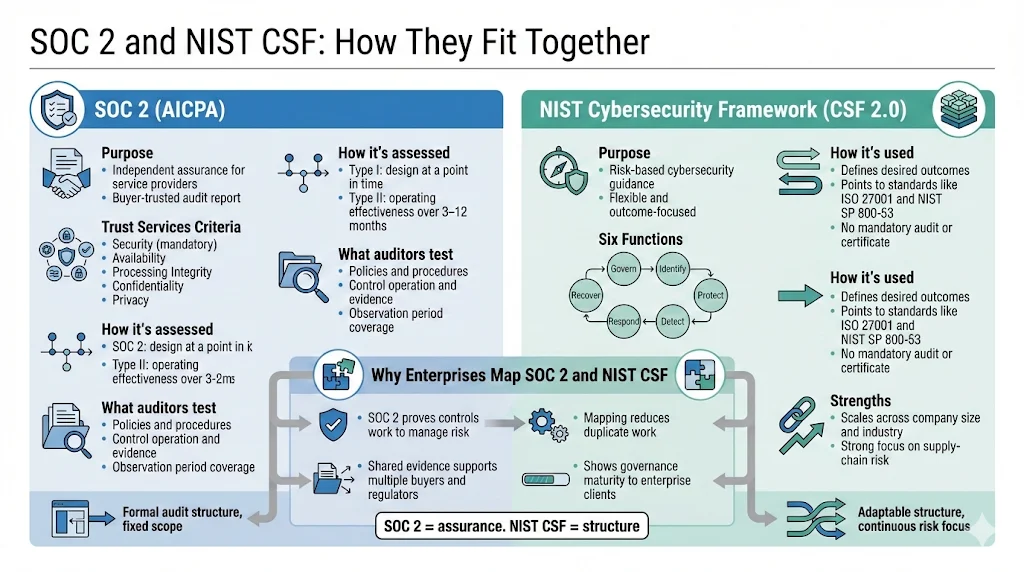
SOC 2 audits evaluate how well a service organization meets the AICPA's Trust Services Criteria: Security, Availability, Processing Integrity, Confidentiality, and Privacy. Security is assessed through nine common criteria (CC1–CC9) covering control environment, communication, risk assessment, monitoring, control activities, logical and physical access, system operations, change management, and risk mitigation; Availability covers capacity management, environmental protection, and backup/testing; Processing Integrity requires defined processing rules, input validation, and accurate processing.
A SOC 2 audit is a Type I (point-in-time design assessment) or Type II (operational effectiveness over 3–12 months). Enterprise buyers usually want a Type II report because it proves controls actually operate. Early-stage startups can typically reach SOC 2 readiness in 4–6 months, mid-sized teams in 2–4 months — and without automation or specialist support, drafting policies, coordinating controls, and gathering evidence can consume hundreds of hours.
What Is NIST CSF?
The NIST Cybersecurity Framework (CSF) gives flexible guidance for managing cybersecurity risk. Version 2.0 organizes everything around six functions:
- Govern (GV) — how you set cybersecurity strategy, roles, policy, and oversight.
- Identify (ID) — understanding assets, suppliers, and risk.
- Protect (PR) — safeguards like identity management, training, data security, and infrastructure resilience.
- Detect (DE) — discovering and analyzing anomalies and indicators of compromise.
- Respond (RS) — containing incidents, analysis, mitigation, and reporting.
- Recover (RC) — restoring assets and operations after an incident.
Unlike SOC 2, NIST CSF prescribes no specific controls — it describes outcomes and points to informative references (ISO 27001, NIST SP 800-53, COBIT) for how to actually implement them. That flexibility is exactly why it's been adopted so broadly across government and private industry regardless of sector or maturity.
The Case for Multi-Framework Compliance
Enterprise clients rarely operate under one rulebook. A healthcare vendor might need SOC 2 to close SaaS deals, HIPAA for PHI, ISO 27001 for international reach, and GDPR for European customers — each with its own vocabulary and control set. Mapping controls across frameworks lets teams reuse evidence, speed audits, and demonstrate real maturity, and large enterprise buyers increasingly won't start a vendor assessment without a SOC 2 report already in hand. Meanwhile, NIST CSF keeps becoming the de facto structure for cybersecurity risk management precisely because it's flexible enough to sit underneath any of them. If ISO 27001 is also on your roadmap, the same NIST CSF column does double duty: see ISO 27001 controls mapped to NIST CSF for the Annex A crosswalk.
SOC 2 vs NIST CSF: What's the Difference?
SOC 2 is an attestation report — an independent CPA firm audits your controls against the AICPA's Trust Services Criteria and issues a formal report you hand to customers. NIST CSF is a voluntary risk management framework — it organizes cybersecurity outcomes into six functions (Govern, Identify, Protect, Detect, Respond, Recover) and gives you a structure to build and mature a security program, but it doesn't produce a certificate or a report an auditor signs. In practice, most companies build their security program's structure around NIST CSF and prove it to customers with a SOC 2 report — the two are complementary rather than competing.
Why Map SOC 2 Controls to NIST CSF
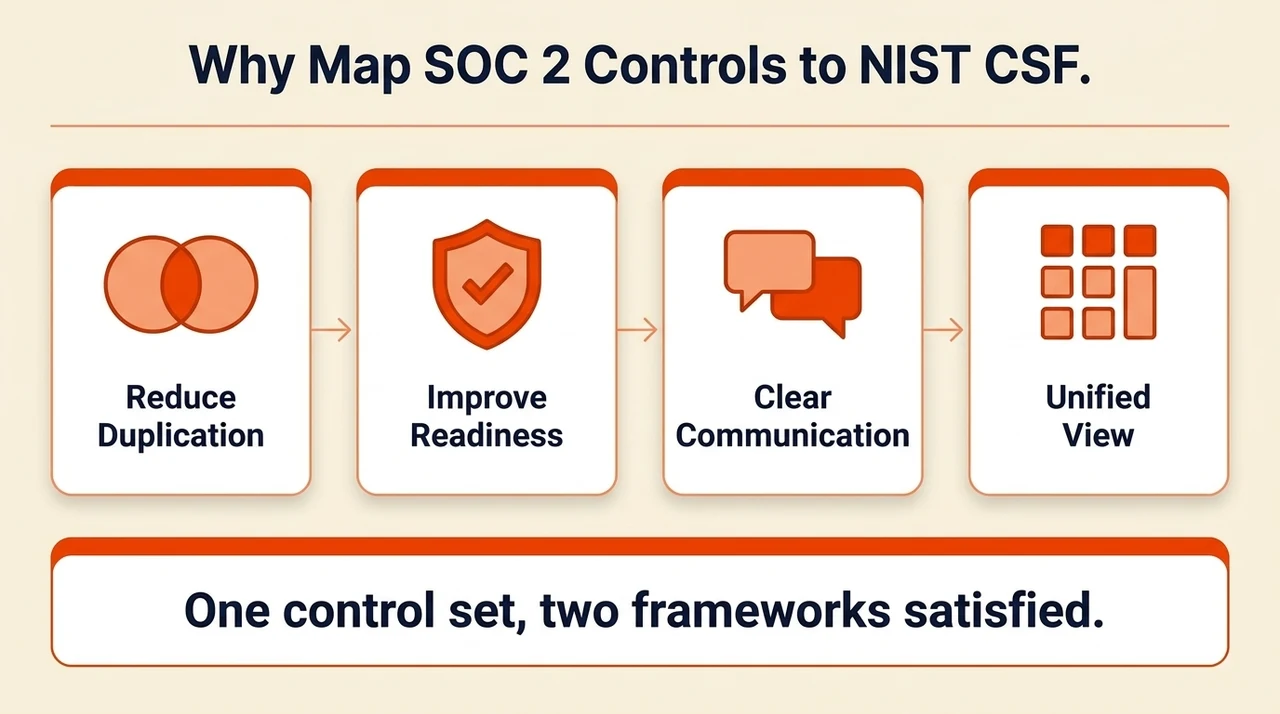
Understanding Framework Philosophies
Understanding the two frameworks' underlying philosophies is what makes the mapping make sense: SOC 2 is outcome-based in a narrow sense: each Trust Services criterion describes what must be achieved (logical access restricted to authorized users, say), leaving the control design to you, with an auditor verifying design and operating effectiveness. NIST CSF is risk-based and flexible in a broader sense — it's a taxonomy of outcomes with no dictated mechanism, letting organizations pick the categories and subcategories that fit their own risk appetite and pull controls from informative references.
Despite the philosophical gap, both frameworks converge on the same themes: governance, risk assessment, access control, incident management, monitoring. Mapping is what translates NIST CSF's broad language into SOC 2's explicit criteria.
Benefits of Mapping
The benefits of mapping compound the more frameworks you carry at once:
- Reduce duplication. Many controls satisfy both frameworks at once — NIST CSF's Protect category for identity and access matches SOC 2's CC6.1 and CC6.2 directly, so one control implementation covers both.
- Improve risk management and audit readiness together. NIST CSF pushes thorough risk identification and governance; SOC 2 demands evidence of design and operation. Combined, you get a program that survives both an internal risk review and an external audit.
- Communicate security posture in two languages at once. Risk managers think in NIST outcomes, auditors think in SOC 2 criteria — a mapping lets you speak both without maintaining two separate stories.
- Create one unified view. A mapping matrix consolidates controls, outcomes, evidence, and status in one place, supporting continuous monitoring and prioritized remediation instead of two disconnected tracking systems.
Common Ground Between SOC 2 and NIST CSF
Both frameworks converge on the same core themes: access control (NIST PR.AC; SOC 2 CC6.x), risk assessment (NIST ID.RA; SOC 2 CC3), incident response (NIST DE/RS/RC; SOC 2 CC7 and CC9), and monitoring and logging (NIST DE.CM; SOC 2 CC4). That overlap is what makes mapping practical rather than academic — it's a genuine shortcut to a single security program instead of two parallel ones, and it turns compliance work into a unified narrative for customers, auditors, and engineers alike.
How SOC 2 and NIST CSF Map at an Overview
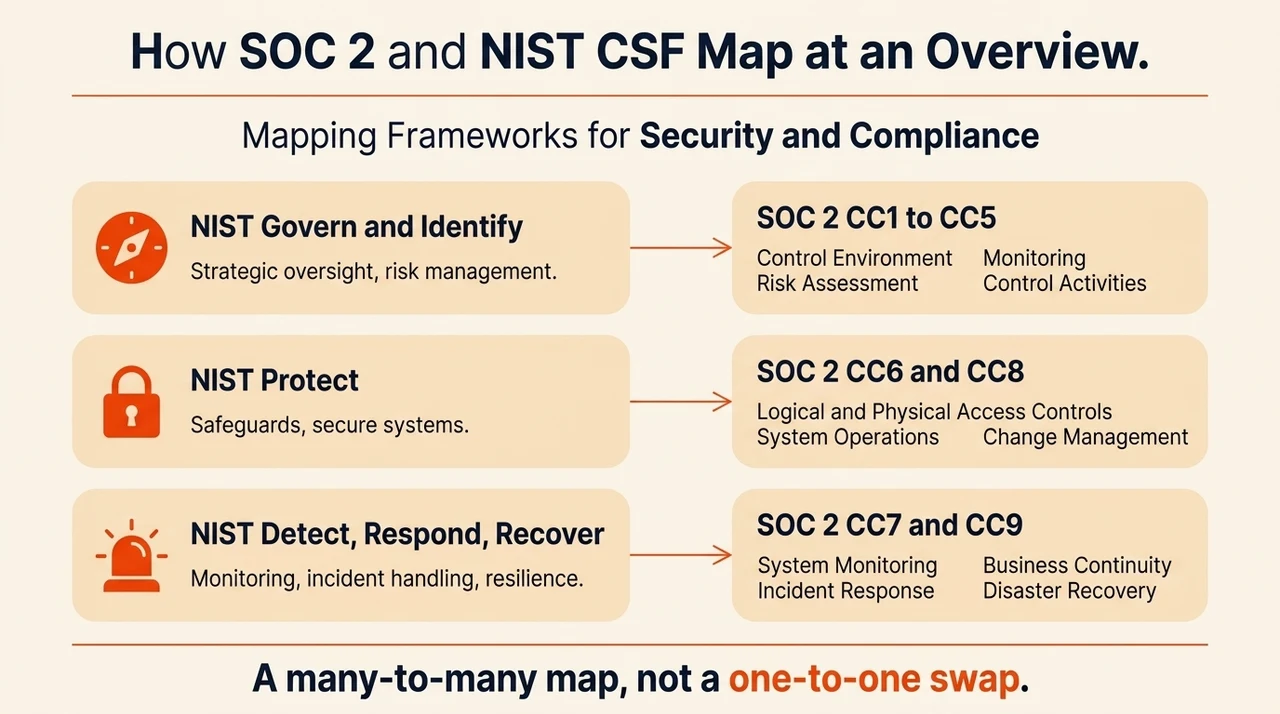
Mapping Framework Structures
Start by matching Trust Services Criteria to CSF functions and categories — the mapping is many-to-many, since one CSF subcategory can correspond to multiple SOC 2 criteria and points of focus. The AICPA publishes crosswalk spreadsheets mapping the 2017 Trust Services Criteria to NIST CSF, and CSF 2.0's own informative references tie subcategories to standards like ISO 27001 and NIST SP 800-53.
At the overview level: Govern and Identify map primarily to SOC 2 CC1–CC5 (control environment, communication, risk assessment, monitoring, control activities) and the category-specific criteria for risk governance. Protect maps to CC6 (logical and physical access), CC8 (change management), and the category-specific criteria for availability, processing integrity, confidentiality, and privacy. Detect, Respond, and Recover correspond to CC7 (system operations) and CC9 (risk mitigation) — both frameworks expect evidence of event handling and mitigation, with CSF emphasizing continuous monitoring and SOC 2 expecting the evidence trail.
One strong security posture covers SOC 2 and NIST CSF.
Share your work email and we'll help you build a control set that satisfies both frameworks at once.
Example Correspondence Scenarios
Linford & Company gives a clean example: NIST CSF Protect (PR.AC-1), which calls for issuing, managing, and revoking credentials, corresponds directly to SOC 2 CC6.1 on logical access security and CC6.2 on user registration. The mapped control needs to: issue credentials to authorized users and devices, remove access when it's no longer needed, and periodically review access appropriateness. One credential management process satisfies both PR.AC-1 and the SOC 2 access controls simultaneously. Similar correspondences hold for backup and recovery (CSF RC.BC; SOC 2 A1.3), incident response (CSF RS.CO; SOC 2 CC7), and risk assessment (CSF ID.RA; SOC 2 CC3).
Tools and Resources for Mapping
The AICPA's own crosswalk spreadsheets map the 2017 Trust Services Criteria to NIST CSF directly. CSF 2.0's informative references link subcategories to ISO 27001 and NIST SP 800-53. Community tools like the Secure Controls Framework and the Cloud Security Alliance's CCM provide broader crosswalks across multiple frameworks at once, and compliance platforms like Konfirmity maintain their own mapping libraries with automated evidence collection built in. Using existing tools instead of rebuilding the correspondence from scratch is what keeps this project from turning into its own multi-month effort.
Practical Steps to Build Your Mapping
Perform a Gap Analysis
List every SOC 2 control and NIST CSF subcategory relevant to your organization, then identify overlaps and gaps — you might already have strong access control covering NIST PR.AC and SOC 2 CC6, but no documented incident response procedure at all. Work through each CSF function asking how existing controls map to SOC 2 criteria, and record every gap as a remediation project. A structured gap analysis like this typically shortens the readiness phase by 2–3 months compared to an ad hoc approach.
If your organization also needs to align with NIST SP 800-53 (common for federal contractors or FedRAMP-adjacent vendors), NIST publishes an official crosswalk between CSF 2.0 outcomes and SP 800-53 Revision 5 controls in its CSF Informative References catalog — use that as your starting map rather than rebuilding the correspondence from scratch.
Create a Mapping Matrix
Build a spreadsheet or use a compliance platform with columns for: CSF Function (e.g., Protect), Category (e.g., Identity Management), Subcategory (e.g., PR.AC-1); the corresponding SOC 2 Criterion (e.g., CC6.1) and its points of focus; Implementation status (planned, in progress, in place); and Evidence (policy documents, system settings, logs). This matrix becomes your living record — the single document you hand an auditor to show exactly how each control satisfies both frameworks at once.
Free spreadsheet
The SOC 2 to NIST CSF Mapping Matrix
Get the free spreadsheet mapping every SOC 2 control to NIST CSF, with example rows already filled in. Enter your work email and we'll send it.
Prioritise Based on Risk
Use your enterprise risk profile to prioritize the controls that matter most to your customers and your own posture. Storing sensitive health data pushes confidentiality and access control to the top; a mission-critical service pushes availability and incident response ahead of everything else. Scoring by data sensitivity, likelihood of attack, and regulatory impact is what keeps the mapping project from trying to fix everything at once.
Maintain Updated Documentation
Frameworks move. NIST released CSF 2.0 in February 2024, and the AICPA updates points of focus periodically. Assign an owner per control, schedule regular reviews, and update the mapping matrix and its evidence whenever either framework changes — consistent maintenance is what prevents the last-minute scramble that turns a mapping project into an audit liability instead of an asset.
Using Mapping to Support Audit Readiness
Building Audit Evidence
A well-mapped control set means you collect evidence once and reuse it everywhere instead of building separate evidence sets per framework. System access review logs satisfy both CSF PR.AC and SOC 2 CC6.1 simultaneously; incident response playbooks support CSF RS.CO and SOC 2 CC7 at the same time. Evidence needs to cover both design (policies, diagrams) and operation (system logs, change tickets, access reviews) — auditors move faster, and read more maturity into the program, when the mapping matrix is what they're handed first.
Streamlining Multi-Framework Reporting
Companies frequently need reports across SOC 2, ISO 27001, HIPAA, or GDPR at once, and mapping is what lets a single control set and evidence base satisfy all of them instead of quadrupling the audit workload. The AICPA permits "SOC 2+" examinations, where an auditor evaluates additional criteria (NIST CSF subcategories, say) alongside the standard Trust Services Criteria and documents the correspondence directly in the report — a single deliverable that demonstrates alignment with multiple standards to an enterprise buyer at once.
Free implementation guide
Free Download: The NIST CSF Implementation Guide
A walkthrough of CSF 2.0 including the new Govern function, the seven-step implementation process, Tiers, and a Current and Target Profile worksheet, just enter your work email.
Real-World Examples and Use Cases
Crosswalk Example: Credential Management
A SaaS provider implementing identity and access management runs into this directly: NIST CSF's PR.AC-1 requires issuing and managing credentials with regular audits of authorized devices, users, and processes, while SOC 2's CC6.1 requires logical access security software and infrastructure, and CC6.2 requires registering and authorizing users with access removed when no longer needed. One process — centralized identity lifecycle management with periodic access review — satisfies all three requirements at once. In practice this looks like integrating an identity provider (e.g., Okta) with HR systems, automating provisioning and deprovisioning, running quarterly access certifications, and capturing evidence directly from the provisioning logs and certification reports.
Use Case: Enterprise SaaS Vendor Responding to an RFP
A mid-size SaaS company selling into financial institutions gets an RFP with hundreds of security questions spanning NIST CSF functions and SOC 2 criteria. With a mapping matrix already built, each NIST subcategory points straight to specific controls and evidence, with the corresponding SOC 2 criteria backing it with independent attestation — for CSF DE.CM on continuous monitoring, the vendor cites logs, SIEM dashboards, and SOC 2 CC4, then attaches the SOC 2 Type II report plus the mapping appendix when the buyer asks for proof. The sales cycle shortens because the answer is already assembled, not improvised.
Use Case: Audit Preparation
Audit preparation is where multi-framework mapping pays off most directly: an e-commerce provider carrying SOC 2 Type II, ISO 27001, and HIPAA obligations at once would otherwise need three separate evidence sets, tripling the workload and the risk of inconsistency between them. A mapping matrix linking SOC 2, NIST CSF, and ISO controls together means the same vulnerability management process addresses ISO 27001 Annex A 8.8, NIST CSF PR.IP-12, and SOC 2 CC7 simultaneously — clients running this way commonly cut annual audit prep from 550–600 hours to around 75, and the observation window itself from 9–12 months down to 4–5, because controls are implemented sooner and evidence accumulates continuously instead of getting reconstructed before each audit.
Challenges and Best Practices
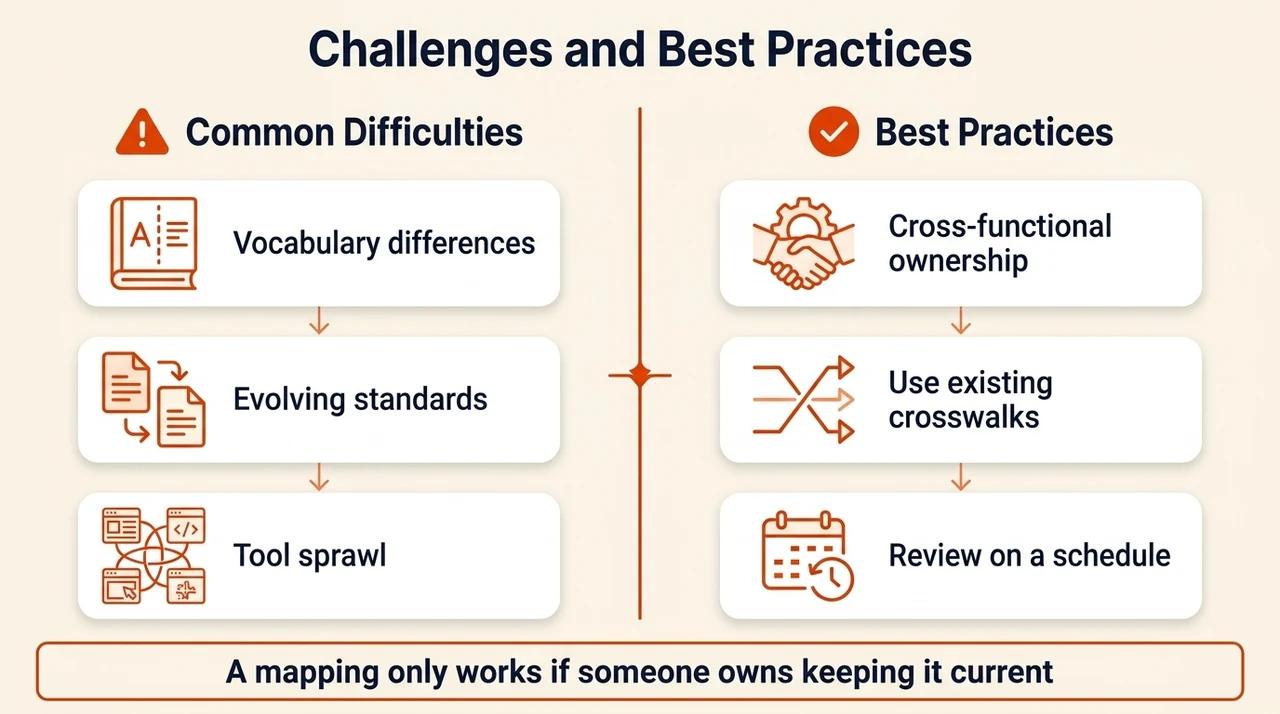
Common Difficulties
The common difficulties in maintaining a mapping are predictable and worth planning for upfront:
- Vocabulary differences. SOC 2 talks about "control environment" and "points of focus"; NIST CSF talks about "functions" and "subcategories." Someone has to translate consistently, or the mapping drifts.
- Evolving standards. CSF 2.0 added the Govern function and reshaped categories; the AICPA periodically updates its points of focus. A mapping that isn't revisited goes stale fast.
- Evidence granularity mismatches. SOC 2 Type II demands continuous evidence over an observation period; NIST CSF specifies no observation window at all. The mapping has to satisfy SOC 2's stricter bar, not NIST's looser one.
- Tool sprawl. Without a central platform, evidence scattered across cloud providers, code repositories, and identity systems turns into a manual assembly job every time.
Best Practices
These best practices are what separate a mapping that stays useful from one that goes stale within a quarter:
- Bring security and compliance in together, early. Cross-functional ownership from the start means everyone actually understands both frameworks, not just their own half.
- Start from existing crosswalks, not a blank sheet. AICPA and NIST publish pre-built mappings; community crosswalks and compliance platforms cut the manual work further.
- Review the mapping on a schedule, not by accident. Revisit it after every framework update or material change to your environment — a new cloud service, a new region.
- Tie mapping outcomes to business goals, not just the audit. The point is better security and faster sales, not merely passing — build the mapping to reflect that.
- Prioritize by risk, consistently. Fix the controls that reduce the highest-impact risk first, and let that same ordering apply across both frameworks at once.
Turn your NIST CSF work into SOC 2 evidence
Book a demo and we'll show how Konfirmity keeps your crosswalk current and collects evidence once, so an RFP asking about either framework gets the same answer.
Book a demo
Frequently Asked Questions
Mapping SOC 2 controls to NIST CSF helps you build a risk-based security program while satisfying audit requirements at the same time. It cuts duplicate work, supports continuous monitoring, and gives auditors and buyers a shared language for the same underlying controls.
They overlap heavily in access control, risk assessment, monitoring, incident response, and governance. SOC 2 is criteria-based and requires evidence over an observation period; NIST CSF is outcome-based and flexible, with no fixed observation window.
Yes. Mapping lets you reuse the same controls and evidence across frameworks instead of rebuilding it per framework — Konfirmity clients typically save under 70 hours a year on evidence collection this way and cut readiness time from 9–12 months to 4–5 months.
Track framework updates as they happen, revise the matrix, and keep documentation in step with both evidence and audit schedules. Assign a control owner, schedule periodic reviews, and lean on automated tools and crosswalk templates to stay current rather than re-deriving the mapping from scratch each time.
No. SOC 2 is based on the AICPA's Trust Services Criteria, an independent standard. NIST CSF is a separate, voluntary framework. The two overlap heavily in practice (access control, risk assessment, monitoring, incident response), which is why mapping one to the other is useful, but SOC 2 was not built on top of NIST CSF.
NIST SP 800-53 is a detailed catalog of hundreds of specific security controls, originally built for federal information systems. SOC 2 is a higher-level attestation report built around five Trust Services Criteria. Organizations that need both typically use 800-53 as their control catalog and SOC 2 as the customer-facing report, mapping between the two rather than choosing one.
Conclusion
For enterprise vendors, SOC 2 is often the entry ticket to doing business at all — but compliance alone isn't the whole story. The global average cost of a data breach reached a record $4.99 million in 2026, up 12% year over year according to IBM's 2026 Cost of a Data Breach Report, and buyers increasingly want proof of a real security program, not just polished documentation. Mapping SOC 2 controls to NIST CSF bridges exactly that gap: it combines SOC 2's attestation power with NIST CSF's risk-based structure, cutting duplication, sharpening audit readiness, and giving everyone from engineers to auditors to buyers the same underlying language for the same controls.
Konfirmity's approach starts with security and arrives at compliance — implementing controls inside your stack and operating them year-round rather than just advising from the sidelines. Clients building a single control set mapped to both frameworks cut readiness time roughly in half and reduce annual effort by hundreds of hours. Security that looks good on paper but fails under pressure is a liability; build the program once, run it daily, and let compliance follow.