
Most enterprise buyers now request assurance artifacts before procurement, and deals stall without operational security and continuous evidence. A compliant information security management system (ISMS) must be battle‑tested during actual incidents. This ISO 27001 Breach Notification Guide explains why managing breaches is essential and how to design a real‑world notification program. Drawing on more than 6,000 security audits and decades of delivery expertise at Konfirmity, it connects standard requirements with legal obligations and enterprise expectations. The IBM 2024 Cost of a Data Breach report found the average cost of a breach reached USD 4.88 million—a reminder that poor preparation can lead to unplanned losses, delayed deals, and customer attrition. The following sections provide practitioner insights on building a notification framework that satisfies auditors and buyers.
What the term “ISO 27001 Breach Notification Guide” means in practice
At its core, ISO 27001 is an international framework that helps organizations manage information security risk through an ISMS. While the standard doesn’t set external reporting deadlines, it requires processes for identifying, reporting and handling incidents. An ISO 27001 Breach Notification Guide translates these principles into operational practices: classifying incidents, triggering internal and external notifications, documenting evidence and lessons learned, and linking these actions to the appropriate Annex A controls. For enterprise suppliers, this guide is more than a checklist—it’s a blueprint for maintaining customer trust and regulatory compliance in the face of disruption.
What ISO 27001 Says About Incident and Breach Management
ISO 27001:2022 emphasises the need for a structured approach to security events. Annex A Control 5.24 (previously A.16.1) sets the objective “to ensure a consistent and effective approach to the management of information security incidents, events and weaknesses”. This control demands that organizations establish responsibilities, detection mechanisms, reporting routes, classification criteria, response procedures and post‑incident learning. Sub‑controls describe planning, monitoring, detection, logging, forensic evidence collection and escalation. Industry guidance notes that effective incident management requires standardised reporting, trained personnel and continuous improvement. Published guidance adds that an incident programme should include stages such as identification, prioritisation, containment, investigation, response and follow‑up, emphasising evidence collection and chain of custody.
Breach notification sits within this incident cycle. The ISMS should define how to identify whether an event qualifies as a breach, who must be alerted, and how quickly. Notifications are not limited to regulators; they include internal teams, customers and partners. A structured process ensures that evidence is preserved and that lessons from one incident improve future resilience. In modern updates, ISO 27001 cross‑references controls on external communications, legal and regulatory requirements, and supplier relationships, reminding teams that breach notification is intertwined with risk management, privacy and business continuity.
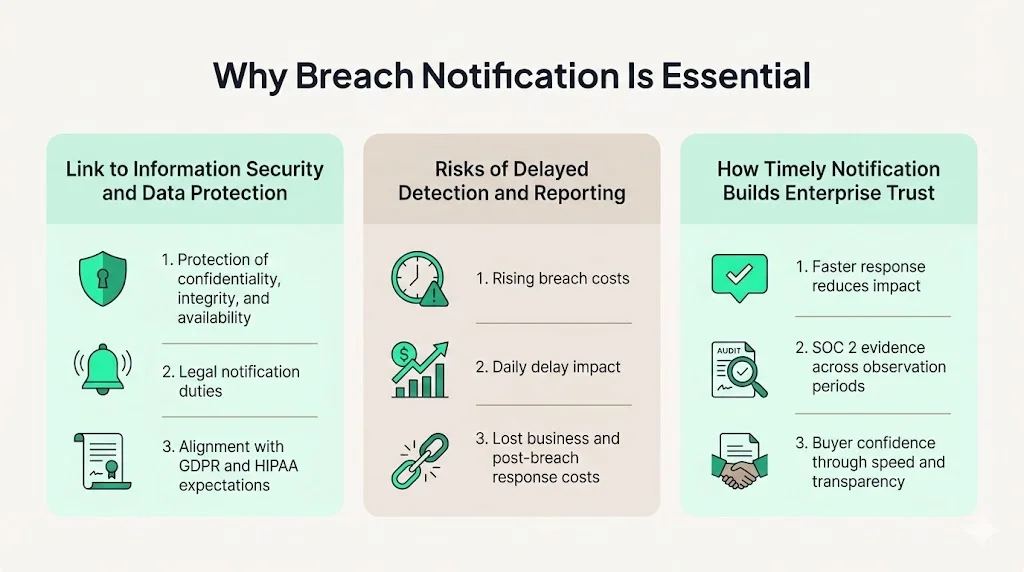
Why Breach Notification Is Essential
1) Connection to information security and data protection
A breach is an incident where confidentiality, integrity or availability of information is compromised. Effective notification protects affected individuals and satisfies legal obligations. Poor incident response undermines trust and invites regulatory penalties. The GDPR, HIPAA and sector‑specific rules all impose notification requirements, so a strong programme ensures the ISMS aligns with these obligations.
2) Risks associated with poor incident response and delayed reporting
Delays are costly. IBM’s 2024 study reported that the global average cost of a data breach rose to USD 4.88 million, the largest increase in a decade. Lost business and post‑breach activities accounted for USD 2.8 million. Teramind’s research shows that every day of delayed detection adds about USD 10,800 to breach costs. Companies that educate customers and provide identity protection see 35 percent less churn, and organisations with mature security programmes experience 63 percent lower breach costs. Stated differently, prompt detection and notification reduce financial impact and preserve brand reputation.
3) How proper notification lowers impact and supports enterprise trust
Fast, transparent notification demonstrates accountability. Under SOC 2 Type II, auditors examine evidence across a three‑ to twelve‑month observation period; delays or incomplete documentation can result in findings that hinder sales. Microsoft’s own incident management policy commits to notifying affected customers within 72 hours of a confirmed breach and providing mitigation details, reflecting buyer expectations for clarity and speed. Timely notification thus signals that your security programme is operational—not just documented—and this readiness directly influences enterprise procurement decisions.
Regulatory Environment and Legal Obligations
This section of the ISO 27001 Breach Notification Guide clarifies how international regulations shape notification timelines and content. Understanding these obligations is essential for building a compliant programme that satisfies both the standard and the law.
GDPR, HIPAA and other regulations
Regulations impose specific reporting timelines. Article 33 of the General Data Protection Regulation (GDPR) requires controllers to notify the supervisory authority within 72 hours of becoming aware of a personal data breach. Notifications must include details about the nature of the breach, the number of data subjects and records affected, potential consequences and mitigation measures. HIPAA’s breach notification rule mandates that individuals be notified without unreasonable delay and no later than 60 days after discovery. When a breach affects more than 500 residents, notice must also be provided to prominent media outlets within 60 days; covered entities must inform the Secretary of Health and Human Services within 60 days, and business associates must notify the covered entity within 60 days. These rules emphasise that external reporting may involve authorities, individuals and other parties.
Differences between ISO requirements and external legal rules
ISO 27001 specifies process requirements but doesn’t prescribe exact notification deadlines or recipients. Legal rules set mandatory timeframes and content. For instance, the GDPR’s 72‑hour rule is strict and includes specific fields; HIPAA allows up to 60 days but requires individual notices. SOC 2 assessments don’t create legal obligations, but the observation period requires evidence of real operations. NIST SP 800‑61r3 notes that organizations should coordinate notifications, follow established procedures on what to report and when, and comply with current laws and regulations. When building your programme, map each ISO control to applicable legal obligations and verify that internal processes meet or exceed regulatory timelines.
Importance of mapping ISO 27001 controls to compliance requirements
Aligning your ISMS with laws prevents gaps. For example, Annex 5.24 requires establishing responsibilities, classification and escalation criteria; GDPR may require notifying regulators within 72 hours and providing details. SoA (statement of applicability) should indicate which controls address data protection laws. Integration ensures that incident response, privacy and legal teams work from the same playbook. Without this mapping, teams may comply with ISO audits while failing legal obligations—risking fines and reputational damage.
Building Your Breach Notification Framework
The ISO 27001 Breach Notification Guide outlined below translates control requirements into an actionable framework that supports enterprise readiness and legal compliance.
Konfirmity’s delivery experience shows that successful programmes are designed in advance, with roles, timelines and evidence flows defined. Below is a framework that aligns with ISO 27001 and regulatory obligations.
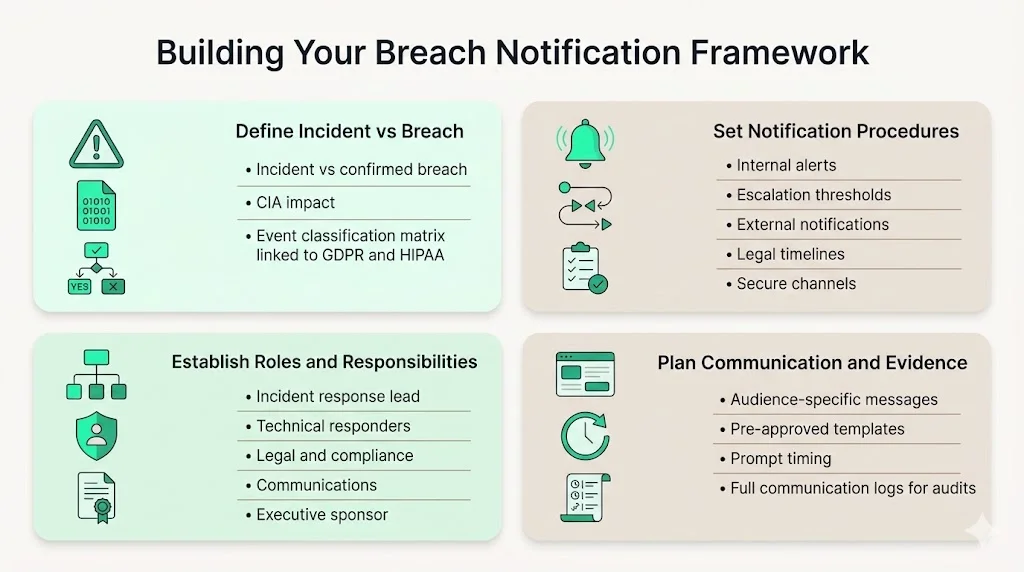
1. Define “Incident” and “Breach”
-
Incident: Any event that compromises or threatens the confidentiality, integrity or availability of information. This includes malware infections, unauthorised access attempts, data loss and service outages. ISO 27001 uses “incident” for a broad range of events, and Annex 5.24 calls for a consistent approach to managing them.
-
Breach: An incident that results in the confirmed disclosure, alteration or loss of personal or sensitive data. Under GDPR and HIPAA, a breach triggers mandatory notifications. Not all incidents become breaches; assessing impact is critical. For example, a firewall alert may be an incident, while an exfiltration of patient data is a breach.
To guide classification, create a matrix that lists typical events (e.g., phishing, ransomware, insider misuse) and whether they constitute a breach. Include cross‑references to legal obligations (e.g., GDPR personal data vs. HIPAA ePHI). Regularly update the matrix as new threats appear.
2. Set Notification Procedures
Define when, how and to whom notifications occur. Procedures should cover:
-
Internal notifications: Specify that the incident response team is alerted immediately via an incident management platform. Include a contact list of roles: CISO, DPO, legal counsel, communications, relevant business units.
-
Thresholds for escalation: Outline criteria for escalating incidents to senior management or the Board. For example, any breach affecting more than 1,000 records or involving sensitive personal data triggers executive involvement.
-
External notifications: Determine which regulators, customers, partners or insurers must be notified. Map legal requirements (GDPR 72 hours; HIPAA 60 days) and contractual obligations. Use templates that capture all required fields (nature of breach, number of records, contact details, mitigation measures).
-
Communication channels: Identify secure methods for notifications, such as encrypted email, secure portals or customer support tickets. Avoid unencrypted channels for sensitive information.
Procedures must be documented in your ISMS and communicated through training. They should be tested annually through tabletop drills or simulated incidents.
Notification speed depends on incident readiness you build today.
Drop your work email and we'll harden your breach response before it matters.
3. Establish Roles and Responsibilities
An incident response programme functions only when everyone knows their role. ISO 27001 Annex 5.24 directs organizations to assign responsibilities for managing incidents. The main roles are:
-
Incident Response Lead: Oversees the programme, coordinates cross‑functional response, ensures procedures are followed, approves communications and reports.
-
Technical Responders: Security engineers and system administrators who analyse logs, contain threats and restore systems. They collect evidence, perform forensic analysis and document actions.
-
Legal and Compliance: Determine whether legal notifications are required, advise on GDPR, HIPAA and contract terms, and liaise with regulators.
-
Communications/Public Relations: Draft and review internal and external messages, coordinate with customers and partners, and manage media interactions. The ISMS platform stresses the importance of strong communication protocols and logging all messages to support regulatory verification.
-
Executive Sponsor: Provides resources, makes high‑impact decisions and ensures lessons learned lead to improvements.
Define a chain of command and escalation points. For example, the Incident Response Lead reports to the CISO, who escalates to the Board if the breach meets critical thresholds. Document these relationships so that hand‑offs are smooth during stress.
4. Communication Planning
Effective communication reduces confusion and maintains trust. Plan in advance:
-
Audience segmentation: Determine messages for internal teams (technical, non‑technical), customers, partners and regulators. Each group needs varying detail.
-
Message templates: Prepare breach notification templates that include required GDPR fields (nature of breach, records affected, consequences and mitigation) and HIPAA content (individual notifications must describe what happened, information involved and steps taken). Having pre‑approved templates accelerates response and reduces legal risk.
-
Timing and tone: Notifications should occur promptly and use plain language. Avoid speculation; communicate known facts, potential risks and steps being taken. Provide contact details for further inquiries.
-
Logging and traceability: Record every communication event. Tools should provide a traceable log of who was notified, when and what was said. This log will serve as evidence for audits and post‑incident reviews.
Step‑by‑Step Breach Notification Process
A systematic process ensures consistency. After an event is detected through automated monitoring or user reports, log it immediately and collect initial evidence. Quickly evaluate scope, severity and impact—consider which systems and data are affected and consult legal counsel to decide whether the incident is a reportable breach. Contain and eradicate threats by isolating affected systems, revoking credentials and applying emergency fixes while preserving evidence. Document actions in an internal report and decide on escalation thresholds.
If a breach is confirmed, notify the appropriate authorities and stakeholders within regulatory deadlines—72 hours for GDPR and up to 60 days for HIPAA—and provide clear, factual information. Log all communications for audit purposes and retain evidence with a clear chain of custody. Finally, conduct a lessons‑learned review to identify what worked, update procedures and integrate findings into the risk management process. Continuous improvement ensures the ISMS matures and auditors can see that incidents lead to concrete changes.
Aligning with ISO 27001 Controls
To operationalise the ISO 27001 Breach Notification Guide, map each part of your framework to specific Annex A controls. The table below illustrates important connections:
Framework Component
ISO 27001 Control (2022)
Description
Incident Planning
5.24.1 – Responsibilities and procedures for managing information security incidents
Requires assignment of roles and development of processes to prepare, detect, report, assess, respond, and learn.
Detection and Monitoring
5.28 – Security monitoring
Calls for mechanisms to detect anomalies and events in a timely manner.
Logging and Evidence
5.10 – Logging
Requires events to be recorded to assist investigations and provide evidence.
Incident Assessment
5.17 – Information security continuity management
Ensures continuity of information processing and sets expectations for assessing impact.
Reporting and Notification
5.34 – Privacy and protection of PII
References applicable data protection requirements and stresses lawful processing and notification.
Post-Incident Learning
5.25 – Lessons learned from information security incidents
Requires periodic reviews and improvements based on incidents and lessons learned.
When auditors ask for the Statement of Applicability, this mapping demonstrates that your breach notification activities are integrated into the ISMS, not bolted on. In practice, controls often overlap; for example, logging supports detection and evidence collection, while security monitoring helps classify incidents. Use the SoA to explain how your programme covers each relevant control and which ones are excluded (with justification).
Tools and Best Practices
A reliable breach notification programme is built on four pillars: technology, training, communication and evidence. Integrated platforms centralise alerts, track remediation and automate notifications; security automation and artificial intelligence can reduce detection time and cut average breach costs by about USD 2.2 million. Regular awareness sessions and realistic drills build muscle memory so that staff can recognise and report incidents quickly. Pre‑approved templates and logging tools provide consistent messaging and audit traceability. Finally, evidence procedures must preserve integrity and a chain of custody. Many organisations partner with managed providers like Konfirmity—drawing on 6,000+ security audits—to implement these elements and reduce the internal burden.
Common Challenges and Pitfalls
Real‑world incident programmes face several obstacles. Teams sometimes view notification as a tick‑box task, relying on templates without rehearsing the process. When a real breach occurs, confusion ensues and deadlines are missed. Unrealistic promises of rapid certification ignore the SOC 2 observation period and the continuous improvement built into ISO 27001. Misclassifying incidents can lead either to under‑reporting (risking fines) or over‑reporting (wasting resources). Finally, incident response spans security, IT, legal and communications; without clear authority and tested hand‑offs, decisions stall. Address these pitfalls by building operational capacity, training teams and clarifying roles.
Metrics and KPIs for Breach Handling
Measuring performance helps improve it. Track the mean time to detect incidents, the time to contain them, and how long it takes to notify internal and external stakeholders relative to legal and contractual deadlines. Analyse incident recurrence and audit findings to identify systemic weaknesses. Reviewing these metrics monthly informs training, resource allocation and continuous improvement.
Audits and Continuous Improvement
Breach notification programmes are scrutinised during internal and external audits. ISO 27001 requires internal audits and management reviews, while SOC 2 auditors examine evidence across the observation period to verify that controls operate effectively. Prepare by maintaining evidence repositories, testing incident response plans regularly and integrating lessons learned into risk management. Continual improvement shows auditors and clients that the programme is living and adaptive while reducing detection time and minimising disruption.
Start the notification clock knowing exactly who does what
Book a demo and we'll show how Konfirmity wires your incident triage, breach decision and notification deadlines to named owners, so the regulator-facing record builds itself as you respond.
Book a demo
Conclusion
A structured breach notification programme is no longer optional. Enterprise buyers, healthcare organizations and regulators expect swift, transparent, and well‑documented responses. ISO 27001 provides the framework, but the real work happens in planning, implementation and continuous operation. The ISO 27001 Breach Notification Guide presented here offers a pragmatic blueprint: define incidents and breaches, establish procedures, assign roles, plan communications, follow a step‑by‑step process, map to controls, monitor metrics, and learn from every incident. With evidence from IBM’s cost of a data breach report, GDPR and HIPAA mandates, and published guidance on incident management, the case is clear: organisations that invest in real security practices minimise losses and build customer trust.
At Konfirmity, we start with security and arrive at compliance. Our human‑led managed service ensures that breach notifications aren’t just documents but lived processes. We don’t simply advise—we execute—deploying controls, monitoring continuously, and assisting with audits. In an era where breach costs are rising and procurement teams demand proof, security that “reads” well but fails under incident pressure is a liability. Build the programme once, operate it daily, and let compliance follow.
This ISO 27001 Breach Notification Guide summarises the essential practices that enterprises need to be ready for incidents and meet buyer expectations.
FAQ
ISO 27001 doesn’t use the term “breach” explicitly; it refers to information security incidents. A breach is generally a confirmed event where data is disclosed, altered or destroyed without authorization. Use Annex 5.24 to establish definitions, responsibilities and procedures and classify incidents accordingly. Legal definitions (GDPR, HIPAA) should guide whether external notifications are required.
ISO 27001 itself does not impose deadlines. Notification timelines come from laws and contracts. GDPR requires regulators to be notified within 72 hours; HIPAA mandates individual notifications without unreasonable delay and no later than 60 days. Many enterprise contracts expect suppliers to notify them within 24 hours of discovery. Aim to detect and classify incidents rapidly so you can meet these obligations.
The standard focuses on internal processes—detecting, reporting and responding to incidents. It doesn’t prescribe external notifications; those are dictated by GDPR, HIPAA and other laws. However, ISO 27001 controls require that communication with external parties be considered and that regulatory and contractual requirements are met.
Enterprise buyers often include security questionnaires, BAAs and DPAs in procurement. They look for evidence of a managed incident programme: defined roles, documented procedures, rapid detection, clear notification timelines, tested communication templates and continuous monitoring. They may ask for SOC 2 Type II reports, ISO 27001 certificates, and proof of compliance with GDPR or HIPAA. Vendors who demonstrate readiness through metrics, logs and strong control design accelerate deals and build trust.