Most enterprise buyers now ask for assurance before procurement. Without real security controls and continuous evidence, deals stall even when teams think they’re ready on paper. Email is central to that challenge. Sensitive data, attachments, financial statements and intellectual property flow through corporate inboxes. An attacker needs only one misdirected message to gain a foothold. IBM’s 2025 Cost of a Data Breach report found the average breach costs about USD 4.88 million, while downtime can reach USD 9 000 per minute. Phishing campaigns are also exploding — the 2025 Hoxhunt report notes that the human element plays a role in 68% of breaches and 80–95% are initiated by phishing attacks. Attacks that bypass filters have increased by more than 4,151% since 2022.
In this context, ISO 27001 Email Security For ISO 27001 is not a checkbox. It’s a vital operational capability that underpins trust with enterprise clients and healthcare buyers. As the founder of Konfirmity, I’ve spent over 25 years helping companies secure their infrastructure and close deals that depend on evidence, supporting thousands of audits along the way. This article explains what ISO 27001 requires, how Annex A.13 tackles communications, and how to build email controls that stand up to auditors, buyers and attackers.
What is ISO 27001 and why email security matters
ISO/IEC 27001 is the world’s most widely recognised specification for information security management systems. The ISO website explains that the standard defines requirements for establishing, implementing, maintaining and continually improving an ISMS. It helps organisations manage risks related to the security of data and promotes a holistic approach — vetting people, policies and technology. Implementing an ISMS protects confidentiality, integrity and availability by applying a risk management process.
The 2022 revision of ISO 27001 introduces 93 controls organised into four themes: organisational (37 controls), people (8), physical (14) and technological (34). These controls offer a portfolio from which organisations select relevant measures, and they sit on top of mandatory clauses 4‑10 covering context, leadership, planning, support, operation, performance evaluation and continuous improvement. Clause 6 focuses on risk management and requires defining risk criteria and treatment plans; Clause 7 mandates resources, training and awareness; Clause 8 requires executing risk treatment plans and maintaining evidence; Clause 9 covers performance evaluation via internal audits and metrics; and Clause 10 demands corrective actions and continual improvement. Together they ensure an ISMS is not just designed but operated and matured over time.
Why does email communication need special focus?
Email is a primary communication channel for businesses of all sizes. Confidential data, personally identifiable information, trade secrets and contracts routinely cross company boundaries. Attackers exploit this ubiquity. According to Hoxhunt’s 2025 report, the human element is present in 68% of breaches and 80–95% of those start with a phishing email. The same report notes that business email compromise (BEC) affected 64% of organisations in 2024, with typical losses of around USD 150 000 per incident. Phishing websites increasingly use HTTPS certificates to appear legitimate—about 80% of phishing sites in 2024. AI‑powered impersonation attacks have risen 15% and QR‑code phishing (“quishing”) increased 25%.
These statistics illustrate why ISO 27001 Email Security For ISO 27001 should be treated as a core discipline rather than an afterthought. The phrase refers to aligning your email practices with the standard’s requirements so you can safely exchange sensitive information while meeting enterprise and healthcare procurement demands.
These figures highlight why protecting email aligns with ISO 27001’s aim of preserving confidentiality, integrity and availability. Enterprise buyers expect to see controls for encryption, access management, monitoring and incident response. Aligning email practices with ISO 27001 demonstrates a risk‑based approach and gives partners confidence that sensitive data is handled securely. Without it, procurement questionnaires and security addenda can delay or derail deals.
CTA: Book a demo
How ISO 27001 and Annex A address communications and email security
Communications security under Annex A.13
To build ISO 27001 Email Security For ISO 27001, you must understand how the standard treats communications. Annex A.13 is the focal point for protecting networks and electronic messaging.
Annex A.13 deals explicitly with communications security. One industry analysis describes communications security as a broad subject covering hardware, software, procedures and people to safeguard the transfer of information. It applies to information stored, transmitted over networks or via electronic messaging, and it extends to third parties interacting with an organisation’s systems. The objective of A.13.1 — network security management — is to protect networks and information processing facilities. This includes network controls, secure configuration of network services and segregation of networks. Firewalls, access lists and segmentation help isolate critical systems, while endpoint verification and monitoring detect intrusions. A.13.1.2 emphasises defining security protocols and service levels in network agreements, and A.13.1.3 advocates network segregation, dividing networks into domains based on trust and function.
The second part of Annex A.13 focuses on information transfer. A.13.2.1 requires policies and procedures for the secure transfer of data. A.13.2.2 ensures that agreements with external parties explicitly state confidentiality and integrity obligations. A.13.2.3 addresses electronic messaging; it requires that digital messaging systems be protected from cyber threats and adhere to policy criteria for content. Encryption, masked communication and monitoring are called out as necessary safeguards. Finally, A.13.2.4 requires confidentiality or non‑disclosure agreements to protect data when third parties handle it.
How email security relates to the wider ISO 27001 structure
Communications controls do not exist in isolation. Annex A’s 93 controls span organisational, people, physical and technological themes. Email security intersects with several of them: access and identity management limit who can send or read sensitive messages; logging and monitoring enable detection and response; supplier management ensures vendors uphold confidentiality; and incident management guides the handling of phishing, data leaks and account compromise.
Implementing email security therefore fits within the ISMS scope defined in Clause 4, risk management under Clause 6, resource allocation and training under Clause 7, operational execution under Clause 8, performance evaluation under Clause 9 and continuous improvement under Clause 10. A solid ISMS weaves email security into policies, procedures and evidence collection instead of treating it as an afterthought.
Implementing ISO 27001‑compliant email security: key steps and best practices
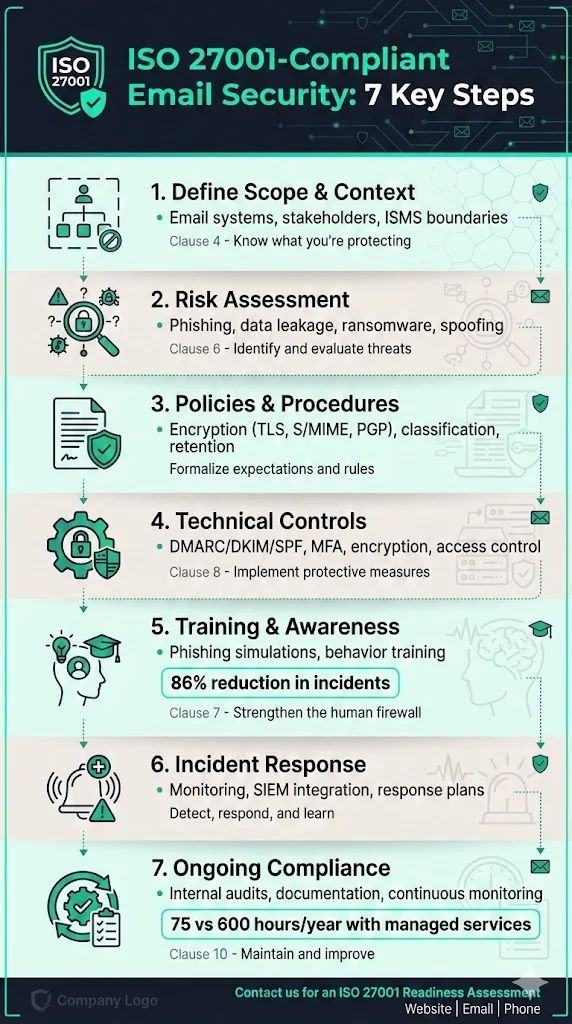
1. Define scope and context (Clause 4)
Start by defining which email systems fall under your ISMS. Clause 4 requires organisations to describe their purpose and scope and identify stakeholders and their security expectations. For email, this includes internal mail servers, cloud email platforms (e.g. Microsoft 365, Google Workspace), mobile devices, third‑party mail services, and interfaces with customer relationship management (CRM) or ticketing systems. Understanding the scope helps auditors assess effectiveness and ensures you don’t leave gaps. Include enterprise clients, healthcare partners, regulators and employees as interested parties. Stakeholders expect confidentiality and reliability; your scope statement should reflect those obligations and define boundaries.
When implementing ISO 27001 Email Security For ISO 27001, the scope statement anchors which mail servers, devices and processes you will protect and document. Being explicit prevents overreach and allows you to prioritise high‑impact channels first.
Lock down email threats first, and ISO 27001 compliance follows naturally.
Drop your work email and we'll harden your communications controls for audit.
2. Conduct a risk assessment (Clause 6)
Clause 6 mandates a documented risk management process. Identify threats such as data leakage, unauthorised access, interception of messages, phishing, spoofing, ransomware delivered via email and misdelivery. Evaluate likelihood and impact. Use methods such as CVSS scores for vulnerability ranking and business impact assessments for financial and reputational harm. The Hoxhunt statistics on rising phishing trends and industry identification of financial and reputational risks provide context. Consider how remote work, mobile devices and multi‑channel messaging expand the attack surface. Determine which Annex A controls apply (A.13 for communications, A.5 for access control, A.8 for encryption and logging) and whether additional safeguards (e.g. secure email gateways, data loss prevention, domain‑based message authentication, reporting and conformance [DMARC]) are needed.
Robust analysis sits at the heart of ISO 27001 Email Security For ISO 27001, because it links specific threats to measurable controls. Demonstrating this connection to auditors and buyers builds credibility and ensures you invest resources where they matter most.
3. Establish email security policies and procedures
Policies formalise expectations and create enforceable rules. Document acceptable email use, including what types of information may be sent, classification labels and retention periods. Specify encryption requirements for sensitive emails (use of TLS for transport, S/MIME or PGP for end‑to‑end encryption) to align with A.13.2.3. Define how employees should verify recipients, handle attachments, use secure file transfer tools for large or sensitive files, and check for phishing indicators. Include procedures for scanning emails for malware and phishing, verifying external domains and reporting suspicious messages. Policies should require NDAs or confidentiality agreements when third parties handle sensitive email content. Align retention and deletion rules with legal obligations such as HIPAA, GDPR or sector‑specific regulations.
Crafting policies is a central deliverable of ISO 27001 Email Security For ISO 27001. Your policy demonstrates to auditors that you have thought through acceptable use, classification, encryption and third‑party interactions. It also sets the expectations for employees and vendors alike.
4. Implement technical controls: encryption, access control and secure configuration
Technical measures bring policies to life. For in‑transit protection, enable Transport Layer Security (TLS) on mail servers and enforce DMARC, DKIM and SPF to prevent spoofing. For at‑rest protection, encrypt mailboxes and archives. Use role‑based access control to restrict who can send, read or forward classified information, and use multi‑factor authentication for all accounts. Audit logs should record access and administrative actions, aligning with Annex A.8.16.
Network controls under A.13.1.1 call for firewalls, endpoint verification and segmentation; ensure your mail servers reside in a segmented network and apply secure configuration standards. If you rely on cloud email, evaluate providers’ security commitments and ensure they support encryption and access logs. Clause 8 requires maintaining evidence that you implemented and operated these controls.
5. Awareness, training and human controls
Clause 7 mandates training and awareness to ensure everyone understands their role. Employees remain the weakest link, so combine phishing simulations with regular reminders on how to recognise malicious messages. Hoxhunt reports that behaviour‑based training can reduce incidents by 86% in six months. Encourage reporting of suspicious emails and reinforce confidentiality obligations through NDAs.
6. Incident response and monitoring
Incidents will occur despite preventive controls. Develop a response plan covering email‑specific threats such as account compromise, phishing and data leaks. Define roles, escalation paths and communications channels, and ensure logging and monitoring capture relevant events. The Verizon DBIR 2025 notes that system intrusion, errors and social engineering are top patterns, reinforcing the need for continuous monitoring. Integrate email alerts with your SIEM and use metrics like time to detect and respond. After incidents, review lessons learned and update controls under Clause 10.
7. Ongoing compliance and audits
Email security should not be a one‑off project. Maintain documentation including policies, risk assessments, treatment plans, incident logs, training records and evidence of control operation. Internal audits should verify that email controls continue to operate as designed and that staff follow procedures. Surveillance audits for ISO 27001 certification will expect evidence over time, similar to SOC 2 Type II observation periods. According to industry guidance, SOC 2 Type II audits typically span 6–12 months. With Konfirmity's security-driven compliance platform, run self-serve or fully managed, our clients achieve ISO 27001 or SOC 2 readiness in about 4-5 months and spend under 70 hours per year on internal tasks, compared with 550-600 hours for a self-managed program. With managed delivery, we handle the continuous monitoring, remediation tracking and auditor coordination so your team can focus on building products.
This long‑term mindset is essential to ISO 27001 Email Security For ISO 27001. Auditors and buyers expect to see evidence across an observation window, not just on the day of certification. By embedding monitoring and review into daily operations, you demonstrate that email security is an ongoing practice rather than a last‑minute scramble.
Common challenges and how to handle them
1) Balancing security with usability
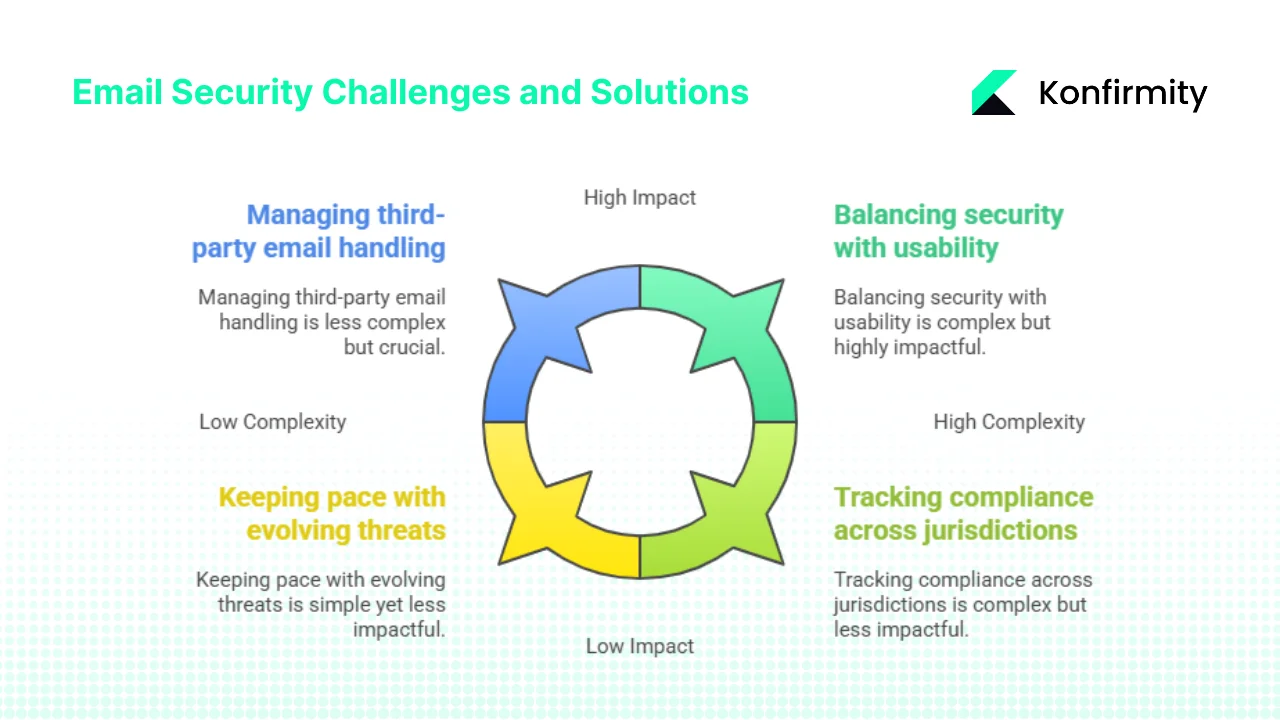
Teams sometimes push back on encryption or strict policies because they worry about productivity. Use user‑friendly secure mail gateways and integrate encryption into mail clients so that sending a secure message feels natural. Remind staff of the real costs of breaches and downtime and emphasise that minor friction is worth the protection.
2) Managing third‑party and vendor email handling
When external vendors handle email, Annex A.13.2.2 requires confidentiality and integrity clauses. Assess vendor security, insist on encryption and strong authentication, and ensure NDAs cover email content. For cloud email providers, review their certifications and include audit and incident‑notification rights in contracts.
3) Keeping pace with evolving threats
Attackers innovate quickly, with phishing surging and ransomware in almost half of breaches. Stay current by reviewing threat intelligence, tuning filters, monitoring DMARC reports and exercising your defences.
4) Tracking compliance across jurisdictions and clients
Enterprises often sell to customers subject to SOC 2, HIPAA, GDPR or sector‑specific regulations. Email security controls must satisfy overlapping requirements, but many ISO 27001 controls align with SOC 2 trust services criteria, HIPAA safeguards and GDPR principles. A well‑documented risk‑based approach allows you to reuse evidence across frameworks and respond quickly to diverse questionnaires.
CTA: Book a demo
Conclusion
Protecting email isn’t optional for enterprises that handle sensitive data or sell to large buyers. The numbers speak for themselves: average breach costs of almost USD 4.9 million and downtime costs of USD 9 000 per minute, while phishing and ransomware remain persistent threats. ISO 27001 Email Security For ISO 27001 provides a framework for managing these risks, but only if you implement the controls holistically. That means defining your scope, assessing risks, drafting policies, deploying encryption and access controls, training your people, monitoring continuously and adapting as threats evolve. Email security is not just a technical exercise; it touches governance, contracts, human behaviour and incident response. Treat email with the same seriousness as your databases and infrastructure. Build controls once, operate them daily and let compliance follow.
Frequently asked questions
1) What is an ISO 27001 email policy?
An ISO 27001 email policy is a formal document within your ISMS that defines how email communications are handled to ensure confidentiality, integrity and availability. It covers acceptable use, data classification, encryption requirements, retention, secure transfer procedures, and third‑party handling. The policy should align with Annex A.13 controls, specify when encryption is mandatory and require confidentiality agreements when sharing sensitive information.
2) What is the ISO 27001 communication policy?
The communication policy under ISO 27001 (part of Annex A.13.2) provides guidelines for transferring information by any means, including email. It requires formal information transfer policies and procedures, agreements with external parties that specify confidentiality and integrity obligations, and safeguards for electronic messaging. The policy should define authorised channels, encryption standards, authentication and verification steps.
3) What is Clause 4.2 of ISO 27001?
Clause 4.2, “Understanding the needs and expectations of interested parties,” requires organisations to identify stakeholders (clients, partners, employees, regulators) relevant to the ISMS and determine their information security requirements. Defining these expectations helps set the scope of the ISMS and informs which email systems and processes must be protected.
4) What are the six key security areas under ISO 27001?
While Annex A organises its 93 controls into four themes, practitioners summarise them into six domains: network security, access control, human resources, physical protection, suppliers and governance. ISO 27001 covers each domain, ensuring a holistic defence that extends to email.