
Most enterprise buyers now require assurance artifacts before signing contracts, and nothing slows a sale like missing proof of operational security. SOC 2 Cookie Compliance brings together two parts of this assurance: having strong internal controls validated by an independent auditor and demonstrating that user data collected through cookies is obtained with proper consent and protected. Rather than treat cookie banners as a superficial legal exercise, forward‑thinking service organizations are aligning cookie management with the same rigorous approach they use for SOC 2. Doing so shortens sales cycles, reduces regulatory exposure and shows customers you operate with integrity.
This article explains what SOC 2 is, how cookies and user consent fit into data protection expectations, the standards to keep in mind, the steps to achieve SOC 2‑aligned cookie compliance, common pitfalls, and why an audited consent management platform (CMP) makes sense. Drawing on Konfirmity's experience supporting over 6,000 security audits as a team with 25+ years of combined expertise, we'll illustrate how a security-driven compliance platform, run self-serve or fully managed, can turn cookie governance into a competitive advantage.
What Is SOC 2?
Service Organization Control 2 (SOC 2) is an attestation framework developed by the American Institute of Certified Public Accountants (AICPA). It is not a certification but an independent auditor’s report on the design and operating effectiveness of a service organization’s controls relevant to five Trust Services Criteria—security, availability, processing integrity, confidentiality and privacy. SOC 2 applies to technology and SaaS providers that handle client data; enterprise customers use these reports to evaluate vendors.
There are two types of SOC 2 reports. A Type 1 report evaluates whether controls are suitably designed at a specific point in time. Auditors look at policies, system descriptions and management assertions but do not test how those controls perform. Type 1 is therefore a “snapshot” of intent. A Type 2 report goes further by assessing the operating effectiveness of controls over a period—typically three to twelve months—which means evidence must show sustained operation. Enterprise buyers prefer Type 2 because it demonstrates not only that controls exist but that they work consistently. The process requires evidence collection (logs, access reviews, change records) and periodic testing by independent auditors.
For context, the Trust Services Criteria include:
-
Security (Common Criteria) – protection against unauthorized access, required for all SOC 2 reports.
-
Availability – systems are operational and usable as committed or agreed.
-
Processing Integrity – system processing is complete, accurate and timely.
-
Confidentiality – information designated confidential is protected.
-
Privacy – personal information is collected, used, retained and disposed of appropriately.
A service organization may include additional criteria beyond security depending on the nature of its services and client expectations. SOC 2 is voluntary, but many enterprise clients and regulated industries make it a contractual requirement because it reduces the burden of individual due‑diligence questionnaires.
How Cookies, Cookie Management and User Consent Tie Into SOC 2 and Data Protection Expectations
Cookies are small text files stored on users’ devices by websites and services. They enable session management, analytics, personalization and targeted advertising. Some cookies are first‑party (set by the site you’re visiting), while others are third‑party (set by external domains). Enterprise buyers care about cookie governance because third‑party cookies can collect personally identifiable information (PII) and share it with unknown vendors, creating data‑protection risks. Regulators now require that users be informed and give consent before non‑essential cookies are set; consent must be freely given, specific, informed and unambiguous.
From a SOC 2 perspective, cookies and consent relate to confidentiality and privacy criteria. Confidentiality requires protecting sensitive internal and client information, while privacy focuses on appropriate collection and use of personal data. Third‑party cookies increase the risk of unauthorized data disclosure or processing outside defined purposes. Auditors will want to see controls that restrict cookie deployment to what is necessary, obtain explicit consent where required and document how consent decisions are enforced. Failing to govern cookies properly undermines security and privacy controls and could lead to increased breach costs—IBM’s 2025 Cost of a Data Breach report found the global average breach cost was $4.44 million, down slightly from $4.88 million in 2024. Healthcare breaches averaged $7.42 million.
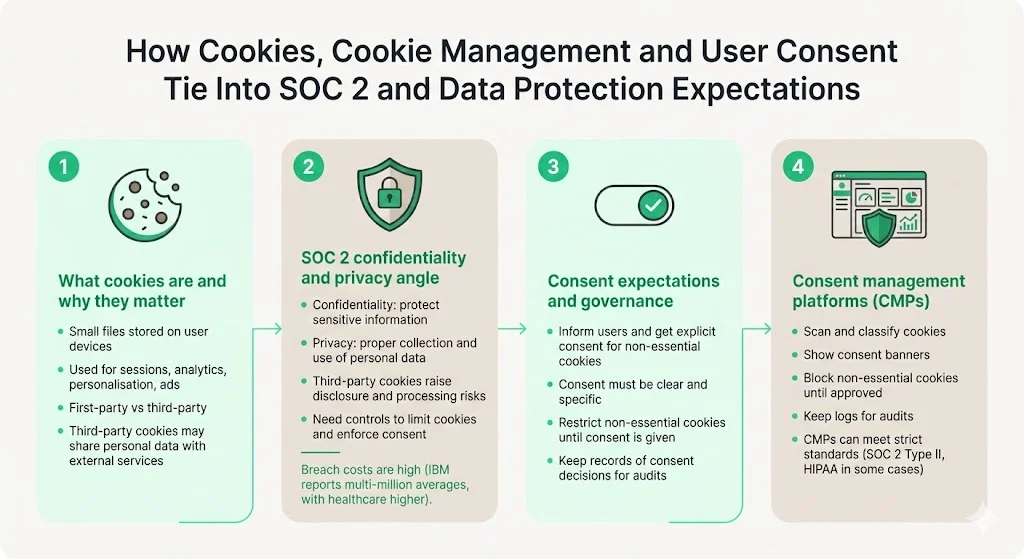
Enterprises use consent management platforms (CMPs) to meet these expectations. A CMP scans the site for cookies, categorizes them (necessary, analytics, marketing), displays consent banners, records user choices, and ensures non‑essential cookies aren’t set until the user agrees. A high‑quality CMP also keeps logs of consent decisions that can be presented during audits. Cookiebot by Usercentrics illustrates this: the company announced in August 2025 that both Usercentrics and Cookiebot achieved SOC 2 Type 2 and HIPAA compliance, confirming that their internal controls comply with the AICPA criteria. Achieving HIPAA compliance—a US healthcare law focused on protecting health information—shows that a CMP can meet strict requirements for data privacy and security.
Understanding the Key Compliance and Security Standards
SOC 2 does not exist in a vacuum. It often intersects with other frameworks and regulations such as ISO/IEC 27001 (information security management), HIPAA (healthcare), and data‑privacy laws like the General Data Protection Regulation (GDPR) in the EU and the California Privacy Rights Act (CPRA). Aligning cookie management with SOC 2 helps you demonstrate due care across these frameworks.
The five Trust Services Criteria provide a structure for controls:
-
Security is mandatory. Controls may include identity and access management, encryption, network segmentation, and monitoring.
-
Availability ensures systems are up and running; organizations may implement disaster recovery and incident response plans.
-
Processing Integrity requires that transactions and data flows are accurate and complete; for cookies this means ensuring consent decisions are accurately recorded and honoured.
-
Confidentiality demands protecting sensitive information from unauthorized disclosure; this includes controlling third‑party scripts and ensuring cookie data is not accessible to unauthorized parties.
-
Privacy addresses the lifecycle of personal data, from collection and processing to retention and deletion.
Cookie management intersects primarily with Confidentiality and Privacy. Data collected via cookies should be minimized, anonymized where feasible, and only shared with trusted processors. Consent logs should be retained according to retention schedules and accessible for audits. If data is used for analytics, processing integrity controls need to ensure that tracking scripts do not misrepresent user behaviour or collect extraneous data.
GDPR and CPRA emphasise user rights: consent must be explicit, withdrawal must be as easy as giving consent, and organizations must maintain audit trails. Violations can result in fines up to €20 million or 4 % of global turnover under the GDPR and up to $7,500 per violation under California’s CPRA. Cookies are often the first touchpoint for data collection, so aligning cookie practices with these standards reduces legal exposure and demonstrates accountability. Moreover, consumer surveys show that trust hinges on data privacy. Cisco’s 2024 Consumer Privacy Survey found that 75 % of respondents said they would not purchase from organizations they don’t trust with their data. Cookie compliance directly influences this trust.
Key Steps: How to Achieve SOC 2: Aligned Cookie Compliance
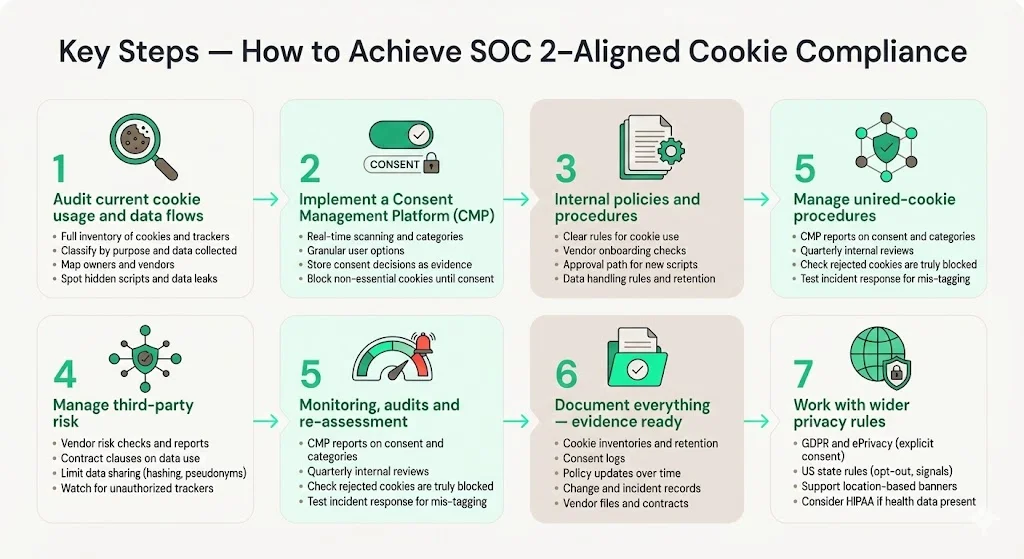
1. Audit Current Cookie Usage and Data Flows
The first step is understanding what cookies your website uses, what data they collect, and where that data goes. Conduct a comprehensive inventory of all cookies—including first‑party and third‑party cookies, as well as other tracking technologies like pixels or local storage. Classify cookies by purpose (essential, performance, analytics, marketing) and document the data fields collected, the retention period, and any third parties receiving the data. This mapping will reveal where sensitive data might be leaving your environment, helping you align with SOC 2 Confidentiality and Privacy criteria.
As part of this inventory, map cookies to system processes and services. Determine who owns each cookie: internal team or external vendor. Identify what contractual and technical controls exist with those vendors. When Konfirmity runs readiness assessments, we often find shadow scripts loaded through tag managers or marketing tools that have not been reviewed by security teams. In our experience, uncovering and remediating these hidden data flows early can reduce audit findings and shorten the readiness window.
2. Implement a Consent Management Platform (CMP)
Deploy a CMP to manage user consent at scale. A good CMP provides:
-
Real‑time cookie scanning and categorization to detect new cookies as marketing or analytics teams deploy them.
-
Consent banners with granular choices, allowing users to opt in or out of specific categories. Interfaces must not nudge users; regulators deem such dark patterns non‑compliant.
-
Consent storage and logs to track when, where and how consent was granted. These logs support audit evidence for SOC 2 Type 2 reports.
-
Integration with tag managers and analytics tools so that cookies are not set until consent is obtained.
Konfirmity often integrates CMPs with incident and change‑management workflows. When marketing teams add new tags, security and compliance are notified to evaluate the vendor’s risk rating, ensure the tag is scoped to appropriate domains, and update the cookie inventory. With this approach, we reduce uncontrolled tag sprawl and maintain consistent evidence.
Cookie compliance starts with real data governance, not just a consent banner.
Share your work email and assess how cookie practices hold under SOC 2.
3. Define and Enforce Internal Policies and Procedures
Policies are the backbone of SOC 2 audits. Draft clear data‑privacy and cookie‑usage policies that specify:
-
When cookies may be used and for what purposes.
-
Procedures for onboarding vendors, including security assessments and contract clauses requiring adherence to your privacy standards.
-
Approval processes for deploying new cookies or tracking scripts. Technical teams should not bypass these processes.
-
Data‑handling expectations: encryption in transit and at rest, pseudonymization/anonymization strategies, and retention schedules.
In our practice, we help clients create a “System Description” that illustrates how cookies fit within their overall data flows and control environment. This document becomes part of the SOC 2 report, giving auditors context about the environment they are assessing and demonstrating management’s understanding of risk.
4. Manage Third‑Party Risk
Third‑party vendors—ad platforms, analytics providers, CDNs—often set cookies or receive data. Under SOC 2, management must monitor and control these relationships. Key actions include:
-
Conducting vendor risk assessments that evaluate the vendor’s security posture and compliance with SOC 2 or equivalent frameworks.
-
Incorporating data‑privacy clauses in contracts that require vendors to use data only for specified purposes, protect it, and delete it when no longer needed.
-
Limiting data sharing to what is necessary. For example, pass hashed identifiers or pseudonymized data instead of raw PII.
-
Monitoring for unauthorized cookies: use the CMP’s scanning reports to detect if a vendor introduces new trackers without notice.
Konfirmity's fully-managed service includes automated vendor intake workflows that use control mapping to evaluate vendor risks against SOC 2 and GDPR requirements. We also use common vulnerability scoring (CVSS) and service level agreements (SLAs) to enforce timely remediation when vendors expose vulnerabilities.
5. Perform Regular Monitoring, Audits and Re‑Assessment
SOC 2 Type 2 attestation requires demonstrating that controls operate over time. Continuous monitoring is essential. Actions include:
-
Using the CMP to generate periodic reports on consent rates, cookie categories and compliance status across domains.
-
Conducting quarterly internal audits of cookie configurations, vendor scripts, and consent logs. Confirm that rejected cookies are not being set and that consent withdrawals are honoured.
-
Reviewing change‑management records to ensure new services go through the cookie approval process.
-
Testing incident response procedures: simulate a mis‑tagging incident to see how quickly the team can disable a rogue cookie.
With Konfirmity's fully-managed service, the observation period for SOC 2 Type 2 typically spans 4-5 months versus 9-12 months for teams managing it alone. Our dedicated experts monitor controls daily, update documentation, and prepare evidence so that auditors can verify effectiveness without surprise findings.
6. Document Everything: Maintain Evidence for Audit Readiness
Auditors rely on documentation to form an opinion. Maintain a living repository of:
-
Cookie inventories, including purpose, owner, data collected and retention.
-
Consent logs and reports from the CMP.
-
Policies and procedures related to cookies, data privacy and vendor management.
-
Change‑management and incident response records involving cookies.
-
Vendor assessments and contracts.
Evidence should cover the entire observation period for Type 2. Use version control to show how policies evolve. At Konfirmity, we provide clients with dashboards showing progress across 64+ control points, linking evidence artifacts to each criterion. This reduces audit prep time by up to under 70 hours per year compared with self‑managed programs and prevents evidence gaps.
7. Align With Other Privacy Regulations
If you serve European residents, your cookie practices must align with GDPR and the ePrivacy Directive: explicit consent for any non‑essential cookie, no pre‑ticked boxes, and the ability to withdraw consent at any time. In the United States, you must navigate a patchwork of state laws. California’s CPRA mandates support for Global Privacy Control signals, a “Do Not Sell or Share My Personal Information” link and clear opt‑out mechanisms. As of 2025, eight additional states introduced privacy laws with varying requirements. A dynamic CMP that can adapt banners based on user location helps ensure compliance. Align cookie practices with broader HIPAA obligations if you handle protected health information; encryption, access controls and audit logs are fundamental. Integrating cookie compliance within your overall ISO 27001 or HIPAA program helps streamline evidence and controls across frameworks.
Challenges and Pitfalls to Watch Out For
Despite best efforts, organizations often stumble when implementing SOC 2 Cookie Compliance. Common pitfalls include:
-
Overlooking Third‑Party Cookies and Vendor Scripts: Marketing or advertising teams can add tags that set cookies without involving security or compliance. These unreviewed scripts may collect personal data and share it broadly, undermining confidentiality. Regular scans and vendor risk assessments mitigate this risk.
-
Incomplete Consent Management: Some CMP implementations still load non‑essential cookies before consent or fail to provide equal prominence to reject options. Regulators consider dark patterns such as hidden opt‑out links or pre‑ticked boxes non‑compliant. Ensure your consent flow respects user choices and logs them.
-
Weak Documentation: Without comprehensive records, auditors cannot assess the design and effectiveness of controls. Failing to document cookie inventories, consent decisions, policy updates or vendor reviews can result in major findings. Invest in maintaining evidence and assign responsibility for documentation.
-
Mixing Cookie Compliance with Regulatory Requirements: Some teams conflate GDPR cookie rules with broader privacy requirements. While SOC 2 is an audit framework, GDPR and CPRA impose specific legal obligations. Understand which rules apply to your audience and design controls accordingly. Using a generic banner across jurisdictions can backfire.
-
Scope Creep: Organizations sometimes attempt to include all Trust Services Criteria in their SOC 2 scope without considering their service architecture. Only include Availability, Processing Integrity, Confidentiality or Privacy if you have controls to support them. Over‑scoping may increase audit findings and effort without adding value.
Case Study: CMP + SOC 2 in Action
A recent real‑world example shows how a CMP can meet stringent audit standards. In August 2025, Usercentrics and its Cookiebot solution announced they had achieved SOC 2 Type 2 attestation and HIPAA compliance. The independent audit confirmed that Usercentrics implemented rigorous internal controls, processes and monitoring mechanisms in accordance with the AICPA Trust Services Criteria. HIPAA compliance demonstrates that the platform protects protected health information as well.
For enterprise customers using Cookiebot, this attestation provides assurance that the CMP’s internal operations—data encryption, access controls, incident response, and consent logging—are audited and meet the criteria for security, availability and confidentiality. Customers can integrate Cookiebot into their own SOC 2 environment with confidence that the underlying consent mechanism is reliable. In procurement cycles, presenting a SOC 2 report from a CMP can shorten due‑diligence questionnaires and reduce vendor risk concerns.
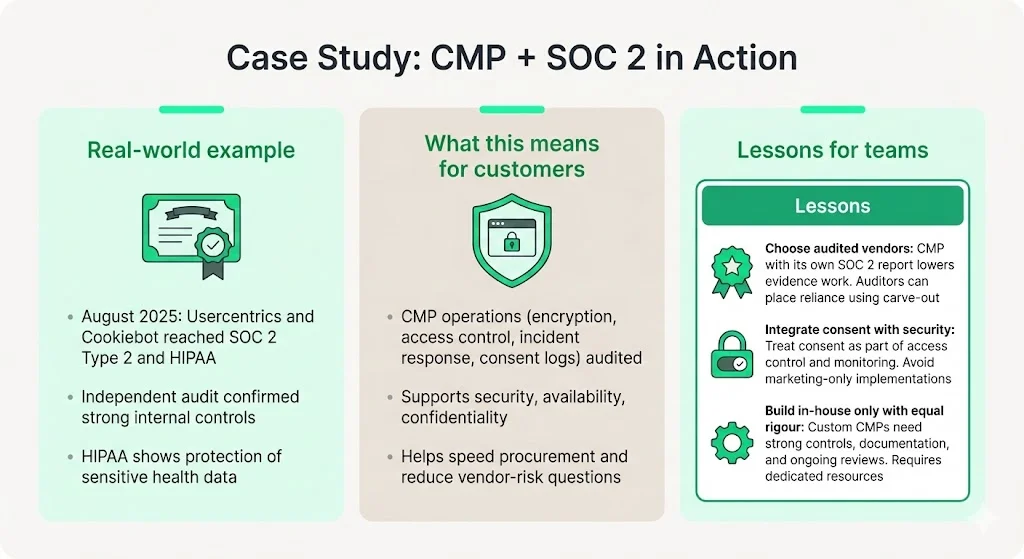
Lessons from this case include:
-
Choose audited vendors: A CMP with its own SOC 2 Type 2 report reduces your evidence burden. When every component of your stack is independently audited, auditors can rely on the subservice’s report under the carve‑out method.
-
Integrate consent with security operations: Usercentrics combined cookie management with HIPAA controls, showing that consent systems can handle sensitive data. Teams should avoid implementing cookie banners as a marketing afterthought and instead integrate them into access control, encryption and monitoring pipelines.
-
Consider building in‑house only if you can match the same rigour: Some organizations prefer to build custom consent solutions. If you go this route, design controls with SOC 2 and privacy requirements in mind, create comprehensive documentation and evidence, and plan for regular audits. Konfirmity has helped companies develop custom CMPs that meet security and privacy criteria, but these projects require dedicated resources and ongoing maintenance.
Why SOC 2 Cookie Compliance Matters for Enterprise‑Client Companies
Enterprise clients expect rigorous security and privacy practices before entrusting vendors with data. A SOC 2 Type 2 report combined with documented cookie compliance signals that your organization treats user data responsibly and can withstand external scrutiny. Neglecting cookie governance is not just a technical misconfiguration—it’s a business risk. Data breaches are expensive; the average global cost of a breach in 2025 was $4.44 million, with U.S. breaches averaging $10.22 million. Non‑compliance with privacy laws can trigger fines up to €20 million or 4 % of global turnover, and 75 % of consumers say they will not buy from companies they do not trust with their data.
SOC 2 Cookie Compliance also reduces sales friction. Procurement teams often send extensive security questionnaires covering hundreds of controls. A current SOC 2 report and clear cookie‑consent documentation can eliminate many questions, accelerating contract negotiations. From Konfirmity’s experience, enterprise sales cycles with completed SOC 2 Type 2 and documented cookie programs close 30–40 % faster than those without. Our fully-managed service typically achieves SOC 2 readiness in 4–5 months, compared with 9–12 months for self‑managed programs, and reduces internal effort from 550–600 hours to under 70 hours per year** by handling control implementation, monitoring and evidence collection.
Finally, cookie compliance is a trust signal. Transparent consent dialogs and the absence of hidden trackers reinforce your brand’s commitment to privacy. With third‑party cookies being phased out and first‑party data strategies gaining importance, adopting a controlled consent framework positions you for a privacy‑preserving future. It also integrates seamlessly with other frameworks: HIPAA for healthcare, ISO/IEC 27001 for information security and GDPR for privacy. By starting with security and arriving at compliance, you not only satisfy audits but build a resilient operation that can respond to evolving threats and regulations.
Make your cookie banner match what your site actually sets
Book a demo and we'll show how Konfirmity keeps your cookie inventory, consent records and third-party tags under review, so the banner is backed by evidence.
Book a demo
Conclusion
SOC 2 Cookie Compliance is not a marketing gimmick; it is a disciplined approach to protect user data and build trust with enterprise buyers. By inventorying cookies, deploying a robust CMP, enforcing policies, managing third‑party risk, monitoring continuously and aligning with multiple privacy laws, organizations can demonstrate that their controls operate effectively. The result is reduced risk of breaches and fines, faster sales cycles, and stronger relationships with customers. Konfirmity is a security-driven compliance platform; run it self-serve, or add the fully-managed service to embed controls into your stack, maintain evidence and support you through audits year-round. Security controls that look good on paper but fail under incident pressure are liabilities; build your program once, operate it daily and let compliance follow.
FAQs
SOC 2 requires service organizations to implement controls addressing the Trust Services Criteria. Security is mandatory; Availability, Processing Integrity, Confidentiality and Privacy are optional based on scope. To achieve compliance, organizations must document their controls, design them to meet the criteria and provide evidence that they operate effectively. For a Type 2 report, controls must operate over a monitoring period; evidence includes logs, access reviews, incident records and change‑management documentation. The AICPA publishes guidance, but external auditors conduct the examination.
The five Trust Services Criteria are Security, Availability, Processing Integrity, Confidentiality and Privacy. Security addresses unauthorized access; Availability covers uptime; Processing Integrity ensures data accuracy and timeliness; Confidentiality protects sensitive information; and Privacy governs the collection, use and disposal of personal data.
No. SOC 2 is voluntary, but many enterprise customers and regulated industries require it as part of vendor due diligence. Having a SOC 2 report simplifies procurement because it provides independent assurance of your controls. Without it, vendors may face lengthy questionnaires and risk losing business to competitors who can prove their security posture.
GDPR is a legal regulation governing personal data protection in the EU. ISO 27001 is an international standard for establishing and running an information security management system (ISMS). SOC 2 is an audit framework developed by the AICPA to evaluate controls relevant to security, availability, processing integrity, confidentiality and privacy. These frameworks are different but complementary. Many organizations implement ISO 27001 for systemic risk management, comply with GDPR for legal obligations and obtain a SOC 2 attestation to provide assurance to customers and partners. Integrating cookie compliance within these frameworks ensures consistent privacy and security across all data handling obligations.