
Most enterprise buyers now request assurance artifacts before procurement. Without operational security and continuous evidence, deals stall. In the context of European privacy law, that assurance typically means a structured GDPR audit. A GDPR audit examines how a company processes personal data, evaluates its privacy controls, and reviews documentation and risk management processes. For companies targeting EU‑based enterprise clients, understanding GDPR audit cost is not optional – it’s a business enabler. This guide explains what constitutes a GDPR audit, why it matters, how costs are split, and how to plan an audit program that stands up to buyer scrutiny without crippling budgets.
What Is a GDPR Audit, and Why It Matters
A GDPR audit is a systematic review of how an organisation processes personal data and how well it follows the General Data Protection Regulation. Auditors look at data mapping and records of processing activities (Article 30), privacy‑by‑design controls, consent management, data protection impact assessments (DPIAs), breach notification procedures, vendor contracts, and staff training. While the GDPR does not explicitly mandate formal audits, Article 42 encourages the establishment of data‑protection certification mechanisms and seals so controllers and processors can demonstrate compliance.
Audits serve several purposes:
-
Initial compliance assessment: A structured review identifies gaps between existing practices and the regulation’s requirements. Organisations launching services in the EU or handling EU residents’ data should perform an audit before go‑to‑market.
-
Periodic reviews: Data systems evolve. Regular audits (often annually) verify that changes have not introduced new compliance risks and provide evidence for renewal of certifications, which last up to three years.
-
Vendor due diligence: Enterprise clients increasingly require vendors to provide documentation of GDPR compliance before signing contracts. A completed audit with a recognised certification or attestation accelerates procurement.
Skipping audits exposes businesses to regulatory penalties, operational disruptions and reputational damage. A 2025 DLA Piper survey reported that EU data‑protection authorities imposed roughly €1.2 billion in GDPR fines in 2024. The same report states that the largest fine under the GDPR—€1.2 billion—was issued to a social media company in 2023. In addition to penalties, the cost of data breaches remains high: the HIPAA Journal summarised IBM’s 2025 Cost of a Data Breach report, noting that global average breach costs were $4.44 million in 2025 and that U.S. healthcare breaches averaged $7.42 million. Enterprise customers know these numbers and will not accept unknown risks in their supply chain.
Components of GDPR Audit Cost (and What You Actually Pay For)
Understanding GDPR audit cost requires dissecting the categories that drive expenditure. These components apply whether you pursue formal certification (e.g., ISO 27701 or Europrivacy), a SOC 2/ISO 27001 attestation that includes GDPR controls, or a customised readiness audit. Costs vary widely based on organisational size, data complexity and the audit method used, but most programmes can be grouped into four buckets.
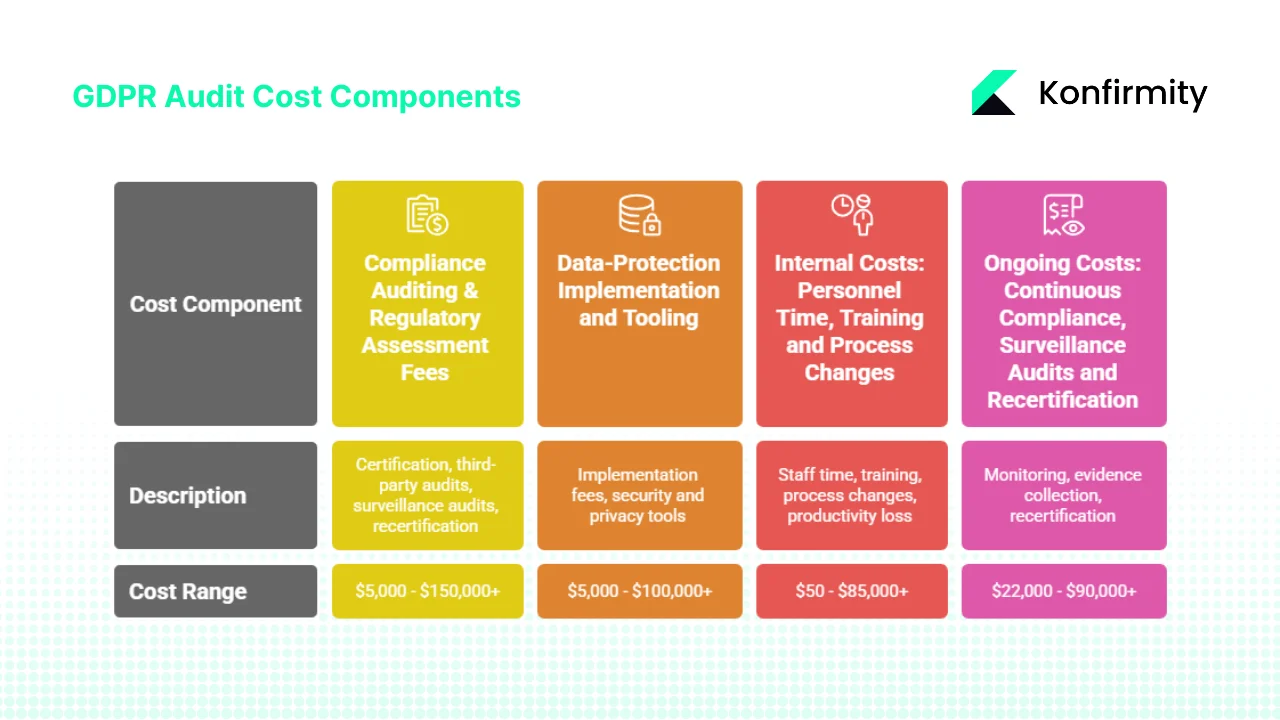
1) Compliance Auditing & Regulatory Assessment Fees
-
Certification or third‑party audit fees: Organisations seeking formal certification pay an accredited body to perform the audit and issue a certificate. Industry guides indicate that these fees typically start around $5,000 and can exceed $25,000 for complex environments. If multiple sites or business units are involved, the fee can climb towards $70,000. A SOC 2 Type II or ISO 27001 certification, which many companies pursue alongside GDPR, may cost $20,000–$150,000 for the audit alone.
-
Surveillance audits and recertification: Certifications generally have a three‑year validity period, but accredited bodies conduct annual surveillance audits to ensure ongoing compliance. These reviews often cost 70–80 % of the initial audit fee.
2) Data‑Protection Implementation and Tooling
-
Implementation fees: Preparing for an audit involves documenting data flows, drafting policies, implementing access controls and consent mechanisms, and remediating gaps. A readiness assessment and gap analysis can cost $5,000–$25,000deepstrike.io. Implementing additional controls or tools may add $10,000–$100,000.
-
Security and privacy tools: Compliance often requires software for consent management, data inventory, encryption, vulnerability management, logging and monitoring. Modern compliance platforms can range from a few thousand dollars per year for startups to $15,000–$50,000+ annually for mid‑size companies.
3) Internal Costs: Personnel Time, Training and Process Changes
-
Staff time: Employees must contribute to data mapping, drafting or updating policies, collecting evidence, and responding to auditor queries. A SOC 2 cost analysis found that readiness assessments and risk assessments alone can run $15,000–$35,000 and that compliance preparation can add $25,000–$85,000 depending on the scope. Those figures represent both external consultancy and internal labour.
-
Training: GDPR requires that personnel handling personal data understand their responsibilities. Ongoing security awareness and privacy training can cost between $50 and $1,000 per employee annually.
-
Process changes and productivity loss: Diverting engineers and operations staff to compliance tasks slows other projects. Effective planning mitigates this by using automation and outsourcing non‑core tasks.
4) Ongoing Costs: Continuous Compliance, Surveillance Audits and Recertification
-
Monitoring and evidence collection: Continuous compliance means you must capture logs, access reviews, and security metrics year‑round. Subscription fees for compliance platforms, vulnerability scans and penetration tests contribute to operational expenditure. DeepStrike’s security audit guide estimates annual maintenance costs at $22,000–$90,000 for SMBs pursuing ISO 27001 or SOC 2.
-
Recertification: Certification validity is limited. When the three‑year period ends, you must repeat the audit; recertification fees are comparable to the initial certification costs.
What Typical GDPR Audit Cost Looks Like: Ranges and Scenarios
Because no two businesses have identical data flows or risk profiles, GDPR audit cost spans a broad range. The figures below combine certification fees, implementation, tooling, and internal labour. They serve as illustrative benchmarks rather than fixed quotes.
| Scenario / company type | Typical audit / compliance cost range | Common characteristics |
|---|---|---|
| Small companies / startups (low data volume / simple processing) | Certification audit ~$5,000–$25,000 plus implementation and tooling ~$10,000–$25,000. Overall, $20,500–$50,000. | Usually have a limited number of systems and simple consent flows. They may pursue a basic Europrivacy seal or SOC 2 Type I attestation. Internal staff handle much of the documentation. |
| Mid-sized companies (moderate data processing, multiple vendors) | Audit fees ~$25,000–$75,000; implementation, controls, training and monitoring bring the first-year cost to $50,000–$150,000. | More complex data flows, legacy systems and several third-party processors require deeper audits and more remediation. Many invest in compliance automation to manage the workload. |
| Large or multi-site enterprises (global operations, heavy data, legacy systems) | Certification and readiness assessments can cost $50,000–$250,000+; remediation may scale into millions depending on system complexity and regulatory scope. | Extensive data processing across multiple jurisdictions means more controls, cross-border transfer assessments and DPIAs. Large firms often coordinate GDPR compliance with ISO 27001, SOC 2 and HIPAA programmes, which increases scope and cost. |
| Ongoing annual compliance (any size) | Recurring costs for tools, monitoring, surveillance audits and recertification vary but can add $22,000–$90,000 per year. | Ongoing costs include annual penetration tests, compliance software subscriptions, internal audits and training. |
These numbers are estimates. Actual GDPR audit cost depends heavily on data volume, number of personal data categories, the number of third‑party processors, existing security posture, and regulatory requirements. Organisations should conduct a detailed scoping analysis to refine these figures.
Main Factors That Drive Up (or Down) GDPR Audit Cost
Several variables influence the ultimate price tag of a GDPR audit. Some factors increase complexity and cost; others can help reduce expenditure.
-
Scale of data processing and personal data inventory: More records, more categories of personal data and more systems mean a bigger audit scope. Each dataset requires documentation, data‑flow diagrams and risk assessments. Usercentrics’ cost analysis reports that organisations in data-intensive sectors saw compliance costs increase by up to 24 % after GDPR implementation.
-
Number of processing activities and third‑party processors: Each process (e.g., marketing analytics, HR onboarding, product telemetry) and vendor connection introduces additional contracts, subprocessor agreements and evidence requirements.
-
Industry and sensitivity of data: Handling sensitive data such as health, financial or children’s data triggers stricter controls like encryption, pseudonymisation and mandatory DPIAs. These demands raise audit scope and remediation costs. IBM’s 2025 breach report reported that U.S. healthcare breaches cost an average of $7.42 million, underscoring the high stakes for regulated sectors.
-
Geographic scope and cross‑border transfers: Multi‑jurisdiction businesses must comply with the GDPR and other privacy laws (CCPA/CPRA, HIPAA, etc.). They also need to review transfer mechanisms (e.g., Standard Contractual Clauses, adequacy decisions) and maintain records of international data flows.
-
Existing security and privacy infrastructure: Companies with mature information security management systems (ISMS) and privacy governance can make use of existing controls and documentation, reducing preparation time and external consultant fees.
-
Use of compliance automation platforms: Manual audits rely on spreadsheets and email, which increase human error and staff hours. Modern platforms automate evidence collection, control mapping and policy generation, cutting labour costs and speeding audits.
-
Internal resource allocation and training: Underestimating the time required from engineers, product managers and legal teams can result in last‑minute panic and expensive external help. Budget for dedicated internal resources and ongoing security awareness programmes.
Reduce GDPR audit cost by fixing real security gaps first.
Share your work email and we'll scope a security-driven compliance plan for your team.
Step‑by‑Step Practical Guide to Planning a GDPR Audit for Busy Teams
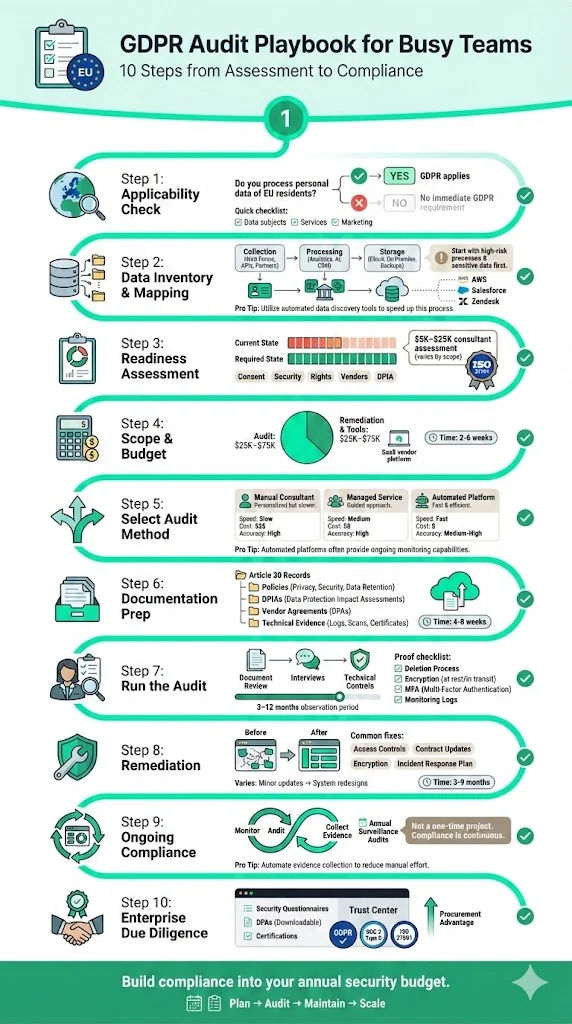
Preparing for a GDPR audit doesn’t require a legal degree but it does demand structured execution. The following playbook outlines actions a “busy team” can take to build a compliant programme without sacrificing core product work.
-
Decide whether GDPR applies: If your organisation processes personal data of EU residents or targets EU users/clients, the GDPR applies regardless of your location. Evaluate data subjects, services, and marketing to confirm applicability.
-
Perform a data inventory and mapping: Identify all personal data collected, processed and stored, including categories (identifiers, financial data, health information), purposes, retention periods, and transfer destinations. Document third‑party processors and sub‑processors. Tools like data inventory platforms or spreadsheets can help. For lean teams, start with high‑risk processes and expand gradually.
-
Conduct a GDPR readiness assessment or gap analysis: Compare current policies, controls and practices against GDPR requirements. Look at consent mechanisms, lawful bases, security controls, data subject rights response processes, vendor contracts, and DPIA triggers. Use frameworks such as ISO 27701 (privacy extension for ISO 27001) to structure the assessment. A readiness assessment from a consultant can cost $5,000–$25,000 but provides a focused roadmap.
-
Estimate scope and budget: Based on the inventory and gap analysis, estimate the external audit fee, implementation labour, tool licences and internal staff hours. Use the ranges discussed earlier to build a budget. For example, a mid‑size SaaS vendor might plan $25,000–$75,000 for the audit and another $25,000–$75,000 for remediation and tools.
-
Select an audit method: Decide whether to work with a manual consultant, engage a managed service provider like Konfirmity, or deploy an automated compliance platform. Manual approaches can offer personalised guidance but may be slower and more expensive. Platforms automate evidence collection, reduce errors and free internal resources.
-
Prepare documentation and evidence: Compile records of processing activities (Article 30), data‑protection policies, security procedures, DPIAs, vendor agreements and breach response plans. Capture access logs, change management records, vulnerability scans and employee training certificates. A shared document repository simplifies auditor access.
-
Run the audit: During the fieldwork phase, auditors review documentation, conduct interviews and examine technical controls. Expect them to request proof of data deletion, encryption, multi‑factor authentication, and monitoring. For SOC 2/ISO audits, they may observe controls over a period (3–12 months). Engage proactively to clarify questions and expedite resolution.
-
Remediate issues: Address auditor findings promptly. Typical remediation includes tightening access controls, updating contracts with processors, implementing encryption, and improving incident response processes. Remediation costs vary widely, from minor policy updates to substantial system redesigns.
-
Plan for ongoing compliance: GDPR is not a one‑time project. Implement continuous monitoring, periodic internal audits and automatic evidence collection. Surveillance audits or recertification occur annually or at the end of the certification cycle. Build these activities into your annual security and compliance budget.
-
Prepare for enterprise‑client due diligence: Large customers often send security questionnaires, require data‑processing agreements (DPAs) and demand proof of certifications. Maintain a trust centre or repository of compliance artifacts to accelerate responses. Having a completed GDPR audit and a cross‑framework attestation (e.g., SOC 2, ISO 27001) positions your company favourably during procurement.
For busy teams, the crucial point is to consider compliance as an ongoing programme rather than a last‑minute scramble. Planning months in advance and using automation reduces stress and cost.
Scope your GDPR audit before you budget for it
Book a demo and we'll walk through your data flows and help you scope a realistic audit budget.
Book a demo
Sample Budget Template & Real‑World Example
Below is a simplified budget template for a mid‑sized SaaS vendor selling to enterprise clients. Actual figures will vary, but the framework helps illustrate how costs accumulate.
| Cost category | Description | Estimated range (USD) |
|---|---|---|
| Data mapping & inventory | Collecting data flows, building records of processing, identifying systems and processors | $5,000–$15,000 (internal staff time + tools) |
| Readiness assessment / gap analysis | Consultant or internal assessment comparing current controls to GDPR requirements | $5,000–$25,000 |
| Audit fees (certification or third-party) | Accredited auditor charges to review documentation, interview staff and issue report | $25,000–$75,000 (Type II or ISO 27701 scopes can be higher) |
| Remediation & controls implementation | Updating policies, implementing encryption, identity management, consent flows, DPIAs | $10,000–$50,000 (variable depending on gaps and technical debt) |
| Training & awareness | Privacy and security training for staff, including phishing simulations | $2,000–$10,000 (depending on headcount) |
| Compliance software / tooling | Data inventory, consent management, logging, automated evidence collection | $7,000–$25,000 per year |
| Ongoing monitoring & maintenance | Annual surveillance audit, vulnerability scans, penetration tests | $15,000–$40,000 per year |
| Total (first year) | Sum of initial activities plus audit fee | $64,000–$165,000 |
Real‑world example: A SaaS vendor with 120 employees processes customer names, emails and usage metrics and integrates with payment processors and CRM platforms. The company performed a data inventory and used a compliance automation platform. It paid $15,000 for the readiness assessment, $45,000 for the ISO 27701/Europrivacy audit, $20,000 for additional encryption and consent tooling, and devoted around 300 internal hours to documentation and training. Annual surveillance and platform fees added $30,000. The investment allowed the vendor to meet EU enterprise client requirements and shorten procurement cycles, securing a seven‑figure contract. Before scoping your own program, map out your audit budget to anchor the numbers to your context.
Common Pitfalls & How to Avoid Unexpected Costs
-
Underestimating internal resource needs: Many teams misjudge the time required to map data flows, draft policies and gather evidence. Allocate dedicated hours and avoid scheduling audits during peak release cycles.
-
Ignoring data in third‑party processors or legacy systems: GDPR requires visibility into all processing activities. Overlooking vendor systems or historical databases leads to audit findings and expensive remediation.
-
Waiting until the last minute: Rushing audits leads to higher consultant fees and stress. Plan at least six months ahead of the target certification date.
-
Overlooking ongoing compliance costs: Budget for continuous monitoring, penetration tests, surveillance audits and recertification. Failing to allocate funds results in non‑compliance and lapsed certifications.
-
Assuming a small footprint means zero risk: Even a small vendor can handle complex data flows or integrate with high‑risk processors, increasing cost and risk. Conduct a proper scoping exercise.
When Might a GDPR Audit Be Mandatory or Essential?
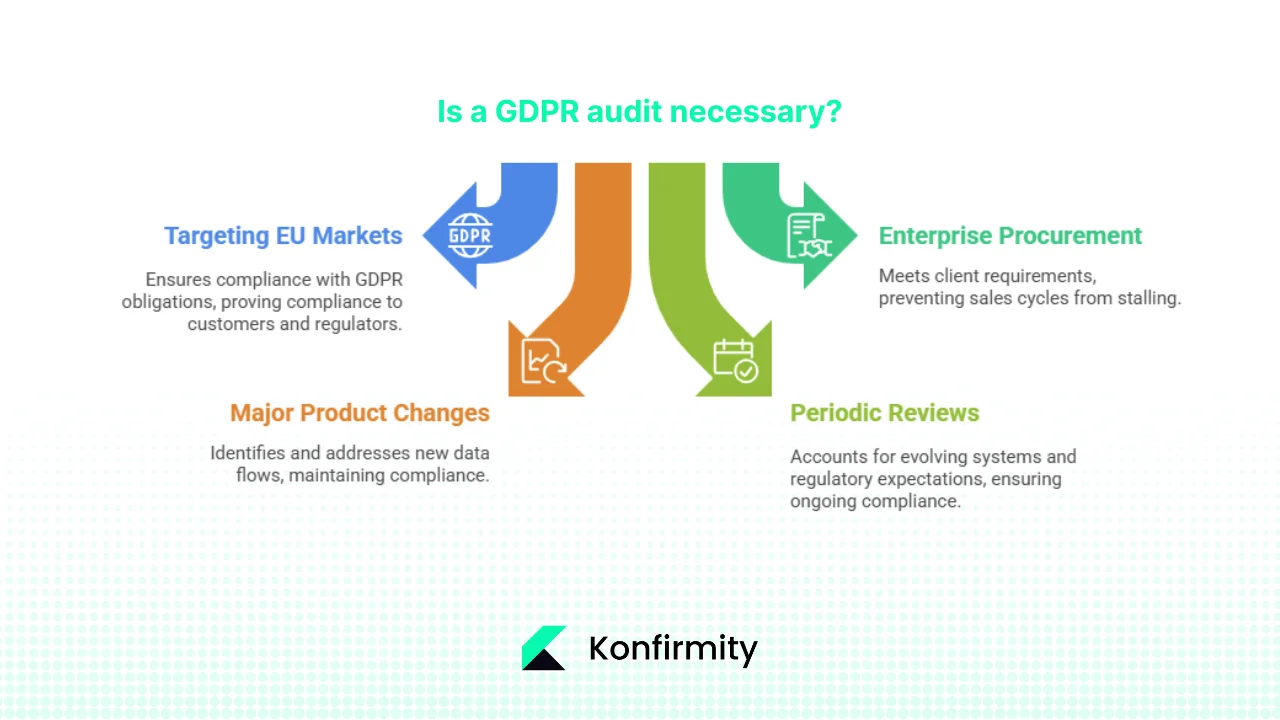
While the GDPR does not explicitly mandate audits, certain situations make them essential:
-
Targeting EU markets or handling EU residents’ data: Any business marketing to or handling data of EU residents must meet GDPR obligations. Audits help prove compliance to customers and regulators.
-
Enterprise procurement: Enterprise clients often require a completed GDPR audit or recognised certification before engaging vendors. Without it, sales cycles stall.
-
Major product changes or new processing activities: Launching new features, integrating new analytics tools or onboarding new vendors can introduce additional data flows. Conduct interim audits or DPIAs to ensure compliance.
-
Periodic reviews: At least annually, organisations should review controls, documentation and processes to account for evolving systems and regulatory expectations.
How to Optimise Audit Cost Without Sacrificing Compliance Quality
Businesses can manage GDPR audit costs strategically by focusing on efficiency and risk reduction rather than cutting corners.
-
Use compliance automation: Platforms that automate evidence collection, policy management and control testing reduce manual effort and errors. They often integrate with cloud systems to capture logs and access changes automatically.
-
Start with thorough data mapping: A detailed personal data inventory limits audit scope to relevant processes. Without clarity on where data resides, audits become expansive and expensive.
-
Prioritise high‑risk processes: Conduct phased audits, tackling critical data flows (e.g., payment processing, health data) first. Lower‑risk processes can be reviewed later.
-
Reuse audit artefacts across frameworks: Many controls overlap between GDPR, ISO 27001, SOC 2 and HIPAA. Leverage common control sets and evidence to avoid duplication. For example, vulnerability management and access reviews satisfy multiple standards.
-
Leverage internal staff for documentation and training: Use internal subject‑matter experts to draft policies and deliver training rather than outsourcing everything. External consultants remain valuable for complex risk assessments and certifications.
FAQs
The total GDPR audit cost depends on organisation size, data complexity and audit scope. Certification or third‑party audit fees generally range from $5,000 to $75,000. After adding implementation, tooling and internal labour, small companies might spend $20,500–$50,000, mid‑size organisations $50,000–$150,000 and large enterprises $100,000–$250,000+. Ongoing annual maintenance adds $22,000–$90,000.
Responding to data‑subject access requests (DSARs) requires identifying personal data across systems, verifying the requester's identity, redacting third‑party information and delivering data securely. A UK survey cited by Usercentrics found that DSARs can cost businesses around €3,000–€7,000 per year. Costs vary with the number of requests, the complexity of data systems and the efficiency of data‑management tools.
The GDPR does not explicitly mandate a formal audit, but Article 42 encourages the use of certification mechanisms. Many organisations conduct audits voluntarily to identify gaps, demonstrate compliance to clients, and obtain privacy seals or certifications. Regulators may also initiate audits following complaints or incidents.
Implementation costs include data mapping, policy development, technical controls, staff training and possibly hiring a data protection officer. A 2024 analysis estimated total GDPR compliance costs ranging from $20,500 to $102,500, depending on organisation size and complexity. Larger companies and data‑intensive industries will exceed these figures, while small startups using automation and existing controls may fall below them.
Turn your GDPR audit budget into a real program
Book a demo and we'll show how Konfirmity keeps GDPR audit costs predictable, self-serve or with our team running the program for you.
Book a demoConclusion
GDPR audits are not just a regulatory formality; they are a strategic investment. For companies serving enterprise clients, demonstrating strong data protection is a prerequisite for market access. The GDPR audit cost varies widely—from around $20,000 for small startups to several hundred thousand dollars for global enterprises—but those expenses pale in comparison to the costs of fines, breaches and lost deals. A structured approach—rooted in proper data inventory, risk‑based scoping, human‑led control implementation and continuous monitoring—allows businesses to manage costs while maintaining a high standard of protection. Konfirmity's experience across thousands of audits shows that investing early in durable controls and automation pays dividends: fewer findings, faster procurements and resilience in the face of evolving threats. Security that looks good in documents but fails under incident pressure is a liability. Build the program once, operate it daily, and let compliance follow.