
Most enterprise customers ask for assurance before signing contracts. Security questionnaires, data protection addenda, and due‑diligence calls are standard for large buyers. Many vendors discover that their internal checklists and policies aren’t enough to satisfy these reviews. Independent audits show that you have designed and operate a privacy program that meets the General Data Protection Regulation (GDPR) and other frameworks. This GDPR Auditor Selection Guide is written for companies selling to enterprise clients. It explains what a GDPR audit is, why it matters, how to pick an auditor, and how to run the engagement so that you end up with a strong program rather than just a report.
Why audits matter for enterprise sales
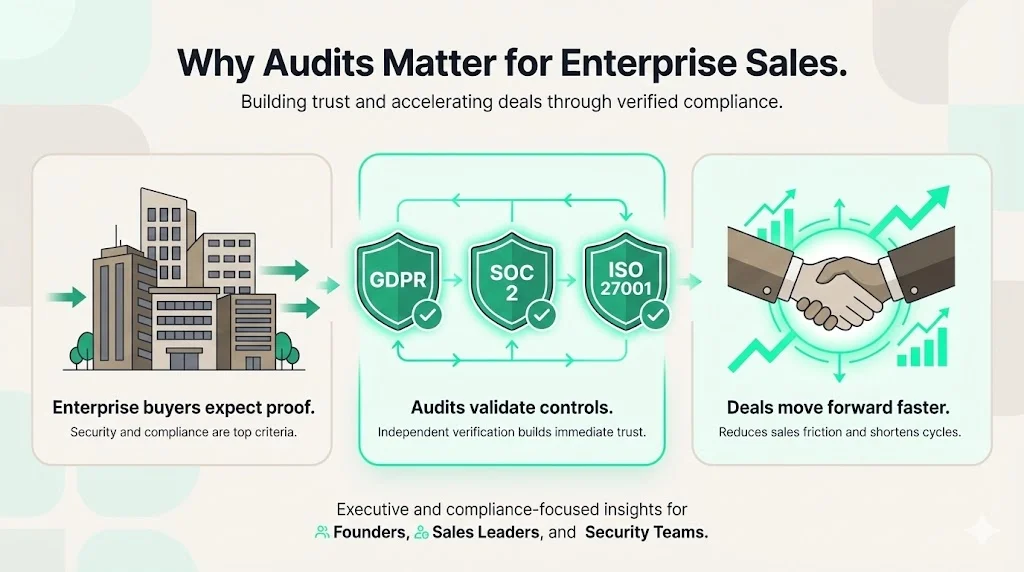
Audits matter because enterprise sales cycles now run through them. The GDPR applies to any organization that processes personal data of individuals in the European Union, even if the company is based elsewhere. Fines for violations can reach €20 million or 4 percent of global revenue. Enforcement is increasing: the CMS Enforcement Tracker recorded 2,245 fines by 1 March 2025, totalling about €5.65 billion. In 2024 alone regulators issued roughly €1.2 billion in penalties. The IBM and Ponemon Institute 2025 report places the global average cost of a breach at USD 4.44 million, with U.S. breaches averaging over USD 10 million. At the same time, a study cited by the Federal Trade Commission estimated that compliance cost small businesses around USD 1.7 million annually when the GDPR came into effect, with large enterprises spending as much as USD 70 million.
For companies pursuing enterprise deals, these numbers are more than statistics. Procurement teams often insist on proof of GDPR compliance, along with evidence of adherence to SOC 2, ISO 27001, and other standards. A proper audit shows that your policies, technical safeguards, and data protection practices stand up to scrutiny. It also helps you identify gaps before regulators or customers do.
What a GDPR audit is and why it matters
A GDPR audit versus a simple check
A GDPR audit is an independent assessment of how your organization collects, processes, stores, and deletes personal data. It goes well outside ticking boxes on a compliance checklist. Auditors review policies, procedures, and technical safeguards across the entire data life cycle. They verify that each processing activity has a lawful basis, that data minimization and purpose limitation principles are respected, and that appropriate security measures like encryption and access controls are in place. The audit also examines your processes for data subject rights, such as access, erasure, rectification, and portability, and ensures that you document processing activities under Article 30.
A simple internal review might consist of answering a questionnaire or scanning policies, but it may miss major issues. A formal audit involves evidence collection, sampling, interviews, and testing. The goal is to identify gaps in documentation or controls, evaluate the maturity of your privacy program, and suggest improvements. This GDPR Auditor Selection Guide emphasizes the importance of an in‑depth audit because it exposes problems that can derail enterprise deals or trigger regulator interest.
Purpose: finding gaps and improving controls
Auditors uncover missing or outdated processing records, inconsistent retention schedules, inadequate consent mechanisms, and weak access controls. For example, Echelon Risk + Cyber notes that many audits fail due to incomplete processing records or poor data retention practices. They also point out that insufficient security controls and untrained employees are common problems. Addressing these weaknesses not only reduces your exposure to fines but also makes your program more resilient. An audit report often serves as evidence in procurement and can reassure prospective clients that your privacy practices are sound.
Preparing for regulator scrutiny
Regulators across the globe are imposing bigger penalties for privacy failures. The DLA Piper survey notes that Ireland alone has issued €3.5 billion in fines since 2018. Outside the EU, enforcement of health‑care privacy rules is also increasing: U.S. regulators issued penalties from $5,000 to $1.5 million in 2025 for HIPAA violations involving inadequate risk analysis and failure to protect electronic patient information. A well‑executed audit demonstrates accountability and can mitigate penalties if something goes wrong. It also strengthens your evidence base for cross‑framework audits like SOC 2 Type II, which require a sustained observation period.
Criteria for selecting a GDPR auditor
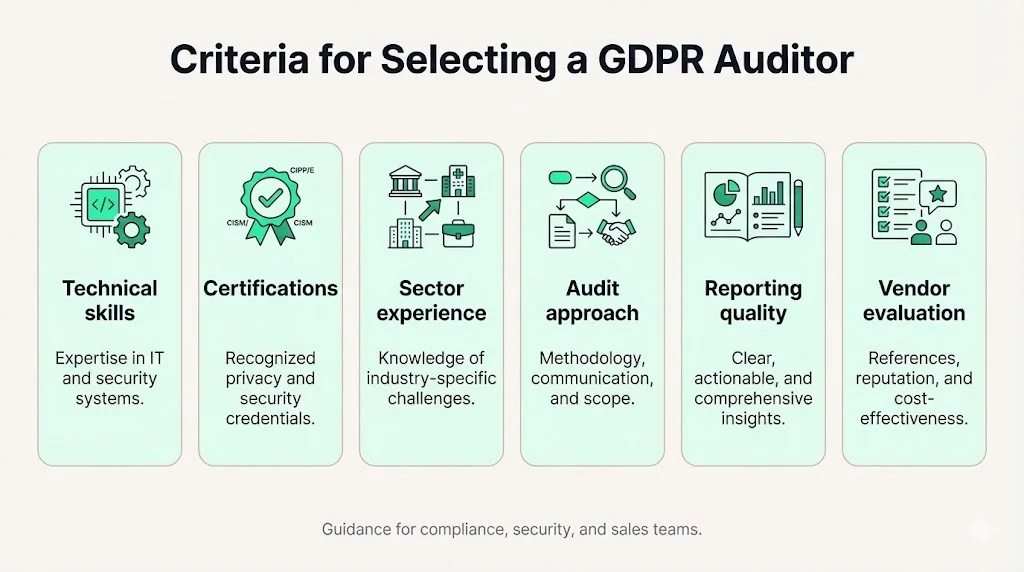
The quality of your audit depends largely on who conducts it. This GDPR Auditor Selection Guide outlines factors to consider when evaluating potential auditors.
1) Technical skill set
A strong technical skill set is the first filter. Your auditor should understand privacy requirements and how they intersect with modern technology. Look for experience in data mapping, classification, encryption, access controls, monitoring, incident response, and management of encryption secrets. They should also be familiar with risk methodologies such as ISO 27005, NIST SP 800‑30, and vulnerability scoring. A strong auditor will assess whether your encryption covers data at rest and in transit, whether access is truly role based, and whether logs are monitored for anomalies. Auditors should also grasp how GDPR obligations intersect with other frameworks such as SOC 2 and HIPAA to help you reuse evidence across audits.
2) Relevant certifications
Certifications signal that auditors follow established practices. Look for the International Association of Privacy Professionals credentials like CIPP/E and CIPM, which demonstrate knowledge of European data protection law and privacy program management. ISO 27001 Lead Auditor credentials show expertise in information security management systems. Many auditors also hold CISSP or CISA credentials, reflecting broad security and audit knowledge. While certificates do not guarantee quality, they are useful indicators when combined with experience.
3) Sector experience
Different industries face unique privacy challenges. SaaS providers rely on cloud platforms and APIs; healthcare vendors must protect electronic patient information under HIPAA as well as the GDPR; fintech firms must meet anti‑money‑laundering and payment regulations. Auditors with sector experience know where typical weaknesses lie. For example, they may check API security and rotation of encryption secrets in fintech, stale access reviews in SaaS, or contract clauses in healthcare. Sector experience helps auditors adapt tests to your context and produce recommendations that are meaningful to your buyers.
4) Audit approach
A disciplined audit process ensures consistency. Expect auditors to define scope and objectives, gather background information, map data flows, review documentation, interview staff, test technical controls, and deliver a report. A risk‑based approach focuses on high‑impact areas rather than applying a generic checklist. Ask candidates how they determine risk, how they sample controls, and how they adapt frameworks like ISO 27001 or SOC 2 to a GDPR audit. Many auditors use templates or questionnaires, but they should adjust them to your business model and risk profile. Verify that they will review your data protection impact assessments, vendor contracts, incident response plans, and training records.
5) Reporting standards
Clear reporting separates good auditors from poor ones. Deliverables should include an executive overview for leadership and a detailed report for technical teams. Reports must explain each finding, describe the evidence, reference relevant GDPR articles or standards, rate the risk, and suggest remediation. Echelon recommends maintaining a clear audit trail with detailed records of data processing and consent management. Ask potential auditors for sample reports to see whether their outputs are clear, prioritize issues, and offer practical suggestions. The report should also point out strengths so you can show evidence of maturity during sales discussions.
6) Vendor evaluation process
Create a comparison matrix to evaluate auditors. Criteria may include price, certifications, technical knowledge, sector experience, methodology, report quality, responsiveness, and references. Give more importance to factors relevant to your situation. For instance, a healthcare vendor might place greater value on HIPAA experience. Assign scores and sum them to rank candidates. Consider whether auditors offer ongoing support or just a single audit. Konfirmity, for example, provides a managed service with dedicated experts who operate your program year‑round. This approach reduces internal effort: clients typically spend under 70 hours per year on evidence collection with Konfirmity, compared to 550–600 hours when running the program themselves. To see what that difference means for your budget, calculate your GDPR compliance ROI.
Choosing a GDPR auditor is easier when your security posture is already solid.
Share your work email and see how Konfirmity prepares you before the auditor arrives.
Step‑by‑step selection process
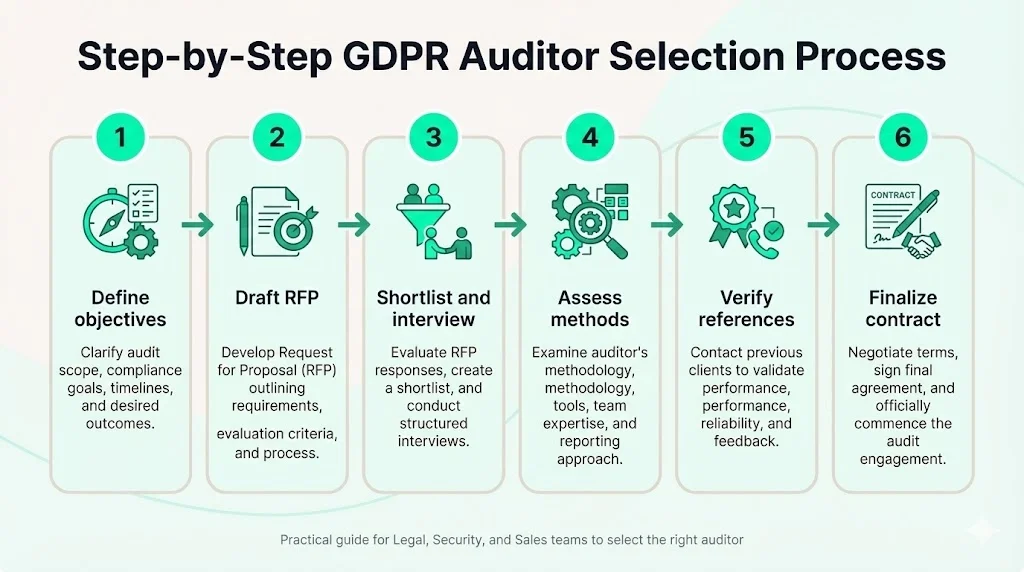
This GDPR Auditor Selection Guide lays out a structured process for selecting and working with an auditor.
Step #1: Define your objectives
Decide what you want from the audit. Are you looking for a baseline assessment to understand your current position? Do you need a gap analysis to prepare for certification? Or do you want a full readiness audit that aligns with enterprise procurement demands? Objectives should reflect your data flows, risk profile, and regulatory obligations. Companies processing sensitive data or operating in regulated sectors may need a broader scope than a small SaaS provider. Clearly defined objectives guide your choice of auditor and help set expectations.
Step #2: Draft a request for proposal
A request for proposal (RFP) communicates your needs to potential auditors. Describe the scope, including systems, data types, geographic coverage, and frameworks. Specify deliverables—reports, executive overviews, remediation plans—and timelines. Include confidentiality and non‑disclosure requirements. Provide context about your business, such as size, sector, and any recent incidents. List evaluation criteria and indicate their importance so vendors know how proposals will be scored. A detailed RFP helps you compare proposals on equal terms.
Step #3: Shortlist and interview
Review proposals and create a shortlist based on credentials, experience, and fit. Watch out for unrealistic timelines or very low prices, which may signal a superficial review. Interview shortlisted auditors to assess their communication skills and approach. Ask about their experience with GDPR audits in your industry, the common findings they encounter, and how they support remediation. Request anonymized sample reports to see the depth of detail and clarity. Confirm that senior auditors will be involved and that they have capacity to meet your timeline.
Step #4: Assess methods and tools
Ask candidates to describe their methodology. Do they use automated data flow mapping? How do they test encryption and access controls? Are penetration tests or vulnerability scans included? If they rely on third‑party tools, check that these tools are secure. Ensure the approach integrates with your existing workflows and supports cross‑framework evidence reuse. You want an audit that goes past questionnaires and probes the effectiveness of your controls.
Step #5: Verify references
Speak with past clients to understand the auditor’s performance. Ask whether the auditor identified significant issues, whether the reports were clear and actionable, and whether support continued after the report. Find out if the audit improved the client’s privacy program and helped with enterprise sales. Good references will vouch for timely delivery, professionalism, and constructive collaboration.
Step #6: Finalize and contract
Once you have chosen an auditor, negotiate the contract. Include confidentiality obligations, liability clauses, the scope of work, the schedule, and review cycles. Specify whether the auditor will sign data processing agreements if they access personal data. Define payment terms and penalties for missed deadlines. Clarify ownership of the work product and whether you can share reports with customers or regulators. Build in provisions for follow‑up work to verify remediation.
What a good GDPR audit looks like
Typical stages
A good audit runs through five typical stages:
-
Planning and scoping: Auditors collaborate with your team to understand the business context, outline objectives, and map data flows. High‑risk areas are identified.
-
Document and evidence review: Policies, procedures, processing records, lawful basis documentation, data protection impact assessments, vendor contracts, and previous audit findings are reviewed. Auditors check that processing records are detailed and that retention schedules respect purpose limitations.
-
Fieldwork: Auditors interview data owners, engineers, and leaders. They test controls such as encryption, access reviews, multi‑factor authentication, change management, monitoring, and incident response. They may sample data subject request workflows, examine vendor risk assessments, and inspect logs for anomalies.
-
Reporting and remediation: A report summarizes findings, rates the risk of each issue, and suggests remedial actions. The report includes an executive overview for leadership and a detailed section for technical teams. A remediation plan prioritizes actions and assigns responsibility.
-
Follow‑up: After remediation, auditors verify that issues have been addressed. Some frameworks require surveillance audits; even when not mandated, follow‑up supports continuous improvement.
Areas typically assessed
Seven areas are typically assessed in a full audit:
-
Processing inventory: Auditors check whether you maintain detailed records of processing activities. Article 30 mandates that you document data flows, lawful bases, categories of data subjects, and recipients.
-
Legal grounds for processing: Each processing activity must have a valid legal basis, such as consent, contract performance, or legitimate interests. Auditors verify that these bases are documented.
-
Consent management: Consent must be specific, informed, unambiguous, and revocable. Auditors evaluate consent capture, withdrawal mechanisms, and records.
-
Vendor contracts: Contracts with processors must include clauses guaranteeing data protection. Auditors review Data Processing Addenda and transfer safeguards.
-
Access controls and encryption: Auditors test whether access to personal data is restricted and role based, and whether data is encrypted at rest and in transit.
-
Data subject rights: Procedures for handling access, deletion, correction, portability, objection, and restriction requests are evaluated. Timeliness and completeness are critical factors.
-
Governance and training: Auditors assess whether management oversees the privacy program, whether risk assessments are conducted, whether staff are trained, and whether there is an incident response plan.
Managing time and effort
Konfirmity’s delivery experience shows that SOC 2 readiness usually takes four to five months with our managed service, compared with nine to twelve months when organizations go it alone. Similar timelines apply to GDPR audits when integrated with security certifications. Clients spend under 70 hours per year on evidence collection and review with our service, versus hundreds of hours when self‑managing. Observation periods for SOC 2 Type II audits can last six to twelve months, so evidence like change‑management tickets, access reviews, and vendor assessments must be collected continuously. A good GDPR audit synchronizes with these windows, ensuring that evidence is current.
Common pitfalls
Watch for these common pitfalls when selecting and working with an auditor:
-
Insufficient technical expertise: Auditors without deep knowledge of cloud architectures, encryption, or API security may miss critical risks. Similarly, auditors unfamiliar with your sector may overlook industry‑specific obligations.
-
Vague deliverables and timelines: Without clear expectations, audits can drag on and yield generic reports. Define deliverables and deadlines in your RFP and contract.
-
Checklist mentality: Audits that rely on generic questionnaires may ignore high‑risk areas. Insist on a risk‑based approach.
-
Ignoring remediation: An audit report is only the beginning. Budget for remediation and plan for follow‑up verification to ensure that issues are resolved.
Case examples
Case scenarios help illustrate how the principles in this GDPR Auditor Selection Guide apply in practice.
SaaS provider pursuing enterprise deals
A mid‑stage SaaS company wanted to sell to Fortune 500 customers. Buyers demanded proof of GDPR and SOC 2 compliance. The company had basic policies but lacked enforcement. It selected an auditor with cloud expertise and CIPP/E and ISO 27001 Lead Auditor credentials. The audit revealed incomplete data mapping, unencrypted backups, and missing vendor risk assessments. Remediation included automated data flow mapping, encryption for backups, and integration of vendor risk workflows. With Konfirmity’s managed service, the company reached SOC 2 Type II and GDPR readiness in about five months, spending around 80 internal hours instead of the 600 hours estimated for a self‑managed program. The audit report satisfied customer due‑diligence requests, allowing deals to progress.
Fintech startup without formal documentation
A small financial‑technology startup processed customer data across multiple countries. It lacked formal data protection impact assessments and had little documentation. The team hired an auditor with fintech experience and CIPP/E certification. The audit showed that several processing activities lacked documented legal bases and that transaction logs were not encrypted. The remediation plan prioritized updating the privacy notice, implementing tokenization, and completing impact assessments for high‑risk processing. After the audit, the startup built a privacy management system and provided evidence of compliance during fundraising due‑diligence processes.
Healthcare software vendor needing dual compliance
A healthcare software vendor processed EU patient data and electronic patient information, so it had to comply with both GDPR and HIPAA. It chose an auditor with ISO 27701 and ISO 27001 credentials and experience with health‑care privacy. The audit reviewed access controls, encryption, incident response, and business associate agreements. It also checked data subject rights workflows and consent mechanisms. Findings included insufficient retention of logs for HIPAA purposes and inadequate safeguards for transfers to a U.S. service provider. The remediation plan extended log retention, updated data processing agreements, and added standard contractual clauses. The combined audit reduced duplication and produced evidence for both regimes.
FAQs
Auditors independently assess your data protection practices against GDPR requirements. They check documentation, test technical controls, evaluate data subject rights processes, and suggest improvements. Their objectivity and expertise often exceed those of internal teams.
The GDPR does not mandate external audits. However, it requires organisations to implement and show appropriate measures. Independent assessments support those obligations and are often requested by customers.
Conduct a full GDPR audit at least annually and whenever you make major changes to processing activities. Regular internal reviews and continuous monitoring complement formal audits.
Internal reviews are valuable, but external auditors bring a fresh perspective and industry knowledge. Third‑party reports have more credibility with regulators and customers.
Auditors review privacy policies, processing inventories, lawful basis documentation, vendor contracts, access logs, risk assessments, data protection impact assessments, consent records, incident response plans, training records, and prior audit reports.
Get audit-ready before the auditor arrives
Book a demo and we'll show how Konfirmity strengthens your security posture so the audit you choose goes smoothly.
Book a demo
Conclusion
Enterprise buyers and regulators demand concrete evidence that your privacy program works in practice. Fines for GDPR violations are rising: more than two thousand penalties totalling €5.65 billion were recorded by early 2025. The average cost of a breach is in the millions of dollars. By following the guidance in this GDPR Auditor Selection Guide, you can choose an auditor who brings technical expertise, sector knowledge, disciplined methods, and clear reporting. Defining objectives, issuing a detailed RFP, interviewing candidates, assessing methods, checking references, and negotiating a solid contract are all steps in a reliable selection process. A thorough audit will uncover gaps, strengthen controls, and give you the evidence you need to win enterprise deals. Build your program once, operate it every day, and let compliance follow. Use this GDPR Auditor Selection Guide to start defining your objectives and requirements.