
Healthcare organisations operate under intense scrutiny. The General Data Protection Regulation (GDPR) sets strict requirements for handling personal data, and regulators are increasingly willing to impose eye‑watering penalties when organisations fall short. In the first half of 2025 alone, European data protection authorities issued more than €3 billion in fines; the largest fine ever, €1.2 billion, was levied against Meta for transferring data to the U.S. without sufficient safeguards. Amazon and TikTok faced fines of €746 million and €530 million respectively, demonstrating that contractual clauses and paper policies do not impress regulators. At the same time, the cost of breaches remains high. IBM’s 2025 Cost of a Data Breach report shows that healthcare breaches in the United States average $7.42 million and take roughly 279 days to detect and contain. The U.S. Department of Health and Human Services has responded by re‑starting HIPAA audits focused on hacking and ransomware, and 50 covered entities and business associates will be audited during 2024–2025.
In this environment, point‑in‑time audits are no longer sufficient. Buyers—especially large hospital networks—now demand real evidence of operational security before signing business associate agreements. As a result, continuous monitoring has become a strategic imperative. Instead of capturing a few screenshots each quarter, organisations must maintain ongoing visibility into where personal data resides, who accesses it and how controls are working in practice. This guide introduces GDPR Continuous Monitoring and shows how a security-driven compliance platform, run self-serve or fully managed, can help healthcare enterprises protect patient data, reduce risks and satisfy regulators. Written by Amit Gupta, founder of Konfirmity, it draws on experience from more than 6,000 security audits and 25 years of combined expertise. The sections that follow define the concept, explain why it matters, outline core components, provide a step‑by‑step implementation roadmap and offer real‑world examples.
What Is GDPR Continuous Monitoring?
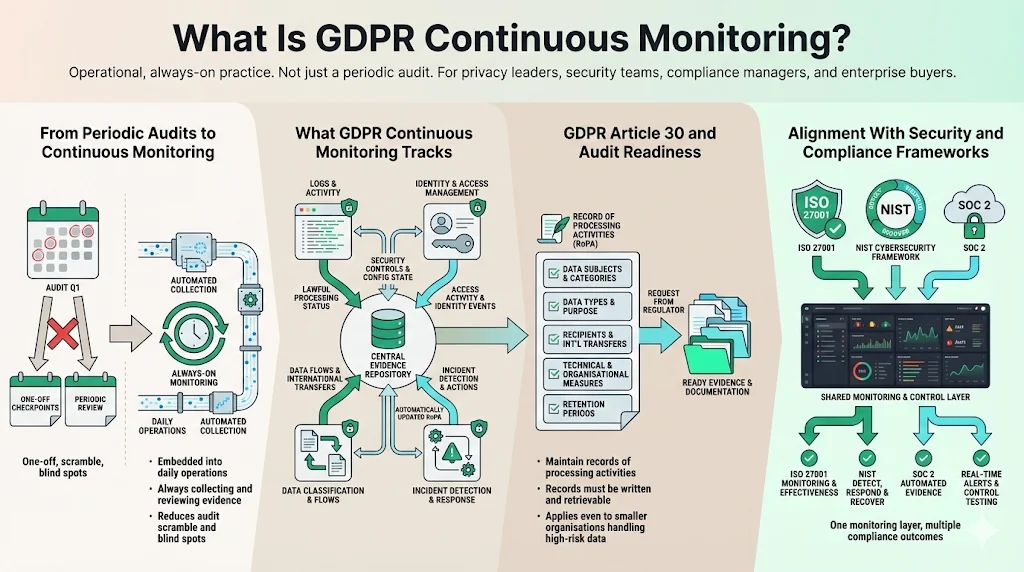
At its core, GDPR Continuous Monitoring means keeping an ongoing watch over data practices, security controls and evidence to ensure that personal information is processed lawfully and protected adequately. It differs from a traditional periodic audit in two important ways. First, continuous monitoring is an operational discipline rather than a one‑off project. It integrates with the organisation’s security stack—logging systems, identity management tools, data classification engines and incident response platforms—to collect, correlate and review evidence automatically. Second, it produces a clear audit trail. Under GDPR Article 30, controllers and processors must maintain records of processing activities that include the categories of data subjects, recipients, international transfers and technical and organisational measures. These records must be available in writing and supplied to supervisory authorities upon request. Even small organisations (those with fewer than 250 employees) are not exempt if they handle high‑risk processing. A continuous monitoring program ensures that these records are up to date and can be produced quickly.
GDPR continuous monitoring sits within broader data privacy and governance frameworks. For example, the ISO 27001 Information Security Management System requires organisations to define security objectives, identify assets and vulnerabilities, implement controls and monitor effectiveness. The NIST Cybersecurity Framework emphasises the Detect, Respond and Recover functions, which rely on timely data collection and analysis. Likewise, SOC 2 trust services criteria encourage automated monitoring and evidence collection over manual checks. A 2025 SOC 2 best practices guide notes that the updated criteria strongly encourage continuous monitoring instead of point‑in‑time manual reviews; best practices include automated security monitoring using SIEM tools, continuous control testing and real‑time alerting. Integrating continuous monitoring with these frameworks provides a coherent approach to governance, risk and compliance while satisfying GDPR obligations.
Why Continuous Monitoring Is Essential for Enterprises
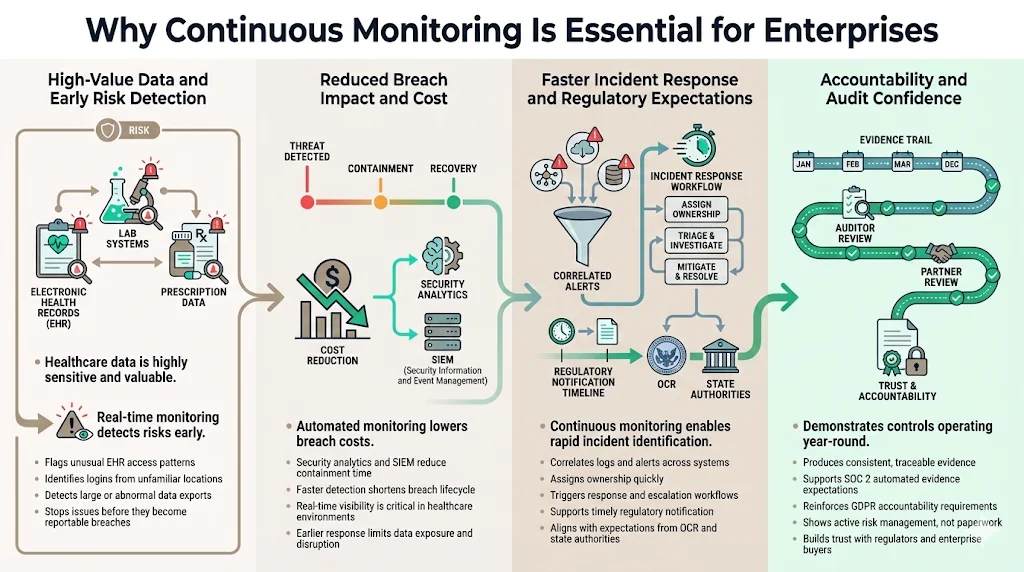
Healthcare providers process some of the most sensitive personal data—diagnoses, lab results, prescription histories—making them attractive targets for attackers. Real‑time monitoring catches risks early, before they turn into reportable breaches. For example, continuous monitoring can detect unusual access to electronic health records, sign‑in attempts from unrecognised locations or large data exports and flag them for investigation. Automated monitoring also reduces breach costs. IBM’s report notes that organisations using security analytics or SIEM reduced average breach costs by $212,000 and shortened containment time to 241 days globally. In healthcare, where the average breach lifecycle is longer, gaining real‑time visibility is critical.
Continuous monitoring supports faster incident response. Regulators expect quick notification when personal data is compromised. The U.S. OCR emphasises that ransomware and other malicious hacking pose ongoing threats and require HIPAA covered entities to ensure compliance with the Security Rule. A program that correlates logs and alerts across systems helps security teams identify incidents quickly, assign ownership and trigger response protocols. It also strengthens overall risk management and cybersecurity posture. The California Office of Information Security’s continuous security monitoring standard requires organisations to aggregate logs and correlate events to detect threats and ensure compliance, noting that real‑time detection and response reduce damage.
Finally, continuous monitoring demonstrates accountability. Regulators and business partners increasingly ask for evidence that controls operate consistently throughout the year. SOC 2 auditors now scrutinise control descriptions and exception reports, and the 2025 criteria call for automated evidence collection. GDPR enforcement actions show that contractual clauses alone are insufficient—organisations must implement risk assessments, technical safeguards and ongoing oversight. By adopting a continuous monitoring program, healthcare enterprises can show regulators and customers that they are managing risk actively rather than simply compiling documents.
Core Components of an Effective GDPR Continuous Monitoring Program
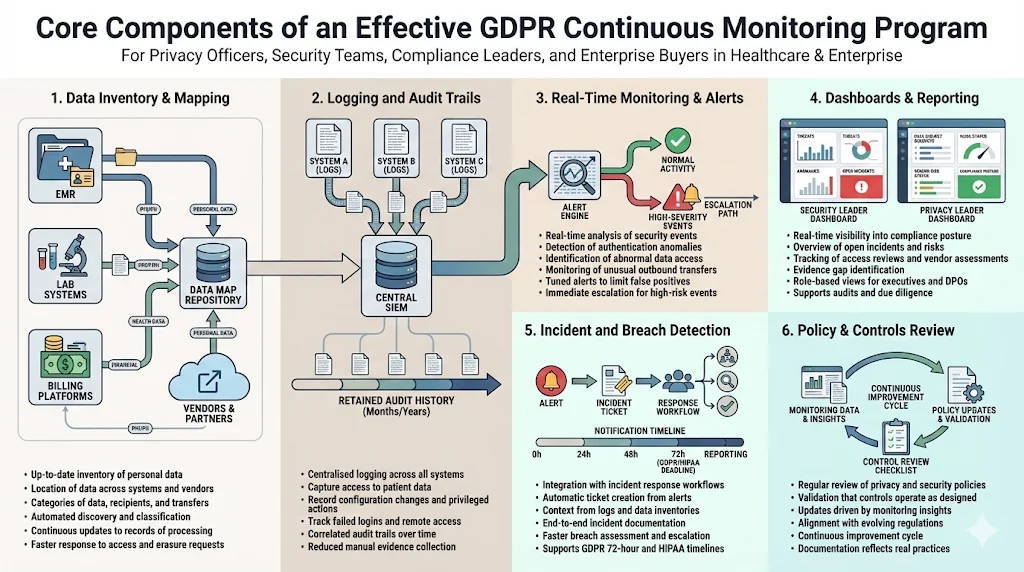
1) Data Inventory & Mapping
A foundational element of GDPR Continuous Monitoring is an up‑to‑date inventory of personal data. Organisations must know what personal data they hold, where it resides and who can access it. Article 30 requires records to include categories of data, recipients and international transfers. In practice, this means mapping data flows across electronic medical record systems, laboratory information systems, billing platforms and third‑party vendors. Tools that automatically discover and classify data within databases and file stores can update inventories continuously, support data minimisation efforts and inform risk assessments.
Maintaining accurate maps also supports data governance. When a customer exercises their right to access or erasure, the organisation can locate relevant data quickly. When evaluating cross‑border transfers, the inventory reveals which systems might be subject to additional safeguards. Konfirmity’s delivery work shows that enterprises lacking proper data inventories often spend weeks during audits reconstructing processing records—a delay that can derail procurement deals.
2) Logging and Audit Trails
Reliable logging is essential for demonstrating compliance. The California continuous monitoring standard emphasises logging unsuccessful logon attempts, remote access activity and system events. Logging systems should capture access to patient data, changes to configurations, privileged account actions and security alerts. Logs must be centralised in a Security Information and Event Management (SIEM) platform that supports correlation and retention appropriate to the audit period.
When properly configured, logs create a reliable audit trail showing that controls operate over time. During audits, independent assessors will request evidence that access reviews were performed, that changes went through proper approvals and that incidents were escalated. Automated log collection reduces manual effort. In our experience, healthcare clients that adopt centralized logging cut evidence collection time by 60‑70 percent and reduce the number of control exceptions.
Free policy pack
The GDPR Logging & Monitoring Policy Pack
A logging policy template, log retention schedule, personal-data-in-logs minimisation register, and a 72-hour breach notification worksheet. Enter your work email and we'll send the pack.
3) Real‑Time Monitoring & Alerts
Collecting logs is only the first step. Effective GDPR Continuous Monitoring requires real‑time analysis of events to detect anomalies. The SOC 2 best practices guide lists automated security monitoring using SIEM and cloud security posture management as essential. Real‑time alerting should cover authentication anomalies (e.g., multiple failed logins), abnormal data access patterns and unusual outbound transfers. Alerts need to be tuned to reduce false positives while ensuring that high‑risk events trigger immediate investigation.
Automated alerting is particularly important for healthcare because of the high cost of breaches. IBM’s report identifies detection and escalation as the largest component of breach costs. Reducing time to respond not only lowers fines but can prevent patient harm. At Konfirmity, we implement SIEM rules that integrate with incident response tools so that high‑severity events generate tickets automatically and include context for triage.
4) Dashboard & Reporting Capabilities
A continuous monitoring program must provide clear visibility to both technical and executive stakeholders. Dashboards should summarise compliance posture across trust services criteria, HIPAA safeguards and GDPR requirements. Real‑time dashboards allow security leaders to see open incidents, overdue access reviews, outstanding vendor assessments and evidence gaps.
These reports are not a substitute for audits but support them by showing that controls operate consistently. One industry white paper on continuous monitoring highlights that frameworks like ISO 27001 and SOC 2 provide the security blueprint while continuous monitoring verifies their effectiveness. Effective dashboards also allow role‑based views—for example, a Chief Information Security Officer (CISO) might see risk trends and resource needs, while a data protection officer focuses on records of processing and data subject rights requests.
5) Incident and Breach Detection
Detecting and responding to potential privacy incidents is central to GDPR Continuous Monitoring. A robust program integrates monitoring with the incident response plan. When an alert is triggered, workflows should assign owners, gather context from logs and data inventories and track response actions. Linking monitoring with incident response tools ensures that alerts do not get lost in email and that each incident is documented from detection through resolution.
Healthcare providers must also plan for cross‑framework reporting. Under HIPAA, covered entities must notify the OCR and affected individuals within prescribed timelines; under GDPR, controllers must notify supervisory authorities within 72 hours of becoming aware of a personal data breach. A continuous monitoring program reduces the time between incident discovery and notification, ensuring compliance with both regimes.
6) Policy & Controls Review
Finally, continuous monitoring requires regular review of privacy policies, data handling procedures and security controls. Regulations evolve; for example, the 2025 SOC 2 criteria introduce new guidance on AI governance, cloud security and vendor risk management. Industry guidance notes that continuous improvement is essential; organisations must use data from monitoring to identify trends and adjust controls. Routine control reviews should verify that policies remain aligned with current law, that technical safeguards are effective and that documentation reflects actual practices.
Step‑by‑Step Process to Implement GDPR Continuous Monitoring
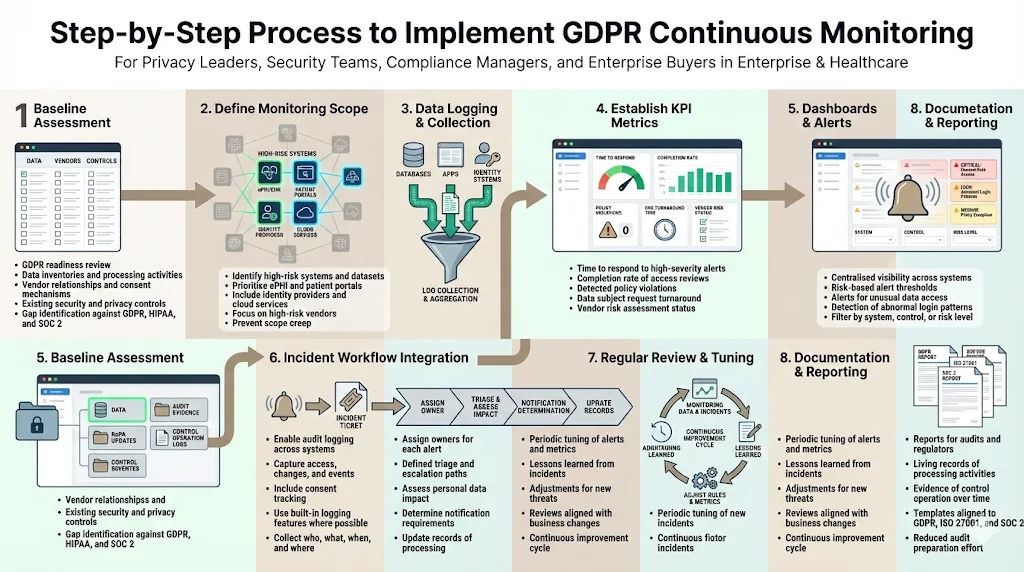
Implementing a continuous monitoring program can seem daunting, but breaking it into manageable steps helps. Drawing on our delivery work and industry best practices, here is a structured approach:
Step 1: Baseline Assessment
Begin with a GDPR readiness review. Conduct a comprehensive audit of data privacy and processing activities, including data inventories, vendor relationships, consent mechanisms and existing security controls. This baseline identifies gaps relative to Article 30 record‑keeping, HIPAA safeguards and SOC 2 trust services criteria. In our experience, enterprises that invest in a thorough baseline avoid costly rework later.
Step 2: Define Monitoring Scope
Decide which systems, data sets and processes require ongoing visibility. Priority should go to systems storing electronic protected health information (ePHI), identity providers, cloud services hosting patient portals and high‑risk vendors. Defining scope early prevents scope creep and ensures that monitoring resources are used where they reduce risk the most.
Step 3: Set Up Data Logging & Collection
Configure systems to collect meaningful logs and events. Enable audit logging for databases, file servers, access management platforms and medical devices. Include consent tracking for web and app interactions. Leverage existing tools—identity providers, cloud platforms and development pipelines—for automated evidence collection; the SOC 2 guide recommends using builtin features before purchasing specialised compliance software. When connecting new systems, design logging to capture the fields needed for evidence: who, what, when and where.
Continuous GDPR monitoring turns your logs into compliance confidence.
Share your work email and we'll show how monitoring evidence strengthens your audit posture.
Step 4: Establish KPI Metrics
Define metrics that quantify both performance and compliance. Examples include average time to respond to high‑severity alerts, percentage of access reviews completed on schedule, number of detected policy violations, number of data subject requests processed within 30 days and status of vendor risk assessments. Metrics should align with risk tolerance and regulatory requirements. For instance, IBM’s report identifies detection and escalation costs as a major factor in breach costs; measuring detection time helps reduce this component.
Step 5: Configure Dashboards & Alerts
Integrate log sources into a centralised dashboard. Set alert thresholds based on risk. For example, trigger a high‑severity alert if a database table containing ePHI is accessed by an account not normally associated with that dataset, or if there are multiple failed login attempts from an unusual IP address. Dashboards should display compliance KPIs and allow filtering by system, control category or risk level.
Step 6: Incident Workflow Integration
Link monitoring alerts with incident management and response teams. For each alert, define an owner, triage criteria and escalation path. Workflows should include tasks such as assessing whether personal data was accessed, determining whether notification is required and updating records of processing. Integrating monitoring with ticketing systems ensures accountability and facilitates post‑incident reviews.
Step 7: Regular Review & Tuning
Schedule periodic checks to refine tooling, metrics and alert thresholds. Use data from incidents and near misses to tune the monitoring program. Published guidance emphasises that continuous improvement is necessary. Quarterly or semi‑annual reviews allow the program to adapt to changing threat patterns, regulatory expectations and business changes, such as new applications or vendors.
Step 8: Documentation & Reporting
Build reports that support internal audits and regulatory requests. Use templates aligned with SOC 2, ISO 27001 and GDPR requirements. Keep a living record of processing activities and controls, updating it whenever a new system or vendor is added. Evidence should demonstrate not only that policies exist but that they operate effectively over the observation period. At Konfirmity, we provide clients with ready‑made audit packages that include evidence for each control point, saving hundreds of hours during audit prep.
Tools & Technologies for GDPR Continuous Monitoring
Numerous tools support continuous monitoring, but success depends on using them within a coherent program rather than buying technology for its own sake.
-
Logging Systems and SIEM Tools. Centralised logging platforms aggregate events from applications, infrastructure and security tools. They support event correlation, retention and analysis. A standard such as California’s continuous security monitoring specification requires SIEM systems to aggregate logs and correlate events to detect threats. Popular SIEM solutions include Splunk, Elastic Security and Microsoft Sentinel.
-
Compliance Dashboards. These tools provide a visual overview of compliance posture across frameworks. They pull data from SIEM tools, identity providers and ticketing systems. Modern dashboards support role‑based views and integrate with frameworks like SOC 2, ISO 27001 and HIPAA. One industry analysis notes that frameworks offer the blueprint while continuous monitoring verifies effectiveness.
-
Real‑Time Alerting Platforms. Solutions such as PagerDuty, Opsgenie or integrated SIEM features send notifications to on‑call responders when thresholds are breached. They should allow escalation policies and integrate with chat and ticketing systems.
-
Data Discovery and Classification Engines. Tools like Varonis, BigID or open‑source alternatives scan databases, file systems and cloud storage to find and classify personal data. They update inventories and support the Article 30 record‑keeping requirement.
When evaluating tools, healthcare enterprises should prioritise integration and automation. Tools must collect logs, produce evidence and feed dashboards without manual intervention. Konfirmity, a security-driven compliance platform, can integrate these tools within the client’s environment, reducing internal effort. On average, clients on our fully-managed service spend 75 hours per year on compliance tasks, compared with 550-600 hours when running programs internally.
Real‑World Examples (Enterprise Use Cases)
Real scenarios illustrate how GDPR Continuous Monitoring works in practice.
-
Example A: Monitoring Data Access in a Customer Database. A hospital uses a centralised SIEM to monitor access to its patient database. When a data scientist runs an ad hoc query outside normal working hours, the SIEM flags the event because the query touches a high‑risk table. The alert triggers a workflow that checks whether the analyst had a legitimate need. A review of the ticket and logs shows that the request was part of a sanctioned research project; the incident is documented and closed. If the access had been unauthorised, the incident response team would initiate containment and notification. Continuous monitoring ensures that unusual access is detected in real time rather than discovered during a quarterly audit.
-
Example B: Automated Detection of Unusual File Transfers. A vendor’s file‑sharing platform exhibits an unusual spike in outbound traffic to an external IP address. The SIEM correlates this with a new automated process introduced by an outsourced billing provider. Because vendor risk is part of the monitoring scope, the organisation is alerted. The incident response team quickly determines that the outsourced provider misconfigured a script, leading to unintentional data exfiltration. The vendor is instructed to fix the script, and the organisation updates its vendor risk assessment. This example underscores the need to monitor third‑party activities continuously—a lesson reinforced by high‑profile fines where data was shared with subcontractors without proper agreements.
-
Example C: Dashboard Reporting for Quarterly Compliance Reviews. An integrated dashboard aggregates metrics across GDPR, SOC 2 and HIPAA controls. The CISO prepares for a quarterly review with the board by pulling metrics such as average incident response time, percentage of timely access reviews and status of data processing agreements with vendors. The data show that response time improved from 48 hours to 12 hours after implementing automated alerting. The board can see progress and allocate resources. When a procurement questionnaire arrives from a prospective customer, the team can provide current evidence that controls are operating effectively, accelerating the sales cycle.
Common Challenges and How to Address Them
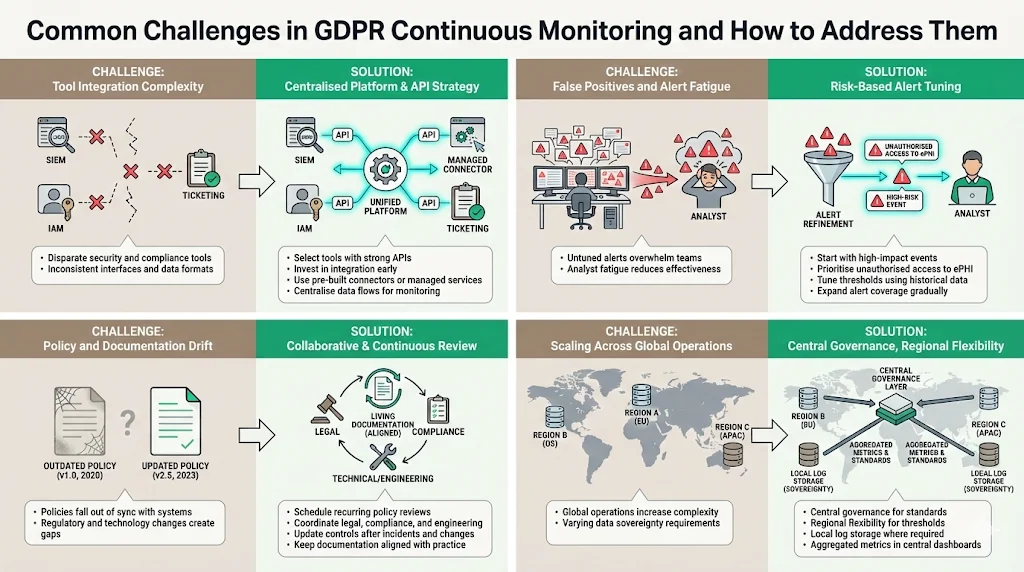
Implementing GDPR Continuous Monitoring is not without obstacles. Healthcare enterprises often encounter tool integration complexity; SIEM, identity management and ticketing systems may come from different vendors with inconsistent interfaces. Address this by selecting tools with robust APIs and investing in integration early. Managed services can help unify tools and provide pre‑built connectors.
Managing false positives is another challenge. Untuned alert rules can overwhelm analysts and lead to alert fatigue. Organisations should refine thresholds over time using historical data and risk‑based priorities. Start with high‑impact events (e.g., unauthorised access to ePHI) and gradually add lower‑risk alerts once the process is stable.
Keeping privacy policies up to date requires coordination between legal, compliance and technical teams. The SOC 2 guidance stresses that controls must evolve with business and technology changes. Set a recurring schedule to review policies and update documentation in light of regulatory developments, new services and lessons from incidents.
Scaling monitoring across global operations can be difficult because different regions may have varying data sovereignty requirements and infrastructure. Use centralised governance to set global standards, but allow regional teams to adapt thresholds and workflows. Data residency concerns may require storing logs locally while providing aggregated metrics to a central dashboard.
Best Practices for Long‑Term Success
To achieve durable security and compliance, enterprises should adopt several best practices:
-
Automate Where Possible. Use automation for evidence collection, log correlation, alerting and reporting. Manual processes are error‑prone and will not scale. Automated monitoring and control testing reduce the internal effort needed to maintain compliance year‑round.
-
Make Dashboards Role‑Specific. Tailor dashboards to the needs of different stakeholders. CISOs need a strategic view of risks, while data protection officers focus on processing records and incident metrics. Auditors need evidence mapping controls to requirements.
-
Review and Update Monitoring KPIs Frequently. Metrics should evolve with threat trends and regulatory focus. For example, if phishing becomes the leading vector, track the number of phishing attempts detected and user reporting rates.
-
Tie Monitoring Outcomes Back to Governance and Risk Frameworks. Integrate continuous monitoring with ISO 27001 risk assessments, SOC 2 control mapping and HIPAA safeguard reviews. This alignment ensures that monitoring addresses real risks and produces evidence relevant to multiple frameworks.
-
Add a Fully-Managed Service. Konfirmity’s fully-managed service combines the platform with dedicated experts who implement controls inside your stack and run them daily. Where GRC software still requires hundreds of hours of internal work, our team takes on the heavy lifting. Compared with one‑and‑done consulting projects, we stay engaged year‑round, monitoring controls, tuning metrics and preparing audit evidence. Clients typically complete SOC 2 readiness in 4–5 months versus 9–12 months when managing it themselves, and they see a 75 percent reduction in internal effort.
FAQs
Continuous monitoring refers to automated systems that track personal data handling in near real time. This includes centralised logging of access and processing activities, automated alerting for anomalies and dashboards that show control effectiveness. The goal is to provide evidence that controls operate consistently, not just at audit time.
The GDPR allows exemptions for organisations with fewer than 250 employees, but only if processing is occasional and low risk. Healthcare providers, even small clinics, often process special categories of data and therefore need the same vigilance as larger institutions. Proportionality applies—you might monitor fewer systems, but you still need continuous visibility into where personal data is stored and who accesses it.
Real‑time logs and alerts feed incident response. When an anomaly is detected—such as a spike in file transfers or unexpected access—alerting workflows trigger investigation. Continuous monitoring shortens the time between a breach and discovery, reducing breach costs and ensuring notification deadlines are met. The California OIS standard emphasises that aggregated logs and correlated events help detect threats quickly.
Dashboards support audits by demonstrating control operation, but they do not replace formal reviews. External auditors still need to examine evidence over an observation window, test control effectiveness and issue reports. Continuous monitoring reduces the work required during audits by keeping evidence up to date.
Useful metrics include incident response time, number of security incidents by severity, status of access reviews, percentage of vendors with up‑to‑date data processing agreements, number of data subject requests processed within statutory time frames, and time to close audit findings. Metrics should align with both security outcomes and regulatory requirements and be reviewed regularly to reflect evolving risks.
Turn continuous monitoring into a managed program
Book a demo and we'll show how Konfirmity keeps your GDPR monitoring evidence current year-round, self-serve or with our team running it for you.
Book a demo
Conclusion
Regulators, buyers and patients demand more than glossy policy documents. They want proof that healthcare organisations operate secure, compliant systems every day. GDPR fines exceeding €3 billion in the first half of 2025 and record U.S. breach costs underscore that non‑compliance and weak security have severe consequences. Continuous monitoring is no longer optional. It provides real‑time visibility, accelerates incident response, reduces breach costs and demonstrates accountability. When designed well—integrated with existing tools, aligned with risk frameworks and supported by dedicated experts—GDPR Continuous Monitoring turns compliance from an annual scramble into a business‑as‑usual practice.
Healthcare enterprises should take the next step by conducting a baseline assessment, defining scope, implementing logging and alerting, setting meaningful metrics and, when you want the heavy lifting handled, engaging a partner that delivers security and compliance as a fully-managed service. Security that looks good in documents but fails under incident pressure is a liability. Build the program once, operate it daily and let compliance follow.