
Enterprise buyers have changed how they buy. In 2025, the barrier to entry for selling to the Fortune 500 isn't just feature parity; it is proven, operational trust. Procurement teams no longer accept a simple "yes" on a security questionnaire. With the global average cost of a data breach hitting $4.88 million in 2024, they demand evidence—specifically, a SOC 2 Type II report that proves you do what you say you do.
For technology leaders and founders, this creates a friction point. You need to close deals, but your engineering team lacks the bandwidth to lose 600+ hours a year chasing evidence for auditors. This is where frameworks collide. Many teams struggle to translate the high-level principles of SOC 2 into concrete technical actions.
The solution lies in connection. When SOC 2 Controls Mapped To CIS safeguards are implemented correctly, you stop guessing at security and start engineering it. This article details how mapping the Center for Internet Security (CIS) Critical Security Controls to SOC 2 Trust Services Criteria transforms compliance from a chaotic scramble into a disciplined operational advantage.
At Konfirmity, having supported over 6,000 security audits across a combined 25+ years of technical execution, we see a clear pattern: companies that build security controls based on CIS frameworks pass SOC 2 audits faster, with fewer exceptions, and significantly less internal friction.
What SOC 2 Is
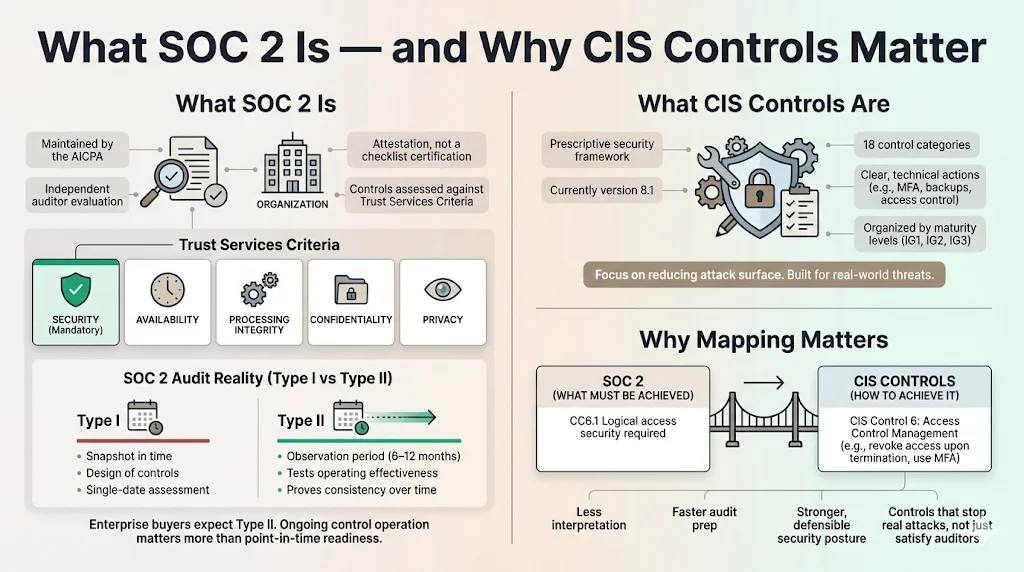
Service Organization Control 2 (SOC 2) is an auditing standard maintained by the AICPA. Unlike a checklist certification, SOC 2 is an attestation. An independent auditor evaluates your organization's controls against the Trust Services Criteria (TSC).
These criteria fall into five categories:
- Security (Common Criteria): The system is protected against unauthorized access. This is the only mandatory criterion.
- Availability: The system is available for operation and use as committed or agreed.
- Processing Integrity: System processing is complete, valid, accurate, timely, and authorized.
- Confidentiality: Information designated as confidential is protected.
- Privacy: Personal information is collected, used, retained, disclosed, and disposed of appropriately.
The Audit Reality: Most enterprise contracts demand a SOC 2 Type II report. A Type I report is a snapshot in time—it proves your design is sound on a specific date. A Type II report covers an observation period (typically 6 to 12 months) and tests the operating effectiveness of those controls.
Enterprise buyers care about Type II because it proves consistency. It shows you didn't just lock the door the day the auditor arrived; you kept it locked every day for a year.
What CIS Controls Are
If SOC 2 asks, "Are you secure?", the CIS Critical Security Controls (CIS Controls) answer, "Here is exactly how to do it."
Currently in version 8.1, the CIS Controls are a prioritized set of actions created by the global security community. They are prescriptive and highly technical. Unlike the broad language of SOC 2, CIS tells you specifically to "Establish and maintain a data recovery process" or "Ensure use of multifactor authentication for all remote access."
The framework consists of 18 control categories (formerly 20), organized by implementation groups (IG1, IG2, IG3) based on organizational maturity. They focus on practical defense—reducing the attack surface and mitigating common threats. This is critical given that exploitation of vulnerabilities tripled in 2024, making technical rigor mandatory.
Why Mapping Matters
Connecting SOC 2 Controls Mapped To CIS safeguards provides a translation layer between auditor expectations and engineering tasks.
SOC 2 criteria are often non-prescriptive. For instance, SOC 2 CC6.1 requires that "The entity implements logical access security software, infrastructure, and architectures." It does not tell you how to do that.
CIS Control 6 (Access Control Management) provides the rigorous steps to satisfy that requirement. By using CIS as your implementation baseline, you automatically satisfy the vaguer requirements of SOC 2. This connection reduces audit preparation time and guarantees that your security program defends against real-world attacks, not just checking boxes.
How SOC 2 Controls Map to CIS Controls
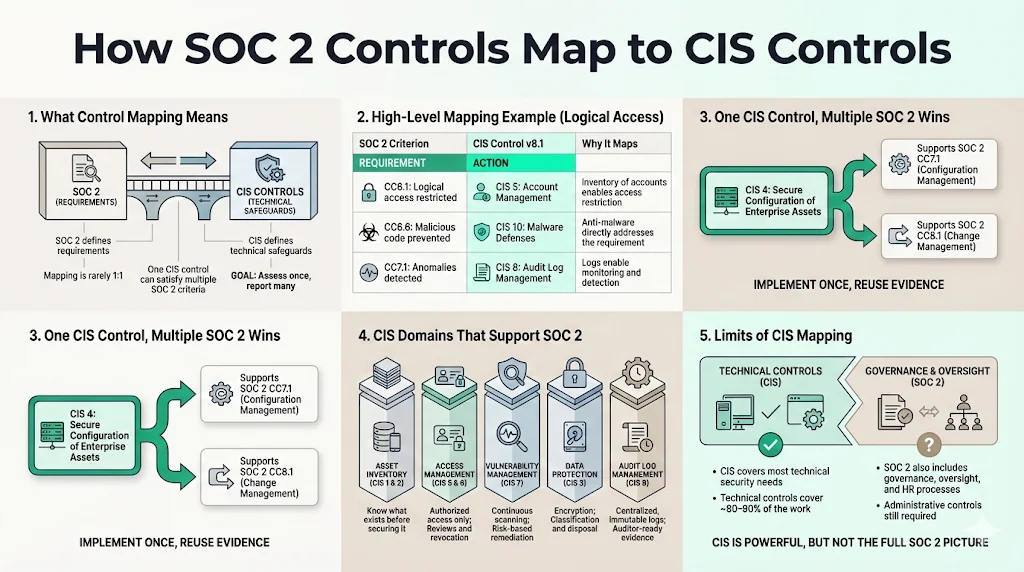
Control mapping is the process of linking a specific requirement in one framework (SOC 2) to a control or safeguard in another (CIS). This is rarely a 1:1 match. Often, a single CIS control will satisfy multiple SOC 2 criteria, or a single SOC 2 criterion will require multiple CIS safeguards to be considered "effective" by an auditor.
The goal is to create a "assess once, report many" environment. Instead of building a separate workflow for SOC 2 evidence and another for internal security checks, you implement the CIS safeguard. That single action then serves as evidence for your SOC 2 audit.
High-Level Mapping Example
To visualize how SOC 2 Controls Mapped To CIS standards function in practice, consider the core domain of Logical Access.
SOC 2 Criteria (The Requirement)
CIS Control v8.1 (The Technical Action)
Why It Maps
CC6.1: Logical access security is implemented to restrict access.
CIS 5: Account Management
CIS 5 dictates creating and managing an inventory of accounts. You are unable to restrict access (SOC 2) if you do not know who has accounts (CIS).
CC6.6: The entity implements controls to prevent malicious code.
CIS 10: Malware Defenses
CIS 10 requires deploying and updating anti-malware software. This is the direct technical answer to the SOC 2 requirement.
CC7.1: System operations are monitored to detect anomalies.
CIS 8: Audit Log Management
CIS 8 mandates collecting, alerting on, and retaining audit logs. This provides the monitoring capability SOC 2 demands.
This logic applies across the entire stack. When we design a program at Konfirmity, we look at the CIS control first. If you implement CIS 4 (Secure Configuration of Enterprise Assets), you are simultaneously generating evidence for SOC 2 CC7.1 (Configuration Management) and CC8.1 (Change Management).
What CIS Controls Covers That Supports SOC 2
The strength of CIS lies in its technical depth. Several CIS domains act as pillars for the SOC 2 Trust Services Criteria:
1. Asset Inventory & Control (CIS 1 & 2): SOC 2 requires you to know what you are protecting. CIS 1 (Hardware) and CIS 2 (Software) mandate strict inventory management. You are unable to secure what you fail to see.
2. Access Management (CIS 5 & 6): This is the single biggest source of audit exceptions. SOC 2 demands "authorized access only." CIS 5 (Account Management) and 6 (Access Control Management) provide the scripts and processes to guarantee user access rights are granted, reviewed, and revoked correctly.
3. Vulnerability Management (CIS 7): SOC 2 asks how you handle risk. CIS 7 provides the cadence: continuous scanning, automated patching, and remediation timelines based on CVSS scores.
4. Data Protection (CIS 3): Directly mapping to the Confidentiality and Privacy TSCs, CIS 3 outlines encryption standards, data classification, and disposal methods.
5. Audit Log Management (CIS 8): Auditors trust logs, not people. CIS 8 guarantees that when an incident occurs—or when an auditor asks for a sample selection—the data exists, is immutable, and is time-stamped.
Using Official CIS Mapping Resources
The Center for Internet Security publishes authoritative companion guides for this purpose. The CIS Controls v8 Mapping to AICPA Trust Services Criteria is an essential document for your compliance officer.
Critical Takeaway from the Official Guidance: The mapping shows that while CIS covers the technical security aspects of SOC 2 exceptionally well, SOC 2 also includes non-technical requirements (communication, board oversight, HR policies). Therefore, while SOC 2 Controls Mapped To CIS safeguards cover 80-90% of the technical heavy lifting, you must supplement them with administrative governance to pass the audit.
Map CIS Controls to SOC 2 once and use the evidence everywhere.
Share your work email and stop maintaining separate control sets for every framework.
Best Practices for Implementing Mapped Controls
Knowing the map is different from walking the path. At Konfirmity, we see companies fail not because they lack knowledge, but because they lack execution discipline. Here is how to implement these mapped controls effectively.
1) Start With a Gap Assessment
Before writing a single policy, you must audit your current state. Run a gap assessment against the CIS Implementation Group 1 (IG1)—this is "essential cyber hygiene."
Determine where your current practices fall short. Do you have Multi-Factor Authentication (MFA) everywhere (CIS 6)? Do you have automated backups (CIS 11)? Once you identify the technical gaps in CIS, cross-reference them with SOC 2 criteria. This gives you a prioritized remediation list that satisfies both security needs and audit demands.
2) Align Policies and Procedures First
Auditors review your "Design" (Type I) before your "Operation" (Type II). Your policies serve as the design specification.
Make sure your Information Security Policy explicitly references the controls you intend to use. If your policy states, "We encrypt all data at rest," make sure you cite the standard (e.g., AES-256) which matches CIS 3. Governance documents should be living instructions, not shelf-ware. They must reflect the reality of your stack, whether you run on AWS, Azure, or on-premise infrastructure.
3) Build Technical Controls Based on Risk
Do not implement controls blindly. Use a risk-based approach. SOC 2 allows management to define the risk acceptance criteria.
If you are a cloud-native SaaS company, your provider (AWS/GCP) handles physical security of the server room (a legacy concern). Focus your CIS implementation on CIS 15 (Service Provider Management) and CIS 4 (Secure Configuration). Build the controls that mitigate the actual risks to your customer data. This "scoping" exercise prevents you from over-engineering your compliance program.
4) Define Audit Cadences and Evidence Collection
This is where the "Konfirmity difference" becomes apparent. A self-managed SOC 2 program often fails because evidence collection is sporadic.
You must establish a cadence.
- Daily: Automated log collection (CIS 8).
- Weekly: Vulnerability scans (CIS 7).
- Quarterly: Access reviews (CIS 5).
- Annually: Penetration testing (CIS 18).
If you miss a quarterly access review during your observation period, you will have an exception in your final report. Exceptions act as red flags to enterprise buyers. You must automate this collection or engage a managed service to guarantee these operational tasks happen like clockwork.
5) Continuous Monitoring
SOC 2 is not a test you cram for; it is a lifestyle. Continuous monitoring tools are essential. You need real-time visibility into whether your encrypted S3 buckets remain encrypted or if a developer accidentally opened port 22 to the public internet.
Automated monitoring satisfies CIS 13 (Network Monitoring) and provides the auditor with assurance that you are watching the shop 24/7/365, satisfying SOC 2 monitoring criteria.
Practical Steps to Get From Mapping to Compliance
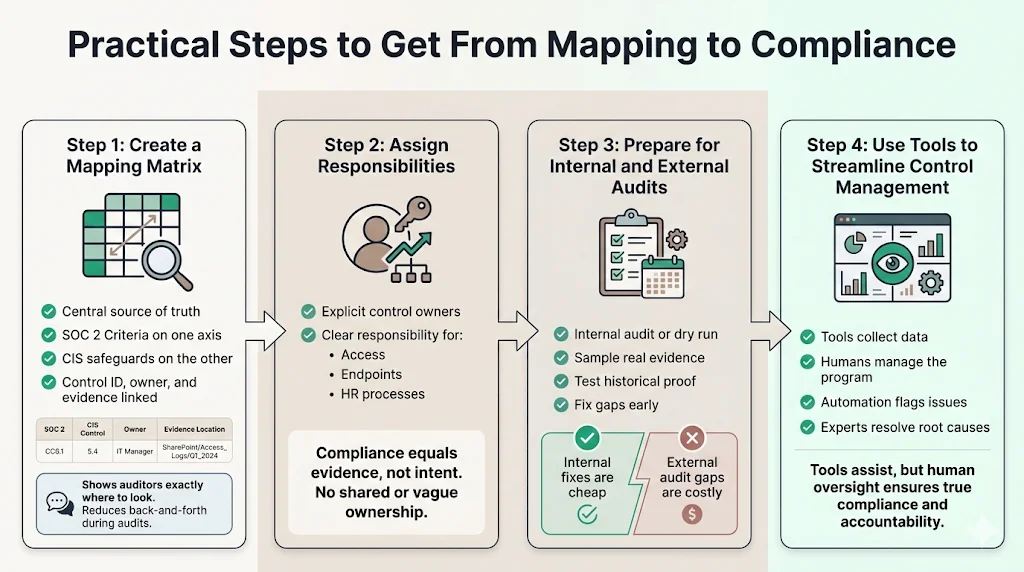
Moving from theory to a signed report requires a structured project plan.
1) Create a Mapping Matrix
Build a central "truth" document. This is typically a spreadsheet or a view within a GRC tool. On the Y-axis, list every SOC 2 criterion relevant to your scope. On the X-axis, list the specific CIS safeguard you have implemented to meet it.
Example Entry:
- SOC 2 CC6.1: Access must be authorized.
- Internal Control ID: AC-05
- CIS Mapping: CIS 5.4 (Restrict Administrator Privileges)
- Owner: VP of Engineering
- Evidence: Screenshot of IDP group settings / Export of admin user list.
By having SOC 2 Controls Mapped To CIS safeguards in a clear matrix, you show the auditor exactly where to look. This reduces the time they spend asking questions and the time your team spends answering them.
2) Assign Responsibilities
Compliance cannot be a side job for your CTO. Assign explicit ownership. Who owns endpoint security? Who owns HR onboarding (which impacts access control)?
At Konfirmity, we often act as the "Control Owner" for our clients, executing the tasks that internal teams ignore. If you do this internally, make sure the assignee knows that "compliance" means "providing evidence," not just "doing the work."
3) Prepare for Internal and External Audits
Conduct a "dry run" or internal audit before the external auditor arrives. Use your mapping matrix as the checklist. Test a sample of your own evidence. If you claim to review logs weekly, pull a random week from three months ago and see if the proof exists.
Fixing a gap during an internal audit costs nothing. Fixing a gap during an external audit costs you a clean report.
4) Use Tools to Streamline Control Management
While software cannot replace a security officer, it helps manage the data. Compliance automation platforms can pull configuration data from your cloud environment. However, rely on them for data collection, not program management. A tool will flag that a control failed; a human expert must investigate why and fix the root cause.
Case Example: CIS’s Own Experience
It is telling that the Center for Internet Security (CIS) itself underwent a SOC 2 Type II audit. They utilized their own controls as the foundation.
In their case study, CIS highlighted that mapping their existing operational work (based on CIS Controls) to the SOC 2 criteria allowed them to identify overlaps. They realized that by simply doing good security work—patching, logging, managing access—they had already completed 85% of the audit preparation.
Critical Insight: Their biggest challenge was not the technology, but the documentation. They had to prove they were following their own advice. This reinforces the need for a "paper trail." For the reader, the lesson is clear: you are likely doing many things right, but if you don't document the link between the action and the requirement, you will fail the audit.
Common Challenges and How to Address Them
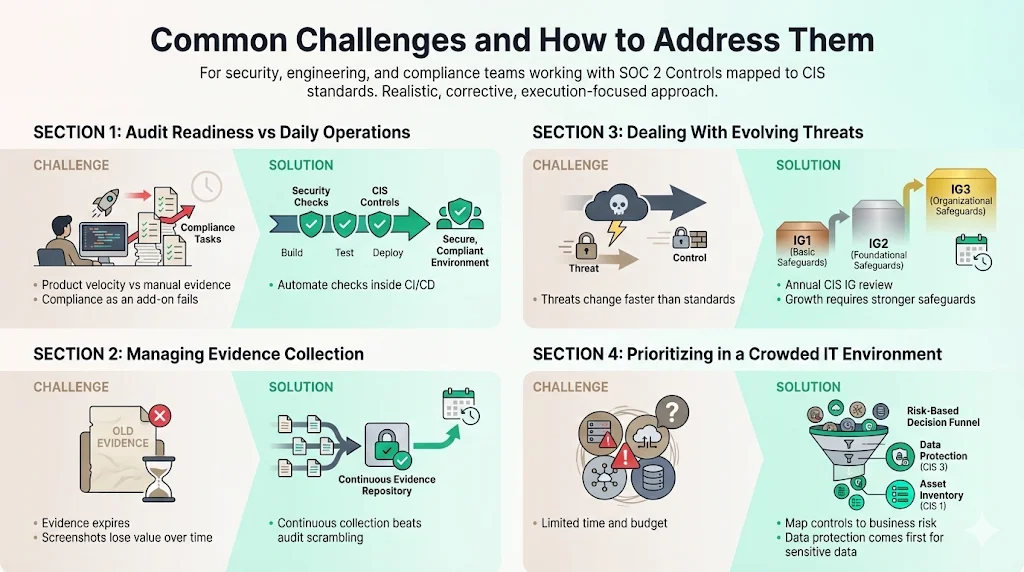
Even with SOC 2 Controls Mapped To CIS standards, companies face operational hurdles.
1) Audit Readiness vs. Daily Operations
The most common friction point is the conflict between shipping code and collecting screenshots. Engineering teams prioritize product velocity. When compliance is an "add-on," it gets deprioritized.
- Solution: Embed controls into the CI/CD pipeline. Make security checks automated so developers don't have to think about them.
2) Managing Evidence Collection
Evidence goes stale. A screenshot from January does not prove compliance in June.
- Solution: Use a managed service or automation to collect evidence continuously. Do not wait for the "audit window."
3) Dealing with Evolving Threats
The threat environment changes faster than audit standards. A control that was sufficient last year might be weak today.
- Solution: Review your CIS Implementation Group level annually. As you grow, move from IG1 to IG2 to stay ahead of threats, which naturally keeps you ahead of SOC 2 requirements.
4) Prioritizing in a Crowded IT Environment
With limited budget and time, which control comes first?
- Solution: Always map back to business risk. If you handle PHI (Protected Health Information), prioritizing data encryption (CIS 3) is non-negotiable compared to a lower-risk policy update.
Conclusion
The demand for trust in the enterprise market is not going away. Security questionnaires are getting longer, and the patience of procurement teams is getting shorter.
Mapping SOC 2 Controls Mapped To CIS safeguards is the most efficient path to meeting this demand. It moves your organization away from "check-the-box" compliance and toward a strong, defensible security posture. By using CIS as your technical blueprint, you guarantee that your SOC 2 report is backed by real operational strength, not just good intentions.
However, frameworks are only as good as their execution. A self-managed SOC 2 initiative typically consumes 550–600 hours of internal leadership time per year. It distracts your best engineers and often results in a scramble during the audit window.
At Konfirmity, we pair a security-driven compliance platform with a fully-managed service. Run it self-serve, or with the fully-managed service we implement the controls, manage the evidence, and handle the audit defense. Our clients typically spend less than 75 hours a year on compliance, while we handle the rest.
Security that looks good on paper but fails under pressure is a liability. Build a program that stands up to buyers, auditors, and attackers alike. Start with security, and compliance will follow.
Frequently Asked Questions
1) What does “controls mapping” mean?
Control mapping is the process of identifying how a specific security action (like a CIS Control) satisfies a regulatory or framework requirement (like a SOC 2 criterion). It connects the "what" (requirement) to the "how" (technical implementation).
2) Is CIS Controls enough for SOC 2 compliance?
CIS Controls cover the vast majority of the technical security and availability criteria within SOC 2. However, SOC 2 also requires administrative controls—such as HR background checks, organizational charts, and board oversight—which CIS does not strictly cover. You need a mix of CIS for technical defense and administrative policies for governance.
3) Do all SOC 2 Trust Services Criteria map to CIS?
Most of the Security, Availability, and Confidentiality criteria map directly to SOC 2 Controls Mapped To CIS technical safeguards. Processing Integrity and Privacy may require additional, specific controls depending on your business logic and data handling practices (e.g., GDPR-specific requirements for Privacy).
4) How long does it take to map and implement?
For a typical Series B SaaS company managing this internally, mapping and remediation can take 9–12 months. With a platform like Konfirmity, which brings pre-mapped control libraries and dedicated experts, readiness is typically achieved in 4–5 months.
5) Can CIS mappings reduce audit time?
Yes. Auditors prefer standard frameworks. When you show an auditor that your controls are based on CIS v8.1, they immediately understand the rigorous standard you are applying. This clarity reduces the number of follow-up questions and shortens the fieldwork phase of the audit.