
How much does a HIPAA audit cost? Most organizations spend $15,000 to $200,000+ on formal auditor and assessment fees alone, depending on size and scope, plus internal staff time and any remediation the audit surfaces. A single-site clinic can budget under $20,000 for a readiness assessment; a multi-site hospital system pursuing HITRUST alongside HIPAA can spend well into six or seven figures once technical remediation and ongoing monitoring are included. There's no fixed price because there's no fixed audit, HIPAA doesn't run a certification program the way ISO 27001 or SOC 2 does, so "the audit" can mean anything from a $5,000 internal risk assessment to a full OCR investigation.
That distinction matters more than the dollar figure. Enterprise buyers and hospital systems increasingly won't sign with a vendor who can't show that protected health information (PHI) is protected by an operating program, not a policy binder pulled off a shelf. This guide breaks down what actually drives HIPAA audit cost, walks through three real-world budget scenarios, and gives you a step-by-step way to estimate your own number. It draws on published cost guidance from the HIPAA Journal, ChartRequest, and Virtual Sprout, plus delivery data from more than 6,000 security audits Konfirmity's team has run.
This guide is written for CISOs, compliance leads, and founders at healthcare organizations and health-tech vendors handling PHI, along with fintechs and any company selling into enterprise or hospital-system accounts where a HIPAA-adjacent security review is part of the deal.
The Short Answer: How Much Does a HIPAA Audit Cost?
Your HIPAA audit cost lands somewhere between $10,000 and $200,000+ for the assessment itself, and the number that actually applies to you depends on three things: organization size, existing security maturity, and whether the assessment is internal, external, or a full OCR investigation. A small clinic with a handful of employees can complete a readiness assessment for $10,000–$20,000. A mid-sized healthcare provider with multiple locations typically spends $100,000–$150,000 once risk assessment, technical remediation, and training are included. A large hospital system pursuing HITRUST certification alongside HIPAA can exceed $1 million in year-one investment.
Those figures cover the assessment itself, not the broader compliance program. Remediation, ongoing monitoring, and staff training run separately, and skipping them to save money up front is what turns a manageable audit finding into a six-figure OCR penalty later.
What a HIPAA Audit Actually Involves
Under the Health Insurance Portability and Accountability Act, the Office for Civil Rights (OCR) has authority to investigate how covered entities and business associates handle PHI. A HIPAA audit is a structured assessment of administrative, technical, and physical safeguards: auditors review risk management practices, confirm adherence to the Privacy and Security Rules, and check that breach and records-request procedures actually work. There's no formal certification baked into the law, instead, OCR uses audits and investigations to enforce it, and most organizations that undergo one do it proactively rather than because OCR called.
Desk Audits vs. Onsite Audits
Audit intensity varies with the reason it's happening. A desk audit is a remote document review focused on specific controls and often requires only limited evidence. An onsite audit goes much deeper, in-person interviews, facility walkthroughs, and system reviews that can span several days. Some audits are part of OCR's periodic audit program; others follow a complaint or a reported breach. Many healthcare organizations run their own internal HIPAA audit or engage a third-party auditor for a readiness assessment before OCR ever gets involved, specifically to find and fix gaps on their own timeline rather than a regulator's. If you're choosing who runs that assessment, our HIPAA auditor selection guide covers what to ask before you sign a statement of work.
Get a HIPAA audit cost estimate built around your organization.
Share your work email and we'll help you scope a HIPAA audit budget against your actual size, PHI footprint, and current security maturity.
What Drives HIPAA Audit Cost: The Real Line Items
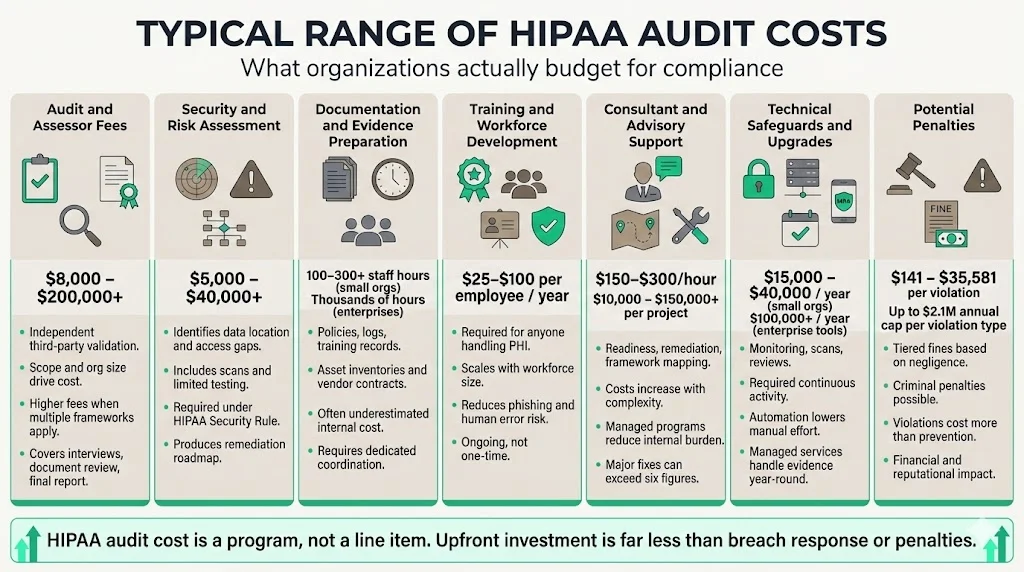
Compliance isn't a single project, it's an ongoing security program that intersects with patient care, procurement, and enterprise sales cycles. Audit cost is one line item inside that program. Direct costs are auditor fees, risk assessments, and consultant charges; indirect costs are the hours your own team spends gathering documentation, training staff, and updating policy. Below are the seven categories that make up a real HIPAA audit budget, using published ranges alongside what we've observed running audits directly.
Audit and Assessor Fees
Third-party auditors provide independent validation of your compliance posture: they review documentation, interview staff, and produce a report. One published HIPAA cost guide puts assessor fees at $15,000 to $200,000+ depending on complexity. A small clinic might engage a part-time consultant for a focused assessment around $8,000–$25,000; a multi-site health system can pay six figures for a full onsite audit. Fees climb further when multiple frameworks (HIPAA plus HITRUST or SOC 2) are in scope, since coordinating evidence across frameworks increases assessor effort.
HIPAA Risk Assessment Cost
A risk analysis, sometimes run as a standalone HIPAA gap assessment, identifies where sensitive data resides, who can access it, and which controls are missing, and it isn't optional. The Security Rule expects covered entities and business associates to perform regular risk analyses as a baseline, not a one-time event. External risk assessments generally run $5,000 to $20,000, and a separate industry guide puts readiness assessments starting around $5,000 for small organizations and exceeding $40,000 for larger ones. For a startup, this typically includes vulnerability scanning and light penetration testing; for a hospital, it stretches into technical architecture reviews, clinician and admin interviews, and device sampling across dozens of applications.
Documentation and Evidence Preparation
HIPAA compliance requires policies for privacy, security, breach notification, contingency planning, device management, and business associate agreements, and gathering the evidence behind them consumes real staff time even though it rarely shows up as a line item. You'll need access logs, training records, incident response plans, asset inventories, encryption proof, and vendor contracts on hand. Across more than 6,000 audits, we typically see small organizations spend 100–300 person-hours preparing evidence; larger systems spend thousands of hours across multiple departments. Assigning a dedicated compliance coordinator, or using a managed service that handles evidence collection year-round, is what keeps this from becoming a scramble every audit cycle. Our HIPAA audit preparation walkthrough covers how to build that evidence library well before assessors ask for it.
Workforce Training
Everyone who touches PHI needs to understand their privacy and security obligations, and training cost scales with headcount and delivery method. One 2025 guide puts annual HIPAA risk assessments at $3,000–$10,000 and security training at $25–$100 per employee. A 30-clinician mental health practice might spend $2,000–$5,000 a year on training; a health system with thousands of staff can invest tens of thousands. Regular training is also one of the cheapest levers you have, phishing and social engineering remain among the most common breach triggers, and consistent training measurably reduces both.
Consultant and Remediation Support
Many healthcare providers hire compliance consultants to design controls, map requirements across frameworks (HIPAA, SOC 2, ISO 27001, GDPR), and guide remediation after an audit surfaces gaps. Hourly rates typically run $150–$300, and project-based engagements range from $10,000 to $150,000 depending on scope. Remediation itself can be as small as a $1,000 policy fix or exceed $200,000 for architectural changes like re-platforming an unencrypted legacy system. At Konfirmity, our managed model embeds a dedicated compliance team that operates controls year-round instead of handing over a report and moving on, which is what drives the roughly 75% reduction in internal effort we see compared with self-managed programs.
Technical Safeguards and Upgrades
Technical measures are the backbone of HIPAA compliance: encryption at rest and in transit, multi-factor authentication (MFA), secure backups, log management, and network segmentation. Virtual Sprout estimates MFA, secure email, and access management rollout at $2,000–$10,000+; one industry guide puts broader technical remediation at $20,000–$150,000 for mid-sized practices. For an enterprise pursuing HITRUST certification alongside HIPAA, security infrastructure like SIEM, identity management, and network segmentation can push the budget into the $250,000–$5,000,000+ range, an investment that also pays off against SOC 2 and ISO 27001 requirements, not just HIPAA.
Ongoing Monitoring and Risk Management
Risk management doesn't end when the report is delivered. The Security Rule requires covered entities to regularly review information-system activity, audit logs, access reports, and incident tracking, on an ongoing basis. For a mental health provider, annual maintenance, monitoring, training updates, and documentation upkeep, typically runs $15,000–$40,000. Automation tooling ranges from around $99/month for small organizations to more than $100,000/year for enterprise deployments. This is the category most organizations underfund, and it's also the one that most directly determines whether next year's audit is a formality or a fire drill.
Free template
The HIPAA-to-NIST CSF Crosswalk Template
Map your HIPAA safeguards to NIST CSF once and reuse the same evidence across HIPAA, SOC 2, and ISO 27001 audits, cutting duplicate assessor hours. Enter your work email and we'll send the PDF.
HIPAA Audit Cost by Organization Size: Three Real Scenarios
Published ranges only go so far, so here are three anonymized budgets based on real engagement patterns, scaled from a single-site clinic to a regional hospital network.
Small Clinic
A small clinic is usually the cheapest scenario to budget for. A single-site family practice with eight employees handles appointment scheduling, basic billing, and a limited electronic health record. They hire a consultant for a $10,000 readiness assessment, which turns up outdated antivirus software and missing encryption. Remediation, a HIPAA-compliant email service and MFA, costs $3,000. Staff complete web-based training at $50 per person, and documentation prep consumes about 80 staff hours. Total initial budget: roughly $15,000, plus about $3,000 a year for ongoing monitoring and training.
Mid-Sized Healthcare Provider
A mid-sized healthcare provider carries more locations and service lines, and the budget grows accordingly. A three-location practice with 150 employees runs radiology, lab work, and telemedicine. They commission a $30,000 onsite audit; an accompanying $20,000 risk analysis flags gaps in network segmentation, portable-device encryption, and access review process. They invest $50,000 in technical upgrades and $7,500 in staff training, and bring in $25,000 of consultant support for remediation and control design. Total initial program cost: roughly $132,500, with about $40,000 budgeted annually for continuous monitoring, vendor risk management, and recurring training.
Large Hospital System
A regional health system with multiple hospitals, clinics, and a research unit pursues HITRUST certification alongside HIPAA and SOC 2 to satisfy payer and partner requirements. Assessment fees across all three frameworks total $150,000. Risk assessments and penetration tests spanning hundreds of systems cost $70,000. Technical remediation, SIEM, identity management, encryption at scale, reaches $1,000,000. Training for thousands of employees costs $75,000, and ongoing operations, continuous monitoring, vendor risk assessments, and documentation upkeep, require a dedicated security and compliance team. Total initial investment exceeds $1.3 million, with annual maintenance in the mid-six figures.
HIPAA Audit Checklist: A 6-Step Process to Estimate Your Cost
Use this six-step process to build your own number rather than guessing from a published range. It's distilled from our work across hundreds of healthcare clients.
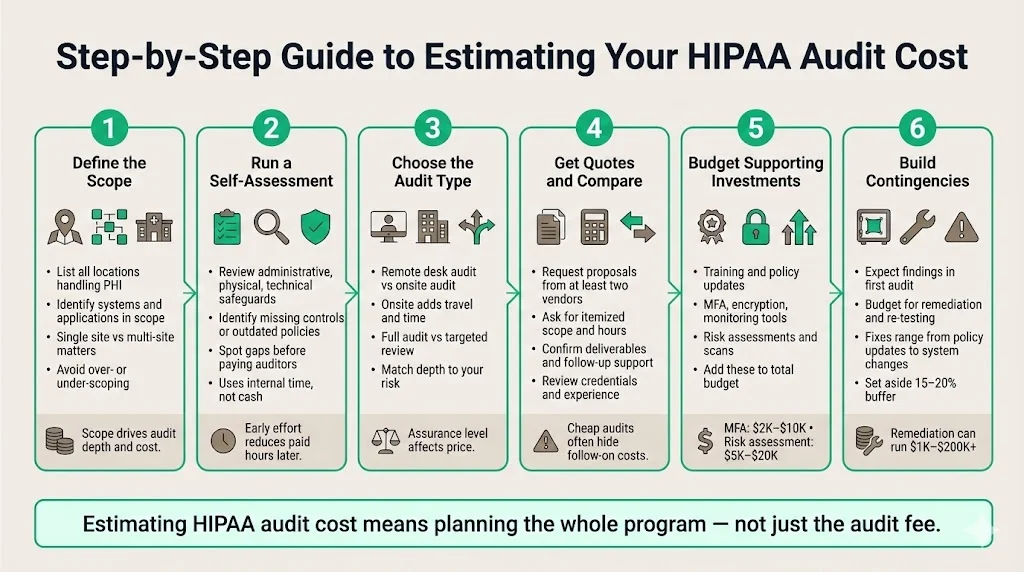
Step 1: Define the scope. List every location, system, and application that touches PHI. A single clinic and a multi-site health system need very different depths of audit; overscoping inflates cost, underscoping increases risk.
Step 2: Run a self-assessment first. Before engaging an auditor, review your own posture against the Security Rule's administrative, physical, and technical safeguard categories. Catching obvious gaps, missing encryption, stale policies, no recent training, internally costs nothing but staff time and cuts consultant hours later.
Step 3: Choose the audit type. Decide between a remote desk audit, a full onsite audit, or a targeted readiness assessment (for example, focused only on Right of Access rules). Remote audits are cheaper; onsite audits add travel and lodging but provide stronger assurance.
Step 4: Get itemized quotes from at least two vendors. Ask for scope, hours, deliverables, and follow-up support in writing. Reputable firms disclose whether their fee includes remediation guidance or just the assessment, and their accreditation (HITRUST assessor status, AICPA peer review, prior healthcare experience) is worth weighing alongside price.
Step 5: Budget the supporting investments, not just the audit fee. If you're rolling out MFA, budget $2,000–$10,000; for a risk assessment, reserve $5,000–$20,000. Roll these into your total HIPAA audit cost estimate rather than treating them as a separate surprise.
Step 6: Build in a contingency. Almost no organization passes a first audit without findings, see our roundup of common HIPAA audit findings for what typically shows up. One published guide shows remediation ranging from $1,000 to over $200,000; setting aside 15–20% of your estimated budget as contingency is a reasonable default.
Factors That Move Your HIPAA Audit Cost Up or Down
- Size and complexity. More staff, devices, and locations mean more policies, more logs, and more points of failure, all of which drive up assessor time and remediation effort.
- Security maturity. Organizations that already run SOC 2 or ISO 27001 usually have most controls in place, so HIPAA readiness costs less. Starting from zero means building policies, processes, and technical safeguards from scratch.
- Type and volume of PHI. Mental health records, genetic data, and other especially sensitive categories require stronger controls, which raises cost.
- Geography and state law. Labor costs vary by region, and some states layer additional privacy requirements on top of federal HIPAA.
- Audit depth and frequency. Regular internal audits and continuous monitoring look like extra spend, but they usually lower the cost of the external audit by catching issues early and keeping evidence current.
HIPAA Audit Cost Versus HIPAA Compliance Cost
It's worth separating the price of an audit from the broader cost of complying with HIPAA. An audit is a snapshot validation; compliance covers every administrative, technical, and physical safeguard, ongoing risk management, workforce training, documentation upkeep, and vendor oversight, on a continuous basis. A mid-range estimate for achieving full compliance in 2024 was $80,000–$120,000, and by 2025 some guides put full programs at $25,000–$100,000+ for smaller organizations, climbing into the millions for large systems. Treat the audit as a line item inside that larger program, not the whole budget, and calculate your compliance ROI to put your specific investment in context. For the full annual number beyond the audit line item, see our HIPAA budgeting guide.
The Cost of Skipping It: HIPAA Violation Fines
Budgeting for an audit gets easier once you weigh it against the alternative. OCR uses a four-tier penalty structure where fines scale with the degree of negligence: per-violation fines range from $141 to $35,581 when the organization was unaware of the violation, rising to a minimum of $71,162 per violation when willful neglect goes uncorrected. Annual caps per violation type sit at $2,134,831. Criminal penalties, while less common, include fines up to $50,000 and possible prison time for knowingly obtaining or disclosing PHI, with steeper penalties when false pretenses or personal gain are involved.
The breach math is worse. IBM's 2025 Cost of a Data Breach Report, summarized by the HIPAA Journal, found the average U.S. healthcare breach cost $7.42 million, against a record $10.22 million average across all U.S. breaches. A breach also disrupts operations and pulls staff away from patient care during the investigation and remediation window. Weighed against those numbers, an audit budget in the tens of thousands is the cheap option.
How to Control HIPAA Audit Cost Without Cutting Corners
There are legitimate ways to bring your HIPAA audit cost down without weakening security:
- Use internal capacity where it's real. If you have competent IT and compliance staff, put them on evidence collection, policy drafting, and initial gap analysis to cut consultant hours. Don't hand compliance tasks to people without the expertise, though, errors in documentation cost more to fix later than they saved up front.
- Automate evidence collection. Compliance platforms that automate evidence gathering, access reviews, and policy distribution start around $99/month for small organizations and scale into enterprise tiers. Automation cuts staff time but still needs configuration and oversight, not zero-touch.
- Prioritize by risk, not by checklist. Run the risk analysis early and put budget against the controls that materially reduce risk, rather than spreading spend evenly across every possible control.
- Combine frameworks where they overlap. If you need HIPAA plus SOC 2 or HITRUST, plan the audits together so evidence gets reused instead of recollected. Coordinated assessments can save 30–40% versus running them separately, which is the logic behind mapping HIPAA safeguards to NIST CSF once and reusing that mapping across frameworks.
- Engage a managed partner for the ongoing work. A human-led managed service that implements and operates controls inside your stack, rather than handing over a report, is what typically gets organizations to SOC 2 readiness in 4–5 months instead of the 9–12 months common in self-managed programs, with a roughly 75% reduction in internal effort and fewer findings because controls are designed and tested from day one.
HIPAA Audit Cost FAQ
It depends on scope and organization size. Readiness assessments start around $5,000 for small organizations and can exceed $40,000. Formal auditor fees range from $15,000 to $200,000+. Smaller clinics often spend under $20,000 in total; large health systems can exceed six figures once remediation and technology upgrades are included.
HIPAA doesn't mandate a routine certification audit the way ISO 27001 or SOC 2 do. The Security Rule does require covered entities to conduct risk analyses and implement safeguards, and OCR runs audits and investigations to enforce compliance. Most organizations choose a third-party audit proactively, to find and fix gaps before OCR contacts them.
A risk assessment is an internal or consultant-led exercise that identifies where PHI lives, who can access it, and what's missing, it's a required, recurring input to your security program. A HIPAA audit is a formal, external review (or an OCR investigation) that validates whether your safeguards actually meet the Security and Privacy Rules. Most organizations run risk assessments continuously and formal audits periodically.
Ongoing maintenance, ongoing monitoring, training refreshers, documentation updates, and periodic reassessment, typically runs $15,000–$40,000 a year for a small-to-mid-sized provider, and considerably more for large systems with dedicated compliance staff. That's separate from the one-time cost of building the program initially, which is usually the larger number in year one.
OCR runs a periodic audit program, but most enforcement activity comes from complaints and reported breaches rather than random selection. A reported breach affecting PHI, a patient complaint, or a business associate incident are the most common triggers. That unpredictability is exactly why proactive readiness assessments exist, they let you find gaps on your own schedule instead of OCR's.
Yes. OCR's tiered penalty structure includes a level where willful neglect not corrected within 30 days carries a minimum fine of $71,162 per violation, and criminal violations can carry fines up to $50,000 plus possible prison time. Civil penalties are capped at $2,134,831 per violation type per year. Proactive investment in audit readiness is what keeps an organization out of that tier.
Start with an internal self-assessment against the Security Rule's safeguard categories before paying a consultant, it catches the obvious gaps for free. Automate what you can (evidence collection, access reviews), prioritize remediation by actual risk rather than checklist order, and if you're also pursuing SOC 2 or ISO 27001, map controls once and reuse the evidence across frameworks instead of paying for duplicate assessments.
Putting Your HIPAA Audit Budget to Work
Get a real HIPAA audit cost estimate, not a guess
Book a demo and we'll map your HIPAA audit cost against your current security maturity, self-serve or with our CISO-led team running the program for you.
Book a demo
Healthcare organizations and the vendors that serve them have a duty to protect patient data, and treating audit cost as an afterthought is the expensive way to learn that. Your size, scope, security maturity, and technology posture set the real number, and while assessor fees and remediation spend can look steep in isolation, they're small next to the cost of a breach or an OCR enforcement action. Plan the audit as one line item inside a broader security program, run continuous risk assessments, invest in the technical safeguards that actually reduce risk, and the audit itself becomes a formality rather than a fire drill.
At Konfirmity, we start with security and arrive at compliance. Our platform runs self-serve or fully managed, and with the managed service our CISO-led team implements controls inside your stack and operates them daily rather than handing over a report and walking away. Across more than 6,000 security audits, our healthcare and fintech clients budget their HIPAA audit cost with real numbers instead of guesswork, and reach readiness with far fewer findings than a self-managed program typically produces.