
Healthcare security leaders today face a compounding challenge. You are not only responsible for securing patient data against increasingly sophisticated ransomware attacks but also for proving that security to a growing list of stakeholders. Regulators, cyber insurance carriers, and enterprise partners all demand evidence of due diligence.
For many organizations, the Health Insurance Portability and Accountability Act (HIPAA) is the baseline. However, HIPAA is descriptive, not prescriptive. It tells you what to do (protect patient data) but not exactly how to build the architecture to do it. This is where HIPAA Controls Mapped To NIST CSF work comes in: the National Institute of Standards and Technology (NIST) Cybersecurity Framework (CSF) supplies the operational "how" that HIPAA leaves open.
The industry struggle is palpable. Security teams often manage HIPAA compliance in one silo and operational security in another. This leads to redundant work, "compliance manufacturing," and gaps in coverage that attackers exploit. By integrating these approaches, organizations can build a durable security posture that naturally satisfies regulatory requirements.
The most effective way to bridge this gap is by ensuring HIPAA Controls Mapped To NIST CSF are central to your strategy. This alignment translates the legal requirements of HIPAA into the operational language of NIST, allowing technical teams to execute security measures that satisfy compliance mandates simultaneously.
In this guide, we will break down the practicalities of this mapping, drawing from Konfirmity’s experience supporting over 6,000 security audits. We will move beyond theory into the operational realities of protecting electronic Protected Health Information (ePHI) in a modern, threat-heavy environment. If you haven't yet built the underlying inventory, our HIPAA controls list guide covers how to structure one first.
Understanding HIPAA Security and Privacy Obligations
HIPAA remains the primary regulatory standard for US healthcare, designed to ensure that individuals’ health information is properly protected while allowing the flow of health information needed to provide high-quality health care.
Brief Overview of HIPAA’s Role in Healthcare Security
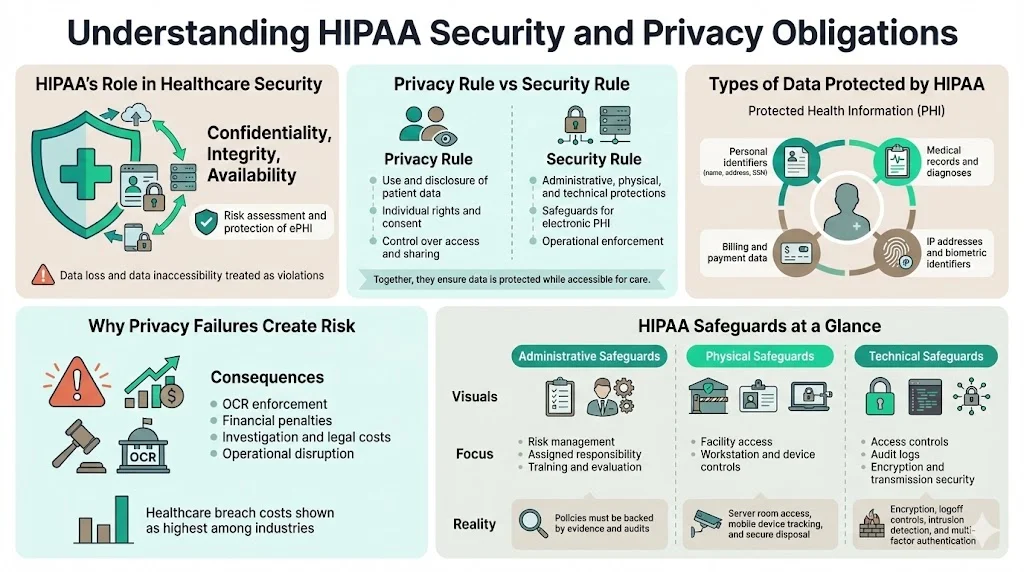
HIPAA’s role extends beyond simple confidentiality. It mandates the integrity and availability of data. If a hospital cannot access patient records due to a ransomware attack, that is a HIPAA violation just as much as a data breach is. The regulation forces organizations to assess risks to ePHI and implement appropriate protections.
Difference Between the HIPAA Security Rule and Privacy Rule
It is vital to distinguish between these two pillars:
- The Privacy Rule addresses the saving, accessing, and sharing of medical and personal information. It focuses on an individual’s right to control the use of their personal health information.
- The Security Rule specifically operationalizes the protections for ePHI. It defines the standards for the administrative, physical, and technical safeguards required to ensure the confidentiality, integrity, and security of electronic protected health information.
Types of Patient Data Protected
HIPAA protects any information held by a covered entity regarding health status, provision of health care, or payment for health care that can be linked to an individual. This includes:
- Names, addresses, and SSNs.
- Medical records and diagnoses.
- Billing and payment history.
- IP addresses and biometric identifiers used in hospital systems.
Why Data Privacy Failures Create Legal and Operational Risk
The Department of Health and Human Services (HHS) Office for Civil Rights (OCR) actively enforces these rules. Beyond fines, which can reach millions of dollars, the operational cost of a breach involves forensic investigations, legal fees, and reputational damage. In 2024, the average cost of a healthcare data breach reached nearly $11 million, the highest of any industry.
Subsection: HIPAA Safeguards at a Glance
HIPAA partitions its requirements into three distinct categories.
Administrative Safeguards
These are the policies and procedures designed to manage the selection, development, implementation, and maintenance of security measures.
- Focus: Security management processes, assigned security responsibility, workforce training, and evaluation.
- Operational Reality: This is where many fail. You might have a policy on paper, but if you lack evidence of monthly access reviews or annual risk assessments, you are non-compliant.
Physical Safeguards
These control physical access to protect against inappropriate access to protected data.
- Focus: Facility access controls, workstation use, and device and media controls.
- Operational Reality: This includes badge access systems for server rooms and increasingly, the tracking of mobile devices and laptops containing ePHI.
Technical Safeguards
These are the technology and the policy and procedures for its use that protect ePHI and control access to it.
- Focus: Access control, audit controls, integrity, person or entity authentication, and transmission security.
- Operational Reality: This involves encryption at rest and in transit, automatic logoff features, and intrusion detection systems.
What Is the NIST Cybersecurity Framework (CSF)?
While HIPAA provides the "what," NIST CSF provides the "how." Created by the National Institute of Standards and Technology, the CSF consists of standards, guidelines, and best practices to manage cybersecurity-related risk.
Purpose of NIST CSF in Modern Cybersecurity Standards
NIST CSF was designed to be a voluntary framework for critical infrastructure, but it has become the gold standard for private industry. It provides a common language for understanding, managing, and expressing cybersecurity risk to internal and external stakeholders.
Why NIST CSF Fits Healthcare Environments
Healthcare environments are complex, mixing legacy on-premise mainframes with cloud-native applications and IoT devices. NIST CSF allows organizations to apply risk management principles across this diverse stack. It moves security from a "checklist" mentality to a risk-based approach, which aligns perfectly with HIPAA’s requirement to conduct an accurate and thorough risk analysis.
The Five NIST CSF Functions
The framework organizes basic cybersecurity activities at their highest level.
1) Identify
Develop an organizational understanding to manage cybersecurity risk to systems, assets, data, and capabilities.
- Healthcare Context: You cannot protect patient data if you do not know where it lives. This involves asset management and governance.
2) Protect
Develop and implement the appropriate safeguards to ensure delivery of critical infrastructure services.
- Healthcare Context: This covers identity management, awareness training, and data security protection (encryption).
3) Detect
Develop and implement the appropriate activities to identify the occurrence of a cybersecurity event.
- Healthcare Context: Continuous monitoring of networks for anomalies that could indicate a breach.
4) Respond
Develop and implement the appropriate activities to take action regarding a detected cybersecurity event.
- Healthcare Context: Having an Incident Response Plan (IRP) that includes notifying affected patients and the HHS if a breach occurs.
5) Recover
Develop and implement the appropriate activities to maintain plans for resilience and to restore any capabilities or services that were impaired.
- Healthcare Context: Restoring clinical data from backups to resume patient care.
Why Map HIPAA Controls to NIST CSF?
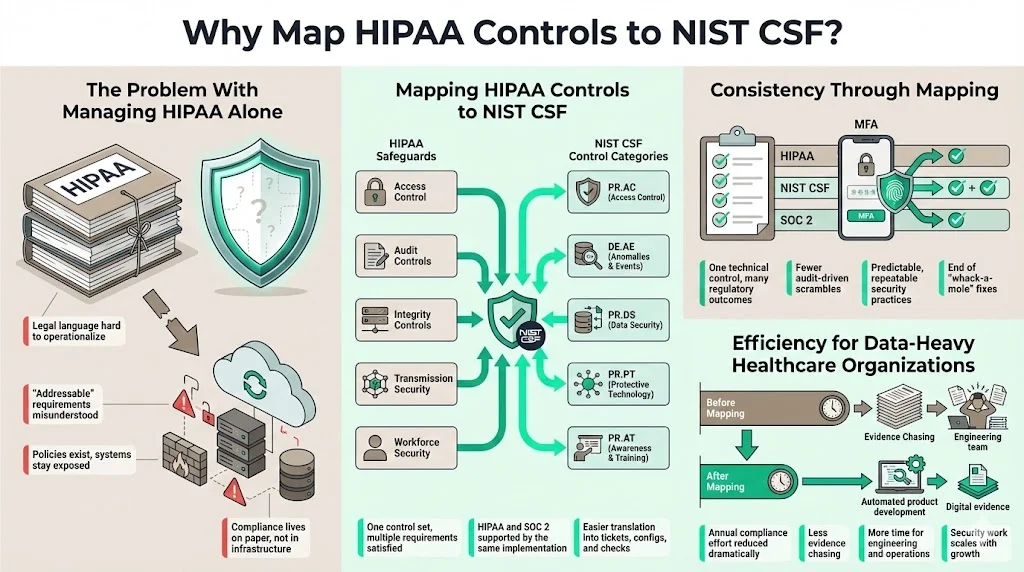
Managing HIPAA in isolation often leads to a "paper shield"—a compliance program that exists in binders but not in the server room.
Challenges of Managing HIPAA in Isolation
HIPAA’s language can feel outdated. Terms like "addressable implementation specifications" often confuse IT teams. Does "addressable" mean optional? (Hint: No, it means you must implement it or an effective alternative). Without a modern framework, teams struggle to translate these legal terms into Jira tickets or configuration settings.
Benefits of Security Controls Mapping
When you utilize a strategy with HIPAA Controls Mapped To NIST CSF, you create a unified control set. Instead of one set of protocols for your HIPAA audit and another for your SOC 2 Type II attestation, you implement a single high-standard control that satisfies both. If your organization is pursuing SOC 2 alongside HIPAA, see how SOC 2's Trust Services Criteria map to the same NIST CSF functions so one control set can satisfy both.
How Mapping Supports Consistent Healthcare Security Practices
Mapping ensures consistency. If NIST recommends multi-factor authentication (MFA) for remote access (PR.AC-7), implementing that control satisfies the NIST requirement and the HIPAA technical safeguard for access control and authentication. This reduces the "whack-a-mole" approach to security where teams scramble to fix individual issues based on which auditor is visiting.
Value for Organizations Handling Large Volumes of Patient Data
For enterprise healthcare companies, efficiency is capital. Konfirmity’s data shows that organizations using a mapped, managed approach reduce their internal compliance effort from 550–600 hours annually to under 70 hours. This releases key engineering talent to build product features rather than chase evidence artifacts.
Is your HIPAA program aligned with the NIST CSF functions that matter?
Drop your work email and map your safeguards to a security framework auditors respect.
HIPAA Controls Mapped To NIST CSF: Core Crosswalk
Where This Crosswalk Comes From
The mapping in this guide is not Konfirmity's invention. HHS, NIST, and ONC first published a formal NIST CSF-to-HIPAA Security Rule crosswalk in 2016. NIST replaced the underlying guidance in February 2024 with NIST Special Publication 800-66 Revision 2, Implementing the HIPAA Security Rule: A Cybersecurity Resource Guide. SP 800-66 Rev 2 includes its own official crosswalk, in Appendix D, tying every HIPAA Security Rule standard and implementation specification to a specific NIST CSF Subcategory and, where relevant, a NIST SP 800-53 control.
The table immediately below follows that same structure: administrative, physical, and technical safeguards mapped down to the CSF Subcategory level, not just the five high-level functions. If your team is building evidence for an OCR audit or a cyber-insurance questionnaire, cite SP 800-66 Rev 2 directly by name. Referencing the current federal source carries more weight with auditors than a paraphrase of it.
| Safeguard | HIPAA Citation | NIST CSF Function | NIST CSF Subcategory | Operational Action |
|---|---|---|---|---|
| Risk Analysis & Risk Management | §164.308(a)(1) | Identify | ID.RA-1 | Conduct annual risk assessments; translate findings into a vulnerability management program with measurable remediation tasks. |
| Workforce Training & Access Control | §164.308(a)(5) | Protect | PR.AT-1 | Implement automated training tools with completion tracking; auditor evidence is completion logs, not policy documents. |
| Policies & Procedures | §164.316 | Identify | ID.GV-1 | Maintain living policy documents reviewed annually and after significant infrastructure changes. |
| Facility Access Controls & Asset Protection | §164.310(a)(1) | Protect | PR.AC-2 | For cloud environments, review hosting providers' SOC 2 reports for physical security; for hybrid environments, maintain badge and visitor logs. |
| Device Security & Media Handling | §164.310(d)(1) | Protect | PR.DS-3 | Obtain destruction certificates for servers and laptops containing ePHI before disposal; track asset transfers formally. |
| Access Control & Authentication | §164.312(a)(1) | Protect | PR.AC-1 | Implement Single Sign-On and enforce multi-factor authentication organization-wide; eliminate shared accounts. |
| Audit Controls & Activity Monitoring | §164.312(b) | Detect | DE.CM-3 | Centralize logs (CloudTrail, application, database) into a SIEM platform for comprehensive activity tracking. |
| Transmission Security | §164.312(e)(1) | Protect | PR.DS-2 | Enforce TLS 1.2 or higher for web traffic; encrypt database connections; disable weak ciphers. |
Common Gaps Found During HIPAA: NIST Mapping
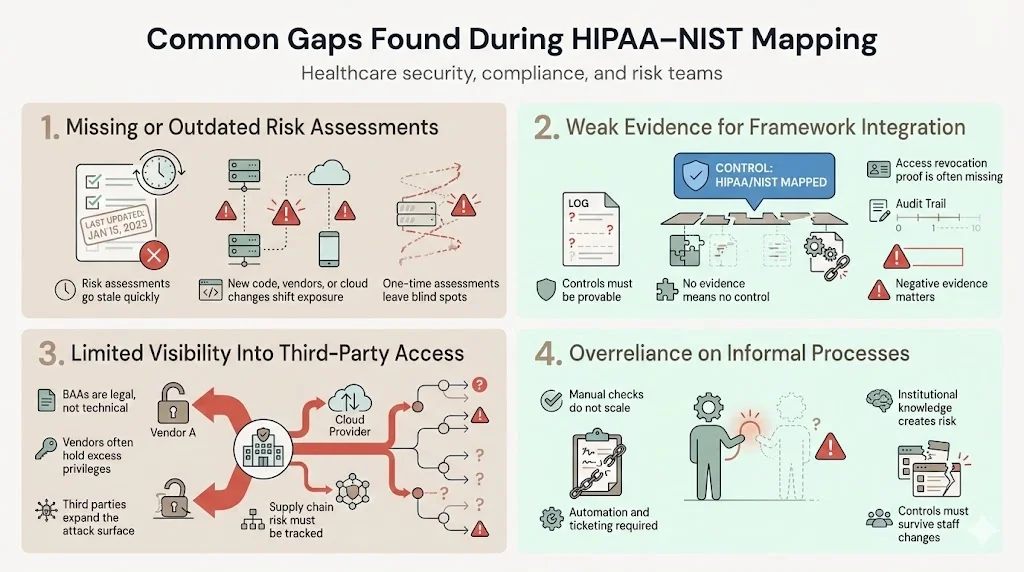
Even with the best intentions, organizations often leave dangerous gaps. When executing HIPAA Controls Mapped To NIST CSF, we frequently encounter specific areas of failure.
1) Missing or Outdated Risk Assessments
Many organizations treat the risk assessment as a "one-and-done" checkbox for the auditor. A risk assessment from 2023 is useless against 2025 threats. If you have deployed new code, added new vendors, or changed your cloud architecture, your risk profile has changed. Our HIPAA gap assessment guide walks through re-scoping that assessment after a material change.
2) Weak Documentation Tied to Security Framework Integration
Teams standardizing on a governance-first approach instead of a technical control set often hit the same documentation gap; see our HIPAA-to-COBIT mapping for how that framework structures the same evidence trail. Auditors function on evidence. If you claim to perform quarterly access reviews but have no tickets, emails, or logs to prove it, the control does not exist. A common gap is the lack of "negative evidence"—proving that you revoked access for a terminated employee within the SLA window (usually 24 hours).
3) Limited Visibility into Third-Party Access
Business Associate Agreements (BAAs) are legally required, but they don't secure your data. We often find that vendors have excessive permissions to ePHI. Mapping to NIST’s Supply Chain Risk Management (ID.SC) helps identify this gap by forcing you to treat vendors as part of your attack surface. For the vendor side of this gap, see the vendor risk mapping process, including how to bring Business Associate Agreements into the same control framework.
4) Overreliance on Informal Processes
"Jim checks the logs every Monday" is not a scalable control. If Jim goes on vacation or quits, compliance breaks. Informal processes are the enemy of durable security. You need automated alerts and ticketed workflows. Our HIPAA continuous monitoring guide covers how to replace those manual checks with something durable.
How Mapping Supports Audits and Assessments
The ultimate test of your security program is the audit. Whether it is an OCR investigation following a breach or a routine assessment, the preparation is identical.
Preparing for OCR Audits Using Mapped Controls
The Office for Civil Rights (OCR) has indicated that alignment with recognized security practices, like NIST CSF, can be a mitigating factor during enforcement actions. If you can demonstrate HIPAA Controls Mapped To NIST CSF and show a history of adherence, you demonstrate "good faith" effort.
Clear Evidence Trails for Auditors
Auditors appreciate structure. When you present your evidence organized by NIST functions—which inherently cover HIPAA safeguards—you tell a coherent story. You move from "Here is a pile of documents" to "Here is how we Identify risks, Protect data, and Detect threats."
Reduced Stress During Compliance Reviews
At Konfirmity, we operate on a model of continuous compliance. By maintaining evidence collection year-round, the "audit prep" phase shrinks from a panic-induced month to a simple export of existing data.
Practical Templates for HIPAA Controls Mapped To NIST CSF
Templates provide the structural foundation for your program. However, a template is only as good as the data you put into it. Teams standardizing on CIS Controls instead of, or alongside, NIST CSF can use this HIPAA-to-CIS Controls mapping for the same safeguards.
HIPAA-to-NIST Crosswalk Template
Your primary tracking document should be a "Source of Truth" matrix. The starter set below matches the crosswalk table earlier in this guide.
| HIPAA Citation | HIPAA Control Description | NIST CSF Subcategory | Internal Owner | Evidence Location | Frequency |
|---|---|---|---|---|---|
| §164.308(a)(1)(i) | Security management process | ID.RA-1 | CISO / Security Lead | GRC platform, risk register | Annual |
| §164.308(a)(5)(i) | Security awareness training | PR.AT-1 | People Ops / Security | LMS completion logs | Ongoing, reviewed quarterly |
| §164.310(a)(1) | Facility access controls | PR.AC-2 | Facilities / IT | Badge system logs, visitor log | Continuous |
| §164.312(a)(1) | Access control | PR.AC-1 | IT / IAM Lead | SSO/IAM platform, access review tickets | Quarterly |
| §164.312(b) | Audit controls | DE.CM-3 | Security Engineering | SIEM dashboard | Continuous |
| §164.312(e)(1) | Transmission security | PR.DS-2 | Infrastructure / DevOps | TLS config scans, cert inventory | Continuous |
(Rows above are a starter set matching the crosswalk table in the prior section. A complete, downloadable version covering all HIPAA Security Rule standards and implementation specifications is available below.)
Free template
Get the full crosswalk spreadsheet
Drop your work email and we'll send the complete HIPAA-to-NIST CSF crosswalk, covering every administrative, physical, and technical safeguard, with columns for owner, evidence location, and review frequency, ready to import into your GRC tool or a plain spreadsheet.
Implementation Tips for Healthcare Organizations
Moving from a fragmented state to a unified, mapped posture requires a deliberate approach.
1) Starting Small with High-Risk Systems
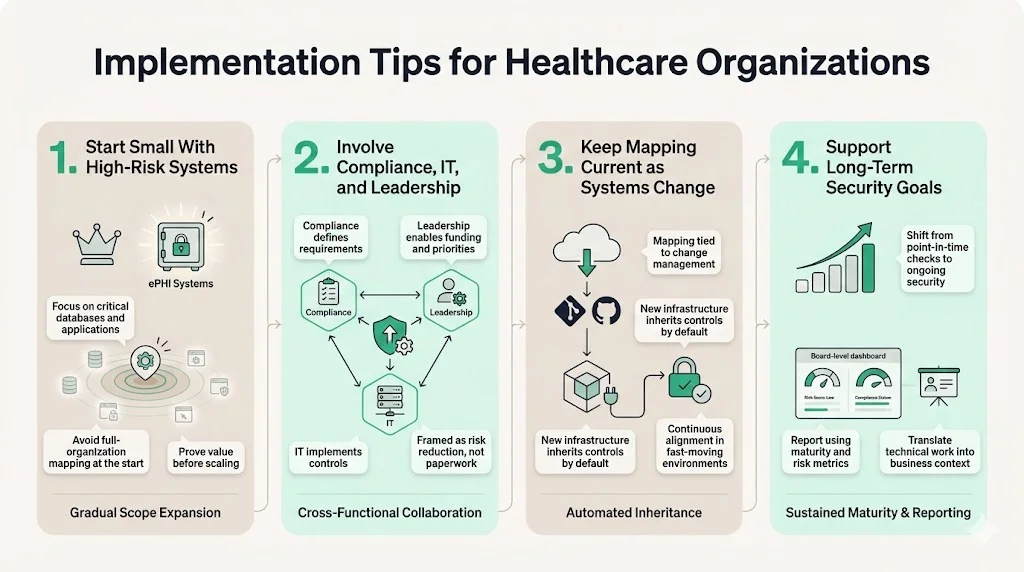
Do not attempt to map the entire organization in week one. Start with the "Crown Jewels"—the databases and applications that store, process, or transmit ePHI. Apply the HIPAA Controls Mapped To NIST CSF methodology to this scope first.
2) Involving Compliance, IT, and Leadership
Security is a team sport. Compliance understands the rules, IT understands the tools, and Leadership holds the budget. You need all three. Frame the initiative not as "more compliance work" but as "risk reduction and sales enablement." Enterprise buyers want to see this level of maturity.
3) Keeping Mapping Current as Systems Change
Cloud environments are dynamic. Code is shipped daily. Your mapping must be part of your Change Management process. If you spin up a new Kubernetes cluster, it must immediately inherit the NIST/HIPAA controls defined in your baseline.
4) Supporting Long-Term Healthcare Security Goals
This mapping supports the shift from "point-in-time" compliance to "continuous" security. It allows you to report to the Board of Directors using business-aligned metrics (e.g., "We are at 95% maturity on the NIST 'Protect' function") rather than obscure regulatory jargon.
See your real HIPAA-to-NIST CSF gap, not a guess
Book a demo and we'll map your safeguards against every NIST CSF subcategory tied to HIPAA, self-serve or with our CISO-led team running it for you.
Book a demo
Conclusion
The demand for rigorous data protection in healthcare will not recede. As threats evolve and patient data becomes more valuable on the black market, the regulatory and commercial pressure to prove security will only intensify.
Adopting a strategy of HIPAA Controls Mapped To NIST CSF is the most logical path forward. It creates clarity out of chaos. Teams that need a more prescriptive Safeguard-level checklist can pair this with our HIPAA-to-ISO 27002 mapping. It allows your organization to build a security program that is defensible, durable, and operational. Instead of chasing separate requirements for HIPAA, SOC 2, and internal policies, you build a single, strong foundation that supports them all. For organizations also holding or pursuing ISO 27001, this ISO 27001-to-NIST-CSF crosswalk shows where Annex A controls overlap with what's mapped here.
At Konfirmity, we believe that you should start with security and arrive at compliance. By focusing on the tangible controls that protect data—and verifying them with continuous evidence—compliance becomes a natural byproduct of good engineering. It is time to move beyond the binders and build a security posture that stands up to auditors, buyers, and attackers alike.
FAQs
The NIST Cybersecurity Framework (CSF) is a set of guidelines and best practices for managing cybersecurity risk. It matters for HIPAA because while HIPAA demands that you protect data, it doesn't specify the technical details of how to do it. NIST CSF provides the structural "how" that fills the gap left by HIPAA's "what," offering a rigorous methodology for securing ePHI.
HIPAA’s Administrative, Physical, and Technical safeguards align directly with the NIST functions of Identify, Protect, Detect, Respond, and Recover. For example, the HIPAA requirement for "Risk Analysis" maps to NIST's "Identify" function, while "Access Control" requirements map to the "Protect" function. This HIPAA Controls Mapped To NIST CSF alignment ensures that every regulatory requirement has a corresponding operational security action.
Technically, no. HIPAA does not mandate the use of NIST CSF. However, the HHS Office for Civil Rights (OCR) and industry auditors widely recognize NIST CSF as the gold standard for demonstrating a complete security program. Using it provides a strong defense and evidence of due diligence during an audit.
Common gaps include outdated risk assessments that don't reflect current infrastructure, a lack of documentation or evidence for "Protect" functions (like terminated user access revocation), and insufficient monitoring of third-party vendors (Business Associates). Organizations often fail to link their written policies to actual technical controls.
Mapping creates a clear "index" for auditors. Instead of searching for scattered evidence, an auditor can look at your HIPAA Controls Mapped To NIST CSF matrix and see exactly how you satisfy each requirement. It speeds up the audit process, reduces back-and-forth questions, and demonstrates a mature, organized control environment.