

Most enterprise buyers now request assurance artifacts before procurement. Without operational security and continuous evidence, deals stall—even when teams think they are "ready" on paper. In healthcare, this scrutiny intensifies because patient trust is the product. If you cannot prove you handle patient data with precision, you lose the contract.
One of the most frequent friction points we see in 2025-26 audits is the mishandling of patient access rights. Security leaders often treat these requests as simple administrative tasks. In reality, they are complex workflows that test your data governance, identity verification, and retrieval capabilities.
This HIPAA Data Subject Request Guide helps busy compliance, legal, and IT teams move beyond reactive scrambling. We will examine how to build a durable, disciplined process that satisfies regulators and protects patient trust.
Why a HIPAA Data Subject Request Guide Matters
Patient expectations regarding health information privacy have shifted. With the enforcement of the 21st Century Cures Act and increased digital literacy, patients expect their medical records to be as accessible as their bank statements.
Request volumes are rising for healthcare organizations. This surge creates significant pain points for compliance and IT teams:
- Fragmented Data: Patient data often lives in disconnected silos—EHRs, billing systems, imaging servers, and third-party vendor platforms.
- Resource Drain: Manual retrieval and redaction consume hundreds of hours annually.
- Risk of Breach: An accidental release to the wrong email address constitutes a reportable breach. With healthcare breach costs hitting record highs in the 2024 IBM Cost of a Data Breach Report, such errors are financially devastating.
At Konfirmity, we have supported over 6,000 security audits as a team with 25+ years of combined expertise. We consistently see that organizations relying on "compliance manufacturing"—generating policies without underlying controls—fail when hit with actual volume. A strong HIPAA Data Subject Request Guide helps teams execute faster and safer by standardizing the workflow.
What Is a HIPAA Data Subject Request?
A HIPAA Data Subject Request is a formal inquiry by an individual to exercise their rights regarding their Protected Health Information (PHI). While the term "Data Subject Request" (DSR) is often associated with GDPR, the concept is deeply rooted in the HIPAA Privacy Rule (45 CFR § 164.524).
It grants individuals the right to inspect and obtain a copy of their PHI in a "designated record set." Unlike broader Data Subject Access Requests (DSARs) seen in consumer privacy laws (like CCPA/CPRA), HIPAA requests have specific exclusions, fee structures, and clinically relevant denial grounds. Healthcare teams must treat HIPAA requests as a distinct workflow; applying a generic privacy logic often leads to non-compliance.
Who Can Submit a Request?
- Patients: The individual who is the subject of the PHI.
- Personal Representatives: Persons legally authorized to make healthcare decisions for the patient (e.g., power of attorney).
- Authorized Third Parties: Individuals or entities the patient explicitly directs to receive the data (e.g., a mobile health app or a life insurance company).
- Special Cases: Requests involving minors, guardians, and estates require strict validation. For example, state laws vary significantly on when a minor controls access to their own reproductive or mental health records.
Types of Requests Covered Under HIPAA
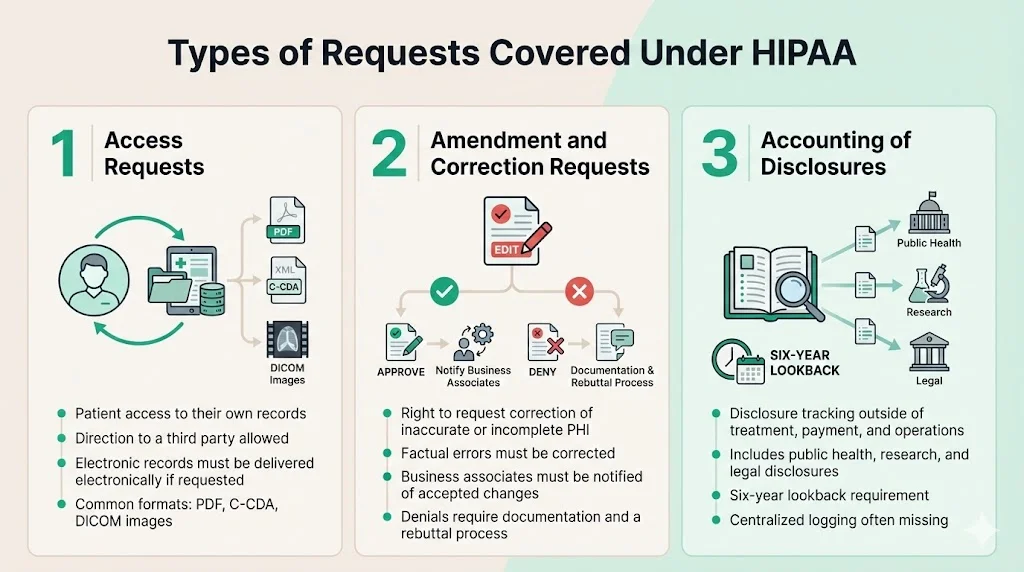
1) Access Requests
This is the most common category. It involves retrieving medical records for the patient's own use or directing them to a third party.
- Digital vs. Paper: If you maintain PHI electronically, you must provide it electronically if the patient requests it in that format.
- Formats: Common requests include PDFs, C-CDA files, or diagnostic images (DICOM).
2) Amendment and Correction Requests
Under 45 CFR § 164.526, patients have the right to request amendments to their PHI if they believe it is inaccurate or incomplete.
- Acceptance: If the error is factual (e.g., wrong blood type), you must correct it and inform relevant business associates.
- Denial: You can deny a request if the information is accurate, or if you did not create the record (unless the creator is no longer available). Denials require specific documentation and a rebuttal process.
3) Accounting of Disclosures
Patients can request a list of who has seen their data outside of treatment, payment, and healthcare operations (TPO). This typically covers disclosures for public health reporting, research, or legal demands.
- Tracking: You must track disclosures for six years prior to the request date.
- Challenges: Many organizations fail audits here because they lack centralized logs for non-TPO disclosures.
What Counts as Protected Health Information (PHI)
To fulfill a request, you must know what to look for. PHI includes any information held by a covered entity that concerns health status, provision of health care, or payment for health care that can be linked to an individual.
Designated Record Sets (DRS): HIPAA gives access rights to the "designated record set." This is broader than just the medical chart. It includes:
- Medical records and billing records.
- Enrollment, payment, claims adjudication, and case management records.
- Any other records used, in whole or in part, to make decisions about individuals.
Exclusions: Crucially, the right of access does not extend to:
- Psychotherapy Notes: Separate notes kept by a mental health professional that are not part of the medical record.
- Legal Proceedings: Information compiled in reasonable anticipation of a civil, criminal, or administrative action.
Patient data requests expose what your security controls actually protect.
Drop your work email and build a request process backed by real access controls.
Legal Timelines and Response Requirements
Across our engagements, we often see teams miss deadlines because they underestimate the retrieval effort. A robust HIPAA Data Subject Request Guide must clarify these hard stops.
1) HIPAA Response Deadlines
- Standard Timeframe: You must act on a request no later than 30 calendar days after receipt.
- Extensions: If you cannot meet the deadline, you may extend the time by an additional 30 days. You must provide the patient with a written statement of the reasons for the delay and the date you will complete the action.
- Consequences: The Office for Civil Rights (OCR) has made the Right of Access Initiative a priority enforcement area. Fines for missed deadlines or unreasonable delays are common.
2) Fees and Cost Considerations
Charging patients for access is legally perilous.
- Allowable Fees: You may only charge a reasonable, cost-based fee. This can include labor for copying (but not reviewing) and the cost of supplies (USB drives).
- Prohibited Fees: You cannot charge for the labor of search and retrieval, nor for infrastructure costs.
- Best Practice: Most modern organizations provide digital access for free to avoid the administrative overhead of calculating compliant fees.
Identity Verification and Authorization Requirements
1) Verifying the Requester
Verification safeguards confidentiality. You must be reasonably certain the person requesting data is who they claim to be.
- Methods: Verify identity through a secure portal login, signature matching, or requesting specific data points (DOB, MRN) that only the patient would know.
- Remote Requests: For email or phone requests, use a multi-factor approach. Do not demand excessive proof (like a driver's license in person) that creates an "unreasonable barrier" to access.
3) Authorization Rules
- Patient Access: A simple request is sufficient; a formal HIPAA Authorization form is not strictly required for the patient to get their own data, though a verification form is standard practice.
- Third-Party Access: If the patient directs you to send data to a third party, the request must be in writing, signed by the individual, and clearly identify the designated recipient and where to send the information.
Step-by-Step HIPAA Data Request Procedures
This section outlines the operational workflow. At Konfirmity, we implement these controls directly within client environments.
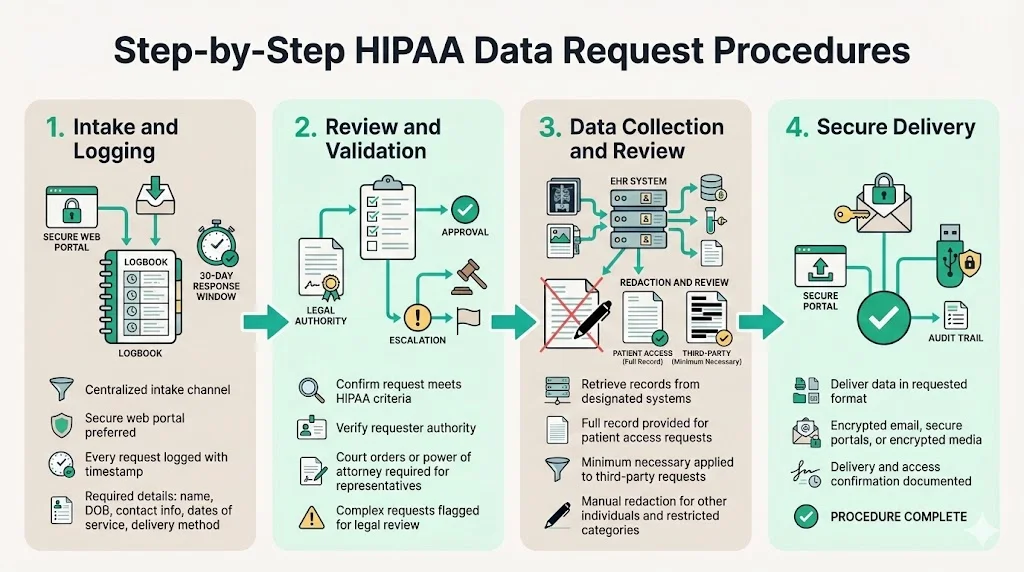
1) Intake and Logging
Establish a centralized intake channel.
- Channels: A secure web portal is ideal. Email is common but risky.
- Logging: Every request must be logged with a timestamp. This starts the 30-day clock.
- Details: Collect Name, DOB, contact info, specific dates of service requested, and delivery preference.
2) Review and Validation
Before pulling data, validate the request.
- Scope: Is this a HIPAA Data Subject Request Guide compliant request?
- Authority: If the requester is a personal representative, do you have the court order or power of attorney on file?
- Flagging: Identify complex requests (e.g., those involving sensitive minor data) for legal review immediately.
3) Data Collection and Review
- Retrieval: Query the EHR and other systems in the designated record set.
- Minimum Necessary: While the "Minimum Necessary" rule does not apply to patient access requests (they get the whole record if they ask for it), it does apply to third-party requests not authorized by the patient.
- Redaction: Manually review documents to redact information regarding other individuals or non-disclosure categories (like psychotherapy notes).
4) Secure Delivery
- Method: Send the data in the format requested.
- Security: Use encrypted email (TLS), secure portals, or encrypted physical media.
- Confirmation: Document that the data was sent and, if possible, when it was accessed.
What Data Can Be Withheld Under HIPAA
Denial of access is the exception, not the rule. However, safeguards exist to prevent harm.
- Psychotherapy Notes: As defined previously, these are generally shielded.
- Harm Threshold: A licensed healthcare professional must determine, in their professional judgment, that access is reasonably likely to endanger the life or physical safety of the individual or another person.
- Information Blocking: Be aware that blocking access without a valid exception violates the 21st Century Cures Act.
- Partial Denial: If you deny part of the record, you must still provide access to the remaining distinct parts.
Managing Requests at Scale
Common Operational Challenges
When volume spikes, manual processes break.
- Fragmented Systems: Logging into five different portals to find one patient's data leads to errors.
- Tracking Risks: Spreadsheets are poor tools for managing 30-day deadlines across hundreds of requests.
Tools and Systems That Help
An effective HIPAA Data Subject Request Guide relies on technology, but tools are not a silver bullet.
- Tracking Platforms: Use ticketing systems (Jira, ServiceNow) configured for privacy workflows to track SLAs.
- Automation: Automate the "easy" retrievals where possible (e.g., standard C-CDA exports).
- Konfirmity Approach: Konfirmity is a platform you can run self-serve or have fully managed. A typical self-managed compliance program takes 550-600 hours of internal effort. With the fully-managed service, we operate the program and reduce client involvement to roughly 75 hours per year. We handle the monitoring, evidence collection, and workflow design so you focus on care delivery.
Data Security and Confidentiality Safeguards
Processing these requests involves handling sensitive data outside the secure EHR environment.
- Access Controls: Only authorized privacy staff should process these requests. Implement Role-Based Access Control (RBAC), the same model detailed in our guide to role-based access control for HIPAA.
- Storage: If you download records to a local drive for redaction, ensure that drive is encrypted and the files are deleted immediately after transmission.
- Training: Staff must be trained to recognize social engineering attempts disguised as data requests.
Handling Errors and Data Breach Response
A mistake in this workflow is often a reportable breach.
- Incorrect Recipient: If you mail Mary Smith's records to Mary Smyth, you have an unauthorized disclosure.
- Containment: Attempt to retrieve or confirm deletion of the data immediately.
- Notification: You must notify the affected patient and potentially HHS/OCR, depending on the scale and risk assessment (4-factor risk assessment). Our HIPAA breach notification guide covers the full notification workflow and timelines.
- Remediation: Update your HIPAA Data Subject Request Guide to prevent recurrence.
Best Practices for Patient Rights Management
- Clear Instructions: Publish easy-to-understand instructions on your website. Do not bury the process in a Notice of Privacy Practices.
- Standard Templates: Use pre-approved legal templates for response letters, extension notices, and denial explanations.
- Internal SLAs: Set an internal goal of 15 or 20 days to allow buffer time before the 30-day legal limit.
- Regular Audits: Review a sample of closed requests quarterly to check for accuracy and timeliness.
See your real data subject request HIPAA gap, not a guess
Book a demo and we'll map your patient access request workflow against the Privacy Rule's timelines and verification requirements, self-serve or with our CISO-led team running it for you.
Book a demo
Conclusion
Security that looks good in documents but fails under incident pressure is a liability. The same applies to patient access. If your process is fragile, a single surge in requests can lead to missed deadlines and federal fines.
We believe in a security-driven, outcome-focused approach. Start with security and arrive at compliance. By operationalizing the steps in this HIPAA Data Subject Request Guide, you build a repeatable mechanism that protects your patients and satisfies auditors.
Consistency matters more than speed alone. Build the program once, operate it daily, and let compliance follow.
Frequently Asked Questions (FAQ)
1) What is a HIPAA data subject request?
A HIPAA data subject request is a formal inquiry by a patient or their representative to access, amend, or track disclosures of their Protected Health Information (PHI) held in a designated record set.
2) How long do teams have to respond to a request?
Organizations have 30 calendar days to respond. This can be extended once by an additional 30 days with a written explanation to the requester.
3) What data can be withheld under HIPAA?
You may withhold psychotherapy notes, information compiled for legal proceedings, and data that a licensed professional determines could cause physical harm to the patient or others.
4) How should identity be verified before releasing records?
Use methods appropriate to the request mode. Secure portals are best. For email/phone, verify distinct data points (DOB, MRN, recent service dates). Avoid demanding government ID unless necessary.
5) What systems help track requests at scale?
Look for privacy management platforms or configured ticketing systems that offer deadline tracking, secure exchange portals, and audit trails. However, remember that software requires human oversight to function correctly.