
The phrase HIPAA Evidence Review Cadence refers to the rhythm at which a healthcare organisation checks, records, and refreshes the evidence required to prove compliance with the Health Insurance Portability and Accountability Act. HIPAA is not a one‑time project; the law expects covered entities and their business associates to maintain administrative, technical, and physical safeguards continuously. That means logs are reviewed, access recertifications happen, policy updates are made, and every item of proof is kept up to date.
In practice, a structured cadence underpins this work. It aligns all stakeholders on when evidence is collected, who is responsible, how it feeds into risk management, and where it is stored. In the sections that follow, I will lay out why a cadence matters, define the key concepts you need to know, provide step‑by‑step guidance on building one, and offer sample schedules and templates. Along the way I will tie these practices to related concepts such as a compliance review schedule, privacy audit frequency, risk management cycle, security controls evaluation, policy review intervals, and document retention schedule.
Why a Review Cadence Is Essential for HIPAA Compliance
1) The regulatory basis
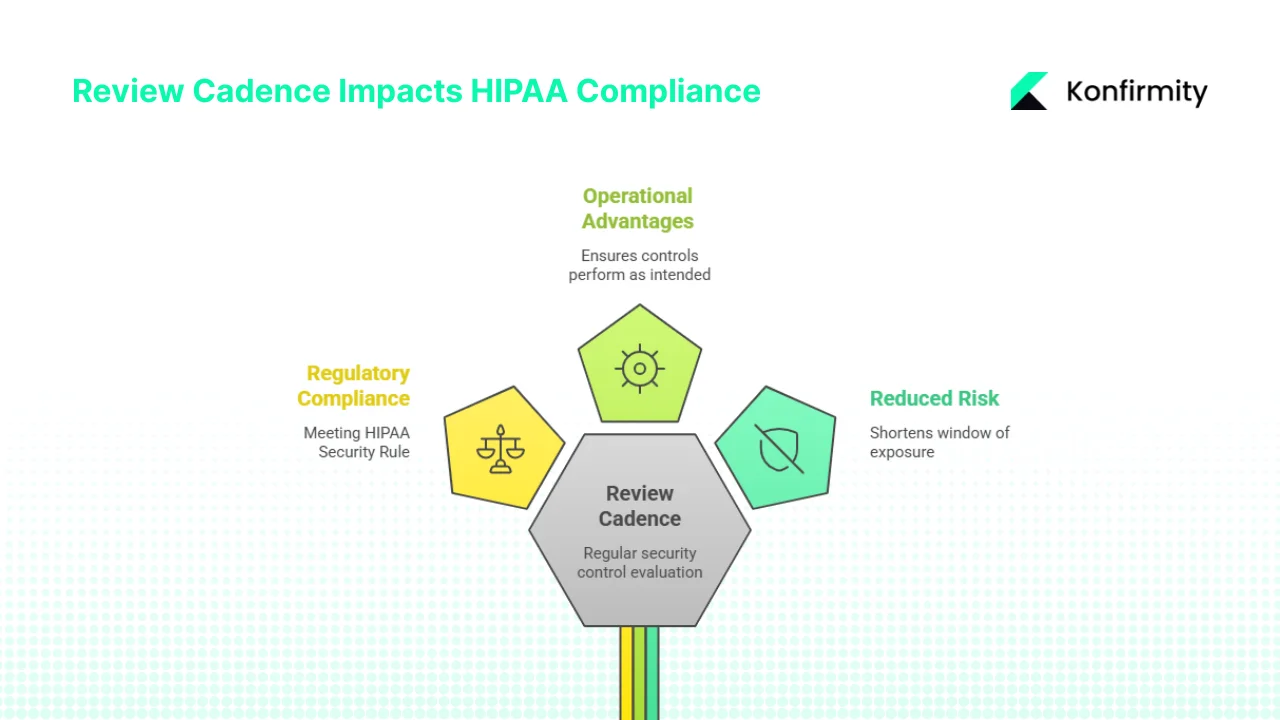
The regulatory basis for a review cadence is the Security Rule's mandate to regularly review system activity — it requires the review, but leaves the exact frequency to you. HIPAA’s Security Rule requires organisations to implement procedures to “regularly review records of information system activity, such as audit logs, access reports and security incident tracking reports”. NIST’s implementation guidance clarifies that policies must define what will be reviewed, how often reviews occur, who performs them, and how results are analysed. The regulation stops short of prescribing exact frequencies—there is no “every quarter” clause—but it does mandate a risk‑based approach. Covered entities must adjust the timing of reviews based on the sensitivity of systems, the volume of electronic protected health information (ePHI), and the threats they face. They must also regularly reassess personnel access to ePHI and log decisions about granting or terminating access. The absence of fixed intervals means that a tailored cadence, documented and justified, is necessary to satisfy auditors and regulators.
2) The practical benefits
The practical benefits of a structured cadence go beyond meeting statutory requirements: it catches control drift early, speeds audit response, and shortens the breach‑detection window. First, it ensures that controls perform as intended. Periodic security controls evaluation—such as reviewing access logs, user account recertifications, and intrusion detection rules—catches misconfigurations or drift before attackers do. Second, it supports the auditing process; when the Office for Civil Rights (OCR) initiates an investigation, investigators will ask for logs, access reports, training records, and incident documentation. Having them organised by date and owner reduces the time to respond and increases confidence that you will pass. Third, a cadence ties together key compliance schedules: the timing of internal audits, the regulatory reporting timeline, policy review intervals, and document retention deadlines. When these schedules align, you avoid working in silos and can demonstrate a coherent risk management cycle. Finally, regular reviews reduce risk: by continuously assessing, remediating, and improving controls you shorten the window of exposure between an issue arising and it being detected. In an industry where the average cost of a healthcare data breach in 2025 was $7.42 million and detection took 279 days, reducing that window directly impacts your bottom line.
3) Risks of no fixed cadence
The absence of a defined review rhythm is itself a risk. Without scheduled reviews you may miss technology or vendor changes, evolving threats, or newly mandated controls. When an external auditor arrives, you could be scrambling to assemble evidence, find owners, or explain why logs haven’t been reviewed since last year. The 2024 BayCare Health System case is an example: regulators fined the health system $800,000 for multiple violations, including failing to regularly review information‑system activity. In my own practice, I’ve seen teams treat evidence collection as an afterthought and then struggle under the weight of last‑minute document gathering. To quote the Auditor‑Ready guidance, the mantra is “keep evidence current, owners accountable, and review cadences on schedule.” A cadence turns those words into action.
Defining Your Evidence Review Cadence: Key Concepts & Terms
Before building a cadence, it helps to clarify the terminology used in compliance. Each term here describes a component of a well‑designed program and aligns with HIPAA and other frameworks.
| Concept | Meaning in practice |
|---|---|
| Compliance review schedule | A calendar specifying when each control is examined, who performs the review, and the required evidence. It covers the privacy rule, security rule, and breach notification rule. |
| Privacy audit frequency | How often you audit privacy controls: verifying that access to ePHI is appropriate, disclosures are recorded, and notices of privacy practices are up to date. High-risk processes may be audited monthly; others quarterly or semi-annually. |
| Data security assessment | A periodic evaluation of technical and organisational safeguards protecting ePHI, including encryption, intrusion detection, patch management, and backup procedures. |
| Regulatory reporting timeline | Deadlines for submitting required reports to regulators, payors, or internal committees. Aligning review cadence with these dates ensures that reports are based on current evidence. |
| Risk management cycle | The continuous process of identifying risks, assessing impact, implementing controls, monitoring performance, and reviewing outcomes. NIST’s Risk Management Framework emphasises that risk management is iterative. |
| Auditing process cadence | The rhythm of internal and external audits, including SOC 2 or ISO 27001 surveillance. Mapping your HIPAA cadence onto this rhythm reduces duplication and ensures readiness for cross-framework audits. |
| Security controls evaluation | Periodic testing and validation of controls—e.g., sampling access logs for anomalies, verifying that encryption keys are rotated, or testing multifactor authentication. |
| Incident response testing | Regular drills and after-action reviews to confirm that incident response plans work and to capture evidence of detection and response times. |
| Policy review intervals | The frequency with which you review and update policies (privacy, security, incident response) to reflect changes in law, technology, or business processes. |
| Document retention schedule | A plan for how long you keep each type of evidence, log, or report. HIPAA requires documentation to be retained for six years from the date of creation or last effective date. |
These concepts weave together. For example, the document retention schedule informs how long audit logs must be kept; in turn, that influences the compliance review schedule and privacy audit frequency. Similarly, the risk management cycle informs which controls require shorter intervals, feeding into the auditing process cadence.
Establishing Your HIPAA Evidence Review Cadence: Step‑by‑Step
Step 1: Inventory of controls and responsibilities
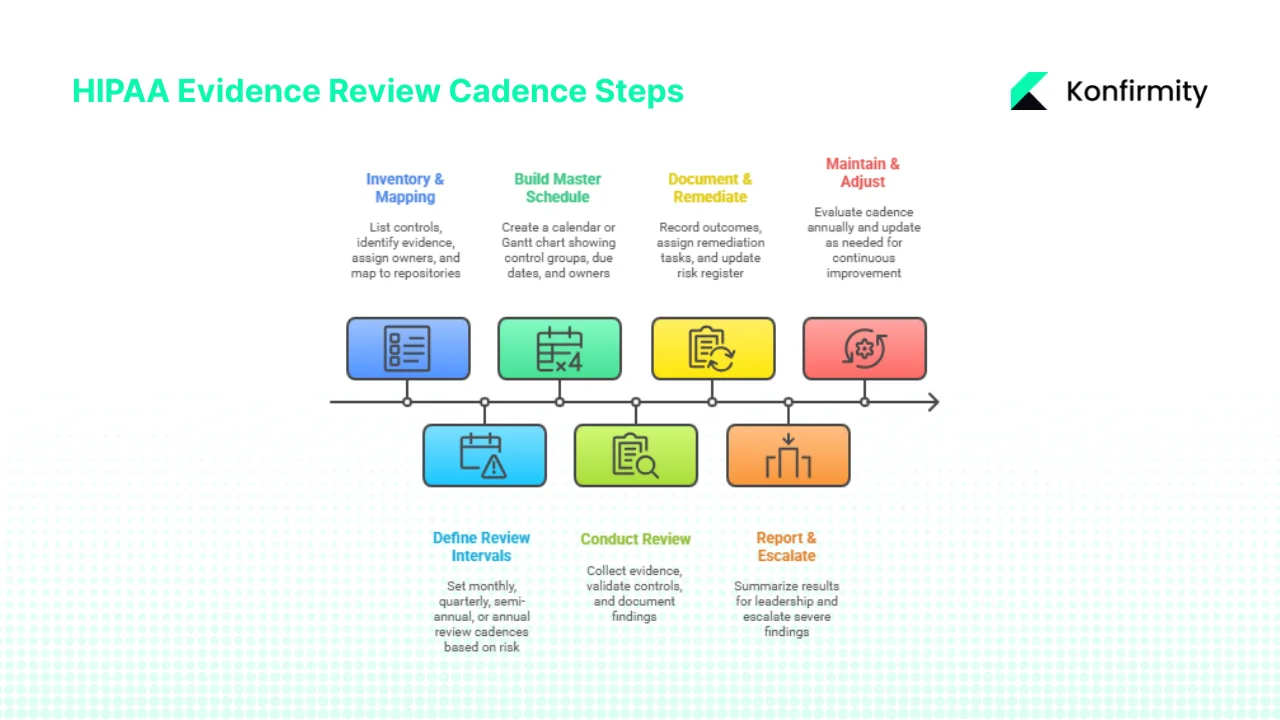
Start by listing all relevant HIPAA controls across the privacy, security, and breach notification rules. For each control, identify the evidence needed to demonstrate compliance—audit logs, user access reviews, training completion records, incident reports, encryption keys, risk assessments, business associate agreements (BAAs), and so on. Our HIPAA evidence collection templates guide has ready-made structures for most of these categories. Assign an owner for each piece of evidence. At Konfirmity we map each control to a repository (for example, a secure GRC platform) and define an evidence steward who ensures the evidence is collected and stored. The auditor‑ready checklist emphasises that every control should be traced to at least one piece of evidence and one responsible party. Without clarity on ownership, reviews slip through the cracks.
Step 2: Define review intervals based on risk
Not all controls carry equal risk. For high‑risk areas—such as ePHI access, privileged user accounts, and vendor connections—set a shorter review cadence. Many organisations conduct user access recertifications and audit log reviews monthly or quarterly chartrequest.com. Medium‑risk controls, like staff training compliance or BAAs for low‑impact vendors, might be reviewed semi‑annually. Low‑risk areas can be reviewed annually. Trigger‑based reviews should also be defined: if there is a breach, a change in system architecture, or a new vendor, an immediate review is warranted. The risk assessment guidance suggests performing an enterprise‑wide risk analysis annually and targeted assessments quarterly for high‑risk systems accountablehq.com. Document the rationale for each interval so that you can explain it to auditors.
Step 3: Build the calendar or schedule
With controls and intervals defined, build a master schedule. A simple calendar view or Gantt chart can show control groups across months, the evidence due date, the owner, and the review status. Align the schedule with the regulatory reporting timeline. For instance, if you must provide a risk analysis report to a payor each February, schedule your risk assessment in December so there is time to address findings. Ensure the schedule also accounts for policy review intervals and document retention deadlines: any policy updates or evidence archiving tasks can be included as events on the calendar. At Konfirmity we embed the HIPAA cadence into our overall compliance calendar, which also covers SOC 2, ISO 27001, and GDPR, enabling cross‑framework reuse of evidence and reducing duplication.
Step 4: Conduct the review
On the scheduled date, the evidence owner collects the required artefacts. The reviewer—often a compliance or security officer—validates that evidence, checks that controls are functioning, and records any gaps. In this phase, go beyond paperwork. Perform security controls evaluation: review access logs for irregular patterns, verify that encryption keys are rotated, confirm that multifactor authentication is enforced, or test a sample of user account terminations. For training, verify not only that modules exist but that completion rates meet your policy threshold. For incident response, review the last table‑top exercise results and ensure after‑action items are closed. Document the scope and methodology of the review; auditors may ask for these details.
Step 5: Document results and remediate
Record the review outcomes in a central repository. Include the date, the reviewer, a list of evidence items, findings, and remediation actions with owners and due dates. If gaps are found—say, a vendor’s BAA has expired or a training module is outdated—assign tasks to the responsible parties and track them to closure. Feed these findings back into the risk management cycle: update your risk register, adjust control ratings, and reflect any changes in your risk treatment plan. Good documentation here not only satisfies auditors but also helps internal stakeholders measure progress.
Step 6: Report and escalate
Summarise review results for leadership. Many organisations use monthly or quarterly reports to their compliance committee or board audit committee. Highlight completed reviews, outstanding tasks, key findings, and trends over time. If your organisation is subject to external reporting—such as payor attestation or state regulatory filings—ensure the cadence provides timely data for those reports. Escalate severe findings or overdue remediation to executives; this transparency helps allocate resources and reinforces accountability.
Step 7: Maintain and adjust the cadence
Finally, treat the cadence as a living program. Each year (or more often if risk changes), evaluate whether the intervals remain appropriate. Emerging threats, new technology, mergers, or a shift toward telehealth may warrant shorter cycles for certain controls. Conversely, improvements in automation may allow you to extend intervals without increasing risk. NIST’s guidance underscores that evaluating and improving the program is part of the administrative safeguards nvlpubs.nist.gov. Update your schedule, ownership, and evidence mapping as needed. Continuous improvement keeps the cadence aligned with your risk profile.
A stale review cadence is how HIPAA controls drift into audit findings.
Drop your work email and build a review schedule that keeps security controls current.
Examples and Templates for Busy Teams
Example review schedule table
A sample schedule helps illustrate how different controls map to evidence, owners, and intervals. Use this table as a starting point and adjust for your environment.
| Control area | Evidence type | Owner | Review interval | Last completed | Next due |
|---|---|---|---|---|---|
| User access recertification | Access review logs | IT security manager | Quarterly | 30 Sep 2025 | 31 Dec 2025 |
| Audit log review | System audit logs (ePHI systems) | Security analyst | Monthly | 15 Oct 2025 | 15 Nov 2025 |
| Training completion | Training records, quizzes | HR compliance lead | Semi-annual | 1 Jul 2025 | 1 Jan 2026 |
| Business associate agreements | BAA registry | Vendor manager | Annual | 1 Mar 2025 | 1 Mar 2026 |
| Risk analysis | Risk assessment report | CISO | Annual (full) + Quarterly (high-risk) | 30 Jan 2025 | 30 Jan 2026 |
| Policy review | Privacy, security, incident policies | Compliance officer | Annual | 31 Dec 2024 | 31 Dec 2025 |
This simple format clarifies responsibilities and reduces ambiguity. Adjust the frequencies based on your risk analysis and incorporate trigger‑based reviews when events occur.
Template, Review checklist for one control area: Incident Response & Testing
-
Evidence: Incident response policy, playbooks, drill results, root‑cause analysis logs (see our HIPAA incident response plan guide for how to structure these).
-
Review steps:
- Verify that an incident response policy exists, is approved by leadership, and covers detection, containment, eradication, recovery, and post‑incident analysis.
- Check that at least one table‑top exercise or drill has been conducted in the review interval; review the after‑action report and confirm that remediation items are closed.
- Confirm that all incident tickets opened in the last period are closed or have an assigned resolution plan.
- Evaluate metrics: average time to respond, number of incidents, time to close remediation.
-
Review interval: Semi‑annual or more frequently for high‑risk systems.
Use similar checklists for other controls (e.g., vendor risk management, encryption key management) to ensure a consistent review methodology.
Template: Calendar view / Gantt style
Many teams find it easier to visualise reviews over a 12‑month period. A simple Gantt chart can list control areas down the left and months across the top, shading cells where reviews occur. For example, access reviews might be scheduled in March, June, September, and December; risk analysis in January; policy reviews in December; vendor BAAs in March; and training in July and January. Tools like project management software or spreadsheets can create this view. Colour‑coding completed versus upcoming tasks provides a quick health snapshot.
Template: Dashboard for monitoring cadence
A dashboard helps track the health of your cadence and provides metrics for leadership. Key indicators include:
-
% of reviews completed on time: Shows adherence to the schedule. A drop here may indicate resource constraints.
-
Number of gaps found: Highlighted by control area; high numbers may signal systemic issues or misalignment between policy and practice.
-
Number of remediation items overdue: Overdue items increase risk; trending these helps prioritise resources.
-
Average time to close remediation: Measures how quickly the organisation addresses findings; shorter times reflect agility.
-
Coverage across frameworks: If you operate under SOC 2, ISO 27001, and HIPAA, track which controls satisfy multiple frameworks, reducing duplication.
With these metrics visible, leadership can make informed decisions and allocate budget toward the highest‑risk areas.
Real‑world scenario
This real‑world scenario shows how a defined cadence turns stale evidence into a competitive advantage during due diligence. Consider a mid‑sized clinic with 120 staff handling thousands of records a month. Initially, the clinic performed risk assessments sporadically and stored evidence in ad hoc folders. When a major insurer requested proof of HIPAA compliance before renewing a contract, the clinic realised its evidence was stale. They partnered with a managed service provider and implemented a cadence: monthly audit log reviews, quarterly user access recertifications, semi‑annual policy and training reviews, and an annual comprehensive risk analysis. Each control had an owner and evidence repository. Within six months, they had current evidence across all controls. In the insurer’s due‑diligence process, the clinic presented its review schedule and risk management reports, which sped up contract renewal by two months. By maintaining their cadence, the clinic also uncovered and closed a vendor access gap that could have led to a breach. This scenario mirrors many we have seen at Konfirmity; operationalising the cadence yields tangible outcomes.
Free download
The HIPAA Audit Request List
Every request an OCR auditor makes, the rule citation behind it, and the evidence that closes it, with worked example rows so your review cadence maps straight onto what an auditor will actually ask for. Enter your work email and we'll send the PDF.
Integrating the Cadence with Other Compliance Processes
HIPAA compliance does not exist in isolation. Your evidence review cadence should integrate with broader risk and security programs.
-
Link to the risk management cycle: NIST’s Risk Management Framework defines a seven‑step cycle: prepare, categorise, select, implement, assess, authorise, and monitor. The cadence operates in the monitor step, feeding back into risk assessment and control implementation. When reviews identify a risk, update the risk register, adjust controls, and reflect these changes in the next cycle.
-
Support document retention: HIPAA requires documentation to be retained for six years. Align your review schedule with this requirement by ensuring that all evidence—logs, reports, policies—are archived securely, following the practices in our HIPAA evidence storage best practices guide, and purge them only after the retention period. A central retention schedule ensures that evidence will be available when auditors ask.
-
Align with privacy audit frequency and data security assessments: Frequent privacy audits ensure that data minimisation, consent management, and disclosure tracking remain in place. Integrating these audits into your cadence ensures that privacy considerations are reviewed alongside technical controls. Likewise, data security assessments—such as penetration tests, vulnerability scans, and configuration reviews—feed into the cadence by providing fresh evidence of control effectiveness.
-
Coordinate with regulatory reporting timelines: Many payors, state programs, or federal agencies require periodic attestation of HIPAA compliance. Align the cadence so that review results are finalised before these reports are due. This avoids last‑minute scrambles and ensures that you can provide accurate, current evidence.
-
Include policy review intervals: Policies are living documents. Incorporate policy updates into the cadence so that, for example, your password policy is reviewed when access control reviews occur. This ensures that evidence collection and policy updates remain in sync.
-
Incorporate incident response testing: Do not treat incident response as purely reactive. Schedule regular drills and review after‑action reports as part of the cadence. This builds muscle memory and ensures that controls and evidence exist before an incident happens.
-
Review security controls evaluation: As you roll out new systems or migrate to cloud platforms, ensure that your cadence includes evaluation of security controls in those environments. For example, verifying that cloud audit logs are centralised, access is controlled via role‑based access, and encryption keys are managed properly.
By embedding the cadence into these processes, you create a unified compliance and security program rather than a collection of disconnected tasks.
Common Pitfalls and How to Avoid Them
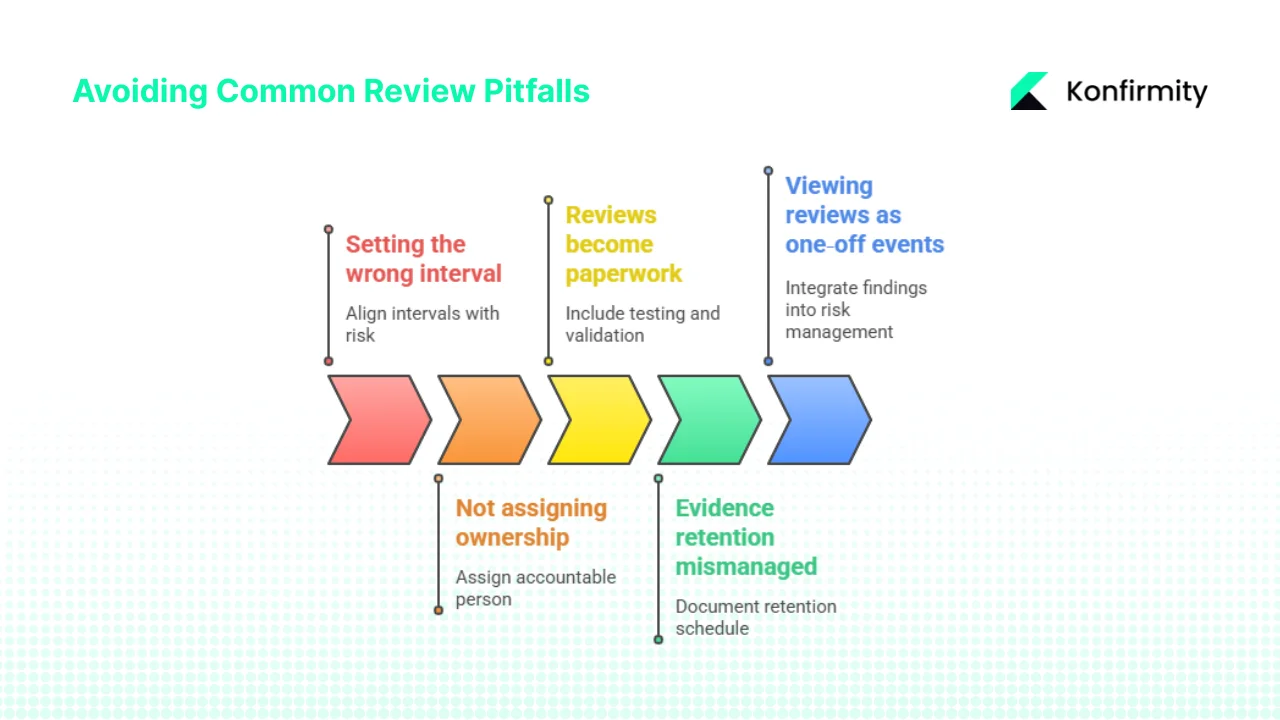
The most common pitfalls in a review cadence are intervals set too long, controls with no owner, and reviews that become paperwork instead of validation. Avoid them as follows.
Setting the wrong interval: One of the most frequent missteps is setting review intervals too long. This stems from a desire to reduce overhead, but it leaves gaps. For instance, if you review user access annually, you may go months with former employees retaining access. Align intervals with risk, and revisit them when risks change.
Not assigning ownership: Controls with no owner often go unchecked. Always assign an accountable person and ensure they know their responsibilities. Use a RACI matrix (Responsible, Accountable, Consulted, Informed) if needed.
Reviews become paperwork: Some organisations treat reviews as mere document collection. To avoid this, include testing and validation in each review. For example, sample user accounts to verify deprovisioning, or run queries against audit logs to detect anomalies.
Evidence retention mismanaged: Without a central retention schedule, evidence may be deleted prematurely or kept insecurely. Document retention is a regulatory requirement, and failing to meet it can hinder investigations.
Viewing reviews as one‑off events: HIPAA compliance is an ongoing process, not a project. Regularly integrate findings into your risk management cycle and adjust controls accordingly. Avoid the mindset that once evidence is collected, you can set it aside until the next audit.
To avoid these pitfalls, leverage scheduling tools, dashboards, and automation. Escalate overdue items to leadership, and integrate your cadence into daily operations rather than treating it as a periodic event. When you need assistance, consider a managed service partner to handle evidence collection and review.
How to Scale This for Busy Teams
Teams with limited resources often struggle to maintain a cadence. Here are practical ways to scale:
-
Prioritise high‑risk controls: If you cannot review everything monthly, prioritise. ePHI access, privileged accounts, and external vendors often warrant shorter intervals, while low‑risk policies can be reviewed annually. Document the rationale.
-
Use automation: Automate evidence collection wherever possible. Pull access logs via APIs, sync training completion from your learning management system, and integrate vulnerability scan results. Automation reduces manual effort and ensures evidence is collected on time.
-
Assign roles clearly: Define the evidence owner, reviewer, and steward for each control. Clear accountability reduces confusion. At Konfirmity, each client has a dedicated CISO and compliance engineer who manage these roles.
-
Reuse evidence across frameworks: Many controls overlap across HIPAA, SOC 2, ISO 27001, and GDPR. Map each control to multiple frameworks so that evidence collected once can serve multiple audits. For instance, user access reviews satisfy SOC 2’s CC6.3 and HIPAA’s administrative safeguards.
-
Maintain a living schedule: Update the schedule when new systems, vendors, or business models emerge. For example, a move to telehealth introduces new access points and data flows that must be integrated into the cadence.
-
Outsource or co‑source: Consider partnering with a managed service provider or auditor to conduct certain reviews, especially technical assessments like penetration testing or data security evaluations. This offloads specialised tasks and brings external expertise.
-
Maintain executive visibility: Keep leadership engaged by sharing cadence metrics. This builds support for necessary resources and demonstrates the value of the program. In our experience, clients who involve executives early achieve faster remediation and fewer findings during audits.
Teams that adopt these practices can operate leaner. For example, a typical SOC 2 readiness effort can take nine to twelve months when self‑managed, consuming 550–600 internal hours. With Konfirmity’s managed service, we often reduce that effort to under 70 hours and complete readiness in four to five months, while delivering audit pass rates above 95%. Similar efficiencies apply when we implement a HIPAA Evidence Review Cadence: evidence is collected continuously, and audits become checkpoints rather than marathons.
FAQ
1) What are the five main rules of HIPAA?
HIPAA comprises several rules. The Privacy Rule governs how covered entities may use and disclose protected health information, granting patients rights over their data. The Security Rule sets administrative, physical, and technical safeguards for ePHI, including regular review of audit logs and access reports. The Breach Notification Rule requires covered entities and business associates to notify affected individuals, the media, and OCR when a breach of unsecured PHI occurs. The Enforcement Rule outlines penalties and investigation procedures when non‑compliance is found, including fines that reached $6.75 million in 2024. Finally, the Administrative Simplification provisions (often called the Transaction and Code Sets Rule) standardise electronic transactions and code sets. A structured review cadence supports all these rules by ensuring that logs, policies, training, and incident handling are current and documented.
2) How do you respond to a HIPAA compliance review?
When regulators or auditors request a review, start by gathering all relevant evidence: policies, procedures, audit logs, training records, risk assessments, and incident reports. Assign reviewers to validate the evidence against each control. Document findings and remediate gaps promptly. Provide regulators with requested documents and demonstrate your cadence: show your schedule, evidence repositories, and reports. After the review, update your risk register and adjust controls or intervals as needed. Transparency and preparation are key.
3) What is the standard algorithm for HIPAA compliance?
There is no single algorithm, but a typical process includes: defining the scope (systems, data, vendors), conducting a risk assessment, implementing controls aligned with HIPAA’s safeguards, continuously monitoring and reviewing those controls (your evidence review cadence), documenting policies and procedures, training staff, and improving based on findings. This cycle mirrors NIST’s risk management steps.
4) How long does it take for a HIPAA violation to be investigated?
Investigation durations vary. According to a 2025 analysis, most HIPAA investigations take several months to a couple of years. Simple cases might be resolved in a few months, moderate cases may require 12–18 months, and complex cases can extend beyond two years. Another source notes that investigations can take several months to more than a year depending on case complexity. The HIPAA Guide emphasises that there is no clear answer: investigations may take months, especially if outside actors are involved. The best way to shorten the process is to maintain current evidence and cooperate fully when investigators request information.
See your real HIPAA evidence review gap, not a guess
Book a demo and we'll map your review cadence against the Security Rule requirements, self-serve or with our CISO-led team running it for you.
Book a demo
Conclusion
A structured HIPAA Evidence Review Cadence is not a luxury; it is a necessity for healthcare organisations handling patient data. HIPAA’s administrative safeguards require regular review of audit logs, access reports, and incident tracking, and you must retain documentation for six years. Beyond compliance, a cadence ensures that controls work, evidence is current, and risks are addressed promptly. By mapping your controls, defining risk‑based intervals, building a schedule, conducting thorough reviews, documenting findings, reporting to leadership, and adjusting as needed, you embed compliance into daily operations. Use the examples and templates provided to design a cadence that fits your organisation’s size and risk profile. In doing so, you will be better prepared for audits, reduce the likelihood and cost of breaches, and strengthen trust with patients and partners. As I often tell clients: security that looks good on paper but fails under incident pressure is a liability. Build your program once, operate it every day, and let compliance follow.