
Most enterprise buyers now ask for assurance artefacts before procurement. Without operational security and continuous evidence, deals stall—even when teams think they’re “ready” on paper. This article demystifies the ISO 27001 Audit Cost and explains why investing in a mature information‑security management system (ISMS) isn’t simply about passing an audit. It’s about making security a credible part of how you do business, especially when selling to large enterprises. As we’ll see, the term ISO 27001 audit cost covers more than the certification fee—it includes gap analysis, ISMS implementation, internal and external audits, and ongoing compliance costs. We’ll break down these components, look at global and regional cost ranges, and map them to the steps a typical enterprise‑serving vendor follows. Our goal is to help you budget and plan realistically, drawing on data from authoritative sources and first‑hand experience managing 6,000+ security audits as a team with 25+ years of combined expertise.
What Goes into ISO 27001 Costs: Components & Categories
Internal versus External Costs
When budgeting for an ISO 27001 program it helps to separate internal costs—those borne by your team—from external costs charged by auditors or consultants:
-
Internal costs: Time spent by your security, engineering, and operations teams to design the ISMS, perform a gap analysis, document policies, implement controls, conduct an internal audit, and remediate issues. Internal costs also include purchasing security tools and training. This “people cost” is often the largest component because it diverts skilled staff away from product work and may require new hires.
-
External costs: Fees paid to the certification body for the Stage 1 and Stage 2 audits; surveillance and recertification audits; consultant fees for readiness assessments or internal audits; and optional services such as penetration testing or managed security tools. External audits are mandatory to achieve certification, whereas consultant involvement is discretionary.
Typical Cost Components
-
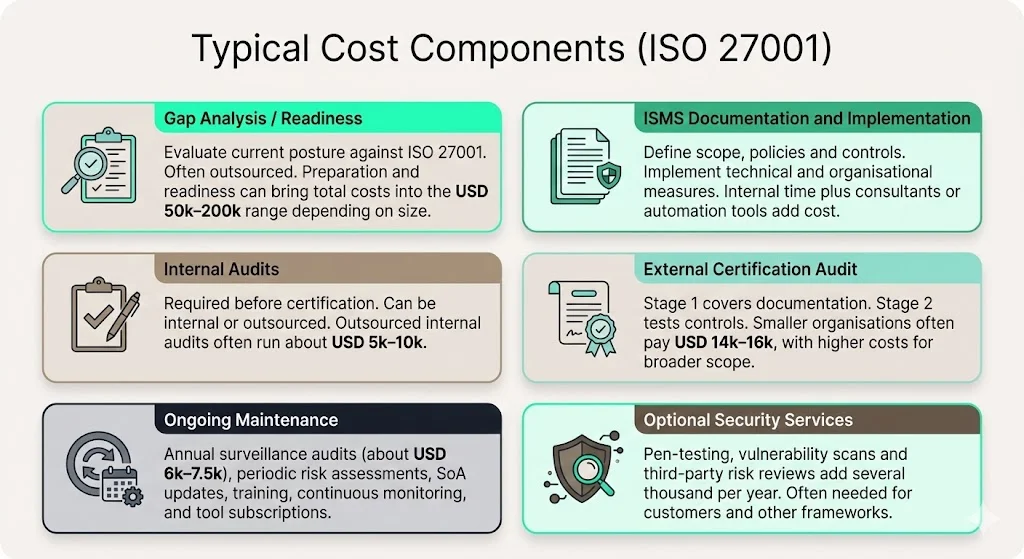
Gap analysis / readiness assessment. Many organisations begin by hiring an external consultant or using internal staff to evaluate their current security posture against ISO 27001 requirements. This ensures resources are spent wisely on remediation rather than guessing. Auditors charge day‑rates or fixed fees for this service. Some guidance suggests that preparation and readiness work—including gap analysis—can bring total certification costs into the USD 50,000–200,000 range depending on size and complexity.
-
ISMS documentation and implementation. Defining scope, policies, processes and controls, then implementing technical and organisational measures (network security, incident response, access control) consumes significant internal time. Outsourcing parts of this work to consultants or using compliance automation platforms adds to costs. Smaller firms sometimes underestimate the staff effort needed to align processes with ISO 27001 Annex A controls.
-
Internal audits. Before bringing in a certification body, the ISO 27001:2022 standard requires an internal audit. You may conduct this yourself, paying only for diverted staff time, or hire an external specialist (often at day‑rates equivalent to external auditors). Industry guidance notes that a comprehensive internal audit may cost USD 5,000–10,000 when outsourced.
-
External certification audit. The certification audit occurs in two stages: Stage 1 assesses documentation and readiness; Stage 2 tests control implementation and effectiveness. One industry analysis reports that Stage 1 and Stage 2 audit fees for smaller organisations typically range between USD 14,000 and 16,000. Larger organisations pay more because more locations, systems and employees must be sampled. The certification body’s quote covers planning, audit days, report writing, and the certificate.
-
Ongoing maintenance costs. ISO 27001 certificates last three years but require annual surveillance audits. Industry guidance estimates surveillance audits cost about USD 6,000–7,500 per year, while secure sources note that recertification (a full audit at the end of the cycle) often costs similar to the initial audit. In between, organisations must conduct periodic risk assessments, update their statement of applicability (SoA), maintain training and awareness programmes, and run continuous monitoring—all of which incur staff time and sometimes tool subscriptions.
-
Optional security services. Penetration tests, vulnerability scans, and third‑party risk assessments are not formally required by ISO 27001 but are often necessary to satisfy enterprise customers or align with other frameworks (SOC 2, HIPAA, GDPR). These services can add several thousand dollars per year. A modern approach is to integrate security tooling such as cloud‑configuration scanning or vulnerability management into the ISMS so that evidence is collected continuously.
How Much Does ISO 27001 Audit/Certification Cost: Benchmarks & Ranges
Global Benchmarks for Small to Medium Set‑ups
For a lean, single‑location organisation with under 100 employees and a focused ISMS scope, the certification audit itself is often the smallest line item. According to industry guidance, Stage 1 and Stage 2 audits cost USD 14,000–16,000. Annual surveillance audits add USD 6,000–7,500, and recertification after three years costs roughly the same as the initial certification. One industry breakdown suggests that internal audits cost USD 5,000–10,000 when outsourced, Stage 1 and Stage 2 audits range from USD 10,000–50,000 depending on scale, and ongoing surveillance audits cost USD 10,000–30,000.
These figures only cover the certification body’s fees. Preparation costs vary widely. Some sources estimate that overall ISO 27001 certification efforts—including gap analysis, documentation and remediation—can range between USD 15,000 and 60,000. One published analysis notes that DIY initiatives can cost USD 5,000–15,000, consultant‑assisted programmes USD 15,000–40,000, and turnkey solutions (managed compliance platforms) USD 30,000–60,000. These ranges highlight how resource constraints and existing maturity levels influence budget.
Broad Range Including Preparation & Consulting
Some organisations misjudge the effort involved and later discover that remediation is more expensive than the audit itself. DPO Consulting emphasises that full ISO 27001 programmes—including preparation, internal work and consulting—often fall between USD 50,000 and 200,000 for mid‑sized and larger firms. The large range reflects differences in workforce size, number of sites, application complexity, and whether the ISMS scope covers one product or the entire organisation. Industry guidance notes that small companies may spend USD 15,000–60,000 in the first year while larger multinational firms can exceed USD 250,000.
Cost Variation in India / South‑Asia Context
Regional labour rates and audit fees influence the ISO 27001 audit cost. Neumetric, a cybersecurity firm in India, provides cost estimates for local organisations: small firms may spend ₹4,00,000–₹8,00,000 (roughly USD 5,000–10,000) on ISO 27001 certification; medium‑sized businesses might spend ₹12,00,000–₹20,00,000 (USD 15,000–25,000); and large organisations with multiple locations could incur ₹41,00,000–₹82,00,000 (USD 50,000–100,000). These figures include consultancy, tools, training and ongoing updates. The variation shows that in emerging markets, certification can be affordable for smaller firms but escalates rapidly as scope expands.
Auditors, Consultants and Day‑Rates
Understanding how auditors and consultants charge helps when negotiating quotes. AuditOne, a UK‑based firm, states that freelance ISO 27001 auditors typically charge USD 1,200–1,400 per audit day. One industry guide notes that an ISO 27001 audit may cost £5,500–12,000 and that auditor fees range from £5,500–18,000 depending on scope. Consultants performing readiness assessments charge hourly rates—the same guide estimates around £140 per hour for 24–160 hours. NovelVista and Advance Innovation Group both indicate that ISO 27001 lead auditor training in India costs between ₹15,000 and ₹45,000 (USD 180–540) including examination fees. These figures provide reference points for internal budget planning.
What Affects the Cost: Key Variables
Several variables determine where your organisation lands within the broad cost ranges:
-
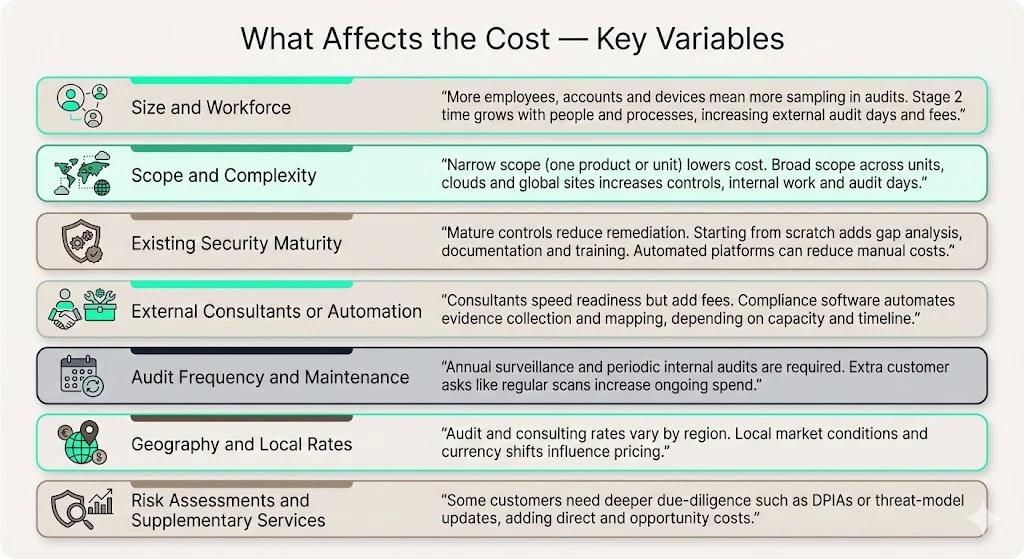
Size and workforce. More employees, user accounts and devices require additional sampling during audits. Stage 2 audit duration scales with the number of people and processes within scope, increasing auditor days and therefore external fees.
-
Scope and complexity of the ISMS. Limiting scope to a single product or department lowers cost by reducing the number of systems, sites and controls under review. Conversely, including multiple business units, cloud environments, on‑premises data centres and global offices raises complexity and increases both internal work and external audit days.
-
Existing security maturity. Organisations with established security controls, policies and evidence management need less remediation. Those starting from scratch invest heavily in gap analysis, documentation, training, and implementation. For instance, industry guidance notes that automated compliance platforms can reduce manual effort and costs in the USD 30,000–60,000 range compared with ad‑hoc approaches.
-
Use of external consultants or automation. Hiring consultants accelerates readiness but adds fees. Some choose to purchase compliance software that automates evidence collection and control mapping. The decision depends on internal capacity and timeline pressures—consultant fees may be justified when enterprise deals require certification quickly.
-
Frequency of audits and maintenance. Annual surveillance audits and periodic internal audits are not optional. Each introduces predictable expenses in the budget. Additional compliance requirements from customers—such as quarterly vulnerability scans or regular penetration tests—further elevate maintenance costs.
-
Geography and local rates. Auditor and consultant rates vary significantly by region. The Neumetric figures illustrate that Indian audit costs are markedly lower than US or European rates. Currency fluctuations and local market competition also influence quotes.
-
Risk assessments and supplementary services. Some enterprise customers require deeper due‑diligence such as data protection impact assessments (DPIAs), vendor risk reviews, or threat‑model updates. Each adds direct and opportunity costs to the program.
Spend your audit budget on security posture, not rework.
Drop your work email and we'll show how managed compliance cuts real costs.
A Typical Step‑by‑Step Cost Journey
The following scenario illustrates how a technology vendor selling to enterprise clients might experience the ISO 27001 audit cost over the certification cycle. Actual numbers will vary by region and complexity; we base the bands on published data and our experience supporting thousands of audits.
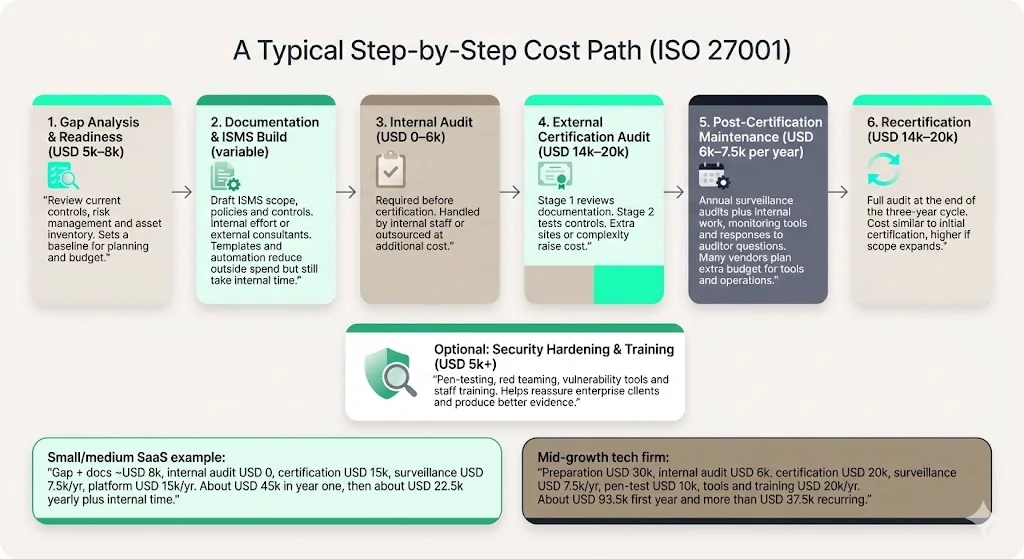
Step 1: Gap Analysis & Readiness (USD 5,000-8,000)
The journey often begins with a gap analysis or readiness assessment to identify missing controls and prioritise remediation. Consultants might charge USD 5,000–8,000 for a 3–5 day engagement, or you could invest comparable internal time. This phase involves reviewing existing policies, evaluating risk management, and establishing an asset inventory. It sets the baseline for budgeting and scheduling.
Step 2: Documentation & ISMS Implementation (variable)
Documenting the ISMS scope, policy statements, risk methodology and control procedures is labour‑intensive. For a small SaaS startup, the internal effort might equate to 100–200 person‑hours. External consultants might bill USD 10,000–20,000 to draft policies, implement technical controls, and create the Statement of Applicability. The cost largely depends on whether you already have security practices in place. DIY approaches using templates and automation can reduce external spend but still require internal dedication.
Step 3: Internal Audit (USD 0-6,000)
ISO 27001 mandates at least one internal audit before certification. Organisations with qualified internal auditors handle this themselves, absorbing only staff time. Others hire external specialists; industry guidance notes that outsourcing an internal audit can cost USD 5,000–10,000. For our example we assign USD 0 (internal team) to USD 6,000 (external firm).
Step 4: External Certification Audit (USD 14,000-20,000)
The certification audit comprises Stage 1 and Stage 2. For a lean company, expect auditor fees of USD 14,000–16,000, plus administrative costs such as travel or translation where necessary. Medium‑sized organisations with multiple sites might see this figure rise to USD 20,000 or more due to additional auditor days.
Step 5: Post‑Certification Maintenance (USD 6,000-7,500 per year)
Once certified, you enter a three‑year cycle with annual surveillance audits. Each surveillance audit typically costs USD 6,000–7,500. Additionally, you’ll allocate internal time and perhaps purchase tools to maintain control effectiveness, perform risk assessments, and respond to auditor questions. Many vendors budget an extra USD 10,000–20,000 annually for continuous monitoring and compliance operations, especially if they serve regulated industries or handle sensitive data.
Step 6: Recertification (USD 14,000-20,000)
At the end of the three‑year cycle, you undergo a full recertification audit. The cost mirrors the initial certification and may increase if the scope has expanded or new business units are added. Planning and budgeting for recertification early helps avoid surprises.
Optional: Security Hardening & Training (USD 5,000+)
Many organisations treat penetration testing, red team exercises, advanced vulnerability management tools, and staff awareness training as critical to reassure enterprise customers. A focused penetration test may cost USD 5,000–15,000; annual training platforms may cost USD 2,000–5,000 per 100 employees. While not strictly part of ISO 27001, these activities bolster security posture and yield evidence that auditors often consider when evaluating risk.
Example Scenarios
Scenario 1: Small/medium SaaS vendor. Consider a SaaS vendor with 50 employees, a single product, and no existing security programme. They engage a consultant for a gap analysis and documentation (USD 8,000), conduct the internal audit themselves (USD 0), pay USD 15,000 for the certification audit, and budget USD 7,500 per year for surveillance audits. They also purchase a compliance automation platform costing USD 15,000 annually. In the first year, their total ISO 27001 Audit Cost is roughly USD 45,000. In subsequent years they pay USD 22,500 (platform + surveillance) and allocate internal resources for maintenance.
Scenario 2: Mid‑growth technology firm. A company with 300 employees, two products, and offices in three countries decides to certify its entire operations. Preparation and documentation (including consultant fees) cost USD 30,000, outsourced internal audit costs USD 6,000, the certification audit runs USD 20,000, and surveillance audits cost USD 7,500 annually. They also engage a penetration testing partner for USD 10,000 and invest in training and compliance tools for USD 20,000 annually. Their first‑year ISO 27001 Audit Cost approaches USD 93,500. Recurring annual costs including surveillance audits, tools, and training exceed USD 37,500. Over the three‑year cycle, the total may surpass USD 160,000, illustrating how scope and optional controls drive up costs. Before committing to a scope, run your own ROI estimate to see where the numbers land for your organisation.
Hard Costs versus Hidden/Indirect Costs
Many organisations underestimate the hidden costs of ISO 27001 compliance. These indirect expenses often exceed the auditor’s invoice:
-
Internal time investment. Building and running an ISMS draws on your best engineers, security staff and operations leaders. In Konfirmity’s experience, a self‑managed ISO 27001 programme can consume 550–600 internal hours per year, whereas a managed service reduces this to under 70 hours. The opportunity cost of diverting experienced staff from product and customer work should be reflected in the business case.
-
Productivity hit. Preparing documentation, implementing controls, and collecting evidence can slow development and operations. For example, formalising change‑management processes may require developers to follow stricter procedures, which can initially feel like overhead.
-
Tools, training and awareness. Access review systems, logging platforms, encryption modules, and training programmes all cost money. While some are capitalised as part of product development, many fall under compliance budgets. Ongoing user awareness campaigns and phishing simulations are often not visible in line‑item audit costs but are essential for sustained security posture.
-
Continuous improvement. ISO 27001 promotes a cycle of “Plan–Do–Check–Act.” After certification you must regularly revisit risk assessments, update controls, and address new threats. These activities demand ongoing vigilance and sometimes the procurement of new services.
Ways to Optimise or Manage ISO 27001 Audit Cost (While Maintaining Quality)
Cutting corners to lower the ISO 27001 audit cost risks audit findings and, more importantly, weak security. Instead, consider these pragmatic strategies:
-
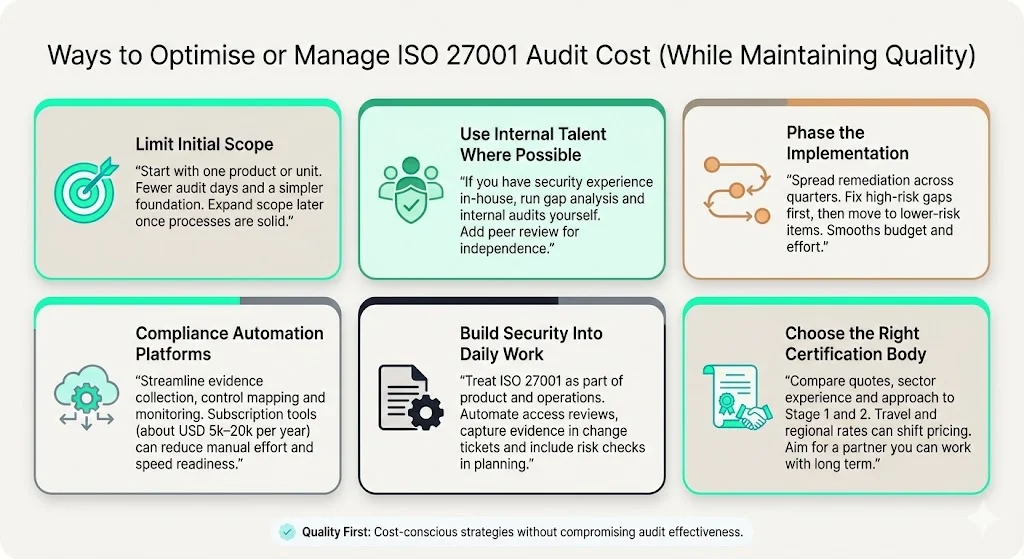
Limit initial scope. Early certification might focus on a specific product or business unit. This reduces audit days and allows you to build a strong ISMS foundation. Once you gain confidence, you can widen scope in future cycles.
-
Leverage internal talent. If your team includes experienced security practitioners, they can perform the gap analysis and internal audit, saving consulting fees. Pair internal audit with cross‑functional peer review to ensure independence.
-
Phase implementation. Spread remediation over several quarters. Tackle high‑risk gaps first, then progressively implement lower‑risk controls. This reduces immediate budget impact and allows lessons learned to inform subsequent phases.
-
Use compliance automation platforms. Managed platforms streamline evidence collection, control mapping, and continuous monitoring. Industry cost ranges show that subscription‑based solutions (USD 5,000–20,000 per year) can reduce manual effort and accelerate readiness. Konfirmity’s own service eliminates the need for hundreds of manual artefacts by integrating into your systems and producing evidence on demand.
-
Integrate security into daily operations. Treat ISO 27001 not as a project but as part of your development and operations lifecycles. Automate access reviews, ensure change‑management tickets capture required evidence, and embed risk assessments into product planning. This reduces hidden costs and makes surveillance audits almost routine.
-
Select the right certification body. Obtain quotes from multiple accredited bodies, comparing day‑rates, expertise in your sector, and approach to Stage 1/2 audits. In some regions, labour rates or travel requirements can significantly affect quotes. Building a long‑term relationship with a certification body may yield cost predictability.
Special Considerations for Companies Selling to Enterprise Clients
Selling into large enterprises or regulated healthcare organisations heightens both scrutiny and expectations. Procurement questionnaires, data protection agreements (DPAs), and business associate agreements (BAAs) often mandate ISO 27001 or equivalent attestations. A narrow certification scope that omits critical services may not satisfy customer due‑diligence, so be prepared to include the systems and processes that handle customer data.
Enterprise buyers typically evaluate how well your ISMS integrates with other frameworks such as SOC 2 and HIPAA. For example, a healthcare client may expect evidence of encryption, audit logs, and breach notification within 60 days. Similarly, a bank may request proof of vulnerability management aligned with CVSS scoring and remediation SLAs. Overlapping frameworks can increase the ISO 27001 Audit Cost but also deliver cross‑framework efficiencies by reusing controls and evidence.
Continuous compliance is critical. Surveillance audits maintain certification, but enterprise clients might demand more frequent attestations, such as quarterly access reviews or real‑time security dashboards. Failing to maintain controls could jeopardise contracts. Budget accordingly for year‑round operations, not just the certification moment.
Finally, transparency matters. Enterprise clients often ask for a cost breakdown or justification when negotiating pricing or contractual terms. Being able to distinguish between direct audit fees, internal investments, and ongoing maintenance helps build trust and positions you as a partner committed to security.
See what ISO 27001 will really cost you, not a range
Book a demo and we'll walk your scope, gap analysis and surveillance years against fixed pricing, and show where the hidden cost sits: your own team's hours, which we keep under 70 a year.
Book a demo
Conclusion
As we’ve seen, there is no single ISO 27001 Audit Cost. The cost depends on organisational size, ISMS scope, security maturity, regional rates, and the mix of internal versus external resources. While audit fees may start around USD 14,000–16,000 for small firms, total expenses including preparation, consulting and maintenance can climb to USD 50,000–200,000 or more. For companies targeting enterprise clients, these costs should be viewed as investments in trust and market access rather than check‑box expenses. A human‑led, managed approach—where experienced practitioners implement controls inside your stack and provide continuous monitoring—reduces the internal burden and increases the likelihood of passing audits. By planning early, choosing the right scope, and integrating security into daily operations, you can build a programme that stands up to buyers, auditors, and attackers alike.
FAQ
Auditor income depends on region, experience and employment type. Freelance ISO 27001 auditors often charge day‑rates rather than earning a fixed salary. AuditOne notes that freelance auditors typically bill about USD 1,200–1,400 per audit day. Employed auditors in the US or Europe may earn annual salaries ranging from USD 70,000 to 150,000 depending on seniority, but these figures vary widely. When budgeting, use day‑rates from certification body quotes as a more accurate measure of audit cost.
The cost of becoming a lead auditor varies by country and training provider. In India, NovelVista and Advance Innovation Group report that lead auditor training and examination cost between ₹15,000 and ₹45,000, which translates to roughly USD 180–540. In the US and Europe, accredited training providers charge around USD 500–600 or €450–600 for similar courses. These programmes typically run for five days and include the examination fee. Check with accredited bodies such as BSI, PECB or IRCA for current pricing and schedule.
Yes. The certification process comprises an initial two‑stage audit (Stage 1 and Stage 2) followed by annual surveillance audits during the three‑year certification cycle. A recertification audit at the end of the cycle is effectively a new Stage 2 audit. Additionally, ISO 27001 requires organisations to conduct periodic internal audits to verify that the ISMS continues to conform to the standard and the organisation’s own policies. Many enterprises perform internal audits at least annually, often quarterly, depending on risk levels.
Consulting fees vary with scope, complexity and region. For gap analysis and readiness assessments, consultants may charge USD 5,000–8,000 for small firms or up to USD 30,000 for medium‑sized projects. Industry guidance notes that ISO 27001 consultant rates in the UK can be around £140 per hour and that total consulting engagement can cost between £10,000 and £48,000 depending on hours required. In India, consultant packages covering gap analysis, documentation and training often range from ₹4,00,000 to ₹20,00,000. Always request a detailed statement of work and compare quotes to ensure value.