
Most enterprise buyers now ask for proof of security and compliance before a single contract can be signed. Procurement questionnaires, business associate agreements and data‑processing addenda all require evidence that you operate a mature information security management system. If you only have policies on paper, deals stall. Working in security and compliance for more than two decades and having supported over 6,000 security audits, I have seen this first‑hand. This guide explains how to conduct ISO 27001 Audit Preparation in a way that protects data, accelerates sales cycles and withstands scrutiny from auditors and enterprise clients.
What ISO 27001 Is and Why It Matters
ISO 27001 is the internationally recognised standard that defines the requirements for an Information Security Management System (ISMS). Developed by the International Organization for Standardization and the International Electrotechnical Commission, the standard sets out how organisations must manage risk, implement controls and continually improve their security posture. The most recent update was published in 2022, and existing ISO 27001:2013 certificates expire after 31 October 2025. In other words, any company that wants to keep its certification must update its ISMS to the new requirements by that deadline.
ISO 27001 is not only about passing an audit—it is about running a system that manages risk in real time. By adopting the standard, companies demonstrate to enterprise customers and regulators that they can protect information consistently. Clause 9 of ISO 27001 requires the organisation to monitor, measure and review its ISMS. Clause 9.2 mandates that internal audits are performed at planned intervals to determine whether the ISMS conforms to both the organisation’s own requirements and the ISO 27001 standard. Clause 9.3 requires top management to review the ISMS to ensure it remains suitable, adequate and effective.
Because enterprise sales cycles and healthcare contracts hinge on trust, demonstrating a functioning ISMS is a competitive necessity. An IBM analysis of the cost of a data breach in 2025 found that the global average cost fell to US$4.44 million, but breach costs in the United States rose to a record US$10.22 million. Healthcare breaches averaged US$7.42 million. These figures underscore why enterprise buyers insist on evidence of strong controls: the financial and reputational consequences of a breach are severe.
Why Audit Preparation Is Critical Before Certification
ISO 27001 requires an internal audit programme, yet many organisations treat the internal audit as a last‑minute tick‑box exercise. High‑performing teams treat internal auditing as the heartbeat of their security programme. Clause 9.2 emphasises impartiality, documented evidence and timely corrective actions to ensure the ISMS remains effective. In practice, this means scheduling audits throughout the year, involving independent auditors (either internal or external) and keeping evidence that every finding is closed.
Thorough ISO 27001 Audit Preparation reduces the risk of non‑conformities during third‑party certification audits. Bridewell’s 2024 guidance explains that internal audits verify whether the ISMS meets both the organisation’s requirements and those of ISO 27001. The guidance lists the key requirements: perform internal audits at planned intervals, verify that the ISMS meets company and ISO 27001 requirements and maintain documented evidence. It also notes that the audit programme must consider the importance of processes and past audit results; criteria and scope must be defined; and auditors must be objective and impartial. When organisations neglect these steps, external auditors find gaps, certification timelines stretch and deal cycles stall.
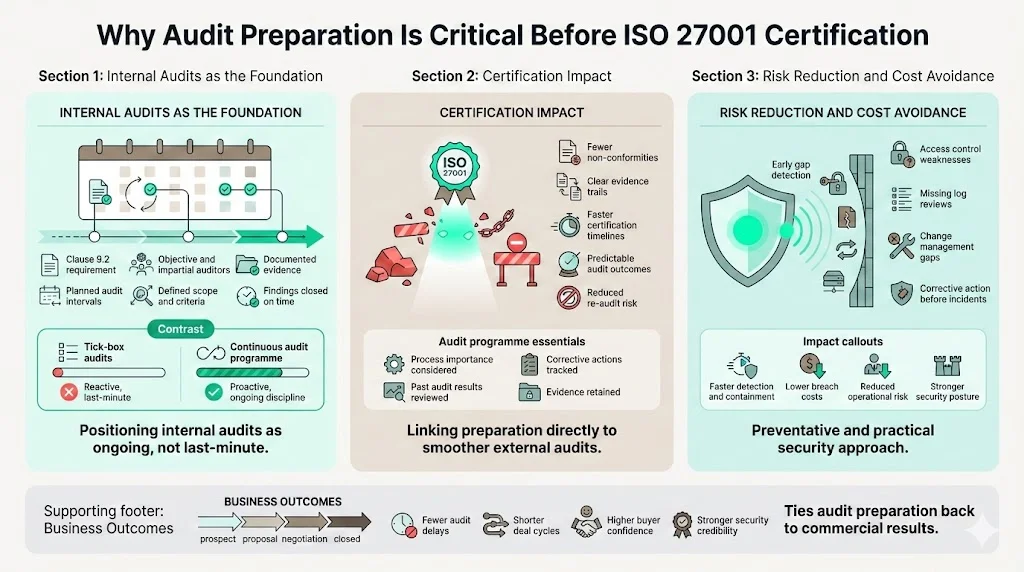
Beyond compliance, good preparation is a risk‑reduction strategy. Internal audits are an opportunity to discover control gaps before attackers do. Poorly designed access control, missing log reviews or lax change management can remain hidden until an incident. The IBM report found that rapid detection and containment, powered by security automation, lowered breach costs by nearly US$1.9 million. A rigorous internal audit programme surfaces these issues early, enabling corrective action that reduces both risk and cost.
What an ISO 27001 Audit Involves
Internal Audit
The internal audit is your readiness check. It must be planned, executed by independent auditors and documented. Bridewell notes that businesses must plan, establish and maintain an audit programme; define criteria and scope; ensure auditor objectivity; report results to relevant management; and maintain evidence of implementation. During the internal audit, auditors review policies, procedures, risk assessments and evidence of control operation. They conduct interviews with control owners and examine logs and records to verify that controls operate as designed. Any non‑conformities are logged with corrective actions.
External Audits
External audits are conducted by accredited certification bodies and occur in several stages. AuditBoard explains that Stage 1 audits focus on documentation: auditors review the ISMS scope, mandatory documents and records to confirm readiness. If gaps are identified, the organisation must remedy them before proceeding to Stage 2. Stage 2 audits assess implementation and effectiveness: auditors interview staff, inspect facilities, review operational processes, examine logs and risk treatment plans and evaluate incident handling. If the organisation meets the requirements, the certification body issues an ISO 27001 certificate, valid for three years.
Between Stage 2 and recertification audits, surveillance audits occur annually. These audits sample controls and departments to ensure the ISMS continues to operate effectively and demonstrates continual improvement. Recertification audits every three years reassess all requirements and determine whether the certificate can be renewed.
What Auditors Look For
Auditors evaluate both documentation and implementation. They expect to see:
-
Evidence of documented procedures and policies: the organisation must have a defined scope statement, information security policy, risk assessment methodology, risk treatment plan and Statement of Applicability (SoA). Industry guidance lists these as mandatory documents for Stage 1 audits.
-
Effective implementation of controls: auditors review logs, access control records, change management tickets, vulnerability scans and other evidence to confirm that controls operate as described.
-
Management review and continual improvement: Clause 9.3 requires top management to review the ISMS at planned intervals. Auditors look for meeting minutes, decisions and actions arising from management reviews.
Certification bodies also assess the length and complexity of the ISMS scope to determine audit duration. AuditBoard notes that the number of personnel and processes within scope influences audit days. Remote audits became common during the pandemic but on‑site audits resumed in 2024 with remote options available when justified.
Defining the Audit Scope
An ISMS scope defines what systems, processes and locations your ISMS covers. A clear scope avoids surprises during audits and ensures that all critical areas are addressed. When defining scope:
-
Identify assets and processes: Document the business units, applications, infrastructure and geographic regions that handle sensitive data. For enterprise clients, include customer‑facing services, third‑party integrations and data storage locations.
-
Consider contractual and regulatory requirements: Align the scope with enterprise contracts, data‑processing agreements and risk profiles. For example, if you handle protected health information, the scope must include HIPAA‑controlled workflows and associated vendors.
-
Map the scope to risk assessment: Your scope sets the boundaries for the risk assessment. Assets outside the scope will not be audited; include them only if they process or store sensitive information or are critical to your services.
Mandatory Documentation
One published guide to ISO 27001 documentation lists the documents auditors expect during Stage 1 audits. These include:
-
A statement defining the ISMS scope.
-
An information security policy.
-
The risk assessment process and methodology.
-
The risk treatment plan and SoA detailing which Annex A controls apply and why.
-
Evidence of competence and training records.
-
Asset inventories and acceptable use policies.
-
Records of risk assessments, risk treatment results and ISMS monitoring.
-
Internal audit reports and management review results.
-
Evidence of non‑conformities and corrective actions.
Maintaining these documents in a version‑controlled repository makes audit preparation much easier. It also helps with other frameworks: many SOC 2 and HIPAA controls rely on the same policies and evidence.
Build an ISMS auditors trust, not one they just approve.
Share your work email and we'll prepare evidence that survives scrutiny.
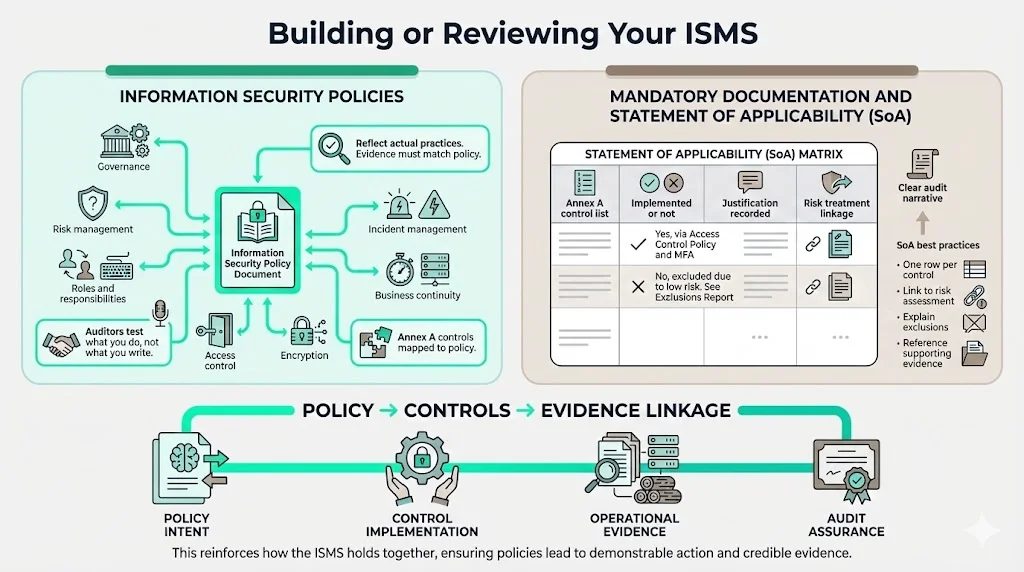
Building or Reviewing Your ISMS
Information Security Policies
Your information security policy outlines how security is managed across the organisation. It should cover governance, risk management, roles and responsibilities, acceptable use, access control, encryption, incident management and business continuity. Make sure the policy reflects actual practices; auditors will ask for evidence that the organisation does what the policy says. Annex A controls should be mapped to your policy to ensure all requirements are addressed.
Mandatory Documentation and SoA
The SoA is a critical ISO 27001 document. It lists the Annex A controls and states whether each control is implemented, along with justification. A clear SoA helps auditors understand your control environment and provides assurance that you have considered each control. When building the SoA, link each control to risk treatment decisions. If a control is not applicable, document why.
Conducting a Risk Assessment
A risk assessment forms the backbone of your ISMS. It helps you identify assets, threats, vulnerabilities and the risks that could compromise confidentiality, integrity or availability. One published 2025 guide outlines the steps involved:
-
Establish the context: Understand internal and external factors, define the ISMS scope and set risk criteria. Set an acceptable risk level aligned with your organisation’s appetite.
-
Identify assets, threats and vulnerabilities: Create an inventory of software, hardware, network infrastructure and data. Classify assets based on confidentiality, integrity and availability. List vulnerabilities such as outdated software, misconfigured cloud services, weak passwords or insufficient training.
-
Analyse and evaluate risks: Assess the likelihood and impact of each risk. Use a scoring system (e.g., a five‑point scale) to prioritise. Consider both tangible impacts (financial loss) and intangible impacts (reputation, contractual penalties).
-
Choose risk treatment options: ISO 27001 recognises four options—treat (implement controls), avoid (discontinue the risky activity), transfer (insure or outsource) and accept (within appetite). Document the rationale and decisions in your risk treatment plan.
-
Document the results: Maintain a risk register with risk descriptions, likelihood, impact, treatment choices, responsible owners and status. Auditors will review the risk methodology and records to confirm that the organisation follows a systematic process.
Different methodologies exist, including asset‑based and threat‑based approaches. An asset‑based approach inventories all assets, evaluates existing controls and identifies threats and vulnerabilities for each asset. A threat‑based approach starts with potential threat scenarios and is helpful in industries such as healthcare or financial services where data is a high‑value target. Choose a method that suits your context, but ensure it is repeatable and documented (as required by ISO 27001 clause 6.1.2).
Implementing and Testing Internal Controls
After selecting risk treatment options, implement controls aligned with ISO 27001 and any additional frameworks you must meet (SOC 2, HIPAA, GDPR). Examples include:
-
Access control: Role‑based access, least privilege reviews, password policies and multi‑factor authentication. Ensure logs show who accessed what and when.
-
Change management: Documented change approvals, code reviews, testing procedures and segregation of duties.
-
Vulnerability management: Regular scans, severity scoring (e.g., using CVSS), and defined service level agreements for remediation.
-
Incident response: Procedures for detecting, reporting and responding to incidents; evidence of drills and post‑incident reviews.
-
Vendor risk management: Due diligence questionnaires, contractual clauses and monitoring of third parties.
Testing controls is just as important as implementing them. Conduct periodic access reviews, perform disaster recovery drills, and check that logs are collected and reviewed. In our experience at Konfirmity, common weaknesses include privilege creep (accounts accumulating unnecessary permissions), vendor sprawl without proper evaluation and logging gaps in cloud services. By addressing these issues during ISO 27001 Audit Preparation, you reduce the likelihood of findings during external audits.
Internal Audit Checklist
A structured checklist keeps your internal audit focused and ensures no requirement is overlooked. Include the following elements:
-
Policies and procedures: Verify that core policies exist, are approved and match practice.
-
Risk assessments: Confirm that risk assessment methodology, risk register and treatment plan are up‑to‑date and approved.
-
Control implementation evidence: Collect logs, access reviews, change tickets and vulnerability scan results to show controls are operating.
-
Monitoring and measurement: Ensure metrics are collected and reviewed; dashboards or reports should be available for auditors.
-
Training and awareness: Check that staff have completed relevant security awareness training and understand their roles.
-
Management review and actions: Review minutes and actions from management reviews.
Bridewell’s step‑by‑step internal audit process emphasises preparation, selecting impartial auditors, issuing a clear scope and agenda, gathering evidence, conducting the audit, producing the report and logging findings for corrective action. Using a checklist ensures that each clause and control is covered.
Performing the Internal Audit
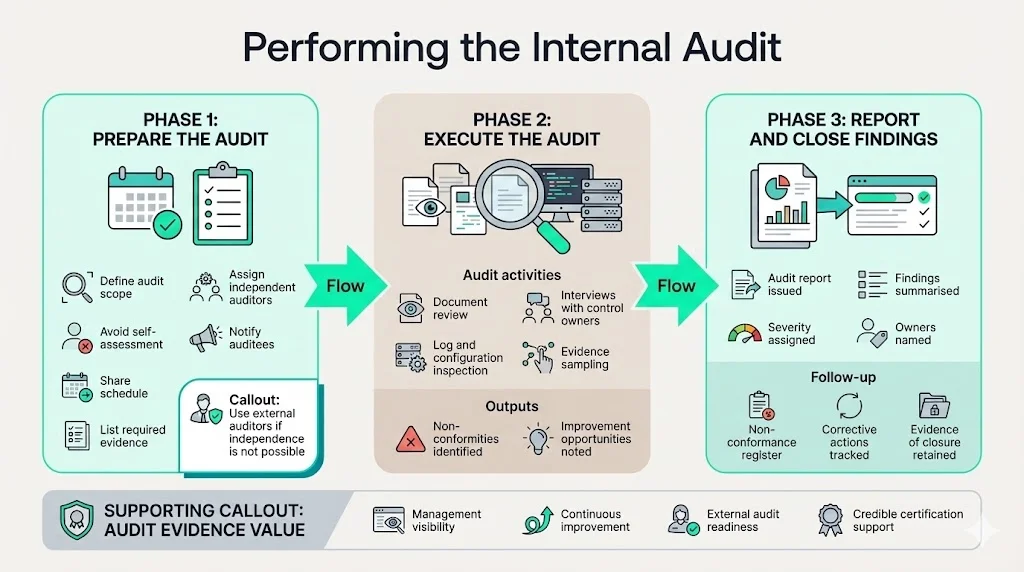
Define roles and responsibilities for the audit. Internal auditors must be independent of the processes they assess. If your organisation lacks qualified internal auditors, consider hiring an external firm; independence is critical to credibility. Prepare by informing auditees of the schedule and expected evidence. During the audit, reviewers will examine documents, interview control owners, inspect logs and identify non‑conformities and opportunities for improvement.
After the audit, issue a report that summarises findings, classifies them by severity and assigns owners and due dates. Log the findings in a non‑conformance register and track each corrective action through to completion. This register becomes a central piece of evidence for both internal management and external auditors.
Document Review and Evidence Collection
Organised documentation is the lifeblood of ISO 27001 Audit Preparation. Auditors will expect to see:
-
Version‑controlled policy documents: Show change history and approvals.
-
Logs and technical evidence: Access logs, monitoring dashboards, vulnerability scan reports and incident tickets demonstrate that controls operate.
-
Training records: Evidence that staff have completed security awareness training and role‑specific training.
-
Risk registers and treatment actions: Provide the auditor with a risk register showing current risks, treatment decisions and statuses.
-
Internal audit reports and management review minutes: Show findings, corrective actions and management decisions.
Evidence should be easy to retrieve. Use naming conventions, store records in a structured repository and maintain an index. Automated evidence collection can save hundreds of hours. Industry guidance notes that compliance automation can cut preparation from months to weeks. In our experience, manual programmes often consume 550–600 hours per year, whereas a managed service with automation can reduce the burden to under 70 hours.
Management Review
Clause 9.3 requires top management to review the ISMS at regular intervals. Published guidance explains that the review ensures the system remains suitable, adequate and effective. The review considers inputs such as the status of actions from previous reviews, changes in external and internal issues, feedback on information security performance, non‑conformities and corrective actions and monitoring results. The outputs include decisions and directions for continual improvement and actions to address non‑conformities.
The frequency of management reviews depends on factors such as organisation size, complexity and risk level. Industry guidance notes that experts recommend reviews at least annually; high‑risk organisations may need to review quarterly. Treat the management review as more than a tick‑box meeting. Use it to align security strategy with business objectives, allocate resources, approve risk acceptance and drive improvements.
Tracking and Addressing Non‑Conformities
Non‑conformities identified during internal audits, management reviews or daily operations must be logged and addressed promptly. Assign each finding to an owner, define corrective actions and set a deadline. Evidence of corrective action is required to close the non‑conformity. Unresolved issues can cause delays or failures in certification audits.
At Konfirmity, we maintain a remediation tracker that links findings to owners and evidence. We use automated reminders and monthly status reviews to ensure accountability. This disciplined approach reduces the number of findings during external audits and demonstrates continual improvement.
Final Pre‑Audit Steps
Before the certification audit, conduct a final walkthrough of your ISMS. Confirm that all mandatory documents are complete, approved and accessible. Ensure that internal audit reports and management review minutes are finalised and that corrective actions are completed. Brief team members who may interact with auditors; they should understand their roles, know where evidence resides and be ready to answer questions about control operation.
What to Expect During Certification Audits
The certification process typically follows a timeline. One industry timeline shows that the pre‑audit phase spans months 1–4, including scoping, risk assessment, control implementation, evidence collection and internal audit. Stage 1 occurs in month 5, when auditors review documentation. Stage 2 occurs in months 6–8, when auditors assess controls and business processes. After successful Stage 2, the certificate is issued for three years. Smaller organisations can be audit‑ready in about four months, whereas larger ones may need a year or more.
During the audits:
-
Stage 1: Expect questions about the ISMS scope, risk assessment process, SoA and mandatory documentation. Auditors may request updates if documents are incomplete or inconsistent.
-
Stage 2: Auditors will test controls. They will ask for evidence of access reviews, change management records, incident response, vendor assessments and training programmes. Be prepared to explain how each control works in practice.
Enterprise clients often perform their own due‑diligence assessments, which mirror certification audits. They expect to see attestation reports (SOC 2 Type II, ISO 27001 certificates), detailed questionnaires, penetration test results and evidence of corrective actions. Providing these artefacts quickly can accelerate sales cycles; lacking them can add weeks or months of scrutiny.
Continual Improvement After the Audit
Certification is not the end. Surveillance audits occur annually, and recertification is required every three years. Use audit outcomes to strengthen your control environment. Update policies when business processes or technologies change. Plan internal audits more frequently if risk profiles shift. Embed security awareness training into onboarding and ongoing education.
Monitor control effectiveness continuously. For example, automate vulnerability scans and patch management, schedule quarterly access reviews and use logging and monitoring tools to detect anomalies. Cross‑map controls to SOC 2, HIPAA and GDPR to leverage work across frameworks. By maintaining evidence year‑round, you avoid the scramble that plagues many first‑time audit programmes.
Walk into the certification audit with the evidence already filed
Book a demo and we'll show how Konfirmity keeps your mandatory documents, internal audit records and management review minutes current, so preparation stops being a six-week scramble.
Book a demo
Conclusion
Thorough ISO 27001 Audit Preparation is essential for protecting data, winning enterprise deals and reducing risk. The standard’s requirements—internal audits, management reviews, documented policies and evidence of control operation—are not red tape; they are the building blocks of a resilient security programme. A disciplined internal audit programme surfaces issues before external auditors do. A clear scope and complete documentation streamline certification. Management reviews keep leadership engaged and drive continual improvement.
Konfirmity’s human‑led, managed service model is built on these principles. We integrate controls into your technology stack, monitor their operation and keep evidence fresh. Our clients typically achieve audit readiness in 4–5 months, compared with 9–12 months when self‑managed. By reducing the internal effort to under 70 hours per year, we free engineering and security teams to focus on delivering value to customers. Security that looks good on paper but fails under pressure is not security at all. Build a programme once, operate it every day and let compliance—and enterprise trust—follow.
Frequently Asked Questions
Internal audits must occur at planned intervals as part of an audit programme. Expert guidance suggests conducting at least one full internal audit per year; high‑risk organisations or those undergoing significant change may need more frequent audits. Use partial audits throughout the year to cover different areas and maintain readiness.
You need a clear scope statement, information security policy, risk assessment methodology, risk treatment plan, Statement of Applicability, asset inventory, training records, internal audit reports and management review minutes. Maintaining version‑controlled policies, logs and evidence simplifies preparation.
Internal audits are self‑assessments conducted by independent auditors within or hired by the organisation. They verify that the ISMS meets the organisation’s requirements and ISO 27001 and identify areas for improvement. External audits are performed by accredited certification bodies. Stage 1 reviews documentation and Stage 2 verifies implementation and effectiveness. Surveillance and recertification audits maintain certification.
Log each non‑conformity with a description, owner, corrective action and due date. Track progress in a non‑conformance register and gather evidence of completion. Review corrective actions during management reviews and verify closure before external audits. Failure to address non‑conformities can delay certification or result in findings during surveillance audits.