
An Information Security Management System (ISMS) sets the governance, risk assessment and control structure that underpins ISO 27001 certification. Change management is a critical part of this system because uncontrolled modifications to infrastructure, software or processes can introduce vulnerabilities. In 2026 all certifications must be consistent with the 2022 edition of ISO 27001, which introduced control 8.32 for change management and a new clause 6.3 on planning changes. Organisations were required to complete their transition by October 2025 or restart certification.
Structured change management protects confidentiality, integrity and availability (CIA) by ensuring that any modification is risk‑assessed, authorised, tested and documented. IBM’s 2025 Cost of a Data Breach report found that U.S. breaches cost an average of $10.22 million while the global average was $4.44 million. The same research notes that shorter detection times cut costs and highlights the importance of disciplined operational processes. A well‑run change management programme reduces the likelihood of outages and security incidents, supporting revenue and reputation.
Despite its importance, many teams view change management as a checklist rather than an operational practice. Some rely on ad‑hoc approvals or untracked changes, leading to audit findings and buyer scepticism. This guide clarifies the objectives of change control under ISO 27001, explains control 8.32 in plain language and provides actionable guidance for design and operation. It also contrasts Konfirmity’s human‑led managed service with self-serve tools and one‑off consultancies, quantifying the benefits of continuous operations. By the end of this guide you will see how ISO 27001 Change Management strengthens security and buyer confidence. Enterprise and healthcare clients evaluate change management during vendor risk assessments.
What Is ISO 27001 Change Management?
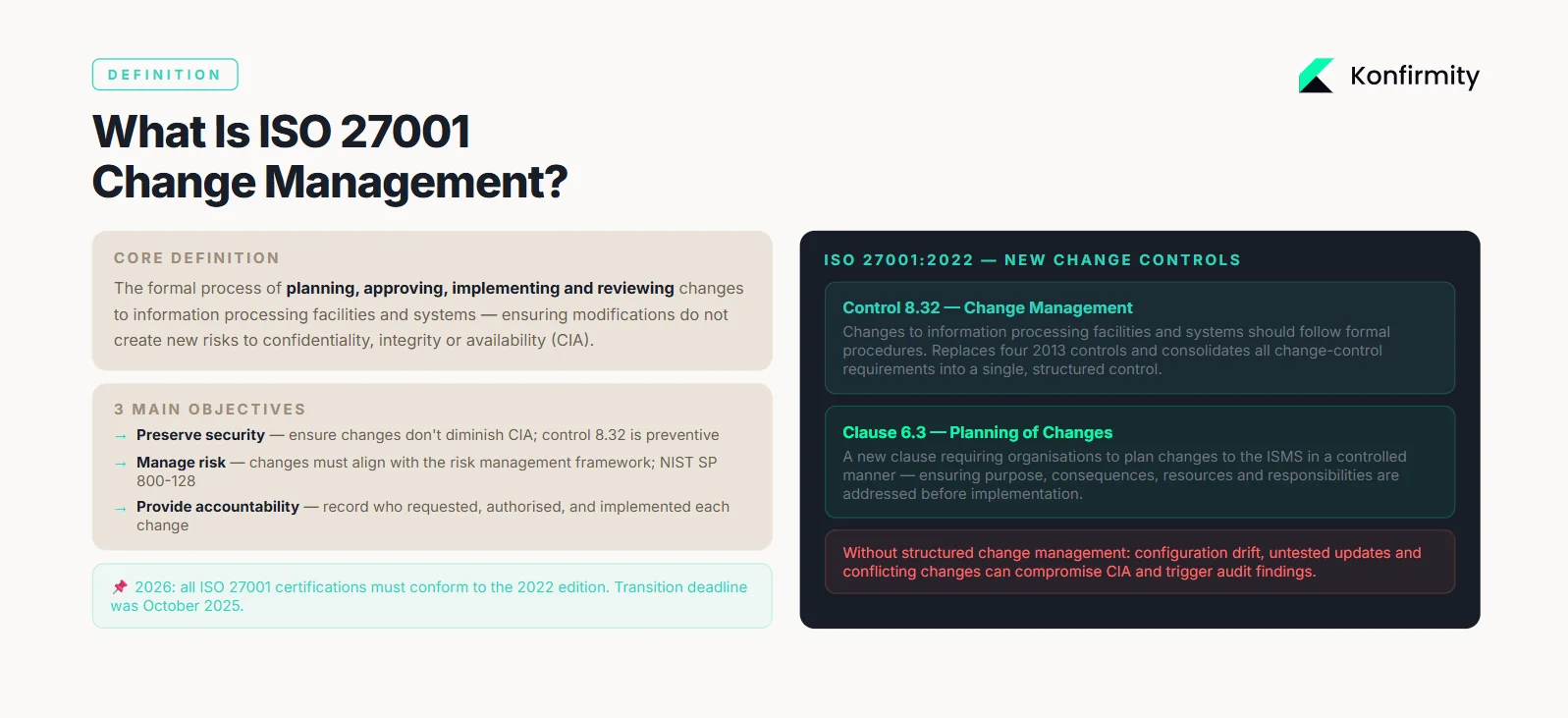
Change management in the context of ISO 27001 refers to the formal process of planning, approving, implementing and reviewing changes to information processing facilities and systems. In other words, ISO 27001 Change Management defines how organisations ensure that modifications do not create new risks. Control 8.32 requires organisations to subject changes to established procedures. The aim is to prevent configuration drift, untested updates or conflicting changes that could compromise the CIA triad.
Main objectives include:
-
Preserve security: Ensuring changes do not diminish confidentiality, integrity or availability. Control 8.32 is preventive and emphasises proper planning, testing and documentation.
-
Manage risk: Ensuring that changes are consistent with the organisation’s risk management framework. NIST SP 800‑128 states that systems are in a constant state of change due to hardware and software updates, patches and new threats, and warns that adjustments to configurations should not adversely affect security.
-
Provide accountability: Maintaining a record of who requested, authorised and implemented each change, which is essential for audits and forensic analysis. Auditors look for change request records showing authorisation, risk assessment and success criteria.
Control 8.32: Change Management under ISO 27001:2022
Control 8.32 is part of the organisational controls in Annex A of ISO 27001:2022. It replaces four older controls from the 2013 edition and consolidates change‑control requirements. The control states that changes to information processing facilities and systems should follow formal procedures. Although Annex A controls are not automatically mandatory, organisations must assess applicability and include change management if their risk analysis shows that uncontrolled changes could cause harm.
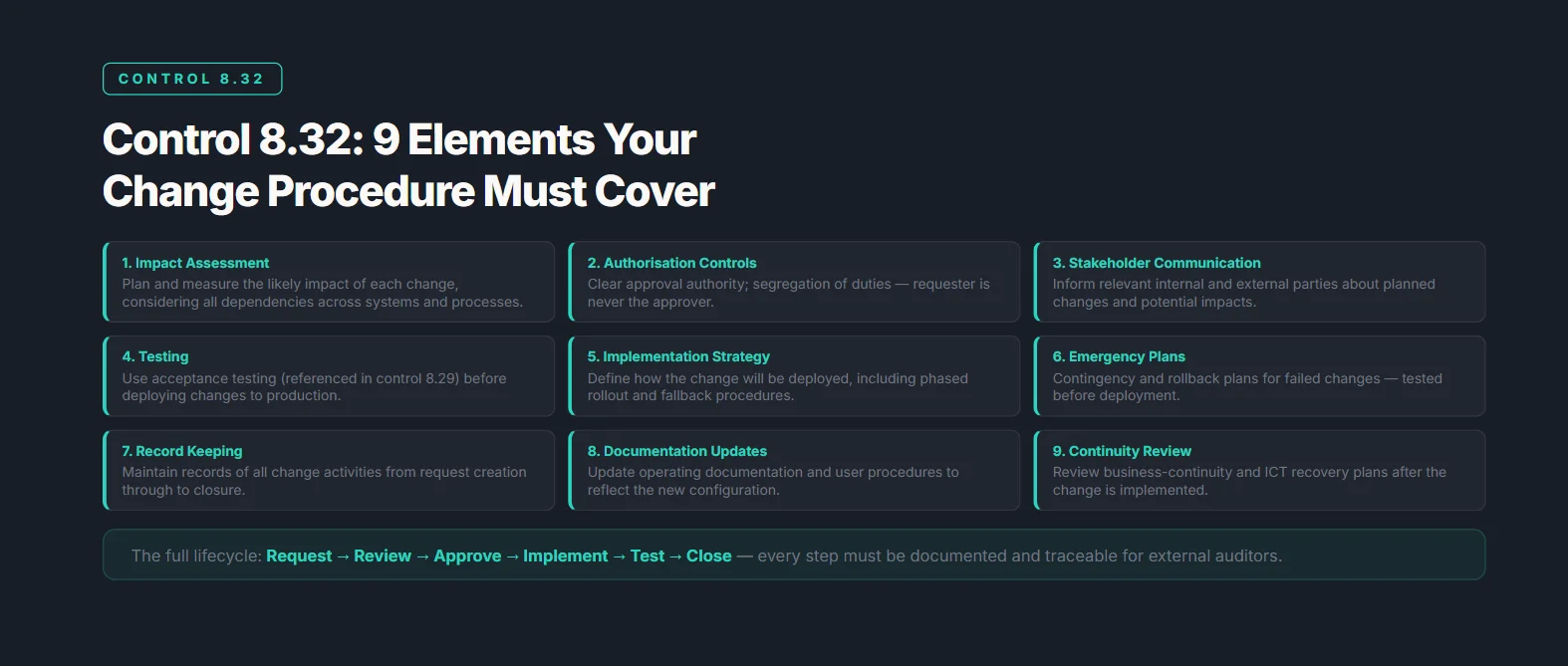
Control 8.32 sets nine elements that a change management procedure should cover:
-
Impact assessment: Plan and measure the likely impact of each change, considering dependencies.
-
Authorisation controls: Implement clear authorisation for changes; segregation of duties ensures the requester is not the approver.
-
Stakeholder communication: Inform relevant internal and external parties about planned changes.
-
Testing: Use acceptance testing processes (as referenced in control 8.29) before deploying changes.
-
Implementation strategy: Define how the change will be deployed, including fallback procedures.
-
Emergency plans: Prepare contingency and rollback plans for failed changes.
-
Record keeping: Maintain records of all change activities, from request to closure.
-
Documentation updates: Update operating documentation and user procedures to reflect the new configuration.
-
Continuity review: Review business‑continuity and ICT recovery plans after the change.
These elements mirror the “request, review, approve, implement, test, and close” lifecycle described by lead auditor Stuart Barker. The process ensures that changes are planned, risk‑assessed, approved by appropriate stakeholders and rolled back if necessary.
Core Elements of ISO 27001 Change Management
Risk Assessment and Impact Analysis
Every change should start with a risk assessment. NIST’s SP 800‑128 notes that system components are constantly modified and warns that adjustments to configurations may introduce new vulnerabilities. The change management procedure must evaluate the potential effects on security, operations and compliance. Important considerations include:
-
Threat environment and vulnerabilities: Assess whether the change introduces new attack vectors or exposes sensitive data. The 2025 Cost of a Data Breach report found that malicious activities caused 51% of breaches, highlighting the need to consider threat likelihood.
-
CIA impact: Determine how the change affects confidentiality, integrity and availability. For example, replacing a network device may improve performance but could weaken default firewall rules if not configured properly.
-
Dependency analysis: Evaluate upstream and downstream dependencies. A database upgrade might require application changes; failing to consider these dependencies can cause downtime.
Practical approach: use a change request template that includes a risk matrix. Assign a risk rating (low, medium, high) based on impact and likelihood, referencing existing risk registers. Link each change to the organisation’s Statement of Applicability to show how it affects selected Annex A controls.
Authorization Process and Change Requests
Approval ensures that changes are consistent with business objectives and security needs. Stuart Barker outlines a “Stop and Check” rule: before changing a firewall rule or migrating to a new cloud provider, teams must ask whether the change will break security. Important practices include:
-
Segregation of duties: The requester and approver should be different. This reduces the risk of unvetted changes and provides a second opinion.
-
Change advisory board (CAB): For high‑impact changes, convene a CAB consisting of the system owner, security manager, and relevant business leaders. The board reviews the risk analysis, proposed implementation plan and fallback strategy.
-
Documented approvals: Maintain evidence of approval. Auditors will ask for the change request ticket or documentation showing who authorised it, the rationale and any conditions.
Automation can streamline this process. Integrate the change request workflow into ticketing systems (e.g., Jira or ServiceNow) and ensure that approvals are recorded with timestamps. This evidence becomes part of the audit package.
Change management done right protects systems and satisfies auditors.
Share your work email and we'll turn your change process into audit evidence.
Version Control and Traceability
Traceability means being able to identify who changed what and when. Use version‑control and configuration‑management tools to maintain a secure baseline, require descriptive commit messages referencing change request IDs and store scripts, deployment manifests and infrastructure‑code templates in a central repository with historical versions for the duration of your observation period. NIST emphasises that configuration management supports secure configurations and risk management.
Incident Handling and Response
Uncontrolled changes are a common root cause of incidents: the 2025 report attributes 26% of breaches to human error and 23% to IT failure. Even with disciplined change control, configuration errors or unapproved updates may still occur. Integrate change and incident management by linking change records to incident tickets, define an emergency process that still includes risk assessment and rollback, and conduct root‑cause analyses to improve procedures when incidents arise.
Implementing Change Management in Your Organisation
Creating a Change Management Policy
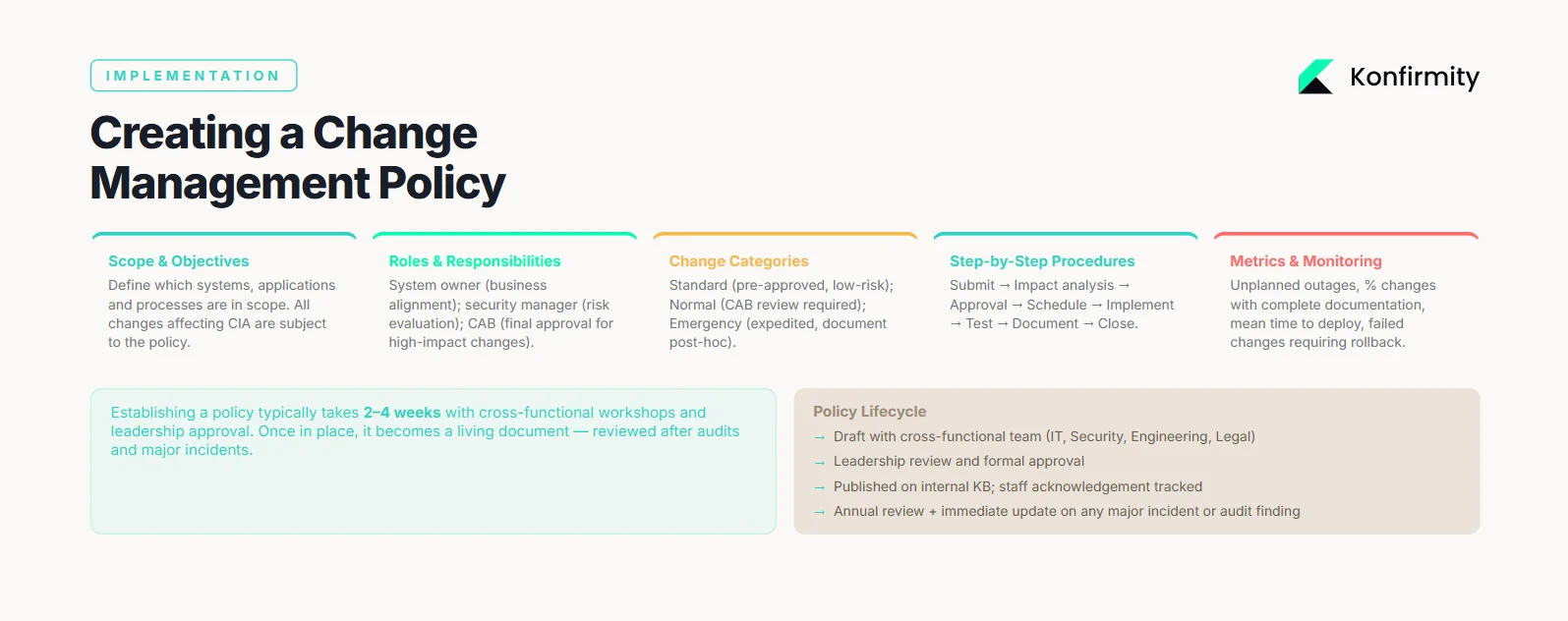
A change management policy formalises expectations and assigns responsibilities. Main components:
-
Scope and objectives: Define which systems, applications and processes are in scope. Clarify that all changes affecting the confidentiality, integrity or availability of information are subject to the policy.
-
Roles and responsibilities: Identify who submits requests, who assesses risk, who approves, who implements and who verifies. For example, the system owner ensures the change is consistent with business objectives; the security manager evaluates risks and controls; the CAB provides final approval for high‑impact changes.
-
Change categories: Distinguish between standard, normal and emergency changes. Standard changes are low‑risk, pre‑approved tasks (e.g., routine patching); normal changes require CAB review; emergency changes are expedited due to incidents.
-
Procedures: Provide step‑by‑step instructions for submitting change requests, performing impact analysis, obtaining approval, scheduling implementation, testing, documenting and closing.
-
Metrics and monitoring: Specify how change management performance will be measured—e.g., number of unplanned outages, percentage of changes with complete documentation, mean time to deploy changes, and number of failed changes requiring rollback.
A clear policy sits at the heart of change management, providing the foundation for procedures, roles and evidence. Konfirmity’s delivery experience shows that establishing such a policy typically takes 2–4 weeks with cross‑functional workshops and leadership approval. Once implemented, the policy becomes a living document subject to regular review and updates after audits or major incidents.
Templates for Change Management
Templates standardise information collected at each step. Providing downloadable templates (for example, within your compliance portal) supports consistent evidence collection. Suggested templates include:
| Template | Purpose | Essential fields |
|---|---|---|
| Change Request Document | Initiates the process and records the “what” and “why.” | Unique ID, description, business justification, systems affected, proposed implementation date, change type (standard/normal/emergency), requester name. |
| Risk Assessment Worksheet | Documents the impact analysis. | Impact on confidentiality, integrity and availability; risk rating; dependencies; proposed controls; reference to risk register. |
| Approval Record | Captures authorisation decisions. | Approver names and roles, date, conditions, comments. |
| Implementation Plan | Guides deployment and testing. | Step-by-step plan, assigned resources, rollback procedure, communication plan. |
| Post-Change Review | Verifies success and updates documentation. | Test results, evidence of monitoring, issues encountered, corrective actions, updates to baselines and documentation. |
Test results, evidence of monitoring, issues encountered, corrective actions, updates to baselines and documentation.
Using these templates ensures that evidence is consistent with ISO 27001 and SOC 2 requirements. For example, industry guidance notes that SOC 2 includes five trust services criteria with 64 individual requirements. Typical Type II audits evaluate the operating effectiveness of 60–100 controls. Documented change records provide cross‑framework evidence for both ISO and SOC audits.
Best Practices for ISO 27001 Change Management
Continuous Improvement and Feedback Loops
Change management should not remain static. Post‑implementation reviews and audit findings provide insights for refinement. Track success rates, emergency‑change counts and incident correlation to identify bottlenecks; incorporate audit feedback by revising risk worksheets and training; and hold retrospectives after major changes to document lessons and update procedures.
Stakeholder Communication and Engagement
Change management succeeds only when everyone understands their role. Important strategies:
-
Communications plan: Develop a communications matrix that identifies which stakeholders need to be informed at which stage (e.g., operations, customer success, compliance, procurement). For enterprise vendors, clear communication with clients about planned changes reduces surprises and demonstrates operational maturity.
-
Cross‑department coordination: Involve IT, security, engineering, quality assurance, legal and customer success in the CAB. A multi‑disciplinary perspective ensures that business objectives, regulatory requirements and technical realities are considered.
-
Client coordination: For vendors handling enterprise or healthcare data, communicate maintenance windows and potential impacts to clients. Provide advanced notice and coordinate timing to minimise disruptions.
Training and Awareness Programmes
Even the best policies fail without trained personnel. Training programmes should show staff how to submit requests, perform risk assessments, document approvals and understand why these steps matter. Use real incident examples to explain the impact of uncontrolled changes and provide practical instruction on tools such as version control, ticketing and configuration‑management platforms. Konfirmity integrates training into managed service delivery: during onboarding, clients receive role‑specific sessions and periodic refreshers. Our clients report improved audit readiness and fewer failed changes after adopting structured training.
Common Challenges and How to Overcome Them
1) Balancing Speed and Security
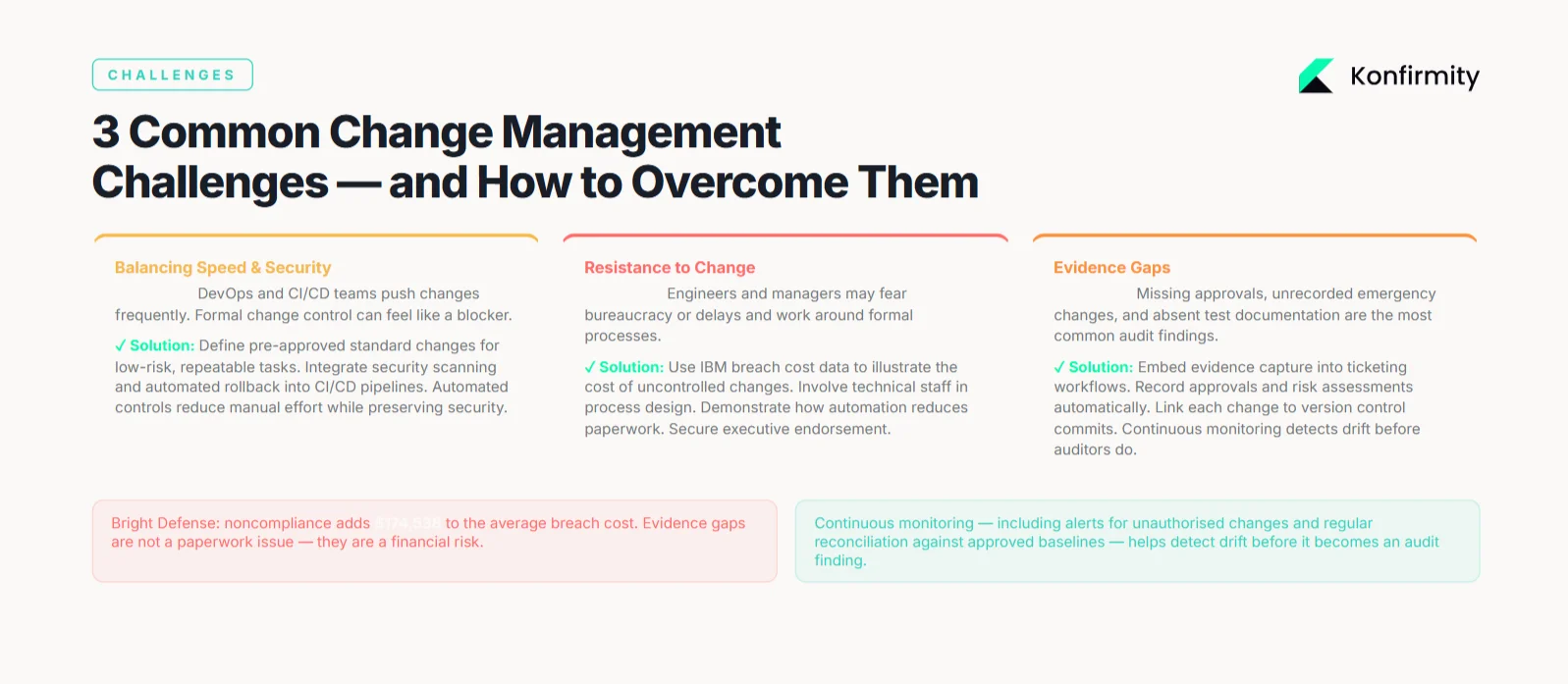
In modern engineering practices such as DevOps and continuous delivery, teams push changes frequently. The challenge lies in balancing rapid deployment with thorough security checks. Strategies include:
-
Change categories: Define criteria for low‑risk standard changes that can be pre‑approved and executed quickly (e.g., applying vendor‑supplied patches that have been tested in a staging environment). Use automation to implement these without CAB review.
-
Automated testing and deployment: Integrate security scanning, configuration compliance checks and automated rollback into CI/CD pipelines. Automated controls reduce manual effort and expedite approvals while preserving security.
2) Dealing with Resistance to Change
Introducing formal change management can meet resistance from engineers and managers who fear bureaucracy or delays. Building a security‑first mindset requires clear communication about why change control matters—use data such as IBM’s breach cost statistics to illustrate the cost of uncontrolled changes. Involve technical staff in designing processes, demonstrate how automation reduces paperwork, secure leadership endorsement and share examples of successful controlled changes. With these approaches, teams appreciate that discipline protects the business rather than slowing it down.
3) Avoiding Evidence Gaps
Auditors increasingly scrutinise evidence. Industry research reports that noncompliance adds about $174,538 to the average breach cost. Missing approvals, unrecorded emergency changes and lack of test documentation are common gaps. Prevent these by embedding evidence capture into ticketing workflows—record approvals and risk assessments, link each change to version control commits and map records to ISO 27001, SOC 2, HIPAA or GDPR requirements. Continuous monitoring, including alerts for unauthorised changes and regular reconciliation of configurations against approved baselines, helps detect drift and ensures that actual practice matches documented procedures.
Turn every change request into audit evidence by default
Book a demo and we'll show how Konfirmity captures change authorisation, impact analysis and rollback records from the tools your engineers already use, so the evidence gap never opens.
Book a demo
Conclusion
Effective ISO 27001 Change Management programmes are foundational to security and audit readiness because control 8.32 requires planned, authorised and tested changes. NIST warns that constant modifications must not undermine security, and data show that breaches are expensive while discipline reduces costs.
Konfirmity’s experience across 6,000+ security audits shows that organisations with structured change management achieve faster certification, experience fewer findings and maintain customer trust. By adopting a human‑led, managed service that designs and runs your security programme, you avoid the burden of building processes alone. We implement controls inside your stack, continuously monitor evidence and support you throughout the audit cycle. Security that reads well in documents but fails under operational pressure is a liability. Build a durable change management programme, integrate it into daily operations and let compliance follow.
Enterprise and healthcare buyers increasingly demand assurance artefacts such as business associate agreements (BAAs) and data‑processing addenda (DPAs) before procurement. Deals stall if vendors are unable to provide operational evidence of change control across frameworks like SOC 2 Type II, HIPAA and GDPR. A human‑led managed service reduces internal workload by implementing controls inside your stack and managing evidence across observation windows, freeing teams to focus on product development while maintaining continuous audit readiness. Konfirmity’s managed service typically shortens SOC 2 readiness from around nine months to about five and reduces internal effort. This evidence‑driven approach accelerates sales cycles while strengthening security.
FAQ
It refers to control 8.32 of ISO 27001:2022, which requires organisations to manage changes to information systems through formal procedures. The objective is to protect confidentiality, integrity and availability by ensuring that changes are planned, risk‑assessed, authorised, tested and documented.
Uncontrolled changes can introduce vulnerabilities that lead to breaches or downtime. IBM’s 2025 report shows that the average U.S. breach costs $10.22 million. Proper change management reduces these risks and provides evidence for auditors and enterprise buyers.
Start by drafting a policy that defines scope, roles, change categories and procedures. Use standard templates for change requests, risk assessments and approvals. Integrate workflows into ticketing and version control systems, ensure segregation of duties, and conduct training. Engage a managed service provider such as Konfirmity to design and operate the process if internal resources are limited.
Essential elements include scope, objectives, roles and responsibilities, change categorisation (standard, normal, emergency), step‑by‑step procedures, approval criteria, communication protocols and metrics for monitoring performance.
Establish a change advisory board for high‑risk changes, require separate individuals to request and approve changes, and record approvals in a system accessible for audits. Automation can enforce these rules by routing requests to the correct approvers and logging decisions.
Use a change request document, risk assessment worksheet, approval record, implementation plan and post‑change review. These templates capture critical information, provide an audit trail and ensure that changes comply with ISO 27001 and SOC 2 requirements.