
ISO 27001 vulnerability management is governed by Annex A 8.8 (the 2022 revision's replacement for control 12.6.1), which requires organizations to identify, assess, prioritize, and remediate technical vulnerabilities on a documented, risk-based schedule, and to keep evidence, an asset inventory, a vulnerability register, and remediation records tied to defined SLAs, ready for audit. Enterprise and healthcare buyers now treat this control area as a qualifier, not a formality: IBM's 2026 Cost of a Data Breach Report puts the global average cost of a breach at a record $4.99 million, up 12% year over year, and most breaches still exploit known, unpatched weaknesses rather than novel attacks.
This guide is written for CISOs, CTOs, founders, and compliance leads at midmarket and startup companies, particularly fintechs with license obligations, healthcare companies handling protected health information (PHI), and vendors selling into enterprise accounts. It draws on Konfirmity's experience across more than 6,000 security audits and 25+ years of combined expertise to show what auditors and buyers actually expect, not just what the standard says on paper.
Key Takeaways: ISO 27001 Vulnerability Management Requirements
- Annex A 8.8 requires a risk-based, documented vulnerability management process with defined ownership, timelines, and evidence — not periodic scanning alone.
- Vulnerability management is not a standalone control. It intersects with risk assessment (Clause 6.1.2), asset management (Clauses 8.1.1–8.1.2), incident response (Clause 16), and continual improvement (Clause 10).
- Auditors expect a vulnerability register, documented remediation SLAs by severity, and evidence of re-scanning after every fix — a single scan before the audit is a common cause of nonconformities.
- A single ISO 27001-aligned program can satisfy overlapping SOC 2, HIPAA, and GDPR requirements, which matters most for companies pursuing multiple frameworks at once.
- Enterprise buyers ask about scan cadence, patch SLAs, and risk-acceptance procedures during due diligence; vendors who answer with documentation, not promises, close deals faster.
Why Vulnerability Management Matters When Selling to Enterprise and Healthcare Clients
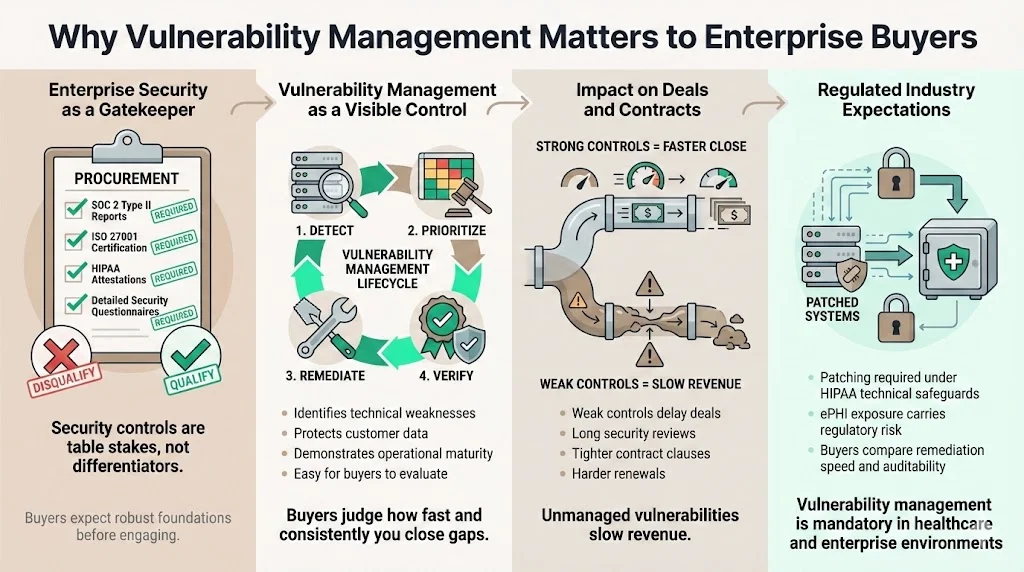
Enterprise and healthcare buyers treat security as a qualifier, not a differentiator. Procurement teams ask for current SOC 2 Type II reports, ISO 27001 certificates, HIPAA attestations, and detailed answers to security questionnaires before a deal moves past due diligence. Vulnerability management is one of the most visible control areas in that review because it directly protects customer data and signals operational maturity. When technical weaknesses go unmanaged, deals stall, renewal terms lengthen, and contractual clauses tighten.
For healthcare vendors handling electronic protected health information (ePHI), patching known vulnerabilities is not optional — it is required under the HIPAA Security Rule's technical safeguards. For fintechs, a sponsor bank or regulator reviewing a license application increasingly expects to see an operating vulnerability management program, not a policy binder. Buyers in both segments compare vendors on how quickly they identify, prioritize, remediate, and verify vulnerabilities, and whether that process is repeatable and evidenced rather than ad hoc.
ISO 27001 Annex A 8.8: What the Standard Actually Requires
ISO 27001:2022 defines an Information Security Management System (ISMS): the policies, procedures, and controls an organization uses to manage information risk. Vulnerability management sits inside that system as a continuous discipline, not a periodic task.
Annex A 8.8: Management of Technical Vulnerabilities
Annex A 8.8, Management of Technical Vulnerabilities, is the control that specifically governs vulnerability management under ISO 27001:2022. It replaces control 12.6.1 from the 2013 version of the standard and requires organizations to obtain timely information about technical vulnerabilities in the systems they use, evaluate their exposure, and take appropriate measures to address the associated risk. The control connects vulnerability handling to risk assessment, asset management, and continual improvement — it is explicit that a scanner report alone does not satisfy it. Organizations need documented processes, defined responsibilities, risk evaluation, treatment planning, and follow-up evidence.
How It Connects to Risk Assessment and Threat Identification
Risk assessment is the starting point for every ISO 27001 control, and vulnerabilities feed into it as threat sources. Clause 6.1.2 requires evaluating the likelihood and impact of identified risks to determine treatment options; without linking vulnerability data to that risk register, organizations cannot justify remediation priorities or risk-acceptance decisions to an auditor. Threat intelligence sharpens the identification stage by highlighting which CVEs are actively exploited or have a public proof-of-concept. Most scanners now integrate with the National Vulnerability Database, which adds more than 2,000 new entries a month, and with Exploit Prediction Scoring Systems (EPSS). Combining CVSS scores, exploitability, asset criticality, and business impact — using a model like FAIR where it helps — is how teams prioritize what genuinely matters to the business rather than what merely scores highest.
Ad Hoc Scanning vs. a Structured ISO-Aligned Approach
Ad hoc scanning produces long lists of CVEs with no context: it misses assets, skips prioritization, and rarely tracks remediation to closure. A structured, ISO-aligned program instead follows a lifecycle — define asset scope, identify vulnerabilities, assess and prioritize risk, treat weaknesses, verify the fix, and monitor for regressions. That lifecycle mirrors the identification, assessment, prioritization, remediation, verification, and reporting stages described by NIST's vulnerability management guidance and by most commercial frameworks. For how penetration testing fits alongside automated scanning inside that lifecycle, see our ISO 27001 penetration testing guide, which covers the difference between the two in detail.
Scanning identifies vulnerabilities. Prioritizing and fixing them earns the audit.
Share your work email and we'll help you build a vulnerability program that satisfies enterprise reviewers.
Common Gaps Enterprise Reviewers Flag During Vendor Security Assessments
Konfirmity's audit experience across thousands of engagements shows the same handful of gaps recur:
- Ad hoc scanning without context. Vendors present high volumes of findings but cannot show how they prioritize them or link them to business risk. Auditors describe these programs as "ad hoc."
- Incomplete asset coverage. Without a complete inventory of cloud accounts, applications, and dependencies, scans miss critical systems, and missing assets get flagged during audits as blind spots.
- Weak prioritization logic. Teams rely solely on CVSS scores and ignore exploitability, asset criticality, or data sensitivity, rather than weighing exploit availability and business impact.
- Lack of documented follow-up. Findings linger in spreadsheets with no clear ownership, remediation record, or acceptance rationale — a common driver of the third-party and supplier-risk gaps that show up in vendor reviews.
- Over-reliance on tools without process. Automated scanners alone do not satisfy auditors. ISO 27001 and SOC 2 both expect manual testing, penetration testing, and threat intelligence to complement automated scans.
The rest of this guide walks through building a program that closes these gaps and holds up under enterprise buyer scrutiny.
Where ISO 27001 Vulnerability Management Lives Across the ISMS
Vulnerability management is not a standalone requirement — it touches several clauses and Annex A controls at once:
| Clause / Control | Requirement |
|---|---|
| 6.1.2 — Risk assessment | Vulnerabilities are inputs into the risk assessment process, which determines likelihood, impact, and treatment plans. |
| 8.1.1 — Asset inventory | A complete inventory of hardware, software, cloud services, and APIs is needed to scope vulnerability scans. |
| 8.1.2 — Asset ownership | Every asset must have an owner responsible for remediation and risk acceptance. |
| Annex A 8.8 — Technical vulnerabilities | Organizations must obtain vulnerability information, evaluate exposure, and take measures to address risk. |
| Clause 10 — Continual improvement | Recurring vulnerabilities or missed SLAs trigger corrective actions and process changes. |
Risk Assessment and Treatment Requirements
ISO 27001 requires organizations to assess risks and decide how to treat them: avoid, mitigate, transfer, or accept. Vulnerability management supplies the data about likelihood and impact of exploitation; the risk assessment translates that into business terms. High-severity, actively exploited vulnerabilities are almost always mitigated or remediated through patching, configuration changes, or compensating controls. Lower-risk weaknesses can be accepted temporarily, but the rationale needs to be documented and approved. Auditors expect that rationale recorded in the risk register and aligned with the Statement of Applicability (SoA) — failing to tie vulnerability treatment back to a documented risk decision is one of the more common non-conformities Konfirmity sees.
Asset Management Responsibilities
A complete asset inventory underpins every downstream step. Clause 8.1.1 requires an up-to-date inventory of hardware, software, cloud services, and APIs, and Clause 8.1.2 requires a named owner for each one so vulnerabilities have clear accountability. Shadow IT, unmanaged SaaS applications, and infrastructure inherited from an acquisition are the most common blind spots. Konfirmity routinely discovers missing assets during onboarding; these gaps get logged as risks and closed through discovery tooling, stakeholder interviews, and configuration review. Without accurate scope, scans produce false negatives, and audits fail on coverage rather than on the vulnerabilities themselves.
Security Controls Tied to Technical Weaknesses
Annex A 8.8 covers technical vulnerabilities directly, but several other controls intersect with it. Change management (A.8.32) ensures patches and configuration changes follow a defined process instead of introducing new risk. Supplier relationships (A.5.21) require third-party services to meet the organization's own vulnerability management expectations — third-party risk remains one of the most commonly cited weak spots in vendor reviews. Secure development (A.8.25–A.8.28) mandates that applications are tested for vulnerabilities during development, before release. Monitoring and logging (A.8.16) helps detect exploited vulnerabilities and verify that remediation actually worked. Vulnerability management works best as part of that ongoing monitoring program rather than a point-in-time exercise; see our ISO 27001 continuous monitoring guide for how to structure it.
How It Supports SOC 2, HIPAA, and GDPR Compliance
For companies pursuing multiple frameworks in parallel, a single risk-based vulnerability program can satisfy overlapping requirements. SOC 2's Security trust service criteria emphasize change management, patch deployment, and vulnerability response. HIPAA requires risk-based technical safeguards and documentation. GDPR Articles 32–34 mandate technical measures proportionate to risk to personal data. Konfirmity frequently reuses the same vulnerability data — the register, the scan reports, the remediation tickets — across SOC 2, HIPAA, and ISO 27001 audits rather than rebuilding evidence for each one.
Building an ISO 27001-Aligned Vulnerability Management Programme
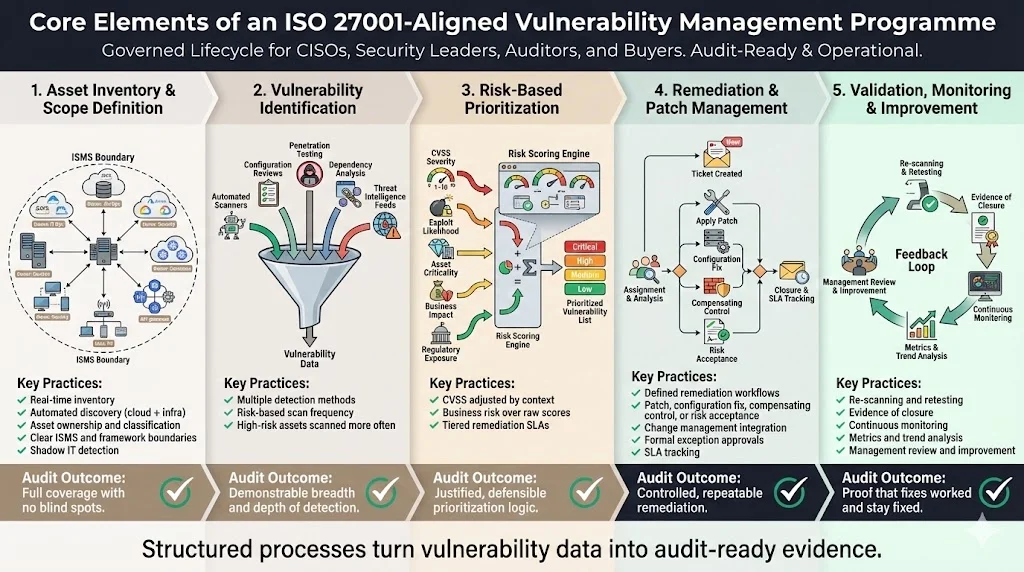
Asset Inventory and Scope Definition
Vulnerability management is blind without an inventory. A working scope definition should:
- Maintain a real-time asset inventory — on-premises servers, virtual machines, containers, serverless functions, databases, endpoints, network devices, and cloud services — using discovery tooling (AWS Config, Azure Resource Graph, Google Cloud Asset Inventory) rather than a manually updated spreadsheet.
- Map ownership and classification. Classify assets by criticality and data sensitivity (production vs. staging), and tie each one to an owner responsible for remediation, risk acceptance, and budget decisions.
- Define scope boundaries. Delineate which systems fall inside the ISMS boundary for ISO 27001 and which fall inside a HIPAA environment or SOC 2 system boundary, including third-party services, APIs, and inherited infrastructure.
- Address shadow IT and inherited risk through periodic discovery and reconciliation — unregistered assets, rogue cloud accounts, and abandoned environments left over from a migration are common findings.
In Konfirmity's experience, organizations with a complete inventory cut audit prep time by 20–30% because they avoid a last-minute scramble to prove coverage; missing assets are one of the most common causes of a failed control test.
Vulnerability Identification Methods
ISO 27001 vulnerability scanning requirements aren't prescriptive about tooling, but once scope is defined, auditors expect identification through more than one method:
- Automated scanning across infrastructure, applications, APIs, and cloud configuration, including dependency analysis (SBOMs) and CIS benchmark checks against containers, serverless functions, and network devices.
- Manual testing and configuration review to catch complex weaknesses scanners miss, especially on high-risk applications.
- Penetration testing. ISO 27001 does not explicitly mandate it, but auditors expect it for high-risk systems, and customers or regulators often require it outright. Record scope, methodology, findings, and remediation status, and for SOC 2 Type II, align the test window with the observation period so the evidence is current.
- Threat intelligence and incident learnings — vendor advisories, the NVD, threat feeds, and lessons from real incidents (scanning for Log4j-style patterns after a disclosure, for example) that adjust what gets scanned and how often.
Konfirmity typically sets scanning cadence by asset risk: weekly for critical internet-facing assets, monthly for internal infrastructure, quarterly for low-risk systems, and more frequently across the board where ePHI sensitivity justifies it.
Risk-Based Prioritization
Identification produces data; prioritization turns it into action. Effective prioritization weighs:
- Severity and exploitability — CVSS scores adjusted for exploit availability and active attacks, not read at face value.
- Asset and business criticality — a CVSS 7.5 finding on an internet-facing payment gateway can outrank a CVSS 9.0 finding on an internal test server.
- Quantitative risk models like FAIR, which translate technical severity into financial and operational terms auditors and budget owners both understand.
- Regulatory and contractual obligations — vulnerabilities on systems handling ePHI or payment data may carry reporting or contractual triggers of their own.
Auditors expect to see this logic documented, and they will check tickets or the register to confirm high-risk findings were closed inside the stated SLA.
Remediation, Patch Management, and Severity-Based SLAs
While ISO 27001 does not mandate specific remediation windows, auditors expect a documented, risk-based SLA. A common, defensible structure ties remediation timelines to CVSS severity:
| Severity | CVSS Score | Recommended Remediation Timeline |
|---|---|---|
| Critical | 9.0–10.0 | 48 hours |
| High | 7.0–8.9 | 7–14 days |
| Medium | 4.0–6.9 | 30 days |
| Low | 0.1–3.9 | 90 days |
Konfirmity's vulnerability management feature lets you set and enforce these SLAs by severity automatically, with full audit-trail history for every fix.
Beyond the SLA itself, an effective remediation process needs:
- Defined workflows integrated into change management, using ticketing systems (Jira, ServiceNow) to assign, track, and approve fixes, with testing and rollback plans recorded alongside them.
- Coordinated ownership across engineering, IT, DevOps, and security so it is clear who patches, who tests, and who verifies closure.
- A patch cadence (a monthly cycle, for example) with an explicit out-of-band path for critical, urgent fixes.
- Documented exceptions for delayed fixes — vendor patch unavailable, high risk of service disruption — with formal risk acceptance from the asset owner and periodic review, as ISO 27001 requires.
Konfirmity's data shows clients running a structured patch process cut remediation time by 30–50% compared with an ad hoc one, largely because ownership and SLAs are unambiguous rather than negotiated after the fact.
Validation and Continuous Monitoring
Validation and continuous monitoring close the loop that remediation opens: ISO 27001 expects evidence that vulnerabilities were treated and that the fix held, not just a ticket marked closed.
- Re-scan or re-test after every patch to confirm the finding is actually gone; for manual fixes, retest or review the change directly.
- Record closure in the vulnerability register with the date, the responsible person, and a reference to the scan report or change ticket.
- Monitor continuously rather than only before an audit — scheduled scans catch new vulnerabilities and confirm resolved ones haven't resurfaced, and scanning tools wired into CI/CD catch issues before they ship.
- Track metrics — open vulnerability count, mean time to remediate, repeat findings by asset — and feed them into management review under Clause 10's continual-improvement requirement.
Vulnerability Management Policy and the Evidence Auditors Expect
A policy sets out purpose, scope, and responsibility; auditors ask for it, alongside the register and scan reports, to confirm the program is formalized rather than informal. At minimum, it should define: scope (which assets and third-party dependencies are in scope for scanning), identification methods (scanners, penetration tests, vendor alerts), a risk-based remediation SLA (see the table above), and an evidence trail an auditor can review on demand — plus review ownership, typically an annual cadence assigned to a senior security leader.
Rather than starting from a static policy template that goes stale the moment your tooling changes, most Konfirmity customers generate their vulnerability management policy, register, and remediation records directly inside the platform, so the documentation always matches what is actually being scanned and patched.
Vulnerability Register Fields Auditors Look For
A vulnerability register is the structured record tying every finding to an owner and a decision. Auditors expect at minimum:
- Unique identifier and date discovered
- Asset reference and owner
- Vulnerability description and source (scanner, pen test, threat intel)
- Severity (CVSS score, exploitability, business impact)
- Priority level and remediation SLA
- Assigned responsible person
- Treatment decision (remediate, mitigate, accept) and justification
- Status (open, in progress, resolved, accepted)
- Evidence of closure (scan report or change ticket reference)
- Risk acceptance approval, where applicable
Spreadsheets are acceptable as a register if they're version-controlled and backed by policy — the format matters less to an auditor than whether every row has a clear audit trail from finding to closure.
Free template
The ISO 27001 Vulnerability Management Policy & Register Template
A ready-to-adapt policy, the severity-based remediation SLA from above, and a fully worked 8-row vulnerability register showing exactly what auditors expect in each field. Enter your work email and we'll send the PDF.
See Konfirmity's vulnerability management feature for how this is automated end to end.
Scan Reports and Remediation Records
Scan evidence should be consistent across tools: state the scope and date of each scan (internal or external, tool used, assets covered), summarize findings by severity, list detailed findings with CVE and affected host, and attach the remediation record — change ticket, patch note, and verification result — for each one. A standardized "scan library" format is what makes this evidence reusable across a customer questionnaire and the next audit, rather than reconstructed each time.
Common Mistakes That Cause Audit Friction
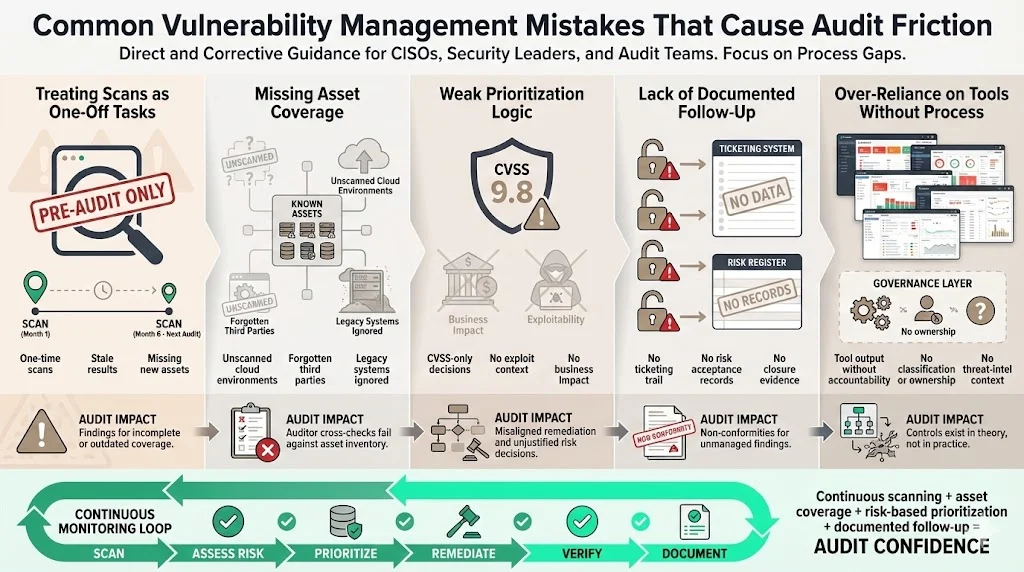
Even well-intentioned programs stumble on the same handful of pitfalls:
- Treating scans as a one-off task before the audit, rather than continuous. A single scan produces findings for missing coverage and stale data.
- Missing asset coverage — cloud accounts, third-party integrations, and legacy systems are the most common omissions, and auditors cross-check the inventory against the scan report to catch them.
- Weak prioritization logic — using CVSS alone, without exploitability or business impact, produces remediation priorities auditors will challenge.
- Lack of documented follow-up — unresolved findings without a justification or ticket trail are a direct path to a nonconformity.
- Over-reliance on tools without process — scanners generate data; without governance, classification, and accountability, that data is noise rather than evidence.
How Vulnerability Management Impacts Enterprise Sales
Enterprise buyers ask detailed questions about vulnerability handling because it reflects whether a vendor can protect their data. Security questionnaires routinely include sections on scanning cadence, patch SLAs, penetration testing, and incident response. Vendors who can hand over audit-ready documentation — policy, register, scan reports, and remediation evidence — shorten procurement cycles; vendors who can't often stall for months in security review.
Buyers in regulated industries like healthcare and finance may treat patching timelines as contractual, where a missed SLA carries a real penalty. Konfirmity's clients report closing enterprise deals 30–50% faster once they can answer a vulnerability questionnaire with documentation instead of a promise. Konfirmity is a security-driven compliance platform: run it self-serve, or add the fully managed service and a dedicated team implements controls, operates them daily, and prepares evidence, so teams spend roughly 75 hours a year on compliance instead of 550–600 hours self-managed. Typical ISO 27001 or SOC 2 readiness with Konfirmity takes 4–5 months, compared with 9–12 months in a fully self-managed program. If you're pursuing SOC 2 alongside ISO 27001, see our SOC 2 vulnerability management guide for how the two frameworks' requirements line up.
See where your vulnerability program stands
Book a demo and we'll map your current scanning, prioritization, and remediation process against what ISO 27001 auditors and enterprise buyers actually check.
Book a demo
Frequently Asked Questions
ISO 27001 requires organizations to obtain information about technical vulnerabilities, assess their exposure, and address the associated risk in a timely manner. Annex A 8.8 mandates a risk-based, documented process with defined roles, treatment timelines, and evidence, integrated with risk assessment, asset management, incident response, and continual improvement.
The five core steps are: asset inventory and scope definition, vulnerability identification through scanning, penetration testing, and vendor alerts, risk-based prioritization using severity scores like CVSS alongside exploitability and business impact, remediation and patch management against a defined SLA, and validation and follow-up to confirm the fix actually worked.
Auditors expect a cadence tied to asset criticality: weekly for high-risk internet-facing systems, monthly for internal systems, and quarterly for low-risk ones. Significant changes — a new deployment, a major upgrade — should trigger an ad hoc scan outside that schedule, and continuous monitoring should adjust frequency when a new exploit emerges for something you run.
ISO 27001 does not explicitly mandate it, but auditors commonly expect it for high-risk or customer-facing systems, especially when SOC 2, HIPAA, or a contract requires it. Pen tests complement automated scanning by finding chained vulnerabilities and business-logic flaws that a scanner will not catch on its own.
Typically the vulnerability management policy, the asset inventory, scan reports, the vulnerability register, change tickets, and risk-acceptance documentation. Auditors are checking for evidence across the full lifecycle — identification, prioritization, treatment, verification, and continuous improvement — not just a snapshot of open findings.
Prioritization combines CVSS severity, exploitability, asset criticality, and business impact; a model like FAIR can translate that into financial or operational terms. Auditors expect this logic documented and applied consistently, with tickets or the register showing that high-risk findings closed inside the stated SLA.
ISO 27001 is the internationally recognized standard for building and operating an information security management system (ISMS). It sets requirements for how organizations identify security risks, including technical vulnerabilities, and implement controls like Annex A 8.8 to manage them on an ongoing basis.
Conclusion
Vulnerability management is not a checkbox; it's a continuous discipline that reduces business risk and accelerates enterprise sales. ISO 27001 Annex A 8.8 requires organizations to obtain vulnerability information, evaluate exposure, and address risk through a structured, risk-based process — not an annual scan. Effective programs start with a complete asset inventory, use multiple identification methods, prioritize by business impact and exploitability rather than CVSS alone, and track remediation through a defined SLA and workflow. Verification and continuous monitoring close the loop, and the policy and register exist to prove all of it happened, not to replace it.
Building this once and operating it daily, whether self-serve or through a managed team, is what turns vulnerability management from an audit finding waiting to happen into a control that actually shortens the sales cycle. Security that reads well in a document but fails in practice is a liability either way.