
A SOC 2 customer security questionnaire is a set of security, privacy, and compliance questions that a prospective customer sends to a vendor before or during the procurement process. It helps the customer assess how you protect data, manage access, respond to incidents, and maintain security controls beyond what they can determine from a SOC 2 report alone.
For SaaS companies, these questionnaires can become a critical part of enterprise sales. A strong SOC 2 program can answer many of the questions, but customers may still ask for additional policies, evidence, or explanations specific to their requirements. This guide explains the questions you can expect, how to prepare accurate responses, what evidence to provide, and how to avoid common mistakes that can slow down security reviews and customer approvals. It draws on standards from AICPA, ISO 27001, NIST, and HHS, as well as patterns from Konfirmity's experience supporting over 6,000 security audits.
What Is a SOC 2 Customer Security Questionnaire?
A SOC 2 customer security questionnaire is a set of questions a prospective or existing customer sends to a vendor to evaluate its security, privacy, and compliance practices. It typically covers areas such as access control, data protection, incident response, business continuity, vendor management, and security policies.
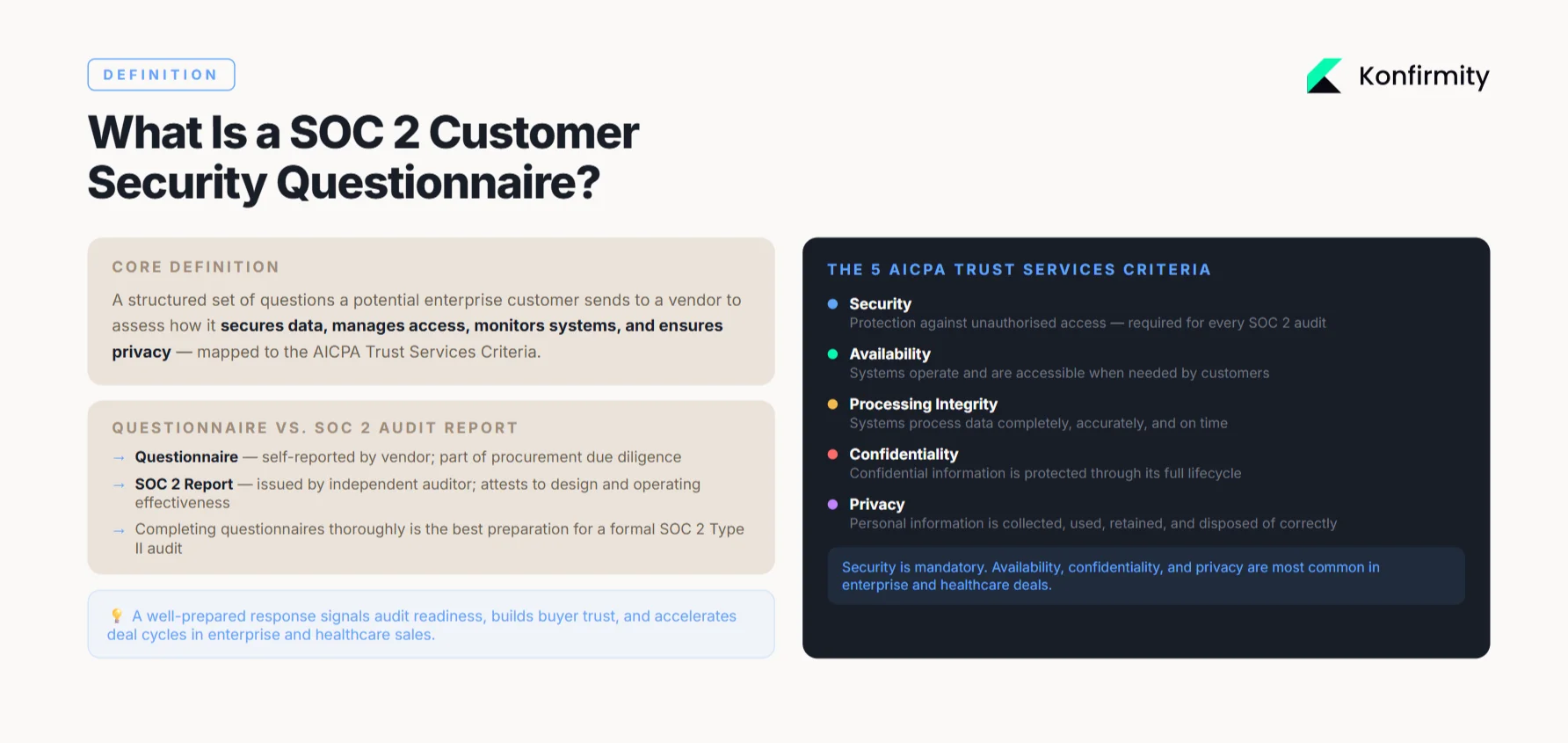
A SOC 2 report can provide independent assurance about your controls, but a customer may still require a questionnaire to evaluate controls or requirements that are specific to its business, data, or procurement process. Unlike the SOC 2 report itself — an attestation from an independent auditor covering the design and operating effectiveness of a service organization's controls — the vendor compiles the questionnaire response directly, in its own words, mapped to whatever format the customer's security team uses.
In short: a SOC 2 customer security questionnaire helps a customer determine whether your security practices meet its requirements before approving or continuing a business relationship.
| What customers assess | What you may need to provide |
|---|---|
| Access controls | Access policies, MFA, access reviews |
| Data protection | Encryption and data-handling practices |
| Incident response | Incident response policy and procedures |
| Business continuity | Continuity and disaster recovery controls |
| Vendor management | Third-party risk processes and assessments |
| Compliance | SOC 2 report, policies, certifications, or other evidence |
Why These Questionnaires Matter
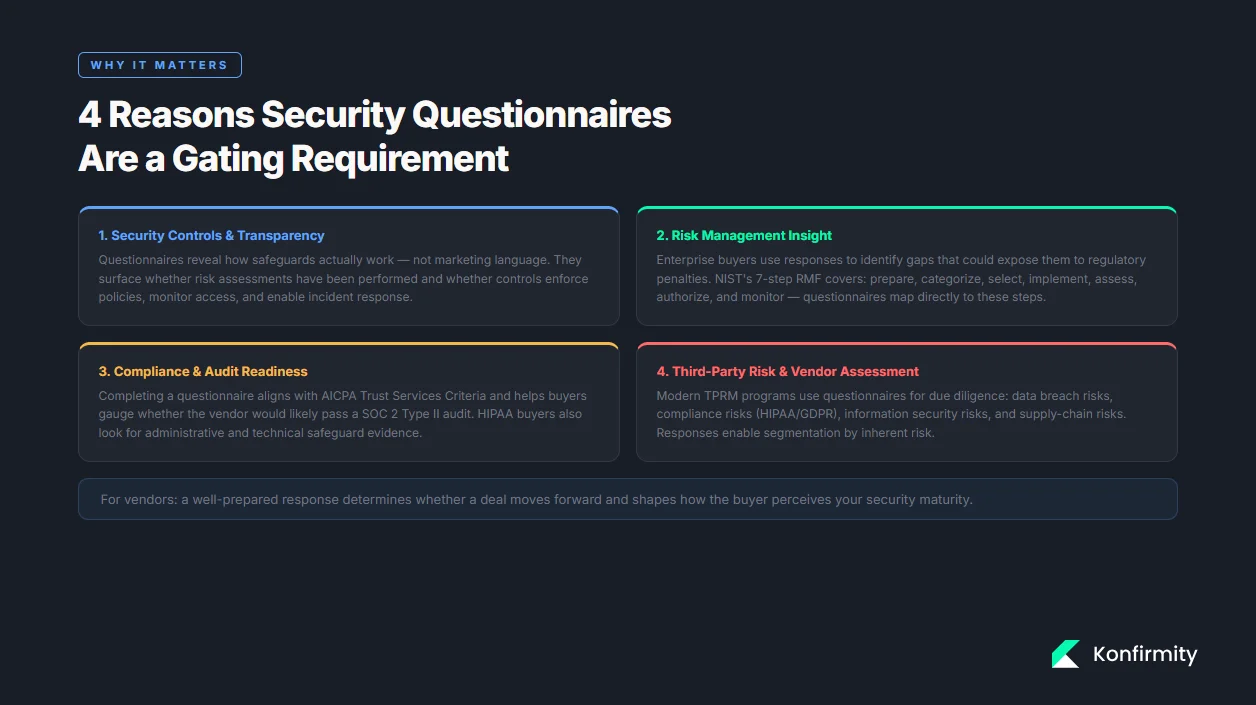
1) Security controls and transparency
Questionnaires reveal how a vendor's safeguards actually work. They ask about policies, technical measures, and operational practices rather than marketing language. Buyers want to see that vendors have documented security management processes and risk assessments. Under HIPAA's Security Rule, organizations must perform an accurate and thorough assessment of potential risks to electronic protected health information (ePHI) and implement measures to reduce those risks. Questionnaires surface whether such assessments have been performed and whether controls exist to enforce policies, monitor access, and respond to incidents.
2) Risk management insight
Enterprise buyers and healthcare organizations use the responses to identify gaps that could expose them to regulatory penalties or service disruption. NIST's Risk Management Framework describes a seven-step process — prepare, categorize, select, implement, assess, authorize, and monitor — that organizations can use to manage information security and privacy risk. A questionnaire maps to these steps by asking vendors to describe how they categorize data, select controls, implement and test them, and monitor for drift. Well-constructed answers provide buyers with a clear picture of threats and the maturity of controls.
3) Compliance standards and audit readiness
Completing a SOC 2 customer security questionnaire is often the first step toward audit readiness. The questionnaire aligns with the AICPA Trust Services Criteria and helps buyers gauge whether the vendor would likely pass a Type II audit (which requires evidence over an observation period). In healthcare deals, buyers also look for HIPAA alignment. HIPAA's Security Rule sets administrative safeguards — such as assigning a security official and training the workforce — and technical safeguards like access control, audit logging, integrity checks, authentication, and transmission security. Questionnaires reference these requirements to confirm that vendors are prepared for compliance.
4) Third-party risk and vendor assessment
Modern third-party risk management (TPRM) programs rely on questionnaires as part of due diligence. UpGuard notes that a vendor risk assessment combines evidence from different sources; security questionnaires are one component and gather deeper insights into categories such as data breach risks, compliance risks (HIPAA or GDPR), information security risks, and supply-chain risks. By analyzing questionnaire responses across all vendors, buyers can segment suppliers by inherent risk, prioritize remediation, and decide whether to onboard or offboard a vendor.
SOC 2 Customer Security Questionnaire: Key Domains and Questions
A SOC 2 customer security questionnaire typically covers multiple control domains. Each domain corresponds to one or more Trust Services Criteria and may map to ISO 27001 or HIPAA controls. Below are the common areas, example questions, and guidance on effective responses.
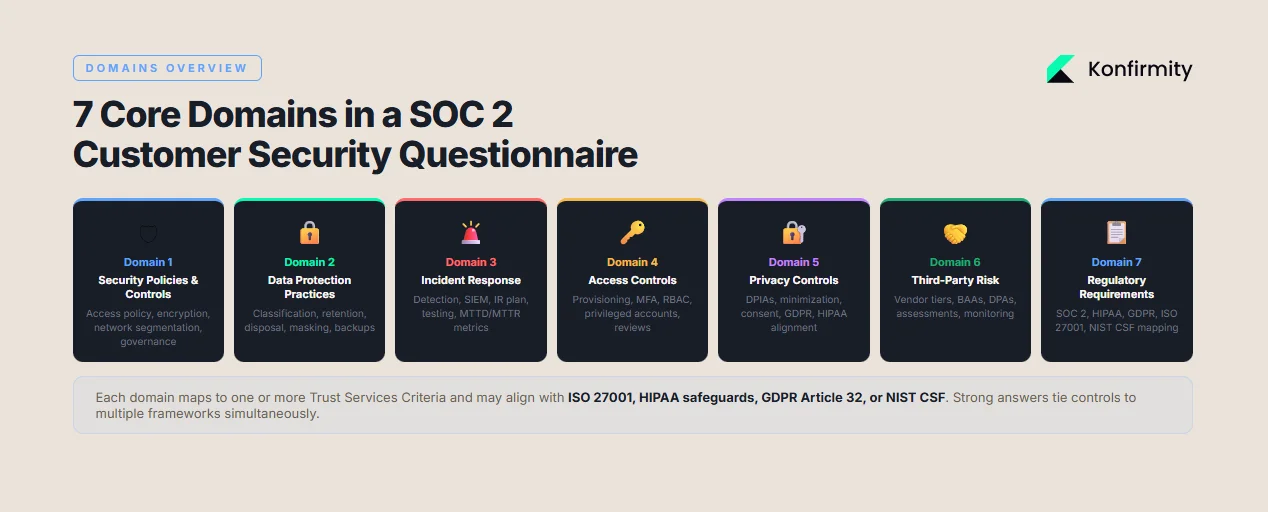
1) Security policies & controls
Customers may ask whether you have documented security policies, who owns them, and how they are reviewed and enforced.
Example: "Do you maintain an information security policy, and how often is it reviewed?"
A strong response briefly describes the policy, ownership, review frequency, and how it is implemented. For deeper questions, ISO 27001:2022 lists 93 controls grouped into four themes — organizational, people, physical, and technological — and vendors can cite the relevant theme to show their program maps to a recognized standard rather than an internal-only document.
- "Describe your access control policy and how it is enforced." A strong answer should explain that access is based on role-based access control (RBAC). Users receive only the permissions they need to do their job. Access rights are reviewed on a set schedule, such as quarterly, and multi-factor authentication (MFA) is required for sensitive systems. For healthcare data, the response should also reference HIPAA requirements: access to ePHI must be granted only to authorized individuals and only when appropriate.
- "What encryption strategies do you use for data at rest and in transit?" The answer should specify the encryption standards in use — commonly AES-256 for stored data and TLS 1.2 or higher for data in transit — and explain how encryption keys and secrets are stored, rotated, and protected.
When answering, vendors should provide references to policies, link them to specific controls, and include evidence (e.g., screenshots of access review logs or encryption settings). General statements such as "we encrypt all data" are insufficient; buyers expect details on algorithms, the rotation frequency of cryptographic secrets, and access restrictions.
2) Data protection
Customers want to understand how you protect their data throughout its lifecycle, including classification, encryption, retention, and deletion.
Example: "How is customer data protected at rest and in transit?"
Mention the key safeguards in place and provide supporting evidence where requested. ISO 27001:2022 added controls for information deletion and data masking, so a strong response also explains how data is classified by sensitivity, how PII is masked to comply with the Privacy criterion, and how data is securely wiped at the end of its lifecycle. HIPAA requires transmission security measures to guard against unauthorized access to ePHI while in transit — cite this explicitly if the customer is a healthcare buyer.
3) Information security & incident response
Expect questions about how you detect, investigate, respond to, and learn from security incidents. NIST's incident response guidance describes six functions — Govern, Identify, Protect, Detect, Respond, and Recover — that must be integrated across operations.
Example: "Do you have a documented incident response plan, and how often is it tested?"
Describe your response process, responsibilities, testing frequency, and incident documentation.
- "How do you detect and respond to threats?" Start with your monitoring setup. Explain how logs from systems, applications, and network devices feed into a Security Information and Event Management (SIEM) platform. Mention intrusion detection or prevention systems, regular vulnerability scans, and include performance metrics such as mean time to detect (MTTD) and mean time to respond (MTTR).
- "How do you record incidents?" Explain how incidents are logged with timestamps, severity, and resolution outcomes. HIPAA's Security Rule requires organizations to document security incidents and their outcomes.
4) Access controls
Customers commonly ask how access is granted, reviewed, and removed, particularly for privileged accounts. Access control is central to both the SOC 2 Security criterion and HIPAA technical safeguards.
Example: "How do you manage privileged access?"
Explain your authentication, authorization, access-review, and deprovisioning processes — how privileged accounts are identified, how multi-factor authentication and just-in-time access are enforced, and how periodic reviews ensure that access remains appropriate. Evidence might include logs from access control systems or third-party identity providers.
5) Privacy controls
These questions focus on how you collect, use, store, and protect personal information. The AICPA's Privacy criterion evaluates how control activities protect personally identifiable information (PII).
Example: "How do you handle customer requests related to personal data?"
Briefly describe your privacy processes and the controls used to protect personal information. Buyers may also ask whether the vendor performs Data Protection Impact Assessments (DPIAs) for high-risk processing and how data minimization is applied. Vendors serving European customers should demonstrate compliance with the General Data Protection Regulation (GDPR) by showing processes for fulfilling data subject requests and cross-border transfer mechanisms.
6) Third-party risk & vendor oversight
Customers may ask how you assess and monitor vendors or subprocessors that have access to systems or customer data. HIPAA requires covered entities to have business associate agreements with partners handling ePHI.
Example: "How do you evaluate your vendors before onboarding them?"
Explain your assessment, risk-rating, monitoring, and remediation processes. Describe how vendors are grouped into risk tiers based on the data they access, the systems they connect to, and the services they provide — higher-risk vendors should face deeper assessments and more frequent reviews. Ongoing monitoring is just as important as the initial review: explain how you track changes in risk over time, such as updated SOC 2 reports, renewed questionnaires, or external risk ratings. Strong answers also mention contractual safeguards — security and privacy clauses, breach notification timelines, and audit rights — and are prepared to show evidence, such as a current vendor inventory and documented remediation actions.
Free guide
50 Security Questionnaire Questions Founders Answer Badly
The weak answer, the strong answer, and the evidence to attach for 50 real security questionnaire questions. Enter your work email and we'll send the PDF.
7) Business continuity & disaster recovery
Customers may ask how you prepare for service disruptions, recover critical systems, and test your continuity plans.
Example: "How often do you test your business continuity and disaster recovery plans?"
Describe your continuity and recovery processes, testing frequency, and relevant recovery objectives — such as Recovery Time Objectives (RTO) and Recovery Point Objectives (RPO). Reference how backups are stored, how failover is tested, and how lessons from each test are fed back into the plan. Buyers weighing availability heavily will want to see that continuity testing is scheduled and documented, not ad hoc.
How to Complete a SOC 2 Customer Security Questionnaire
Completing a SOC 2 customer security questionnaire is a project in itself. Based on Konfirmity's experience and industry frameworks, the following steps provide a repeatable workflow.
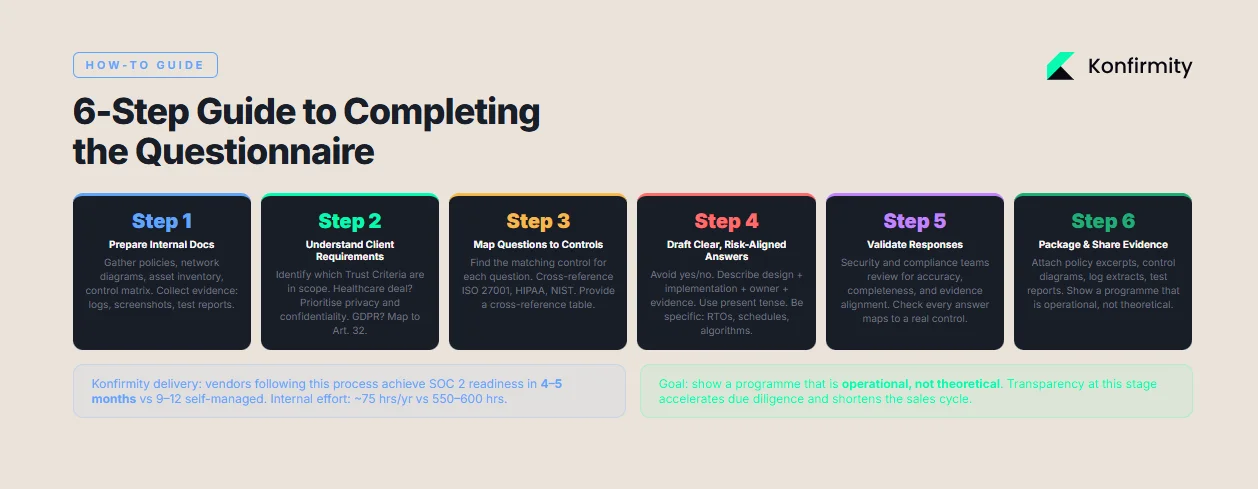
1) Prepare your internal documentation
- Inventory controls and policies: Gather copies of security policies, diagrams of network segmentation, inventory lists of assets, and a control matrix mapping controls to frameworks (SOC 2, ISO 27001, HIPAA, GDPR). ISO 27001 categorizes controls into organizational, people, physical, and technological themes; use this categorization to ensure all areas are covered.
- Collect evidence: Collect evidence showing that controls are operating effectively. This might include access review logs, encryption configuration screenshots, audit logs, and incident response reports. For HIPAA, ensure documentation covers administrative, physical, and technical safeguards.
- Define scope: Clarify which products or services are included in the questionnaire and ensure boundaries are clear. A vendor with multiple product lines may have different control implementations; identify and document the scope to avoid confusion.
2) Understand the customer's requirements
Different customers care about different trust principles. Security is always mandatory for SOC 2, but availability, processing integrity, confidentiality, and privacy may be optional. Determine which principles are in scope by reviewing the customer's request. In healthcare deals, privacy and confidentiality are often critical. If the customer references HIPAA, ensure you understand which HIPAA safeguards they expect. If they cite GDPR or ISO 27001, adjust your answers accordingly.
3) Map questions to controls
For each question, identify which control it maps to in your control matrix. For example, a question about incident logging might map to ISO 27001 control 8.16 (monitoring activities) and HIPAA audit controls. Use your control matrix to cross-reference and avoid duplicative answers. Provide a cross-reference table if the questionnaire allows attachments; this shows the customer that you have a structured program and reduces follow-up questions.
4) Draft clear, risk-aligned answers
Avoid one-word answers. Each answer should describe how the control is designed and implemented, who is responsible, and how effectiveness is measured. If a question asks, "Do you have a disaster recovery plan?" respond with a concise description of the plan, the Recovery Time Objectives (RTO), frequency of testing, and references to relevant controls. Use the present tense to describe processes in operation. If a control is not yet implemented, explain the interim mitigation and provide a timeframe.
5) Validate responses
Have your security and compliance teams review the draft responses. They should check for consistency, completeness, and evidence alignment. Validate that each response addresses the question, references the correct control, and includes supporting documentation — and that it does not contradict what your SOC 2 report actually says. Poor internal review leads to incomplete answers and delays during customer review.
6) Package and share with supporting evidence
When finalizing the questionnaire, attach supporting evidence such as policy excerpts, control diagrams, log extracts, and test reports. If the customer uses a portal, provide evidence as attachments or links. Ensure sensitive information is redacted or shared via a secure channel. The packaging should demonstrate that your program is operational — not theoretical. This degree of transparency accelerates the customer's due diligence and can reduce the length of the sales cycle.
Konfirmity's delivery experience shows that vendors who follow this process can achieve SOC 2 readiness in four to five months with a dedicated team, compared to nine to twelve months in self-managed projects. Our managed service reduces internal effort to about 75 hours per year versus 550–600 hours for self-managed programs, because we handle control design, evidence collection, and audit coordination. Sustained control operation means that questionnaire responses remain consistent across multiple customers.
Want a second set of eyes on your questionnaire?
Drop your work email and we'll walk through what a strong response looks like for your stack.
Example Questions & Answer Templates
Below are simplified examples of how to respond to common questionnaire items. Replace sample text with details from your environment.
1) Security controls example
This example shows how to turn a network segmentation question into a specific, evidence-backed answer instead of a policy summary.
- Question: "Describe your network segmentation and firewall policies."
- Answer template: "Our production environment is segmented from corporate networks using VLANs and a zero-trust approach. Firewalls enforce inbound and outbound rules based on service requirements. Inbound traffic passes through a Web Application Firewall (WAF) with rules aligned to OWASP Top 10. All rules are reviewed quarterly by the Network Security Manager. We monitor firewall logs through our Security Information and Event Management system, and alerts feed into our incident response process."
2) Incident response example
- Question: "Describe your incident response process and testing frequency."
- Answer template: "We maintain a formal incident response plan governed by our Chief Information Security Officer (CISO). The plan defines roles (Incident Commander, Communications Lead, Technical Lead), escalation paths, and procedures for containment, eradication, and recovery. Incidents are recorded in our ticketing system with severity and timeline. The plan is tested quarterly through tabletop drills and annual live simulations. Lessons from each incident or drill are incorporated into risk assessments and control improvements."
3) Third-party risk example
- Question: "How do you assess the security posture of your subcontractors?"
- Answer template: "We maintain a third-party risk management program. Each supplier is classified by criticality: high-impact suppliers undergo annual assessments that include reviewing SOC 2 reports, ISO 27001 certificates, and security questionnaires. We require vendors handling customer data to sign business associate agreements (for healthcare data) or data processing agreements (for EU data). We monitor suppliers through continuous attack surface scanning and require remediation of critical findings within 30 days. Our Vendor Risk Committee reviews assessment results quarterly and approves onboarding or termination."
These templates show the depth of detail customers expect. Customize them to reflect your controls and support them with evidence.
What If Your SOC 2 Report Doesn't Cover the Question?
Not every customer question will be covered by your SOC 2 report. The report's scope is fixed at the time of the audit, so a customer asking about a control outside that scope — or a Trust Services Criterion you didn't include, like Availability or Privacy — is common, not a red flag by itself. Check your internal policies and controls first, provide relevant supporting evidence, and answer transparently if a requested control isn't currently in place. State what interim mitigation exists and when the gap will close, rather than stretching the report's language to imply coverage it doesn't have. Customers and their security reviewers cross-reference questionnaire answers against the report itself; a mismatch is more damaging to trust than an honest "not yet, here's our timeline."
Common Mistakes When Answering Customer Security Questionnaires
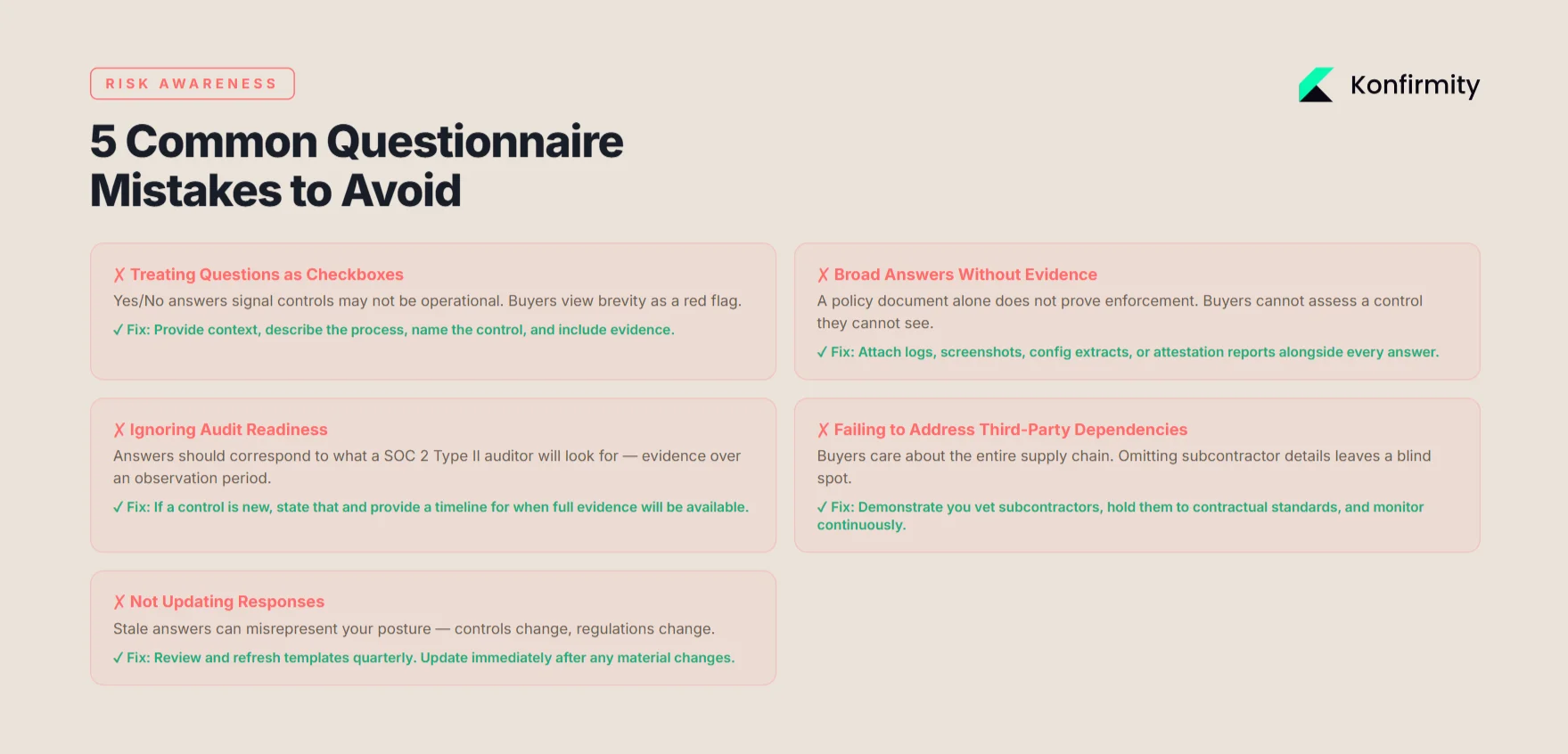
- Giving vague or one-word answers: "Yes" or "we have a policy" tells a reviewer nothing about how a control actually works. Provide context, map each answer to a control, and describe the process.
- Providing unsupported claims: A policy document alone does not prove enforcement. Include logs, screenshots, or attestation reports to show that controls are functioning.
- Sharing unnecessary sensitive evidence: Oversharing — full configuration exports, unredacted logs, internal architecture diagrams beyond what was asked — creates its own risk and can slow a review down while the customer's security team decides how to handle what you sent. Share exactly the evidence requested, redacted where appropriate.
- Giving answers that contradict your SOC 2 report: If your questionnaire response describes a control differently than your report does — a different encryption standard, a different testing cadence — reviewers notice, and it undermines confidence in both documents. Keep a single source of truth and draft from it.
- Failing to address customer-specific requirements: A generic template answer that ignores the customer's stated regulatory context (HIPAA, GDPR, a state privacy law) reads as if you didn't read the question. Tailor the response to what they actually asked.
Tools and Templates to Help Your Team
Effective response preparation benefits from tools that manage evidence, map controls across frameworks, and automate questionnaires. Vendors can use control inventory templates derived from ISO 27001:2022 to map each control to SOC 2 criteria and regulatory requirements. Spreadsheet templates can track policies, control owners, and evidence. Automation tools like Copla or UpGuard provide libraries of editable questionnaires, integrate with ticketing and scanning tools, and produce risk dashboards. Additionally, ensure you have templates for business associate agreements and data processing agreements; HIPAA requires covered entities to have written agreements with business associates. The goal is not to "fill out forms faster" but to maintain living controls and evidence so that questionnaires become straightforward.
Conclusion
In high-stakes enterprise and healthcare sales, a SOC 2 customer security questionnaire is much more than a document — it is a window into a vendor's security posture. By asking targeted questions about policies, controls, data protection, incident response, access management, privacy, business continuity, and third-party oversight, customers assess whether a vendor can be trusted with sensitive data and critical workloads. Responding effectively requires a structured control program, evidence of operation, and an understanding of the customer's requirements. Standards such as SOC 2's Trust Services Criteria, HIPAA's administrative and technical safeguards, ISO 27001's control themes, and NIST's risk management and incident response guidance provide a blueprint for building those controls. For a broader walkthrough of the questionnaire lifecycle itself — pre-questionnaire readiness, completion steps, and what comes after submission — see the SOC 2 Questionnaire Guide. Vendors who invest in real security — through risk assessments, control design, continuous monitoring, and incident response — find that compliance follows naturally.
Stop answering questionnaires from scratch every time
Book a demo and we'll show you how a managed program keeps evidence current, so every customer security questionnaire is a copy-and-verify job, not a fire drill.
Book a demo
FAQ Section
It is a structured set of questions from a potential customer that asks a vendor to describe how it secures data, manages access, monitors systems, and ensures privacy. The questions are mapped to the AICPA Trust Services Criteria — security, availability, processing integrity, confidentiality, and privacy — and help customers assess whether the vendor would likely meet SOC 2 requirements. Unlike an audit report, it is a self-reported document and part of procurement due diligence.
Many enterprises, particularly those in regulated sectors, issue security questionnaires as part of their procurement process. Healthcare organizations that handle ePHI are required under HIPAA to ensure that their business associates have appropriate safeguards. While not all customers call their questionnaire "SOC 2," most large organizations will request evidence of controls aligned to SOC 2, ISO 27001, or other frameworks.
A SOC 2 audit is an examination by an independent auditor who issues a report (Type I or Type II) attesting to the design and operating effectiveness of controls. A SOC 2 customer security questionnaire is not an audit; it is a customer's assessment tool. However, completing it thoroughly helps vendors prepare for a formal SOC 2 audit by mapping questions to controls and gathering evidence in advance.
Incomplete or vague answers raise red flags. Customers may request clarifications, delay procurement, or choose another vendor. Regulators have imposed penalties on organizations that failed to assess and mitigate risks; for instance, a HIPAA resolution agreement with a business associate involved paying $175,000 after a ransomware incident affected 170,000 individuals because the vendor failed to assess risks to ePHI. Providing complete, accurate responses backed by evidence reduces such risks.
Yes, but with caution. Maintain a baseline template that describes your controls and evidence, then adjust language to match the customer's terminology and trust criteria. Ensure that any changes in your environment or regulations are reflected. Regularly updating your template prevents stale information and reduces the risk of misrepresenting your posture.
Update responses whenever there are material changes to your environment, such as new services, major control updates, or regulatory changes. Additionally, review and refresh your templates quarterly to incorporate improvements in controls, audit findings, or changes in frameworks. Segment customers by risk and perform high-risk assessments more frequently; apply a similar discipline to your own questionnaire templates.
A SOC 2 customer security questionnaire is the specific document a prospect or customer sends you during procurement, asking how your controls work. If you're looking for the broader lifecycle — how to get audit-ready, complete a questionnaire step by step, and manage what happens after submission — see the SOC 2 Questionnaire Guide, which covers the process end to end rather than the customer-facing document alone.