
Most enterprise buyers now request assurance artifacts long before procurement. Without operational security and continuous evidence, deals stall—even when teams think they’re ready on paper. SOC 2 sets expectations for how a service organization protects information across security, availability, processing integrity, confidentiality, and privacy. Yet one often‑misunderstood aspect of readiness is training. SOC 2 does not include a checklist item titled “training,” but auditors look for proof that staff understand policies and practice security every day. This article explores what SOC 2 training requirements really mean, why training matters for audit success, and how to build a program that stands up to scrutiny. The guidance draws on authoritative standards such as AICPA’s Trust Services Criteria, ISO 27001:2022 Annex A 6.3 and NIST SP 800‑50r1. It also includes insights from Konfirmity’s experience supporting more than 6,000 security audits over the past 25 years.
What “SOC 2 Training Requirements” Actually Means
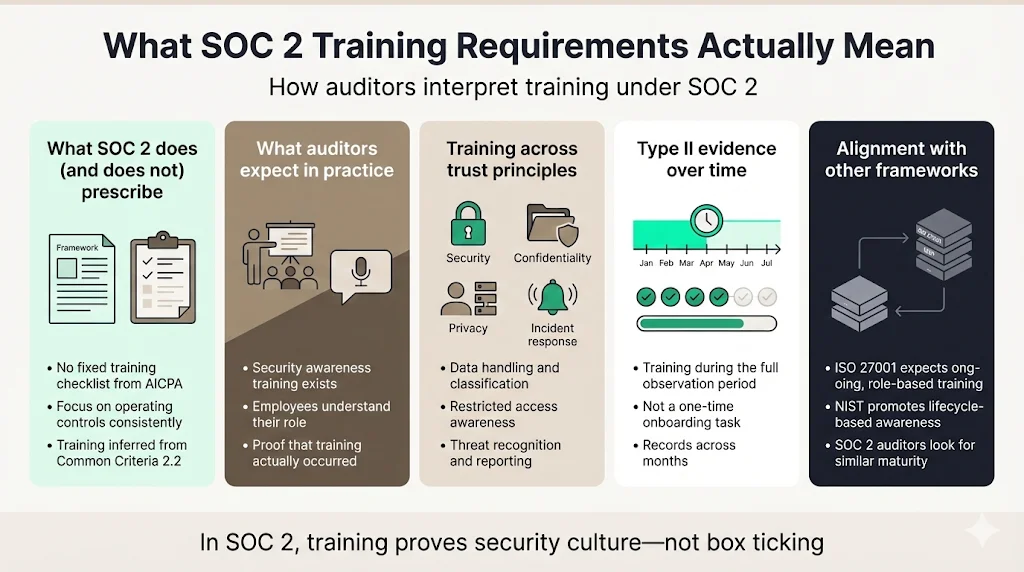
The American Institute of CPAs (AICPA) does not publish a prescriptive training checklist for SOC 2. Instead, the framework expects a service organization to design policies and controls aligned with the Trust Services Criteria and to operate them consistently. Common Criteria 2.2 within the security criterion states that entities must “communicate information to improve security knowledge and awareness and to model appropriate security behaviours to personnel through a security awareness training program”. In practice, auditors interpret this as a requirement to educate employees on how to protect information and to prove that training occurred.
Training also supports other trust principles. Confidentiality and privacy controls depend on staff understanding data classification, restricted access, and how to handle sensitive information. Incident response relies on employees recognizing and reporting threats promptly. Auditors frequently interview team members to verify that training processes and security awareness are real. For Type II reports, they look for evidence that training occurs throughout the observation period, not just once at the beginning.
Other frameworks emphasize explicit training obligations. ISO 27001:2022 Annex A 6.3 requires organisations to implement ongoing information security awareness, education, and training programs so that personnel understand and fulfil their security responsibilities. It recommends at least annual refreshers and role‑based content aligned to the organisation’s policies. NIST SP 800‑50r1 similarly urges organisations to develop a cybersecurity and privacy learning program that integrates with organisational goals and emphasises a life‑cycle approach to awareness and training. While SOC 2 does not prescribe training frequency, auditors often look for similar practices because they demonstrate a culture of security.
Why Training Matters for SOC 2 Compliance
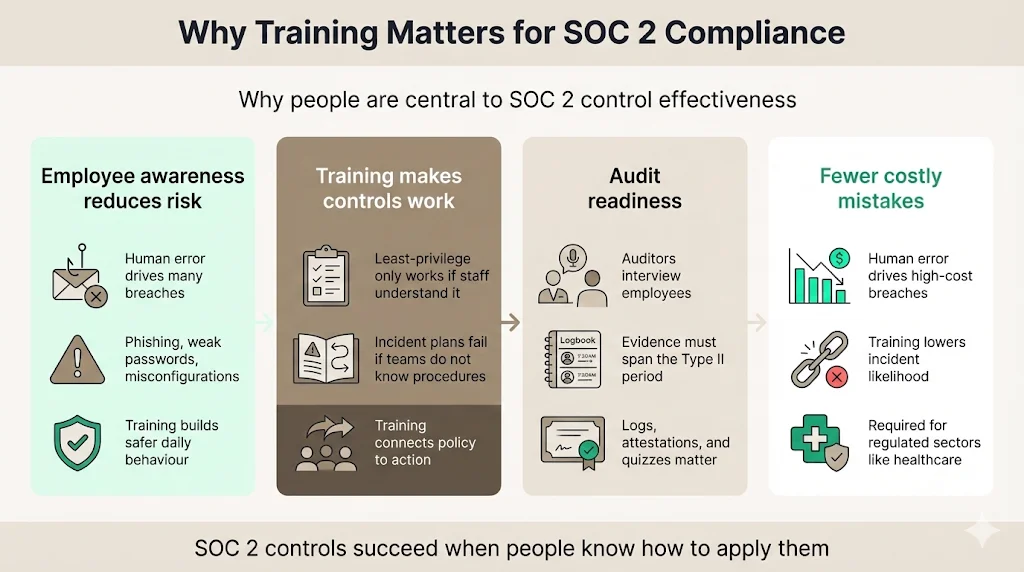
Employee awareness. People are often the weakest link in security. Phishing scams, weak passwords and misconfigured permissions remain leading causes of data breaches. According to Everbridge’s summary of PwC’s 2024 Global Digital Trust Insights survey, the percentage of businesses experiencing data breaches costing over US $1 million rose from 27 % to 36 %. Many of those breaches start with human mistakes. Educating employees on secure practices—phishing prevention, password hygiene, data handling—reduces risk and builds a security‑conscious culture.
Control effectiveness. SOC 2 controls only work if people know how to perform them. Access reviews fail when administrators do not understand least‑privilege principles. Incident response plans are useless if the on‑call engineer does not know where to find them. Training ensures that staff understand internal policies and how controls apply to their roles. ISO 27001 emphasises that information security education, awareness and training are essential components of risk management. By aligning training goals with controls, organisations strengthen their overall security posture.
Audit preparation. Auditors routinely ask employees about security practices to gauge whether documented procedures are followed. NordLayer notes that auditors may interview employees to verify training processes and security awareness. During a Type II audit, they may ask for evidence that training occurred during the observation period. Having a structured training program with attendance logs, quizzes and signed attestations demonstrates that policies are more than just words on paper.
Reduced human error. The IBM Cost of a Data Breach Report (2024), summarized in industry analyses, estimates the average cost of a breach at nearly US $4.9 million and notes that the most expensive breaches often involve human error. By investing in training, organisations can reduce the likelihood of mistakes that lead to costly incidents. For healthcare providers handling protected health information, training is also a HIPAA requirement—staff must understand administrative, physical and technical safeguards.
Core Components of SOC 2 Training Programs
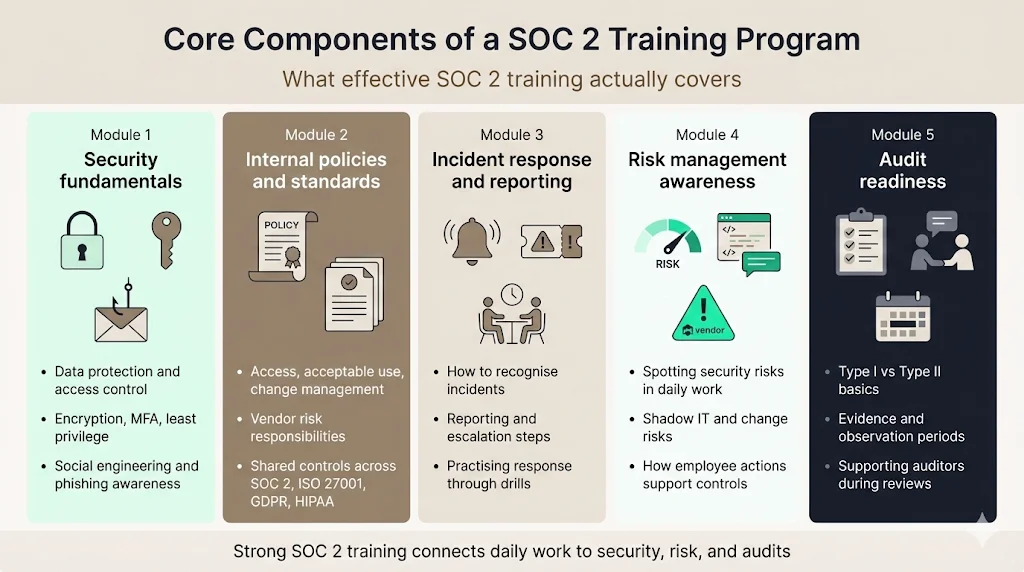
A robust program covers multiple modules and tailors content to different audiences. Below is a framework practitioners can adapt:
1. Security fundamentals
-
Data protection and access control. Explain how data is classified and protected. Cover topics such as encryption at rest and in transit, credential management, least privilege, and multi‑factor authentication.
-
Social engineering awareness. Use real phishing examples to teach employees how attackers operate. Many organisations supplement training with simulated phishing to measure susceptibility and provide targeted coaching.
2. Internal policies and compliance standards
-
Policy requirements. Review key policies (access management, acceptable use, change management, vendor risk) and connect them to daily tasks. This helps employees see why controls exist and how they affect their work.
-
Multi‑framework awareness. Many vendors pursue SOC 2 alongside ISO 27001, HIPAA or GDPR. Highlight how common controls (access reviews, logging, data retention) support multiple standards. ISO 27001’s Annex A 6.3 calls for regular policy refreshers; training should reflect this by revisiting key policies when they change.
3. Incident response and reporting
-
Recognising incidents. Teach staff what constitutes an incident—unauthorised access, suspicious emails, system failures—and how to classify severity.
-
Reporting procedures. Outline the steps for raising an incident ticket, escalating to security, and preserving evidence. Provide clear contact information for the incident response team.
-
Drills. Run tabletop exercises so teams can practise responding to scenarios. Real incidents rarely follow scripts; practice helps reduce panic and ensures a swift, coordinated response.
4. Risk management awareness
-
Risk identification. Explain how to spot security risks in day‑to‑day activities. This includes understanding vendor risk, reviewing changes to the codebase, and recognising unapproved shadow IT.
-
Control contributions. Show employees how their actions feed into continuous monitoring and control effectiveness. For example, timely completion of access reviews and prompt reporting of suspicious activity support risk management.
5. Audit readiness
-
Audit expectations. Explain the difference between SOC 2 Type I and Type II. Clarify observation periods, sampling, and the role of evidence. Onspring’s guidance reminds organisations that training should be continuous rather than annual and that role‑based training fosters a culture of security.
-
Supporting auditors. Teach staff how to support control assessments, answer questions honestly, and provide documentation. Make it clear that auditors may interview them to verify awareness.
Security training that changes behavior is worth more than a training log.
Share your work email and build a program that passes audits and actually reduces risk.
Steps to Build a SOC 2 Training Program
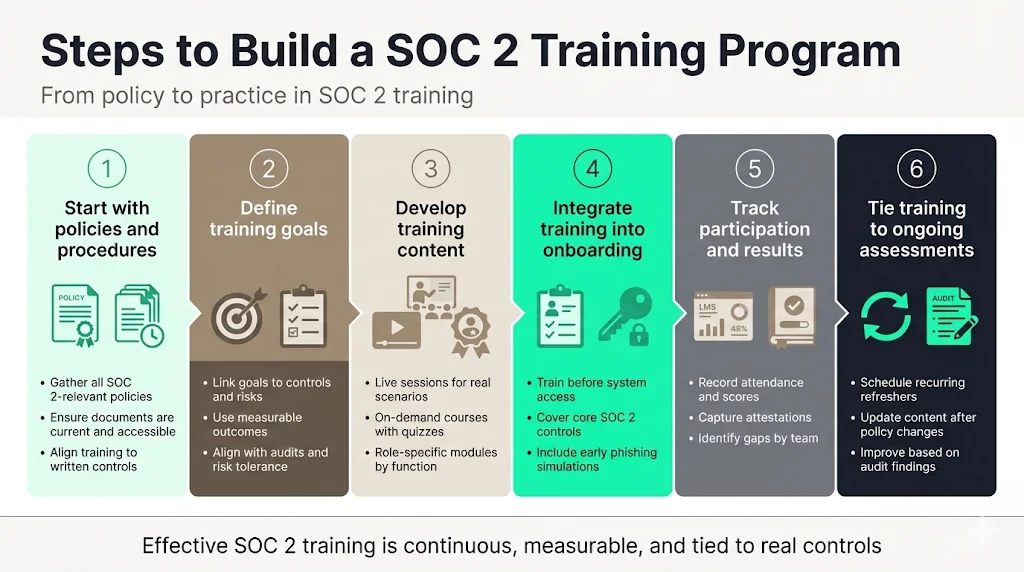
The following approach combines control design with practical execution. It reflects patterns Konfirmity observes across 6,000+ security audits.
1. Start with policies and procedures
Gather all internal policies relevant to SOC 2. This includes security policies (access, encryption, change management), privacy notices, vendor risk procedures and incident response plans. Ensure they are documented, versioned and accessible. Training must reflect these documents; outdated or undiscovered policies undermine the program.
2. Define training goals
Link goals to controls and risk areas. For example:
-
Increase phishing resistance by at least 30 % over the next year through simulated exercises.
-
Ensure all staff complete access control training within their first month and pass an assessment.
-
Achieve 100 % completion of annual incident response refresher modules.
Quantifiable targets allow organisations to measure progress and adjust the program as needed. Goals should align with risk appetite, audit deadlines and regulatory requirements.
3. Develop training content
Create modules that reflect the components described above. Use a mix of delivery formats:
-
Live sessions. Host interactive workshops or webinars. For example, run quarterly sessions on incident response where teams walk through real case studies.
-
On‑demand courses. Provide e‑learning modules that employees can complete at their own pace. Use short videos, quizzes and scenario‑based questions to keep attention. ISO 27001 recommends training through sessions or online resources such as videos or webinars.
-
Role‑based training. Tailor content to departments. Engineering teams need secure coding practices and change management guidelines, while HR must understand privacy obligations. NordLayer notes that Type II audits assess continuous compliance and require evidence of regular staff security training.
4. Integrate training into onboarding
New hires should complete baseline SOC 2 training on day one or before receiving access to production systems. Provide them with essential policies, highlight key controls and ensure they pass an initial assessment. Include them in simulated phishing campaigns early so they internalize safe practices.
5. Use tools to track participation and results
Leverage learning management systems (LMS) or compliance tools to log completion dates, scores, and attestations. Logs serve as audit evidence and help managers identify gaps. Hut Six advises using a learning management system that quantifies awareness levels across departments. Such tools enable targeted remediation before an audit.
6. Tie training to ongoing control assessments
Training should not be a one‑time event. Plan recurring sessions—quarterly or semi‑annual—based on risk and audit cycles. Update content whenever policies change or incidents reveal new risks. Use feedback from audits or control tests to refine modules. Continuous improvement aligns with NIST’s recommendation to treat learning programs as iterative.
Templates and Practical Resources
Organisations preparing for SOC 2 can accelerate training design with ready‑made resources. The following templates mirror what Konfirmity uses during engagements:
Training module checklists. For each module (security fundamentals, policy awareness, incident response, risk management, audit readiness), list objectives, required readings, exercise formats and required scores. Checklists ensure consistency across sessions.
Presentation and workshop templates. Develop slide decks that explain trust principles, highlight internal policies and walk through real incidents. Include diagrams showing where controls fit into system architecture. Provide facilitators with speaker notes and Q&A prompts.
Quiz and assessment templates. Create question banks that cover key topics. Use multiple‑choice questions, scenario‑based challenges and short answers. Score thresholds (e.g., 80 %) ensure comprehension. Record results for each participant.
Attestation and record templates. Draft forms that employees sign (digitally or physically) to confirm completion and understanding of training. These should include the date, module name, and version of the curriculum. Store signed forms and digital logs in a controlled repository.
How to Prove Training for Auditors
Auditors typically ask for three categories of evidence:
-
Attendance logs. Export completion data from your LMS. Logs should include names, dates, modules completed and scores. They demonstrate participation across the organisation and show that training occurred within the observation period.
-
Quiz results and attestations. Provide assessment scores to show that employees not only attended but understood the material. Include signed attestations or digital acknowledgments. Hut Six highlights the value of testing employee awareness rather than simply providing tutorials.
-
Versioned curriculum. Maintain version control for training materials. Auditors want to see that content reflects current policies. Attach revision dates and document who approved changes. When policies update—say, after a major vulnerability disclosure—update the training module and record the date.
Organize these records in a central repository accessible to the audit team. Label folders clearly (e.g., “2025 Q2 Training Evidence”). During readiness assessments, provide a summary table showing training completion rates per department and any remediation actions taken.
Best Practices for Effective SOC 2 Training
Through thousands of audits, Konfirmity’s experts have identified practices that differentiate successful programs:
-
Keep modules concise and practical. Attention spans wane quickly. Aim for sessions under 30 minutes and break complex topics into smaller segments. Use real‑world examples—phishing emails, code snippets, system outage stories—to make lessons relatable.
-
Update content when policies change. When you revise access management procedures or adopt new logging tools, revise the relevant training module. ISO 27001 emphasises that awareness programs should align with current policies and security procedures.
-
Link training to risk management. Show how training supports risk mitigation. For example, highlight how timely reporting of lost devices reduces data exposure. Connect security awareness metrics (e.g., phishing click rates) to your risk register.
-
Integrate with other frameworks. Use training as an opportunity to educate employees about HIPAA, GDPR or other obligations. This reduces duplication and reinforces a unified security culture.
-
Use continuous monitoring to inform training. Review incident trends and vulnerability scans. If phishing success rates rise or misconfigured IAM roles recur, adjust your modules accordingly. NIST’s life‑cycle approach encourages using metrics to adapt programs.
Common Pitfalls to Avoid
-
Treating training as a single event. One‑time workshops leave employees with fading memories. Continuous learning is essential, particularly for Type II audits that evaluate controls over months.
-
Disconnecting training from internal controls. Generic cybersecurity videos may cover basics but ignore your organisation’s specific procedures. Tailor content to policies, systems and risk profile.
-
Failing to track evidence. Without logs, assessments and attestations, you cannot prove training occurred. Auditors may conclude that policies are not enforced.
-
Neglecting leadership involvement. Senior management must champion training. If executives skip sessions, employees may view training as optional.
Prove security training happened, for everyone, on time
Book a demo and we'll show how Konfirmity assigns role-based training, chases the stragglers, and keeps the completion records and quiz results your auditor will sample.
Book a demo
Conclusion
SOC 2 training requirements are not simply about ticking a box. A strong program equips employees to recognise threats, operate controls and support audits. It derives from the AICPA’s expectation to communicate security information and model appropriate behaviour and mirrors requirements in ISO 27001 and NIST SP 800‑50r1 for ongoing awareness and education. For vendors pursuing enterprise deals, training is part of the cost of doing business. Buyers and auditors will ask how you prepare your people to safeguard their data, and they will look for evidence over time.
Through Konfirmity’s managed service, organisations complete SOC 2 readiness in four to five months, compared with nine to twelve months when self‑managed. Our clients typically spend under 70 hours per year on compliance tasks versus the 550–600 hours common among internal teams. Those savings come from embedding experts who design controls, operate them daily, collect evidence continuously and manage training end‑to‑end. We don’t just advise—we execute. When controls are built to last and training is woven into operations, compliance follows naturally.
FAQs
SOC 2 does not list a discrete training control, but auditors expect evidence that personnel understand and follow policies. Common Criteria 2.2 requires communication of security knowledge and modelling of appropriate behaviours through a security awareness program. Therefore, training is effectively required to meet the Trust Services Criteria.
Anyone whose role affects security, access, incident response, vendor management or control evidence should receive training. This includes engineers, administrators, customer support, HR, finance, executives and contractors. ISO 27001 states that all personnel must understand their information security responsibilities.
At minimum, during onboarding and regularly thereafter. ISO 27001 suggests annual refreshers or more frequent sessions based on risk. A Type II SOC 2 audit covers an observation period of several months; training must occur within that window. Quarterly phishing simulations and semi‑annual policy reviews are common.
Evidence includes attendance logs, quiz results, signed attestations and versioned curricula. Logs should show who completed which module and when. Assessments demonstrate comprehension. Attestations confirm acknowledgement of responsibilities. Keep materials up to date to reflect current policies and procedures.