
ISO 27001 Certification:Build Security That OpensGlobal Markets
ISO 27001 isn't just a certificate — it's proof you've built an information security management system that continuously protects customer data. Required by European enterprises, expected by global buyers.
Book a call
[01] Why Companies Get ISO 27001
ISO 27001 unlocks international enterprise deals, aligns with regulatory expectations, and provides a single security framework that scales across regions and compliance standards.
// The Reality
ISO 27001 is the baseline expectation for European enterprises, large international buyers, and government tenders. Without it, you are filtering yourself out of those conversations before they begin.
// Business Impact
You stop losing deals to procurement teams that won't accept a US-only standard. International tenders open up. RFP responses get faster because the boilerplate questions about security maturity are already answered.
// Where It Lands Hardest
- Europe: ISO 27001 is the assumed baseline
- Middle East: standard requirement for government and financial sector deals
- Asia-Pacific: increasingly mandatory in Singapore, Hong Kong, Japan
- Latin America: growing in enterprise and fintech procurement
// Strategic Advantage
Sales motion shifts from defending your security posture to citing your certificate. The conversation moves from "prove you're secure" to "let's talk pricing."
[02] What ISO 27001 Actually Is
ISO 27001 is two halves working together: management-system clauses that define how you run security, and Annex A controls that define what you actually do. You need both to certify.
Clause 4
Context of the Organization
Understand the business and the parties that depend on it. Identify customers, regulators, employees, and other stakeholders, and define the ISMS scope they expect you to protect.
Clause 5
Leadership
Top management owns the ISMS. They set policy, define roles, allocate resources, and make information security a board-level commitment — not a security-team hobby.
Clause 6
Planning
Identify risks to the information you hold and decide how to treat them. Set measurable security objectives and the plans that move you toward them.
Clause 7
Support
Provide the resources, competence, awareness, communications, and documented information the ISMS needs to operate.
Clause 8
Operation
Execute the risk treatment plan, run the security operations the ISMS calls for, and keep evidence of what you did.
Clause 9
Performance Evaluation
Measure whether the ISMS is working. Run internal audits, monitor and analyse the results, and hold management reviews on a defined cadence.
Clause 10
Improvement
When something goes wrong, take corrective action. When something can be better, do it. The ISMS is meant to mature year over year.
[03] Understanding The Standard
ISO 27001 is not just a certificate — it's a structured management system for building, operating, and continuously improving information security across your organisation.
[1/7] GAP ASSESSMENT & PLANNING (WEEK 1-2)
Your dedicated CISO conducts a structured gap assessment against ISO 27001 requirements. This phase defines scope, evaluates current security posture, identifies gaps, and builds a clear certification roadmap with milestones and ownership.
// What Happens
Initial ISMS foundation is established. You gain clarity on scope, current maturity level, and exactly what is required to achieve certification.
// Deliverables
- ISMS scope statement
- Detailed gap analysis report
- ISO 27001 project plan
- Resource requirements and certification timeline
// Effort
- Timeline: 1-2 weeks
- Your involvement: 10-15 hours (interviews, documentation review, approvals)
// activities
- Scope Definition: Define ISMS scope (locations, systems, data, processes in scope)
- Project Planning: Create certification roadmap with milestones and responsibilities
- Gap Analysis: Identify gaps between current state and ISO 27001 requirements
- Stakeholder Interviews: Align engineering, ops, legal, and leadership on scope and ownership
[04] One Security Program. Two Certifications.
ISO 27001 and SOC 2 share roughly 70% of their controls — run a single, unified security program to achieve both certifications faster, reducing duplicated effort and unnecessary rework.
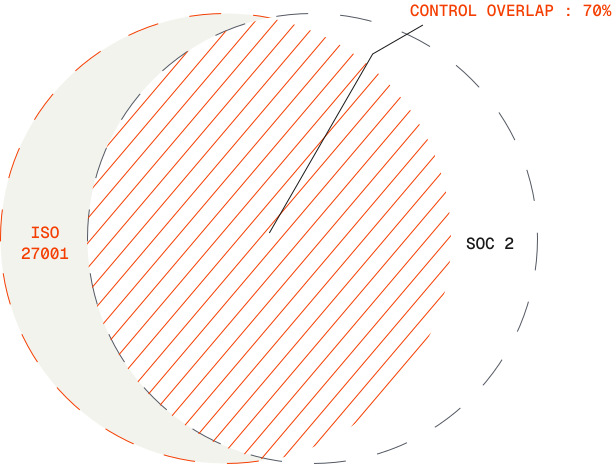
70% control overlap means implementing both doesn't double the work.
// WHY MANY COMPANIES PURSUE BOTH
Different regions expect different standards. ISO 27001 and SOC 2 together provide global coverage on a single security foundation.
// Geographic Coverage
- ISO 27001 → European and international markets
- SOC 2 → North American enterprises
// Complementary Strengths
- ISO 27001 → Comprehensive ISMS, risk-based approach, global recognition
- SOC 2 → Detailed operational controls, customer-specific Trust Services Criteria, US market standard
[05] A Smarter Security Investment
When platform, service, and execution are considered together, Konfirmity delivers security and compliance with fewer tradeoffs and clearer long-term costs.
DIY Manual
Platform
None
Service
None
Audit
$15K
Year 1 total
$15K
Annual
$5K
Generic Platform
Platform
$25K
Service
None
Audit
$15K
Year 1 total
$40K
Annual
$30K
Traditional Consultant
Platform
None
Service
$50K
Audit
$15K
Year 1 total
$65K
Annual
$25K
Konfirmity
Platform
Included
Service
Included
Audit
$15K
Year 1 total
$50K
Annual
$35K
[05] FAQ's
What ISO 27001 Actually Involves
With an existing security program: ~90 days. Building from scratch: 4–5 months. Complex environments (multi-region, multi-product): 6–8 months. The accelerators are cloud-native infrastructure, real leadership buy-in, and any existing policy documentation.
If you sell to North America only, SOC 2 is enough. If you sell to European or Asia-Pacific enterprises, government, or any procurement team outside the US, you will eventually be asked for ISO 27001. The two share around 70% of their controls, so adding ISO 27001 on top of SOC 2 is incremental — not greenfield.
Yes. Scope is yours to define. Startups certify a single product, a single environment, or even a single business line. The standard scales down to small teams — what matters is that the ISMS is real and used, not that it covers a hundred systems.
The certificate is valid for three years. Year 2 and Year 3 require surveillance audits — narrower than Stage 2 but still rigorous. Year 4 is a full recertification audit. Between audits, the ISMS keeps operating: risk reviews, control testing, internal audits, management reviews. Drop the operating cadence and you lose the certificate.
[07] get started
Get started in the way that fits you best -- see the platform in action, speak directly with a security expert, or get real proof through a free external scan of your environment.
See the platform in action. We'll show you:
Adaptation to your specific stack
Integration with your existing tools
Custom evidence collection workflows
Dashboard views for stakeholders
Speak directly with one of our security experts:
Security program design for your industry
Compliance roadmap (SOC 2 → ISO)
Risk assessment and treatment planning
Vendor security review guidance
Want proof? We'll scan your surface for free:
Exposed assets and misconfigurations
SSL/TLS vulnerabilities
Vendor risk in your supply chain
Comparison to industry benchmarks
Guides
ISO 27001 guides & articles
Beginner Guides
amit-gupta
2026-02-21
ISO 27001 Controls List: A 2026 Guide for Busy Teams with Examples

This article explains ISO 27001 Controls List in plain language. You’ll learn what it means, why it matters, the exact steps to do it, and get checklists, examples, and templates to move fast with con.
Beginner Guides
amit-gupta
2026-02-17
ISO 27001 Controls Mapped to NIST CSF 2.0: The Full Crosswalk (2026)
A full ISO 27001:2022 Annex A to NIST CSF 2.0 crosswalk table, the reverse NIST-to-ISO view, the gaps mapping exposes, and a free crosswalk workbook.
Audit & Readiness
amit-gupta
2026-08-17
How long does ISO 27001 certification take?
Most companies get ISO 27001 certified in 6-12 months, some in as little as 3. See the phase-by-phase timeline, real audit examples, and how to speed it up.
Security Controls & Practices
amit-gupta
2026-02-28
ISO 27001 API Security: Key Requirements, Steps, and Templates (2026)
This article explains ISO 27001 API Security For ISO 27001 in plain language. You’ll learn what it means, why it matters, the exact steps to do it, and get checklists, examples, and templates to move.
Beginner Guides
amit-gupta
2026-02-27
ISO 27001 Change Management: A Walkthrough with Templates (2026)
This article explains ISO 27001 Change Management in plain language. You’ll learn what it means, why it matters, the exact steps to do it, and get checklists, examples, and templates to move fast with.
Audit & Readiness
amit-gupta
2026-02-28
ISO 27001 Common Audit Findings: A Practical Guide (2026)
This article explains ISO 27001 Common Audit Findings in plain language. You’ll learn what it means, why it matters, the exact steps to do it, and get checklists, examples, and templates to move fast.
Audit & Readiness
amit-gupta
2026-02-27
ISO 27001 Internal Audit Guide: Best Practices and Key Steps for 2026
This article explains ISO 27001 Internal Audit Guide in plain language. You’ll learn what it means, why it matters, the exact steps to do it, and get checklists, examples, and templates to move fast w.
Data & Privacy
amit-gupta
2026-02-28
ISO 27001 PHI Handling Guide: Your Step-by-Step Guide (2026)
This article explains ISO 27001 PHI Handling Guide in plain language. You’ll learn what it means, why it matters, the exact steps to do it, and get checklists, examples, and templates to move fast wit.
Beginner Guides
amit-gupta
2026-02-15
ISO 27001 Business Continuity And DR: Best Practices for 2026
This article explains ISO 27001 Business Continuity And DR in plain language. You’ll learn what it means, why it matters, the exact steps to do it, and get checklists, examples, and templates to move.
Legal & Contracts
amit-gupta
2026-02-22
ISO 27001 Customer Security Questionnaire: Key Requirements (2026)
This article explains ISO 27001 Customer Security Questionnaire in plain language. You’ll learn what it means, why it matters, the exact steps to do it, and get checklists, examples, and templates to.
Beginner Guides
amit-gupta
2026-02-16
ISO 27001 Data Warehouse Security: Your Step-by-Step Guide (2026)
This article explains ISO 27001 Data Warehouse Security For ISO 27001 in plain language. You’ll learn what it means, why it matters, the exact steps to do it, and get checklists, examples, and templat.
Beginner Guides
amit-gupta
2026-02-22
ISO 27001 Do’s And Don’ts: A Practical Guide with Steps & Examples (2026)
This article explains ISO 27001 Do’s And Don’ts in plain language. You’ll learn what it means, why it matters, the exact steps to do it, and get checklists, examples, and templates to move fast with c.