
SOC 2 Type II:The Audit Your BuyersAlready Expect
SOC 2 is the report North American enterprises ask for first. Type I proves your controls are designed correctly; Type II proves they actually operated over time. Required for procurement, expected by security teams, the price of doing B2B in the US.
Book a call
[01] Why Companies Get SOC 2
SOC 2 unblocks North American enterprise procurement, shrinks vendor security questionnaires from hundreds of questions to a single attached report, and forces the operational discipline that prevents incidents.
// The Reality
Almost every mid-market and enterprise B2B deal in the US asks for SOC 2 Type II during procurement. Without it, you fail the security review before anyone talks to your champion.
// Business Impact
Vendor security questionnaires shrink from 200 questions to attaching a report. Procurement cycles compress. Champions don't have to fight their security team on your behalf.
// Who Asks
- Enterprise procurement and vendor risk teams
- Customer security reviewers (CISO offices)
- Insurance carriers writing cyber policies
- Investors during diligence
// Strategic Advantage
A customer-facing, named-auditor report is more tangible than a certificate. Buyers read the controls and the auditor's opinion — and they trust it more than a logo.
[02] What SOC 2 Actually Is
SOC 2 is two layers of structure: the Trust Services Criteria that say what the auditor opines on, and the Common Criteria CC1–CC9 underneath that say how. Together they define what your CPA tests.
Security
Common Criteria (CC1–CC9)
MandatoryEvery SOC 2 report covers Security. Protects against unauthorised access — physical and logical — and proves the system resists threats that could compromise the other categories.
Availability
System availability for operation and use
OptionalAdd when uptime is part of your sales motion. Covers performance monitoring, disaster recovery, business continuity, and capacity management against committed SLAs.
Confidentiality
Protection of confidential information
OptionalAdd when customers share data marked confidential (not just personal). Covers encryption, access restriction, and disposal of confidential data when no longer needed.
Processing Integrity
System processing is complete, valid, accurate, timely, authorised
OptionalAdd when your service processes transactions where correctness matters (payments, calculations, data transformation). Proves the system does what it claims, end to end.
Privacy
Personal information handled per the entity's privacy notice
OptionalAdd when you collect personal information directly from end users. Distinct from confidentiality — covers notice, choice, consent, retention, and data-subject access.
[03] Understanding the SOC 2 Process
SOC 2 isn't a one-shot certificate — it's an annual cycle of operating controls, collecting evidence, and having an independent CPA firm test the result. The first year sets up the rhythm; every year after refines it.
[1/7] SCOPING & READINESS (WEEK 1-2)
Define the system boundary, pick which Trust Services Criteria to include, and run a structured readiness assessment. The output is a clear list of what exists, what's missing, and what scope the report will cover.
// What Happens
Scope, TSC selection, and gap analysis. You leave this phase knowing exactly what the report will cover and what work remains before the audit.
// Deliverables
- System description draft
- TSC selection rationale
- Gap analysis report
- Audit timeline with milestones
// Effort
- Timeline: 1-2 weeks
- Your involvement: 8-12 hours
// activities
- System Boundary: Identify components, data flows, sub-service organisations
- TSC Selection: Pick Availability/Confidentiality/PI/Privacy based on customer demand
- Gap Analysis: Current controls vs SOC 2 expectations
- CUEC Definition: Identify Complementary User Entity Controls your customers must implement
[04] One Security Program. Two Reports.
SOC 2 and ISO 27001 share roughly 70% of their controls — run a single, unified security program to cover both North American and European procurement on one foundation, not two.
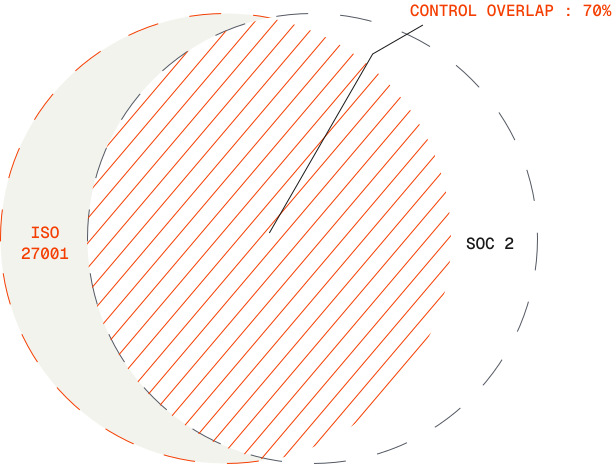
70% control overlap means one operating cadence supports two reports.
// WHY MANY COMPANIES PURSUE BOTH
SOC 2 covers the North American procurement default; ISO 27001 covers everything outside the US. Different regions, same controls underneath.
// Geographic Coverage
- SOC 2 → North American enterprises
- ISO 27001 → European and international markets
// Complementary Strengths
- SOC 2 → Detailed operational controls, auditor-named report, customer-shareable
- ISO 27001 → Management-system framing, internationally recognised certificate
[05] A Smarter Security Investment
When platform, service, and execution are considered together, Konfirmity delivers security and compliance with fewer tradeoffs and clearer long-term costs.
DIY Manual
Platform
None
Service
None
Audit
$15K
Year 1 total
$15K
Annual
$5K
Generic Platform
Platform
$25K
Service
None
Audit
$15K
Year 1 total
$40K
Annual
$30K
Traditional Consultant
Platform
None
Service
$50K
Audit
$15K
Year 1 total
$65K
Annual
$25K
Konfirmity
Platform
Included
Service
Included
Audit
$15K
Year 1 total
$50K
Annual
$35K
[05] FAQ's
What SOC 2 Actually Involves
Enterprise buyers want Type II. Type I is a point-in-time design opinion useful for unblocking a deal while the Type II observation period runs. Most companies do Type I once, then operate Type II annually.
Type I in 8–12 weeks of focused work. Type II adds a 3–12 month observation window on top — first Type II often runs a 6-month window, annual thereafter is 12 months. The audit fieldwork itself is 4–8 weeks.
Security is always included. Add Availability if uptime is contractually committed. Add Confidentiality if customers share data marked confidential. Add Processing Integrity if your service does transaction-style processing. Add Privacy only if you collect personal information directly from end users. Most B2B SaaS starts with Security + Availability + Confidentiality.
If you sell to North America, yes. ISO 27001 is poorly recognised in US procurement, even though the controls overlap heavily. The right move is one unified program that produces both — about 30% incremental effort, not double.
No. SOC 2 Privacy is loosely aligned with GDPR principles but doesn't satisfy GDPR's specific obligations (lawful basis, data subject rights, ROPA, DPIA, breach 72-hour). Use SOC 2 to show security posture; use a GDPR program to handle the regulation.
Type II is annual. Each report covers a 12-month window and is followed by another. A bridge letter from your auditor covers the gap between report periods so customers can rely on you continuously.
[07] get started
Get started in the way that fits you best -- see the platform in action, speak directly with a security expert, or get real proof through a free external scan of your environment.
See the platform in action. We'll show you:
Adaptation to your specific stack
Integration with your existing tools
Custom evidence collection workflows
Dashboard views for stakeholders
Speak directly with one of our security experts:
Security program design for your industry
Compliance roadmap (SOC 2 → ISO)
Risk assessment and treatment planning
Vendor security review guidance
Want proof? We'll scan your surface for free:
Exposed assets and misconfigurations
SSL/TLS vulnerabilities
Vendor risk in your supply chain
Comparison to industry benchmarks
Guides
SOC 2 guides & articles
Audit & Readiness
amit-gupta
2026-01-05
SOC 2 Evidence Review Cadence: A Walkthrough with Templates (2026)

This article explains SOC 2 Evidence Review Cadence in plain language. You’ll learn what it means, why it matters, the exact steps to do it, and get checklists, examples, and templates to move fast wi.
Beginner Guides
amit-gupta
2026-02-19
SOC 2 Continuous Monitoring: Best Practices and Key Steps for 2026
This article explains SOC 2 Continuous Monitoring in plain language. You’ll learn what it means, why it matters, the exact steps to do it, and get checklists, examples, and templates to move fast with.
Beginner Guides
amit-gupta
2026-02-25
SOC 2 Controls List: Best Practices and Key Steps for 2026
This article explains SOC 2 Controls List in plain language. You’ll learn what it means, why it matters, the exact steps to do it, and get checklists, examples, and templates to move fast with confide.
Beginner Guides
amit-gupta
2026-02-20
SOC 2 Controls Mapped To NIST CSF: A Practical Guide (2026)
How SOC 2 Trust Services Criteria map to NIST CSF's six functions, a free mapping matrix, and practical steps to build one control set that satisfies both.
Legal & Contracts
amit-gupta
2026-03-04
SOC 2 Customer Security Questionnaire: Questions & How to Answer Them
Learn how to answer a SOC 2 customer security questionnaire: common questions, evidence examples, and response tips to keep enterprise deals moving.
Data & Privacy
amit-gupta
2026-02-20
SOC 2 Data Subject Request Guide: Your Step-by-Step Guide (2026)
This article explains SOC 2 Data Subject Request Guide in plain language. You’ll learn what it means, why it matters, the exact steps to do it, and get checklists, examples, and templates to move fast.
Beginner Guides
amit-gupta
2026-02-26
SOC 2 Do’s And Don'ts: Your Step-by-Step Guide (2026)
This article explains SOC 2 Do’s And Don’ts in plain language. You’ll learn what it means, why it matters, the exact steps to do it, and get checklists, examples, and templates to move fast with confi.
Security Controls & Practices
amit-gupta
2026-02-25
SOC 2 Encryption Requirements: A Walkthrough with Templates (2026)
This article explains SOC 2 Encryption Requirements in plain language. You’ll learn what it means, why it matters, the exact steps to do it, and get checklists, examples, and templates to move fast wi.
Beginner Guides
amit-gupta
2026-02-26
SOC 2 Enterprise Guide: A Practical Guide with Steps & Examples (2026)
This article explains SOC 2 Enterprise Guide in plain language. You’ll learn what it means, why it matters, the exact steps to do it, and get checklists, examples, and templates to move fast with conf.
Beginner Guides
amit-gupta
2026-02-13
SOC 2 For SaaS: A Walkthrough with Templates (2026)
This article explains SOC 2 For SaaS in plain language. You’ll learn what it means, why it matters, the exact steps to do it, and get checklists, examples, and templates to move fast with confidence..
Beginner Guides
amit-gupta
2026-02-13
SOC 2 Gap Assessment Guide: A 2026 Guide for Busy Teams
This article explains SOC 2 Gap Assessment Guide in plain language. You’ll learn what it means, why it matters, the exact steps to do it, and get checklists, examples, and templates to move fast with.
Security Controls & Practices
amit-gupta
2026-02-26
SOC 2 Key Management Best Practices: Key Requirements & Templates (2026)
This article explains SOC 2 Key Management Best Practices in plain language. You’ll learn what it means, why it matters, the exact steps to do it, and get checklists, examples, and templates to move f.